How Montessori Toys Change From Baby to Elementary Age
The toy that works at eight months and the toy that works at eight years are not the same object scaled up, and that is the single most useful thing to understand before you spend anything.
A baby needs something safe to grab, mouth, and drop. An eight-year-old needs a problem worth solving. Buy the wrong one for the wrong stage and you get the same result either way: a child who ignores it, or a child who uses it wrong. Montessori toys from baby to elementary age are really a story about a child’s changing relationship with challenge, not a catalogue of wooden objects that get progressively more expensive.
This is the map. It covers what changes at each stage, what to actually buy, what to skip, and how to tell the difference between a toy that earns its place on the shelf and one that just looks like it does.
How Montessori Toys Change as Children Grow
The progression is cleaner than most toy marketing suggests. Infants work on grasping and sensory feedback – the hand discovering the world. Toddlers move into fine-motor coordination and practical life: carrying, pouring, stacking, participating. Preschoolers start classifying, sequencing, building language and early math. Elementary-age children reason, plan, construct, code, and collaborate.
A toy is Montessori-aligned when it supports purposeful activity, gives real feedback, invites hands-on learning, offers a manageable challenge, and lets the child repeat it independently. That is the whole test. A plastic shape sorter can pass it. A $200 wooden set can fail it.
Simplicity matters more for younger children because their attention is short and their motor control is developing. Older children need richer systems – multiple steps, real decisions, room to make mistakes and correct them without an adult hovering.
Here is the insight that saves the most money: a higher piece count or a more advanced appearance does not mean more educational value. A 200-piece kit with no clear progression is worse than a 12-piece material the child can master and revisit. You are buying levels of challenge, not volume.
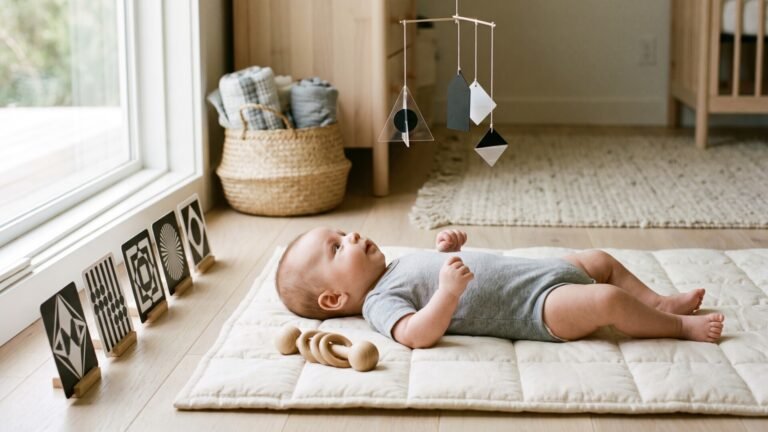
Montessori Toys for Infants: Birth to 12 Months
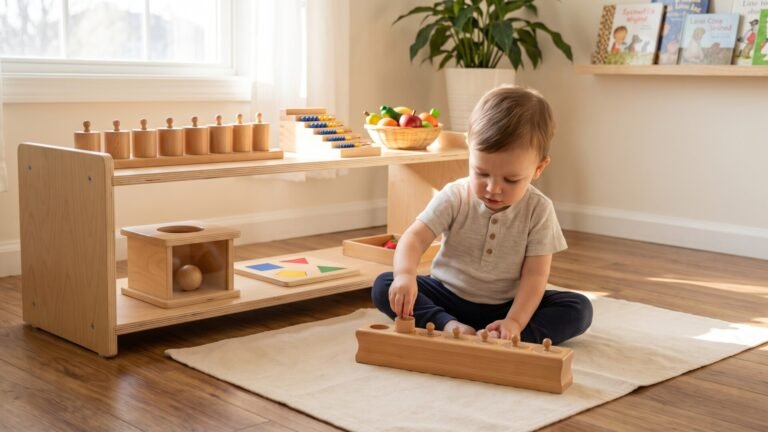
The work of the first year is visual tracking, reaching, grasping, transferring an object from hand to hand, object permanence, sitting, crawling, and safe exploration. Everything you buy should serve one of those.
The Lovevery Montessori Play Gym is the premium option here, and it earns the price if you will actually use the varied sensory and motor stations it provides. If you will not rotate or set it up, skip it – a play mat you never unroll is just floor clutter.
For grasping, the Manhattan Toy Skwish is the classic. It compresses, springs back, and rewards every clumsy grab. Watch the manufacturer’s age guidance and supervise – this is a mouthing toy, not a leave-alone toy.
A HABA clutching toy or grasping rattle covers the same ground at budget-to-mid-range prices, and honestly, for most families it is enough. For older infants ready to retrieve a hidden object, a simple wooden object permanence box is the single most useful purchase of the year.
What to avoid: small parts, loose cords, battery compartments a baby can reach, poorly finished wood, and anything that asks an infant to perform a task before they can. Rotate three or four toys at a time, keep them within reach on the floor, and lean on floor-based play rather than containers or electronic entertainment.
For the full breakdown, see our Montessori Toys for Infants guide.
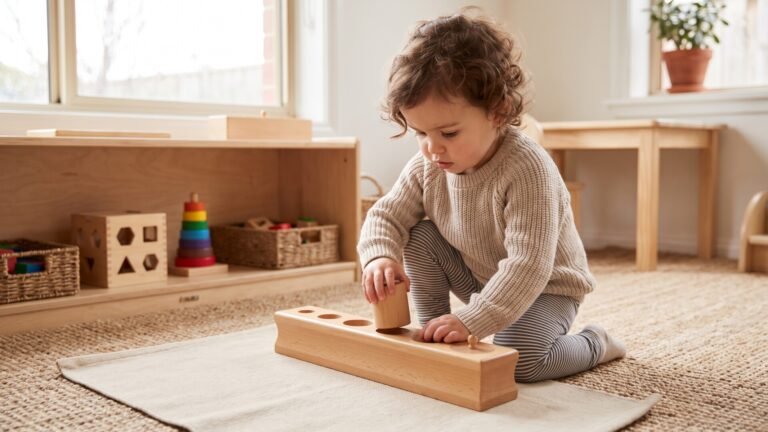
Montessori Toys for Toddlers: Ages 1 to 3
Toddlerhood is where repetition, coordination, cause and effect, movement, language, and participation in real tasks take over. The toddler does not want a new activity every day. They want the same one, forty times, until they own it.
The Melissa & Doug First Bead Maze builds hand-eye coordination through controlled movement, and it survives being sat on. The Melissa & Doug Wooden Pounding Bench is the purest cause-and-effect toy on the market – you hit it, it responds, forever. Both are loud in the way a hammer is loud, which is to say the noise is the point and there is no volume switch.
Montessori-style wooden knob puzzles with large, easy-to-grasp pieces are the workhorse of this age. A Learning Resources Sorting Pie or similar large-piece sorting activity handles color and shape matching, though open-ended sorting beats drilling a correct answer every time.
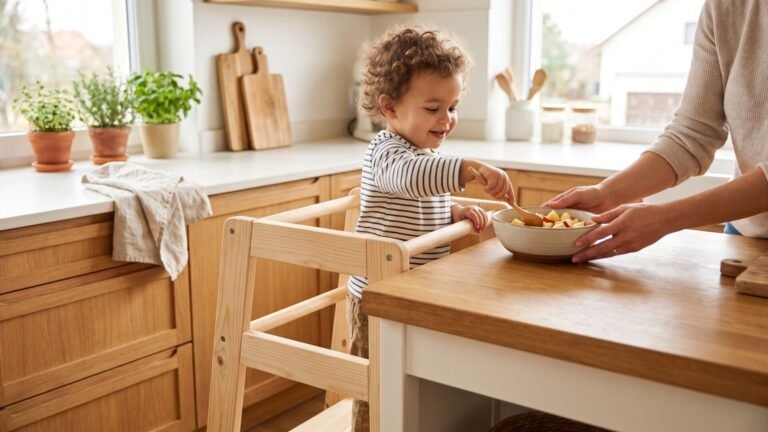
The unexpected win at this age is a child-sized wooden practical life set – a small sweeping set, a food-preparation tool, a pouring pitcher. Toddlers want to do what you are doing. A toy that lets them actually help gets used far longer than any electronic learning toy, and it costs less.
Realistic scale, manageable pieces, and a visible endpoint matter more than branding. And be warned: plenty of products labeled for Montessori homes have too many pieces, weak construction, or activities that frustrate a toddler without an adult standing right there. See our Montessori Toys for Toddlers article for the full list. Supervise mouthing, climbing, water play, and any practical-life tool with an edge.
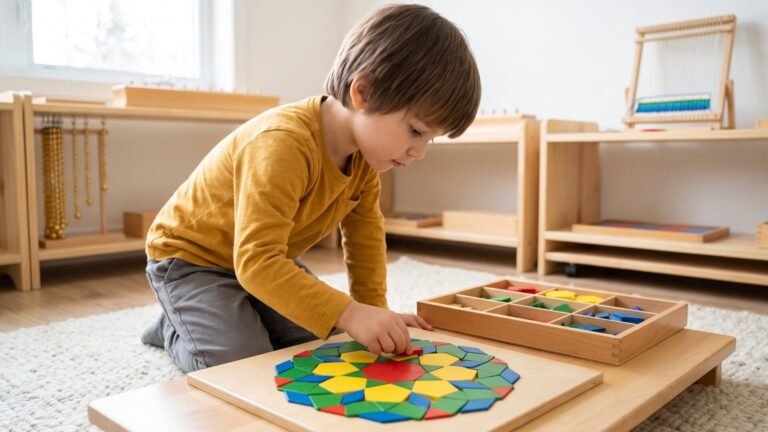
Montessori Toys for Preschoolers: Ages 3 to 6
Preschoolers shift from basic manipulation into classification, sequencing, language, early math, practical life, and – if you get it right – genuinely sustained concentration.
The Melissa & Doug Wooden Pattern Blocks and Boards handles visual discrimination, patterning, and independent construction. The Montessori Pink Tower teaches size discrimination and sequencing through careful movement; quality and storage matter far more than the brand stamped on the box. The Brown Stair or a combined sensorial set does the same for comparing dimensions.
Montessori sandpaper letters build tactile letter formation and sound awareness – introduce them when the child shows interest, not as a daily drill. Forced phonics practice is not Montessori, it is homework.
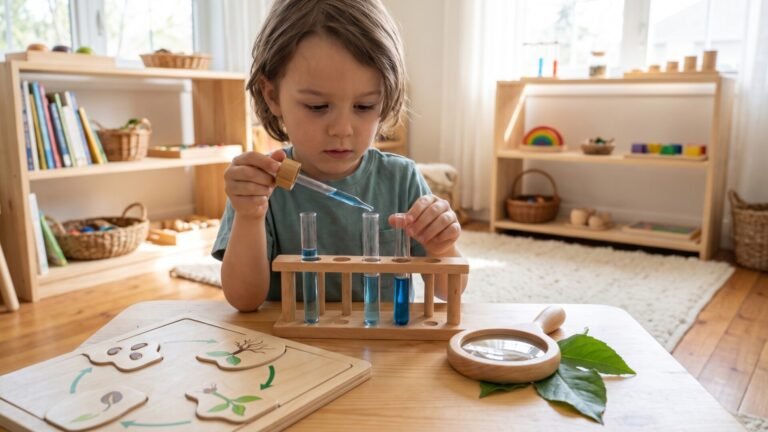
For open-ended construction, the LEGO Classic Creative Brick Box is the mainstream option that quietly does everything Montessori materials do: planning, design, persistence, and the willingness to rebuild after failure. The Learning Resources Primary Science Lab Set covers supervised observation and experimentation for the child who wants to know why.
Preschool materials often have a single clear purpose, but a good one can be revisited at increasing complexity for years. Pretend play is not anti-Montessori when it is child-led and open-ended – it only clashes when an electronic script does the imagining for them. Keep fewer toys visible so attention can settle. Our Montessori Toys for Preschoolers article covers the full progression.
Montessori Toys for Early Elementary Children: Ages 6 to 9
The elementary years expand from concrete skill practice into reasoning, project work, collaboration, research, storytelling, design, and applying knowledge to something real.
The LEGO Classic Large Creative Brick Box is the long-term backbone here – engineering challenges, construction, and iterative problem-solving with no ceiling. LEGO Education SPIKE Essential is the premium option for guided coding and robotics, but be honest about the setup: it needs an adult to get it running and to troubleshoot when it stops.
The Snap Circuits Jr. SC-100 introduces electrical experimentation, subject to its age and safety guidance. Melissa & Doug Suspend handles balance, planning, and family play in one box. The Learning Resources Code & Go Robot Mouse Activity Set is the accessible entry to sequencing and algorithmic thinking. A quality wooden fraction or decimal set gives concrete math models to a child who is not ready for abstract worksheets.
Older children need a genuine problem to solve, not another activity with a predetermined answer. Judge any purchase on whether the child can work independently: clear instructions, visible feedback, reasonable setup, reusable challenges, and enough flexibility to make mistakes.
On screen-free versus technology-supported learning – coding and robotics fit a Montessori-inspired home when the child is an active creator, not a passive consumer. The Montessori Toys for Early Elementary Children article goes deeper.
What Most Parents Get Wrong About Montessori Toys by Age
The first mistake is assuming babies need an expensive Montessori collection. A small rotation of safe, open-ended objects delivers most of the value. The second is buying toddlers advanced educational kits when they would get more from practical-life tools and sturdy manipulatives.
The third is turning preschool “work” into academic pressure. The goal is concentration, coordination, and the satisfaction of mastering something – not early performance. A four-year-old who spends twenty minutes pouring beans back and forth is doing exactly the right work.
The counterintuitive point: elementary-age Montessori play often looks less traditionally Montessori. It includes LEGO, robotics, board games, and science kits. That is not a compromise. When the child is actively reasoning and creating, the principles are intact.
Age labels indicate safety and likely readiness. The better decision rule is simpler: buy for the child’s current challenge, not the child’s future potential. A toy bought two years early is a toy that sits on the shelf and teaches the child it is not for them.
ToyGuideHub Longevity Analysis: Which Toys Still Make Sense After Six Months?
Most toy reviews measure the first ten minutes. The only question that matters is what is still in rotation after six months, so here is a scoring framework you can apply to anything before you buy. Rate each factor from 1 to 5.
Replayability: does the activity support repeated use, or is it one successful attempt and done?
Developmental runway: can the child use it in simpler and more advanced ways over time, or does it have a single fixed outcome?
Parent burden: setup, cleanup, supervision, and storage. This is the factor buyers underestimate most.
Real-world durability: resistance to missing pieces, breakage, and loss of interest.
Now apply it to the categories. Simple grasping and object permanence toys score 5 on replayability for infants but 1 on runway – they are excellent and short-lived, which is fine as long as you know that going in. Practical-life tools score high on real-world value when you actually integrate them into routines, and near zero if you do not.
Sensorial materials like the Pink Tower score high on developmental clarity but take a hit on parent burden: storage and presentation are real demands. LEGO and open-ended construction score high on runway and durability for preschoolers and elementary children, with a real cleanup burden. Coding and robotics kits can score high for older children but low on parent convenience, because someone has to set up and troubleshoot.
The hidden cost of overbuying is not the purchase price. It is storage, rotation labor, lost components, and buying replacements before the child has exhausted what they already own. A missing LEGO piece is a rounding error. A missing piece from a 40-piece specialty set can retire the whole thing.
The best long-term purchase is almost always the material with multiple levels of challenge, not the product with the most features. A single well-made construction set will outlast three themed kits that each do one thing.
Choosing the Right Montessori Toy for Your Family
Best for Small Spaces
Favor one-piece or compact activities: wooden puzzles, a small bead maze, sandpaper letters, pattern blocks, or a modest LEGO box. Large Montessori furniture-style materials need a dedicated shelf and a real storage plan before they come home. Our Montessori Toys by Age hub covers room-by-room storage and rotation.
Best Budget Approach
Buy fewer high-use materials rather than a complete themed set. Start with wooden puzzles, practical-life tools, a small construction set, or secondhand sensorial materials after checking condition and completeness. Spend more only where it buys something: precise construction, durable hinges, safe finishes, or many years of use.
Best for Independent Play
Look for clear beginnings and endings, visible feedback, manageable setup, and the ability to repeat without adult correction. Independent play depends on environment and presentation as much as the product – a toy on a high shelf is not independent.
Best for a Montessori-Inspired Family
You do not need to follow a strict classroom model. Combine a small number of purpose-built materials with everyday objects, books, outdoor time, art supplies, building toys, and cooperative games. Rotation, accessibility, child-sized storage, and a limited selection matter more than brand loyalty.
Comparison Table
| Age Stage | Main Focus | Strong Starter Choice | Best Long-Term Category | Parent Burden | Typical Budget |
|---|---|---|---|---|---|
| Birth to 12 months | Reaching, grasping, tracking, object permanence | Manhattan Toy Skwish | Simple sensory and grasping materials | Low to moderate supervision | $15-$150 |
| Ages 1 to 3 | Coordination, repetition, practical life | Melissa & Doug Wooden Pounding Bench | Puzzles, practical-life tools, sorting | Moderate cleanup and supervision | $15-$80 |
| Ages 3 to 6 | Language, sensorial learning, early math, concentration | Melissa & Doug Pattern Blocks and Boards | Open-ended building and sensorial materials | Moderate setup and storage | $20-$150 |
| Ages 6 to 9 | Reasoning, construction, coding, project work | LEGO Classic Creative Brick Box | Building, science, robotics, strategy games | Moderate to high setup | $30-$300 |
Prices are approximate, vary by retailer, and should be checked against current age and safety guidance. [Affiliate: Check current pricing and availability through our recommended partners]
Pros and Cons of Following Montessori Toy Principles
Pros
- Encourages purposeful repetition and longer periods of concentration.
- Makes it easier to match toys to a child’s current developmental needs.
- Can reduce clutter by favoring fewer, more versatile materials.
- Supports practical independence and hands-on learning beyond formal academics.
Cons
- High-quality wooden materials and specialty sets can be expensive.
- Some classic materials require significant storage space and careful presentation.
- Strict interpretations can make ordinary imaginative, building, or electronic learning toys seem unnecessarily off-limits.
- Parents may feel pressure to buy a complete system when a small, thoughtfully chosen selection would be enough.
Skip This If
Skip large Montessori bundles that contain many loosely related pieces but no clear storage system or progression. You are buying a box, not a curriculum.
Be cautious with expensive infant subscription boxes if you will not rotate materials or use the included parent guidance. The box is only half the product; the other half is you.
Avoid advanced coding or science kits for younger children because the box promises early learning. An activity that needs constant adult intervention delivers less independent play than a simple building set – not more.
And do not buy a toy only because it uses natural wood, neutral colors, or Montessori wording. Materials and design matter more than appearance. A beautifully photographed wooden object with a frustrating mechanism is still a frustrating object.
Conclusion
The progression is worth holding in your head: infants need safe sensory and movement experiences, toddlers need repetition and practical-life participation, preschoolers are ready for sensorial, language, early math, and construction materials, and elementary children need open-ended projects, reasoning, science, coding, and collaboration.
The best overall approach is a small rotating collection matched to your child’s current developmental challenge – not their imagined future. The best budget choice is practical-life activities, wooden puzzles, and open-ended building materials. The best premium choice is carefully selected sensorial materials or a quality robotics kit for an interested older child. The best long-term choice is LEGO or another durable construction system that grows with the child’s planning and design skills.
If you take one thing from all of this, take the decision rule: buy for the challenge your child has right now. The toy that fits today gets used for years. The toy bought for the child they will be in two years sits on the shelf and waits, and by the time they are ready, you have both forgotten it is there.
[Affiliate: Check current pricing and availability through our recommended partners], and compare the product’s age guidance with your child’s current abilities before choosing.
Frequently Asked Questions About Montessori Toys From Baby To Elementary Age
Are Montessori toys suitable from birth?
Some Montessori-inspired materials suit infancy, but safe design, supervision, and developmental readiness matter more than the label. Babies need simple objects without small parts, loose strings, or accessible batteries.
How often should Montessori toys change as a child grows?
There is no fixed schedule. Rotate when the child has mastered an activity, stops returning to it, or needs a new level of challenge. Keep genuinely useful open-ended materials available much longer.
Do Montessori toys need to be made of wood?
No. Wood is common because it is durable and gives useful tactile feedback, but alignment depends on whether the material supports active, purposeful learning. Well-designed plastic, electronic, and mixed-material products can work when used actively.
Can LEGO be considered Montessori?
LEGO is not a traditional Montessori material, but open-ended construction supports Montessori-aligned outcomes: concentration, planning, hand control, independence, and problem-solving, especially for preschool and elementary-age children.
What is the best first Montessori toy for a baby?
Start with a safe grasping toy, a simple rattle, or an object permanence activity once the child is ready. The best choice depends on the baby’s current movement and exploration skills, not on which item is selling best.
Are Montessori toys worth the higher price?
Some are, when precision, durability, and years of use justify it. Expensive branding does not guarantee better play value, and practical-life activities or simple construction toys often deliver more per dollar.
How do I know if a Montessori toy is too advanced?
Watch for frequent requests for adult help, confusion about the activity’s purpose, unsafe handling, or frustration after brief attempts. Put it away and try a simpler version rather than treating difficulty as a lack of ability.
Should I buy a full Montessori set or individual pieces?
Individual pieces, chosen for the child’s current challenge. A full set commits you to storage and a progression you may not use, and it front-loads cost before you know what your child actually returns to.