Building & Construction Toys: The Complete Guide for Parents
The best building toy you can buy is not the one with the most pieces in the box. It is the one your child can pick up without help, build something with in the first ten minutes, and still be using next winter when the novelty has worn off everything else. That single tradeoff, between what a set looks like on the shelf and what it actually does on your floor, decides almost every purchase in this category.
Most parents buy for the finished model. They should be buying for the twentieth rebuild. A set that produces one impressive thing and then sits there is a display piece. A set that produces something different every time is the one that earns its floor space. Building and construction toys sit at the intersection of creativity and practical problem-solving, which is why they outlast almost everything else in the toy box, provided you choose the right system at the right moment.
What Counts as a Building or Construction Toy?
The category is wider than the shelf label suggests. A building or construction toy is anything a child joins, stacks, balances, connects, arranges, or engineers into a structure, vehicle, model, or imaginary setting. That includes a bucket of plain wooden blocks and a five-hundred-piece licensed spaceship, and those two things behave very differently in your home.
The useful split is between open-ended systems and guided kits.
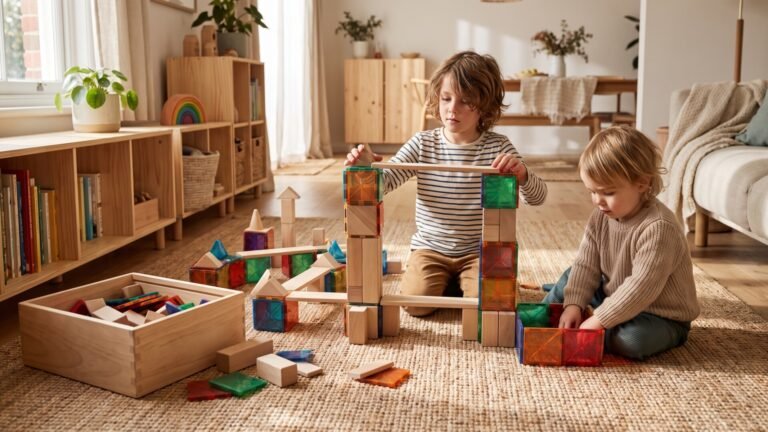
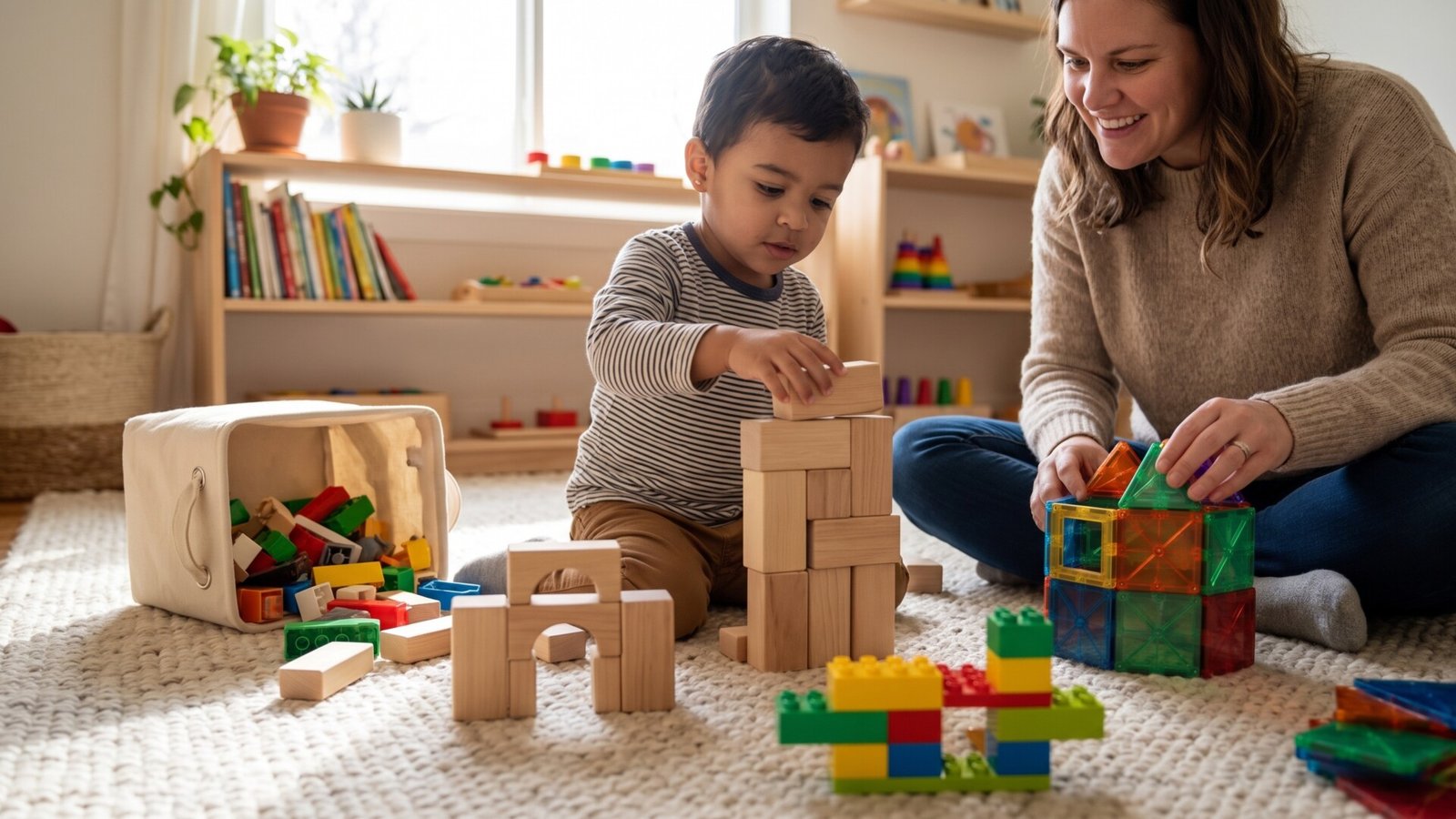
Open-ended systems, such as wooden blocks, magnetic tiles, and loose parts, give the child components and no instructions. The play value comes from what they invent. Guided kits, such as most LEGO City sets or a themed model with one intended result, give the child a destination. Both are legitimate. They just produce different kinds of play, and children often want both at different times.
What separates a genuinely open-ended toy from one that only claims to be is simple: can your child start building without a specific skill, an adult explanation, or an expansion pack they do not own? If the answer is no, it is a kit with a build step, not a construction toy in the fullest sense.
The variables that actually decide whether a set works in your house are motor skills, age, piece count, connection method, cleanup, storage, and how much adult help the thing demands. You will notice price is not on that list. Price matters, but it matters far less than whether the pieces fit your child’s hands and your hallway cupboard.
Building Toy Types and What Each One Does Best
Organizing by brand is how retailers do it. Organizing by the kind of play each system supports is how you should do it, because that is what determines whether the box gets opened twice or two hundred times.
Wooden Blocks and Loose Parts
Classic wooden blocks, unit blocks, stacking pieces, and wooden construction sets such as Melissa & Doug Wooden Building Blocks and Tegu magnetic wooden blocks are the oldest answer to this question and still one of the best. They build spatial reasoning, balance, and visual planning, and they do it through low-frustration experimentation. Nothing snaps. Nothing is ruined by a wrong move.
The trade-off is real: fewer built-in connection points means structures collapse more often. For some children that is the whole point, a tower to knock down and rebuild. For others it is a source of genuine rage. Know which child you have before you buy.
Magnetic Tiles and Magnetic Construction Sets
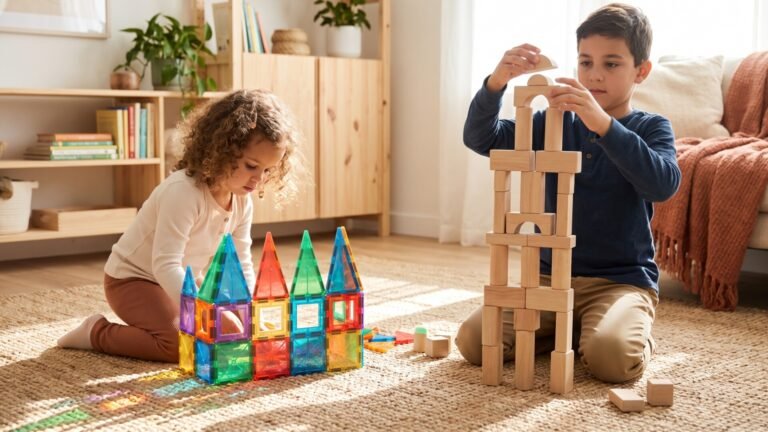
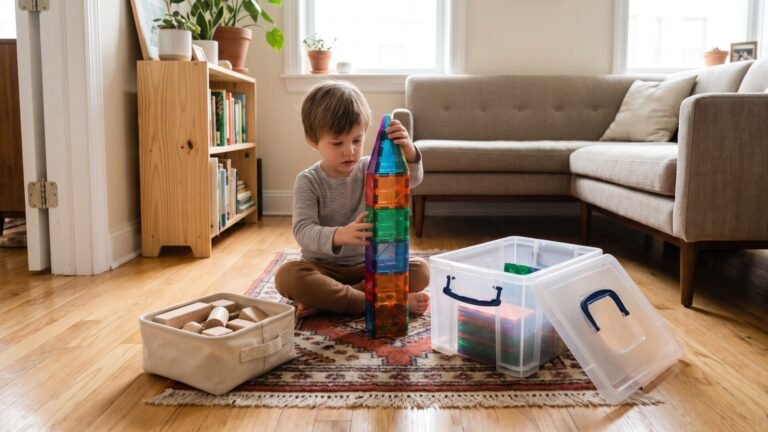
Magna-Tiles and PicassoTiles are the two names most parents encounter first, and the format is genuinely clever. Magnets do the connecting, so a three-year-old gets a wall to stand up on the first attempt. That immediate success is why magnetic tiles work so well for 2D-to-3D transitions and for collaborative floor play with a sibling or a parent.
Two practical warnings. First, a collection of tiles takes up more space than you expect, because they are flat and they spread. Second, magnets and seams need periodic inspection. Check tiles for cracks, keep damaged pieces out of use, and follow the manufacturer’s current safety guidance rather than a rule of thumb from a forum. If you are weighing these against traditional blocks, our comparison of Magnetic Tiles vs. Building Blocks covers the age-by-age differences properly.
Interlocking Bricks and Small Construction Systems
LEGO Classic Creative Brick Box, LEGO DUPLO, and Mega Bloks cover the full range here, from chunky toddler pieces to standard bricks. The important distinction is not brand, it is piece size. Large toddler-friendly pieces, standard bricks, and highly specialized single-purpose elements behave like three different toys.
Brick systems reward persistence and precision. They also have a failure mode: a child who only ever follows instructions stops inventing. The box that gets played with for years is usually the one with a broad mix of generic bricks, not the one with the most themed mini-figures.
Gear, Connector, and Engineering Sets
K’NEX, Plus-Plus, and Learning Resources Gears! Gears! Gears! sit in a different tradition. These teach mechanical thinking, pattern recognition, sequencing, and how movement transfers through a structure. They are excellent for the child who wants to know why the thing turns.
They are also less forgiving. Smaller connectors and more complex assembly push these toward older preschoolers and school-age children. Hand a gear set to a three-year-old and you have bought yourself a job.
Model and Pretend-Construction Sets
LEGO City, LEGO Creator 3-in-1, and construction vehicle sets are strongest for the child who wants a finished result, role-play, and a story to act out afterward. That is a legitimate kind of play and it holds attention well for the right kid.
What these sets offer less of is flexible independent building. Once the model is built, the pieces are largely committed. If your child likes inventing more than displaying, a bucket of mixed components will beat a themed set every time.
How to Choose Building Toys by Age and Developmental Stage
Age labels are a starting point, not a verdict. Developmental readiness matters more, and a child who is ahead in fine motor skills will outgrow a label while a child who is not will find it frustrating. Use these as a guide and adjust for the child in front of you.
Toddlers
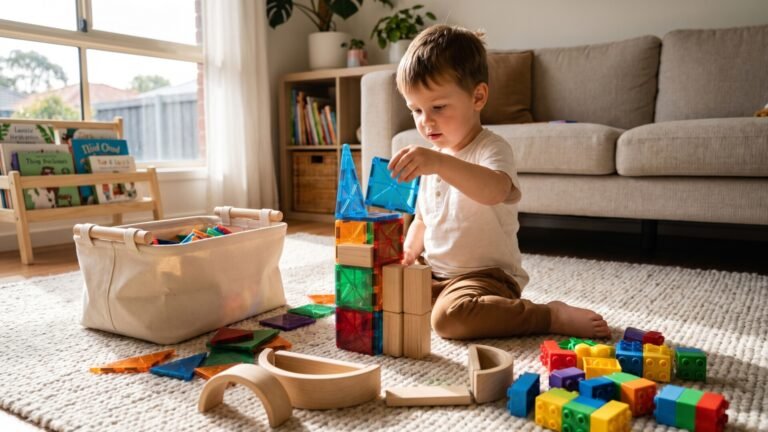
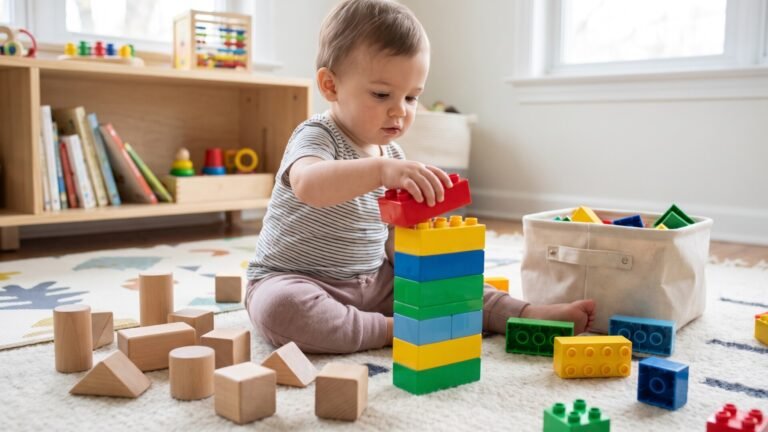
Large, easy-to-grip pieces are the whole game here. LEGO DUPLO, Mega Bloks, large wooden blocks, and chunky stacking toys all fit. The play at this stage is stacking, knocking down, filling, dumping, matching, and simple vertical structures, and that is genuinely enough.
Choking hazards deserve plain attention. Any set with small components or magnets needs active supervision, and magnets in particular need to be kept away from children who still mouth objects. Follow the stated age range on the package and the manufacturer’s current safety instructions. For a fuller breakdown, see Best Building Toys for Toddlers.
Preschoolers
This is where magnetic tiles, larger interlocking bricks, wooden connector sets, and simple gear systems come into their own. Preschoolers are working on color, shape, balance, simple symmetry, and building familiar structures such as houses, bridges, and towers.
The best sets at this age produce a quick result but still allow experimentation, because a preschooler’s patience for a failed build is short. Our Best Building Toys for Preschoolers guide goes deeper on the specific sets worth the money.
Ages 6-8
LEGO Classic, LEGO Creator 3-in-1, K’NEX, Plus-Plus, and more detailed magnetic systems all work here. The focus shifts to planning, following multi-step directions, revising a design that failed, and combining construction with storytelling.
This is the age where piece count starts to mislead parents. A 500-piece set of tiny specialized parts is not harder than a 300-piece set of general bricks. It is just more fiddly. Challenge comes from the complexity of the build, not the number on the box. See Best Building Toys for Kids Ages 6-8.
Ages 9-12
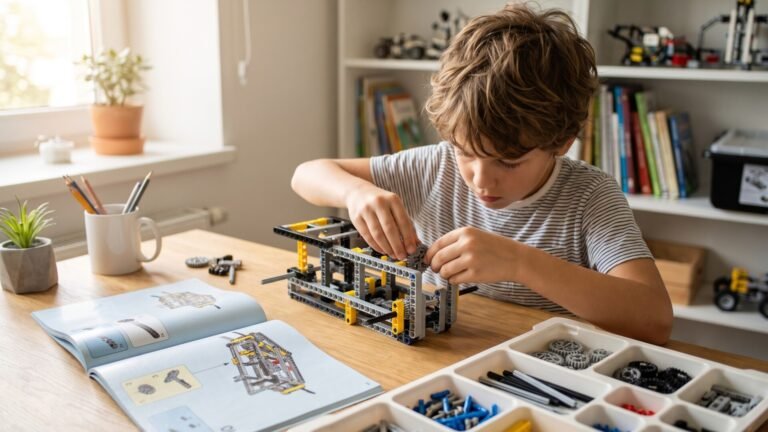
Complex LEGO Technic or Creator sets, K’NEX engineering sets, robotics and coding-compatible building systems, and advanced model kits all belong here. The skills in play are mechanical reasoning, structural stability, patience, and finishing a long project.
One warning worth stating flatly: do not buy an advanced set just because your child can read the age range. If they dislike lengthy instruction-following, a Technic set becomes a shelf ornament with a guilty feeling attached. Our Best Building Toys for Kids Ages 9-12 guide matches sets to temperament, not just age.
The Key Buying Factors Parents Should Use
Once you know the types and the ages, the decision comes down to a handful of tests. Run each candidate set through these before you spend anything.
Age fit and frustration level. Choose pieces the child can manipulate independently, with a manageable challenge left over. Too easy becomes repetitive within a week. Too hard means you are building it while they watch, which is an adult project with a child present.
Open-ended value versus guided results. Decide whether your child wants freeform building, a themed model to complete, or a blend. Children whose interests shift do best with a mixed system that supports both.
Durability and connection quality. Plastic thickness, magnet enclosure, connector tightness, and wood finishing all determine how the set survives repeated assembly and disassembly. Cheap connectors are the single most common reason a system dies early.
Storage and cleanup. Bins of loose parts, flat magnetic tiles, boxed sets, and systems that need sorting all create different cleanup loads. Storage friction decides whether a toy gets used on a Tuesday evening when everyone is tired. If space is tight, Best Building Toys for Small Spaces is worth reading before you buy anything large.
Independent play and adult involvement. Some systems produce quick solo play. Others need reading, planning, or troubleshooting with a parent. Neither is better, but only one of them gives you twenty minutes to make dinner.
Expansion cost and compatibility. Before committing to a system, check whether future pieces are affordable and compatible with what you already own. A cheap starter set attached to an expensive ecosystem is not cheap.
Safety. Respect age labels. Watch for small parts, magnets, broken components, and splintering or damaged wood. Inspect toys regularly, retire anything cracked or compromised, and follow the manufacturer’s current safety instructions rather than a general rule.
Pros and Cons of Building and Construction Toys
Pros
- Build spatial reasoning, fine motor control, planning, persistence, and creative problem-solving through hands-on play.
- Offer replay value, because the same pieces can become different structures, vehicles, scenes, or machines.
- Support independent play, sibling cooperation, storytelling, and parent-child projects.
- Often grow with the child when the system has enough variety and compatible expansions.
Cons
- Loose pieces create storage and cleanup problems, especially in small homes.
- A set can be age-appropriate on paper and still too frustrating or too instruction-heavy for a particular child.
- Missing pieces, damaged connectors, and lost specialty parts quietly reduce what a system can do.
- Premium systems get expensive once you add expansions, themed sets, and storage.
- Some visually impressive kits offer less replay value than a plain open-ended set at a third of the price.
Best Building and Construction Toys for Different Families
Six sets, chosen to cover different budgets, ages, and play styles. Prices are approximate and move with set size, retailer, and sale season.
LEGO DUPLO Classic Brick Box
| Feature | Details |
|---|---|
| Age Range | Typically 18 months and up; verify the current package |
| Key Features | Large interlocking bricks, simple shapes, storage box |
| Price (approx) | $25-$50 |
The Verdict
The strongest entry point for a toddler who is ready to stack, connect, and take apart large pieces. It gives you the familiar LEGO construction system without the fine-motor demands of standard bricks, which means the child can succeed alone.
Best For
Toddlers and younger preschoolers beginning to build independently.
Pros and Cons
Pros
- Easy-to-handle large pieces
- Strong brand ecosystem and expansion options
- Supports both building and pretend play
Cons
- Limited challenge for older children
- Some sets emphasize themed play over open-ended construction
- Add-on purchases add up
Melissa & Doug Wooden Building Blocks Set
| Feature | Details |
|---|---|
| Age Range | Varies by set; many are intended for ages 3 and up |
| Key Features | Solid wooden shapes, natural stacking and balancing, open-ended construction |
| Price (approx) | $20-$40 |
The Verdict
A practical first open-ended building set for families who want simple, screen-free construction with no instructions and no batteries. Its value comes from repeat use, not from features. This is the set that is still on the floor in three years.
Best For
Preschoolers, imaginative builders, and homes that favor classic wooden toys.
Pros and Cons
Pros
- Encourages balance, spatial reasoning, and imaginative play
- No proprietary connectors or instructions to lose
- Durable when stored and handled properly
Cons
- Structures collapse more easily than connected builds
- Takes more patience for children who want immediate success
- Bulky to store
Magna-Tiles Clear Colors 32-Piece Set
| Feature | Details |
|---|---|
| Age Range | Commonly 3 years and up; verify current safety labeling |
| Key Features | Magnetic geometric tiles, flat storage, 2D and 3D construction |
| Price (approx) | $50-$70 |
The Verdict
The best premium starter system for a child who wants to build something tall in the first five minutes. Magnetic connections make experimentation rewarding rather than punishing. Be aware that a 32-piece set is a starter, not a collection, and two children building together will want more.
Best For
Preschoolers and early school-age children who enjoy fast, visual construction.
Pros and Cons
Pros
- Immediate connections reduce frustration
- Supports flat patterns and three-dimensional builds
- Combines with compatible magnetic tile systems
Cons
- Higher entry price than basic blocks
- Large collections take up more space than expected
- Tiles need periodic inspection for damage
PicassoTiles 60-Piece Magnetic Tiles Set
| Feature | Details |
|---|---|
| Age Range | Commonly 3 years and up; verify the current package |
| Key Features | Magnetic tiles in multiple shapes, larger starter quantity, open-ended building |
| Price (approx) | $35-$60 |
The Verdict
The value-oriented magnetic tile option, and the honest answer for families who want a bigger starting collection without the premium price. Confirm compatibility and construction quality before mixing brands, and inspect the set when it arrives.
Best For
Families seeking a budget-friendly magnetic construction set for shared play.
Pros and Cons
Pros
- More pieces for the initial purchase
- Encourages collaborative and open-ended building
- Covers several basic geometric shapes
Cons
- Quality can vary by set and retailer
- More pieces increase cleanup demands
- A lower price does not replace careful inspection
LEGO Classic Creative Brick Box
| Feature | Details |
|---|---|
| Age Range | Commonly 4 years and up; verify the current package |
| Key Features | Assorted standard bricks, wheels, eyes, shapes, storage box, building ideas |
| Price (approx) | $30-$60 |
The Verdict
The best all-purpose construction set for a child ready for standard-size bricks. It balances open-ended creativity with enough prompts to help a child who does not know what to build first, and the generic brick mix is what keeps it alive for years.
Best For
Preschoolers and school-age children who want both free building and simple guided ideas.
Pros and Cons
Pros
- Broad range of brick shapes and colors
- Strong replayability and expansion potential
- Works for solo building and family projects
Cons
- Small pieces require supervision around younger children
- Sorting and storage become important
- Children may need help moving from copying models to inventing
K’NEX Construction Set
| Feature | Details |
|---|---|
| Age Range | Varies by set; many are aimed at ages 7 and up |
| Key Features | Rods and connectors, multiple model possibilities, structural building |
| Price (approx) | $30-$60 |
The Verdict
For older children who want to understand how parts connect and how a framework holds together. It offers a genuinely different challenge from bricks, with more emphasis on tension, bracing, and planning, and it rewards the child who likes to work out why something failed.
Best For
School-age children interested in engineering-style construction and repeated model building.
Pros and Cons
Pros
- Encourages structural reasoning and persistence
- A different building experience from bricks
- Supports multiple models from one collection
Cons
- Connections require more force and precision
- Less immediately satisfying for younger builders
- Finished builds need careful handling
Skip This If: Oversized Theme-Only Construction Sets
The buying trap in this category is the giant themed set with a high piece count and a single intended result. It is not automatically better value. The warning signs are consistent: many specialized pieces, one finished model on the box, a high price, and very little the child can do with the parts once the instructions are complete.
If your child invents rather than displays, a smaller open-ended set or a system with compatible expansions will produce more play for less money. Buy the theme for the child who genuinely collects the theme. Buy the bricks for everyone else.
Comparison Table: Which Building Toy Fits Your Family?
| Product | Typical Age | Best For | Replayability | Approx. Price |
|---|---|---|---|---|
| LEGO DUPLO Classic Brick Box | 18 months and up | First construction play | High | $25-$50 |
| Melissa & Doug Wooden Blocks | 3 years and up | Open-ended stacking | High | $20-$40 |
| Magna-Tiles Clear Colors | 3 years and up | Fast 3D building | High | $50-$70 |
| PicassoTiles Magnetic Set | 3 years and up | Budget magnetic play | High | $35-$60 |
| LEGO Classic Creative Brick Box | 4 years and up | All-purpose brick building | Very high | $30-$60 |
| K’NEX Construction Set | Often 7 years and up | Engineering-style builds | High for interested builders | $30-$60 |
Prices are approximate and shift with set size, retailer, and sale period. Check current pricing and availability through our recommended partners before committing to a system.
What Most Reviews Miss
Most buying advice in this category is written from the product photo outward. It counts pieces, lists features, and calls a set impressive. That tells you nothing about what happens on day nine, when the model is built and the child looks around for something else to do.
Here is the thing the feature lists cannot tell you. Piece count and play value are not the same number, and past a certain point they move in opposite directions. A 200-piece set with accessible, general-purpose components will out-produce a 900-piece set with dozens of single-use specialty parts, because the child can actually find what they need and put it together without a search party. The bigger set looks like more toy. It is more inventory.
The second thing most reviews miss is the gap between display value and play value. A detailed model looks superb on a shelf and in a product photograph. It also has exactly one configuration, and once your child has built it, the interesting part is over. Basic bricks, tiles, and blocks have no finished state, which is precisely why they get rebuilt for years. The set that photographs worst often plays best.
Third, the “open-ended” label is applied far too generously. A toy is only genuinely open-ended if the child can start building with the pieces in the box, at their current skill level, without an adult explaining the system or a missing expansion pack. By that test, a lot of marketed-as-creative sets fail. They are kits with a build step and a marketing department.
Then there is the ownership test, which is the only one that matters after six months. The best system in your house will be the one your child can reach, understand, and rebuild without a cleanup negotiation first. If getting the pieces out takes ten minutes and putting them away takes fifteen, the toy is not being used, no matter how good it is. Storage friction is the silent killer of construction toys, and it is almost never mentioned in a review.
The practical rule that falls out of all this: buy the smallest set that supports the kind of construction your child actually does. Then expand only after repeated use proves the system fits. You will spend less, store less, and end up with more play. If you want to go deeper on this, Open-Ended Building Toys That Grow With Your Child is the full argument.
How to Choose by Family Situation
General lists are less useful than named recommendations. Here is the decision resolved by situation.
Best for Toddlers
LEGO DUPLO, Mega Bloks, or large wooden blocks. Prioritize large components, easy cleanup, and supervised exploration over advanced construction. Nothing with small parts or magnets.
Best for Preschoolers
Magna-Tiles for fast 3D success, Melissa & Doug wooden blocks for open-ended play, or a larger LEGO DUPLO set for a child who enjoys connecting pieces. All three produce a result within minutes, which is the only thing that matters at this age.
Best for STEM and Engineering Interests
K’NEX, Learning Resources Gears! Gears! Gears!, LEGO Classic, or an age-appropriate LEGO Technic set. Match the system to your child’s patience and fine-motor ability, not to the most complex-looking box on the shelf. Best Construction Toys for Developing Problem-Solving Skills covers this match in detail.
Best for Independent Play
LEGO Classic, magnetic tiles, or a well-organized wooden block collection. Independent play depends on two things: storage the child can access alone, and a child who already knows several things they can build. Both are solvable, and neither is automatic.
Best for Small Spaces
Flat-storing magnetic tiles, a modest LEGO Classic box, Plus-Plus, or a small wooden block set. Best Building Toys for Small Spaces has the storage specifics.
Best for Quiet Indoor Play
Wooden blocks, magnetic tiles, LEGO Classic, or Plus-Plus. No batteries, no sirens, no volume switch to find. See Quiet Building Toys for Indoor and Independent Play.
Best Open-Ended Investment
A system with interchangeable pieces and a long age span: LEGO Classic, magnetic tiles, quality wooden blocks, or Plus-Plus. These are the sets that survive a sibling and a house move.
Which Building Toy Still Makes Sense in Three Years?
Cost per use is the only price that matters, and it looks nothing like the sticker price. A $40 toddler set used daily for eighteen months is cheaper per hour than a $120 mega-set used four times. The question is not what a set costs. It is how many years of use you get out of it and how much of that use is independent.
Ownership patterns differ by system. Toddler sets get heavy daily use across a shorter developmental window, then get handed down or sold. Basic LEGO, magnetic tiles, and wooden blocks tend to stay useful across several years, often across two children, because the pieces do not expire when a stage ends. That is the real argument for buying a system rather than a set.
What actually shortens a toy’s life is predictable. Brittle connectors that snap under repeated assembly. Lost specialty pieces that make a model unbuildable. Damaged magnets that have to be retired for safety. Poor storage that turns cleanup into a chore. And sets that depend on one completed model for their entire appeal.
A simple framework for parents:
- Estimate how often the child will realistically use it, not how often they might.
- Favor systems that can be expanded gradually rather than all at once.
- Check whether younger siblings can eventually use the pieces safely.
- Consider whether the toy supports both construction and pretend play, because that doubles its useful life.
The counterintuitive conclusion is worth stating plainly: a mid-priced starter collection usually beats a premium mega-set bought before your child’s interests are clear. You do not yet know whether you have a brick kid or a tile kid. Buying big before you know is how people end up with a storage problem and a lesson. If you are still deciding between formats, read Magnetic Tiles vs. Building Blocks and Wooden Blocks vs. Plastic Building Sets before you spend the money.
The Bottom Line
The best building and construction toys are the ones your child can use repeatedly, with enough challenge to grow into and not so much complexity that you end up managing every build. That is the whole decision, and it is why the winners here are systems rather than single sets.
Best Overall: LEGO Classic Creative Brick Box, for age range, replayability, and expansion. Best Budget: Melissa & Doug Wooden Building Blocks for open-ended play, or PicassoTiles if you want magnetic construction. Best Premium: Magna-Tiles, for quick, accessible 3D building that the whole family uses. Best for Toddlers: LEGO DUPLO Classic Brick Box. Best for Engineering Interests: K’NEX construction sets.
Check current pricing and availability through our recommended partners. If you want the age-specific picks, start with Best Building Toys for Toddlers or Best Building Toys for Preschoolers and work up from there.
Frequently Asked Questions About Building & Construction Toys
What is the best type of building toy for a two-year-old?
Large, easy-to-grip pieces such as LEGO DUPLO, Mega Bloks, and oversized wooden blocks are usually more appropriate than standard bricks, small connectors, or magnetic pieces with small components. At two, the play is stacking, filling, dumping, and knocking down, and the toy should be built for exactly that.
Are magnetic tiles safe for children?
Follow the product’s stated age range, inspect tiles and seams regularly, keep damaged pieces out of use, and follow the manufacturer’s current safety guidance regarding magnets and small parts. Magnets that come loose from a damaged toy are the specific concern, which is why inspection matters more here than with plain blocks.
Are building toys genuinely educational?
They build practical skills: fine motor control, spatial reasoning, planning, persistence, and problem-solving. That is a real and worthwhile list. It is not a guarantee of academic outcomes, and any product claiming more than this is overselling.
How many building pieces does a child need?
It depends on the system, the age, the play space, and whether the child builds alone or with siblings. Access and usability matter more than the maximum count. A child who can find and reach what they need will build more with 150 pieces than with 600 in a sealed box.
Which is better: wooden blocks or plastic building sets?
Wooden blocks are strongest for open-ended balance and imaginative construction. Plastic sets offer more secure connections, detailed models, and easier step-by-step progression. Most families end up with both, and Wooden Blocks vs. Plastic Building Sets gives the full decision rule.
Can building toys help with independent play?
They can, but only when the difficulty matches the child, the pieces are easy to access, and the child already has some starting ideas. No toy guarantees independent play. Storage and skill match do most of the work.
How should building toys be stored?
Shallow bins, divided containers for small connectors, labeled drawers for larger collections, and instruction books kept separately. The test is that starting and cleaning up should be equally easy. If cleanup is harder than setup, the toy loses.