Montessori Math Games for Kids
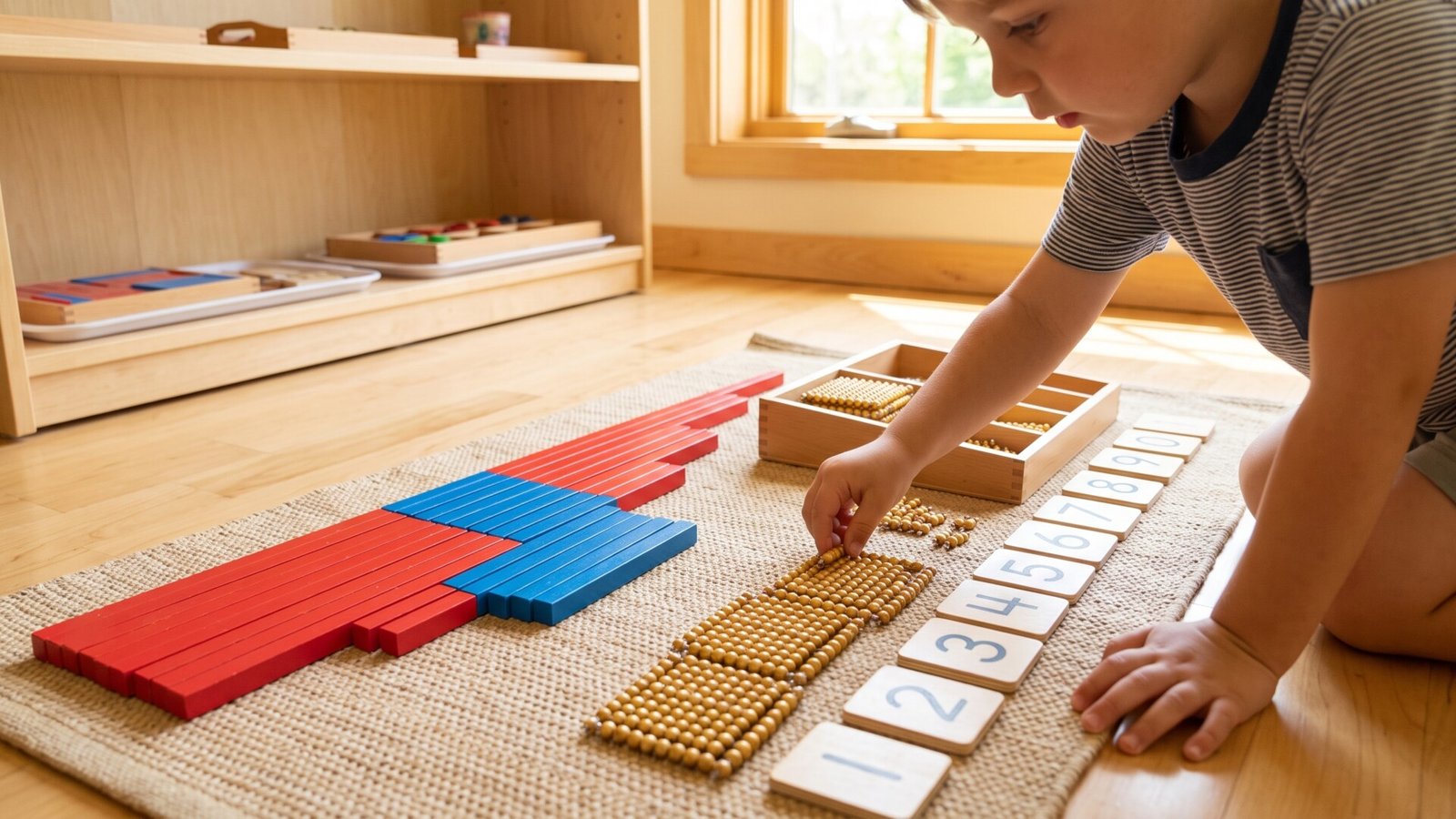
Mathematics is more than numbers and symbols—it is a language of patterns, relationships, and logical thinking. Montessori math games allow children to experience numbers, operations, and geometry through hands-on, purposeful play, building understanding step by step from concrete materials toward abstract ideas.
Unlike traditional worksheets or screen-based math games, Montessori math activities invite children to think, problem-solve, and explore abstract concepts through concrete materials, making learning intuitive and engaging.
This page serves as a Montessori math games sub-hub, connecting families and educators to age-appropriate materials, games, and activities from toddlers through early elementary. It is part of the complete Montessori Toys & Activities for Kids hub and our wider Montessori & Early Learning Toys collection, where we cover hands-on tools and play-based activities that help children build number sense, problem-solving skills, and confidence.
Montessori Math Games at a Glance
- Best for: children who learn by touching and moving things, from toddlers sorting objects to early-elementary children working with place value and fractions.
- Core idea: start with real objects, then move to symbols once the concept makes sense.
- What you need: a small, rotating set of 8–12 well-chosen materials, plus everyday items like beans, buttons, measuring cups, and clocks.
- Safety note: counters, beads, and other small materials are choking hazards for children under 3. Use larger items and stay close.
What Are Montessori Math Games?
Montessori math games are structured, tactile activities that guide children to understand mathematical concepts naturally. They are often self-correcting, multi-sensory, and designed to progress from concrete experiences to abstract reasoning, with hands-on manipulatives for counting, measuring, and sorting, and a focus on reasoning, pattern recognition, and problem-solving rather than memorization.
A note on terminology: “Montessori” is not a certification for toys, so a product can carry the name without following the principles. Our guide to what makes a toy Montessori explains what to look for beyond the label.
Why Montessori Math Is Unique
Traditional math often begins with symbols, formulas, and abstract instruction. Montessori flips this approach, starting with concrete, meaningful experiences. Children manipulate beads, rods, tiles, and other tactile materials to understand quantity, sequencing, and relationships, covering number sense and counting, the four operations, fractions, decimals and place value, geometry, measurement, and logical thinking. By connecting hands-on experiences with abstract symbols, children get repeated practice building a foundation in mathematical reasoning.
The Montessori Math Sequence: From Quantity to Symbol
Montessori classrooms usually introduce math in a deliberate order. You do not need to follow it exactly at home, but knowing the sequence helps you choose materials that fit where your child is now. Before number work begins, children typically spend time with sensorial materials that train them to compare size, length, and weight; see our Montessori sensory toys guide for that groundwork.
- Quantity first. Number rods (rods that increase in length, often alternating red and blue sections) let a child feel and see 1 through 10 before any written numbers.
- Symbol next. Sandpaper numerals let a child trace the shape of each digit while saying its name.
- Quantity meets symbol. Spindle boxes, and cards and counters, ask the child to place the right number of objects in each compartment or beside each numeral, including zero.
- The decimal system. Golden bead material represents units, tens, hundreds, and thousands with single beads, ten-bead bars, hundred squares, and thousand cubes, introducing place value physically.
- Operations. Children combine, exchange, share, and compare the same materials to explore addition, subtraction, multiplication, and division.
- Moving to abstraction. Gradually the child works with written equations and mental math, using the materials less as understanding grows.
Ages are flexible. Some children are ready for spindle boxes around age 3 or 4, others later; follow interest rather than a calendar. If your child is just starting out, our guide to toys that build early math foundations is a good companion.
Where to Start: Match the First Game to Your Child
Most guides list games by category and leave you to guess which one comes first. Because the sequence builds, the most useful question is what your child can already do. This table pairs each stage with a starting game and a sign it is time to move on:
| Your child can already… | Start with | Move on when they can… |
|---|---|---|
| Sort and match objects | Counting objects into an egg carton or onto a tray | Touch each object once while counting to 10 |
| Count to 10 reliably | Number rods or graded blocks, then sandpaper numerals | Name numerals and match them to quantities |
| Match numerals to quantities, including zero | Spindle box or cards and counters | Place the right number in each compartment without help |
| Understand 10 as a group | Golden-bead-style game with beans in bags of ten | Build 23 as two tens and three units, then exchange ten units for a ten |
| Build numbers with tens and units | Addition and subtraction with the same material | Explain why you exchange, then try a few problems on paper |
Common mistakes: buying place-value beads before a child can count objects accurately, putting out every material at once, correcting a wrong answer instead of letting the material show it, and rushing to worksheets because a child can recite numbers. If an activity ends in frustration, go back one row, not forward.
A Sample Week at Home
For a child around 4 who is counting to 10, a light week might look like this. Monday: egg-carton counting with large counters. Tuesday: set the table, one fork and cup per person. Wednesday: number rods or graded blocks, ordered from shortest to longest. Thursday: numeral hunt, finding cards 1 to 10 around the room. Friday: repeat the favorite from earlier in the week. Keep sessions short and child-led, stop when interest fades, and let a game repeat for as many days as your child wants.
Core Categories of Montessori Math Games
Montessori math materials and games are generally organized around numbers, operations, geometry, and measurement. These categories provide a roadmap for progressing from concrete manipulation to mental calculation.
Number Sense and Counting Games
Number sense is the cornerstone of mathematical understanding. Montessori games help children explore quantities, one-to-one correspondence, and symbolic representation, linking physical objects to numeric symbols and strengthening visual and tactile memory.
Examples of Number Sense Games
- Number rods and bead chains
- Counting boards with physical counters
- Object-to-number matching games
- Number puzzles and sequencing activities
Easy At-Home Counting Games
- Egg-carton counting: label the cups 1–12 and ask your child to place that many large pom-poms or bottle caps in each one (use large items for children under 3).
- Set the table: count out one fork, one cup, and one napkin per person to practise one-to-one correspondence.
- Stair counting: count steps out loud as you climb together.
- Number hunt: hide numeral cards around a room and have your child find them in order.
Operations Games (Addition, Subtraction, Multiplication, Division)
Once number sense is established, children explore operations through hands-on games rather than abstract calculations. Common materials include bead bars for addition and subtraction, golden bead materials for multiplication and division, math equation puzzles, and game-based problem-solving cards. They help children visualize operations concretely, understand mathematical relationships, and rely less on memorization alone.
A Simple Golden-Bead-Style Game You Can Play With Household Items
You do not need a full classroom set to try the idea behind the golden beads. Use dried beans as “units,” a small bag of ten beans as a “ten,” and a larger bag of ten tens as a “hundred.” Ask your child to build a number such as 23 (two tens and three units), then “exchange” ten loose beans for a ten bag when they have enough. This is a good preview of carrying and borrowing, and it works best with children who are past the mouthing stage (roughly age 3 and up, with supervision).
Fractions and Place Value Games
Fractions and place value can be abstract concepts for children. Montessori materials make these tangible through color-coded beads, bars, and boards: fraction circles and bars, decimal bead boards, place value charts, and fraction dominoes and matching games. These help children compare quantities, understand equivalence, and connect visual representation with numeric concepts.
At home, food makes fractions easy to see: cut a pizza, pancake, or sandwich into halves, quarters, and eighths and let your child compare the pieces.
Geometry and Spatial Reasoning Games
Geometry is not limited to shapes on paper. Montessori geometry games engage children in hands-on exploration of forms, spatial relationships, and symmetry, using geometric solids and shape puzzles, pattern blocks, tangram puzzles, and constructive triangles and modular shapes. They encourage spatial awareness, classification, logical reasoning, and fine motor practice.
Puzzles are an easy entry point. See when to introduce puzzles, the Montessori puzzle progression guide, and, for older children, logic and math puzzles for 8-year-olds.
Measurement and Data Games
Montessori encourages children to explore measurement and data through real-world, interactive games: rulers, scales, and measuring cups, volume and weight comparison activities, time and calendar exercises, and sorting and graphing manipulatives. They give children a hands-on understanding of units and quantities and connect math with everyday life.
Cooking is one of the best measurement games: let your child level cups of flour, compare a half cup with a full cup, and watch the clock on the oven. Our Montessori kitchen activities for toddlers give more ideas.
Montessori Math Games by Age Group
Toddlers (1–3 Years)
At this stage, children focus on pre-math skills like counting, sorting, and matching. See our guide to Montessori toys for toddlers for more. Good activities include counting with objects and toys, simple shape sorting games, matching number cards with items, and pattern recognition games. The goal is familiarity with numbers, shapes, and sequences. For under-3s, choose large pieces and supervise closely.
Preschoolers (3–6 Years)
Preschoolers begin exploring basic operations and quantity relationships. For product ideas, see Montessori math kits for 3–5 year olds and Montessori toys for preschoolers. Good activities include number rods and bead chains, simple addition and subtraction games, shape classification and patterning, and early measurement. Games for four-year-olds that build reasoning are covered in Montessori logic toys for 4-year-olds.
Early Elementary (6–9 Years)
Older children engage in more complex operations, fractions, geometry, and problem-solving. See Montessori toys for early elementary. Good activities include multiplication and division with golden beads, fraction and place value activities, tangrams and advanced geometry puzzles, and measurement-based games. The goal is to deepen reasoning and connect concrete materials to abstract concepts.
Quick Reference: Materials by Age
| Material | Math concept | Typical age range* | Everyday substitute |
|---|---|---|---|
| Number rods | Quantity 1–10, length | About 3–5 | Stacks of blocks in graded heights |
| Spindle box / cards and counters | Numeral-to-quantity, zero | About 3–6 | Egg carton with large counters |
| Golden bead material | Place value, operations | About 4–7 | Beans in bags of ten |
| Bead chains | Skip counting, multiplication | About 5–8 | Counting by twos and fives with a string of beads |
| Fraction circles or bars | Equivalence, comparison | About 5–9 | Pizza, paper circles |
| Tangrams / pattern blocks | Geometry, spatial reasoning | About 4–9 | Paper shapes cut from card |
*These are typical starting ranges, not milestones; every child moves at their own pace. Always check the manufacturer’s age grade, since small beads and counters are a choking risk for children under 3.
Creating a Montessori Math Area at Home
A prepared math area encourages independent exploration and repeated practice. Use low shelves for accessible materials, an organized tray or basket for each game, a limited and rotating set of activities to maintain focus, and enough space for manipulation and extended work sessions. For more on setting up the space, see simple Montessori activities you can do at home and toy storage and safety.
How to Present a Math Activity
- Invite, don’t insist. Say, “Would you like to see something new?” and sit beside your child at a table or mat.
- Show slowly with few words. Demonstrate the activity once, using careful hand movements, then step back.
- Let them repeat. Repetition is the point; there is no need to move on quickly.
- Use the material’s built-in feedback. If a bead bar does not fit, let the child notice and correct it rather than telling them.
- Put it back together. Returning the activity to its tray teaches order and prepares it for next time.
Montessori Math Games vs. Traditional Math Toys
Montessori math games tend to be hands-on and tactile, self-correcting, progressive, and focused on understanding over speed. Many typical “educational” math toys are digital or screen-based, lean on memorization or drill, and aim at quick results rather than comprehension.
That said, this is a generalization. Some conventional toys, such as good base-ten blocks, tangrams, or a simple balance scale, work just as well as classroom Montessori materials, and many families mix both. The key question is whether the toy lets a child explore a concept with their hands and check their own work.
How Montessori Math Games Support Academic Readiness
Math games give children practice with numeracy, logical thinking, and problem-solving, which are useful as they start formal schooling. No game can guarantee academic results, but these are the skills Montessori math aims to build: strong number sense, confidence with calculations, the ability to reason through problems, and a connection between concrete and abstract concepts.
If your child is struggling with math at school, hands-on practice can help, but speak with their teacher too, since persistent difficulty sometimes needs additional support.
Choosing Montessori Math Games as Gifts
Math games make good gifts because many grow with the child and remain relevant across age levels. Prefer manipulatives over electronic toys, select games that are self-correcting, choose durable, natural materials, and check the age grade on the box.
Check what is included before you buy: loose bead sets can have hundreds of tiny pieces that are easy to lose, while sets with trays, boxes, or pre-assembled bars keep play tidier. Prices vary a great deal between full classroom-style sets and simple starter kits, so compare contents and check current retail prices. A small starter set often goes further than a big box your child is not yet ready to use. Many Montessori math materials are also offered in cheaper non-wooden versions, and either can work if the child can use it independently.
Related Math and Logic Guides
- Montessori Math Kits for 3–5 Year Olds – age-appropriate kits for counting, patterns, and basic operations
- Toys That Build Early Math Foundations – manipulatives for sequencing and early arithmetic
- Montessori Coding and Logic Games – screen-free sequencing and pattern activities
- The Top 5 Simple Science Kits for 4-Year-Olds – counting, measurement, and observation through experiments
- Inclusive Math Manipulatives for Preschoolers
- Montessori Learning Activities by Age
Frequently Asked Questions About Montessori Math Games
Do children need to be able to read to play these games?
No. Many games use objects, beads, and manipulatives to teach concepts before reading skills emerge.
What if my child loses interest in a math material?
Put it away for a week or two and offer something from a different category. Check whether it is too easy or too hard, using the move-on signs in the table above, and bring it back when it feels new again.
My child is older and has never used Montessori materials. Where do we start?
Start at the concept, not the age. If place value is shaky, try the bean-bag exchange game and build numbers with tens and units, even at age 7 or 8. Skip any step your child can already do easily.
Can these games support children struggling with math?
They can help. Hands-on, self-correcting materials let children explore and understand concepts at their own pace. If difficulty persists, talk with your child’s teacher or a specialist, since games alone may not be enough.
Do I need the full set of Montessori materials?
No. Start with one or two materials that match your child’s current stage, and use household items (beans, egg cartons, measuring cups) for extra practice.
Are Montessori math materials safe for toddlers?
Many include small beads, counters, or cubes that are choking hazards for children under 3. Check the manufacturer’s age grade, choose larger pieces for toddlers, and supervise closely.
Final Thoughts: Learning Through Manipulation and Exploration
Montessori math games transform learning from abstract numbers on a page into tangible, joyful experiences. By connecting hands-on manipulation to reasoning and problem-solving, children can build confidence with math that carries into the school years. Start with what your child can do today, keep the materials few, and let repetition do the work.