Best Building Toys for Kids Ages 9–12
The best building toy for a nine-to-twelve-year-old is the one that survives the second build, not the one that wins the first afternoon. That single line decides almost everything in this category. A set with a thousand pieces can be finished by dinner and never opened again, while a smaller, cheaper system gets rebuilt, modified, and raided for parts until the pieces are scattered under three different beds. The question is not which toy is most impressive in the box. It is which one still earns its floor space by next summer.
Kids in this range split into recognisable types. Some want to follow a technical plan and end up with a working gearbox. Some want to invent something nobody has instructions for. Some want their construction to light up or move. Some want a quiet tabletop project they can pick up and put down. Match the toy to the type and you get months of use. Mismatch it and you get an expensive box that gets opened once.
Here is the shortlist, with the honest trade-offs attached.
Why Building Toys Change at Ages 9-12
Something shifts around nine. The building stops being about the object and starts being about the plan. A child this age can hold a multi-step sequence in their head, read a technical diagram, notice that step fourteen will not work because step nine was wrong, and go back to fix it. That is a genuinely different activity from stacking bricks and calling it a castle.
The word “advanced” gets used loosely in this category. What actually separates a tween building toy from a younger one is not piece count or difficulty for its own sake. It is the demand for planning, spatial reasoning, and the willingness to revise a failed design rather than abandon it.
Ability varies enormously within this age range, and the age label on the box is a starting point, not a guarantee. A nine-year-old who has been building since they were four can outperform a twelve-year-old who is new to the hobby. Buy for the builder, not the birthdate.
There is also a fork in the road that the marketing rarely acknowledges. Some sets are built to be finished. Others are built to be used. A single-model display piece gives you one satisfying afternoon and then sits on a shelf. A system gives you a build, a rebuild, a modification, and eventually a parts bin that feeds every future project. Both are legitimate purchases, but they are not the same purchase.
If your builder is younger or less experienced, our guide to Best Building Toys for Kids Ages 6-8 is the better starting point. If you are specifically buying to develop reasoning and persistence, Best Construction Toys for Developing Problem-Solving Skills goes deeper on that angle.
How We Chose the Best Building Toys
We are not going to pretend these were lab-tested. They were not. What follows is an editorial judgement based on how these products behave in real homes over months, not minutes.
Every pick carries a ToyGuideHub Build Value Score, rated out of 10. It is a decision aid, not a measurement. It weighs six things:
- Challenge and progression. Does the set offer real problem-solving, or does it just demand endurance through repetitive steps?
- Replayability and creativity. Can the child rebuild, combine, or modify it after the main model is done?
- Durability. Will the pieces survive being stored in a bin and stepped on in socks?
- Independent-play potential. Can the child get going without an adult reading the manual aloud?
- Storage burden. How much floor, shelf, and bin space does this thing actually eat?
- Price-to-use value. Approximate cost divided by how many times it realistically gets used.
A high score does not mean a toy is right for your child. It means the toy does a lot with what it costs. A themed set that perfectly matches a child’s obsession can beat a higher-scoring system, because motivation is the engine that makes any of this work.
Best Building Toys for Kids Ages 9-12
| Product | Approx. Price | Build Style | Build Value Score | Best For |
|---|---|---|---|---|
| LEGO Technic sets | $50-$200+ | Mechanical, model-based | 9/10 | Kids who enjoy mechanisms |
| LEGO Creator 3-in-1 sets | $15-$60 | Rebuildable brick | 9/10 | Flexible play, strong value |
| LEGO Classic Large Creative Brick Box | $35-$60 | Open-ended brick | 8.5/10 | Imaginative builders |
| K’NEX 70 Model Building Set | $30-$60 | Rod-and-connector | 8.5/10 | Structural challenges |
| Thames & Kosmos Structural Engineering | $35-$70 | Guided experiments | 8/10 | Real-world design interest |
| Snap Circuits Jr. or Classic | $30-$80 | Construction plus electronics | 8/10 | Functional STEM projects |
| Plus-Plus building sets | $15-$50 | Pattern and spatial | 7.5/10 | Quiet, compact building |
LEGO Technic Sets
| Feature | Details |
|---|---|
| Age Range | Commonly 9-12, varies by set |
| Key Features | Gears, steering, suspension, working mechanisms |
| Price (approx.) | $50-$200+ |
The Verdict
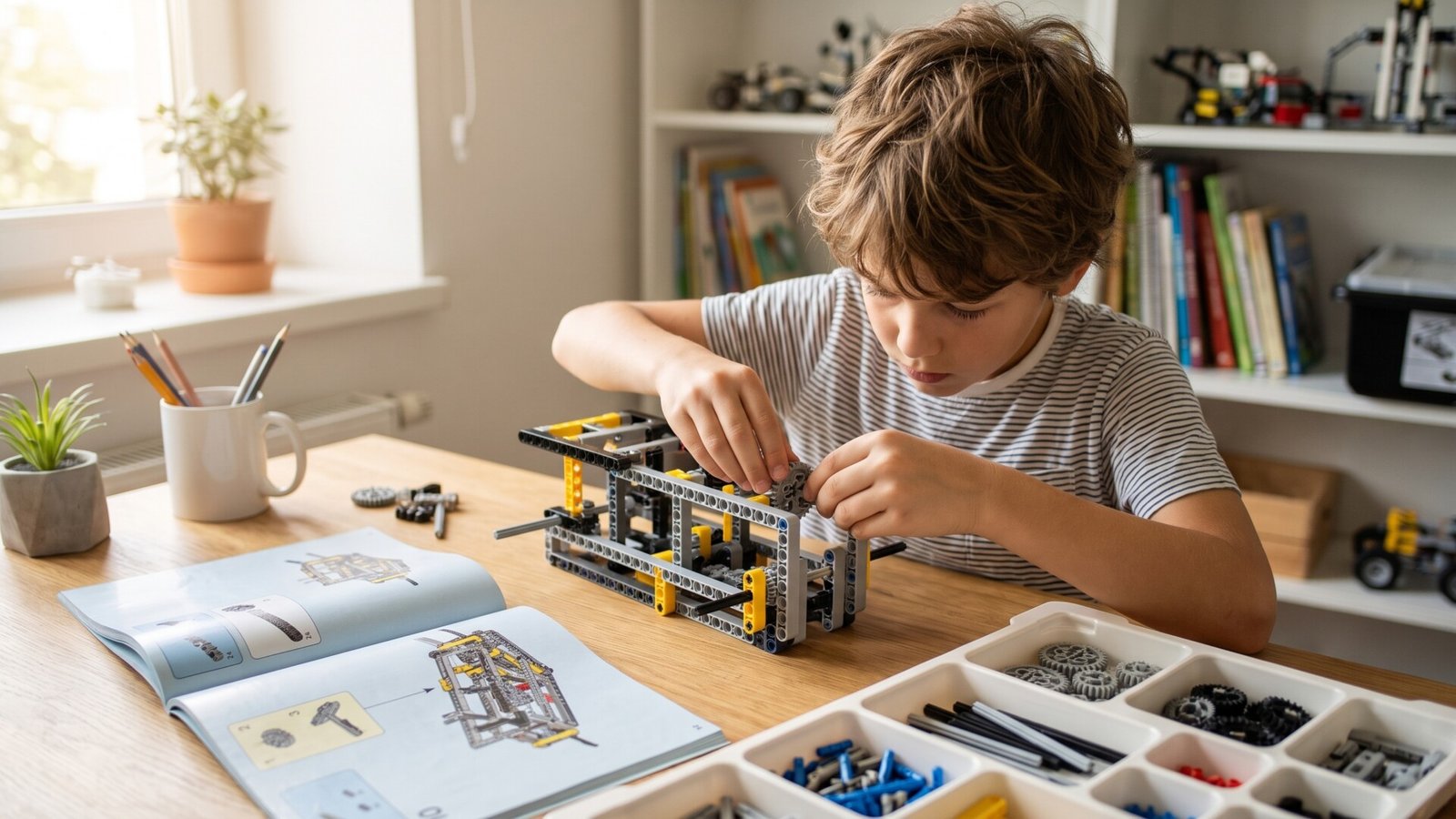
Technic is the strongest premium choice for a child who wants to understand how something moves, not just how it looks. The mechanisms are the point. A steering rack that actually steers, a suspension that actually compresses, a gear train that transfers motion through three stages. That is a different kind of satisfaction from placing a decorative tile.
It is also more guided than open-ended. You are following a plan, and the plan is long. That is fine if your child enjoys the discipline of a technical build. It is a poor fit for a kid who wants to invent.
Buy the smaller Technic sets first. A mid-range vehicle model gives you the same mechanical vocabulary as a flagship at a fraction of the cost, and it tells you whether the child actually has the patience before you spend two hundred dollars finding out.
Best For: Children who like vehicles, machines, and patient step-by-step building.
Pros
- Genuine progression from simple mechanisms to complex systems.
- Finished models do something, rather than sitting there.
- Wide range of price points and difficulty levels.
Cons
- Small pieces demand careful sorting and storage.
- Instructions leave little room for freeform building.
- Flagship sets get expensive fast.
LEGO Creator 3-in-1 Sets
| Feature | Details |
|---|---|
| Age Range | Commonly 7-12, larger sets more challenging |
| Key Features | Multiple official models, standard LEGO compatibility |
| Price (approx.) | $15-$60 |
The Verdict
This is the best overall balance of instructions, creativity, price, and replayability. The three-in-one concept is genuinely useful, but do not oversell it. You usually cannot build all three models at once. The child dismantles one to build the next. It is one toy with three possible outcomes, not three toys.
Where the system really earns its keep is after the official builds are done. The bricks are standard LEGO, so they join the wider collection, get raided for parts, and turn into something else entirely. That is why the value holds up.
Best For: Families who want one versatile set that supports both guided and imaginative play.
Pros
- Multiple builds improve value and replayability.
- Combines easily with existing LEGO.
- Approachable budget and mid-range prices.
Cons
- Only one official model at a time.
- Some secondary builds are thinner than the main one.
- A child uninterested in the theme will stall.
LEGO Classic Large Creative Brick Box
| Feature | Details |
|---|---|
| Age Range | Commonly 4+, most useful for experienced 9-12 builders |
| Key Features | Mixed bricks, wheels, eyes, assorted colors |
| Price (approx.) | $35-$60 |
The Verdict
This is the pick for the child who ignores the instructions on purpose. An open-ended box produces more long-term play than any single themed set, but it requires initiative. Hand this to a child who needs a clear finished project and you will get a shrug.
The included storage container helps, but it is a starting point, not a system. Once the collection grows past a few hundred pieces, you will want trays or compartment organisers. The box is a lid, not a solution.
Best For: Imaginative builders, siblings sharing a collection, and children who dislike being told what to make.
Pros
- High replayability and full LEGO compatibility.
- Encourages design, storytelling, and iteration.
- Does not go obsolete when a theme fades.
Cons
- Less satisfying for children who need a guided project.
- Requires sorting and real storage.
- May need extra wheels or specialty pieces.
K’NEX 70 Model Building Set
| Feature | Details |
|---|---|
| Age Range | Suited to older children, varies by model |
| Key Features | Rods, connectors, wheels, structural frameworks |
| Price (approx.) | $30-$60 |
The Verdict
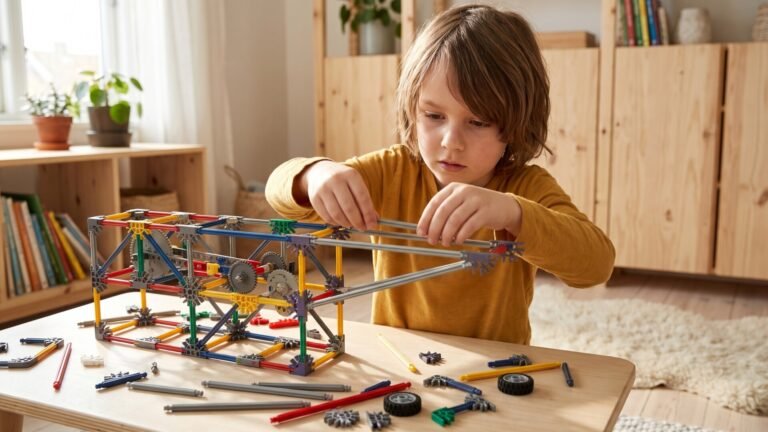
K’NEX is the strongest alternative for a child more interested in structures than miniature detail. Rods and connectors make balance, tension, and span visible in a way bricks do not. When a tall tower wobbles, the child can see exactly which joint is failing and why.
The trade-off is tactile. The connections can be stiff, and some children need help pressing pieces together on the first few builds. Finished models are also less robust than a solid brick build, so rough play shortens their life.
Best For: Children who enjoy bridges, vehicles, tall structures, and testing stability.
Pros
- Encourages structural reasoning and experimentation.
- Multiple models extend use beyond one project.
- A genuinely different building experience.
Cons
- Connections may feel stiff for smaller hands.
- Models can be fragile during rough play.
- Storage is more complicated than a single box.
Thames & Kosmos Structural Engineering: Bridges and Skyscrapers
| Feature | Details |
|---|---|
| Age Range | Aimed at older children, check current package guidance |
| Key Features | Guided structural projects, engineering concepts, explanatory materials |
| Price (approx.) | $35-$70 |
The Verdict
This is for the child who asks why a bridge bends or a tower sways. It is closer to a short course than a toy, and its value comes from the explanation and the challenge process, not the piece count.
That makes it a poor fit for unrestricted fantasy building. If your child wants to invent a spaceship, this will frustrate them. If they want to know why their spaceship’s wings sag, this is exactly right.
It is also the best pick on this list for a shared adult-child session. The reading load is real, and a parent nearby turns a stalled experiment into a conversation.
Best For: STEM-oriented children who enjoy testing ideas through controlled experiments.
Pros
- Makes structural concepts concrete and observable.
- Encourages prediction, testing, and revision.
- Excellent for a joint parent-child project.
Cons
- Less open-ended than a loose brick system.
- Some materials have limited use after the main activities.
- Requires more reading and attention than a recreational set.
Snap Circuits Jr. or Snap Circuits Classic
| Feature | Details |
|---|---|
| Age Range | Jr. for younger users, Classic for older or experienced |
| Key Features | Snap-together components, lights, sounds, switches |
| Price (approx.) | $30-$80 |
The Verdict
Snap Circuits is building-adjacent rather than conventional construction, and it earns its place because it combines assembly, sequencing, and troubleshooting with an immediate visible result. The circuit either works or it does not, and the child finds out in seconds.
That feedback loop is the whole appeal. It is also less dependent on fine motor precision than tiny construction pieces, which makes it a good option for a child who gets frustrated by fiddly parts.
Pick the version carefully. Junior sets suit beginners and get outgrown quickly. Classic gives an older child more room to experiment before hitting the ceiling.
Best For: Children interested in electronics, switches, lights, and functional projects.
Pros
- Immediate feedback makes experimentation rewarding.
- Components reuse across many projects.
- Less reliant on fine motor precision.
Cons
- Projects are more constrained than open-ended building.
- Batteries and component storage add upkeep.
- Introductory versions get outgrown.
Plus-Plus Building Sets
| Feature | Details |
|---|---|
| Age Range | BIG for younger or fine-motor-sensitive builders, standard for experienced |
| Key Features | One interlocking shape, flat mosaics, 3D forms |
| Price (approx.) | $15-$50 |
The Verdict
Plus-Plus is the quiet, compact option. One piece shape, endless arrangements, and a storage footprint small enough to live in a drawer. For a small apartment or a child who likes focused tabletop work, it solves problems the other sets create.
The single shape is both the strength and the limit. It encourages pattern and form exploration but offers none of the mechanical variety of LEGO or K’NEX. A child who wants gears will be bored within a week. A child who likes repetition and precision will build for an hour without noticing.
Best For: Quiet builders, small spaces, travel, and children who enjoy patterns.
Pros
- Very small storage footprint.
- Supports flat and three-dimensional designs.
- Suits calm, focused independent play.
Cons
- No mechanisms or realistic models.
- Tiny pieces are easy to lose.
- Some children find the shape repetitive.
What Most Buyers Get Wrong About Building Toys for Tweens
Piece count is the most misleading number on the box. A thousand-piece set can be a thousand repetitions of the same motion, demanding endurance rather than thought. A two-hundred-piece mechanical model can require more genuine design decisions, more spatial reasoning, and more recovery from mistakes. If you are comparing two sets and the only difference you can articulate is the number, you are comparing the wrong thing.
The second mistake is trusting the word “educational.” Plenty of engineering kits are genuinely educational, and plenty of them need substantial reading, setup, and adult troubleshooting before the child gets anything out of them. Educational value that never gets accessed is not value. It is shelf weight.
Third, parents often assume open-ended is automatically better. It usually has better long-term value, but only for a child who enjoys inventing projects. An open-ended box handed to a child who needs a visible finish line produces nothing but guilt for the parent who bought it.
Here is the counterintuitive part. A themed set is often the smarter purchase, precisely because the theme is the motivation. A child obsessed with space will read a difficult instruction manual, troubleshoot a broken mechanism, and rebuild a model three times, all because the finished thing matters to them. The same child handed a generic box of bricks may build a wall and walk away. Motivation drives learning. The theme is not decoration; it is the engine.
Finally, most buyers underestimate the storage problem. Small connectors, specialty pieces, and half-finished models do not live neatly. If you do not solve storage before purchase, you will be solving it in a panic three weeks later, and pieces will already be missing.
Which Building Toy Still Makes Sense After Six Months?
Six months is the honest test. A set that gets built once and shelved has failed, no matter how good the afternoon was.
A single large display model is the riskiest purchase in this category. It is impressive, it is expensive, and once it is finished it cannot easily become anything else. If it gets displayed, fine. If it gets disassembled, you now own a very expensive parts bin.
Expandable systems behave differently. LEGO Creator, LEGO Classic, K’NEX, and Plus-Plus all share one property: the pieces keep working after the first project ends. They combine, they get raided, they feed the next build. That is why the cost-per-use math tilts so heavily toward systems over time. A moderately priced system used repeatedly will beat a premium set completed once, and it is not close.
What actually kills value over time is predictable. Missing pieces, broken connectors, lost instructions, no storage plan, and a finished model that cannot be altered. Most of these are preventable. Download the instructions or photograph the manual. Keep specialty pieces bagged separately. Sort the small connectors before they migrate.
The parent decision rule is simple. Choose a themed set when the child has a strong, specific interest right now. Choose a construction system when you want repeat use and a growing parts collection. Choose a guided engineering kit when you are willing to sit down and participate. Pick the wrong one and the toy fails for reasons that have nothing to do with quality.
If space is the constraint, Best Building Toys for Small Spaces covers the compact options properly. If you want something that grows rather than expires, Open-Ended Building Toys That Grow With Your Child is the deeper read.
How to Choose the Right Building Toy
Best Overall
LEGO Creator 3-in-1 wins on the broadest combination of affordability, replayability, familiar construction, and compatibility with whatever LEGO already lives in your house. It is the safest bet for a child whose interests you are not entirely sure about.
Best Premium
An appropriately sized LEGO Technic set, for a child who enjoys mechanisms and detailed construction and will genuinely appreciate the higher price. Buy mid-range first and scale up if the patience is there.
Best Budget
A smaller LEGO Creator 3-in-1 set or a compact Plus-Plus set, depending on whether the child prefers conventional models or quiet pattern-based building. Both deliver real value under forty dollars.
Best for STEM and Engineering
Thames & Kosmos Structural Engineering for structural concepts, Snap Circuits Classic for electronics and functional projects. They teach different things, so pick by interest rather than by label.
Best for Open-Ended Play
LEGO Classic Large Creative Brick Box, particularly for a child who already uses LEGO pieces creatively and does not need a plan.
Best for Small Spaces and Independent Play
Plus-Plus, with the piece size chosen according to the child’s fine-motor comfort. It stores in a drawer and works on a tray table.
A quick framework:
- Buy a themed set if the child has a strong current obsession and will push through a difficult build because of it.
- Skip the themed set if the theme is generic and the child mainly wants to invent.
- Buy a system if you want the pieces to keep working for years.
- Skip the system if the child needs a visible finish line to stay engaged.
- Buy a guided engineering kit if you will sit down with them.
- Skip it if the child will be working alone and dislikes reading.
For quiet indoor options, Quiet Building Toys for Indoor and Independent Play is worth a look before you commit.
Safety, Storage, and Parent Setup
Follow the manufacturer’s current age guidance on the box, and check it again if a younger sibling is now in the house. Small parts are normal in this category, but they are still a choking hazard for children under three, and pieces get dropped.
Inspect pieces periodically for cracks, sharp edges, or damage, especially after rough play or a younger sibling’s involvement. Retire anything that has failed. It is not worth the risk for the sake of one connector.
Storage is the difference between a toy that lasts and a toy that gets binned. Sorting trays, labelled bags, shallow bins, and compartment organisers all work. The goal is simple: keep instructions and specialty pieces together, and keep small connectors out of the carpet.
Batteries and electronic components need their own routine. Check them regularly, remove batteries from anything going into long-term storage, and follow the manufacturer’s guidance on both. Loose electronic parts and curious toddlers are a bad combination.
The Long View
Think about where this ends up in three years. The themed set your child begged for will likely be disassembled, its pieces absorbed into the general collection or lost under furniture. The Technic model might still be on a shelf, dusty and admired. The open-ended box will have become something else entirely, rebuilt a dozen times into things you never saw coming.
That is the real argument for buying the system over the spectacle. Not because open-ended is nobler, but because a bin of compatible pieces is still useful when the instructions are long gone and the theme has faded. A finished model is a destination. A system is a workshop.
So buy for the builder in front of you, not the one on the box. If they follow plans, get the Technic. If they invent, get the Classic box. If they need a win, get the Creator 3-in-1 and let them build all three. And if they are happiest at a quiet table with small pieces and no audience, Plus-Plus will outlast almost everything else on this list. Check current pricing and availability through our recommended partners, and start with the set that matches how your child actually builds.
Frequently Asked Questions About Building Toys For Kids Ages 9–12
Are building toys good for kids ages 9-12?
They support spatial reasoning, planning, persistence, and creative problem-solving, which is why they stay popular through the tween years. Treat those as practical benefits rather than guaranteed outcomes. A child who enjoys the building gets them. A child who does not will not, no matter what the box claims.
What is the best building toy for a 10-year-old?
It depends on how they build. LEGO Creator 3-in-1 for broad appeal, LEGO Technic for a child who loves mechanisms, and LEGO Classic for an imaginative builder who ignores instructions. If you are unsure, Creator 3-in-1 is the safest starting point.
Are LEGO Technic sets too difficult for most 9-year-olds?
Not inherently. Difficulty depends on the specific set and the child’s prior building experience. Smaller Technic models are well within reach for a patient nine-year-old, while large flagship sets can frustrate anyone. Check the current age recommendation and the model’s complexity before buying.
Is an open-ended building set better than a themed building set?
Open-ended sets usually deliver more repeat use, because the pieces keep working after the first project. Themed sets deliver more motivation, because the finished model matters to the child. If your child needs a goal to stay engaged, a themed set will outperform a better-designed open-ended one.
What building toys are best for children who lose interest quickly?
Look for systems with short projects, multiple official builds, or visible functions. LEGO Creator 3-in-1 gives three outcomes from one box, and Snap Circuits gives an immediate result in seconds. A single long build is the worst choice for a child with a short attention span.
How should parents store building toys with lots of small pieces?
Use shallow bins, sorting trays, or compartment organisers, and keep instructions with the specialty pieces. Sorting by type rather than colour makes rebuilding faster and reduces the chance that a critical connector disappears into the vacuum.
Are STEM building toys worth the higher price?
Sometimes. The premium is justified when the components are reusable across many projects, when the experimentation is genuinely open, or when the child’s interest is strong enough to carry the reading load. It is not justified when you are paying for a label on a box of ordinary bricks.