Best Educational Montessori Toys for 3-Year-Olds
Many parents of three-year-olds make the same early mistake: they buy every brightly colored, button-pushing, sound-making toy they can find, then watch their child ignore most of it in favor of stacking wooden blocks or pouring water between cups. That everyday pattern is a good introduction to Montessori thinking. Three-year-olds rarely need flashy electronics or complicated play sets. They need toys that respect their developing minds, challenge their growing hands and let them figure things out on their own.
Montessori-style toys are designed to support independence, concentration and real skill-building rather than passive entertainment. This guide walks through the best educational Montessori-style toys for three-year-olds, organized by developmental area, with the age grade, trade-offs and safety notes for each. It is part of our Montessori Toys for Toddlers (1–3 Years Old) series within the wider Montessori & Early Learning Toys hub.
Quick Picks for 3-Year-Olds
- Fine motor: Melissa & Doug chunky wooden puzzles, or Tegu magnetic wooden blocks for building.
- Cognitive skills: Melissa & Doug Shape Sorting Cube (24+ months).
- Social and pretend play: Hape Gourmet Kitchen (3+) or a LEGO DUPLO house set.
- Language: Eric Carle’s The Very Hungry Caterpillar board book, and LeapFrog Fridge Phonics if you are comfortable with an electronic option (ages 2–5).
What Makes a Toy Montessori
Before we talk about specific products, it helps to clarify what Montessori actually means in the context of toys. Maria Montessori was an Italian physician and educator who developed an approach to learning based on observing how children naturally develop. Her method emphasizes hands-on learning, self-directed activity and respect for the child.
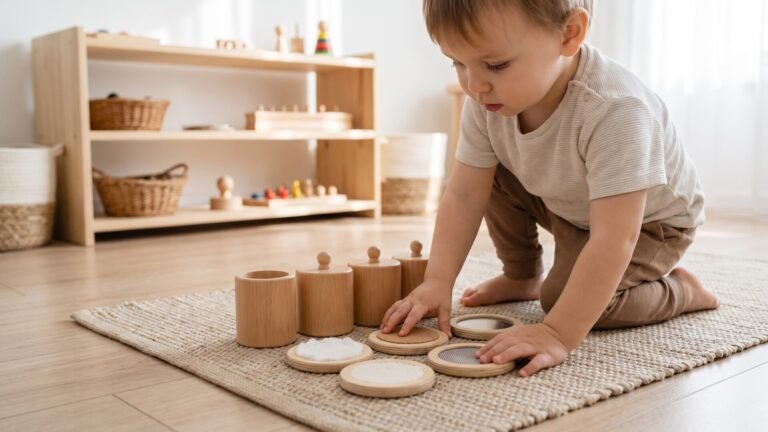
Montessori-aligned toys usually share several characteristics. They are often made from natural materials such as wood, metal or fabric. They have a single purpose or clear learning goal. They allow the child to self-correct, meaning the toy itself shows whether the task was done correctly. And they are aesthetically calm, because Montessori believed an orderly, beautiful environment supports concentration. Note that “Montessori” is not a protected certification, so the label on a box tells you less than the way a toy actually works.
For a three-year-old, the right toy sits at the edge of their ability, challenging them just enough to stay engaged but not so much that they become frustrated. Montessori described “sensitive periods” when children are especially drawn to things such as order, language and sensory refinement, and many of the toys below meet children in those interests.
At three, most children are refining fine motor control, learning to dress themselves, beginning to notice letters and numbers, developing social skills through parallel and early cooperative play, and building vocabulary quickly. Every child develops at their own pace, so treat these as general patterns, not a checklist.
Safety First: Small Parts, Magnets and Batteries at Age 3
Toy age grades are mainly safety ratings. A toy marked 3+ is considered suitable from a safety viewpoint for a three-year-old, but it may still contain small parts that are dangerous for younger siblings. Before you buy:
- Small parts: If there is a child under 3 in the home, keep small pieces out of reach, even if the product is graded for your three-year-old.
- Magnets: Magnetic building toys have sealed magnets, but loose or detached magnets are a serious swallowing risk. Choose well-made sets from reputable brands, inspect them regularly and stop using any with cracks or loose magnets. The U.S. Consumer Product Safety Commission has detailed guidance on magnets.
- Batteries: Button and coin batteries in electronic toys must be secured behind a screw-closed compartment. Check that the compartment is secure.
- Recalls: Check cpsc.gov/Recalls before buying, especially for secondhand toys.
Types of Montessori Toys for 3-Year-Olds
Fine Motor Skills Development
Fine motor skills are the foundation for writing, buttoning a shirt and using scissors. At three, children are moving from broad arm movements toward more precise hand control. Many can hold a crayon, string large beads and turn pages one at a time.
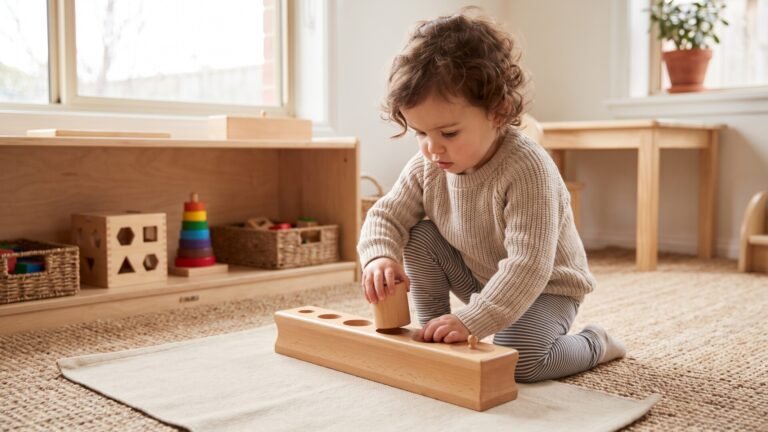
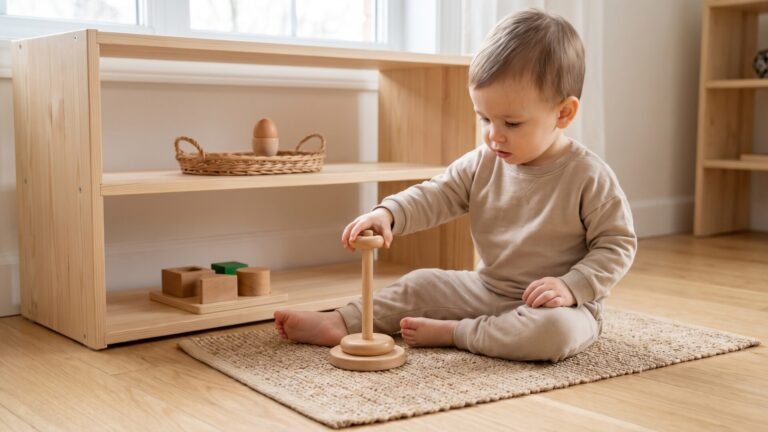
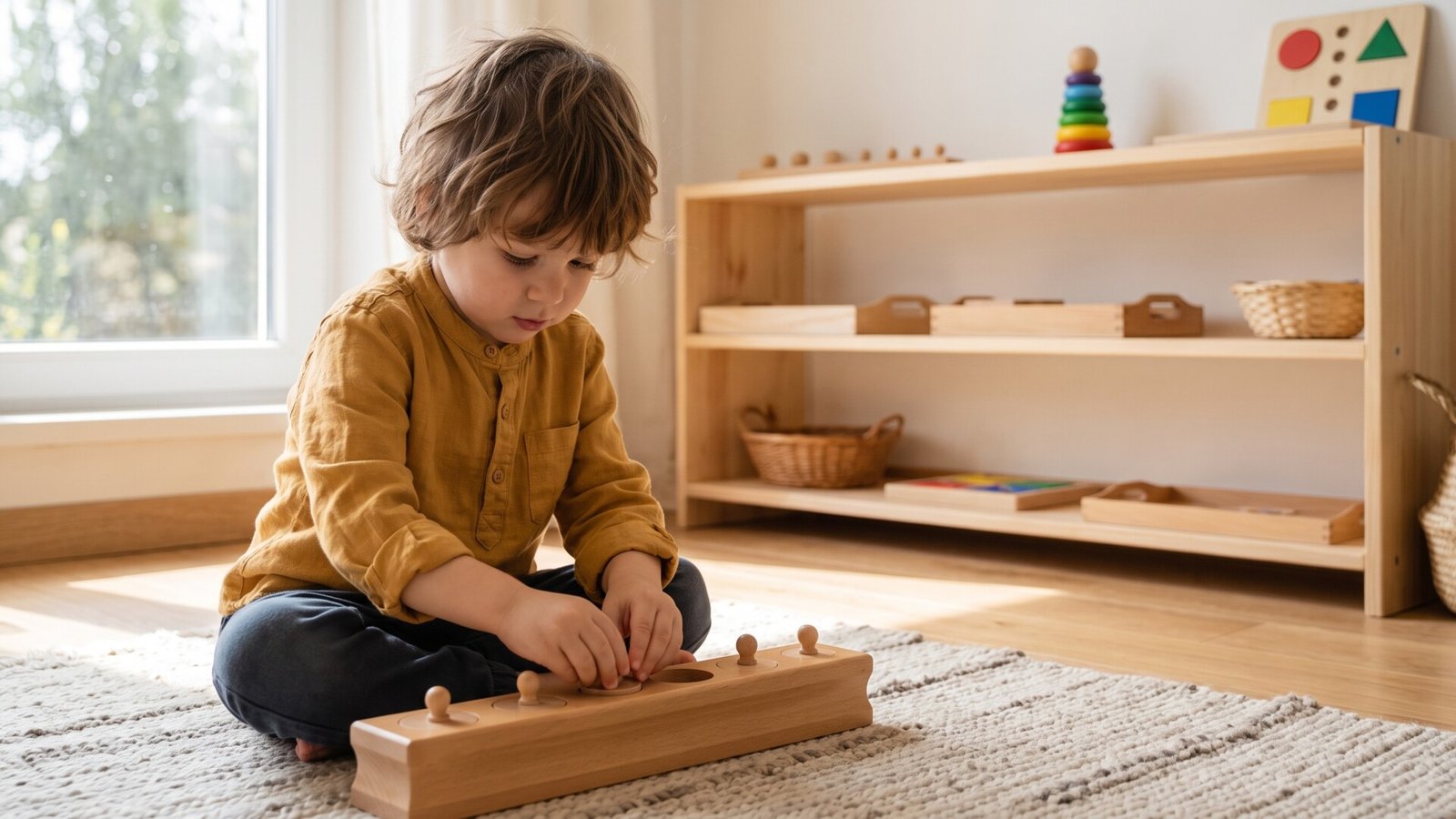
The best Montessori toys for fine motor development involve grasping, twisting, stacking and threading. These actions exercise the small muscles in the hands and fingers and give practice in hand-eye coordination. Wooden puzzles with knobs, stacking rings, lacing beads and pegboards are classic examples. The satisfaction of a peg finally fitting its hole after several attempts is a good example of persistence being rewarded without any adult reward.
Cognitive Skills
Cognitive play at this age involves understanding cause and effect, sorting and classifying, recognizing patterns and solving simple problems. Montessori-style toys here often involve matching, sequencing and building.
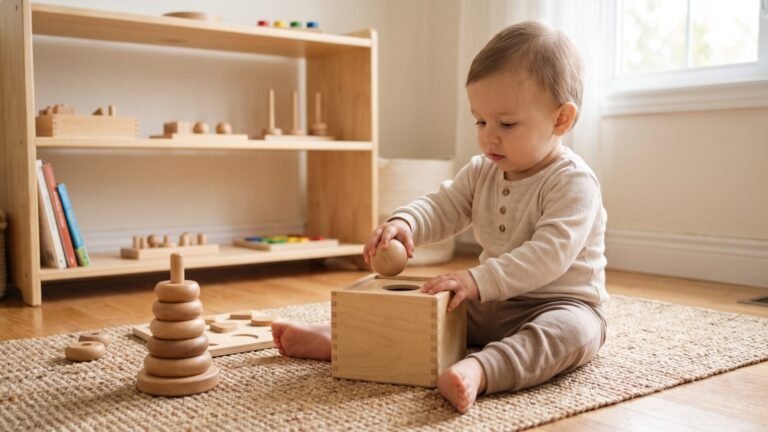
Shape sorters, nesting blocks, memory games and simple puzzles all invite this kind of thinking. The key is that the child works through the problem rather than pressing a button for a reward. When a square block doesn’t fit a round hole, the child has to work out why and try something different. Look for toys with graduated difficulty, such as stacking blocks that can be arranged by size, color or pattern, because the child can keep using them in more sophisticated ways as they grow.
Social and Emotional Development
Three-year-olds are beginning to understand that other people have feelings and perspectives different from their own. They often engage in parallel play, playing alongside other children, and are just starting to move toward cooperative play.
Role-play sets, puppets and cooperative games support this. A play kitchen, a dollhouse or a set of animal figures lets children act out social scenarios, practice empathy and take turns. The toy simply provides the stage; the children write the script.
Language and Communication Skills
Language grows quickly between ages two and four. Many three-year-olds are speaking in short sentences, asking constant questions and loving stories, songs and rhymes.
Montessori language materials focus on real objects, pictures and words rather than abstract symbols. Picture books with clear images, alphabet puzzles and matching games that pair objects with words all support language development. A caution: a toy that talks for your child, by announcing a letter at the press of a button, can end up doing the work for them. Tracing a sandpaper letter while you say its sound, for instance, gives a child more to do than pressing a button.
Recommended Montessori Toys
Specifications below come from manufacturer and retailer listings and can change, so confirm on the product page before buying. Prices are approximate US ranges.
Fine Motor Skills Development Toys
Melissa & Doug Wooden Puzzles
Melissa & Doug’s wooden peg and chunky puzzles are a dependable starting point for fine motor practice. The knobs or thick pieces suit small hands, and the images are clear and engaging. The “chunky” puzzles with thick pieces are especially useful for three-year-olds who are still developing precision.
Puzzles are self-correcting: a piece either fits or it doesn’t, so the child knows right away without adult input. Wooden construction means they usually survive drops and can be handed down to siblings. Prices vary by puzzle; check the age grade on each box, since piece counts and sizes differ.
Tegu Magnetic Wooden Blocks
Tegu blocks are hardwood blocks with magnets sealed inside, so pieces click together. That lets children build things that regular blocks can’t, such as cantilevers and “floating” elements, and the click gives satisfying sensory feedback that supports hand strength and coordination.
Sets range from small travel packs to larger classroom sets; the 24-piece set is a common starting point for one child. Because these contain magnets, follow the safety notes above: check the manufacturer’s age grade, inspect blocks for damage and keep them away from toddlers who mouth objects.
Cognitive Skills Toys
Melissa & Doug Shape Sorting Cube
The shape-sorting cube is a classic. Retailer listings give an age grade of 24+ months and describe a wood-and-plywood build, so it is well suited to a three-year-old who is ready to move beyond the simplest sorters. Each shape fits only its matching hole, so the child must rotate and try different orientations to find a match. Typical street price is roughly $20–$32.
The cube itself becomes a toy: children stack things on it, roll it and use it in pretend play. A three-year-old will likely master the basic task quickly, so for longer-lasting challenge, offer it alongside puzzles or ask them to sort shapes by color after matching them.
Social and Emotional Development Toys
Hape Gourmet Kitchen
Hape’s Gourmet Kitchen is a solid wood play kitchen, graded 3+ by the manufacturer, with a sink, two-plate stove, an oven with a window, a cabinet and a spice shelf. The knobs click and turn, and it is finished with non-toxic water-based paint according to the brand. Expect to pay roughly $100–$140, depending on sales and bundled accessories.
What makes it a good fit for Montessori-aligned play is the realism: working knobs, a visible oven window and a layout that mirrors a real kitchen invite children into sustained pretend play and into mirroring everyday life. Add real, safe tools such as a small pitcher and child-sized whisk to take the same idea further. It is a large piece of furniture and a major spend, so measure your space first.
LEGO DUPLO Town Family House
The DUPLO Family House (set 10835) is graded 2–5 years and has 69 pieces, with figures, furniture and accessories for acting out daily routines such as breakfast, bedtime and tidying up. Chunky bricks take real pressure to connect and separate, which builds hand strength. One caveat: LEGO lists this particular set as retired, so you may find it only via resale. Check current DUPLO Town sets for similar play, and see our guide to DUPLO sets for toddlers under $40.
DUPLO is also expandable, so sets combine to create bigger worlds, though that means extra spending if your child wants more.
Language and Communication Skills Toys
The Very Hungry Caterpillar Board Book
Eric Carle’s classic is a sturdy board book that three-year-olds can handle on their own. The story is simple and repetitive, and children learn the days of the week, counting and the idea of a butterfly’s life cycle. Predictable text means children often memorize the pattern and “read” along, which builds confidence. A note on Montessori fit: Carle’s illustrations are collage-style rather than photographic, so if you favor realistic imagery, pair it with a nature book of real photographs.
LeapFrog Fridge Phonics Magnetic Letter Set
This electronic option is for families comfortable with some tech. The set includes 26 interactive magnetic letter tiles and a tile reader, and the manufacturer lists an age range of 2–5 years. Children place a letter in the reader to hear its name and sound; pressing again plays a word and sentence, plus songs. LeapFrog says it supports letter names, sounds and fine motor skills.
It sits at the less traditional end of the Montessori spectrum, since a toy that speaks does some of the work. It works best as a supplement to hands-on letter play, such as tracing letters and naming real objects, not a replacement. Check the battery compartment is securely closed, as with any electronic toy.
At a Glance: Comparison Table
| Toy | Skill Area | Manufacturer Age Grade | Approx. Price | Watch Out For |
|---|---|---|---|---|
| Melissa & Doug wooden puzzles | Fine motor | Varies by puzzle | Varies | Check age grade per box |
| Tegu magnetic wooden blocks | Fine motor / building | Check box | Check retailer | Magnets: inspect for damage |
| Melissa & Doug Shape Sorting Cube | Cognitive | 24+ months | $20-$32 | May be mastered quickly |
| Hape Gourmet Kitchen | Pretend / social | 3+ | $100-$140 | Size and price; small parts |
| LEGO DUPLO Family House (10835) | Pretend / building | 2-5 years | Resale only (retired) | Retired set |
| The Very Hungry Caterpillar board book | Language | Board book | Check retailer | Collage-style art |
| LeapFrog Fridge Phonics | Language | 2-5 years | Check retailer | Electronic; batteries |
Practical Application
Knowing which toys to buy is only half the work. The other half is creating an environment where they can do their job. Montessori philosophy emphasizes the prepared environment: a space that is organized, accessible and inviting.
Start by reducing the number of toys available at any given time. Many Montessori families rotate toys every week or two, keeping six to eight options visible. With fewer choices, children often play more creatively and for longer.
Arrange toys on low, open shelves where children can see and reach everything. Use baskets or trays to group related items: a puzzle tray with one puzzle, a small basket of sorting pieces, a book stand with one or two books. That visual order helps children choose independently and put things back.
Set up clear zones for different types of play: a small table and chairs for puzzles and fine motor work, a floor mat for blocks, and a corner for the play kitchen. And resist the urge to direct play. If your child uses the shape sorter as a hat, that is exploration, and stepping back often lets a child stay with a toy longer than being shown the “right” way.
Free and Low-Cost Montessori Activities for 3-Year-Olds
Montessori practice is just as much about real tasks as it is about toys, so some of the best activities cost almost nothing:
- Pouring and transferring: Dry rice or beans between two small pitchers, then water with a small sponge for cleanup. This invites hand control and concentration.
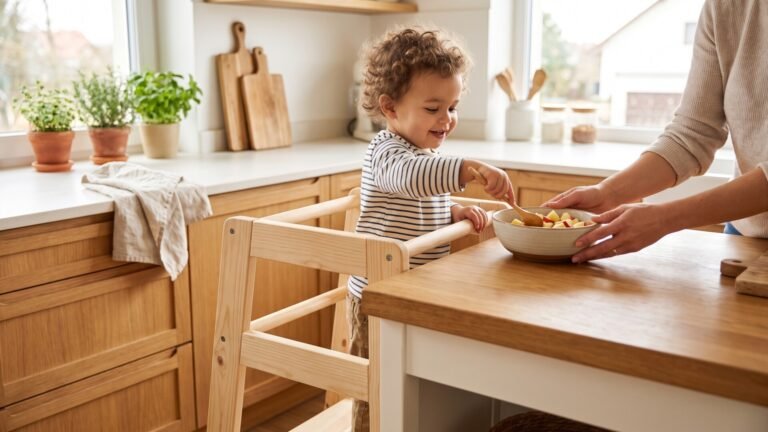
- Helping in the kitchen: Washing vegetables, spreading soft toppings or wiping the table with a child-sized cloth.
- Sorting by color or size: Large buttons, socks or blocks into muffin tin cups (avoid very small items if your child still mouths objects).
- Dressing practice: A frame with large buttons, zippers or snaps to practice self-care skills.
For more on these everyday tasks, see our guides to Montessori sensory toys for 1–3 year olds and Montessori kitchen helpers and learning towers.
The Value of Investing in Montessori Toys
Montessori-style toys are not cheap. A single wooden puzzle can cost more than a plastic alternative, and a quality play kitchen is a significant spend. That hesitation is reasonable.
The case for spending more is durability. Cheap toys tend to crack, lose pieces or stop working, while solid wood and quality materials often last through several children and can be passed on, donated or resold. Well-known brands such as Hape and Melissa & Doug tend to hold resale value better than mass-market plastic toys. Here is an illustrative example of cost-per-use: a $50 toy used twice a week for three years is used about 300 times, or roughly 17 cents per use, while a $10 toy that breaks after two uses costs $5 per use.
That said, price does not equal quality, and you do not need to buy everything on this list. If budget is tight, start with one puzzle, one pretend-play item and a few books, and combine them with the free activities above.
More Guides in This Series
- The 15 Best Montessori Toys for 2-Year-Olds (the previous age)
- Best Montessori Toys for 4-Year-Olds (the next age)
- Best Montessori Toys for 1-Year-Olds
- Top 7 Montessori-Style Sound Explorer Toys for Toddlers Under 3
- Montessori Toys for Toddlers (1–3 Years Old), the main guide for this age group
Where to Buy
You can find these toys at major retailers like Amazon, Target and Walmart, as well as specialty educational toy stores. Check the product links in this article for current pricing and availability.
[Affiliate: Shop Montessori Toys on Amazon]
[Affiliate: Browse Hape Toys Collection]
[Affiliate: Explore Melissa & Doug Puzzles]
Disclosure: some links on this page are affiliate links. If you buy through them, we may earn a commission at no extra cost to you. Prices and specifications are approximate and can change, so confirm on the retailer’s page.
Final Thoughts
More toys do not mean more learning. The right toys, used in the right environment, create conditions for hands-on exploration and concentration. The best Montessori-style toy isn’t the most expensive or most popular; it is the one your child returns to again and again.
Every child is different. Some three-year-olds love puzzles, while others prefer building or pretend play, and the Montessori approach honors those differences by letting children follow their own interests at their own pace.
No toy is magic, and none can guarantee a particular outcome. But thoughtfully chosen toys can support independent thinking, problem-solving and a love of learning, which is worth far more than any price tag.
Frequently Asked Questions About Best Educational Montessori Toys For 3 Year Olds
What are Montessori toys?
Montessori toys support hands-on learning based on the principles of Maria Montessori. They are often made from natural materials, have a clear purpose, and allow children to self-correct without adult intervention. ‘Montessori’ is not a protected certification, so judge each toy by how it works.
How do I choose the right Montessori toy for my three-year-old?
Look for toys that match your child’s current abilities and interests while offering a small challenge. Observe what they are drawn to and favor hands-on, open-ended play over passive entertainment. Check the manufacturer’s age grade and small-part warnings.
Are Montessori toys worth the investment?
Often, but not always. Durable toys can be used across several years and children, which lowers the cost per use. You don’t need to buy everything: start with a few well-chosen toys and combine them with free, everyday activities.
Are magnetic blocks safe for three-year-olds?
Well-made sets with sealed magnets are designed for children of the stated age grade, but loose magnets are a serious swallowing hazard. Check the age grade, inspect pieces regularly, stop using damaged sets, and keep them away from younger siblings. See cpsc.gov for current guidance.
Can Montessori toys be used for children of other ages?
Many can. A shape sorter may be too simple for a five-year-old, but blocks and building sets grow with the child. Browse our guides for 2-year-olds and 4-year-olds for adjacent options.
How do Montessori toys differ from traditional toys?
Montessori-style toys emphasize independence, open-ended play and developmental learning rather than entertainment. They tend to rely on the child’s actions rather than lights and sounds.
Are electronic toys like LeapFrog Fridge Phonics Montessori?
Not traditionally. Montessori approaches favor hands-on, self-correcting materials, and a toy that speaks for the child does some of the work. Some families use electronic toys as occasional supplements alongside tracing letters and reading together.
Where can I buy high-quality Montessori toys?
Reputable toy retailers, specialty educational toy stores and brand websites are good places to start. Read age grades and reviews, and check for recalls before buying secondhand.