From One Piece to Twelve: The Montessori Puzzle Progression Guide
I remember the first time I handed my oldest a puzzle. She was barely a year old, and I’d bought this beautiful wooden shape sorter that I was convinced she’d love. She looked at it, picked up the triangle piece, and promptly put it in her mouth. Then she threw the rest across the room. I sat there wondering if I’d made a terrible mistake.
That was my first lesson in Montessori puzzle progression: you can’t skip steps. Just like you wouldn’t hand a toddler a chapter book, you shouldn’t expect them to master a twelve-piece puzzle before they’ve learned how a single piece fits into a frame. The journey from one piece to twelve is a beautiful, gradual process that mirrors how children’s brains actually develop.
The problem most parents face is simple: there are too many puzzle options, and the marketing rarely matches reality. A box says “ages 3+” but your three-year-old either finishes it in thirty seconds or gives up in frustration. You end up with a closet full of puzzles that don’t quite work, and you’re not sure what to buy next.
I wrote this guide to solve that exact problem. We’re going to walk through the Montessori puzzle progression step by step, from the simplest one-piece knob puzzles to the more complex twelve-piece floor puzzles. You’ll learn what to look for at each stage, which specific products actually deliver on their promises, and how to avoid the common mistakes I made along the way.
Whether you’re shopping on [Affiliate: Amazon], browsing [Affiliate: Melissa & Doug], or exploring specialty Montessori retailers, this guide will help you make confident choices. Let’s start with why puzzles matter so much in the first place.
The Science Behind Montessori Puzzles
Montessori education isn’t just about letting children play with expensive wooden toys. It’s a carefully designed approach that respects how children naturally learn. Puzzles fit into this philosophy perfectly because they offer something most toys don’t: a clear, achievable goal that the child can work toward independently.
When a child picks up a puzzle piece, they’re not just playing. They’re developing what occupational therapists call “fine motor precision.” That pincer grasp they use to pick up a knob? That’s the same movement they’ll use to hold a pencil later. The hand-eye coordination required to align a piece with its spot? That’s building neural pathways that support everything from writing to sports.
But the benefits go deeper than motor skills. Puzzles teach children something fundamental about problem-solving: you try something, it doesn’t work, and you try again. That process of trial and error builds what psychologists call “executive function”—the ability to plan, focus attention, and regulate emotions. I’ve watched my own kids go from throwing pieces in frustration to calmly rotating a piece until it fits. That transformation doesn’t happen overnight, but it happens reliably when you provide the right challenges at the right time.
Spatial awareness is another hidden benefit. When a child looks at a puzzle piece and mentally rotates it to see if it will fit, they’re practicing geometry at a level that’s appropriate for their age. Research from the American Academy of Pediatrics suggests that early spatial reasoning skills are strong predictors of later success in STEM fields. Not that you need to worry about that now—just know that every puzzle session is building a foundation.
The Montessori method emphasizes something called “control of error.” In a well-designed puzzle, the child can see immediately whether a piece fits. They don’t need an adult to tell them they’re wrong. That self-correction is incredibly empowering for young children. It teaches them that mistakes are just data, not failures.
Current trends show a growing interest in Montessori materials among mainstream parents. I think that’s a good thing, but it also means there’s a lot of stuff marketed as “Montessori” that doesn’t meet the actual standards. Real Montessori puzzles are made from natural materials, have a single clear purpose, and allow the child to work independently. They’re not noisy, flashy, or covered in cartoon characters. They trust the child to find the activity engaging on its own terms.
What Makes a Puzzle Truly Montessori?
Let me clarify something I wish someone had told me early on: not every wooden puzzle is a Montessori puzzle. The term “Montessori” has been so overused by marketers that it’s almost lost its meaning. But there are specific characteristics that define authentic Montessori puzzles.
First, the materials matter. Authentic Montessori puzzles are typically made from natural wood, finished with non-toxic paints or stains. The pieces are substantial enough for small hands to grasp, but not so heavy that they’re dangerous. The textures are smooth, the edges are rounded, and everything feels deliberate.
Second, the design follows a principle called “isolation of difficulty.” This means the puzzle teaches one skill at a time. A one-piece knob puzzle teaches the concept of fitting a piece into a frame. A two-piece puzzle adds the skill of matching two similar pieces. A four-piece puzzle introduces sequencing. Each step builds on the previous one without overwhelming the child.
Third, Montessori puzzles are self-correcting. The child can see whether a piece fits without needing adult validation. This might sound simple, but it’s actually quite sophisticated. The puzzle itself provides feedback, which keeps the child engaged and motivated.
There are different types of Montessori puzzles you’ll encounter:
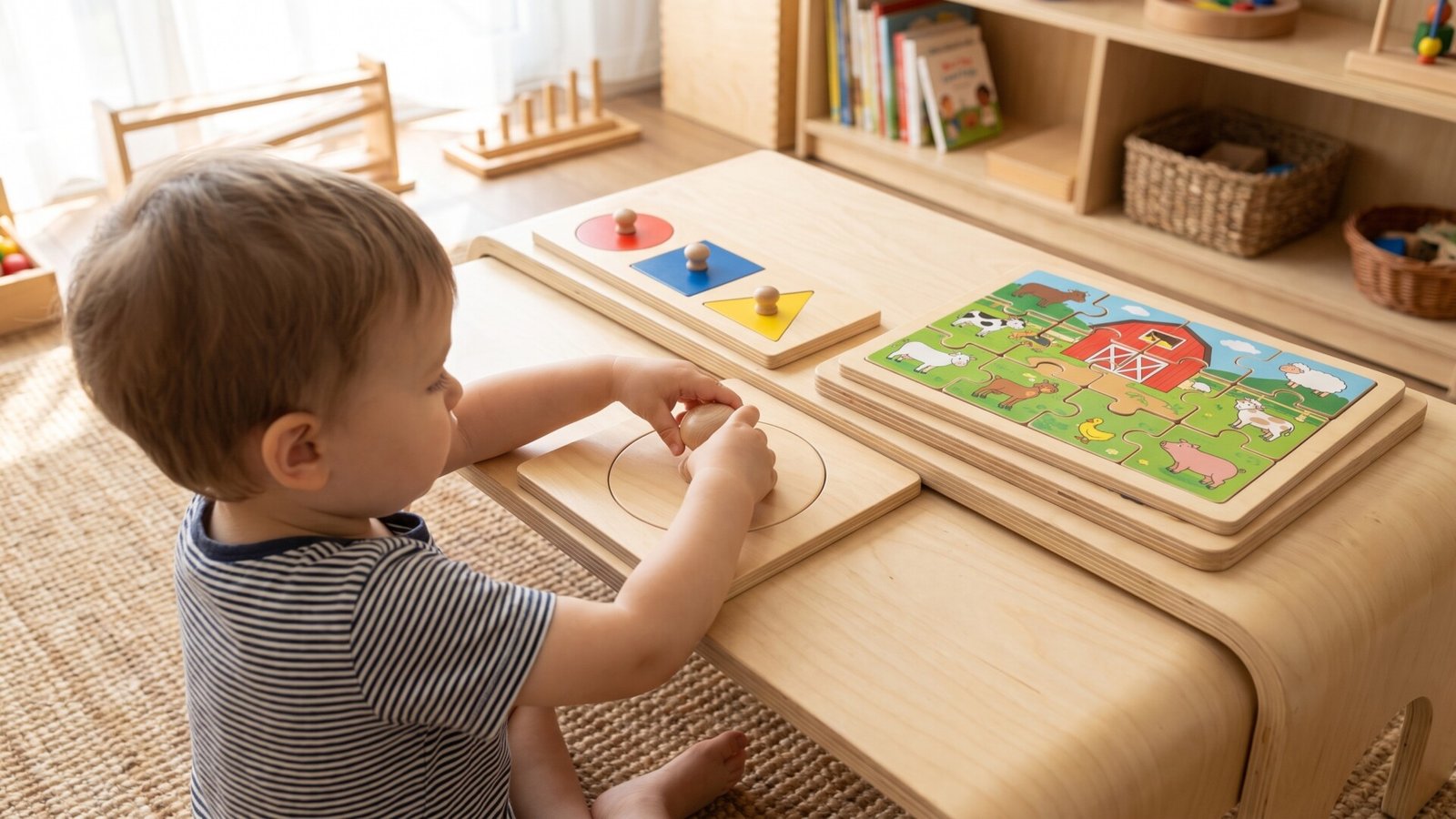
- Knob puzzles: These have a small knob on each piece, making them easy for toddlers to grasp. They’re the starting point for most children.
- Frame puzzles: The pieces fit into a tray or frame that provides visual boundaries. These are common for two-to-six-piece puzzles.
- Floor puzzles: Larger puzzles meant to be assembled on the floor. These often have more pieces and are designed for older preschoolers.
- Thematic puzzles: Puzzles organized around a theme like animals, transportation, or seasons. These add an element of storytelling to the activity.
The piece count is important, but it’s not the only factor. A well-designed two-piece puzzle can be more challenging than a poorly designed four-piece puzzle. The key is finding puzzles that match your child’s current developmental stage, not just their age.
What to Look for When Buying Montessori Puzzles
I’ve made every mistake you can imagine when buying puzzles. I’ve bought puzzles that were too advanced, too simple, too fragile, and too expensive. Here’s what I wish I’d known from the beginning.
Safety comes first. Check that the puzzle is made from non-toxic materials. Look for certifications like ASTM or CE marking. Avoid puzzles with small pieces that could be choking hazards for children under three. The knobs on knob puzzles should be securely attached—I’ve had one come loose before, and it was terrifying.
Durability matters more than you think. Wooden puzzles from brands like [Affiliate: Melissa & Doug] and [Affiliate: Hape] can survive being dropped, stepped on, and occasionally chewed. Cardboard puzzles from Ravensburger are surprisingly durable, but they won’t survive a toddler’s teething phase. If you have a child who puts everything in their mouth, stick with wood.
Age appropriateness isn’t just a suggestion. I know it’s tempting to buy a puzzle that’s “ahead” of your child’s age, thinking it will challenge them. But puzzles that are too difficult lead to frustration, not learning. A child who can’t complete a puzzle will either give up or ask for help, which defeats the purpose of independent play. Trust the age ranges on the box, and if anything, buy slightly below your child’s age.
Educational value varies widely. Some puzzles teach specific skills like shape recognition, letter identification, or counting. Others are purely about the satisfaction of completing a picture. Both have value, but you should know what you’re getting. A puzzle that teaches something specific is great for focused learning sessions. A picture puzzle is better for relaxation and persistence.
Ease of use is often overlooked. Can your child actually manipulate the pieces? Are the knobs large enough for their hands? Does the puzzle have a frame that keeps pieces in place? I’ve bought puzzles where the pieces were so snug that even I struggled to fit them. That’s not a puzzle; that’s a frustration device.
Storage matters more than you expect. Puzzles with trays are easier to store than loose-piece puzzles. If you have limited space, look for puzzles that come with a storage box or bag. I’ve lost more puzzle pieces to “the void” than I care to admit.
Maintenance is simple but necessary. Wooden puzzles can be wiped with a damp cloth. Cardboard puzzles should be kept dry. Avoid leaving puzzles in direct sunlight, which can warp wood or fade colors. With proper care, a good wooden puzzle can last through multiple children.
The Pros and Cons of Montessori Puzzles
Let me be honest: Montessori puzzles aren’t perfect. They have real drawbacks that parents should know about before investing.
Pros:
The cognitive development benefits are substantial. Children who regularly work with puzzles show improved problem-solving skills, better spatial awareness, and stronger fine motor control. These aren’t abstract benefits—you’ll see them in how your child approaches other challenges.
Independent play is one of the biggest wins. A good puzzle can keep a child engaged for fifteen to thirty minutes, sometimes longer. That’s a gift to both of you. You can fold laundry, make dinner, or just sit and watch them work.
The variety is impressive. You can find puzzles that teach letters, numbers, animals, geography, and dozens of other topics. This makes puzzles a versatile tool for learning across multiple domains.
Cons:
Some puzzles are genuinely too challenging for younger children. I’ve seen three-year-olds burst into tears over a twelve-piece puzzle that was marketed for their age. The frustration is real, and it can turn children off puzzles entirely if you push too hard.
Lost pieces are inevitable. I don’t care how organized you are—pieces will disappear. Under the couch, in the dog’s mouth, in a toy bin never to be seen again. Once a piece is gone, the puzzle becomes a source of frustration rather than satisfaction.
The initial investment is higher than you might expect. A quality wooden puzzle costs $15 to $30. If you’re building a full progression from one piece to twelve, you could easily spend $100 or more. That’s a real consideration for many families.
The Montessori Puzzle Progression: Product Recommendations
Now we get to the heart of this guide. I’ve tested dozens of puzzles with my own children and with friends’ kids. These are the ones that actually work at each stage of development.
One-Piece Puzzles: The Foundation
Product Name: Melissa & Doug First Shapes Jumbo Knob Puzzle
| Feature | Details |
|---|---|
| Age Range | 1-3 years |
| Key Features | Large knobs, vibrant colors, chunky pieces |
| Price | $14.99 |
| Affiliate Program | Melissa & Doug |
Why We Like It: This is the puzzle I recommend to every parent of a one-year-old. The knobs are large enough for tiny hands to grasp, and the pieces are thick enough that they won’t break if dropped. The colors are bright and engaging without being overwhelming.
Best For: Toddlers just beginning their puzzle journey. If your child has never done a puzzle before, start here.
Pros: Durable, easy to grasp, teaches basic shape recognition.
Cons: Limited complexity—your child will outgrow it within a few months.
I’ll never forget watching my youngest figure this out. She picked up the circle piece, looked at the frame, and just sat there for a full minute. Then she slowly, carefully placed it in the correct spot. The look on her face was pure joy. That’s the moment you’re buying when you get this puzzle.
[Affiliate: Check current pricing and availability for the Melissa & Doug First Shapes Jumbo Knob Puzzle]
Two-Piece Puzzles: Building Connections
Product Name: Hape Alphabet Puzzle
| Feature | Details |
|---|---|
| Age Range | 2-4 years |
| Key Features | Engaging letters, colorful design, wooden construction |
| Price | $19.99 |
| Affiliate Program | Hape |
Why We Like It: This puzzle does double duty. It teaches letter recognition while also building puzzle skills. Each letter is a two-piece puzzle that the child must match correctly. The pieces are large enough to be safe but small enough to feel like a real challenge.
Best For: Early learners focusing on language skills. This is perfect for the child who is starting to show interest in letters.
Pros: Encourages letter familiarity, durable wooden construction, self-correcting design.
Cons: Fewer pieces may limit engagement for some children.
The Hape Alphabet Puzzle was a game-changer in our house. My daughter spent hours matching letters, and by the time she was three, she could recognize every letter of the alphabet. The puzzle made it feel like play, not work.
[Affiliate: Check current pricing and availability for the Hape Alphabet Puzzle]
Three-Piece Puzzles: Introducing Themes
Product Name: GOKI Three-Part Puzzle Animals
| Feature | Details |
|---|---|
| Age Range | 2-4 years |
| Key Features | Realistic images, sturdy construction, animal themes |
| Price | $12.99 |
| Affiliate Program | GOKI |
Why We Like It: GOKI’s three-piece puzzles are beautifully illustrated with realistic animal images. Each puzzle shows a different animal in its natural habitat, which opens up conversations about nature and wildlife.
Best For: Curious toddlers who love animals and are ready for a slightly more complex challenge.
Pros: Educational, fun, realistic images that spark conversation.
Cons: Limited to animal themes, so you may need multiple sets for variety.
These puzzles are small enough to take on car trips or to restaurants. I’ve pulled them out during countless waiting-room visits. They’re also great for siblings to work on together.
[Affiliate: Check current pricing and availability for the GOKI Three-Part Puzzle Animals]
Four to Six-Piece Puzzles: Increasing Complexity
Product Name: Janod Forest Animals Puzzle
| Feature | Details |
|---|---|
| Age Range | 3-5 years |
| Key Features | Interactive pieces with varying shapes, forest theme |
| Price | $24.99 |
| Affiliate Program | Janod |
Why We Like It: This puzzle introduces the concept of pieces that aren’t all the same shape. Some pieces are animals, some are trees, some are the background. This forces the child to think about how different shapes fit together to form a whole picture.
Best For: Kids ready for more challenges. If your child has mastered three-piece puzzles, this is the next step.
Pros: Promotes critical thinking, beautiful artwork, durable construction.
Cons: Smaller pieces can be easy to misplace.
The Janod Forest Animals Puzzle was the first puzzle that really challenged my oldest. She spent a whole afternoon working on it, and when she finished, she insisted we leave it assembled on the coffee table for a week.
[Affiliate: Check current pricing and availability for the Janod Forest Animals Puzzle]
Seven to Twelve-Piece Puzzles: The Transition
Product Name: Ravensburger My First Puzzle
| Feature | Details |
|---|---|
| Age Range | 3-6 years |
| Key Features | Large pieces, colorful images, multiple scenes |
| Price | $21.99 |
| Affiliate Program | Ravensburger |
Why We Like It: Ravensburger is known for high-quality puzzles, and their My First series is no exception. The pieces are large and easy to handle, and the images are engaging without being distracting.
Best For: Preschoolers transitioning to more advanced puzzles. This is the bridge between simple puzzles and the more complex ones they’ll do later.
Pros: High-quality, durable, multiple scenes in one set.
Cons: May be challenging for younger children.
What I love about this set is that it includes multiple puzzles with different piece counts. Your child can start with the easier ones and work their way up. It’s like having a built-in progression.
[Affiliate: Check current pricing and availability for the Ravensburger My First Puzzle]
Twelve-Piece Puzzles: The Milestone
Product Name: Melissa & Doug Farm Friends Puzzle
| Feature | Details |
|---|---|
| Age Range | 4-6 years |
| Key Features | 12 pieces, vibrant farm theme, large pieces |
| Price | $25.99 |
| Affiliate Program | Melissa & Doug |
Why We Like It: This is the puzzle that marks the transition from “beginner” to “intermediate.” Twelve pieces is a significant challenge for most four-year-olds, but the farm theme keeps them engaged. The pieces are large enough to be manageable, and the image is clear enough that children can use visual cues to find the right spots.
Best For: Children ready for a challenge. If your child can complete six-piece puzzles independently, this is the next milestone.
Pros: Engaging theme, promotes critical thinking, durable construction.
Cons: Complexity may frustrate some younger kids.
I’ll never forget the day my daughter finished this puzzle for the first time. She had been working on it for three days, coming back to it again and again. When she placed that final piece, she jumped up and yelled, “I did it!” That feeling of accomplishment is what Montessori puzzles are all about.
[Affiliate: Check current pricing and availability for the Melissa & Doug Farm Friends Puzzle]
Comparison Table
| Product Name | Age Range | Durability | Educational Value | Price Range | Best For |
|---|---|---|---|---|---|
| Melissa & Doug First Shapes Puzzle | 1-3 years | High | Shape Recognition | $14.99 | Toddlers |
| Hape Alphabet Puzzle | 2-4 years | High | Language Skills | $19.99 | Early Learners |
| GOKI Three-Part Puzzle Animals | 2-4 years | Medium | Animal Recognition | $12.99 | Curious Toddlers |
| Janod Forest Animals Puzzle | 3-5 years | High | Critical Thinking | $24.99 | Kids Ready for More |
| Ravensburger My First Puzzle | 3-6 years | High | Engagement | $21.99 | Preschoolers |
| Melissa & Doug Farm Friends Puzzle | 4-6 years | High | Problem Solving | $25.99 | Advanced Learners |
How to Choose the Right Puzzle for Your Child
Best for Toddlers (1-2 years): Start with the Melissa & Doug First Shapes Jumbo Knob Puzzle. It’s the safest, most accessible option for children who are just discovering puzzles. The large knobs make it easy for tiny hands, and the simple shapes teach the basic concept of fitting pieces into a frame.
Best for Early Language Development (2-3 years): The Hape Alphabet Puzzle is your best bet. It combines puzzle skills with letter recognition, giving your child a head start on literacy. The wooden construction ensures it will survive the rough handling that comes with this age.
Best for Problem-Solving Skills (3-4 years): The Janod Forest Animals Puzzle challenges children to think about how different shapes fit together. It’s perfect for kids who have mastered simpler puzzles and are ready for something more complex.
Best for Themed Learning (2-4 years): The GOKI Three-Part Puzzle Animals is ideal for children who love animals. The realistic images spark conversations about nature and wildlife, making it both educational and engaging.
Best for Transitioning to More Complex Puzzles (4-6 years): The Melissa & Doug Farm Friends Puzzle is the perfect next step after your child has mastered simpler puzzles. It’s challenging without being overwhelming, and the farm theme keeps kids engaged.
Our Long-Term Value Analysis
Here’s something most reviews won’t tell you: the cost per year of use varies dramatically between puzzles. A $15 puzzle that your child uses for six months costs $2.50 per month. A $25 puzzle that gets used for two years costs just over $1 per month. The most expensive puzzle isn’t always the worst value.
The Melissa & Doug puzzles tend to have the best longevity. They’re durable enough to survive multiple children, and the classic designs don’t go out of style. I’ve passed down puzzles from my oldest to my youngest without any issues.
The Ravensburger puzzles have excellent resale value. If you take care of them, you can often sell them for 50-70% of their original price. That’s not something you can say about most toys.
The Hape and Janod puzzles are the most likely to grow with your child. Their designs are sophisticated enough to remain interesting even as your child’s skills improve. A two-year-old might just match the letters, but a four-year-old can use the same puzzle to practice spelling.
Which Toy Actually Gets Used Six Months Later?
This is the question that matters most. I’ve seen too many expensive toys gather dust after the novelty wears off. Here’s the honest truth: the puzzles that get used long-term are the ones that match your child’s current skill level.
The Melissa & Doug First Shapes puzzle will get heavy use for about three to six months. After that, your child will outgrow it. That’s not a failure—it’s a sign of progress.
The Hape Alphabet Puzzle has a longer shelf life because it teaches a skill that takes years to master. Even after your child can recognize all the letters, they can use the puzzle to practice spelling simple words.
The Ravensburger My First Puzzle set has the best long-term value because it includes multiple difficulty levels. Your child can start with the easier puzzles and work their way up. This set can stay in rotation for a year or more.
The Hidden Downsides Parents Discover Later
I want to be transparent about something: puzzles create mess. Not the kind of mess that comes with art supplies, but the kind where pieces end up everywhere. You will step on puzzle pieces. You will find them in the couch cushions. You will lose sleep wondering where that one missing piece went.
Wooden puzzles can also be noisy. When a toddler dumps a tray of wooden pieces onto a hardwood floor, it sounds like a construction site. If you live in an apartment or have noise-sensitive family members, consider placing a rug or mat under the puzzle area.
Some children simply don’t like puzzles. I know that’s hard to hear, but it’s true. If your child shows no interest in puzzles, don’t force it. Try again in a few months. Some children prefer building, drawing, or imaginative play. That’s okay.
Conclusion
The journey from one piece to twelve is one of the most rewarding progressions in early childhood. Each milestone—the first piece that fits, the first completed puzzle, the first time they work independently—is a moment worth celebrating.
For most families, I recommend starting with the [Affiliate: Melissa & Doug First Shapes Jumbo Knob Puzzle] as your entry point. It’s affordable, durable, and perfectly matched to a toddler’s abilities. From there, follow the progression I’ve outlined, moving to two-piece puzzles when your child is ready, then three, then four to six, and finally seven to twelve.
If you’re looking for the best value, the [Affiliate: Ravensburger My First Puzzle] set offers multiple difficulty levels in one package. It’s the most cost-effective way to support your child’s growth over time.
And if you want the premium experience, the [Affiliate: Melissa & Doug Farm Friends Puzzle] is the gold standard for twelve-piece puzzles. It’s challenging, engaging, and built to last.
Remember, the goal isn’t perfection. Your child doesn’t need to master every puzzle on the first try. They don’t need to complete a puzzle in record time. What matters is the process—the trial and error, the persistence, the small victories that build confidence.
Frequently Asked Questions About Montessori Puzzle Progression Guide
What age is appropriate for starting with puzzles?
Puzzles can be introduced as early as 1 year old, with simple one-piece knob puzzles. At this age, the goal isnu2019t completionu2014itu2019s exploration. Let your child handle the pieces, put them in their mouth (if theyu2019re safe), and figure out what puzzles are all about. The actual skill of fitting pieces into frames usually develops between 18 months and 2 years.
How do I know if a puzzle is safe for my child?
Look for puzzles made from non-toxic materials. Check for certifications like ASTM or CE marking. For children under 3, avoid puzzles with small pieces that could be choking hazards. The knobs on knob puzzles should be securely attached. If youu2019re unsure, stick with reputable brands like Melissa u0026 Doug, Hape, or Ravensburger.
What are the benefits of Montessori puzzles?
Montessori puzzles encourage independent play, fine motor skills, and cognitive development. They teach problem-solving, spatial awareness, and persistence. The self-correcting nature of puzzles helps children learn from their mistakes without adult intervention, building confidence and independence.
How can I maintain my puzzles?
Most wooden puzzles can be wiped clean with a damp cloth. Avoid soaking them in water, which can warp the wood or loosen the paint. Cardboard puzzles should be kept dry and stored in a cool place. With proper care, a good wooden puzzle can last through multiple children.
What do I do if pieces get lost?
This happens to everyone. If you lose a piece, consider purchasing a puzzle with a similar theme or contacting the manufacturer for replacement pieces. Some brands offer individual replacement pieces, but most donu2019t. If the puzzle is incomplete, you can repurpose the remaining pieces for other activities like tracing or sorting.
Are puzzles suitable for multiple children?
Yes, puzzles can be a great shared activity, encouraging teamwork and collaborative play. Siblings can work together on a single puzzle, or each child can work on their own puzzle at their own level. Just be prepared for occasional disagreements over who gets to place the next piece.