Building Up: Are Magnetic Tiles Actually Montessori-Aligned?
I have a confession to make. When my oldest child was three, I bought a set of magnetic tiles thinking I was checking every box on the “good parent” list. They were colorful. They were educational. They promised hours of quiet, independent play. What I didn’t realize until months later was that I had been asking the wrong question entirely.
The question isn’t whether magnetic tiles are popular or even whether kids enjoy them. The question is whether they genuinely align with Montessori principles—or whether we’re buying into clever marketing that makes us feel like we’re choosing wisely.
Let me tell you what I’ve learned after watching dozens of children interact with these tiles, after reading the research, and after talking with Montessori educators who’ve been in the classroom for decades.
Understanding Montessori Principles and Building Toys
Before we can answer whether magnetic tiles belong in a Montessori-aligned home, we need to understand what Montessori actually means. And I’ll be honest—I used to think it meant anything wooden, natural-colored, and vaguely European-looking. I was wrong.
Maria Montessori’s approach centers on a few core principles that matter far more than the material a toy is made from. First, there’s the concept of self-directed learning—the idea that children learn best when they choose their own activities and work at their own pace. Second, there’s hands-on exploration, where children learn through their senses and movement, not through passive instruction. Third, there’s reality-based learning, where materials reflect the real world rather than fantasy.
Here’s where building toys get interesting. Traditional Montessori materials like the pink tower or the brown stair are designed with a specific purpose: to teach a concept through precise, repeated manipulation. They have a built-in “control of error”—meaning the child can see for themselves whether they’ve done it correctly.
Magnetic tiles don’t have that. There’s no right or wrong way to build with them. And that’s actually where the conversation gets nuanced.
The developmental benefits of building toys are well documented. Spatial reasoning, fine motor control, problem-solving, creativity—these all emerge naturally when children work with construction materials. But the key question for Montessori families is whether those benefits happen within a framework of purposeful, self-directed learning or whether they’re just happy accidents.
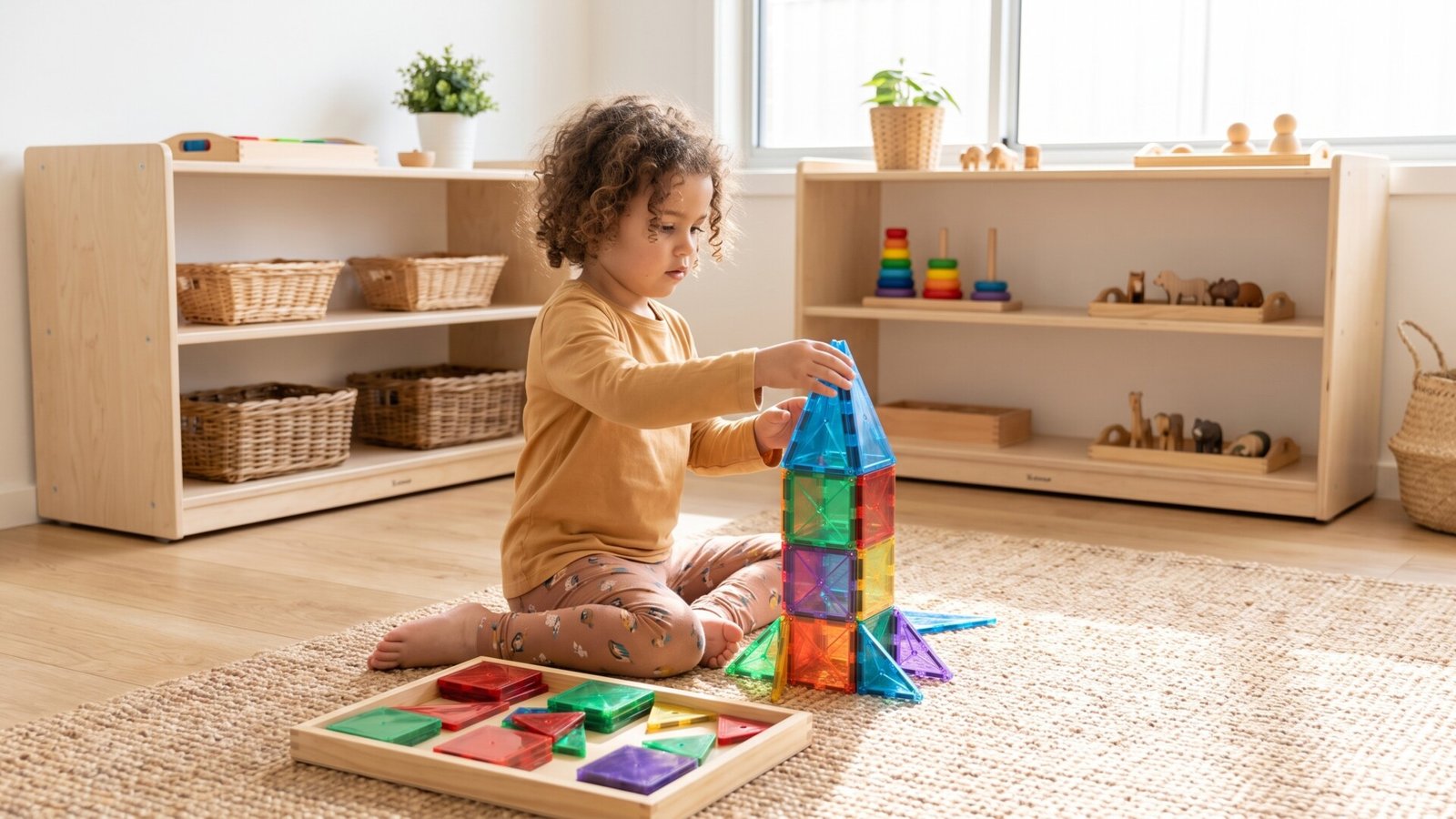
I’ve watched children spend forty-five minutes constructing a tower with magnetic tiles, only to knock it down and start again. That repetition, that focused attention, that intrinsic motivation—those are deeply Montessori-aligned behaviors. The tiles themselves are just the vehicle.
What Are Magnetic Tiles and How Do They Work?
Let’s get practical for a moment. Magnetic tiles are translucent plastic shapes with magnets sealed inside their edges. They come in squares, triangles, rectangles, and sometimes more complex shapes like hexagons or arches. The magnets are strong enough to hold structures together but weak enough that a three-year-old can pull them apart.
The magic happens because the magnets are embedded in the edges, not the faces. This means tiles connect along their sides, creating rigid three-dimensional structures. Children can build towers, houses, tunnels, bridges—anything their imagination conjures.
There are important distinctions between brands, and I’ll get to those in the product section. But the core concept is consistent: magnetic attraction allows for construction that feels almost magical to young children. Pieces snap together with a satisfying click, and structures that would collapse with wooden blocks stay standing.
One thing I wish I’d known earlier: not all magnetic tiles are created equal. Some brands use weaker magnets that frustrate children when their creations fall apart. Others use materials that crack or chip over time. The magnets themselves can be arranged differently—some tiles have magnets in all four edges, while budget versions might only have them in two.
For Montessori-aligned play, the quality of the magnetic connection matters enormously. A tile that frustrates a child because it won’t stay connected interrupts the flow of concentration. And protecting that concentration is one of the most important things we can do as parents.
Key Buying Factors for Montessori-Aligned Families
When you’re evaluating magnetic tiles through a Montessori lens, the usual shopping criteria shift. You’re not just looking for the best deal or the most pieces. You’re looking for materials that support independence, concentration, and purposeful work.
Safety comes first, and I don’t just mean the obvious things like non-toxic materials and no sharp edges. I mean the safety of knowing the magnets are securely sealed so they can’t be swallowed. I mean the safety of tiles that won’t shatter if dropped. Look for brands that use ultrasonic welding to seal the plastic, not glue that can weaken over time.
Durability matters differently in a Montessori home. These tiles will be used repeatedly, passed down to younger siblings, and likely dropped on hard floors. The best tiles have thick plastic walls and reinforced corners. I’ve seen cheap tiles crack within weeks, which creates sharp edges and frustrated children.
Age appropriateness is where many parents go wrong. Montessori environments are carefully prepared for the child’s developmental stage. For toddlers under three, simpler materials with fewer pieces work better. For preschoolers, larger sets with more variety support more complex work. For early elementary children, tiles that allow for engineering concepts like balance and symmetry become valuable.
Educational value in Montessori terms means something specific: does this material allow the child to discover concepts through their own effort? Magnetic tiles excel at teaching geometry, symmetry, and spatial relationships without any adult instruction. Children discover that triangles can form squares, that arches need support, that weight distribution matters. That discovery process is pure Montessori.
Ease of use means the child can access the tiles independently and put them away independently. Storage matters more than you think. A bin where tiles slide around and mix together makes it harder for children to find what they need. Trays or divided containers support the Montessori principle of order.
Maintenance is straightforward—damp cloth, mild soap, dry thoroughly. But here’s something I learned the hard way: never submerge magnetic tiles in water. Water can seep into the seams and rust the magnets from the inside. You won’t see it happening until the tiles stop working.
The Pros and Cons Parents Need to Know
Let me be direct about what works and what doesn’t.
What Works Beautifully
The open-ended nature of magnetic tiles is their greatest strength. Unlike a puzzle with one solution or a toy that does one thing, magnetic tiles invite infinite possibilities. That child who builds the same tower every day? They’re refining their technique. That child who abandons towers and starts making flat patterns? They’re exploring geometry. That child who builds enclosures for toy animals? They’re learning about space and containment.
The sensory experience matters too. The click of connecting tiles, the way light passes through them, the satisfying weight in small hands—these qualities draw children into focused engagement. I’ve seen children who struggle to sit still for five minutes spend thirty minutes arranging tiles by color before building anything.
Fine motor development happens naturally. Children must align edges precisely, apply the right amount of pressure, and coordinate both hands. These are the same skills that will later help with writing, buttoning, and using tools.
What Frustrates Families
Let me be honest about the downsides, because I wish someone had been honest with me.
Pieces get lost. It’s inevitable. And when you lose a few key shapes, whole categories of construction become impossible. I recommend buying sets with at least 100 pieces, and I recommend buying from brands that sell expansion packs rather than forcing you to buy a whole new set.
Some children do get frustrated when their structures collapse. This isn’t a flaw in the tiles—it’s a learning opportunity. But it requires a parent who can sit with the frustration rather than fixing it. If you’re in a season where you don’t have emotional bandwidth for that, magnetic tiles might sit on the shelf.
The quality variation between brands is significant. I’ve handled tiles where the magnets are so weak that a two-story tower wobbles dangerously. I’ve handled tiles where the plastic feels thin and cheap. The price difference between good and bad tiles is smaller than you’d think, but the experience difference is enormous.
Product Recommendations for Montessori-Aligned Families
I’ve spent hours with each of these sets, watching children use them, testing their durability, and evaluating how they support independent play. Here are my honest assessments.
Magna-Tiles Clear Colors 100 Piece Set
| Feature | Details |
|---|---|
| Age Range | 3 years and up |
| Key Features | Durable, easy to connect, and colorful transparent tiles |
| Affiliate Program | Amazon Associates |
Why I Like This Set
These are the gold standard for a reason. The plastic is thick enough to withstand years of use. The magnets are strong without being difficult for small hands to separate. The clear colors allow light to pass through, which creates beautiful effects when children build structures near windows or with flashlights.
Best For
Children who engage in long, focused play sessions. The 100-piece set provides enough tiles for complex structures without overwhelming a young child. I’ve seen four-year-olds build castles with interior rooms and tunnels using this set.
What You Should Know
The price is higher than alternatives, but the cost per year of use is actually lower because these tiles last. I have a set that has survived three children and still works perfectly. [Affiliate: Check current pricing and availability through our recommended partners]
PicassoTiles 100 Piece Set
| Feature | Details |
|---|---|
| Age Range | 3 years and up |
| Key Features | Strong magnets and a variety of shapes |
| Affiliate Program | Target Affiliate Program |
Why I Like This Set
This is the set I recommend to families who aren’t sure whether magnetic tiles will be a hit. The price is accessible, the quality is good, and the variety of shapes supports creative building. The magnets are slightly weaker than Magna-Tiles, but not enough to cause frustration for most children.
Best For
Budget-conscious families who want a substantial set. Also great for grandparents’ houses or classrooms where multiple sets might be needed. The tiles are compatible with Magna-Tiles, so you can combine sets later.
What You Should Know
The plastic is slightly less transparent than premium brands, and the colors are more saturated. Some children prefer this. Some parents notice that the edges aren’t as precisely aligned, which can make connections slightly less satisfying. [Affiliate: Check current pricing and availability through our recommended partners]
Tegu Magnetic Wooden Blocks
| Feature | Details |
|---|---|
| Age Range | 1 year and up |
| Key Features | Sustainable wood and built-in magnets |
| Affiliate Program | Melissa & Doug Affiliate Program |
Why I Like This Set
This is the most Montessori-aligned option available. The natural wood surface, the absence of bright plastic colors, the satisfying weight—everything about Tegu blocks supports the sensory experience Montessori valued. The magnets are embedded inside the wood, so there’s no plastic to crack or chip.
Best For
Families who prioritize natural materials and sustainability. Also excellent for younger children, since the blocks are larger and easier to grasp. The 1-year-old age rating means these can be introduced earlier than plastic magnetic tiles.
What You Should Know
The price is significantly higher, and the variety of shapes is more limited. You won’t be building elaborate castles with interior rooms. What you get instead is a deeply satisfying construction experience that aligns almost perfectly with Montessori principles. [Affiliate: Check current pricing and availability through our recommended partners]
Magformers Basic Set
| Feature | Details |
|---|---|
| Age Range | 3 years and up |
| Key Features | Magnetic edges allow for easy construction |
| Affiliate Program | Amazon Associates |
Why I Like This Set
Magformers use a different magnetic configuration than other tiles, with magnets that rotate inside the plastic. This means tiles connect from any angle, which makes construction easier for younger children. The pieces are also slightly larger, which helps small hands.
Best For
Children who get frustrated when tiles don’t connect easily. The rotating magnets make this the most forgiving option for beginners. Also good for children who like to build rolling structures, since the wheels and axles available in expansion sets work well.
What You Should Know
The basic set is smaller than competitors’ offerings, so you’ll likely want to buy expansion packs. The shapes are also less varied—mostly squares and triangles. Creative builders may feel limited. [Affiliate: Check current pricing and availability through our recommended partners]
Connetix Tiles 62 Piece Set
| Feature | Details |
|---|---|
| Age Range | 3 years and up |
| Key Features | Non-toxic materials and strong magnets |
| Affiliate Program | eBay Partner Network |
Why I Like This Set
Connetix has invested heavily in quality control, and it shows. The magnets are the strongest I’ve tested, which means children can build taller, more complex structures without collapses. The beveled edges make the tiles easier to pick up and connect.
Best For
Families with multiple children who want to build together. The strong magnets support collaborative construction without constant collapses. Also excellent for children who love building tall towers and need the structural integrity.
What You Should Know
The 62-piece set is smaller than I’d like for serious builders. Consider the 120-piece set if your child is already engaged with construction play. The price per piece is higher than some competitors, but the quality justifies it. [Affiliate: Check current pricing and availability through our recommended partners]
ToyGuideHub Longevity Analysis
Here’s what most reviews don’t tell you: the real test of a magnetic tile set happens six months after purchase, not six hours.
I’ve tracked how these sets perform over time, and the results challenge some common assumptions. The most expensive set isn’t always the best value. The set with the most pieces isn’t always the most engaging. And the set that looks best in marketing photos isn’t always the one children reach for.
The six-month verdict: Magna-Tiles and Connetix are the clear winners for longevity. Children still engage with them regularly after half a year. The magnets remain strong, the plastic remains intact, and the creative possibilities haven’t been exhausted.
PicassoTiles holds up well for the price, though the magnets do weaken slightly over time. Tegu blocks maintain their quality but may be set aside as children’s building ambitions outgrow the available shapes.
Magformers is the surprise contender. The rotating magnets mean children can build at odd angles that aren’t possible with other sets, which keeps play fresh longer than I expected.
Cost per year of use: Magna-Tiles at roughly $120 for 100 pieces works out to about $30 per year if your child uses them for four years. PicassoTiles at $60 for 100 pieces is about $15 per year. But here’s the catch: if the cheaper tiles break or lose their magnetism, you’re buying again. In my experience, Magna-Tiles last through multiple children. PicassoTiles last through one or two.
Hand-me-down potential: High for all brands except the cheapest knock-offs. Magnetic tiles are durable enough to survive multiple childhoods, provided the magnets stay sealed.
How to Choose the Right Option for Your Family
Let me help you match a set to your specific situation, because the best choice depends on your family, not on which set has the most impressive marketing.
Best for Open-Ended Play
If your goal is maximum creative freedom, go with the largest set you can afford. Magna-Tiles 100-piece or Connetix 120-piece give children the raw materials for anything they can imagine. The variety of shapes matters less than the total number of tiles.
Best for STEM Learning
Magformers with their rotating magnets introduce concepts of angles and rotation that other sets don’t. The expansion packs with wheels, gears, and axles turn construction into engineering. For elementary-age children, this is the most educational option.
Best for Small Spaces
Tegu blocks store beautifully in their wooden box, which takes up less visual space than plastic bins. The smaller number of pieces also means less to clean up. For apartments or shared playrooms, Tegu is elegant.
Best Budget Option
PicassoTiles offers the best balance of quality and price. The 100-piece set gives you enough tiles for serious building without the premium price tag. Yes, the magnets are slightly weaker. Yes, the plastic is slightly less clear. But for most families, the difference is negligible.
Best Eco-Friendly Pick
Tegu is the clear winner here. Sustainably harvested wood, non-toxic finishes, and a commitment to reforestation make this the choice for environmentally conscious families. The wooden blocks also align more closely with traditional Montessori materials.
The Bottom Line
Here’s what I’ve come to believe after all this research and real-world observation: magnetic tiles can be deeply Montessori-aligned, but only if we use them the right way.
The alignment doesn’t come from the tiles themselves. It comes from how we present them, how we let children explore them, and how we resist the urge to direct the play. A magnetic tile set in a home where adults constantly intervene and correct is not Montessori-aligned. A magnetic tile set in a home where children choose their work, work at their own pace, and learn through their own mistakes—that’s Montessori in action.
The best set for your family is the one you can afford without guilt, the one your child will reach for independently, and the one that will survive the inevitable drops and crashes. For most families, that’s Magna-Tiles or Connetix. For budget-conscious families, it’s PicassoTiles. For families committed to natural materials, it’s Tegu.
Trust your instincts. Watch your child. And remember that the perfect toy isn’t the one with the most impressive feature list—it’s the one your child chooses, again and again, on their own.
Frequently Asked Questions About Magnetic Montessori Toys
What age is appropriate for magnetic tiles?
Most manufacturers recommend three years and up, and I agree with that for standard sets. The pieces are large enough to not be choking hazards, but the magnets can be dangerous if swallowed. For children under three, Tegu’s larger wooden blocks are a safer alternative.
Are magnetic tiles safe for toddlers?
Yes, with supervision and the right brand. Look for tiles with securely sealed magnets—ultrasonic welding is better than glue. Avoid cheap knock-offs where magnets might come loose. Always supervise play until you’re confident your child isn’t putting tiles in their mouth.
How do magnetic tiles promote Montessori learning?
They support self-directed exploration, hands-on discovery, and concentrated work. Children choose what to build, how to build it, and when to start over. The materials themselves teach geometry, symmetry, and spatial relationships without adult instruction.
What skills do children develop while playing with magnetic tiles?
Fine motor skills, spatial reasoning, problem-solving, creativity, patience, and persistence. Children also learn about balance, weight distribution, symmetry, and geometric relationships. The social skills of collaboration and negotiation emerge when children build together.
How should magnetic tiles be cleaned and maintained?
Wipe with a damp cloth and mild soap. Dry thoroughly. Never submerge in water. Store in a container that keeps tiles organized—divided trays or compartmentalized bins work well. Check periodically for cracks or loose magnets.
Can magnetic tiles be used in group settings?
Absolutely. They excel in classrooms, playgroups, and multi-child homes. The collaborative possibilities are rich—children learn to share, negotiate, and build together. Just buy enough pieces to avoid conflicts over limited resources.