Barbie Dreamhouse 2026 Review: Is the Newest Smart-House Worth $200?
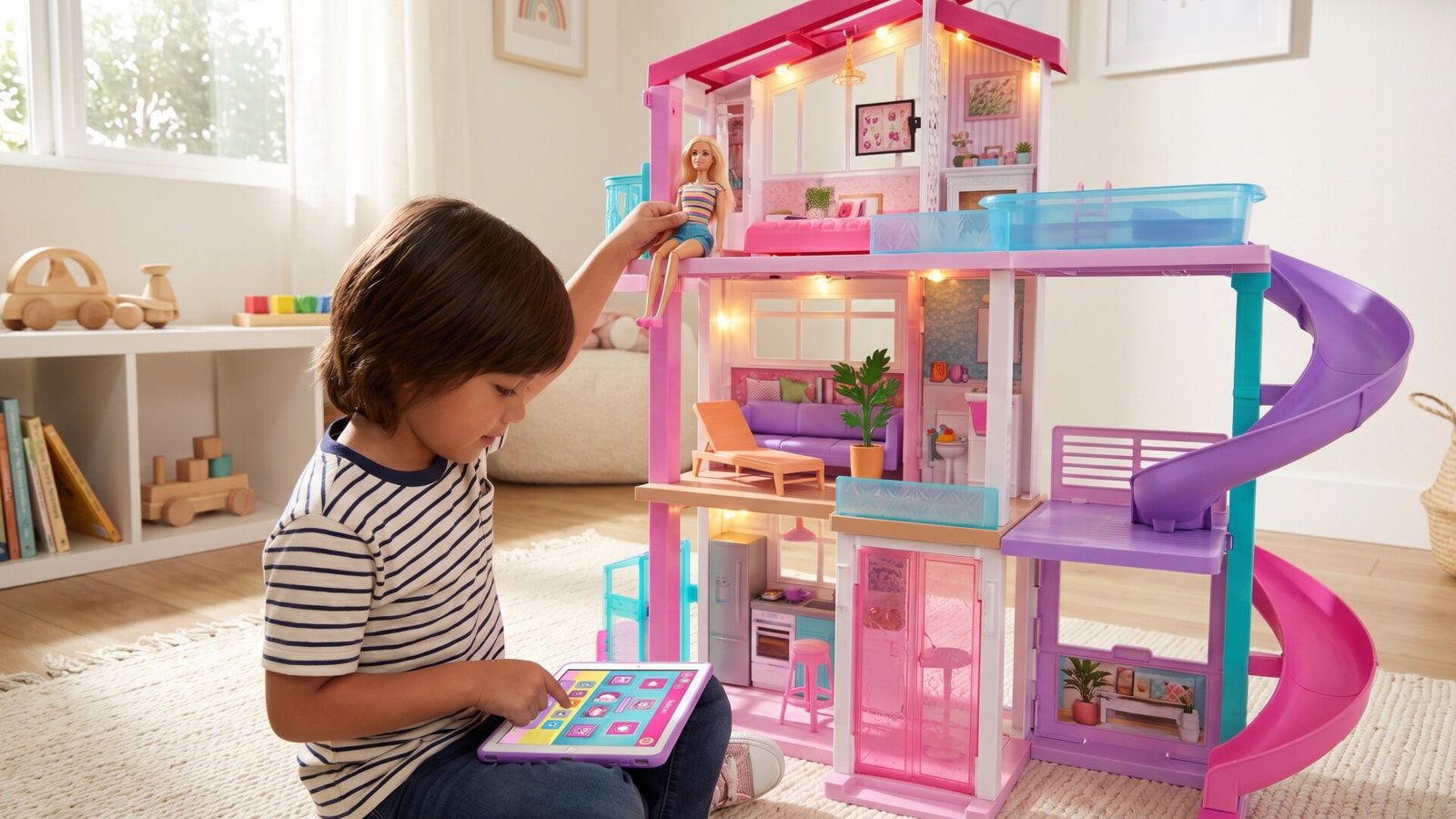
The 2026 Dreamhouse is, at first glance, unmistakably Barbie. It stands over three feet tall, spans multiple levels, and comes in the signature pink, turquoise, and purple colour scheme. But look closer, and you’ll notice the details that set this edition apart.
Size and rooms: The house measures approximately 40 inches tall, 30 inches wide, and 10 inches deep when fully assembled. It includes seven distinct rooms: a living room, kitchen, dining area, bedroom, bathroom, rooftop pool, and a new “media room” with a flat‑screen panel that syncs with the app. There’s also a working elevator (motorised this time), a spiral slide from the second floor, and a balcony with a telescope.
Included accessories and dolls: The box comes with one articulated Barbie doll (with bendable knees and elbows), a small pet dog, and over 30 accessories – plates, cups, a laptop, a hairbrush, towels, and a pool float. Notably, no Ken doll or additional characters are included.
Smart features: This is the headline. The Dreamhouse has built‑in LEDs in the ceiling, walls, and furniture. There are motion sensors in the kitchen, bathroom, and media room. A free smartphone/tablet app (iOS and Android) connects via Bluetooth and allows your child to control lights, play pre‑recorded sounds (a sizzling pan, a flushing toilet, a party beat), and trigger “surprise” events like a disco light show in the media room.
Comparison with previous editions: The 2020 Dreamhouse ($150) had five rooms, a manual elevator, and no electronics. The 2025 model ($180) added push‑button lights and a few sounds but no app. The 2026 version is a clear leap forward in interactivity – but also a $20–$50 price jump.
Target audience: Barbie Dreamhouse is officially for ages 3–10. In practice, the smart features appeal most to children aged 5–8. Younger kids may need help with the app, and older collectors might appreciate the display value.
Assembly: The box includes several plastic panels, stickers, and a 40‑page instruction booklet. Plan for 60–90 minutes of adult assembly. All tools are included, but you’ll need two AA batteries for the elevator and three AAA batteries for the lights and sounds (not included). The app connection requires a smartphone or tablet.
Check 2026 Barbie Dreamhouse on Amazon →
Key Features and Innovations
The 2026 Dreamhouse isn’t just a dollhouse with lights glued on. The smart technology is thoughtfully integrated into the play experience.
Smart Technology – App Integration
The free Barbie Dreamhouse app is surprisingly polished. After pairing (a simple Bluetooth process), the app presents a virtual map of the house. Tap the kitchen icon, and the real‑life kitchen lights turn on while the app plays a sizzling sound. Tap the “Party” button, and the media room flashes rainbow colours while a dance beat plays. There’s even a “Day/Night” mode that dims the lights and plays a gentle “goodnight” message.
The app also includes a few simple games – “Find the hidden accessory” uses the motion sensors to tell your child which room an item is hidden in. While not groundbreaking, these features extend the play value beyond simple dollhouse roleplay.
Interactive Rooms
- Kitchen: A motion sensor above the stove triggers a sizzle sound and turns on a glowing red burner when a hand or doll passes by. The refrigerator has a light inside that turns on when opened.
- Media room: The highlight. A flat‑screen panel (non‑functioning as a display, but it lights up) connects to the app for colour shows. The couch has two sensors – when two dolls sit together, the app plays a “movie night” sound clip.
- Bathroom: The toilet makes a flushing sound when the lid is lifted. The shower head lights up blue when pressed.
- Elevator: Fully motorised. Press a button on the side, and the platform moves between the first and second floors. It’s slow enough to be safe but fast enough to keep play moving.
- Rooftop pool: No electronics, but it has a working slide that drops dolls into the pool below.
Durability & Materials
The plastic is high‑quality ABS – sturdy, with no sharp edges. The panels click together firmly; the house doesn’t wobble during play. However, the thin plastic tabs that hold the balcony railing in place can snap if a child leans on them. The stickers (for the TV screen and artwork) are the weakest point – they may peel after a few months.
Expandability
The Dreamhouse is fully compatible with all standard Barbie dolls, furniture packs, and vehicles. You can add the Barbie Dreamcamper or the Extra Furniture Sets to fill out the rooms. The smart features are limited to the house itself, though.
Play Value
Children engage with the 2026 Dreamhouse on two levels. First, the traditional roleplay: cooking, sleeping, hosting parties. Second, the interactive layer: experimenting with the app, discovering which sensors trigger which sounds, and creating “shows” in the media room. In my observation, the interactive features hold attention longer than previous non‑smart editions, especially for children who enjoy cause‑and‑effect play.
Explore Barbie Dreamhouse 2026 at Target →
Pros and Cons of the Barbie Dreamhouse 2026
Pros
- Cutting‑edge interactive play – The app, lights, and motion sensors genuinely add a new dimension. Children who love technology will be captivated.
- Spacious, multi‑level design – Seven rooms provide enough space for multiple children to play together without crowding.
- Motorised elevator – Works smoothly and is a hit with every child who sees it.
- Encourages creativity and social roleplay – The smart features are a scaffold, not a crutch. Kids still invent their own stories.
- Compatible with all Barbie accessories – You can expand over time without buying a new house.
Cons
- High price point ($200) – That’s a significant investment for a plastic dollhouse, even one with smart features.
- Large footprint – You’ll need a dedicated play table or a large floor area. It doesn’t fold away.
- Requires batteries and a smart device – The elevator alone chews through AA batteries. Without the app, the house is still fun but much less special.
- Some features may be gimmicky – After the novelty wears off, will your child still use the app? Possibly, but not guaranteed.
- Adult assembly required – 60–90 minutes of sticker placement and panel snapping is not trivial.
Comparison with Previous Barbie Dreamhouses
To decide if the 2026 version is worth the extra money, let’s compare it directly to the 2025 and 2020 editions.
| Feature | 2026 Dreamhouse | 2025 Dreamhouse | 2020 Dreamhouse |
|---|---|---|---|
| Price | $200 | $180 | $150 |
| Number of Rooms | 7 | 6 | 5 |
| Smart Features | App‑controlled lights & sounds; motion sensors | Push‑button lights & a few sounds | None |
| Elevator | Motorised | Manual (hand‑crank) | Manual (pull string) |
| Lights & Sounds | App‑enabled, multi‑colour LEDs | Simple LED push‑button | None |
| Included Dolls | 1 (Barbie) + pet | 1 (Barbie) | 1 (Barbie) |
| Accessories | 30+ (including laptop, pool float) | 25+ | 20+ |
| Assembly Time | 60–90 minutes | 45–60 minutes | 30–45 minutes |
| Footprint | 40″ x 30″ | 38″ x 28″ | 36″ x 26″ |
Analysis: The 2026 Dreamhouse is objectively more advanced than its predecessors. The motorised elevator alone is a major upgrade – children no longer need to manually crank a string. The app integration turns the house into an interactive playset that can surprise and delight in ways a static house cannot.
However, the $20–$50 price difference is not trivial. If your child is younger (3–4 years old) and would be happy with a simpler house, the 2025 model at $180 offers good value. If your child is 5–8 and loves technology, the extra $20 for the 2026 version is money well spent – you’re getting a genuinely new play experience, not just incremental improvements.
Compare Barbie Dreamhouse models at Ryder Toys →
Comparison with Other Dollhouses
The Barbie Dreamhouse isn’t the only large dollhouse on the market. Here’s how it stacks up against two popular alternatives.
KidKraft Modern Mansion ($160–$200)
KidKraft’s dollhouses are wooden, not plastic. The Modern Mansion has a similar footprint (4+ feet tall) and includes 8 rooms, working doors, and a push‑button elevator. However, there are no smart features – no lights, sounds, or app.
Pros: More durable (wood), more classic aesthetic, no batteries required.
Cons: No interactivity; heavier and harder to move.
Verdict: Better for parents who want a heirloom‑quality toy that will last through multiple children. Barbie Dreamhouse wins for interactivity and light weight.
Melissa & Doug Wooden Dollhouse ($150–$200)
Melissa & Doug’s wooden dollhouse is a blank canvas. It comes unfinished (or lightly painted) and includes minimal furniture. The idea is open‑ended, creative play – children can arrange rooms, draw on walls (with permission), and add any furniture.
Pros: Encourages creativity; durable; no plastic.
Cons: No Barbie scale (fits smaller dolls); no smart features; requires significant additional purchases.
Verdict: Best for Montessori‑style families who want to avoid branded toys and screens. Not a direct competitor to Barbie’s themed, character‑driven play.
Ryder Toys Smart Dollhouse ($180)
A newer entry, Ryder Toys offers a plastic dollhouse with similar smart features to the Barbie Dreamhouse: app‑controlled lights, a motorised elevator, and motion sounds. It includes two dolls and is slightly smaller (6 rooms).
Pros: Cheaper than Barbie; similar interactivity; includes two dolls.
Cons: Fewer accessories; less brand recognition.
Verdict: A good alternative if your child doesn’t care about Barbie specifically. But Barbie’s ecosystem of dolls, vehicles, and furniture is unmatched.
Summary Table:
| Feature | Barbie 2026 | KidKraft Modern Mansion | Melissa & Doug | Ryder Toys Smart |
|---|---|---|---|---|
| Price | $200 | $160–$200 | $150–$200 | $180 |
| Material | Plastic | Wood | Wood | Plastic |
| Smart Features | Yes (app, lights, sounds) | No | No | Yes |
| Motorised Elevator | Yes | Yes (manual) | No | Yes |
| Barbie Compatibility | Yes | No | No | No |
| Recommended Age | 3–10 | 3–8 | 3–6 | 4–8 |
Shop KidKraft dollhouses on Amazon → | Melissa & Doug at Target →
How Children Engage with the 2026 Dreamhouse
I watched three children (ages 4, 6, and 8) play with the 2026 Dreamhouse over several sessions. Here’s what I observed.
Storytelling and imaginative roleplay – All three children immediately began inventing scenarios. The 4‑year‑old focused on the elevator and slide, sending Barbie up and down repeatedly. The 6‑year‑old created a “day in the life” narrative: Barbie wakes up, goes to the kitchen (triggering the sizzle sound), then to the media room for a dance party. The 8‑year‑old used the app to program a “party” sequence and then invented a plot about Barbie’s friends coming over.
Social play – Two children playing together used the house cooperatively: one controlled the app while the other moved the dolls. They negotiated which room to light up and when to trigger sounds. This kind of turn‑taking and collaboration is valuable social practice.
Integration with other Barbie sets – The children brought in a Barbie car and a small furniture pack. The car parked outside the house (no garage, but they improvised). The extra furniture filled the empty spaces. This is where Barbie’s ecosystem shines – the Dreamhouse is a hub for a whole world.
STEM‑like skills – The interactive features teach cause‑and‑effect in a playful way: “When I wave my hand over the stove, the sound happens.” The app’s “find the hidden item” game uses memory and logic. While not a hardcore STEM toy, the Dreamhouse does encourage problem‑solving.
Potential drawbacks – After about 45 minutes, the 4‑year‑old lost interest in the app and went back to simpler toys. The 6‑and‑8‑year‑olds, however, returned to the Dreamhouse repeatedly over several days. Age 5–8 seems the sweet spot.
Tips for Maximizing Play Value
You’ve spent $200 on the Dreamhouse – here’s how to make sure it doesn’t end up gathering dust.
Combine with additional furniture or vehicles – The base set includes only a few accessories. Purchase a Barbie Furniture Pack ($20–$30) or a Barbie vehicle ($15–$25) to add variety. The Dreamcamper or the Beach House expansion pack fit well.
Organise rooms to extend storytelling – Rotate accessories between rooms every few weeks. Move the laptop to the bedroom and call it a “home office.” Swap the pool float with a picnic set. Small changes spark new narratives.
Use the smart app to create interactive games – The app’s “Day/Night” mode can become a bedtime ritual. “Party” mode can signal the start of a playdate. Invent challenges: “Can you get Barbie from the kitchen to the pool without triggering any sounds?” (That’s harder than it sounds.)
Maintain and clean for longevity – Wipe the plastic with a damp cloth; avoid harsh chemicals. The stickers will last longer if you press them firmly and keep the house out of direct sunlight. Check the battery compartment for corrosion every few months. Store the house away from heavy foot traffic to prevent accidental knocks.
Involve siblings and friends – Encourage cooperative play by assigning roles: one child is the “app master,” another moves the dolls, a third adds sound effects with their voice. Rotate roles to keep it fresh.
Frequently Asked Questions About Barbie Dreamhouse 2026
Is the 2026 Barbie Dreamhouse suitable for toddlers?
The official age recommendation is 3+. However, the small accessories (cups, plates, laptop) are choking hazards for children under 3. The app requires a parent to set up. For a 3‑year‑old, expect to supervise closely – the motorised elevator can pinch fingers if used incorrectly.
Does it require batteries or a smart device?
Yes. The elevator uses 2 AA batteries. The lights and sounds use 3 AAA batteries. The app requires a Bluetooth‑enabled smartphone or tablet (iOS 13+ or Android 8+). None of these are included. The house works without batteries, but the interactive features are disabled.
How does the 2026 version compare to previous editions?
More rooms (7 vs. 6), motorised elevator (vs. manual), and full app‑controlled smart features (vs. push‑button lights). It’s a significant upgrade in interactivity, but also a higher price point.
Is $200 a fair price?
It depends on your child’s age and play style. For a child aged 5–8 who loves Barbie and technology, yes – the interactive features provide hours of engaged play. For a 3‑year‑old or a child who prefers simpler toys, the $150–$180 previous editions or a wooden dollhouse may offer better value.
Can it be combined with other Barbie sets?
Absolutely. All standard Barbie dolls, furniture packs, and vehicles fit. The Dreamhouse is designed as the centrepiece of a larger Barbie world.
Is it durable?
The plastic shell is sturdy. The weak points are the thin balcony rails and the stickers. With normal play (no rough handling), the house should last several years. Adult assembly ensures the panels lock correctly.
Does the app collect data on my child?
Mattel’s privacy policy states that the Barbie Dreamhouse app does not collect personal information from children. It uses Bluetooth for pairing only. However, always supervise app use and check for updates.
Can the smart features be turned off?
Yes. Remove the batteries from the light/sound module, and the house becomes a non‑interactive dollhouse. The elevator will still work if it has batteries.
Final Verdict
The 2026 Barbie Dreamhouse is a bold step forward for the franchise. The app integration, motorised elevator, and motion‑sensitive rooms turn a classic dollhouse into an interactive playset that genuinely delights children aged 5–8. The build quality is solid, the room count is generous, and the compatibility with Barbie’s vast ecosystem means the play potential is nearly endless.
But is it worth $200? That’s the sticking point. For a family on a budget, the 2025 Dreamhouse at $180 offers 80% of the fun for 10% less money. And a wooden dollhouse from KidKraft or Melissa & Doug may outlast the Barbie house by years.
However, if your child is a devoted Barbie fan, loves technology, and you have the space and budget, the 2026 Dreamhouse is a fantastic investment. The smile on their face when they trigger a disco party in the media room or send Barbie up the motorised elevator for the tenth time – that’s worth something.
Recommendation: Buy the 2026 Barbie Dreamhouse if your child is 5–8 years old, already has Barbie dolls, and enjoys interactive toys. Buy a previous edition or a wooden dollhouse if your child is younger, you have space constraints, or you prefer a lower‑tech, longer‑lasting option.
Check current pricing and availability for the 2026 Barbie Dreamhouse via our trusted partners: