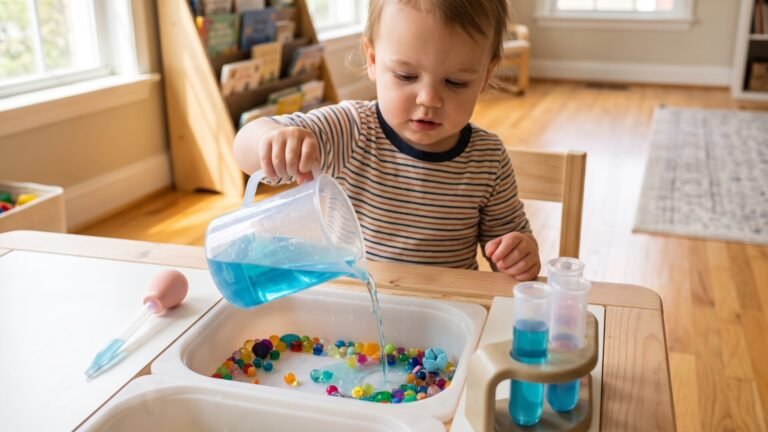
STEM Toys That Build Fine Motor Skills in Young Kids
I have a confession to make. When my oldest was a toddler, I thought fine motor skills were something that just happened naturally—like learning to walk or talk. I’d hand her a crayon, she’d scribble, and I assumed that was enough. It wasn’t until I watched her struggle with a simple zipper at preschool drop-off that I realized how much deliberate practice these small muscles actually need.
That moment sent me down a rabbit hole of research, and what I found surprised me. The toys that built her fine motor skills the most weren’t the flashy electronic gadgets or the expensive “educational” tablets. They were the ones that required her hands to work—to pinch, twist, stack, and connect. And many of them happened to be STEM toys.
Here’s the thing: STEM toys aren’t just about preparing your child for a future in engineering or coding. They’re about giving little hands the workout they need to master everyday tasks—buttoning shirts, holding pencils, using scissors. The science, technology, engineering, and math components are bonuses that happen to make the play more engaging and purposeful.
In this article, I’m going to walk you through the STEM toys that actually deliver on their promises for fine motor development. I’ve tested these with my own kids, watched them with neighbor’s children, and talked to occupational therapists about what really works. You’ll find specific product recommendations, honest pros and cons, and practical advice for choosing the right toy for your child’s unique needs.
Let me tell you what I wish someone had told me years ago.
Understanding Fine Motor Skills and Why STEM Toys Matter
Fine motor skills involve the coordination of small muscles in the hands, fingers, and wrists. These are the muscles your child uses to pick up a cheerio, turn a page, or eventually write their name. They develop in a predictable sequence, but they require practice—lots of it.
The American Academy of Pediatrics emphasizes that hands-on play is critical for developing these skills. When children manipulate objects, they’re not just playing; they’re building neural pathways that support everything from handwriting to self-care.
STEM toys are particularly effective because they naturally require precise movements. Building a tower with blocks demands controlled placement. Completing a puzzle requires matching shapes and turning pieces. These aren’t arbitrary exercises—they’re purposeful challenges that keep children engaged long enough to build real strength and coordination.
I remember watching my daughter spend twenty minutes trying to connect two LEGO Duplo bricks. She’d press, adjust, press again. Her tongue would stick out in concentration. When they finally clicked together, her face lit up. That wasn’t just play. That was her brain and hands learning to work together in a way that no screen ever could replicate.
Parents today have legitimate concerns about screen time. We worry that our kids aren’t getting enough hands-on experiences. STEM toys offer a solution—they’re interactive in the physical sense, requiring touch, manipulation, and experimentation. They pull children away from passive consumption and into active creation.
Current educational trends reinforce this. STEM learning isn’t just about content knowledge; it’s about process. Children learn to ask questions, test hypotheses, and persist through failure. When a block tower falls, they rebuild. When a puzzle piece doesn’t fit, they try another angle. These are life skills disguised as play.
What Makes a STEM Toy Effective for Fine Motor Development?
STEM toys encompass a broad category. The acronym stands for Science, Technology, Engineering, and Math, but in practice, these toys blend these disciplines in ways that feel natural to children.
A good STEM toy for fine motor development should require:
- Grasping – The ability to hold and manipulate objects
- Pincer grip – Using thumb and forefinger to pick up small items
- Hand-eye coordination – Aligning what the eyes see with what the hands do
- Bilateral coordination – Using both hands together in a coordinated way
- Wrist stability – Maintaining a steady position while the fingers work
These aren’t terms you’ll see on most toy boxes, but they’re the foundation of fine motor development.
There’s an important distinction between different types of STEM toys. Building sets like LEGO or Magna-Tiles focus on construction and spatial reasoning. Puzzles emphasize problem-solving and shape recognition. Manipulatives like lacing beads or sorting games target precision and patience. Each type works different muscle groups and cognitive skills.
The best STEM toys for fine motor development are the ones that require repeated, varied movements. A toy that a child can master in five minutes and then abandon isn’t building lasting skills. But a toy that offers increasing complexity—where success requires more precise movements over time—will keep those small muscles working.
What to Look for When Buying STEM Toys for Fine Motor Skills
Safety comes first. I cannot emphasize this enough. Young children explore with their mouths, so any toy you buy must be made from non-toxic materials. Look for certifications like ASTM (American Society for Testing and Materials) or CPSIA (Consumer Product Safety Improvement Act) compliance. Avoid toys with small parts that could become choking hazards for children under three.
Durability matters more than you might think. I’ve watched toddlers throw toys across rooms, step on them, and drop them down stairs. A toy that breaks on the first impact isn’t just frustrating—it’s potentially dangerous with sharp edges or loose pieces. Solid wood, thick plastic, and reinforced connections are worth paying for.
Age appropriateness is where many parents get tripped up. A toy labeled for ages 3+ might be perfect for a three-year-old but frustrating for a two-year-old. Pay attention to the specific skills required. Can your child grasp the pieces? Are the connections too tight for their current strength? Trust your judgment over the box recommendations.
Educational value should be genuine, not just marketing. A toy that claims to teach coding but only has one button isn’t teaching much. Look for toys that offer multiple ways to play, that grow with your child, and that encourage open-ended exploration rather than following a single script.
Ease of use and storage will determine whether the toy actually gets played with. If pieces are too small or too numerous, they’ll end up lost under furniture. If assembly requires adult intervention every time, your child won’t develop independence. Consider how the toy fits into your daily life.
Maintenance is the hidden factor nobody talks about. Some toys need batteries that drain quickly. Others have pieces that are impossible to clean. Wooden toys may need occasional oiling. Electronic components can fail. Think about the long-term commitment before you buy.
The Pros and Cons of STEM Toys for Fine Motor Development
Pros
The benefits are substantial. STEM toys directly build fine motor skills through purposeful repetition. Every time your child picks up a block, turns a screw, or threads a bead, they’re strengthening those small muscles.
These toys also encourage creativity and problem-solving. Unlike passive entertainment, STEM toys require active engagement. Children must figure out how pieces fit together, what happens when they try different approaches, and how to recover from mistakes.
There’s also the social component. Many STEM toys work well for collaborative play. Siblings or friends can build together, negotiate roles, and learn to share. This builds communication skills alongside fine motor development.
Cons
Not every STEM toy delivers lasting value. Some have limited play potential—once your child masters the basic activities, there’s nothing new to discover. These toys end up in the donation pile within weeks.
Price is another consideration. High-quality STEM toys can be expensive, and the most expensive option isn’t always the best. You might pay $50 for a building set that gets ignored while a $15 puzzle becomes a daily favorite.
Finally, not every toy suits every child. A child who loves animals might ignore a construction set. A child who struggles with frustration might need simpler toys that offer quick success. There’s no one-size-fits-all solution.
Our Top STEM Toy Recommendations
LEGO Duplo Town Farm
| Feature | Details |
|---|---|
| Age Range | 2-5 years |
| Key Features | Large bricks for easy handling, farm-themed accessories |
| Price | $30-$50 |
| [Affiliate: Check price on Amazon] |
Why We Like It
LEGO Duplo is the gold standard for introducing construction play to young children. The bricks are large enough that toddlers can grasp them easily, but the connection requires just enough pressure to build hand strength. The farm theme adds narrative elements that keep children engaged beyond the building itself.
Best For
Toddlers who enjoy farm animals and building. This set works particularly well for children who need motivation to practice fine motor skills—the promise of creating a barn or feeding animals keeps them coming back.
Pros
- Safe, large pieces eliminate choking concerns
- Encourages cooperative play with siblings
- Compatible with other Duplo sets for expansion
- Durable enough to survive years of play
Cons
- Limited to farm themes; may not appeal to all kids
- Pieces can get lost in carpet or under furniture
- Some children lose interest after building the set once
Melissa & Doug Wooden Puzzles
| Feature | Details |
|---|---|
| Age Range | 2-4 years |
| Key Features | Colorful, chunky pieces for easy grasping |
| Price | $10-$25 |
| [Affiliate: Check price on Amazon] |
Why We Like It
There’s a reason Melissa & Doug puzzles have been a staple in homes and classrooms for decades. The chunky wooden pieces are perfect for developing the pincer grip—that thumb-and-forefinger coordination that’s essential for writing. Each piece requires your child to match shape to space, building spatial reasoning alongside fine motor control.
Best For
Young children learning shapes and colors. These puzzles offer immediate feedback—the piece either fits or it doesn’t—which helps children self-correct without adult intervention.
Pros
- Durable wooden construction that lasts for years
- Bright colors and familiar images engage attention
- Easy to clean with a damp cloth
- Affordable price point for the quality
Cons
- Limited complexity; may not be suitable for older kids
- Some puzzles have small pieces that could be lost
- No expansion possibilities once mastered
VTech Drop and Go Dump Truck
| Feature | Details |
|---|---|
| Age Range | 1-3 years |
| Key Features | Interactive learning and fine motor skill building |
| Price | $25-$40 |
| [Affiliate: Check price on Amazon] |
Why We Like It
This toy combines cause-and-effect learning with fine motor practice. Children drop colorful rocks into the truck, which triggers sounds, songs, and phrases that teach colors and numbers. The act of grasping each rock, positioning it over the opening, and releasing it requires precise hand control.
Best For
Toddlers who enjoy active, sensory play. The sounds and movements provide immediate reinforcement that encourages repetition—and repetition is exactly what builds fine motor skills.
Pros
- Encourages sensory exploration through sound and movement
- Interactive features maintain engagement
- Teaches colors and numbers alongside motor skills
- Sturdy enough to withstand rough handling
Cons
- Requires batteries which may need regular replacement
- Limited play value once the novelty wears off
- Some parents find the sounds annoying after repeated play
Magna-Tiles Clear Colors Set
| Feature | Details |
|---|---|
| Age Range | 3-6 years |
| Key Features | Magnetic building tiles for creative construction |
| Price | $50-$120 |
| [Affiliate: Check price on Amazon] |
Why We Like It
Magna-Tiles are genius for fine motor development. The magnetic connection requires children to align pieces carefully and apply just the right amount of pressure. The transparent tiles allow children to see how their constructions come together, adding a visual element that reinforces spatial awareness.
Best For
Children who love building and creating. These tiles offer endless possibilities—houses, castles, cars, animals—which means the toy grows with your child’s imagination.
Pros
- Open-ended play that never gets old
- Magnetic connection is satisfying and easy for small hands
- Teaches geometry and spatial reasoning naturally
- Durable construction that lasts for years
Cons
- Higher price point than many alternatives
- Tiles can scratch over time
- Requires flat surface for building
Learning Resources Gears! Gears! Gears!
| Feature | Details |
|---|---|
| Age Range | 3-6 years |
| Key Features | Interlocking gears for mechanical exploration |
| Price | $25-$40 |
| [Affiliate: Check price on Amazon] |
Why We Like It
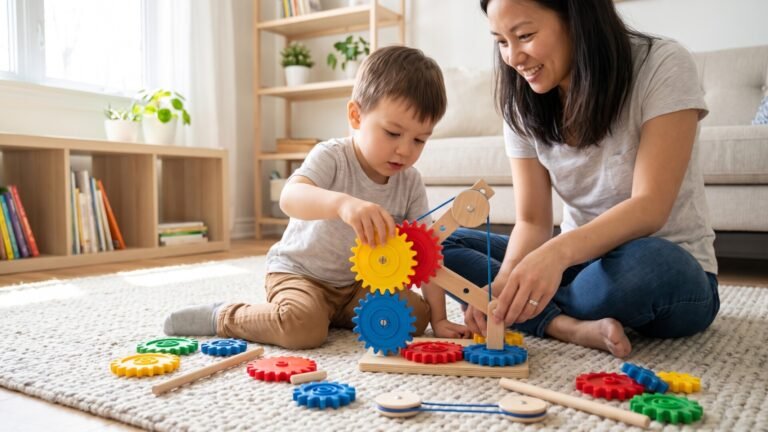
This set introduces cause and effect in a mechanical context. Children must fit gears onto pegs, align them correctly, and turn the crank to see the whole system move. The precision required to connect each gear builds dexterity and patience.
Best For
Children who are curious about how things work. The mechanical nature of this toy appeals to kids who enjoy figuring out systems and seeing results.
Pros
- Teaches basic engineering principles
- Requires precise hand movements for assembly
- Encourages experimentation and problem-solving
- Compatible with expansion sets
Cons
- Small pieces can be easy to lose
- Some children find the assembly frustrating
- Limited to gear-based constructions
Fat Brain Toys Teetherz Pipsqueak
| Feature | Details |
|---|---|
| Age Range | 6 months-2 years |
| Key Features | Silicone teether with grasping nubs |
| Price | $10-$15 |
| [Affiliate: Check price on Amazon] |
Why We Like It
This might not look like a STEM toy, but it’s a perfect introduction to fine motor development for the youngest children. The silicone nubs encourage grasping and mouthing, which builds hand strength and oral motor control. The bright colors and varied textures stimulate sensory exploration.
Best For
Infants and young toddlers who are just beginning to develop hand control. This toy meets them where they are developmentally.
Pros
- Safe, non-toxic silicone material
- Easy to clean and sanitize
- Portable for on-the-go use
- Encourages early grasping skills
Cons
- Limited play value for older children
- Simple design may not hold attention long
- Not suitable for children who are past the teething stage
SmartMax My First Build & Drive Set
| Feature | Details |
|---|---|
| Age Range | 1-5 years |
| Key Features | Magnetic construction with vehicles |
| Price | $30-$50 |
| [Affiliate: Check price on Amazon] |
Why We Like It
SmartMax uses large magnetic pieces that are easy for small hands to connect. The magnetic pull is strong enough to hold constructions together but light enough that children can separate pieces independently. The vehicle base adds a functional element—children can build and then play with their creation.
Best For
Toddlers who are ready for construction play but not yet ready for smaller building sets. The large pieces reduce frustration while still building skills.
Pros
- Large pieces eliminate choking hazards
- Magnetic connection is easy for small hands
- Encourages imaginative play with vehicles
- Durable construction
Cons
- Limited to vehicle-themed builds
- Magnetic pieces can attract to metal surfaces
- Higher price point for the number of pieces
Hape Quadrilla Wooden Marble Run
| Feature | Details |
|---|---|
| Age Range | 4-8 years |
| Key Features | Wooden track system with marbles |
| Price | $40-$80 |
| [Affiliate: Check price on Amazon] |
Why We Like It
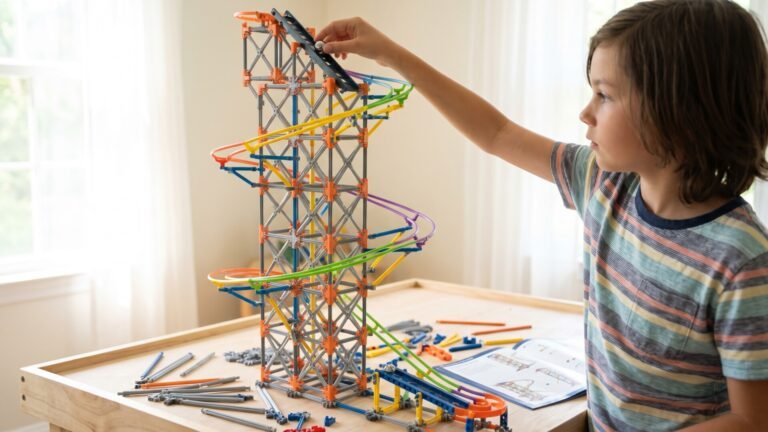
Marble runs require careful placement of tracks, ramps, and tunnels. Each piece must be aligned precisely for the marble to travel successfully. This builds hand-eye coordination, patience, and spatial reasoning. The wooden construction is beautiful and durable.
Best For
Older preschoolers and early elementary children who enjoy building and cause-and-effect play. This toy rewards persistence and careful work.
Pros
- Teaches physics concepts through play
- Beautiful wooden construction
- Encourages experimentation and iteration
- Compatible with expansion sets
Cons
- Requires more adult supervision for younger children
- Marbles can be choking hazards if lost
- Higher price point
Educational Insights Design & Drill Activity Center
| Feature | Details |
|---|---|
| Age Range | 3-6 years |
| Key Features | Toy drill and screws for pattern creation |
| Price | $30-$40 |
| [Affiliate: Check price on Amazon] |
Why We Like It
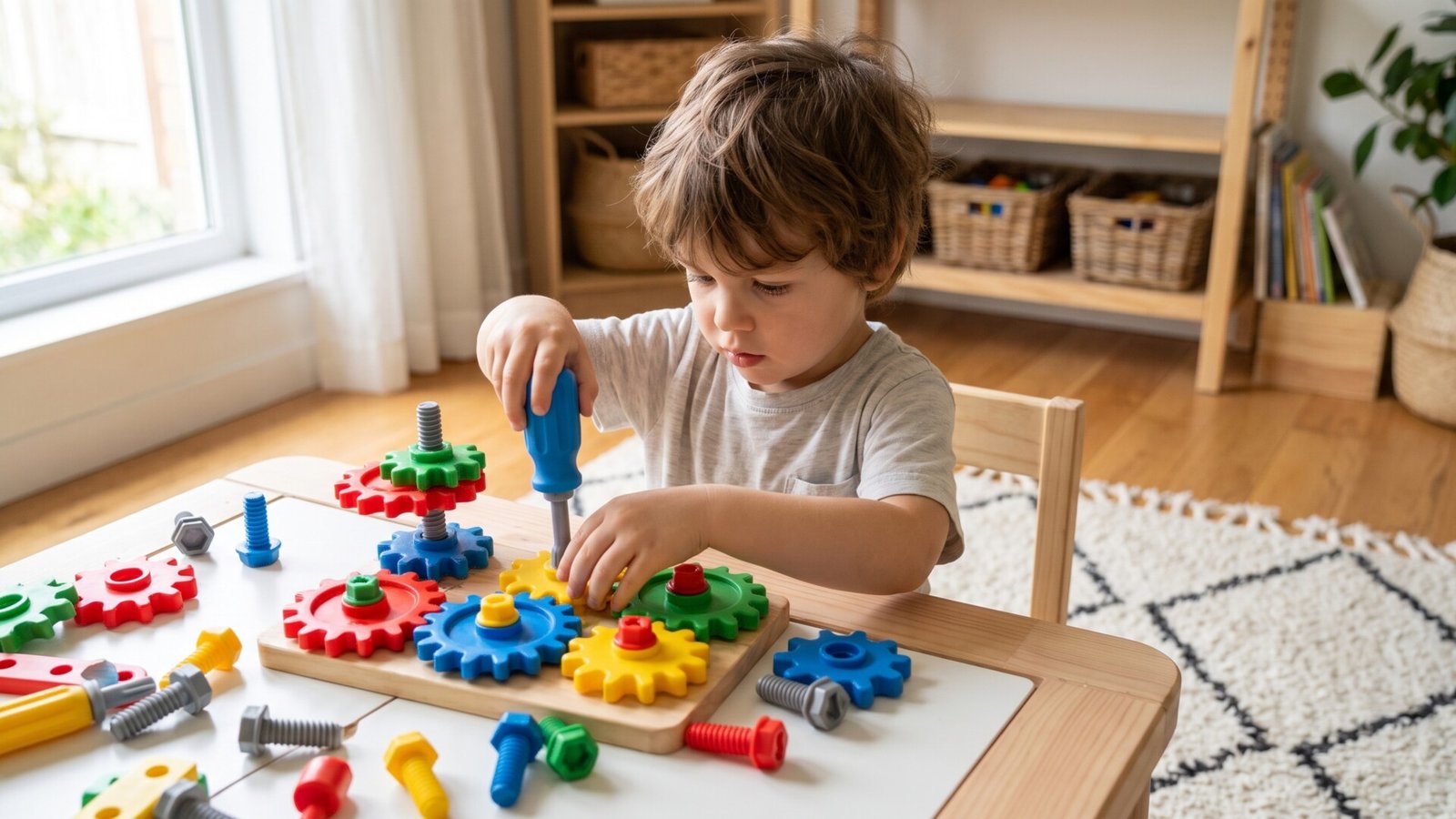
This toy directly targets the hand muscles needed for writing. Using the toy drill requires a twisting motion that builds wrist stability and finger strength. Children follow pattern cards or create their own designs, combining fine motor practice with creative expression.
Best For
Children who enjoy hands-on construction and pattern activities. The tool element appeals to kids who like pretend play with realistic equipment.
Pros
- Directly builds hand strength for writing
- Encourages following instructions and patterns
- Open-ended creative possibilities
- Durable plastic construction
Cons
- Drill requires batteries
- Small screws can be lost
- Some children struggle with the drill mechanism
Comparison Table
| Product | Age Range | Durability | Educational Value | Price Range | Best For |
|---|---|---|---|---|---|
| LEGO Duplo Town Farm | 2-5 years | High | High | $30-$50 | Toddlers |
| Melissa & Doug Wooden Puzzles | 2-4 years | Medium | Medium | $10-$25 | Young children |
| VTech Drop and Go Dump Truck | 1-3 years | Medium | High | $25-$40 | Active play |
| Magna-Tiles Clear Colors Set | 3-6 years | High | High | $50-$120 | Creative builders |
| Learning Resources Gears! Gears! Gears! | 3-6 years | Medium | High | $25-$40 | Mechanical explorers |
| Fat Brain Toys Teetherz Pipsqueak | 6m-2 years | High | Low | $10-$15 | Infants |
| SmartMax My First Build & Drive Set | 1-5 years | High | Medium | $30-$50 | Toddler builders |
| Hape Quadrilla Wooden Marble Run | 4-8 years | High | High | $40-$80 | Older preschoolers |
| Educational Insights Design & Drill | 3-6 years | Medium | High | $30-$40 | Pattern lovers |
How to Choose the Right STEM Toy for Your Child
Best for Small Spaces
If you’re in an apartment or have limited play space, focus on toys that offer high engagement in a compact footprint. Melissa & Doug puzzles are perfect—they take up minimal space and can be stored flat. The VTech Drop and Go Dump Truck is also compact enough to fit in a corner or on a shelf.
Best for Toddlers
For children under three, prioritize safety and simplicity. The Fat Brain Toys Teetherz Pipsqueak and SmartMax My First Build & Drive Set are excellent choices. They have large pieces that eliminate choking hazards while still building fine motor skills. LEGO Duplo is also a strong option for this age group.
Best for STEM Learning
If educational value is your primary concern, the Hape Quadrilla Marble Run and Learning Resources Gears! Gears! Gears! offer the most direct STEM learning. They teach physics, engineering, and cause-and-effect relationships while building fine motor skills.
Best for Montessori Homes
Montessori principles emphasize natural materials, open-ended play, and self-directed learning. The Hape Quadrilla Marble Run fits these criteria beautifully with its wooden construction and limitless building possibilities. Melissa & Doug wooden puzzles also align with Montessori values.
Best Budget Pick
The Melissa & Doug Wooden Puzzles offer the best value for the price. At $10-$25, they’re affordable, durable, and effective at building fine motor skills. The Fat Brain Toys Teetherz Pipsqueak is also budget-friendly for infants.
Best Premium Pick
Magna-Tiles Clear Colors Set is the premium choice that justifies its price through longevity and versatility. Children use these tiles for years, and they remain engaging through countless creative possibilities. The initial investment pays off in hours of play.
ToyGuideHub Longevity Analysis
Here’s what most reviews won’t tell you about these toys six months after purchase.
The LEGO Duplo sets have remarkable staying power. I’ve seen families pass them from oldest to youngest child, adding new sets over time. The key is that Duplo works as a system—you can combine sets, build new things, and keep the play fresh. The initial farm set might become part of a larger zoo or castle. This expandability makes the cost per year of use very low.
Magna-Tiles have similar longevity. Children who master simple towers move on to complex structures, cars, and even geometric shapes. The tiles don’t wear out, and they work for independent play or group projects. I’ve watched siblings spend hours building together, which is rare for any toy.
The VTech Drop and Go Dump Truck has the shortest lifespan of our recommendations. Once children master the dropping motion, there’s little challenge left. The sounds become repetitive, and most children move on within a few months. This doesn’t make it a bad toy—it serves its purpose for a specific developmental window—but it’s not a long-term investment.
The Hape Quadrilla Marble Run has excellent longevity for older children. The complexity increases as children develop better spatial reasoning and patience. A four-year-old might build simple tracks, while an eight-year-old creates elaborate multi-level runs. This toy truly grows with the child.
The hidden cost to watch for is lost pieces. Marble runs lose marbles. Building sets lose bricks. Puzzles lose pieces. Consider whether replacement parts are available before you buy. LEGO and Magna-Tiles both sell individual pieces, which extends the life of the toy significantly.
Final Thoughts
I’ve watched my own children struggle and succeed with these toys. I’ve seen the frustration when a piece won’t fit and the joy when it finally does. That process—the repeated attempts, the small adjustments, the eventual triumph—is exactly what builds fine motor skills.
The best STEM toy for your child is the one they’ll actually play with. A perfect toy that sits on the shelf does nothing. So consider your child’s personality, your home environment, and your budget. Start with one or two well-chosen options and see how they respond.
For most families, I recommend starting with LEGO Duplo if your child is under three, or Magna-Tiles if they’re older. Both offer exceptional value, longevity, and skill-building potential. For a budget-friendly option, Melissa & Doug puzzles deliver reliable results.
Frequently Asked Questions About STEM Toys That Build Fine Motor Skills In Young Kids
What are fine motor skills and why are they important?
Fine motor skills involve the coordination of small muscles in the hands, fingers, and wrists. They’re essential for everyday tasks like writing, buttoning clothing, using utensils, and tying shoes. Strong fine motor skills support independence and academic readiness.
At what age should I start focusing on fine motor skill development?
You can start from birth. Infants benefit from grasping toys and mouthing objects. By six months, babies begin reaching for and holding items. Toddlers should have opportunities to stack, sort, and manipulate objects. The earlier you introduce these activities, the stronger the foundation.
Are all STEM toys safe for my child?
Not automatically. Always check age recommendations and safety certifications. Look for non-toxic materials, avoid small parts for children under three, and inspect toys regularly for damage. Even well-known brands can have safety issues with specific products.
How can I encourage my child to play with STEM toys?
Follow your child’s interests. If they love animals, choose animal-themed sets. If they enjoy building, start with simple construction toys. Play alongside them initially, then step back as they gain confidence. Praise effort rather than results to encourage persistence.
What should I look for in a STEM toy to ensure it builds fine motor skills?
Look for toys that require grasping, pinching, twisting, or pressing. The toy should offer increasing challenge as skills develop. Avoid toys that do most of the work for the child—the learning happens through the struggle.
How can I maximize the educational value of STEM toys at home?
Ask open-ended questions during play. “What happens if you try this?” “How can you make it taller?” “What else could you build?” Connect the play to real-world experiences. Talk about how gears work in a bicycle or how magnets hold things on the refrigerator. —