When to Introduce Puzzles (Progression by Age)
A Parent’s Guide to Helping Kids Build Skills One Piece at a Time
Puzzles are one of the simplest toys you can bring into your home, but they’re also among the most powerful. They build problem-solving skills, attention, fine motor strength, spatial awareness, patience, and confidence. And the best part? Puzzles grow with your child.
But parents often wonder:
- When should I start?
- What type of puzzle is right for my child’s age?
- How do I know when they’re ready for more pieces?
- How can I prevent frustration and keep puzzles fun?
This guide walks you through the age-by-age progression of puzzles, from babyhood to early elementary. You’ll learn what puzzles help your child build the right developmental skills at the right time—without overwhelming them.
Let’s explore how to introduce puzzles in a way that feels natural, empowering, and fun.
Why Puzzles Matter for Development
Before we dive into age groups, it helps to understand what puzzles actually teach.
1. Fine Motor Skills
Picking up knobs, sliding shapes, and placing pieces strengthens finger muscles and prepares little hands for writing.
2. Spatial Reasoning
Matching shapes, flipping pieces, and rotating them teaches a child how objects fit together—a skill needed for everything from math to sports.
3. Visual Discrimination
Kids learn to see details: color, pattern, shape, orientation, and outline.
4. Problem-Solving
Puzzles teach kids to try, adjust, evaluate, and try again—without the fear of “failure.”
5. Perseverance and Focus
Working through a puzzle lengthens attention span and builds frustration tolerance in a low-pressure way.
6. Planning and Logic
As puzzles get more complex, kids learn strategy, sequencing, and mental mapping.
Puzzles don’t just entertain—they literally sculpt your child’s brain.
When to Introduce Puzzles: Age-By-Age Guide
Each age group has its own developmental milestones. The key is matching the puzzle style—not the number of pieces—to what your child is ready for.
This progression gives you a clear roadmap.
Age 0–12 Months: Early Exploration
Babies aren’t “doing puzzles” yet, but you can absolutely introduce puzzle-like play.
Best Types of Puzzles for This Age
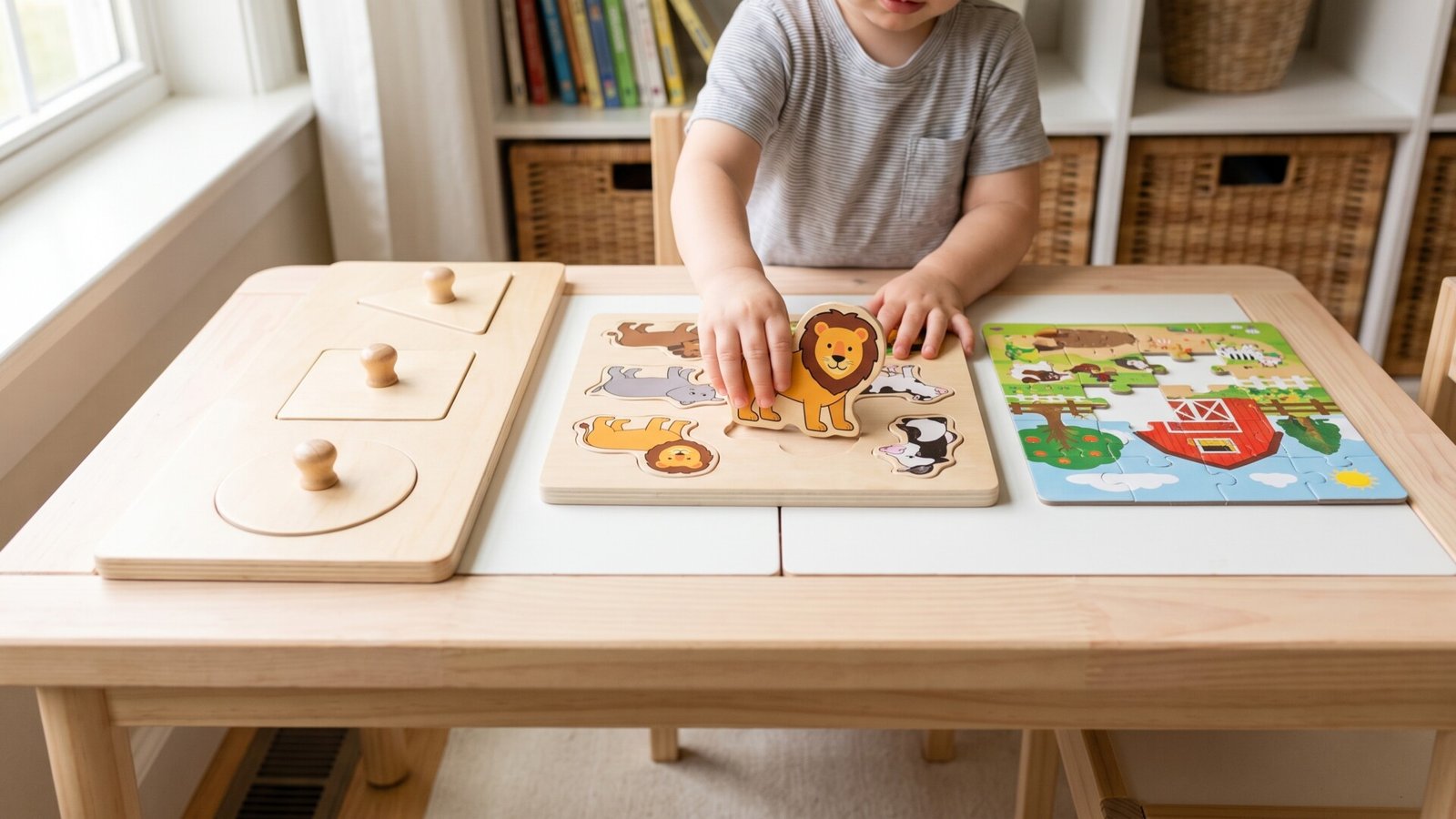
- Large wooden shapes with chunky knobs
- Single-shape puzzles (circle, square, triangle)
- Stacking rings
- Large posting toys (putting objects through a hole)
- Nesting cups
These are technically pre-puzzles that teach:
- grasping
- releasing
- shape recognition
- cause-and-effect
- hand-eye coordination
Even if babies don’t complete them intentionally, they benefit from exploring the pieces.
What to Expect
- They’ll mouth pieces.
- They’ll remove pieces but not replace them.
- They’ll bang, throw, and explore with all senses.
This stage is about familiarizing—not solving.
Age 1–2 Years: Knob & Chunky Puzzles
Between 12 and 24 months, toddlers suddenly make huge leaps in motor control and attention. This is the perfect time to introduce true puzzles, but they must be extremely simple.
Best Puzzle Types
- Chunky wooden puzzles (animals, vehicles, farm themes)
- Peg or knob puzzles
- First shape sorters
- Two-piece matching puzzles (like animal halves)
Good picks include things like farm animals, simple vehicles, or shapes.
Skills Learned
- Matching shape to outline
- Using two hands together
- Isolating finger movements
- Beginning problem-solving
- Learning categories (animals, foods, letters)
What to Expect
Toddlers love removing pieces. Putting them back will take time. They’ll succeed only with simple shapes and clear outlines. That’s exactly right for this stage.
If your child gets frustrated, remove all but two pieces. Slowly add more over time.
Age 2–3 Years: Simple Jigsaw Puzzles & Peg Boards
Around age two, toddlers are ready for the next step: interlocking pieces.
Best Puzzle Types
- 2-piece puzzles (parent/baby animals, matching pictures)
- 3–5 piece jigsaw puzzles
- Wooden peg puzzles with more shapes
- Puzzles with knobs removed (flatter pieces)
- Large inset puzzles
- Color-matching or shape-matching boards
This is also when many kids enjoy puzzles that feature familiar characters, vehicles, or animals—they recognize what’s being built and stay motivated.
Skills Learned
- Rotating pieces until they fit
- Recognizing part-to-whole relationships
- Increased persistence
- Improved visual scanning
- Fine motor precision
- Early sequencing
What to Expect
Kids at this age enjoy puzzles but need help orienting pieces. If large jigsaw pieces feel hard, guide them by helping them connect the first pair. Their confidence grows quickly.
Age 3–4 Years: Bigger Jigsaws & More Complex Themes
This is the puzzle “sweet spot.” Kids this age love seeing an image appear before their eyes, and their brains are ready for bigger challenges.
Best Puzzle Types
- 12–24 piece jigsaw puzzles
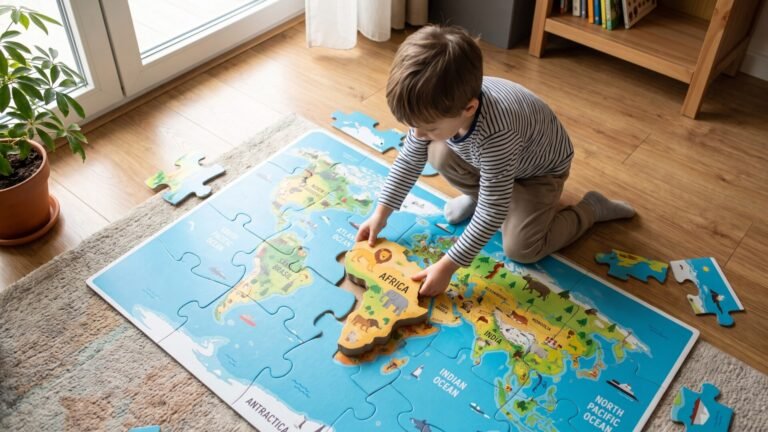
- Large floor puzzles (alphabet trains, maps, animals)
- Chunky knob puzzles with more detail
- Story puzzles (sequences with 3–6 panels)
- Puzzles with irregular shapes (dinosaurs, princess castles)
- Magnetic puzzles for travel
Floor puzzles are fantastic because kids can spread out and use their whole bodies during the process.
Skills Learned
- Bigger-picture planning
- Visual memory
- Early logic and sequencing
- Shape recognition at a detailed level
- Social skills if done cooperatively
What to Expect
Kids may dump all pieces and stare, overwhelmed. Show them how to:
- Build the edges
- Sort pieces by color or pattern
- Look for the “main image” pieces (like the face of an animal)
Your guidance becomes the scaffold that helps them eventually work independently.
Age 4–5 Years: Strategy Emerges
Kids this age begin to use actual puzzle strategies, like:
- doing edges first
- sorting by categories
- rotating pieces before trying them
- remembering where pieces might fit
Best Puzzle Types
- 24–48 piece jigsaw puzzles
- Floor puzzles with detailed scenes
- Puzzle maps (solar system, countries, community helpers)
- Themed puzzles (dinosaurs, fairies, robots)
- Chunky logic puzzles (tangrams, pattern blocks)
This is also a good age to introduce puzzles based on your child’s interests.
Skills Learned
- Longer attention span
- Multi-step planning
- Early critical thinking
- Pattern recognition
- Independent problem-solving
What to Expect
Kids this age begin completing puzzles without help, but frustration still happens. Encourage breaks, not quitting. Remind them: “Puzzles are solved one piece at a time.”
Age 5–6 Years: Complex Images & Higher Piece Counts
Kindergarteners are usually ready to push past beginner puzzles.
Best Puzzle Types
- 48–100 piece puzzles
- Puzzles with complex artwork
- Story sequencing puzzles (advanced)
- Early logic puzzles
- 3D starter puzzles
Kids this age enjoy puzzles with finer details—forests, space scenes, underwater worlds. They’re ready for images that require scanning rather than simple color blocks.
Skills Learned
- Attention to detail
- Advanced spatial awareness
- The ability to hold a mental image
- Stronger perseverance
- Early reading comprehension through story puzzles
What to Expect
At this stage, kids may want to complete puzzles alone. Many enjoy leaving a puzzle out and returning to it over time.
Age 6–8 Years: Higher Piece Counts & 3D Puzzles
Kids entering grade school often experience a leap in spatial reasoning. This opens the door for more advanced puzzles.
Best Puzzle Types
- 100–300 piece jigsaws
- 3D puzzles (globes, buildings, animals)
- STEM puzzle kits
- Puzzle games (Rush Hour, Gravity Maze)
- Pattern and logic puzzles
This is when puzzles really challenge kids in exciting ways.
Skills Learned
- Logic and reasoning
- Plan-ahead thinking
- Advanced sequencing
- Persistence on multi-day challenges
- Understanding complexity
What to Expect
Kids may struggle with large sections of sky or water in a puzzle. Show them how to group by:
- edge pieces
- colors
- patterns
- shapes (flat vs. round connectors)
This helps them develop stronger visual organization skills.
Age 8+: Advanced Puzzles & Brain Teasers
By this age, many kids are ready for puzzles that truly push their limits.
Best Puzzle Types
- 300–500 piece puzzles
- Challenging 3D puzzles
- Mechanical puzzles (like gear puzzles)
- Brain teasers and logic puzzles
- Puzzle kits connected to engineering or art
Kids might even begin to enjoy puzzles with:
- subtle gradients
- detailed scenery
- historical themes
- famous artworks
Skills Learned
- Long-term planning
- Advanced spatial visualization
- Fine motor mastery
- Critical thinking
- Sustained focus
What to Expect
At this stage, puzzles become a hobby rather than a developmental skill. Kids might work independently for long stretches, especially if the puzzle matches their interests.
Signs Your Child Is Ready to Move Up
Every child progresses at their own pace, but these signs usually appear when it’s time for a new challenge:
- They finish puzzles quickly and want more
- They ask for harder images
- They lose interest in puzzles that used to excite them
- They try puzzles without help
- They stay focused longer than before
Move up gradually—don’t jump from 12 pieces to 100 pieces overnight. The sweet spot is the challenge that feels just slightly out of reach.
Signs a Puzzle Is Too Hard
If your child is:
- avoiding puzzles
- getting angry or frustrated quickly
- throwing pieces
- refusing to try
- staring without knowing where to start
…the puzzle is probably beyond their current skill level.
Dial it back until they feel competent again. Confidence is foundational to puzzle enjoyment.
How to Help Your Child Without Doing It for Them
Puzzles should be empowering, not discouraging. You can support your child by offering strategies instead of solutions.
Try things like:
- “Do you want to sort pieces by edges first?”
- “Let’s find all the pieces with blue on them—that might be part of the sky.”
- “Try rotating it to see if it fits differently.”
- “What do you think the next step is?”
- “Look at the picture on the box to get clues.”
Your role is guide—not solver.
How to Store Puzzles Without Losing Pieces
If puzzles overwhelm your storage space, here are helpful methods:
- Use zipper pouches for each puzzle
- Tape the puzzle picture inside the pouch
- Keep all pouches in a single basket
- Use plastic photo cases for 24–100 piece puzzles
- Label everything clearly
Kids are more likely to choose puzzles when they’re neatly organized.
Great Puzzle Themes for Kids
Every child engages more deeply with puzzles that match their interests.
Popular themes include:
- Farm animals
- Dinosaurs
- Construction vehicles
- Princesses
- Space
- Ocean animals
- Maps
- Unicorns
- Cars and trucks
- Favorite characters
- Trains
Introducing puzzles through topics your child loves helps them stick with the challenge.
Recommended Puzzle Types to Consider
- Chunky wooden puzzles
- Knob-style puzzles
- Shape sorters
- Wooden jigsaw puzzles
- Floor puzzles
- 12–24 piece themed puzzles
- Magnetic travel puzzles
- Story sequencing puzzles
- 48–100 piece starter sets
- 3D building puzzles
- Logic puzzle games
These puzzle categories work beautifully for different ages across the progression above.
Conclusion
Puzzles grow with your child—from early shape sorters in babyhood to 300-piece jigsaws in grade school. Introducing them at the right time builds confidence, strengthens fine motor skills, and teaches problem-solving in the most joyful way.
The key is simple:
Choose puzzles that match your child’s developmental level—not their age on the box—and slowly build up. Celebrate small victories, offer support when needed, and watch as puzzles become a treasured part of your child’s learning journey.