Simple Montessori Activities You Can Do at Home
If you’ve ever looked up Montessori ideas online, you’ve probably seen spotless white playrooms, wooden everything, perfectly organized shelves, and toddlers who never seem to spill anything. Real life usually looks a little different. The good news is that you do not need a picture-perfect setup to bring Montessori ideas into your home. Montessori is an approach to how children learn, not a decorating style, and most of the activities below use things you already own.
At its core, Montessori at home is about:
- independence
- hands-on learning
- real-life experiences
- following your child’s interests
- simple, purposeful materials
This guide gives you 28 simple Montessori activities you can do at home, grouped by type, with a suggested age range and a safety note for each. If you want a wider look at Montessori activities for kids, or to match activities to your child’s age, see our Montessori learning activities by age guide.
Quick answer: start with two or three activities from the practical life section (pouring, spooning, washing fruit), put them on a tray on a low shelf, show your child once, slowly, without talking much, and then step back. Add one new activity when the first becomes easy.
Montessori at Home: The Guiding Ideas
Before you start, keep these ideas in mind:
1. Child-sized everything. When children can reach and use things themselves, they tend to use them more confidently.
2. Real, functional tools. Montessori practice favors real items (a small real jug, a real sponge) over pretend ones, since children enjoy doing the real thing. Choose sizes and materials that are safe for your child’s age.
3. Slow, calm, and intentional. Show an activity slowly, with few words, so your child can watch your hands.
4. Set up and step back. Your job is to introduce the activity. Your child’s job is to explore it, make mistakes and repeat it.
5. Follow the interest, not the schedule. If your child loves pouring, let them pour. Repetition is how children build confidence.
Safety First: Quick Rules for Home Montessori Activities
- Small parts and children under 3. Beans, rice, lentils, pom-poms, beads, buttons, coins and cotton balls can be choking hazards. Anything that fits inside a toilet-paper tube is too small for a child who still mouths objects. For younger toddlers, use larger items and stay within arm’s reach.
- Supervise water and tools. Never leave a young child alone with a basin of water, a knife, or a spray bottle.
- Food allergies and food safety. Check allergies before offering nut butters or other allergens, and cut round foods (grapes, cherry tomatoes) lengthwise for young children.
- Glass and breakables. Many families start with small plastic or ceramic jugs and move to glass later, with close supervision.
- Cleaning products. For window washing and wiping, use plain water or very mild solutions, and keep real cleaners locked away.
- Know your child. Ages given below are typical starting points, not requirements.
For official guidance on small parts and age labelling, see the US Consumer Product Safety Commission.
Practical Life Activities (The Heart of Montessori)
Practical life activities are among the easiest to set up because they are just everyday tasks done at a child’s size. Children enjoy doing real work, and these tasks give plenty of practice with motor control, concentration and independence. For preschoolers, see also our practical life activities for preschoolers.
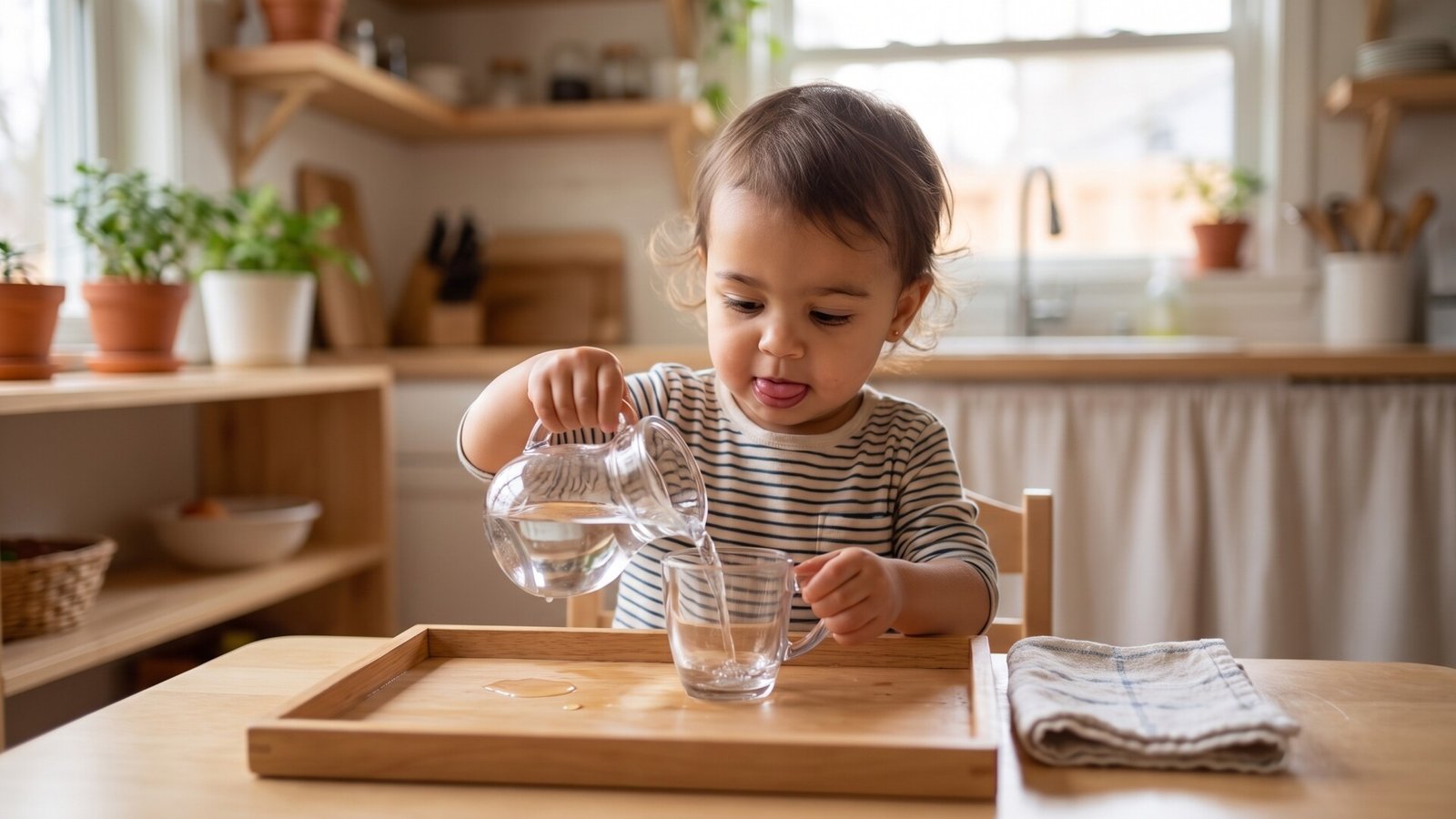
1. Pouring Water Between Two Cups
Age: about 18 months and up. You need: two small cups, a small pitcher or bottle, a tray and a towel. What to do: put a small amount of water in the pitcher, show your child how to pour slowly into the other cup, then step back. It practises: wrist control, hand-eye coordination and cause and effect. Variation: if water feels too messy, try scooping dry rice or sand on a tray, but only with children who no longer mouth objects, since these are small items. Watch for: slippery floors; a towel under the tray helps.
2. Transferring with a Spoon
Age: about 18 months and up. You need: two small bowls, a spoon, and something to scoop. For younger toddlers, use large items like big pom-poms or soft balls that cannot be swallowed. It practises: concentration, hand-eye coordination and controlled wrist movement. Easier: big objects. Harder: smaller objects and a smaller spoon, once your child no longer mouths things.
3. Washing Fruits or Vegetables
Age: about 18 months and up. You need: a small bowl of water, a soft scrub brush and firm produce like apples, potatoes or carrots. What to do: show how to put the produce in the water and gently scrub. It practises: fine motor control, sensory exploration and taking part in family routines. Watch for: supervise water, and rinse produce again at the sink before eating.
4. Sweeping with a Child-Sized Broom
Age: about 2 years and up. Set up: a small broom and dustpan, plus a “sweeping square” made with masking tape; show your child how to sweep crumbs or paper scraps into the square. It practises: gross motor control, coordination and a sense of responsibility. Many children repeat this again and again, which is exactly the point.
5. Window Washing
Age: about 2½ years and up. You need: a spray bottle with plain water, a small squeegee and a cloth. What to do: spray the window, then wipe or squeegee from top to bottom. It practises: arm strength, wrist rotation and imitation of real adult work. Watch for: use water only, and keep real glass cleaner away from children.
6. Watering Plants
Age: about 18 months and up. You need: a small watering can and a few sturdy plants. What to teach: how to check the soil, pour slowly, and stop before the plant floods. It practises: care for living things, pouring control and routine. Watch for: some houseplants are toxic if chewed, so choose child-safe plants and keep the others out of reach.
7. Simple Food Preparation
Age: from about 18 months with close supervision. Montessori homes and classrooms let children help prepare food from a young age. Good beginner tasks:
- Slicing a banana with a child-safe or butter knife
- Peeling an orange or clementine
- Spreading a soft topping on crackers (check for allergies before using nut butters)
- Using a child-safe chopper on soft foods
- Cutting soft cheese
These tasks invite fine motor practice, independence and confidence. Stay within reach whenever tools are involved, and choose foods that are safe for your child’s age.
Sensory Activities
Montessori sensory work helps children notice and compare what they see, touch, hear and smell. You don’t need official materials; everyday objects work well. For ready-made options, see our guide to Montessori sensory toys.
8. Texture Exploration Tray
Age: about 2 years and up for most items; use only large, mouth-safe items for younger children. A simple, open-ended sensory starter: fill a tray with smooth large stones (bigger than a child’s fist), fabric scraps, a wooden block, a feather and a sheet of fine sandpaper. Let your child feel and describe each one. It practises: vocabulary, sensory discrimination and calm, focused exploration. Watch for: cotton balls, small stones and feathers are not for children who mouth things.
9. Sound Matching with Containers
Age: about 3 years and up. Fill pairs of small, opaque containers (spice jars or clean yogurt cups) with rice, beans, pasta or sand, and seal them securely (with tape if necessary). Shake them and let your child match the pairs by sound. It practises: listening, memory and problem-solving. Watch for: sealed lids are essential, since loose contents are small items.
10. Color Sorting
Age: about 2 years and up. One of the easiest sensory and early math activities. Offer large items such as colored lids, big blocks or crayons, and set out two or three bowls. Keep choices small for younger children. For under-3s who mouth things, avoid tiny items like pom-poms and wooden beads.
11. Nature Basket
Age: about 2½ years and up. Montessori practice values contact with the natural world. Gather pinecones, leaves, large shells, rocks and dried flowers, and let your child explore and talk about what they notice. Watch for: small items and sharp shells for children who mouth things.
12. Matching Cards to Objects
Age: about 18 months and up. Collect a few real objects (a toy fruit, a toy animal, a spoon) and matching pictures, either found or printed. Your child matches object to card. It practises: vocabulary, visual discrimination and pre-reading skills.
Fine Motor Activities
These quieter activities help build the finger strength and hand control that later support drawing and writing. Our guide to the best first toys for early motor skill development has more.
13. Bead Threading
Age: about 2½–3 years and up with chunky beads. Use big wooden beads and a stiff lace or shoelace. Start with big beads and thick laces, then make it trickier. It practises: hand-eye and two-handed coordination and patience. Watch for: small beads are choking hazards; stay close and keep beads away from younger siblings. Do not use cords that could wrap around a neck.
14. Stickers on a Line
Age: about 2 years and up. Draw a simple line on paper and let your child place stickers along it. It practises: finger strength, coordination and spatial awareness. Peeling and placing stickers is harder than it looks. Remove leftover stickers from small mouths.
15. Posting Activities
Age: about 12 months and up with large objects. Posting means putting objects through a slot. DIY options include large lids or foam shapes into a slit-cut cardboard box, wide craft sticks into a container, or big pom-poms into a milk carton. Repetition is the point. Avoid anything small enough to swallow for young toddlers (for example, plastic coins).
16. Opening and Closing Containers
Age: about 12–18 months and up. Montessori classrooms often have an “opening and closing” tray with jars, boxes, tins and small pouches. Your child practises opening, closing, twisting, snapping and zipping. Watch for: sharp edges on tins and anything small stored inside containers.
Gross Motor Activities
Movement is a big part of Montessori, not just quiet table work.
17. Simple Obstacle Course
Age: about 18 months and up. Use cushions to climb over, a line to walk along, a tunnel to crawl through, and a basket to carry across the room. It gives practice with balance, coordination and body awareness. Keep it low and soft.
18. Walking the Line
Age: about 2½ years and up. Tape a line on the floor and let your child walk heel-to-toe, carry something while walking, or balance a beanbag. Walking on a line is a well-known exercise in Montessori classrooms.
19. Carrying Heavier Items
Age: about 2 years and up. Let your child help carry a small laundry basket, a small bag of books, or a box of blocks. Children often enjoy this “heavy work,” and it gives them a purposeful job. Keep loads light enough to be safe and clear a path first.
Language Activities
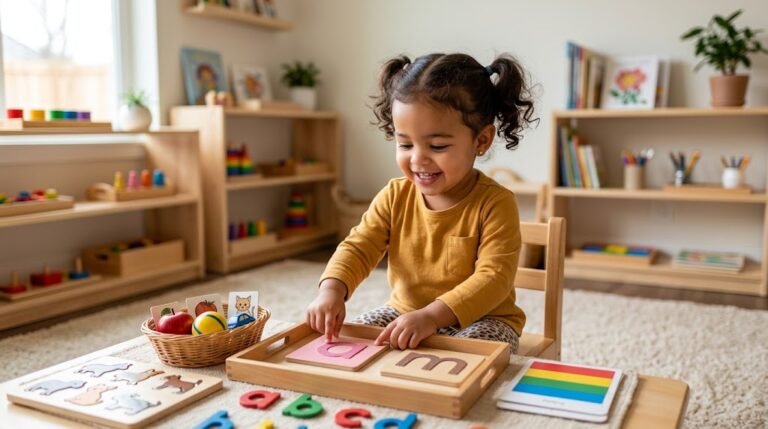
Montessori language activities are natural: naming things, exploring sounds, and looking at real images together.
20. Object Naming Basket
Age: about 18 months and up. Fill a small basket with real objects such as a spoon, a brush, a ball, a toy car and a small toy fruit. Sit together and name each item slowly. This builds vocabulary through real objects rather than flash cards.
21. Matching Photos to Reality
Age: about 2 years and up. Print pictures of your child’s toys, household items, pets or family members, and let them match photo to real object. It supports recognition, categorizing and early reading readiness.
22. Mystery Bag
Age: about 2½ years and up. Put three to five familiar objects in a cloth bag and let your child reach in, feel, and name an object before pulling it out. It strengthens language, memory and touch awareness. Use objects too large to swallow for children who mouth things.
Math and Early Problem-Solving Activities
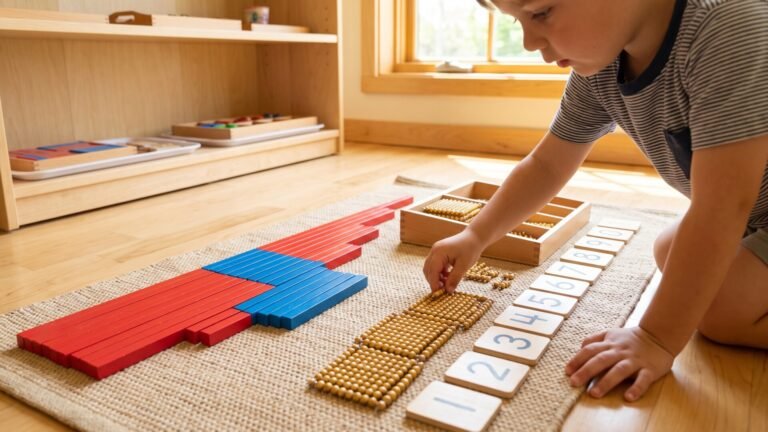
These are about basic logical thinking, not equations. For more, see our Montessori math games for kids.
23. Sorting by Size
Age: about 2½ years and up. Give your child blocks, stones, cups or lids and ask them to sort big from small. Later, try small, medium and large.
24. Simple Puzzles
Age: about 18 months and up. Choose puzzles with chunky shapes, knobs and three to six pieces. They build focus and hand control, and give instant, self-correcting feedback: a piece fits or it doesn’t.
25. Matching Pairs
Age: about 2 years and up. Use socks, lids, shapes or printed cards. Matching is a foundation for early logic skills and builds visual attention.
Bonus: Life Skills
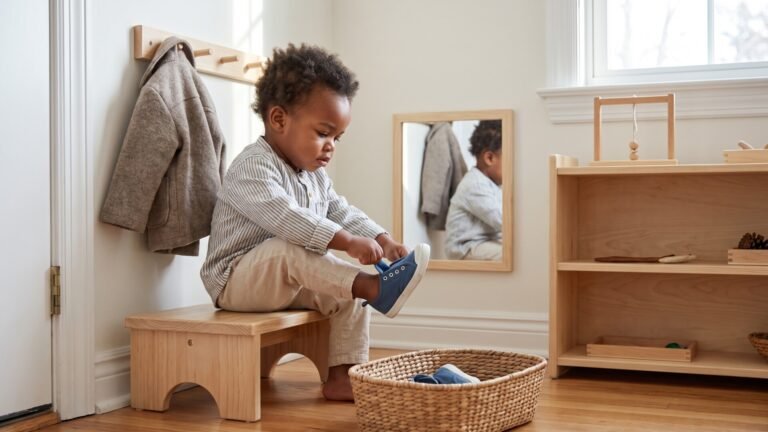
26. DIY Dressing Practice
Age: about 2½ years and up. Instead of buying dressing frames, use old shirts with buttons, jackets with zippers and pants with snaps. Let your child practise on the clothing itself, ideally laid flat on a table.
27. Brushing Their Own Hair
Age: about 2 years and up. Offer a small mirror and a child-sized brush, and invite them to try, with no pressure.
28. Setting the Table
Age: about 2 years and up. Show your child where the cup and utensils go, and how to carry items carefully. It seems small, but it can build real pride and independence.
Which Activities to Start With, by Age
| Age | Good starting activities | Main thing to watch |
|---|---|---|
| 12–18 months | Posting (large items), opening and closing, simple puzzles, object naming basket | Choking hazards; stay close |
| 18–30 months | Pouring, spooning (large items), washing produce, watering plants, sweeping, simple obstacle course | Water spills; supervise tools |
| 2½–4 years | Window washing, food prep, bead threading, sound matching, walking the line, dressing practice | Small parts; knives; allergens |
These are rough starting points. If an activity is too hard, make it easier or put it away for a few weeks.
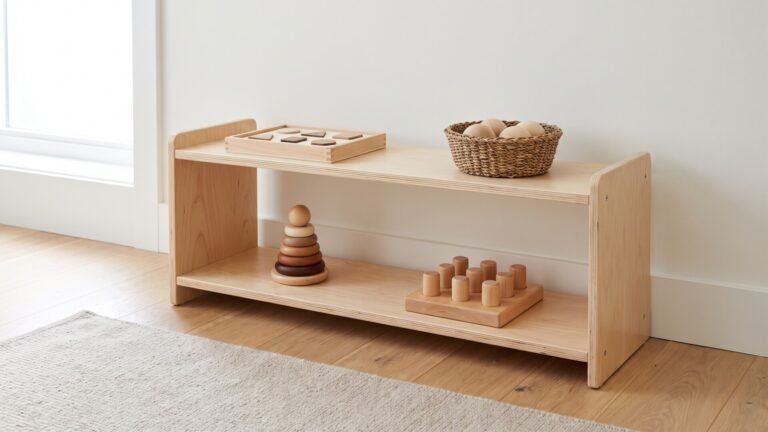
Creating a Simple Montessori Home Setup
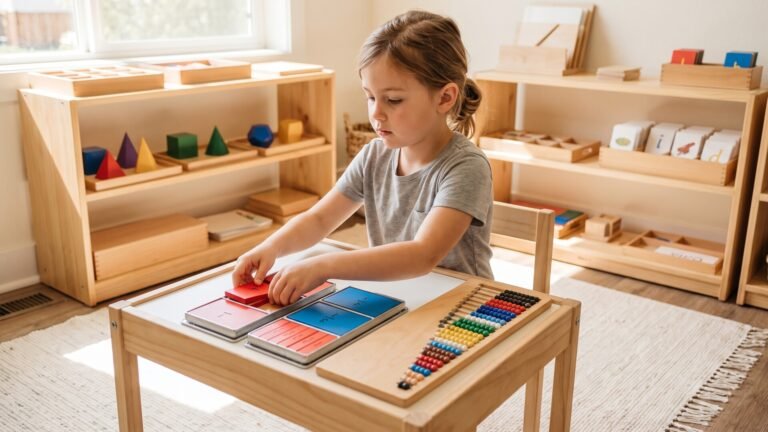
You only need a few small changes, and the minimalist Montessori play shelf guide shows how:
- A low shelf with roughly 6–8 activities, each on its own tray
- Child-sized tools when possible
- Everything visible and easy to reach
- Rotating activities every week or two
- A calm, uncluttered space, as far as real life allows
If you are wondering whether a toy is truly Montessori-friendly, our guide to what makes a toy Montessori explains the principles, and wooden toys vs plastic covers materials. You do not need to replace what you already own.
Explore More Montessori Guides
- Montessori & Early Learning Toys (the main hub)
- Montessori Learning Activities by Age
- Montessori Creative Play Toys
- Montessori STEM Toys and Montessori Coding and Logic Games
- Are Magnetic Tiles Actually Montessori-Aligned?
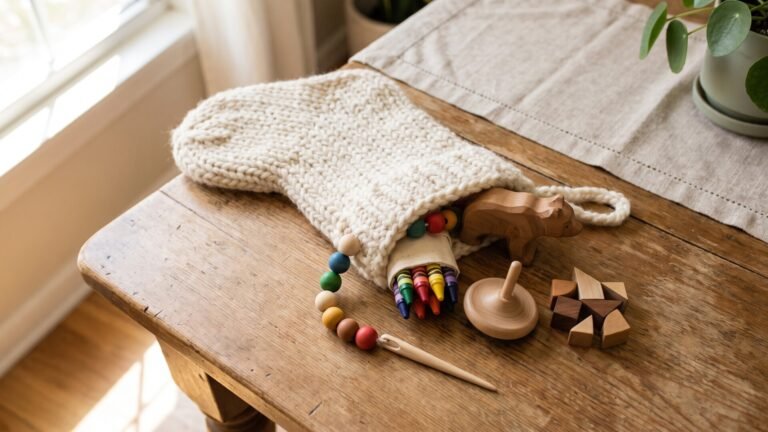
- 15 Montessori Stocking Stuffers That Are Actually Educational
Frequently Asked Questions
Frequently Asked Questions About Montessori Activities At Home
What are easy Montessori activities to do at home?
Pouring water between two cups, spooning large objects between bowls, washing fruit and vegetables, watering plants, sweeping with a child-sized broom, and sorting by color are all simple, low-cost starting points.
Do I need special Montessori materials?
No. Most activities can be done with items you already own, such as small jugs, bowls, spoons, cloths, and a tray. Specialized materials can be helpful but are optional.
At what age can I start Montessori activities?
Many practical life activities suit children from about 18 months, and simple posting and exploring activities can start earlier with large, safe objects. Always supervise and follow your child’s readiness.
Are rice and beans safe for toddler Montessori activities?
Only for children who no longer mouth objects, and with close supervision. Small items are choking hazards for children under 3, so use larger items or water instead for younger toddlers.
How many activities should I put out at once?
A small selection, often 6 to 8 on a low shelf, is a common approach. Rotate them every week or two based on your child’s interest.
Does my home have to look like a Montessori classroom?
No. Montessori is an approach to learning rather than a look. Child-sized access, real tasks, and calm, simple choices matter more than matching a particular style.
Final Thoughts
Montessori at home doesn’t need to be fancy, expensive, or complicated. The heart of it is giving your child chances to explore, take part in real life, move their body, build independence and follow their curiosity, using simple, purposeful materials. If you offer even a few of the activities above, with attention to safety and your child’s age, you are already bringing Montessori ideas into your home in a meaningful way.
Start small, follow your child’s lead, and adjust as they grow. When you are ready for more, our Montessori & Early Learning Toys hub is a good next stop.