Montessori Creative Play Toys
Creativity is a big part of how children learn in a Montessori home or classroom. Montessori is often associated with practical life, sensory work and math, but open-ended creative materials give children room to explore, experiment and express themselves using the skills they are building elsewhere.
Montessori-style creative toys let children experiment, construct and solve problems independently. Instead of dictating one way to play, they are open-ended and purposeful, so each child can find their own methods and stories.
This page is our Montessori creative play sub-hub. It covers the main categories of creative materials, a three-question test for any toy, what building sets really cost per piece, what suits each age, and how to set up a creative area. It sits within our wider guide to Montessori and early learning toys.
A Note on the Word “Montessori”
“Montessori” is not a protected certification for toys, so a product marked this way may or may not reflect Maria Montessori’s ideas. We use it here to describe toys and materials that fit common Montessori principles: child-led use, real and natural materials, a clear purpose, and an uncluttered presentation. Some Montessori teachers also point out that fully open-ended toys such as blocks are more common at home than in a traditional classroom, where materials usually have one clear purpose. Both can sit on a home shelf. If you want a deeper explanation, read what makes a toy Montessori and our guide to wooden toys vs plastic.
What Is Creative Play in a Montessori Setting?
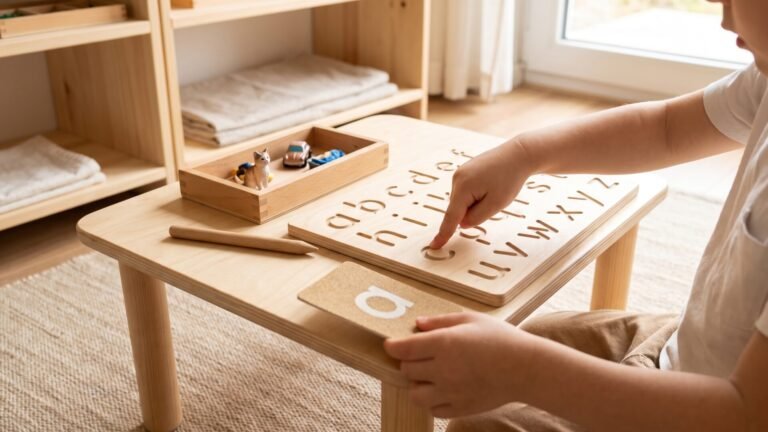
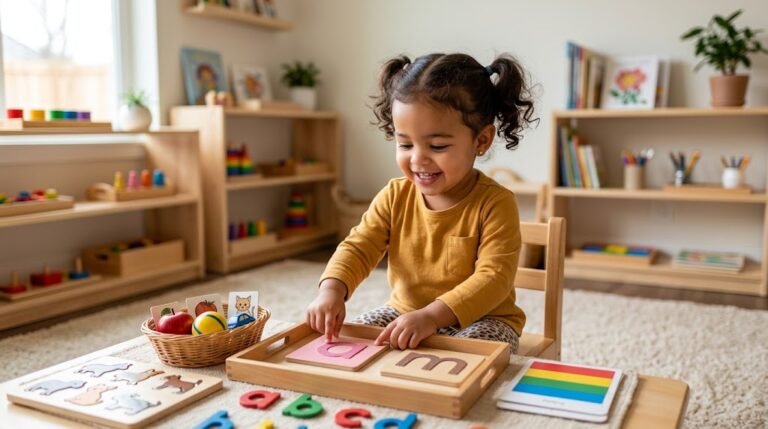
Montessori-style creative play is not passive entertainment. It combines freedom of choice with real materials and a purpose. Children explore materials deliberately, repeat what they enjoy and find their own solutions. Compared with a heap of loosely related toys, it typically invites intentional exploration of a few well-chosen materials, uses real tools and natural materials where it is safe, gives hands and fingers plenty of practice, and leaves room for patience, trial and error, and persistence.
Children often develop a strong sense of ownership when they can use materials to build, mix or transform something themselves.
Why Creative Play Matters
Creative play gives children a place to apply what they are learning in flexible ways. Without promising any particular outcome, open-ended materials invite children to practise:
- Fine and gross motor coordination
- Cause-and-effect experiments and planning
- Self-expression and talking about feelings
- Working alongside and communicating with others
Montessori programs generally combine guided work with long, uninterrupted periods in which children choose their own activities. Creative materials fit naturally into that rhythm. For more on why open-ended materials hold interest, see the science of open-ended play.
The Three-Question Test for Any Creative Toy
Many conventional creative toys focus on the result: kits that must be completed one way, electronic toys that respond instantly, or sets with a preset outcome. Montessori-style creative toys focus on the process rather than the final product. Because the label tells you little, ask three questions in the shop:
- Can the child use it with no instructions? If an adult has to explain the “right” way before it works, it is a kit and not an open-ended material.
- Does it work without batteries or a screen? A toy that does the interesting part for the child leaves little for the child to do.
- Can you name five different things it can become? Blocks pass easily (a tower, a road, food, a counting tool, a fence). A toy that is one thing, such as a single-theme set, fails.
A toy that passes all three is a good creative buy whether or not it says “Montessori”. A toy that fails two is better treated as a one-off gift. That said, a kit isn’t “bad.” Many children enjoy following instructions, and some kits are a fine stepping stone, as long as the child can also use the pieces in their own way afterwards.
Categories of Montessori-Style Creative Play Toys
Building and Construction Toys
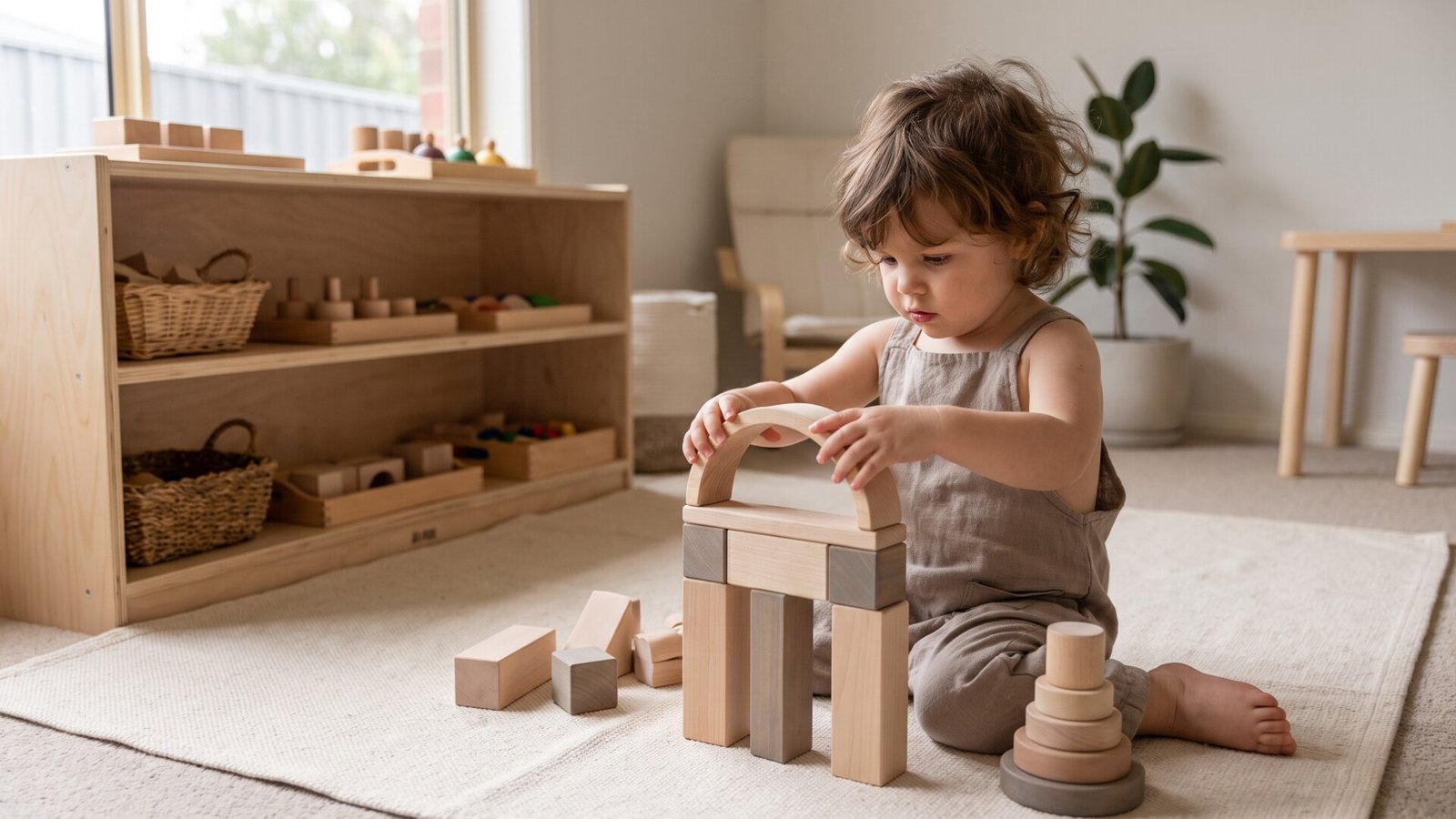
Construction toys invite children to explore balance, spatial thinking and structure. Three popular open-ended options differ more in price than in what they let a child do:
| Set | Labeled age | Typical price | Approx. cost per piece |
|---|---|---|---|
| Melissa & Doug 100-piece wooden blocks | 2+ | $13–$30 | $0.13–$0.30 |
| KAPLA 200-plank box | 3+ | $80–$150 | $0.40–$0.75 |
| Magna-Tiles Clear Colors, 100 pieces | 3+ | $120–$145 | $1.20–$1.45 |
Prices vary by retailer and sale timing; cost per piece is simple arithmetic on those ranges. The comparison shows why plain blocks suit a first set: they cost a fraction of the others per piece, and the child can already build in all the ways the dearer sets allow, except with magnets. KAPLA planks reward patient older preschoolers who like towers and arches. Magna-Tiles, labeled for ages 3+, are the most expensive by far, and whether they count as “Montessori” is debated; see our article Are magnetic tiles actually Montessori-aligned?
Plain blocks and planks are generally the most open-ended. Pre-designed kits can still be creative when the child is free to modify the model. Safety note: magnetic sets should have fully enclosed magnets, and loose small magnets are a serious hazard if swallowed, so keep them away from children under 3. KAPLA lists its sets as not suitable for children under 36 months because of small parts.
Art and Craft Materials
Art is a natural way to express ideas, explore textures and learn how materials behave. Good Montessori-style choices include washable watercolor and tempera paints, chunky crayons and pencils, natural clay, play dough or beeswax modeling material, child-safe scissors, glue sticks and collage papers, and recyclable cardboard, tubes and fabric scraps.
Offer a small, well-organized selection instead of a giant bin: one drawing tray, one painting setup and one “junk art” box is plenty. Look for art materials labeled non-toxic and conforming to ASTM D-4236 (the US art-material safety standard), and keep scissors and small tools for ages the packaging allows. Paper and paint last longer when you show a child how to carry and clean up a tray, which is a practical-life lesson in its own right.
Music and Movement
Music and movement give children a chance to explore rhythm, pitch and coordination. Bells, xylophones, rhythm sticks, shakers, scarves and ribbons all work, and older children can try simple string instruments or recorders. These materials let children listen carefully, copy patterns and invent their own. Choose instruments with real tones rather than toy-like electronic sounds, and keep the volume manageable at home. A small, well-tuned xylophone or a set of hand bells teaches more about pitch than a keyboard that plays songs on its own, because the child makes every sound. Simple listening games add to the creative shelf at almost no cost: play a short rhythm on a drum and ask your child to copy it, hide a shaker and ask where the sound is coming from, or play slow and fast music and invite scarf dancing. Offer instruments in a basket within reach, and remind children that instruments are for making music, not for banging on furniture, so sound-making stays a respected activity.
STEM-Integrated Creative Toys
Creative play and STEM overlap when children design, test and adjust. Simple machines and lever sets, open construction kits for older children, and screen-free coding games with hands-on parts all fit. For more, see Montessori STEM toys and Montessori coding and logic games.
Pretend Play
Many Montessori educators prefer pretend play rooted in real-life roles and tasks, because it helps children make sense of the world around them. Fantasy play is not forbidden at home, and plenty of families mix the two. Realistic props include child-sized kitchen sets and cleaning tools (see our Little Chef Corner guide), puppet theaters with simple natural puppets, dress-up clothes for real jobs, and play money, scales and market items. See our themes and pretend play section for more ideas.
Creative Play by Age Group
| Age | Good materials | What children practise | Adult role |
|---|---|---|---|
| 1–3 years | Large blocks, stacking toys, soft dough, shakers, bells | Exploring, hand-eye coordination, cause and effect | Close supervision; safe sizes only |
| 3–6 years | Open block sets, paints, clay, simple instruments, early STEM kits | Planning, fine motor control, imaginative thinking | Offer materials; step back |
| 6–9 years | Larger building sets, mixed-media art, sculpting, coding robots | Multi-step projects, persistence, design thinking | Provide time and workspace |
Find out more in our Montessori Toys by Age Group article and our guide to Montessori learning activities by age. For the youngest children, see the best first toys for early motor skill development.
Creating a Creative Play Area at Home
A prepared environment helps children focus and take the initiative:
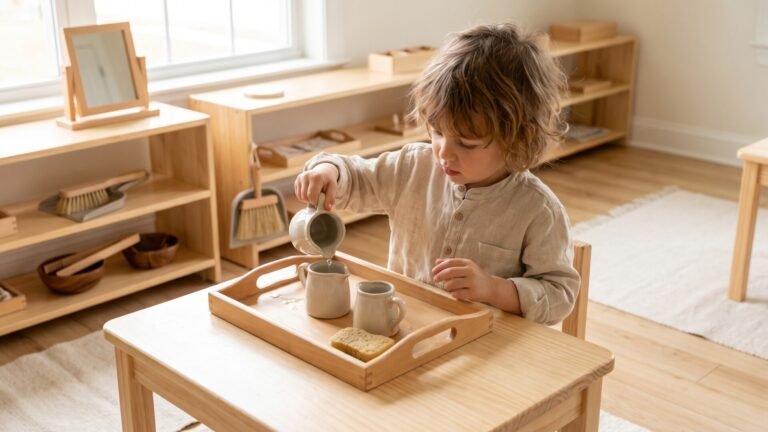
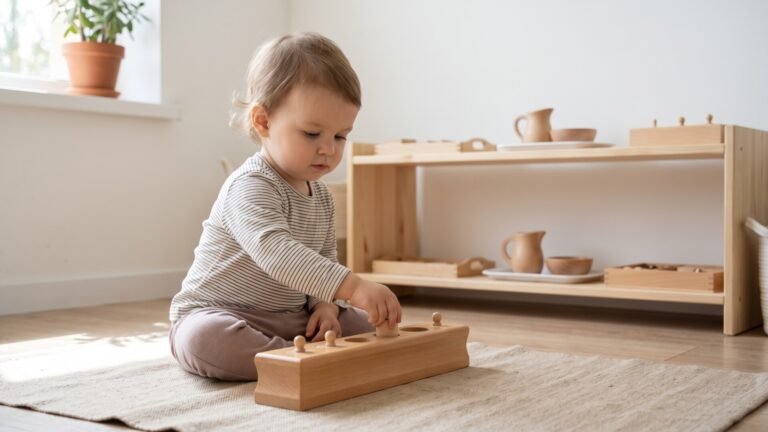
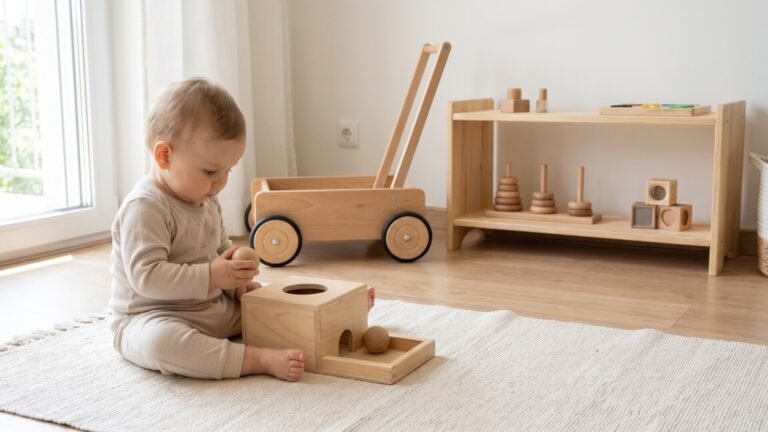
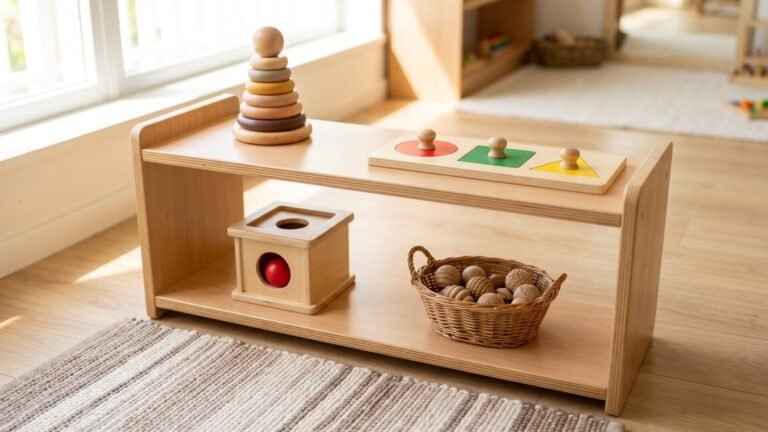
- Use low, open shelves so children can choose and return materials themselves
- Offer a limited selection, with each material in its own tray or basket. Four to eight items on the shelf is enough
- Rotate materials every week or two
- Keep a clear table or floor space for projects, and a spot where a half-finished build can stay for a day
- Include an apron, a small broom and a cloth so children can clean up after themselves
Our step-by-step guide to a minimalist Montessori play shelf shows how to do this without overspending, and simple Montessori activities you can do at home has more ideas.
Supporting the Process, Not the Product
What adults say matters as much as what is on the shelf. Instead of “What a beautiful house!”, try describing what you see: “You used the long planks for the walls and put the small ones on top.” Instead of fixing a wobbly tower, ask “What could make it steadier?” and wait. Avoid asking children to name or explain a drawing, since not every picture is of something, and resist the urge to finish a project for them.
If your child asks for help, show one step slowly and then hand the materials back. Photograph finished builds instead of keeping every one, so the blocks can go back on the shelf for the next idea, and display a few artworks at child height so they can see their work is valued.
A Sample Starter Shelf by Age
If you are starting from scratch, these shelves show how little a good creative setup needs. Each uses five or six items and swaps one or two in every few weeks.
- Ages 2–3: a 100-piece wooden block set (labeled 2+), chunky crayons and large paper, a pair of shakers or bells, and a basket of scarves for movement. Keep markers and paint for supervised sessions.
- Ages 3–5: the same blocks plus a plank set such as KAPLA, a tray of play dough or clay with simple tools, washable watercolors, a xylophone, and a few real-life pretend props such as a market basket and play money.
- Ages 6 and up: larger building sets, a mixed-media art box with a sketchbook, a simple string or wind instrument, and a screen-free coding game for children who like puzzles.
Open-Ended and Closed-Ended Toys: Aim for a Balance
Open-ended toys have no fixed goal: blocks, clay, scarves and art supplies. Closed-ended toys have a built-in correct outcome: puzzles, shape sorters and many classic Montessori materials. Each does a different job. Closed-ended materials give a sense of accomplishment and train focus, because the child can see when the task is complete. Open-ended materials give room to imagine and invent. A shelf with a mix, such as one puzzle, one set of blocks and one art tray, usually holds a child’s interest longer than a shelf of only one kind. Children differ, too. A child who loves order may settle into puzzles first and need a gentle invitation to build; a child who loves movement may start with scarves, drums and big floor builds. Follow what your child returns to, and treat the other materials as invitations that you can offer again a few weeks later. Mess is part of the process. Keep a small tray under clay and paint, use a washable mat under the art table, and teach a simple order: take out one material, use it, wipe it, put it back. Children manage these routines earlier than many adults expect, and the habit makes creative play easier to sustain. If you find your child abandons open-ended materials quickly, add a small challenge to them rather than more toys, for example “Can you build a bridge that a toy car can cross?”
Creative Play vs. Free Play
Both are valuable. Free play is unstructured and child-led; Montessori-style creative play adds a prepared environment and purposeful materials. Compared with a loose pile of toys, it often encourages repeated practice with the same material, makes it easier to concentrate because there is less clutter, and gives children a sense of ownership over their space. You don’t have to choose one. Many families keep a curated shelf for focused work and leave the rest of the house open for messy, imaginative play.
Choosing Creative Play Toys as Gifts
Open-ended materials make good gifts because they stay useful over time. Prefer open-ended and versatile materials over single-use gadgets, choose durable, natural materials when your budget allows, and be cautious with electronic or highly directive toys if you want to stay close to the Montessori approach. Check the age label, not just the “Montessori” tag, and ask the family what the child already owns so you add a new kind of material rather than a duplicate. A 100-piece block set is a safe, low-cost gift for a child of 2 or older; save the premium sets for children who already build every day. Looking for small gifts? Our list of 15 Montessori stocking stuffers may help.
Common Mistakes to Avoid
- Buying by label. A wooden toy is not automatically Montessori, and a plastic toy isn’t automatically bad.
- Too much at once. A crowded shelf makes it harder to choose and to focus.
- Directing the play. If you always show the “right” way, you take away the discovery.
- Paying for the premium set first. Check whether your child builds with a basic set before spending more per piece.
- Ignoring safety. Small parts, magnets and some art supplies need extra care for children under 3.
Frequently Asked Questions About Montessori Creative Play Toys
How much should I spend to start a creative play shelf?
Very little. A 100-piece wooden block set costs roughly $13–$30, and washable paint, paper and a simple instrument round out a workable shelf. Add pricier sets such as KAPLA planks or Magna-Tiles only if your child builds nearly every day. Cost per piece is far lower with plain blocks.
How many creative materials should be out at once?
Four to eight is a good range: one building material, one art tray, one music item and a few pretend-play props. Too many choices make it harder for a child to settle. Store the rest out of sight and rotate every week or two when your child seems bored.
When can children start using real art supplies?
Most toddlers can use chunky crayons and washable paint with close supervision. Scissors, clay tools and small beads need an age label and an adult nearby. Follow the packaging age, look for ASTM D-4236 conformance on art materials, and keep supplies out of reach of children who still put things in their mouths.
Are magnetic tiles a good creative toy?
They are very open-ended and popular for building, but they are labeled for ages 3+ and need fully enclosed magnets. They cost much more per piece than wooden blocks, and whether they fit a strict Montessori approach is debated; see our dedicated article on the subject.
Do children outgrow open-ended creative toys?
Rarely. Blocks, clay and art supplies stay useful for years because children use them in more complex ways as they grow. A toddler stacks a tower, a five-year-old builds a bridge and an eight-year-old plans a city. You may only need to add quantity or complexity, not replace the set.
Final Thoughts
Open-ended, purposeful materials in a calm, prepared space give children room to explore, build and imagine at their own pace. Start with a handful of good materials—some blocks, basic art supplies and a simple instrument—watch what your child gravitates toward, and build from there.