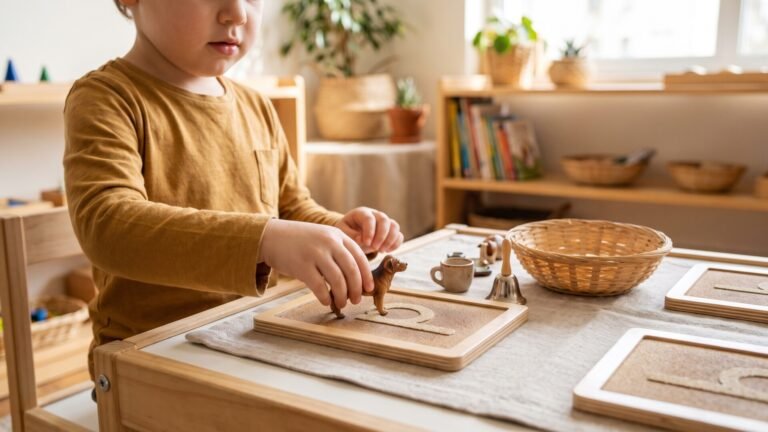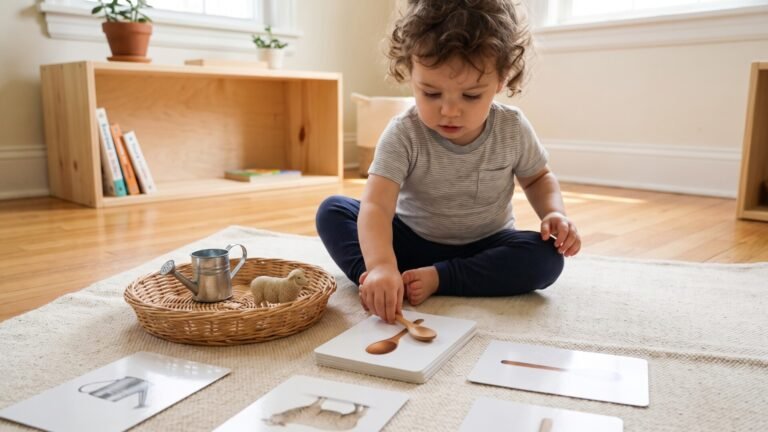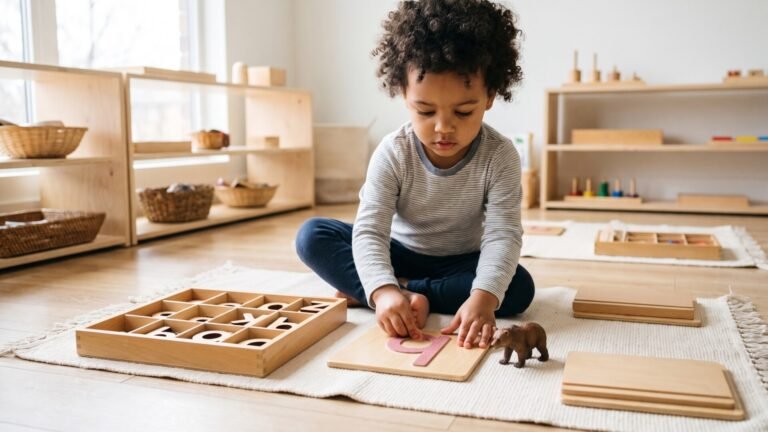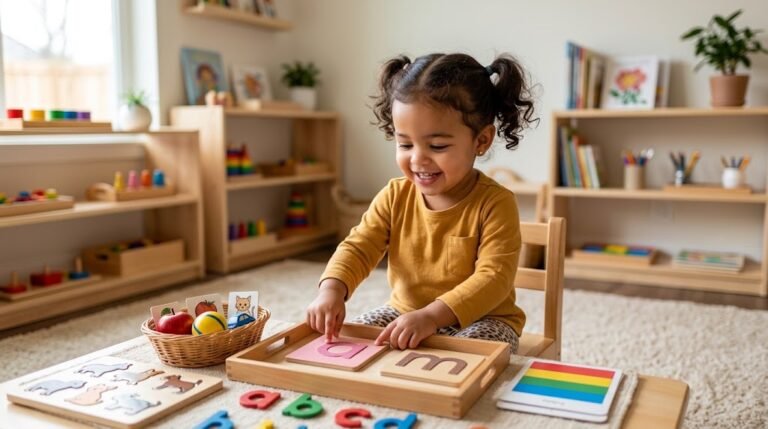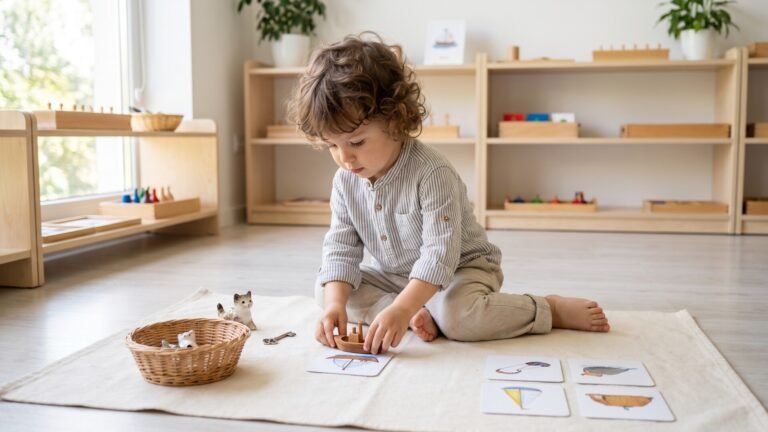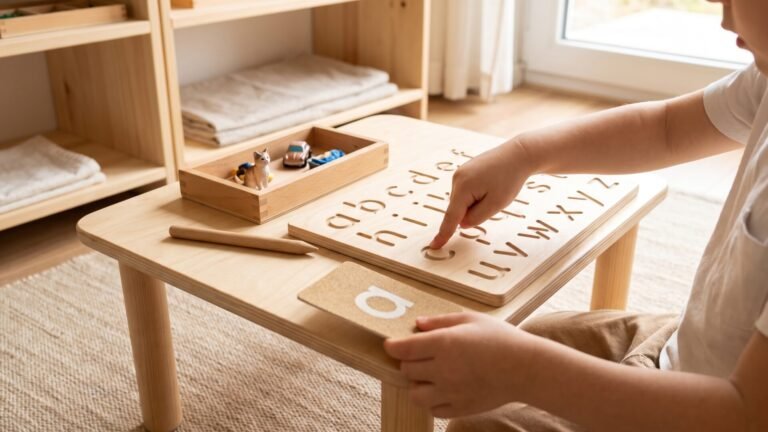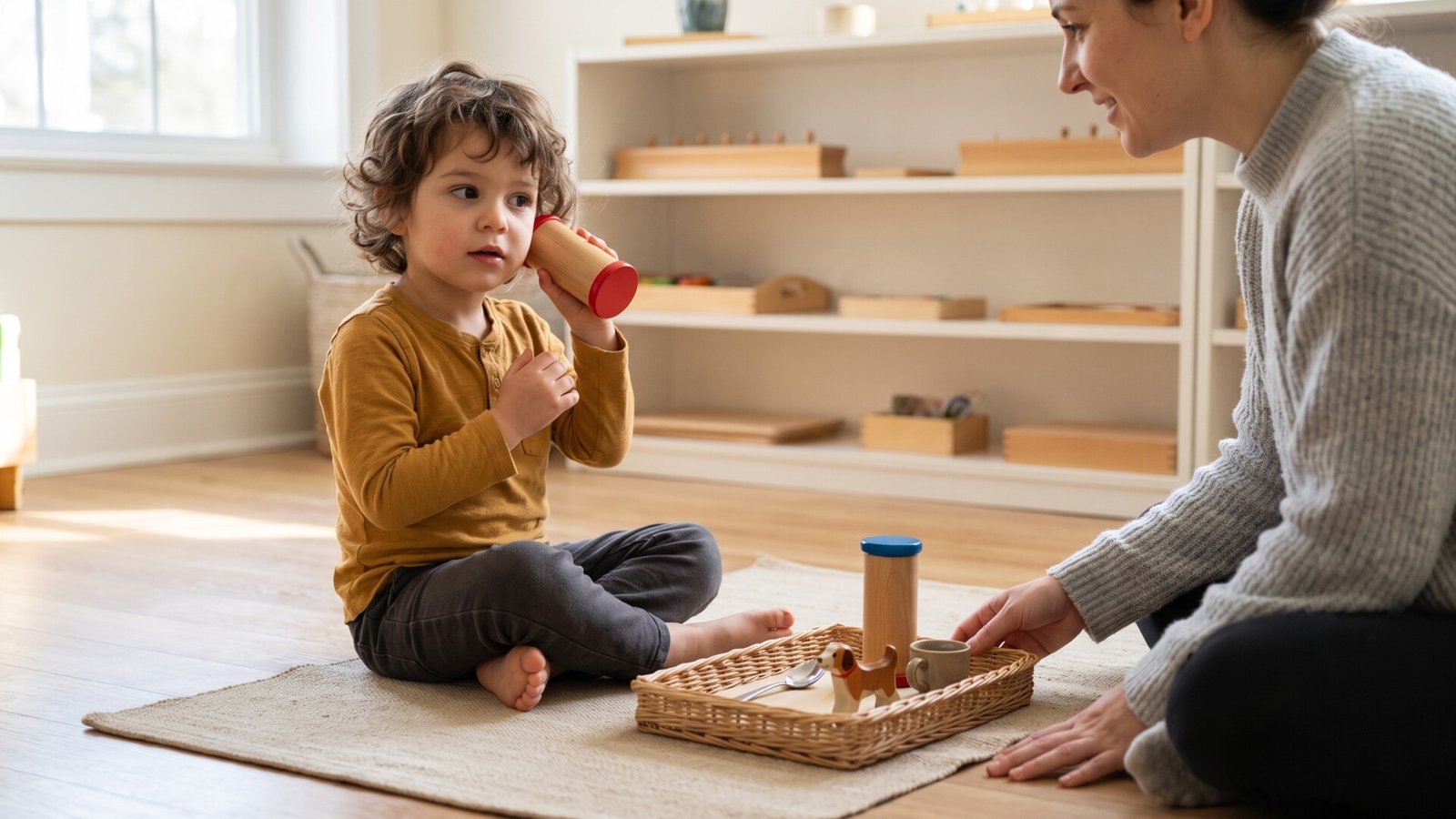
Montessori Sound Games for Language Development
If you want a screen that talks at your child, this is not the article for you. If you want a box with forty buttons and a recorded voice naming colors, you can stop reading now and save yourself the money. What actually moves language forward in the early years is quieter and cheaper than that: a handful of real sounds, an adult who listens, and a game short enough that the child asks for it again tomorrow.
Montessori sound games are listening and speaking activities, not reading instruction. They train a child to notice, hold, compare, and copy sounds, and that habit is what later makes phonics click instead of collapse. The catch is that the useful versions are almost never the ones with the biggest feature list. Most of what you need costs under $35, and some of it is already in your kitchen.
Why Montessori Sound Games Matter for Language Development
Auditory discrimination sounds clinical. In practice it means your child can tell that "cup" and "cap" are different words, that a spoon tapped on a table sounds nothing like a spoon tapped on a cushion, and that your voice went up because you asked a question rather than made a statement. None of that is automatic. It gets built by repetition, and it gets built fastest when someone is playing with the child rather than testing them.
The skills stack in a rough order. First a child notices a sound. Then they hold it in memory long enough to compare it to the next one. Then they reproduce it, either by copying a rhythm or by saying a word that starts the same way. Then they start using that skill on purpose, which is the moment a four-year-old announces that "sun" and "sock" start the same, unprompted, from the back seat of the car.
That last moment is the whole point. It is also the bridge to reading, because phonemic awareness, the ability to hear and manipulate individual sounds inside words, is one of the strongest early predictors of how smoothly a child will learn to decode print. Sound games are not a reading program. They are the groundwork that makes a reading program work.
The Montessori sequence puts concrete listening and spoken language well before anything printed. A child might spend months on environmental sounds, rhythm, and naming before anyone shows them a letter. This is deliberate. Asking a child to match sounds to symbols before they can hear the sounds reliably is like asking them to sort laundry before they can tell colors apart.
One note on framing. Sound games are play, and they are not speech therapy. If you have concerns about your child’s speech or language development, that is a conversation with your pediatrician or a speech-language professional, not something a set of shakers resolves. What the games do is give every child more practice at the listening end of language, which is useful regardless.
What Counts as a Montessori Sound Game
The label on the box tells you almost nothing. "Montessori" appears on wooden toys, plastic toys, apps, and flashcards, and the word is not protected, so anyone can print it. Judge the material by how it gets used instead.
A real sound game has a few recognizable features:
- A clear purpose. One skill at a time. Matching sounds, or identifying a sound, or copying a rhythm. Not all three at once.
- Limited materials. A tray with six shakers, not a bin with sixty pieces.
- Active participation. The child does the listening, the matching, the saying. The adult does not perform.
- Real or recognizable sounds. Actual objects, actual instruments, actual voices. Recordings of cartoon sound effects are a different thing.
- Repetition. The same game, several days running, is the mechanism. Novelty is not.
- An adult who models rather than dominates. You demonstrate once, then you get out of the way.
That last point is where most products fail. An electronic toy that responds to every press with a song and a light show is doing the work the child should be doing. The child presses, the toy performs. Nothing is being noticed, held, compared, or reproduced.
The main activity types worth knowing:
- Environmental sound matching and guessing. What is that sound? Can you find what makes this sound?
- Sound shakers and auditory memory games. Match two containers that sound the same. Find the pair you heard a moment ago.
- Listening walks. Go outside, stop, listen, name what you hear. Traffic, birds, a distant lawnmower.
- Spoken-language games such as I Spy. The Montessori version is entirely oral: "I spy with my little eye something that starts with mmm." No letters, no printed words.
- Beginning-sound games. For children who can already hear and say words clearly, isolating the first sound and sorting objects by it.
You can run every one of these with objects you own. Which is worth remembering before you spend anything.
How to Choose Materials That Actually Get Used
Age appropriateness and readiness
Toddlers, roughly eighteen months to three years, are working on environmental sounds, imitation, and simple rhythm. They are not ready for beginning sounds, and letter cards will just become chew toys. Keep it to listening walks, animal sounds, one-step sound actions, and shakers.
Younger preschoolers, around three and four, can handle matching, hidden-object guessing, rhythm copying, and loud-versus-soft contrasts. Vocabulary explodes here if you feed it, so name what you hear and how it was made.
Older preschoolers, four to six, are the ones ready for I Spy with beginning sounds, object sorting, and the slow connection between a spoken sound and a printed letter. Even here, follow the child. Some five-year-olds are ready. Some are not, and pushing it turns a game into a test.
Sound quality and control
Favor materials that make distinct, moderate-volume sounds. A set of six shakers that all sound vaguely like rice in plastic is worse than two shakers that sound obviously different. If you cannot tell the difference with your eyes closed, neither can your child.
Volume matters more than most listings admit. Harsh, loud electronic effects are hard to listen to closely, and close listening is the entire skill. If a toy has a volume switch, check whether your child can find it, because they will. If it has an off switch buried under a flap, that is a design decision someone made about your evening.
Durability, storage, and supervision
Sealed containers, secure lids, washable surfaces. Sound cylinders that open are a choking hazard and a mess. Wooden shakers that split at the seam are a splinter risk. Check the manufacturer’s age guidance and small-parts warnings on the specific listing, and inspect anything with a glued or screwed joint every few weeks.
Storage decides whether a material gets used. A set that lives on one tray and goes back on that tray is a set that comes out on a Tuesday afternoon. A set that dissolves into the general toy bin is gone by March. This is not a small point. It is most of the difference between the materials that survive and the ones that do not.
The ToyGuideHub scoring framework
I score sound-game materials on six things: how clearly the sounds carry, how many different games one material supports, how much the child can do without you narrating, how well it survives a sibling and a dropped tray, how much floor and shelf it eats, and what it costs. The score is a decision aid, not a lab result. Nothing here was tested in a facility. It reflects what these materials are like to own.
| Product | Approximate price | Best use | Independence | Storage burden | ToyGuideHub value view |
|---|---|---|---|---|---|
| Melissa & Doug Musical Instruments Set | $20-$35 | Real-sound exploration and listening games | Moderate | Moderate | Strong starter value |
| Montessori sound cylinders or sound-shaker matching set | $20-$50 | Auditory discrimination and matching | Moderate | Low to moderate | Best dedicated sound material |
| Learning Resources 3-Inch Rainbow Answer Buzzers | $15-$25 per set | Listening games and turn-taking | Moderate | Low | Useful for structured group play |
| Hape Egg Shaker Musical Instruments | $10-$20 | Rhythm, imitation, and sound comparison | Moderate | Low | Good budget add-on |
| Wooden vocabulary puzzle (See-Inside Counting Peg or similar) | $15-$25 | Vocabulary and spoken-language prompts alongside sound play | High | Low | Helpful cross-sell, not a sound game by itself |
| Movable alphabet or beginning-sound object set | $25-$60 | Transition from spoken sounds to early literacy | Adult-supported | Moderate | Best for children ready for speech-sound work |
Montessori Sound Games Worth Considering
These six serve different roles, and only two of them are what most people would call a sound game. The rest are supporting materials that make the games easier to run and easier to repeat.
Melissa and Doug Musical Instruments Set
Age range: Check the current manufacturer recommendation on the listing. The set contains multiple pieces, so supervision matters more with younger children.
What it does: A selection of real instruments, which means real sounds rather than recorded ones. You get loud and soft, shake and tap and scrape and ring, and enough variety to run a dozen short games.
Approximate price: Usually around $20-$35.
The verdict: A flexible starter set, not a formal Montessori material, and it should not be treated as one. Its value comes from structured use. Left out as free-play noise equipment, it becomes exactly that within a week. Put it away between sessions and it stays useful for years.
Best for: Families who want one accessible set for sound exploration, rhythm, and spoken vocabulary.
Pros: Multiple distinct sound types; supports movement and turn-taking; broadly reusable across ages.
Cons: Can become genuinely noisy; needs adult limits; pieces need organized storage or they scatter.
Games to run: "Which instrument did you hear?" with the instrument hidden behind a cushion. Sorting instruments into loud and soft. Copying a two-sound pattern, then a three-sound pattern. Describing how each one is played, which quietly builds verbs.
[Affiliate: Check current pricing on the Melissa and Doug instrument set]
Montessori Sound Cylinders or Sound-Shaker Matching Set
Age range: Typically preschool use. Check the individual listing for the exact recommendation and small-parts warnings.
What it does: Matching containers by sound. Two boxes sound identical, the rest do not, and the child works through until every pair is found. The visual design is deliberately plain so the ears do the work.
Approximate price: Commonly $20-$50, depending on construction and whether a presentation tray is included.
The verdict: This is the closest thing to a dedicated Montessori auditory discrimination material, and it is the one to buy if your child likes careful, quiet matching work. Do not pay a premium for poorly sealed containers or sounds that are too similar to distinguish. A $45 set with six identical-sounding cylinders is a $45 box of disappointment.
Best for: Preschoolers who can handle a structured matching task, and families who want a quiet material that stores on one tray.
Pros: Low visual distraction; encourages real concentration; compact compared with an instrument set; repeatable for years.
Cons: Sound quality varies widely by seller; needs an adult presentation first; small components require supervision.
Games to run: Match identical sounds. Order sounds from quiet to loud where the set allows. Describe the action used to make each sound. Play again a week later and see whether the pairs are remembered.
[Affiliate: Compare Montessori sound cylinder sets on Amazon]
Learning Resources 3-Inch Rainbow Answer Buzzers
Age range: Follow the current package guidance and use with supervision.
What it does: Distinct buttons with different sound effects, designed for classroom response. In a sound-game context they give a group a way to answer without everyone shouting at once.
Approximate price: Usually around $15-$25 for a set.
The verdict: Not a Montessori material, and not pretending to be. They earn a place when you have siblings or a small group and need turn-taking to work. They fail when the adult lets the game become a race, because speed rewards guessing and guessing is the opposite of listening.
Best for: Families or classrooms that need a clear response tool for group sound games.
Pros: Encourages participation; easy to understand; supports turn-taking; cheap.
Cons: Sound effects can distract from the listening; not suited to quiet independent work; batteries and electronics add maintenance.
Games to run: Press the matching buzzer after hearing an animal sound. Assign one buzzer to "same" and another to "different." Answer after a short spoken clue, with a pause long enough for thinking.
[Affiliate: Check the price of Learning Resources answer buzzers]
Hape Egg Shaker Musical Instruments
Age range: Check current manufacturer guidance, supervise younger children, and inspect regularly for cracks or loose parts.
What it does: One clear, manageable sound in a shape a toddler can grip. That is the whole product, and that is the point.
Approximate price: Usually around $10-$20.
The verdict: A low-cost way to add a distinct sound to games. Less versatile than a full instrument set, but the simplicity is an advantage for a child who gets overwhelmed by choice. If you buy one thing from this list for a two-year-old, buy this.
Best for: Toddlers and younger preschoolers beginning to imitate sounds and rhythms.
Pros: Simple to use; affordable; stores in a drawer; hard to break in normal use.
Cons: Limited sound range; repetition wears thin for adults; needs inspection for cracks or loose parts.
Games to run: Copy one shake, then two. Play and stop. Pair shaking with fast, slow, quiet, and loud, which is vocabulary disguised as a game.
[Affiliate: See current Hape shaker pricing]
Wooden Vocabulary Puzzle as a Spoken-Language Prop
Age range: Check the product recommendation and small-parts guidance.
What it does: Picture vocabulary and object naming. It makes no sound at all, which is why it belongs here as a supporting material rather than a sound game.
Approximate price: Usually around $15-$25.
The verdict: Sound games get more useful when the child has a bank of familiar words to work with. You cannot sort objects by beginning sound if you cannot name the objects. A simple picture puzzle builds that bank, and it stores flat.
Best for: Parents connecting listening games to vocabulary and early language.
Pros: Encourages naming and conversation; pairs easily with household objects; simple to store.
Cons: Provides no auditory discrimination on its own; gets outgrown by children who already know the vocabulary; needs adult prompts to stay interesting.
Games to run: Name each picture. Emphasize the first sound naturally, without stretching it into a performance. Sort small objects by sound. Make a short story using three chosen items.
[Affiliate: Check wooden vocabulary puzzle options]
Movable Alphabet or Beginning-Sound Object Set
Age range: Generally better for preschoolers ready to hear and discuss beginning sounds. Follow the material’s exact guidance.
What it does: Bridges spoken sounds and printed symbols. Real objects get matched to their initial sound, then to a letter.
Approximate price: Usually around $25-$60 for a basic set, more for premium wooden versions.
The verdict: A later step, not a first purchase. It makes sense when the child reliably names objects and shows interest in how words begin. Introduce letters too early and a listening game becomes a test with a wrong answer, which is the fastest way to end the game permanently.
Best for: Preschoolers moving from oral sound awareness toward early literacy.
Pros: Connects spoken sounds with symbols; supports many sorting activities; useful well beyond one game.
Cons: Requires readiness; needs careful adult modeling; small letters or objects require supervision.
Games to run: Start with three familiar objects. Say the word naturally. Isolate the initial sound without exaggerating it. Let the child decide whether a match sounds right, and do not correct every attempt.
[Internal: See our guide to Montessori toys for early letter recognition]
What to Skip
Large electronic language centers. The kind with a screen, a recorded voice, and forty activity modes. They encourage pressing rather than listening, they eat shelf space, and they cost three times what the useful materials cost. The child learns which button makes the noise, which is a real skill and not the one you were shopping for.
Noisy sound books with a button on every page. Same problem in a flatter format. The button is the activity.
Generic electronic talking flash-card systems deserve caution as a category rather than a blanket no. Some are fine as occasional prompts. Most are a screen with extra steps, and they replace the conversation rather than starting it.
Oversized multi-piece kits are the third trap. If setup takes longer than the game, the game does not happen.
Spend first on one quiet, versatile material, or make sound cylinders at home with six plastic eggs and different fillings, sealed with tape. Then decide whether you need anything else. Before buying, check current age guidance, choking warnings, battery requirements, volume, and construction on the specific listing.
ToyGuideHub Independent Play Score: Which Materials Work Without Constant Adult Direction?
Independent play here does not mean leaving a young child alone with small parts. It means the child can pick up the material, understand the task from a short presentation, and work at it while you make dinner four feet away. That is the version of independence that decides whether a material gets used on a Wednesday.
I score five things. Can the child understand the task after one demonstration? Does the material have a clear start and finish, so the child knows when they are done? Can they notice their own errors, or does every mistake need an adult to flag it? Is setup manageable in under a minute? And does the activity still hold up after the novelty fades?
Sound cylinders score highest on all five. The task is obvious once shown, the finish is built in, and the control of error is the material itself. If two cylinders do not match, the child hears it. No adult correction required, which means no adult required to hover. A four-year-old can work a set for fifteen minutes and put it back on the tray. That is a genuinely rare thing in a toy.
Shakers and instrument sets score lower, not because they are worse but because they are open-ended. Open-ended means the child needs a boundary, and boundaries come from an adult. Left alone with an instrument set, most children will discover that hitting two things together is fun and that hitting them faster is funner. That is fine, but it is not a language game. The material only becomes a sound game when someone structures it, which means the independence score is really a score for how well the material survives being used without you.
Buzzers score in the middle. The task is clear, but the electronic feedback pulls attention toward the button and away from the listening. Beginning-sound materials score lowest for independence and highest for payoff, because they genuinely need an adult to model and to resist the urge to correct.
Here is the counterintuitive part. The simplest material usually produces more concentrated language practice than the one with lights, recordings, and multiple modes. A child with six eggs and a tray is doing one thing: listening. A child with a talking toy is doing several things, and listening is not the one getting the most repetitions. More features means more to attend to, and attention is the scarce resource in a four-year-old.
How to Use Sound Games at Home
For toddlers. Start with listening walks. Stop on the sidewalk, hold still, and name what you hear. Traffic, a dog, a screen door. Add imitation, stop-and-go games, and one-step sound actions like "shake it once." Keep sessions to two or three minutes and stop while the child is still enjoying it. Ending early is how you get a second session tomorrow.
For younger preschoolers. Add matching sounds, hidden-object guessing, rhythm copying, and loud-versus-soft contrasts. This is also where vocabulary takes off, so describe how a sound is made. Scrape, tap, rattle, ring, thud. Children this age will copy the words back if you use them naturally instead of quizzing.
For older preschoolers. Introduce the Montessori I Spy format properly. "I spy with my little eye something that starts with mmm." No letters, no printed words, just the sound. Move to object sorting by beginning sound, then, only when the child is ready, connect a spoken sound to a printed letter.
A few things that make all of this work better. Model clearly and then wait, because the pause is where the thinking happens. Use real words rather than baby versions, since "bottle" is not harder than "baba" and it is the word they will need. Avoid correcting every attempt, because a child who is corrected four times in a row stops offering answers. Reduce background noise, which usually means turning off the television. And repeat the games the child likes across several days rather than cycling through new ones.
[Internal: More structured activities in our Montessori language activities for preschoolers]
What Most Buyers Get Wrong About Montessori Sound Games
The first mistake is believing the material has to be branded Montessori to work. It does not. Montessori is a method, not a trademark, and what makes an activity Montessori-style is how it is presented and used. A tray of six eggs filled with rice and beans, sealed with tape, presented once and left on a shelf, does more for auditory discrimination than a $60 wooden set that gets dumped in a bin. Control of the activity, a clear purpose, and repetition are the ingredients. Packaging is not.
The second mistake is assuming louder and more entertaining means better language practice. It does not, and it often means the opposite. A child needs to notice a distinction, hold it in memory, and put it into words. A toy that responds to every press with a song does the noticing for them and skips the memory and the words entirely. The entertainment is real. The language practice is not.
The third mistake is buying letters too early. A movable alphabet is a wonderful material for a child who can already hear that "map" and "moon" start the same way. For a child who cannot, it is a box of shapes with rules attached, and the rules make no sense yet. Oral language comes first. It is not a warm-up you can skip.
The fourth is the ownership trade-off nobody mentions in the listing. An inexpensive household-object game often gets used more than a costly set, because it lives on a shelf, sets up in ten seconds, and does not require a special lesson to run. The expensive set that needs a formal presentation and occupies half a shelf gets used twice and then becomes furniture. Cost and use are only loosely related in this category, and sometimes they run in opposite directions.
How to Choose the Right Option for Your Home
Best Budget Pick
Hape Egg Shaker Musical Instruments, or a homemade sound-matching activity built from plastic eggs and pantry fillings. Fewer sound types, but low storage burden and easy repetition, which is what actually drives the skill.
[Affiliate: Check Hape egg shaker pricing]
Best Dedicated Montessori-Style Material
A well-made Montessori sound-cylinder or sound-shaker matching set. Check sound clarity with your own ears if you can, confirm the containers are sealed, and look for included storage before paying more than about $40.
[Affiliate: Compare sound cylinder sets]
Best Overall for Versatility
The Melissa and Doug Musical Instruments Set, for families who can manage the noise and the storage. It supports sound identification, rhythm, vocabulary, and group play, but only when an adult structures the sessions and puts it away afterward.
[Affiliate: See the Melissa and Doug instrument set]
Best for Toddlers
One simple shaker, listening walks, and household objects. Skip the phonics kit. Simplicity and safe handling matter more than the activity count on the package, and a toddler does not need twelve options.
Best for the Language-to-Literacy Transition
A movable alphabet or beginning-sound object set, but only after the child shows readiness by noticing beginning sounds on their own. If you are not sure, wait a month and try again.
[Internal: Compare letter-focused materials in our Montessori toys for early letter recognition guide]
Conclusion
The best overall pick for most families is the Melissa and Doug Musical Instruments Set, provided you structure the sessions and store it between them. The best dedicated material is a well-made sound-cylinder or sound-shaker matching set, and the best budget option is a Hape egg shaker or six plastic eggs you filled yourself this morning. Save the movable alphabet for a child who is already noticing beginning sounds without being asked.
Here is the cheaper truth. For most homes, the $10 shaker and the eggs from the pantry will do more for language development than anything on this list, because they get used. They set up in seconds, they store in a drawer, and they do not require you to remember a lesson. Buy the dedicated set if your child genuinely likes careful matching work and you want a material that lives on a tray. Buy the instrument set if you have the shelf space and the patience for noise. Otherwise, start with what is already in the kitchen and see whether the games stick before you spend anything at all.
Check current pricing and availability through our recommended partners, and compare the material against your child’s age, listening ability, and what will realistically come off the shelf on a Tuesday.
Frequently Asked Questions About Montessori Sound Games For Language Development
What are Montessori sound games?
Purposeful listening and speaking activities that help a child notice, compare, remember, and reproduce sounds. They use household objects, instruments, sound containers, or spoken games like I Spy. The defining feature is that the child is doing the listening, not watching a toy do it.
What age can children start Montessori sound games?
Toddlers can begin with environmental listening and imitation, usually around eighteen months to two years. Matching and beginning-sound activities generally suit older toddlers and preschoolers, depending on readiness rather than birthday. If a child is not enjoying it, they are not ready, and that is normal.
Do Montessori sound games teach children to read?
They support listening, vocabulary, and early phonemic awareness, which are foundational for reading. They do not replace a broader language and literacy sequence, and no single material teaches reading. Think of sound games as the groundwork that makes later instruction land.
Are sound cylinders worth buying?
Worth it if your child enjoys focused matching, you want a quiet reusable material, and the set has clearly distinct sounds and sealed construction. A homemade version with plastic eggs and tape is enough for many homes, and it works just as well.
How long should a sound game session last?
Follow the child’s attention rather than a timer. Two focused minutes with a toddler beats fifteen distracted ones. Short, successful repetitions across several days do more than one long lesson, and stopping while the child is still engaged is what brings them back.
Are electronic sound toys good for language development?
They can provide occasional listening prompts, but they should not be the default. Parent modeling, real objects, conversation, and active sound comparison offer more flexible practice, and they do not run out of batteries at the worst moment.
What safety issues should parents check?
Small parts, sealed containers, loose components, volume, batteries, and broken shells. Check the current manufacturer age guidance on the specific listing, and supervise whenever a material contains small pieces or is used by a child who still mouths objects. Inspect anything with glued or screwed joints regularly.
Can I make sound games without buying anything?
Yes, and for many families this is the better first move. Plastic eggs filled with rice, beans, pasta, and coins, sealed with tape, make a working sound-matching set. A spoon, a pot, and a cushion cover three distinct sounds. Start there and buy only what you find yourself missing.
How many sound materials does a home actually need?
One dedicated matching material and one instrument or shaker is plenty. Rotating two things keeps them interesting. A shelf with six sound toys produces a child who plays with none of them, because choosing is harder than playing.