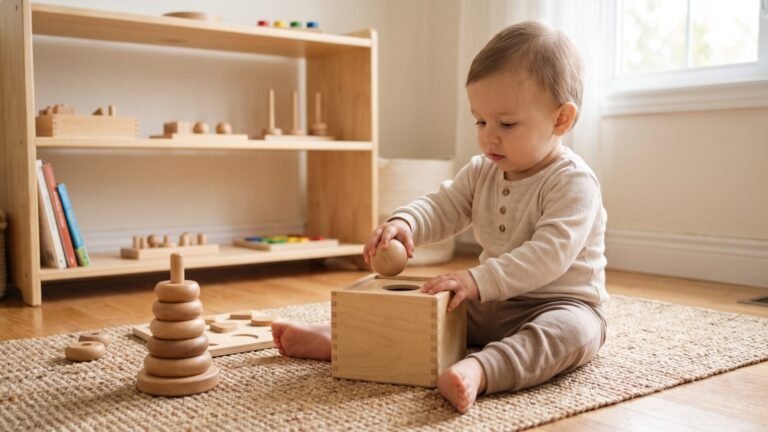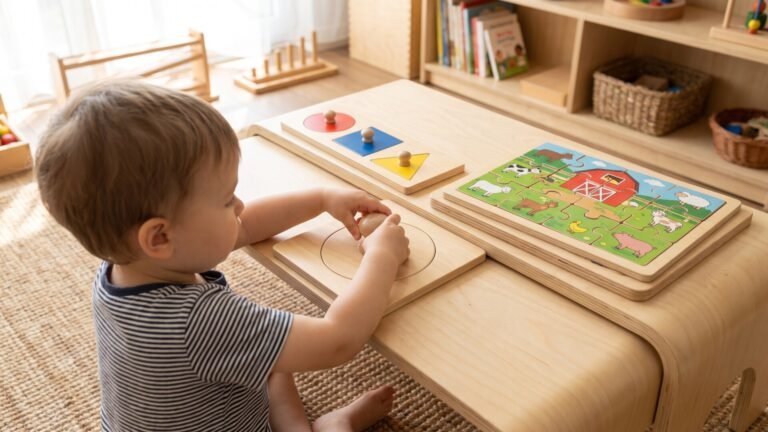
Montessori Language Activities for Preschoolers
It is 4:45 on a Tuesday and you are sitting on the floor with a small person who has lost interest in the fourth alphabet workbook you have tried this month. The workbook is open to a page of capital A’s. Your child is drawing a cat. Not a letter A. A cat. They are narrating the cat’s entire day, in detail, with sound effects. You close the workbook.
Here is what is actually happening: your child is doing language work. They are just not doing it on paper, and they are not doing it in the order the workbook expects. The best Montessori language activities for preschoolers are short, hands-on, repeatable activities that connect spoken language to real objects, sounds, and only then to symbols. Not worksheets. Not flashcards. Real things, named out loud, handled, sorted, and eventually built into words.
This is for parents of roughly three-to-five-year-olds who want to support language and early literacy without turning the preschool years into formal schoolwork. Readiness varies wildly at this age, so treat every age marker here as a rough guide, not a deadline. And Montessori-inspired does not mean buying a classroom. A few well-chosen materials and a consistent routine go further than a shelf full of alphabet products.
What Montessori Language Activities Are Designed to Do
Montessori language work moves through a sequence, and the sequence matters more than the materials. It starts with conversation and vocabulary, moves into listening and sound awareness, then letter recognition, then mark-making, and only then early reading. Children who skip ahead to symbols without the spoken-language foundation tend to memorize shapes without connecting them to sounds.
That is the difference between Montessori-inspired activities and worksheets. A worksheet asks a child to look at a letter and circle it. A Montessori activity asks the child to handle an object, hear its name, say the name, sort it, match it, and repeat the whole thing tomorrow because they want to. The child is doing something with their hands and their mouth at the same time, which is why it sticks.
The developmental benefits are real but modest, and worth stating plainly rather than overselling. These activities support vocabulary and expressive language, listening and auditory discrimination, phonological awareness, fine-motor control for writing preparation, and the habit of concentrating on one task. None of that is a guarantee, and none of it happens on a schedule. You are providing good conditions, not engineering an outcome.
Preschoolers benefit from concrete materials before abstract symbols because abstraction is genuinely hard at this age. A four-year-old can understand that the word "sun" starts with a particular sound. Asking that same child to recognize the letter S on a page, remember its name, remember its sound, and connect it to a word is four tasks stacked on top of each other. Give them the sound first, one task at a time.
Follow the child’s interest rather than a fixed reading timetable. Some four-year-olds build words. Some four-year-olds want nothing to do with letters and will spend the year narrating elaborate stories about a cat. Both are fine. The second child is not behind.
The Core Buying and Activity Principles
Four principles decide whether this goes well, and none of them involve spending more money.
Use real language before isolated symbols. Build activities around conversation, naming, storytelling, and descriptive words before expecting a child to identify letters. A child who can describe the difference between rough and smooth, heavy and light, will have an easier time with letter work later because they have practice attaching words to precise observations.
Choose one clear challenge at a time. Materials that combine colors, instructions, sounds, and symbols in one activity look impressive on a shelf and confuse the child using them. A tray with three objects and one instruction beats a busy board with eleven.
Favor tactile, self-correcting materials. Movable letters, object baskets, sound cards, and matching work produce more purposeful practice than decorative worksheets because the child can tell whether they got it right without an adult hovering. That independence is the point. It is also what makes the activity repeatable without you.
Keep materials manageable. Small trays, baskets, labeled containers, limited choices. If setup and cleanup take longer than the activity, you will stop setting it up. This is the single most common reason home language activities quietly die.
Safety, briefly and seriously. Supervise small objects and movable letters with children who still mouth materials, and check manufacturer age guidance before buying anything. Inspect wooden pieces for splinters, loose parts, and peeling finishes, especially on inexpensive sets. And when you present an activity, use clear, respectful language and resist correcting every attempt. You are modeling, not marking.
Montessori Language Activities to Try at Home
Vocabulary and Oral Language Activities
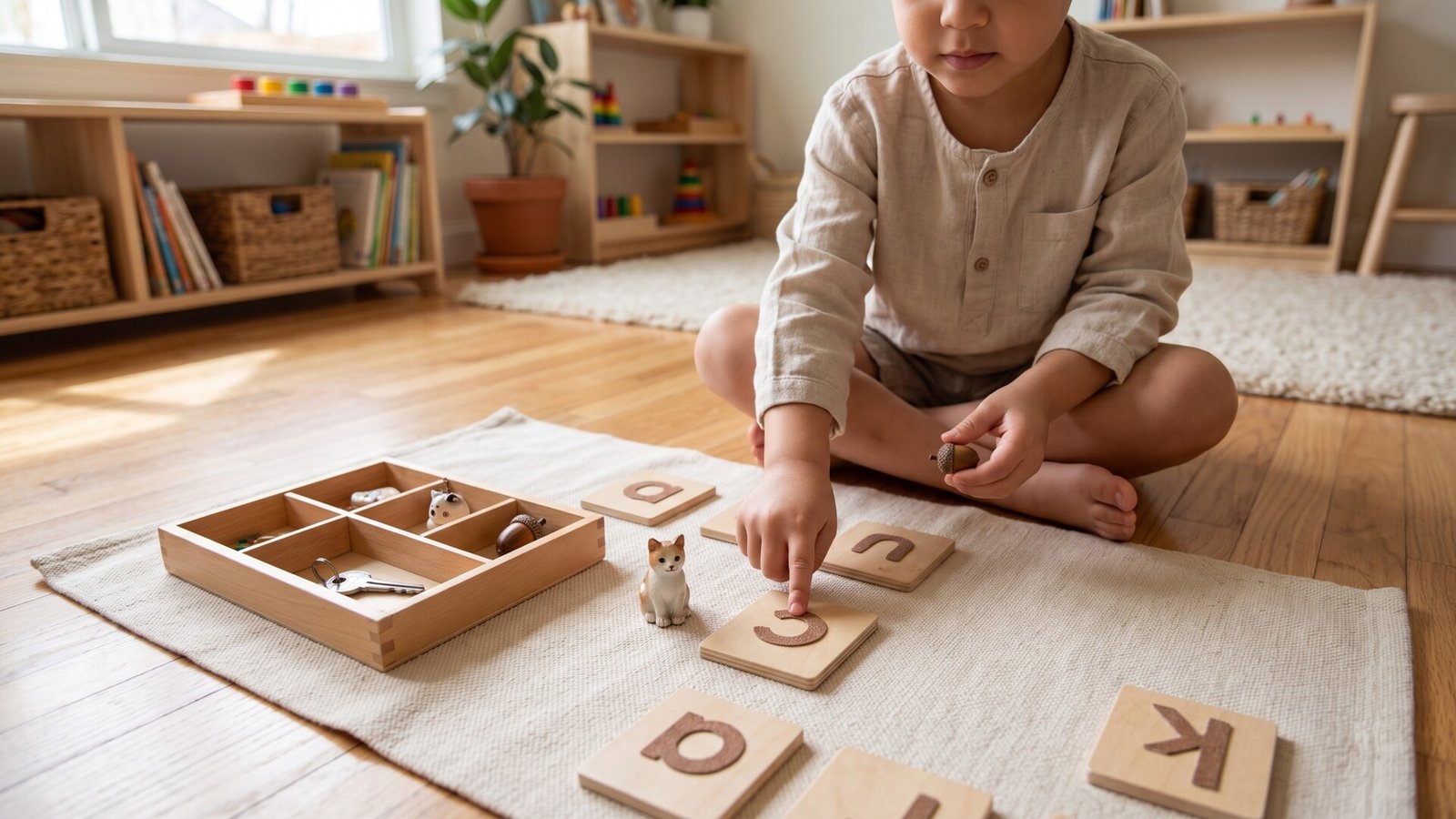
Start with a classified object basket. Fill it with familiar items: a spoon, a brush, a cup, a key, a sock. Name each one, describe what it does, and invite the child to retrieve or group them. This sounds too simple to matter. It is the foundation everything else sits on, and it costs nothing.
A matching and naming game comes next, using real objects and realistic picture cards. Begin with object-to-object matching, then move to object-to-picture. The progression matters because matching a spoon to a spoon is easier than matching a spoon to a photograph of a spoon, and the second one is closer to reading.
Use three-period lessons selectively, and only with a small number of objects at a time. Name the objects. Ask the child to identify one. Then invite the child to name it independently. If the child cannot do the second step, they will not manage the third, and the lesson should end there rather than continue into frustration.
Build descriptive language during ordinary routines. Talk about texture, size, position, function, and sequence while you are doing something else. "This one is heavier." "The cup goes behind the bowl." The key is not to test the child with rapid questions. Naming things out loud during a shared task is the whole activity.
Listening and Sound Games
Oral sound games come before letters, and they are free. Notice beginning sounds in familiar words. Ask whether two words start alike. Ask the child to listen for a target sound in a short list of words. None of this requires a material on a shelf.
Present the sound game without adding letter symbols too early. If you show the letter S while playing a beginning-sound game, you have turned a listening activity into a symbol activity, and the child is now doing two things. Keep them separate until the sounds are solid.
Keep sessions playful and brief, accept approximate pronunciation, and stop before the child becomes frustrated. A sound game that ends while the child is still enjoying it gets played again tomorrow. One that ends in tears does not. For a fuller progression, see our article on Montessori sound games for language development.
Sandpaper Letter Preparation and Tactile Letter Work
Tracing textured letters connects visual, auditory, and muscular memory when it is presented properly. The child sees the shape, hears the sound, and feels the letter under their fingers at the same time. That combination is why sandpaper letters persist in Montessori classrooms despite being low-tech.
Introduce a small group of lowercase letters rather than the full alphabet at once. Two or three is plenty. The sequence is: adult traces and gives the sound, child traces while hearing the sound, child identifies the requested letter, child recalls the sound independently. If the child stalls at step three, go back to step two next time.
Avoid teaching letter names as the only response. Montessori-style work emphasizes the sound a letter represents because sounds are what you use to build words. That said, English has plenty of irregular spellings, and letter names are not harmful. Give the sound consistently and let the name come up naturally.
Movable Alphabet and Early Word Building
The movable alphabet is a bridge from spoken words to written language, not an alphabet puzzle. The child hears a word, identifies its sounds, and places letters down to represent those sounds. This lets them compose words before their pencil control catches up, which is the entire reason it exists.
Begin with short phonetic words connected to objects or pictures when the child is ready. Sun. Map. Cat. Pig. Put the object on the mat, say the word slowly, and let the child find the letters. If they can hear the sounds, they can build the word. If they cannot, they are guessing, and it is time to go back to sound games.
Practical setup matters more than the set you buy. Use a limited number of letters rather than the whole alphabet, provide a work mat or tray so the letters stay in one place, and return pieces to compartments after use. A movable alphabet with ninety pieces scattered across a carpet is a cleanup job, not an activity.
Storytelling, Sequencing, and Early Writing
Three-picture story sequences invite the child to put events in order and explain what happened first, next, and last. This is comprehension work disguised as a card game, and it is the part of language development that letter drills consistently miss.
Offer a basket of story objects for retelling familiar tales or inventing new ones. A few animal figures and a small house will generate more language than most literacy apps, because the child has to supply every word themselves.
Provide sand, chalkboards, blank paper, and thick pencils for voluntary mark-making rather than requiring letter-perfect handwriting. Drawing, labeling, dictating a sentence, and retelling a story all support language development even when conventional reading is not yet established. A child who dictates a sentence for you to write is doing composition.
Five Useful Materials for Montessori Preschool Language Work
These are optional tools that support the activities above, not requirements. Prices are approximate USD ranges seen at US retailers in late 2026; check current pricing and the manufacturer’s age grade before buying. Most of these materials carry small-parts warnings, which matters if a toddler shares the room.
Sandpaper Letters
Suggested product: Lowercase print sandpaper letters on wooden boards from a Montessori maker such as Adena, IFIT Montessori or Nienhuis (the classroom standard, at the top of the price range). A lower-cost card alternative is Didax’s Sandpaper Letters set: 26 capital and 28 lowercase cards (including alternate forms of l and t) with tracing arrows, around $30-$35.
| Feature | Details |
|---|---|
| Age Range | Usually 3-5, depending on readiness |
| Key Features | Textured letter shapes, tactile tracing, phonetic sound practice |
| Price (approx) | $25-$60 |
The Verdict
Worth buying when the child is interested in letters and benefits from tracing, but quality varies substantially. Look for clear letter shapes, durable construction, and a presentation that supports phonetic sounds rather than decorative alphabet practice.
Best For
Families ready to move from spoken sound games into tactile letter recognition.
Pros and Cons
- Pros: Hands-on and reusable; supports multisensory learning; works well in short lessons
- Cons: Can be introduced too early; lowercase and uppercase conventions vary; some inexpensive sets have unclear shapes
Moveable Alphabet
Suggested product: A small print movable alphabet with a compartment box. In the classic layout consonants are red (or pink) and vowels are blue. Adena, IFIT Montessori and Kid Advance sell home-friendly versions, roughly $20-$70 depending on whether the box is included and how many copies of each letter you get; Nienhuis sets cost more. An alphabet puzzle is not a substitute: it has one copy of each letter, fixed in place, so a child cannot build words with it.
| Feature | Details |
|---|---|
| Age Range | Usually 4-6, depending on sound and letter readiness |
| Key Features | Loose letters for word building, spelling practice, and composition |
| Price (approx) | $20-$70 |
The Verdict
One of the strongest Montessori-inspired purchases for a preschooler who understands several letter sounds and wants to build words. A standard alphabet puzzle is cheaper but does not offer the same open-ended word-building use.
Best For
Children who can hear some sounds in words and are ready to compose simple phonetic words. [Affiliate: Check current pricing on Amazon]
Pros and Cons
- Pros: Supports writing before pencil fluency; encourages independent word building; highly reusable
- Cons: Easy to lose pieces; requires adult guidance at first; less useful before sound awareness develops
Realistic Object and Picture Card Sets
Suggested product: Safari Ltd TOOB figures paired with realistic picture cards, or a Montessori-style classified card set from a specialist seller. Each TOOB holds about a dozen small, realistic figures on a theme (farm, ocean, nature, musical instruments and so on), is rated 3+, and usually costs around $12-$20. Themed TOOBs make easy beginning-sound baskets: a farm TOOB gives you a cow, a pig and a horse, which already covers three different starting sounds. The figures are small enough to be a choking risk, so keep them away from younger siblings.
| Feature | Details |
|---|---|
| Age Range | Usually 3-5 |
| Key Features | Naming, matching, categorizing, vocabulary, storytelling |
| Price (approx) | $15-$45 |
The Verdict
Often more versatile than narrowly labeled literacy toys. The same objects support naming, sorting, beginning-sound games, prepositions, storytelling, and descriptive language. That range is what makes them worth the shelf space.
Best For
Children who need richer vocabulary practice or prefer real-world, hands-on materials. [Affiliate: Check current pricing on Amazon]
Pros and Cons
- Pros: Flexible across many activities; supports oral language first; easy to combine with household objects
- Cons: Small figures may be unsuitable for younger children; card quality varies; storage can become cluttered
Wooden Movable Letter or Word-Building Set
Suggested product: Melissa & Doug See-Inside Alphabet Peg Puzzle (26 pieces, model 3272, usually about $15-$20) for letter familiarity, or a wooden letter-building and spelling set from a Montessori specialist. Note the age grade: the puzzle carries a small-parts warning and is not for children under 3. It uses capital letters with a picture under each piece, so it teaches letter shapes and names more than sounds.
| Feature | Details |
|---|---|
| Age Range | Usually 3-5 for letter puzzles; 4-6 for word-building sets |
| Key Features | Letter handling, matching, visual recognition, early spelling |
| Price (approx) | $15-$50 |
The Verdict
A wooden letter puzzle is an affordable entry point, but do not mistake it for a complete language curriculum. Choose it for matching and recognition, then move toward loose letters if the child starts composing words.
Best For
Families seeking a lower-cost introduction to letter shapes and controlled matching. [Affiliate: Check current pricing on Amazon]
Pros and Cons
- Pros: Budget-friendly; easy to store; familiar format for independent play
- Cons: Often emphasizes letter names over sounds; limited open-ended use; may become a short-lived activity
Story Sequence Cards or Conversation Cards
Suggested product: A picture sequencing card set from an educational supplier, with three- and four-step stories made of realistic photos or clear drawings. You can also make your own: photograph three steps of something your child does every day, such as brushing teeth or planting a seed, and print them. Homemade cards built from the child’s own routines are often the ones they want to retell.
| Feature | Details |
|---|---|
| Age Range | Usually 3-6 |
| Key Features | Sequencing, oral storytelling, descriptive language, comprehension |
| Price (approx) | $15-$35 |
The Verdict
A good counterweight to letter-focused products. These strengthen the language children need to understand instructions, retell events, and make meaning from books, which is the part of literacy that shows up in every subject later.
Best For
Children who enjoy stories, pretend play, and explaining what they see. [Affiliate: Check current pricing on Amazon]
Pros and Cons
- Pros: Builds oral language; supports independent storytelling; useful away from formal letter work
- Cons: Picture quality affects engagement; some sets are too simple for older preschoolers; requires conversation to reach full value
Skip This If: Overloaded Alphabet Workbooks
Do not prioritize thick alphabet workbooks, flashcard bundles, or electronic alphabet toys simply because they contain a lot of letters. Volume is not the same as practice. These products offer quick recognition drills, but they rarely provide tactile, conversational, or open-ended use, and the child is usually passive while using them.
A small basket of real objects, a few quality sound materials, and time for storytelling will do more for most families than a shelf of workbooks. If you already own the workbooks, they are not harmful. They are just not the priority.
Comparison Table: Which Material Fits the Child?
| Material | Typical Price | Best Skill | Independent Use | Best For |
|---|---|---|---|---|
| Sandpaper letters | $25-$60 | Sound and letter connection | Moderate | Children beginning tactile letter work |
| Movable alphabet | $20-$70 | Word building and early composition | Moderate | Children ready to build phonetic words |
| Object and picture cards | $15-$45 | Vocabulary and categorization | High with practice | Vocabulary-rich language work |
| Wooden letter puzzle | $15-$50 | Letter matching and recognition | High | Budget-conscious beginners |
| Story sequence cards | $15-$35 | Narrative language and sequencing | Moderate | Children who enjoy stories and discussion |
What Most Parents Get Wrong About Montessori Language Activities
They begin with letters because letters are visible. A letter is something you can point at, so it feels like progress. Vocabulary, sound discrimination, and conversation are invisible, so they feel like nothing is happening. They are the work. Letters are the last step, not the first.
They confuse quiet behavior with meaningful independent work. A child sitting quietly with an alphabet puzzle may be matching shapes by color, not practicing language. Purposeful naming, matching, and composition are what make the activity valuable. Watch what the child is actually doing, not how calm they look.
They buy too many materials. A smaller rotation reduces clutter, improves concentration, and makes it easier for the child to repeat successful work. Ten half-used activities on a shelf teach less than three that get used properly. The shelf is for the child, not for the feeling that you have provided enough.
They correct too much. Excessive correction turns language practice into performance, and a child who is being graded stops experimenting. Model the correct word naturally in your reply and let the child try again. If they say "lellow," you say "yes, yellow" and move on.
ToyGuideHub Independent Language Practice Score
This is our editorial scoring framework for language materials, rated 1-5 across five dimensions. Clear purpose means the child can understand what to do without a complicated setup. Replayability means the material supports repeated use rather than one-time novelty. Language depth means it encourages naming, sound work, storytelling, or composition rather than button pressing. Parent burden scores higher when setup, cleanup, and teaching demands are lower. Growth over time means the material stays useful as skills develop.
| Material | Independent Practice | Replayability | Language Depth | Parent Burden | Growth Over Time |
|---|---|---|---|---|---|
| Sandpaper letters | 3/5 | 4/5 | 4/5 | 3/5 | 4/5 |
| Movable alphabet | 3/5 | 5/5 | 5/5 | 3/5 | 5/5 |
| Object and picture cards | 4/5 | 4/5 | 5/5 | 4/5 | 4/5 |
| Wooden letter puzzle | 4/5 | 3/5 | 3/5 | 4/5 | 3/5 |
| Story sequence cards | 3/5 | 4/5 | 5/5 | 4/5 | 4/5 |
These are planning ratings based on how the materials are designed and used, not laboratory testing and not predictions about any particular child. A material that scores well here can still sit untouched for six months if it arrives before the child is ready for it. The scores tell you what a material is capable of, not what your child will do with it.
The Hidden Cost of Choosing the Wrong Language Material
The lowest price is not the lowest total cost. A $12 activity used twice costs $6 per use. A $45 movable alphabet used weekly for two years costs about fifty cents per use, and it is still on the shelf for a younger sibling. That math is worth doing before you click buy, because the cheap option is only cheap if it gets used.
The hidden costs are the ones that show up after the box is open. Missing pieces and difficult storage are the big ones. A set with ninety loose letters and no compartment tray becomes a daily cleanup job, and you will stop getting it out. Materials that require constant adult prompting are expensive in a different currency. Products that teach letter names but do not support sound work look educational and quietly work against the sequence. Oversized sets overwhelm a small play area, and an overwhelmed child does not choose the activity.
Here is the calculation worth running before any purchase. Estimate expected weekly use. Estimate the useful age span, which for language materials is usually longer than you think because the same objects serve different activities at three and at five. Weigh the storage burden honestly. Then ask whether the material supports more than one language activity. Something that does one thing has to be very good at that one thing to earn its space.
Applied to this category: the best long-term value is a movable alphabet and a realistic object set, because both keep working as skills grow. The best low-cost entry is household objects, paper cards, and a simple wooden letter puzzle. The best specialist purchase is quality sandpaper letters, and only when the child is ready for them. The most likely to disappoint is anything with one purpose and a lot of buttons.
How to Choose Activities by Readiness and Home Situation
Best for a Three-Year-Old Beginning Language Work
Prioritize conversation, object naming, matching, sound games, and short three-period lessons. That is the whole plan for this age, and it does not require a purchase. If your child is newly three or still working on earlier skills, our article on Montessori language activities for 2-year-olds covers the groundwork. Avoid requiring independent word building before the child shows sound and letter interest. There is no prize for starting early.
Best for a Preschooler Interested in Letters
Use sandpaper letters, beginning-sound games, letter matching, and simple object-to-letter work. Introduce only a few letters at a time and watch whether the child can identify them without repeated prompting. If you have to remind them every time, the group is too big. Our guide to Montessori toys for early letter recognition covers the material options in more detail.
Best for a Preschooler Ready to Build Words
Choose a movable alphabet, object baskets, and short phonetic word activities. This is the stage where a real purchase earns its keep, because the child is doing something no worksheet can replicate. For the wider material landscape, see our complete guide to Montessori language and literacy toys.
Best for Small Spaces or a Tight Budget
Use a small tray, household objects, homemade picture cards, paper, chalk, and one durable letter material. That setup covers vocabulary, sound work, mark-making, and early letter recognition. Add materials only when an existing activity is used consistently and no longer offers an appropriate challenge. The second condition matters as much as the first.
Best for a Child Who Avoids Formal Letter Practice
Start with storytelling, sound hunts, songs, object sorting, pretend play, and drawing. Keep letters available without making them the required endpoint. Read aloud daily and talk about what you read. A child who spends preschool avoiding letters and narrating stories is building the vocabulary and comprehension that reading depends on. Our article on Montessori pre-reading activities for toddlers covers the earlier version of this approach.
Practical Parent Guidance and Safety
Keep presentations short and stop while the child is still engaged. Repeated voluntary use matters more than long lessons, and a five-minute activity chosen by the child beats a twenty-minute activity imposed by you.
Demonstrate slowly, use precise but natural vocabulary, and avoid turning every activity into a quiz. The moment a child feels tested, the activity becomes a performance and the learning gets shallower.
Store small pieces in labeled containers and supervise children who may mouth objects. Check wooden materials for sharp edges, loose parts, peeling paint, and accurate age guidance, and follow the manufacturer’s age rating rather than your own assessment of your child.
Adapt activities to the child’s communication style, attention span, and interests. If a child is not talking much yet, the object naming and sound games still apply. If a child prefers moving to sitting, run the sound game while walking.
If you have persistent concerns about hearing, speech, comprehension, or communication, seek professional guidance. Toys are not a substitute for an evaluation or a support service, and no material on this list is designed to address a developmental concern.
A Simple Week of Montessori Language Activities
Most families do better with a light rhythm than a curriculum. This is one example of how the activities above can fit into ordinary days in ten to fifteen minutes. Swap days around freely, skip anything that is not landing, and repeat whatever your child asks for again.
| Day | Activity | What it practises | Materials |
|---|---|---|---|
| Monday | Object basket: name, describe, sort by use | Vocabulary and descriptive language | 5-6 household objects, a basket |
| Tuesday | “I spy something that starts with /m/” | Beginning sounds, listening | None |
| Wednesday | Trace two or three sandpaper letters, then hunt for objects that start with those sounds | Sound-symbol link | Sandpaper letters, small objects |
| Thursday | Three-card story: order it, tell it, then tell it backwards | Sequencing and narrative | Sequence cards or photos |
| Friday | Build two or three short words for objects on the mat | Word building (only if ready) | Movable alphabet, objects |
| Weekend | Read aloud, then ask the child to retell their favourite page | Comprehension and expressive language | Library books |
If your child is not ready for Friday’s word building, replace it with a second sound game or a drawing-and-dictation session where they draw a picture and you write down the sentence they tell you about it. That is composition too.
When to Ask for Professional Advice
Preschool language ranges are wide, and a child who prefers stories to letters is not a concern. It is still worth knowing when to check in. The American Speech-Language-Hearing Association (ASHA) publishes age-by-age communication milestones that many paediatricians use as a reference. Talk to your child’s doctor, or ask for a speech-language evaluation, if your preschooler is hard for unfamiliar adults to understand most of the time, rarely uses sentences, has trouble following simple directions, seems not to hear you reliably, or has lost words or skills they had before. Asking early is never the wrong call, and none of the activities here replace that conversation.
More Montessori Guides for Preschoolers
- Montessori and early learning toys: the overview of every Montessori area on the site.
- Montessori language games for preschoolers and language games for older kids: game-style versions of the activities above.
- Montessori practical life activities for preschoolers: pouring, spooning and threading build the hand control that later goes into writing.
- The Montessori puzzle progression guide: how to tell when a child is ready for the next puzzle, including letter puzzles.
- Montessori-aligned cooperative board games: turn-taking and conversation practice for four- and five-year-olds.
- Inclusive math manipulatives for preschoolers: the same concrete-before-abstract idea, applied to numbers.
- How to find real wood Montessori toys on a budget: useful before buying sandpaper letters or a movable alphabet online.
- Toys for children who prefer solitary play: ideas for quieter children who like to work alone.
- Looking ahead: the best Montessori toys for 6-9-year-olds, where grammar and reading materials take over from early sound work.
Where This Actually Lands
Back to the Tuesday floor. The workbook is closed. The cat has had a full day, and your child has narrated all of it, which means they spent twenty minutes on vocabulary, sequencing, and expressive language without anyone calling it language work. That is the version of this that survives contact with a real preschooler.
If you want to buy one thing, buy a movable alphabet for a child who can already hear some sounds in words. If you want to buy nothing yet, build an object basket from your kitchen and start naming things. If your child is somewhere in between, a set of realistic object figures and picture cards will carry you through vocabulary, sorting, beginning sounds, and storytelling for a couple of years.
Check current pricing and availability through our recommended partners, and choose the material that matches your child’s present readiness rather than the most advanced-looking set. The advanced-looking set will still be there in six months. So will the cat.
Frequently Asked Questions About Montessori Language Activities For Preschoolers
What is the best Montessori language activity for a preschooler?
A real-object naming and matching activity is the strongest starting point because it builds vocabulary before asking the child to manage abstract symbols. Children ready for early literacy can move to sound games, sandpaper letters, and a movable alphabet.
Should preschoolers learn letter names or letter sounds first?
Both have a place, but Montessori-style early literacy work gives strong attention to the sounds letters represent because sounds are what you use to build words. Present the sound consistently and let the letter’s name come up naturally.
Are Montessori language activities suitable for children who are not reading yet?
Yes. Conversation, storytelling, object classification, listening games, and sound awareness are meaningful language work even when a child is not reading. Preschool development does not follow one fixed timetable, and reading readiness varies widely at this age.
How long should a Montessori language activity last?
Only as long as the child remains engaged and can participate successfully. A focused presentation may take a few minutes. Voluntary practice can continue longer if the child is working purposefully, and you should let it.
Do I need expensive Montessori materials at home?
No. Household objects, homemade cards, books, paper, and conversation cover a large part of Montessori-inspired language work. Buy specialized materials when they provide a tactile or self-correcting experience that is genuinely difficult to recreate at home.
Is a movable alphabet appropriate for every preschooler?
It is most useful when a child recognizes some letter sounds and can hear at least some sounds in simple words. Introducing it too early turns word building into guessing or frustration, which is worse than waiting.
Are alphabet apps and electronic toys helpful for language development?
They may provide limited recognition practice, but they should not replace conversation, reading aloud, sound games, storytelling, and hands-on materials. For most families, open-ended physical materials offer more flexible language use and less passive screen time.
How many materials should I have out at once?
Three or four is plenty for most preschoolers. Rotate them rather than adding more, and keep the rest stored. A child who can see everything available usually chooses the easiest thing, not the most useful one.
What if my child refuses letter activities entirely?
Follow the interest instead of the sequence. Storytelling, sound hunts, songs, object sorting, pretend play, and drawing all build the language skills that reading depends on. Keep letters available without making them the required endpoint.
What colors should a movable alphabet be?
The traditional Montessori movable alphabet uses red (or pink) consonants and blue vowels, which helps children see that most words need a vowel. Single-color sets work too; the color coding is a helpful cue, not a requirement.
Should sandpaper letters be lowercase or uppercase?
Most Montessori programs start with lowercase print letters, because most of the text children see in books is lowercase. Some sets include both cases. Pick the style (print or cursive) that matches what your child will meet at school.
Is an alphabet puzzle a Montessori language material?
Not really. A puzzle like the Melissa & Doug See-Inside Alphabet Peg Puzzle is fine for letter-shape familiarity, but it has one fixed copy of each letter and mostly teaches letter names. It cannot be used to build words the way a movable alphabet can.