Best Montessori Toys for 1-Year-Olds
The people who sell toys will tell you the bestseller is the one with the most buttons. The people who work in early years settings will tell you something different, and it is usually this: the toy a one-year-old plays with longest is the one that does the least on its own. A post with rings. A box with a ball. A bead maze that has been on the same three curvy wires since the 1970s. None of it looks like much on a shelf. All of it gets used.
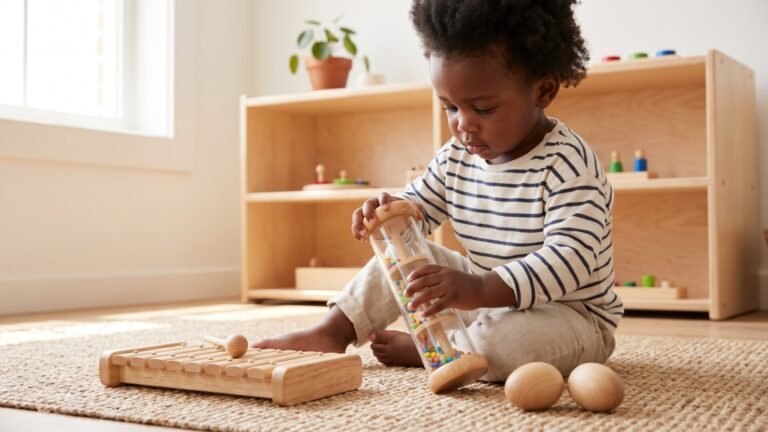
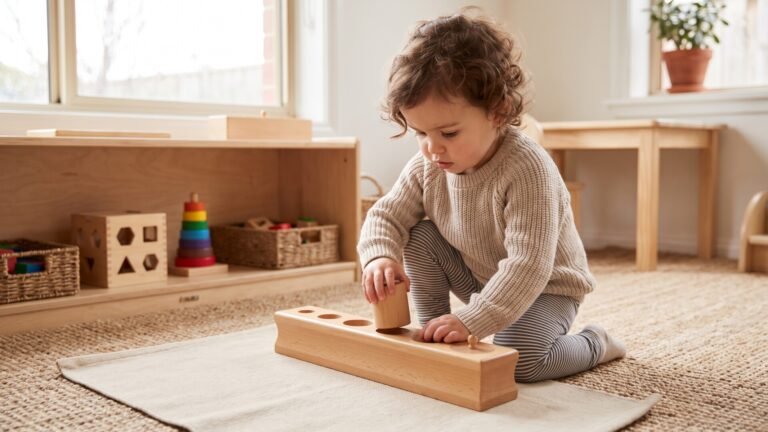
That is the short answer to the whole question. The best Montessori toys for 1-year-olds are simple, open-ended things that support movement, grasping, object permanence, matching, and the first stirrings of independence. Not the ones with the most features. The ones with the fewest.
One caveat before you spend anything. A 1-year-old’s abilities swing wildly. Some are walking, some are not close. Some will sit with a posting box for eleven minutes, which at this age is a geological era. So treat every age label as a starting point, not a promise, and buy for the child in front of you rather than the one on the box.
What Montessori Means for a 1-Year-Old
“Montessori toy” is mostly a retail description. There is no governing body checking whether a wooden rainbow deserves the label, and plenty of products use it because it sells. The principles underneath it are more useful than the branding: purposeful activity, hands-on exploration, real-world relevance, freedom within limits, and independence that increases gradually as the child’s skills do.
Around twelve to eighteen months, the skills developing are pretty consistent. Standing and cruising into walking. Placing objects and removing them. A pincer grasp that gets sharper by the week. Imitating what you do. Cause and effect, which is the big one. And the beginnings of simple problem-solving, usually in the form of “if I drop this, someone retrieves it.”
Montessori-style toys tend to be simple, quiet, and made of materials that survive being mouthed. That does not make every electronic toy inappropriate, and it does not make plastic a failure. A toy that lights up and plays a song is not morally worse than a wooden ring. It is just doing more of the work, which leaves less for the child. That is the trade, and it is worth understanding before you pay a premium for the absence of batteries.
If you want the wider picture across the whole age band, Montessori Toys for Toddlers (1-3 Years Old) covers what changes between one and three and where the money is best spent at each stage.
How to Choose Montessori Toys for a 1-Year-Old
Developmental fit
Look for one clear challenge the child can attempt now and come back to later. Posting, stacking, transferring, opening, closing, matching. A toy with a single obvious action gets used. A toy with six modes gets pressed at random and abandoned.
Safety and supervision
Age-appropriate design, sturdy construction, securely attached parts, smooth edges, and no small detachable pieces that create a choking risk. Follow the manufacturer’s age guidance, and check toys regularly for loose parts, cracked finish, or anything that has started to wobble. Small parts, magnets, batteries, and cords all deserve a second look. If you are unsure about a specific product, the manufacturer is the only source that matters.
Independence and frustration level
The best toy here is one a child can succeed with after a short demonstration. Some activities still need you nearby, and that is normal. But if the toy only works when an adult operates it, you have bought yourself a job.
Ownership practicality
Storage footprint, cleanability, noise, and durability all decide whether a toy stays in rotation. A toy that takes four minutes to set up and ninety seconds to knock down will end up in a cupboard by February.
What Most Buyers Get Wrong About Montessori Toys
A higher price does not make a toy more Montessori. Neither does natural wood, and neither does a muted color palette that photographs well. You are paying for durability, safety, and developmental fit. Sometimes those things cost more. Sometimes you are paying for beige.
The second mistake is expecting the toy to be used correctly. At this age, dropping, carrying, banging, filling, emptying, and repeating are the play. A one-year-old who carries the stacking rings around the room and never stacks them is not misusing the toy. They are in the middle of using it.
Third: fewer toys usually produce better engagement. A child who can see, reach, and understand their options will pick one and stay with it. A child facing a wall of choice will move between things without settling. The rotation approach is not minimalism for its own sake – it is about making the available choice legible.
Here is a decision rule worth keeping. Choose one toy for movement, one for fine-motor practice, and one open-ended option. That is three. Live with those for a month before adding anything specialized, and you will learn more about your child’s preferences than any review can tell you.
Best Montessori Toys for 1-Year-Olds
Every toy below is scored out of 10 on the same six criteria: developmental fit, independence potential, durability, replayability, safety practicality, and value. These are editorial judgments based on how the category behaves in real homes, not laboratory testing. A high score means the toy does its job for most children at this age. It does not mean your child will agree.
PlanToys Push Along Zebra
| Feature | Details |
|---|---|
| Age Range | Typically suited to early walkers; verify current manufacturer guidance |
| Key Features | Push-along design, movement practice, sturdy wooden construction |
| Price (approx) | $35-$60 |
The Verdict
This is a movement toy, not a walking trainer. It gives a child who is already pulling up something purposeful to push across the floor, and it survives being leaned on. It should not be treated as a balance aid and should never be left near stairs or a step-down.
Score: 8/10. It earns that on durability and developmental timing. It loses points because it is useless to a child who is not yet interested in moving, and there is a window of about four to six months where it matters most.
Best For
Early walkers who enjoy carrying, pushing, and covering ground.
Pros and Cons
- Pros: Encourages active play; visually simple; stays interesting after first steps
- Cons: Needs open floor space; not right for every pre-walking child; pushing play loses novelty once walking is confident
Melissa & Doug First Bead Maze
| Feature | Details |
|---|---|
| Age Range | Commonly designed for babies and young toddlers; verify the current label |
| Key Features | Large movable beads, grasping and hand-eye coordination practice, compact footprint |
| Price (approx) | $15-$30 |
The Verdict
The unglamorous one that keeps working. It sits on the floor or a stable surface, the beads move, and the child’s hands figure out the rest. Check the frame and bead attachments every few weeks – this is a toy that gets leaned on and dropped.
Score: 8/10. Cheap, compact, and genuinely replayable. It loses points for being less open-ended than a basket of safe household objects, and for frustrating children who are not yet ready to work a bead around a curve.
Best For
Small homes, moving between rooms, and children who like repetitive hand movement.
Pros and Cons
- Pros: Affordable; compact; encourages grasping and visual tracking
- Cons: Less open-ended than loose safe objects; can frustrate; occupies one specific type of play
PlanToys Wooden Stacking Ring
| Feature | Details |
|---|---|
| Age Range | Commonly suited to babies and toddlers; verify current manufacturer guidance |
| Key Features | Large rings, stacking post, color and size exploration |
| Price (approx) | $20-$35 |
The Verdict
The classic introduction to placing and removing. Expect your 1-year-old to carry the rings, scatter them, and possibly wear one as a bracelet before they ever stack anything. That is fine. The stacking comes later, and the toy is still earning its place.
Score: 8.5/10. The post needs supervision, and some children outgrow basic stacking quickly. But it is one of the most reliably used toys at this age, and it stores in a shoebox.
Best For
Children practicing grasp-and-release, posting, and early stacking.
Pros and Cons
- Pros: Supports repeated practice; small storage footprint; simple to demonstrate
- Cons: Post requires supervision; some children move on fast; check painted surfaces for wear
Lovevery The Babbler Play Kit
| Feature | Details |
|---|---|
| Age Range | Built for a specific developmental window; confirm the current kit range |
| Key Features | Multiple coordinated activities, object permanence and fine-motor play, curated presentation |
| Price (approx) | $80-$120 per kit, depending on format |
The Verdict
This is a curation purchase, not a developmental necessity. If you want someone else to have done the thinking and you will actually rotate the pieces, it works. If you already own a stacking ring and a posting box, you are mostly buying duplicates in nicer packaging. Nothing here is required for Montessori play.
Score: 7.5/10. The pieces are well chosen and the guidance is genuinely useful. The score reflects the convenience premium and the storage discipline it demands.
Best For
Gift buyers and parents who want a ready-made developmental rotation.
Pros and Cons
- Pros: Removes the research; several related activities; supports toy rotation
- Cons: Higher upfront cost; some pieces get used far more than others; needs storage discipline
Wooden Object Permanence Box with Tray
| Feature | Details |
|---|---|
| Age Range | Often suitable for sitting babies and toddlers beginning object permanence play; verify the label |
| Key Features | Drop-and-retrieve activity, removable tray, cause-and-effect practice |
| Price (approx) | $25-$50 |
The Verdict
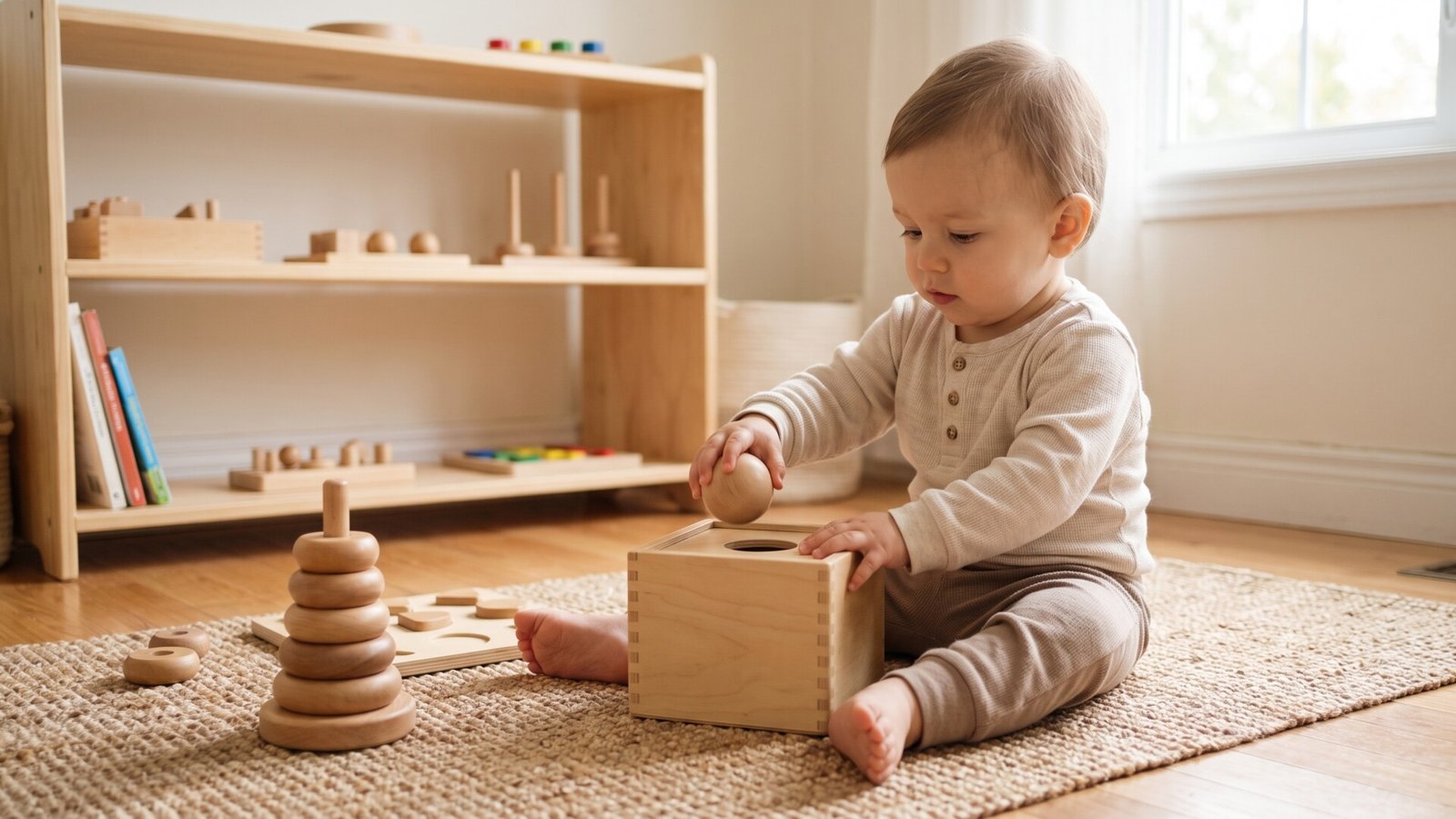
The strongest single purchase on this list for most families. The child drops the ball, it disappears, it reappears in the tray. That loop is endlessly repeatable, and it teaches something real. The included ball must meet the manufacturer’s safety requirements – do not substitute random small objects from around the house.
Score: 9/10. Clear challenge, high repeatability, compact storage, moderate price. Quality varies a lot between sellers, so buy from a source with clear age guidance and a return policy.
Best For
Children fascinated by putting things in and taking them out.
Pros and Cons
- Pros: Clear, repeatable challenge; encourages retrieval and repetition; useful across several months
- Cons: Can become repetitive; included pieces need supervision; construction quality varies widely
Hape Pound and Tap Bench
| Feature | Details |
|---|---|
| Age Range | Commonly marketed for babies and young toddlers; verify the current age label |
| Key Features | Pounding activity, removable balls, cause-and-effect play |
| Price (approx) | $25-$40 |
The Verdict
A safe outlet for banging, which is a real need at this age and better directed at a bench than at your coffee table. It is louder than most of this list, and there is no volume switch, because there is no volume. The household environment decides whether this is a good purchase.
Score: 7/10. Developmentally solid, genuinely engaging, and it builds hand strength. It loses points on noise and on how much adult management the loose balls require.
Best For
Toddlers who enjoy cause-and-effect action and active hand play.
Pros and Cons
- Pros: Engaging for repetitive play; supports hand strength and coordination; combines action with a visible result
- Cons: Noise is intrusive; pieces must be monitored; can be over-stimulating in a small space
Grimm’s Large Rainbow
| Feature | Details |
|---|---|
| Age Range | Manufacturer guidance varies; use only when the specific piece suits the child, and supervise closely |
| Key Features | Open-ended stacking, arranging, enclosing, and pretend play |
| Price (approx) | $80-$120 or more, depending on size and seller |
The Verdict
A long-term toy, not a first manipulative. Your 1-year-old will carry it, stack it, nest it, and knock it down, and the larger pieces need close supervision throughout. The value shows up in year three and four, when it becomes a bridge, a house, a fence, and a ramp. Verify the specific product’s age guidance and material safety information before buying.
Score: 7.5/10. Superb long-term play potential, poor short-term developmental targeting, and the storage footprint is real.
Best For
Families who want one open-ended toy that outlasts the toddler years.
Pros and Cons
- Pros: Strong long-term potential; supports flexible thinking; becomes part of pretend play
- Cons: Expensive; takes up space; some versions are not appropriate for unsupervised use with younger children
Comparison Table: Best Montessori Toys for 1-Year-Olds
| Product | Approx. Price | Best Developmental Fit | Durability Potential | Space and Parent Hassle |
|---|---|---|---|---|
| PlanToys Push Along Zebra | $35-$60 | Movement and early walking | High with proper use | Needs floor space |
| Melissa & Doug First Bead Maze | $15-$30 | Grasping and visual tracking | Moderate to high | Compact, low setup |
| PlanToys Wooden Stacking Ring | $20-$35 | Placing, removing, stacking | High | Compact |
| Lovevery The Babbler Play Kit | $80-$120 | Curated mixed activities | Moderate to high across pieces | More storage and sorting |
| Wooden Object Permanence Box | $25-$50 | Retrieval and cause and effect | Varies by construction | Compact |
| Hape Pound and Tap Bench | $25-$40 | Banging, coordination, action-reaction | Moderate to high | Noisy but manageable |
| Grimm’s Large Rainbow | $80-$120+ | Open-ended play, long-term use | High | Larger storage footprint |
Editorial scores, for quick reference: Object Permanence Box 9, Stacking Ring 8.5, Push Along Zebra 8, Bead Maze 8, Lovevery Kit 7.5, Grimm’s Rainbow 7.5, Pound and Tap Bench 7.
ToyGuideHub Independent Play Score
The Independent Play Score is an editorial estimate, not a measurement. It asks four things about each toy. How easily can a child start using it after a brief demonstration? How many meaningful actions does it support? How often does an adult have to reset it? And how long does it stay useful as the child’s skills move on?
A high score means the toy works when you are not sitting on the floor with it. That matters more than most reviews admit, because the honest reason parents buy these toys is that they need eleven minutes to make dinner.
Run the shortlist through real household scenarios and the ranking shifts.
A parent preparing dinner. The child is in the kitchen, contained, and you are at the stove. The object permanence box wins outright here. The child drops the ball, retrieves it, drops it again. No reset, no adult input, no noise. The stacking ring is close behind, though the rings will migrate across the floor and you will collect them later. The pound bench is the one you regret at this exact moment, because it is loud and the balls roll under the fridge.
A grandparent supervising one child. Fewer variables, more attention available. Here the bead maze and the stacking ring both do well, and the push toy becomes viable if there is a clear run of floor and no stairs. The Grimm’s rainbow needs an adult who is comfortable with close supervision and larger pieces, which is a different kind of attention than most grandparents signed up for.
A small apartment. The bead maze and stacking ring take up almost nothing. The object permanence box is compact. The push toy needs a corridor. The rainbow needs a shelf and a decision about whether you own a shelf.
A family rotating toys weekly. This is where the premium kit is at its best, because rotation is exactly what it is designed for. It is also where a single object permanence box quietly outperforms it, because one toy that gets used every day beats five that get used in sequence.
The counterintuitive conclusion is worth sitting with. A 1-year-old often benefits more from one clearly understood toy than from a large subscription box with many competing activities. The box is not worse. It is just asking a very young child to choose between things they cannot yet compare, and asking you to manage the storage.
Which Toy Still Makes Sense After Six Months?
The eight-month verdict is the one that matters, because the first month is not a test. Everything is interesting in the first month.
The toys that hold their place are the ones with more than one job. The Grimm’s rainbow is the clearest example: at one it is a stacking and knocking toy, at two it is a sorting and arranging toy, at three it is a bridge for cars. The stacking ring does something similar on a smaller scale – rings become counters, bracelets, and eventually coins in a pretend shop. The object permanence box stays useful as long as the drop-and-retrieve loop holds, which for most children is a good stretch of months. A sturdy push toy earns its keep during the walking transition and then, honestly, gets retired.
What reduces value is narrower. Toys with one action and no variation. Toys with pieces small enough to vanish under furniture, because a toy missing a third of its parts is a toy nobody reaches for. Toys that are loud enough that you start steering the child away from them, which is a purchase you have effectively cancelled. And toys that need an adult to reset them every ninety seconds, because that is not a toy, that is a shift.
The parent calculation is simple, even if the answer varies. Divide the price by the realistic months of regular use. A $30 stacking ring used most days for a year is working out at well under a dollar a week. A $100 kit where two pieces get played with and four sit in a box is a much worse deal than the sticker suggests. Cheap and used beats expensive and stored.
Pros and Cons of Montessori-Style Toys for 1-Year-Olds
Pros
- Encourage hands-on exploration and repeated practice.
- Often support independent play with less electronic distraction.
- Many simple wooden toys stay relevant across several stages.
- Clear activities make it easier to see what the child is working on.
Cons
- Natural materials and specialist brands raise the price without guaranteeing better play value.
- Some toys need close supervision because of balls, rings, posts, or removable pieces.
- Open-ended toys look underwhelming to adults and take patience before the value shows.
- A large collection creates clutter and reduces meaningful choice.
Skip This If
Skip the flashy electronic toys marketed as Montessori. The label is doing the work, and the toy is doing the entertaining. Skip the oversized collection – buying seven toys does not produce seven times the play, it produces a storage problem. And skip marketplace listings with no clear age guidance, no named manufacturer, and no construction detail. If you cannot find out what it is made of and who made it, that is your answer.
How to Choose the Right Option
Best Budget Pick
The Melissa & Doug First Bead Maze or the PlanToys Wooden Stacking Ring, depending on current pricing and what your child is actually doing this month. A child who grabs and releases wants the rings. A child who tracks movement and works things with their fingers wants the maze. Both come in under $35.
Best Overall
The Wooden Object Permanence Box with Tray. It has the clearest single challenge, the highest repeatability, a compact footprint, and a moderate price. It is the one purchase on this list that most families will not regret, provided the specific product meets age and safety requirements.
Best for Early Walkers
The PlanToys Push Along Zebra, for a child already pulling up or walking, with supervision and a clear floor area. Buy it when the walking starts, not before.
Best Premium Option
The Lovevery The Babbler Play Kit, for families who value curation and will use the rotation. It is a convenience purchase, and there is nothing wrong with that as long as you know that is what you are buying.
Best for Long-Term Open-Ended Play
The Grimm’s Large Rainbow, for buyers comfortable with the price, the storage, and close supervision during early use. This is the one that will still be in the house when the child is five.
Best for Noisy, Active Play
The Hape Pound and Tap Bench, when the household can tolerate repeated pounding and the child needs a clear cause-and-effect outlet. Some children need to hit things. Better a bench than a sibling.
The One Thing to Remember
If you take nothing else from this, take the object permanence box. It is the cheapest way to buy yourself a genuinely useful stretch of independent play, and it is the toy most likely to still be in rotation when the weather turns. Add a stacking ring if your child is a grabber, a bead maze if your space is tight, and a push toy only when the walking actually starts.
Everything else on this list is a variation on the same idea, and the premium options are premium because of curation and longevity, not because they teach something the cheaper ones cannot. A small, well-chosen rotation beats a large collection every time, and the child will tell you which one they wanted all along.
For the next stage, Montessori Sensory Toys for 1-3 Year Olds covers tactile play as the hands get busier, and The 15 Best Montessori Toys for 2-Year-Olds: Focus on Independence picks up where this list leaves off. When your child starts wanting to do what you do in the kitchen, Best Montessori Kitchen Helpers: Top-Rated Learning Towers for 2-Year-Olds is the place to look, and Top 7 Montessori-Style Sound Explorer Toys for Toddlers Under 3 covers the noisy end of the category if that is where your child lives. Further out, Best Educational Montessori Toys for 3-Year-Olds shows what the next jump looks like.
Check current pricing, age guidance, and availability through our recommended partners.
Frequently Asked Questions About Toddlers
Are Montessori toys good for 1-year-olds?
They can be, when they match the child’s current abilities, are safe for their age, and encourage hands-on exploration. They are not automatically better because of the label. A simple toy that fits what your child can already do will outperform an expensive one they cannot yet manage.
What is the best first Montessori toy for a 1-year-old?
It depends on what the child is already trying to do. If they place and remove, a stacking ring. If they drop and retrieve, an object permanence box. If they carry and fill, a simple container with safe large objects. Watch for a week before buying and the answer usually shows up on its own.
Are wooden toys safer than plastic toys?
Material alone does not decide safety. Check the age guidance, the construction, the finish, any detachable parts, sharp edges, and the condition of the toy over time. A well-made plastic toy can be safer than a poorly finished wooden one. Inspect regularly and follow the manufacturer’s instructions.
How many Montessori toys should a 1-year-old have?
Aim for a small rotation rather than a number. A few visible choices covering movement, fine-motor work, open-ended play, and object permanence is plenty. Keep the rest out of sight and swap them in when interest drops.
Can a 1-year-old play independently with Montessori toys?
Independent play at this age means short periods after a demonstration, in a safe space, with you nearby. It does not mean unsupervised play or guaranteed long stretches of quiet. Some children manage ten minutes. Some manage two. Both are normal.
Are Montessori toys worth the higher price?
Sometimes. Compare cost, durability, replayability, and how long the toy stays in use. Plenty of affordable toys offer excellent value, and premium products earn their price when they solve a real problem – longevity, curation, or storage. Pay for those, not for the aesthetic.
What should I avoid in Montessori toys for a 1-year-old?
Small loose parts, unclear age guidance, unstable furniture-style products, damaged finishes, overly complicated activities, and anything that only works when an adult operates it. If a toy needs constant intervention to function, it will not get used.
Do I need a subscription kit to do Montessori at home?
No. A stacking ring, a posting box, and a basket of safe household objects cover most of what a 1-year-old needs. Kits are a convenience, and convenience is a legitimate thing to pay for – just do not mistake it for a requirement.