Montessori Toys for Toddlers (1–3 Years Old)
Toddlerhood is one of the most transformative stages of childhood. Between the ages of one and three, children move from simple sensory exploration to intentional action, problem-solving, and early independence. Maria Montessori described the early years as a time of the “absorbent mind”, when children take in their surroundings with remarkable intensity and are driven to do things for themselves, over and over, until they master them.
Montessori toys for toddlers are designed to meet that drive. Rather than distracting or entertaining, they provide purposeful challenges that invite children to practise fine motor control, language, coordination, concentration, and confidence. These toys do not rush children into academics; they give toddlers a chance to practise the skills that later learning builds on.
This page is the sub-hub for Montessori toys for toddlers (1–3 years). It explains the toddler stage, walks through the main toy categories, covers safety for under-3s, names a few real starter toys with US prices, and links to our in-depth guides for each age and skill.
Quick answer: a good toddler Montessori shelf starts with household practical-life items (a small jug, a sponge, a tray), one or two well-made wooden toys such as a pounding bench or shape sorter, and simple books. Buy toys graded for under-3s, add one new challenge at a time, and save small-bead and coin activities for after the third birthday unless they are sized for toddlers.
If you are looking beyond toddlerhood, our Montessori Toys & Activities for Kids hub organizes materials by age, skill level, and developmental stage, and our Montessori Toys by Age Group page shows every age band side by side.
Start Here: Our Toddler Guides by Age
If you already know your child’s age, these guides give the most specific recommendations:
- Best Montessori Toys for 1-Year-Olds
- The 15 Best Montessori Toys for 2-Year-Olds: Focus on Independence
- Best Educational Montessori Toys for 3-Year-Olds
- Best Montessori Kitchen Helpers: Top-Rated Learning Towers for 2-Year-Olds
- Top 7 Montessori-Style Sound Explorer Toys for Toddlers Under 3
- Montessori Sensory Toys for 1–3 Year Olds
Coming from the baby stage? See Montessori Toys for Infants (0–12 Months). Looking ahead? See Montessori Toys for Preschoolers (3–6 Years Old) and, later, Montessori Toys for Early Elementary (6–9 Years Old).
Understanding the Montessori Toddler Stage
Toddlers are no longer passive observers. They want to touch, carry, pour, open, close, stack, match, and imitate the adults around them. Montessori observed that toddlers do well when they can take part in real-life activities using tools sized for them.
Common characteristics of the Montessori toddler stage include:
- A strong desire for independence (“I do it myself”)
- Repetition of actions, sometimes dozens of times in a row
- Rapid development of coordination and balance
- Growing language comprehension and expression
- A sensitivity to order, routine, and consistency
Good Montessori toys respect these needs with realistic, hands-on materials that let children practise safely and successfully. Remember that “Montessori” is not a protected label: a toy sold under the name is not automatically better than a simple wooden toy that follows the same principles (child-led, purposeful, self-correcting, natural materials).
Why Montessori-Style Toys Suit Toddlers
Many conventional toddler toys rely on lights, sounds and scripted responses. Montessori-style toys take a different approach, emphasizing self-correction, simplicity, and purposeful movement. Well-chosen toys of this kind give toddlers chances to practise fine and gross motor skills, concentrate for longer on one task, solve small problems independently, and feel the satisfaction of finishing something themselves.
Because each material focuses on one main skill, toddlers can concentrate without being overwhelmed. This is an approach, not a guarantee; children differ, and plenty of toddlers enjoy a mix of Montessori-style and conventional toys.
Toddler Safety: What to Check Before You Buy
Children under 3 still mouth objects and are at higher risk from small parts. Use this checklist for every toy on a toddler shelf:
- Small parts: Toys intended for children under 3 are subject to small-parts rules in the US. Anything that fits inside a toilet-paper tube is a choking risk, so be careful with beads, pegs, coins and loose pieces. Threading beads and posting coins should be sized for toddlers and used with supervision.
- Button and coin batteries: Keep these out of reach entirely; they cause serious injury if swallowed.
- Magnets: Avoid small or loose magnets, which are dangerous if swallowed.
- Real tools: Practical-life tools such as glass pitchers or knives should only be used where an adult is close. Many families choose shatter-resistant pitchers and child-safe knives for young toddlers.
- Furniture and towers: Learning towers and stools need a stable base; always supervise.
- Finishes: Look for non-toxic paints and finishes and follow the manufacturer’s age grade.
See the US Consumer Product Safety Commission’s toy safety pages for official guidance on age labels and small parts.
A Starter Shelf: Real Toys, Age Grades and US Prices
Most “best Montessori toys for toddlers” lists mix toys graded for babies, toddlers and preschoolers without saying so. The table below shows the maker’s age grade next to typical US prices, so you can see what fits now and what should wait. Prices move often; check before you buy.
| Item | Maker’s age grade | Typical price | Verdict for 1–3 |
|---|---|---|---|
| Household jug, sponge, cloth and tray | None (household items) | $0–$20 | Start here |
| Hape Pound & Tap Bench | 12 months+ | $23–$40 | Good from the first birthday |
| Melissa & Doug Shape Sorting Cube | 2+ (on the maker’s site) | $15–$24 | Best around age 2 |
| Lovevery toddler Play Kits | Staged by month (13 months+) | About $120–$132 per kit, every 3 months | Optional; pays for curation |
| Melissa & Doug Primary Lacing Beads | 3+ (small-parts warning) | $14–$20 | Wait until 3 |
A few notes. The Hape Pound & Tap Bench is a wooden bench with a hammer, three balls and a slide-out xylophone, so it covers cause-and-effect and simple music in one toy. The Melissa & Doug Shape Sorting Cube has 12 wooden shapes and a hinged lid; some retailers list it from 18 months, but the maker’s own site says 2+, which is the grade to follow. Lovevery sells staged subscription kits with a play guide; at roughly $120–$132 every three months for toddlers, that is around $500 a year. The Primary Lacing Beads are often shown on toddler lists, but they carry a choking-hazard warning and are graded 3+.
Buy, make or wait: make practical-life activities from what you own; buy one well-made toy per skill area you see your child reaching for (a pounding bench for cause and effect, a shape sorter for problem-solving, a few board books for language); and wait on anything graded 3+. Choose a subscription only if you value having someone else plan the rotation, not because the toys are essential.
Core Categories of Montessori Toys for Toddlers
Montessori toddler toys generally fall into several overlapping categories. Each invites a different kind of practice while supporting independence and concentration.
Practical Life Toys for Toddlers
Practical life activities are at the heart of Montessori toddler education. They let children practise everyday skills that adults often take for granted.
What Are Practical Life Toys?
Practical life toys are not “pretend” tools. They are real, functional objects scaled to a toddler’s size, so the child can take part in daily life. Examples include:
- Pouring sets with small pitchers and cups
- Spoon and scooping activities
- Dressing frames with zippers, buttons, or snaps
- Child-sized brooms and dustpans
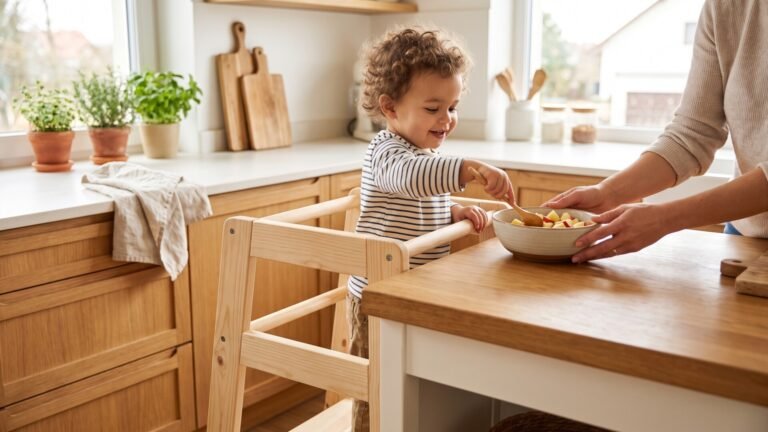
- A learning tower or kitchen helper so toddlers can reach the counter (see our learning tower guide)
These activities give toddlers practice with hand-eye coordination, fine motor control, focus and patience, and independence. Practical life materials are often the most engaging items in a toddler environment because they match a child’s natural wish to imitate adults. They are also usually the cheapest to start: a small jug, a sponge, a cloth and a tray can be found in most homes.
Sensory Toys for Toddlers
While infants take in broad sensory input, toddlers begin to notice differences. Montessori sensory toys for toddlers help children compare texture, weight, size, color, and sound.
Common Montessori Sensory Toys
- Texture boards or matching cards
- Sound cylinders or shakers
- Color tablets or sorting trays
- Weighted objects for comparison
These toys invite children to compare and sort, build descriptive vocabulary, and explore calmly. Because they isolate one variable at a time (for example, only sound or only texture), toddlers can focus without confusion.
For toys designed to engage the senses safely, see Montessori Sensory Toys for 1–3 Year Olds. For toddlers who still chew everything, see 7 Safe Sensory Toys for Toddlers Who Chew, and for sound-focused play see the Montessori-style sound explorer toys.
Fine Motor and Hand Skill Toys
Between ages one and three, toddlers rapidly build the hand strength and coordination that later supports drawing, self-feeding, dressing and eventually writing. Montessori fine motor toys often include:
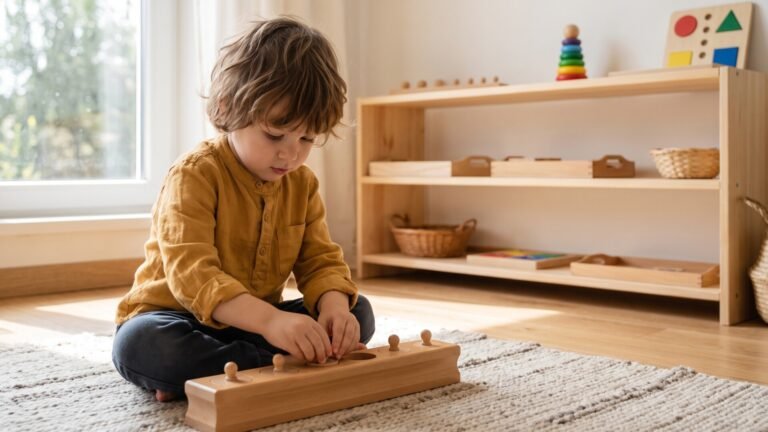
- Peg boards with large pegs
- Chunky threading beads (large, with a stiff lace, and graded for under-3s)
- Coin and posting boxes (use large, toddler-safe discs)
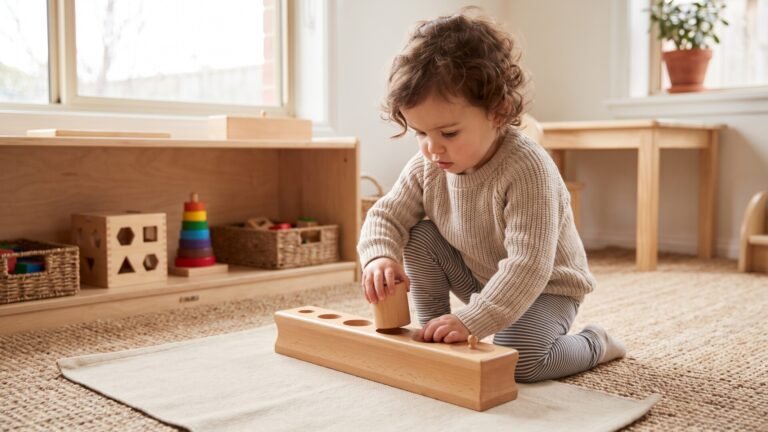
- Simple puzzles with knobs
These materials give toddlers practice with finger strength, using both hands together, and precise movements. Unlike electronic toys that give instant feedback, they reward effort with a visible result, such as a peg that fits or a piece that drops through.
Language Development Toys
Language grows quickly in the toddler years. Montessori language toys support vocabulary, sound awareness and early communication without pushing reading too soon. Talking with your toddler during play matters more than any particular toy.
Montessori Language Materials for Toddlers
- Object-to-picture matching cards
- Realistic animal or object figurines
- Simple wooden puzzles with labeled pieces
- Books with clear, realistic images (see our pre-reading activities)
These materials invite naming, categorizing, listening and speaking. Montessori language work stays connected to real objects and experiences rather than abstract symbols.
Problem-Solving and Cognitive Toys
Toddlers are natural problem-solvers. Montessori toys channel that curiosity into small, structured challenges: shape sorters with limited pieces, stacking and nesting toys, size-grading towers, and simple cause-and-effect toys.
These toys give toddlers a chance to explore spatial relationships, persist through trial and error, and notice and fix their own mistakes. Many Montessori materials are “self-correcting”: a piece simply will not fit if it is in the wrong place, so the child gets feedback without an adult stepping in.
Creative and Open-Ended Play
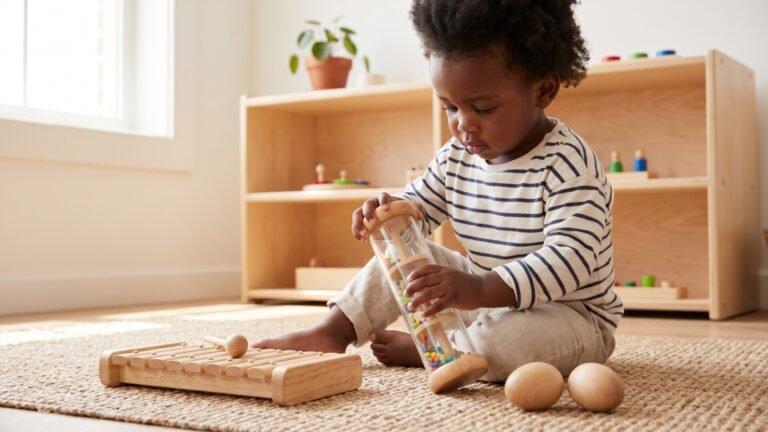
Montessori emphasizes purposeful activity, but creativity matters too. Montessori creative toys are open-ended rather than scripted: wooden blocks, simple art materials (large crayons, washable paints), simple instruments such as drums, shakers or xylophones, and pretend-play objects rooted in real life (kitchen tools, dolls).
These materials let toddlers express ideas, explore rhythm and movement, and begin imaginative play. Traditional Montessori practice keeps early play grounded in reality, though many families add fantasy play as children grow.
Montessori Toy Recommendations by Toddler Stage
Toddlers develop at different rates, but certain interests tend to appear in a typical order.
Early Toddlers (12–18 Months)
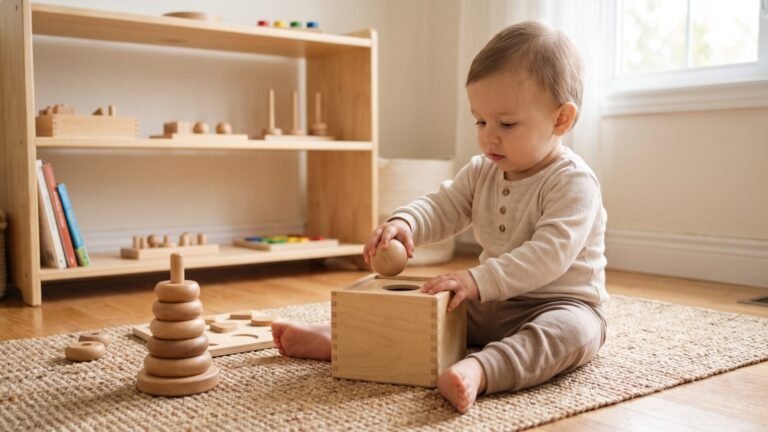
At this stage, toddlers focus on movement, simple manipulation, and repetition. Good toy types are posting boxes, stacking rings, push toys without electronics, a pounding bench, and simple shape sorters. The goal is exploration and repetition. For more detail, see Best Montessori Toys for 1-Year-Olds.
Mid Toddlers (18–24 Months)
Toddlers begin refining coordination and expressing independence. Good toy types are practical-life pouring activities, peg boards, object matching games, and simple puzzles. Children at this stage often enjoy more challenge and more choice. See the 15 best Montessori toys for 2-year-olds.
Older Toddlers (24–36 Months)
Problem-solving, language, and creativity expand rapidly. Good toy types are dressing frames, size-grading toys, language matching cards, and beginner art and music materials. These lead naturally into preschool-level Montessori work; see Best Educational Montessori Toys for 3-Year-Olds.
At a Glance: Toy Types by Age
| Toy type | Typical starting age | What it encourages | Watch out for |
|---|---|---|---|
| Posting box / shape sorter | About 12 months | Hand-eye coordination, matching | Pieces that fit through a choke tube |
| Stacking and nesting toys | About 12–18 months | Spatial reasoning, persistence | Rough or poorly finished wood |
| Pouring and scooping set | About 18 months | Wrist control, concentration | Breakable pitchers; water spills |
| Peg board | About 18–24 months | Pincer grip, color matching | Small pegs for younger toddlers |
| Dressing frames | About 2–3 years | Self-care skills, finger strength | Frustration if too hard |
| Object-matching cards and figurines | About 18–36 months | Vocabulary, categorizing | Small figurines |
| Learning tower | About 18 months and up | Joining kitchen tasks | Stability; supervision |
The ages above are typical starting points based on common manufacturer age ranges and Montessori practice, not rules. Always follow the age grade on the product.
Setting Up a Montessori Toddler Toy Environment
A prepared environment matters as much as the toys. Key elements include:
- Low shelves with limited choices
- Clearly defined activity spaces (a table, a mat, a tray per activity)
- Child-sized furniture and tools
- Regular toy rotation based on what your child is interested in
Rather than overwhelming a toddler with options, Montessori environments emphasize order and accessibility, so children can choose a material and return it to its place. Our guide to a minimalist Montessori play shelf shows how to do it step by step.
Montessori Toys vs. Traditional Toddler Toys
| Montessori-style toys | Many traditional toys | |
|---|---|---|
| Feedback | Comes from the material itself (self-correcting) | Often lights and sounds |
| Focus | Real-world skills, one skill at a time | Entertainment, many features at once |
| Materials | Wood, metal, cloth, glass or ceramic for older toddlers | Often plastic and electronics |
| Play style | Child-led, repeated practice | Often scripted or adult-led |
| Trade-off | Can cost more; fewer quick “wow” moments | Easier to find; may be less durable or more stimulating |
There is no need to throw out what you already own. Many families keep a few favorite conventional toys and add Montessori-style materials where they see their child’s interest.
How Montessori Toddler Toys Connect to Preschool Skills
Montessori toys for toddlers are not early academics. They give toddlers chances to practise skills that later learning builds on: attention and focus, fine motor control, language comprehension, and confidence and independence. Every child develops at their own pace, and no toy guarantees readiness for preschool. If you have questions about your child’s development, talk to your pediatrician.
Choosing Montessori Toys as Toddler Gifts
Simple, open-ended toys make thoughtful gifts because they stay useful for a long time. When choosing:
- Prioritize simplicity and quality of construction
- Match the age grade on the box to the child, not just the milestone
- Prefer battery-free toys, which also removes the button-battery risk
- Pick toys with more than one way to play, such as blocks, rings or a basket of scarves
- If you are unsure what a family already owns, a book, art supplies or a practical-life item is rarely a duplicate
Common Questions About Montessori Toys for Toddlers
Frequently Asked Questions About Montessori Toys For Toddlers
Do toddlers get bored with Montessori toys?
Often not. Because the toys allow repetition and mastery, many toddlers return to them again and again. Rotating a small selection every week or two helps keep interest fresh.
How many toys should a toddler have access to?
There is no fixed number, but a small selection, often around 6 to 10 toys on a low shelf, is common in Montessori homes. Rotate them based on what your child is currently interested in.
Can Montessori toys be used in non-Montessori homes?
Yes. The toys work in any home that values simple, child-led play. You do not need to follow the whole method, rearrange your house, or give away the toys your child already loves.
Can a plastic toy be Montessori?
Montessori practice favours natural materials, but the principles matter more than the material. A sturdy plastic stacking cup that is simple, self-correcting and used for real exploration fits the approach better than a noisy wooden toy with flashing lights.
When should I switch from toddler to preschool Montessori toys?
Follow the child and the age grade. Most families add preschool materials such as small lacing beads, sandpaper letters and more complex puzzles around the third birthday, once a child has stopped mouthing small objects. See our preschool Montessori guide.
What should I avoid on a toddler Montessori shelf?
Skip toys that do the playing for the child (lots of lights, sounds and buttons), sets with dozens of tiny pieces, and anything graded 3+ that has small parts. Also avoid crowding the shelf: too many choices at once can make it harder for toddlers to settle.
Final Thoughts: Supporting Independence Through Play
The toddler years bring fast growth, curiosity, and determination. Montessori-style toys honor this stage by giving children real, simple tools to explore the world on their own terms, with an adult close by to keep things safe.
By choosing toys that emphasize hands-on learning, real-world skills, and focused engagement, you create a space where toddlers can practise and grow through experience rather than instruction. For more Montessori ideas, browse the practical life activities for toddlers or visit our Montessori & Early Learning Toys hub.