Montessori Sensory Toys
Sensory learning is at the heart of the Montessori method. Long before children are ready for abstract ideas, they make sense of the world by touching, looking, listening, smelling and moving. Montessori sensory toys are not designed to entertain or overwhelm. They are designed to help a child notice differences more precisely, one quality at a time, and to hold attention while doing it.
In a Montessori classroom, each sensory material isolates a single quality, such as size, colour, texture, weight or sound, so the child can compare and grade it without other distractions. This page is the sensory-toys guide within our Montessori & Early Learning Toys section. It explains the classic materials, how they differ from the flashing, noisy toys sold as “sensory”, what suits each age, and how to build a small, calm sensory shelf at home without overspending.
If you are looking for activities and materials organised by age rather than by sense, start with our Montessori Toys & Activities for Kids guide.
Quick Answer: What Are Montessori Sensory Toys?
Montessori sensory toys, usually called sensorial materials, are hands-on objects that let a child compare and sort one sense-based quality at a time. Unlike many commercial sensory toys that emphasise stimulation, they emphasise discrimination and awareness: which tablet is the darkest, which cylinder is the loudest, which tower block is the next size up. They are typically made of wood, metal, fabric or glass, have no batteries, and are often self-correcting, meaning the child can see for themselves whether the task was completed correctly.
These materials are designed to:
- Isolate a single sensory quality
- Invite repetition rather than a one-time try
- Be self-correcting wherever possible
- Support calm, focused exploration
Why Sensory Learning Matters in Montessori Education
Maria Montessori treated the senses as a young child’s main route to understanding. Her sensorial materials were built around the idea that grading and matching real objects gives children a concrete base for later ideas about size, shape, order and language. Children working with these materials are encouraged to practise:
- Noticing small differences between similar objects
- Using descriptive words such as rough, smooth, heavier, louder and thinner
- Sequencing and grading, which are early habits of mind that later connect to maths
- Sustained attention on one task
It helps to stay measured about this. The materials invite these skills; they do not guarantee them, and no toy replaces conversation, outdoor play and time with caring adults. Think of a sensory shelf as one good ingredient in a child’s day.
How Montessori Sensory Toys Differ from Conventional Sensory Toys
Many toys marketed as “sensory” rely on flashing lights, loud songs or a jumble of textures. Those are not wrong, and some children enjoy them, but they work differently. The table compares the two approaches so you can decide what your child needs.
| Feature | Montessori sensorial materials | Typical commercial sensory toys |
|---|---|---|
| Focus | One quality at a time (size, colour, sound, texture) | Many stimuli at once |
| Power | Usually none; the child’s own senses do the work | Often lights, music or batteries |
| Feedback | Self-correcting (the pieces fit, or they do not) | Cause-and-effect rewards |
| Materials | Wood, metal, glass, fabric | Mostly plastic, foam, silicone |
| Best for | Quiet, focused, repeated practice | Calming, fidgeting or free exploration |
| Typical trade-off | Higher price for classic sets; adult demonstration helps | Can overstimulate some children; novelty fades |
One honest caveat: “Montessori” is not a protected certification, so a product can carry the label without following the method. Judge a toy by what it does (single quality, no unnecessary extras, child can check their own work), not by the logo on the box. If your child enjoys open-ended sensory play, our guide to understanding sensory play explains how the two approaches complement each other.
The Classic Montessori Sensorial Materials
If you read about Montessori sensory work you will keep meeting the same handful of named materials. Knowing them helps you shop, because most commercial “Montessori sensory” products are home-sized versions or look-alikes of these.
| Material | Sense and quality | What the child does | Typical starting age |
|---|---|---|---|
| Pink Tower | Sight: size (ten cubes) | Builds the cubes from largest to smallest | About 2.5 to 3 |
| Brown Stair (Broad Stair) | Sight: width | Orders ten prisms by thickness | About 2.5 to 3 |
| Red Rods (Long Rods) | Sight and touch: length | Orders rods from shortest to longest | About 3 |
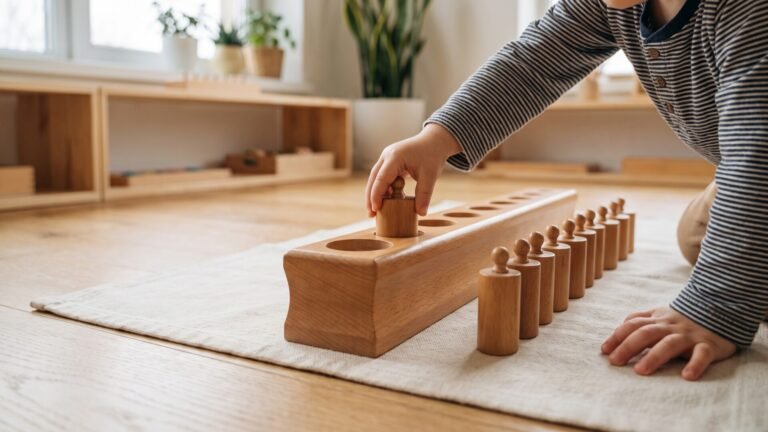
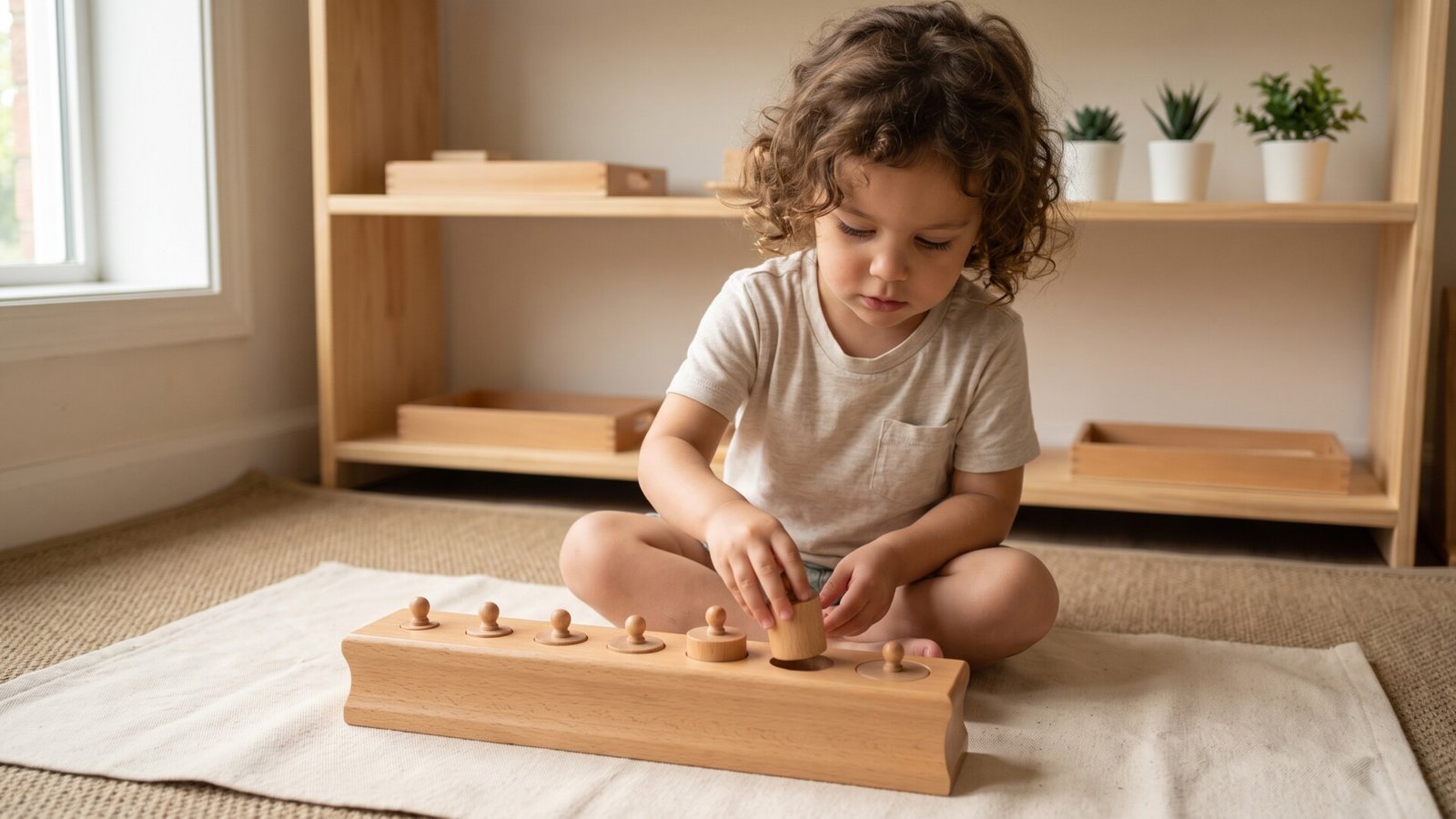
| Knobbed Cylinders | Sight: dimension | Fits cylinders into matching holes in a block | About 2.5 to 3 |
| Color Tablets | Sight: colour | Matches and grades paired colour tablets | About 3 |
| Sound Cylinders | Hearing: loudness | Shakes pairs and finds the matching sound | About 3 |
| Fabric Matching Box | Touch: texture of cloth | Matches pairs by feel, often blindfolded | About 3 |
| Touch Boards and Tablets | Touch: rough and smooth | Runs fingertips across graded surfaces | About 2.5 to 3 |
| Thermic and Baric Tablets | Touch: temperature and weight | Compares and grades tablets by feel | About 3.5 to 4 |
| Geometric Solids | Touch and sight: 3D shape | Names and matches solids | About 3 to 4 |
| Mystery Bag | Touch (stereognostic sense) | Identifies hidden objects by feel | About 3 |
| Smelling Bottles | Smell | Matches pairs of scents | About 3 to 4 |
The starting ages above are the ranges commonly used in Montessori classrooms, not safety ratings. They describe when most children can manage the task, and children vary widely. The manufacturer’s age grade on the box is a separate matter: it is a safety rating tied to small parts and materials, and you should follow it first.
Tactile Sensory Toys (Touch)
Touch is often the first sense children explore deliberately. Montessori tactile materials help children notice texture, temperature, weight and form.
Common Montessori Tactile Toys
- Texture boards and fabric tablets
- Smooth and rough wooden shapes
- Sensory balls made from natural materials
- Mystery bags with matching objects for blind touch exploration
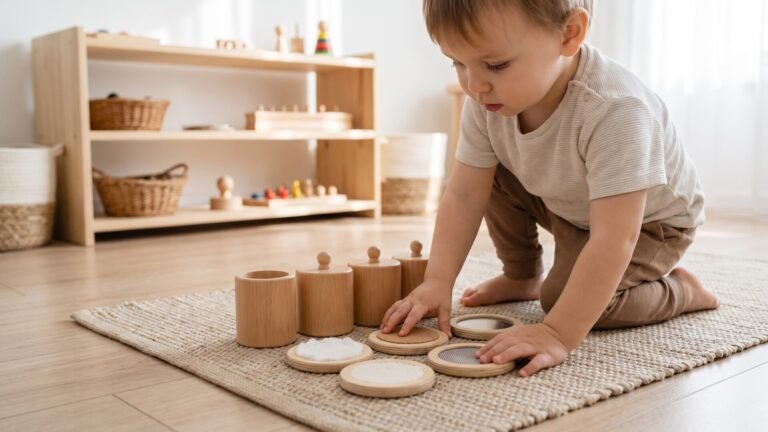
These materials give children a chance to practise tactile discrimination, build descriptive vocabulary, and work their hands with careful control. Many families find quiet touch work a calming part of the day, though how settling it is depends on the child.
Buying notes. A home version can be as simple as a drawstring bag and pairs of everyday objects, such as a wooden spoon, a large button and a smooth stone, as long as nothing is small enough to be a choking hazard for the child using it. For fabric matching, two identical sets of fabric squares in contrasting textures (cotton, velvet, burlap, satin) do the same job as a branded box.
Visual Sensory Toys (Sight)
Visual materials help children compare colour, size, shape and spatial relationships. They are also where the best-known Montessori materials live.
Common Montessori Visual Toys
- Colour tablets and matching sets
- Size-grading towers, such as pink-tower style stackers
- Knobbed cylinder blocks and shape puzzles
- High-contrast visual cards for young babies
Because each set varies only one thing, a child can see that the “next” piece is slightly larger or darker, which builds careful looking, classification and sequencing, habits that later connect to early maths and geometry.
Buying notes. Authentic classroom pink towers and knobbed cylinders are precisely machined and priced accordingly. Home-sized stacking towers and cylinder blocks from mainstream toy brands cover much the same ground at a lower cost; check that the cube or cylinder sizes step up evenly, because uneven grading defeats the purpose. Painted pieces should be labelled non-toxic and compliant with the US toy safety standard (ASTM F963) or the equivalent where you live.
Auditory Sensory Toys (Hearing)
Auditory materials help children tell sounds apart without being swamped by noise.
Common Montessori Auditory Toys
- Sound cylinders (paired shakers filled with different materials)
- Wooden rattles with varied fillings
- Bells and chimes, often graded by pitch
- Matching games based on sound
The pairing format is self-correcting: the child shakes two cylinders and hears whether the sound matches. Listening in this way supports attention and a sense of volume and pitch, and it connects naturally to the sound-matching games in our Montessori language and literacy toys guide.
Safety note. Shakers and rattles must be sealed so that fillings (rice, beads, seeds) cannot escape. A closed shaker that cracks open is a choking hazard for a child under three. Inspect them regularly and retire any that loosen.
Smell and Taste
Smell and taste are rarely sold as standalone toys, but they are part of Montessori sensory learning and are usually woven into everyday activities.
- Smelling jars with natural scents such as lavender, mint or orange peel
- Herb and spice exploration, with fresh herbs from the kitchen
- Food preparation, where tasting and smelling are part of the real task
These experiences build vocabulary and attention to the world around the child. Food and scent activities overlap with practical life work, and our Montessori practical life toys and activities page has kitchen ideas to pair with them. Keep strongly scented oils away from young children, and always check for food allergies before offering tasting activities.
Sensory Toys by Age Group
Sensory learning changes as children grow, moving from simple exposure to deliberate comparison and grading.
Infants (0 to 12 Months)
For babies, the goal is gentle, safe exposure rather than discrimination. Typical choices include:
- High-contrast visual cards for tummy time
- Soft fabric objects of different textures
- Simple, easy-to-grasp rattles
- A floor mirror used under supervision
Everything at this age goes to the mouth, so size and construction matter more than philosophy. Choose pieces that are too large to fit inside a toddler-safe small-parts test cylinder, and avoid anything with button batteries or loose fillings.
Toddlers (1 to 3 Years)
Toddlers begin to compare and repeat. Good options are texture boards, sound-matching shakers, simple colour sorting, and large sensory balls and shape sets.
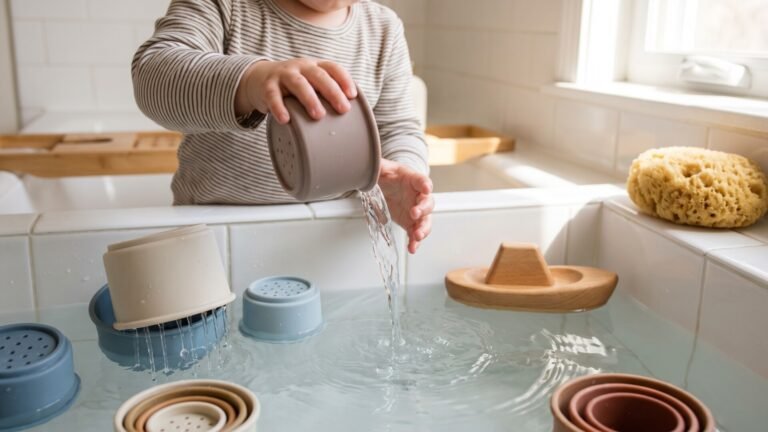
Explore safe and stimulating options for toddlers who learn through touch in our guide to Montessori Sensory Toys for 1–3 Year Olds. If you want a bath-time version, sensory-rich Montessori bath toys for toddlers are covered separately.
Preschoolers (3 to 6 Years)
Preschool is the age at which the classic materials in the table above come into their own. Children can now grade colour tablets, order a pink-tower style stack, match sound cylinders and work with a blindfold or mystery bag.
- Colour tablets with several shades per colour
- Size-grading towers and rod sets
- Sound cylinders and graded bells
- Texture matching and geometric solids
Early Elementary (6 to 9 Years)
Older children use sensory ideas in more abstract ways: geometry solids, measurement and comparison tools, classification activities and hands-on science kits. The materials become tools for reasoning instead of discovery for its own sake.
Safety Notes for Sensory Toys
Sensory materials are meant to be handled, mouthed by the youngest children and used with little interruption, so safety deserves a plain section of its own.
- Follow the manufacturer’s age grade. Children under three should not have toys with small parts. Materials such as small geometric solids, beads and smelling-bottle lids can be choking hazards.
- Check fillings and closures. Sound cylinders, rattles and smelling jars must stay sealed.
- Avoid high-powered magnets and button batteries in anything a young child can reach.
- Skip water beads in homes with children who still mouth objects, because they can swell dangerously if swallowed.
- Supervise tasting and scent activities, and check for allergies first.
For current safety guidance on small parts, magnets and batteries, consult the U.S. Consumer Product Safety Commission at cpsc.gov.
Creating a Montessori Sensory Environment at Home
You do not need a classroom to give a child good sensory work. A few habits do most of the job:
- Low shelves with a few materials. Three to six activities is plenty. Fewer choices usually means deeper use.
- A defined work space. A small mat or tray tells the child where the work lives and where it ends.
- A calm, uncluttered corner. The same material is easier to focus on without competing noise.
- Rotation. Swap materials every week or two, or when interest fades. Our guide to Montessori practical life toys shows a similar small-shelf approach.
Show the child how to use a material slowly, with few words, then step back. Repetition is the point; a child who repeats the same grading task ten times is not bored, they are practising.
Sensory Play vs. Sensory Learning
Montessori sensory work differs from open-ended sensory play in intentional focus. Sensory play, such as dough, sand or water, invites free exploration and is valuable in its own right. Montessori sensory learning is more structured: it isolates a quality, invites repetition and often has a clear “right” arrangement. Both have a place, and a child can enjoy a messy sensory bin in the morning and a quiet cylinder-block puzzle in the afternoon.
How Sensory Materials Connect to Early Learning
Sensory materials invite practice of skills that later schoolwork draws on, though they are only one contributor among many:
- Visual comparison, which supports noticing letter and number shapes
- Listening for small differences, which relates to hearing sounds in words
- Spatial reasoning through size, length and shape
- Descriptive language for comparing objects
For the maths side, see our guide to toys that build early math foundations.
How to Choose Montessori Sensory Toys (and Gifts)
Sensory materials make thoughtful gifts because many of them stay useful for a couple of years. When choosing one:
- Match the age grade first, then the child’s readiness.
- Look for one clear quality. If a toy tries to do five things, it is probably not a sensorial material.
- Prefer sturdy, natural materials, but do not assume wood alone makes a toy educational.
- Check that it is self-correcting so the child does not need you to confirm each attempt.
- Buy fewer, better pieces. One well-made set often beats a bundle of look-alikes.
Classic sets such as the pink tower and knobbed cylinders can be a significant purchase, so for many families a mix of one or two classic pieces plus homemade matching activities is the sensible route. Prices vary a lot by maker, and classroom-grade (AMI-style) sets cost far more than home-school versions. The ranges below are approximate US prices gathered from retailer listings and Montessori price-tracking sites; they change often, so confirm with the seller before buying.
| Material | Home-school versions (approx.) | Classroom-grade versions (approx.) |
|---|---|---|
| Pink Tower (10 cubes) | $40 to $75 | $140 and up |
| Knobbed Cylinder Blocks (set of 4) | $125 to $200 full size; mini sets from about $23 | Higher, often sold block by block |
| Sound Cylinders (two sets) | $25 to $60 | $110 and up |
| Color Tablets, Box 3 (63 tablets) | $45 to $65 | $150 and up |
Because prices differ by seller and by whether the wood is solid beech or a cheaper species, compare sizes and finish as well as cost. Check that cubes and cylinders are accurately graded, since uneven steps undermine the purpose of the material. Home-school versions are normally fine for family use; classroom-grade versions are built for years of daily use by many children.
Which Material to Buy First
If you are starting a home sensory shelf, a short order of purchase helps you avoid spending on pieces your child is not ready for:
- Sound Cylinders. They are among the least expensive classic materials, and the pairing game works well for a child of about three. Check that every cylinder is fully sealed.
- Knobbed Cylinder Blocks (mini or full size). A good first visual material, often placed on the shelf around age 2.5 to 3. A mini set is a sensible trial before paying for full size.
- Pink Tower. A natural next step, and widely available in home-school versions. Add a stand only if you want a defined place for it.
- Color Tablets. Start with the first and second boxes and move to the graded third box when your child can match confidently.
Children are individuals, so treat this as a sequence to adapt rather than a rule. If your child is not interested after a few weeks of calm presentation, put the material away and try it again later.
DIY Versions of the Classic Materials
Many of the classic sensorial exercises can be reproduced at home with inexpensive materials, which is a good way to find out what your child enjoys before buying wooden sets. Keep the key principle: one quality varies, everything else stays the same.
- Colour matching and grading: free paint-chip cards from a hardware store, cut into pairs, replace Color Tablets for matching and grading by shade.
- Size grading: nesting cups, graduated wooden blocks or boxes of ascending sizes give practice in ordering by size.
- Sound pairs: pairs of identical opaque containers with different fillings (rice, lentils, sand), sealed with strong tape or glue, work like Sound Cylinders. Inspect them often and discard any that open.
- Touch matching: pairs of fabric squares or cards covered in different grades of paper or fine sandpaper can be matched by touch, with or without a blindfold.
- Mystery bag: a cloth bag and a handful of safe, larger-than-choking-size household objects, such as a wooden spoon, a sponge and a smooth stone.
Homemade versions will not have the precision of a machined set, so use them for matching and discrimination games rather than fine grading. For other low-cost ideas that fit the same age range, see our DIY sensory bin recipes.
Once you have a sense of the materials and budget, the next consideration is whether they suit your particular child.
Sensory Needs and Specific Learners
Quiet, predictable, structured materials can suit children who find busy toys overwhelming, and many families of sensory-sensitive and autistic children find the order of these materials a good fit. Every child is different, though, and some children seek stronger input than Montessori materials offer. If you are choosing for a child with specific sensory needs, an occupational therapist who knows the child can advise on what to try. If calm and regulation are your main goals, our guide to how sensory toys help with emotional regulation compares more stimulating options. For more, see our article on why the order and logic of Montessori toys support autistic toddlers and our guide to sensory and special-needs toys.
Related Montessori Guides
- Montessori & Early Learning Toys: Building Skills Through Play, the main section guide
- Montessori Practical Life Toys: Complete Guide
- Montessori Language and Literacy Toys: Complete Guide
- Montessori Language Games for Kids
- Montessori Language Games for Preschoolers
Final Thoughts
Montessori sensory toys invite children to slow down, look closely and compare. You do not need a full classroom set. A handful of well-chosen materials, a calm place to use them and an adult who demonstrates once and steps back will do more than a shelf full of lookalikes. Choose by age grade and safety first, then by clarity of purpose, and let the child’s interest decide what stays.
Frequently Asked Questions About Montessori Sensory Toys
Are Montessori sensory toys suitable for children with special needs?
Often, yes. Their calm, single-quality design can suit sensory-sensitive children, but every child differs. An occupational therapist who knows your child can advise on what fits.
Do children outgrow sensory toys?
Sensory work changes rather than disappears. Younger children explore textures and sounds; older children use the same ideas for grading, measuring and classifying.
Can sensory toys replace academic learning?
No. They complement it by giving children practice in comparing, ordering and describing, but they are one part of a broader mix of play, conversation and instruction.
What are the most important Montessori sensory materials?
The best-known are the Pink Tower, Brown Stair, Red Rods, Knobbed Cylinders, Color Tablets, Sound Cylinders, touch boards, thermic and baric tablets, geometric solids and the mystery bag. Home-sized versions exist for most of them.
At what age can my child start using Montessori sensory materials?
Simple tactile and visual items suit babies from the first months, while the classic graded materials typically begin around 2.5 to 3 years. Always follow the manufacturer’s age grade for safety.
Do I need to buy authentic Montessori materials?
No. ‘Montessori’ is not a protected certification. Look for a single clear quality, sturdy construction and self-correcting design, and consider homemade matching games for textures, sounds and scents.
How much do Montessori sensory materials cost?
Home-school versions are usually the best value: roughly $40 to $75 for a Pink Tower, $25 to $60 for Sound Cylinders, $45 to $65 for the third box of Color Tablets, and $125 to $200 for a full-size set of four Knobbed Cylinder Blocks (mini sets start around $23). Classroom-grade sets cost considerably more. Prices change, so check current listings.
Are Montessori sensory toys safe for babies and toddlers?
They can be, when you choose pieces with no small parts for children under three, sealed fillings, and no batteries or magnets within reach. Supervise young children.
How is Montessori sensory learning different from sensory play?
Sensory play is free exploration of materials like water or dough. Montessori sensory learning isolates one quality and invites repetition and comparison. Both are useful.