Connetix Magnetic Tiles vs. Magna-Tiles: Which Are Stronger for Big Towers?
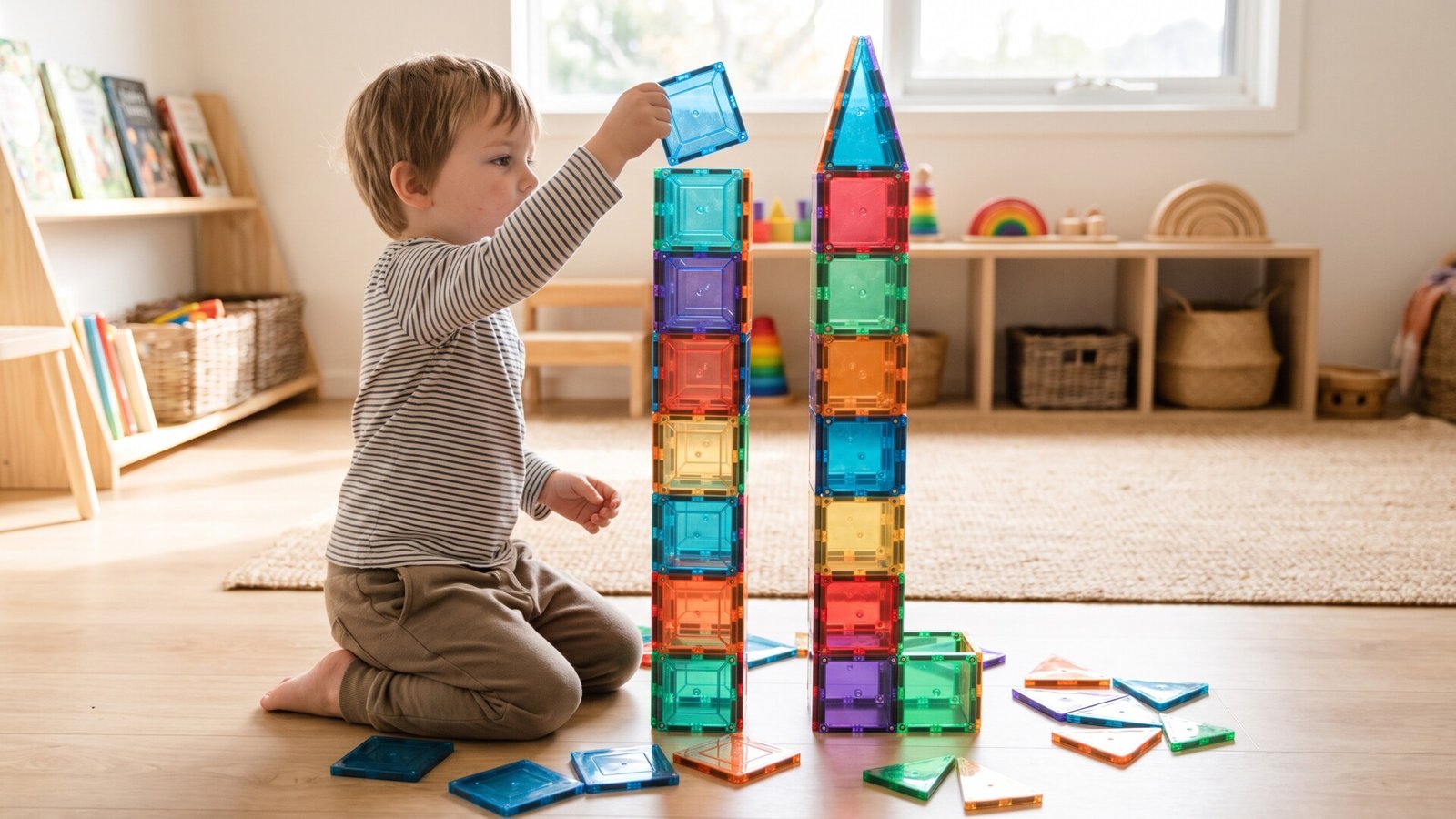
There’s a quiet thrill that comes when a child places the final tile on a tower that stretches nearly as high as their own shoulder. The whole room holds its breath. Will it hold? Or will gravity win with a spectacular crash? For parents, watching that tower wobble is a mix of pride and dread. And in 2026, the magnetic tile market has two heavyweight contenders vying to keep those towers standing: Connetix and Magna-Tiles.
Both brands are beloved for open‑ended STEM play. Both offer rainbow colors, sturdy construction, and endless creative possibilities. But when the goal is maximum height, the small differences matter immensely. Magnet strength, tile weight, edge precision, and structural rigidity all determine whether a tower climbs confidently or collapses in frustration.
This guide cuts through the marketing hype and answers the one question parents and educators ask most: Which brand builds taller, more stable towers? We’ll compare magnet power, material quality, real‑world performance, and the best sets from each brand. Whether you’re adding to a growing collection or buying your first set, you’ll leave knowing exactly which tiles will help your young engineer reach the ceiling.
The Tall Tower Test: Why Magnetic Strength is All That Matters
For most magnetic tile builds, a basic connection is enough. A little house, a flat pattern, a simple cube, even a sturdy castle square—they’ll all hold just fine. But when you start stacking a tower three, four, five feet high, the physics change. Suddenly, every single magnetic connection is under real, constant stress.
The secret to a tall tower is static friction: the resistance created when two surfaces are pressed together. A heavier individual tile, no matter how heavy, actually increases this friction, creating a more rigid and less wobbly connection. The tile’s weight is crucial because it pushes down on the magnets below, strengthening their hold and preventing the whole structure from swaying.
The other critical factor is the precision of the moulding. A tile with an imperceptible warp or an edge that doesn’t align perfectly will create a microscopic pivot point, which acts as a stress concentrator. At lower heights, this is negligible. But as the tower climbs, these small imperfections are magnified, introducing a slight wobble that eventually leads to a catastrophic collapse.
In short, building a tower is the ultimate and only true test of a magnetic tile’s engineering and real-world performance.
Brand Showdown: Connetix vs. Magna-Tiles
Connetix Magnetic Tiles
Connetix is the new premium contender that has quickly built a reputation for innovation. Their tiles feature a beveled edge design that is claimed to increase scratch resistance and create a more precise alignment.
Key Specifications:
- Magnet Size: Noticeably larger than Magna-Tiles
- Weight (10 stacked): Approximately 11 oz
- Material: Non-toxic ABS plastic, BPA and phthalate free
- Connection Strength: Superior
The beveled edges serve a dual purpose. Not only do they protect the tile’s finish, but they also help each piece click into a more uniform, stable position with less wiggle room. This precision is invaluable for tall builds.
Magna-Tiles
Magna-Tiles are the industry pioneers with over two decades of history. Their design features a classic, simple style with a visible criss-cross lattice design on the surface, which is structural reinforcement, not just decoration.
Key Specifications:
- Magnet Size: Smaller than Connetix
- Weight (10 stacked): Approximately 10.3 oz
- Material: Food-grade, non-toxic MABS plastic
- Connection Strength: Very Good
The lattice structure is a strength-through-design approach. The reinforcement is supposed to make the tile less likely to crack under stress. However, the trade-off is a slightly less “premium” aesthetic and a marginally lower tile weight.
Magnet Strength and Structural Stability
This section is the core of any serious comparison. For building tall, there is a clear and consistent narrative in expert reviews and community feedback: Connetix has the stronger magnetic hold. Reviews consistently note that Connetix has “stronger magnets” and “superior magnet strength”.
This advantage is not just anecdotal. Direct visual comparisons have shown that the physical magnets inside the two brands’ tiles are noticeably different in size, with Connetix’s being significantly larger. In the world of physics, a larger magnet generates a stronger magnetic field, which translates directly into a stronger pull between two tiles. This is the single most important factor for tall towers.
However, Magna-Tiles are not weak. Their magnets are “sturdy” and are “still powerful enough for daily play pleasure”. They are fantastic for standard construction. But for large, tall structures, that extra magnetic “grip” from Connetix is what currently gives them the competitive edge.
Material Quality and Longevit
Both brands are the undisputed leaders in build quality and safety. Both are made from non-toxic, BPA-free materials, and their magnets are permanently sealed inside the plastic with industrial-strength ultrasonic welding and reinforced with rivets.
Connetix use a thicker, heavier plastic that contributes to the tile’s overall weight and durability. Their unique beveled edges are also claimed to make the tiles more resistant to scratches.
Magna-Tiles have a reputation for being virtually indestructible. The lattice design is intended to reinforce the structure and prevent cracking. Owners often report that their sets from 10 years ago are still in perfect condition.
Both brands are excellent. Connetix feels slightly more premium in hand, while Magna-Tiles have the edge of an ultra-long, proven track record.
Design and Physical Feel
Design: Connetix has a minimalist, “clear” look with minimal internal markings, creating a beautiful stained-glass effect in natural light. Magna-Tiles have the classic, functional criss-cross design. This is purely an aesthetic preference.
Physical Feel: Connetix tiles are slightly smaller and denser. Their heavier weight per square inch significantly contributes to the stability of a tall tower and makes them feel very premium. In contrast, while Magna-Tiles are still excellent, they feel slightly lighter and more toy-like when you hold both side-by-side. Some parents worry the lack of visible bracing in Connetix makes them less sturdy, but the consensus is that this is not the case—their beveled design makes them equally, if not more, durable.
The Ultimate Tall Tower Face-Off
So, which one actually wins in the real world?
Magna-Tiles are larger and heavier overall, which helps build a sturdy foundation. However, when stacking high, their magnets can sometimes struggle, and the slightly looser edge alignment can lead to an overall wobble.
Connetix, on the other hand, are engineered to win this specific battle. They use their larger, more powerful magnets combined with a heavier individual tile weight and the precision of the beveled edge to create a fundamentally more rigid and stable structure.
Best Connetix and Magna-Tiles Sets for 2026
Best for Tall Towers: Connetix 102-Piece Rainbow Creative Pack
Best for: Families who want the absolute best magnet strength and tallest possible towers.
This is the set that tower-builders dream of. With 102 pieces, it strikes the perfect balance between variety and quantity – enough to build soaring structures without overwhelming young builders. The set includes:
- 6 large squares (foundation anchors)
- 36 small squares (the workhorses of vertical stacking)
- 24 equilateral triangles
- 12 right triangles
- 8 isosceles triangles
- 6 rectangle doors/windows
- 4 fence pieces
- 6 rectangle panels
Tower-building performance: The larger squares provide an exceptionally stable base, while the strong magnets and beveled edges keep each level perfectly aligned. Users report building towers up to 4–5 feet tall with careful engineering. The heavier tile weight (11 oz per 10 stacked) reduces wobble significantly compared to lighter tiles.
Durability: Thick, premium ABS plastic with ultrasonic welding; the beveled edges do a great job of hiding small scuffs. Some users note that the glossy finish can show fingerprints, but they wipe clean easily.
Price range: $$$ (approx $120–150 depending on sales)
| Pros | Cons |
|---|---|
| Strongest magnets of any set tested | Higher price than Magna-Tiles equivalent |
| Heavier tiles improve static friction | Glossy finish shows smudges |
| Beveled edges for perfect alignment | Large squares may be too big for very small hands (3+) |
| 6 large squares = fantastic tower bases | Not as widely available in physical stores |
Best for: Kids aged 4–10 who are serious about tall constructions and families planning to buy only one premium set.
Check price on Amazon | Connetix official store
Best Overall Classic: Magna-Tiles 100-Piece Clear Colors Set
Best for: Families who want a proven, durable all‑rounder that will last for years and survive multiple children.
The 100‑piece set is the standard‑bearer. It contains 100 translucent pieces in classic Magna‑Tiles colours: red, orange, yellow, green, blue, purple, and clear. Piece breakdown:
- 50 small squares
- 20 equilateral triangles
- 10 right triangles
- 10 isosceles triangles
- 4 large squares
- 6 specialty shapes (windows, arches, etc.) – depending on the exact version (clear colors set may vary).
Tower-building performance: The magnets are strong but slightly weaker than Connetix. Towers up to 3 feet are stable; beyond that, you may notice a slight wobble. However, the lattice design adds structural rigidity to the tiles themselves, preventing warping under heavy loads. The lighter weight (10.3 oz per 10 stacked) means less downward pressure, which can limit maximum height but makes the set easier for toddlers to handle.
Durability: Legendary. Magna‑Tiles have been in classrooms for over 20 years. The food‑grade MABS plastic is extremely impact‑resistant and can survive being stepped on. The riveted magnet seals are considered the gold standard for safety.
Price range: $100–130
| Pros | Cons |
|---|---|
| Unmatched long‑term durability | Magnets are not as strong as Connetix |
| Proven in classrooms for decades | Only 4 large squares – fewer foundation pieces |
| Slightly more affordable than Connetix | Lighter tiles = lower static friction |
| Wide availability (Target, Amazon, etc.) | Lattice design may be less “premium” looking |
Best for: Daycares, preschools, families with toddlers (2.5–4) who are still rough on toys, and anyone who wants a set that will last 10+ years.
Check price on Amazon | Target
Best Premium Expansion Set: Connetix Mega Pack (212 Pieces)
Best for: Serious builders, large families, or those who want an absolutely massive collection with unmatched creative potential.
The Connetix Mega Pack is the ultimate “buy once, cry once” set. At 212 pieces, it includes everything in the 102‑piece Creative Pack plus additional large squares, specialty shapes (like arches, window frames, and curved pieces), and a wider range of colours. The exact breakdown varies by edition, but typically:
- 12 large squares (double the foundation strength)
- 70+ small squares
- 50+ triangles (all types)
- 20+ specialty pieces (windows, doors, fences, arches)
- 10 rectangle panels
- Storage bin with dividers (on some versions)
Tower-building performance: With twice as many large squares, you can build two separate tall towers simultaneously, or combine them into an absolutely massive structure. The additional weight and magnet strength make towers up to 6 feet possible with careful balance. The included storage bin helps keep pieces organised.
Durability: Same premium ABS as the 102‑piece set, but with more pieces, the weight adds up. The storage bin is a nice bonus, though some users prefer aftermarket sorting solutions.
Price range: $250–320
| Pros | Cons |
|---|---|
| Largest piece count of any set reviewed | Very expensive upfront |
| 12 large squares = incredible tower foundations | Overkill for casual builders |
| Includes specialty shapes for advanced builds | Heavy to move around |
| Storage bin included (some versions) | Limited availability (often online only) |
Best for: Families with 2–3 children who will play together, committed homeschoolers, or anyone who already owns a smaller set and wants to massively expand.
Check on Amazon | Specialty toy retailers
Best Budget Entry Set: Magna-Tiles 32-Piece Starter Set
Best for: Families who are new to magnetic tiles and want an affordable, low‑risk introduction.
The 32‑piece starter set is the perfect gateway. It includes:
- 22 small squares
- 10 equilateral triangles
That’s it. No large squares, no specialty pieces. But that simplicity is intentional – it forces creative problem‑solving and proves that you can build a surprising number of structures with just two shapes.
Tower-building performance: With no large squares, towers are limited to about 2 feet before stability becomes an issue. However, for a 3‑year‑old’s first attempts, that’s more than enough. The smaller pieces are easier for little hands to manipulate, and the lower magnet strength is actually safer for beginners (easier to pull apart).
Durability: Same legendary Magna‑Tiles construction. These will survive years of play and can be passed down.
Price range: $40–55
| Pros | Cons |
|---|---|
| Most affordable entry point | No large squares – limited tower height |
| Great for travel (small box) | Only two shapes – can feel repetitive |
| Perfect for ages 2.5–4 | Must buy expansion packs for serious building |
| Widely available (Target, Walmart, Amazon) | Magnets are weaker than larger sets (same as 100‑pc, but fewer pieces) |
Best for: Toddlers, first‑time buyers, grandparents looking for a gift, or as a travel set to keep in the car.
Check price on Amazon | Target
Best Classroom / Bulk Set: Magna-Tiles XL School Pack (200 Pieces)
Best for: Daycares, preschools, libraries, or large families with multiple children.
This set is designed for heavy group use. It contains 200 pieces in a durable storage bin with a locking lid. The piece mix is heavy on squares and basic triangles, with fewer specialty shapes – because classroom settings prioritise durability and volume over variety. Typically:
- 100 small squares
- 60 equilateral triangles
- 20 right triangles
- 20 large squares
Tower-building performance: With 20 large squares, you can build multiple tall towers or one exceptionally wide, stable tower. The magnets are the same as the standard Magna‑Tiles (good, not great), but the sheer number of large squares compensates. Expect stable towers up to 3.5–4 feet.
Durability: These are the most durable magnetic tiles on the market. They have been drop‑tested, thrown, and stomped in real classrooms for years. The storage bin is rugged and stackable.
Price range: $200–280
| Pros | Cons |
|---|---|
| Highest piece count for value (≈$1–1.40/piece) | Bulk packaging – not gift‑boxed |
| 20 large squares = excellent foundations | Few specialty shapes (no windows/arches) |
| Storage bin included | Only available from educational suppliers or online |
| Designed for rough, daily use | Magnets not as strong as Connetix |
Best for: Schools, homeschool co‑ops, large families with 3+ children, or anyone who prioritises volume and durability over aesthetics.
Check on Amazon | Educational suppliers
Summary Table – Best Sets at a Glance
| Set | Piece Count | Large Squares | Magnet Strength | Tower Height Potential | Price Range | Best For |
|---|---|---|---|---|---|---|
| Connetix 102‑piece | 102 | 6 | Very High | 4–5 ft | $$$ | Tall towers, premium feel |
| Magna‑Tiles 100‑piece | 100 | 4 | High | 3–3.5 ft | $$ | Classic all‑rounder |
| Connetix Mega Pack | 212 | 12 | Very High | 5–6 ft | $$$$ | Serious builders |
| Magna‑Tiles 32‑piece | 32 | 0 | Medium | 1.5–2 ft | $ | Budget / beginners |
| Magna‑Tiles XL School Pack | 200 | 20 | High | 3.5–4 ft | $$$ | Classrooms / large groups |
Connetix vs. Magna-Tiles for Tower Strength
When you’re building a tower that reaches for the ceiling, every magnetic connection is under real, constant stress. A wobbly house or a flat mandala won’t reveal the subtle differences between brands – but a five‑foot tower will. In this head‑to‑head, we’re not looking at colours, packaging, or cute accessory packs.
We’re looking at the raw physics of stacking: magnet pull force, tile weight, edge alignment, and structural rigidity. Does Connetix’s larger magnet and beveled design actually keep a tower straighter? Does Magna‑Tiles’ lighter, lattice‑reinforced build make it more forgiving under load? Let’s break down exactly how each brand performs when gravity is the only judge.
| Feature | Connetix | Magna-Tiles |
|---|---|---|
| Magnet Size | Visibly larger | Smaller |
| Tile Weight (10 stacked) | Heavier (~11 oz) | Lighter (~10.3 oz) |
| Connection Feel | Rigid, precise, strong click | Satisfying, but slightly looser |
| Tall Tower Stability | Excellent; best available | Very Good; stable but can wobble |
| Design Aesthetic | Sleek, beveled edges, minimal lines | Classic, lattice reinforcement lines |
| Feel in Hand | Dense, premium, robust | Slightly lighter, still durable |
Connetix vs. Magna-Tiles — Which Ultimate Winner?
After putting both sets through the crucible, the best answer is that they are two different tools for two different play styles.
Choose Connetix if:
- Your family’s primary mission is building tall, stable towers.
- You value a modern, sleek, light-refracting aesthetic.
- A denser, weightier, and more robust-feeling tile is important to you.
Choose Magna-Tiles if:
- You want a set with a 20+ year track record of legendary durability.
- Your play involves a lot of floor area, driving cars, and building sprawling villages.
- The slightly lower price point and wide availability are your main factors.
My personal verdict: For casual, everyday building, both are fantastic. However, for the specific goal of building the tallest possible tower, Connetix is the clear winner. Their engineering with larger magnets and a denser tile makes them fundamentally more stable when stacked to extreme heights.
The good news is that Connetix and Magna-Tiles are fully compatible. The best strategy for a serious magnetic tile family is to start with a large Connetix set for tall, structural builds and then expand your collection with Magna-Tiles themed expansion packs to add new storytelling elements and unique shapes. No matter which you choose first, you are buying an open-ended toy that will grow with your child for years. The real difference is that with Connetix, that tower reaching for the ceiling is just a little more likely to stay standing.