Best Solar-Powered Science Kits: Thames & Kosmos SolarFlower Review
Solar‑powered science kits sit at an interesting crossroads: they’re part mechanical build, part mini energy lesson, and part living decor piece you can prop on a windowsill. The Thames & Kosmos SolarFlower lands right in the middle of that space, and if you’ve seen the swirling ruby or sapphire petals pop up on your feed, you’ve probably wondered whether it’s a genuine STEM tool or just a pretty desk gadget. After spending time with the kit and comparing it across other solar offerings, I think it succeeds at being both—but not always for the reasons you might expect.
In this guide, I’ll walk through exactly how the SolarFlower kit works, where it shines educationally, and where its sun‑dependence can be a limitation. I’ll also stack it against the best solar‑powered robotics and experiment kits for 2026, so you can decide whether this flower deserves a spot on your shelf or in your shopping cart. Because sometimes the best way to understand the sun isn’t to read about it—it’s to build something that moves because of it.
Why Solar‑Powered STEM Kits Are Growing in Popularity
Over the past few years, solar‑powered science kits have quietly become one of the fastest‑growing segments of the STEM toy market. The reasons go beyond simple novelty. Parents and educators are looking for hands‑on ways to introduce renewable energy concepts, and these kits deliver cause‑and‑effect learning that a textbook simply cannot match: a child tilts a solar panel toward the sun, watches a motor spring to life, and immediately grasps the link between light, electricity, and motion.
These kits also offer a screen‑free alternative to endless tablet time, and they blend environmental awareness with core engineering skills. Many of the best kits also feature modular components and interchangeable parts, encouraging experimentation rather than one‑and‑done assembly. Thames & Kosmos has been at the forefront of this movement for years, with a 2026 product lineup described as the company’s most innovative ever.
The SolarFlower is an interesting evolution: it doesn’t just teach photovoltaics; it also covers mechanical systems like motors and planetary gears, and the finished product is designed to be displayed rather than stowed in a drawer. That combination—learning plus decoration—helps explain why solar kits are migrating beyond classrooms and into living rooms.
What Is the Thames & Kosmos SolarFlower Kit?
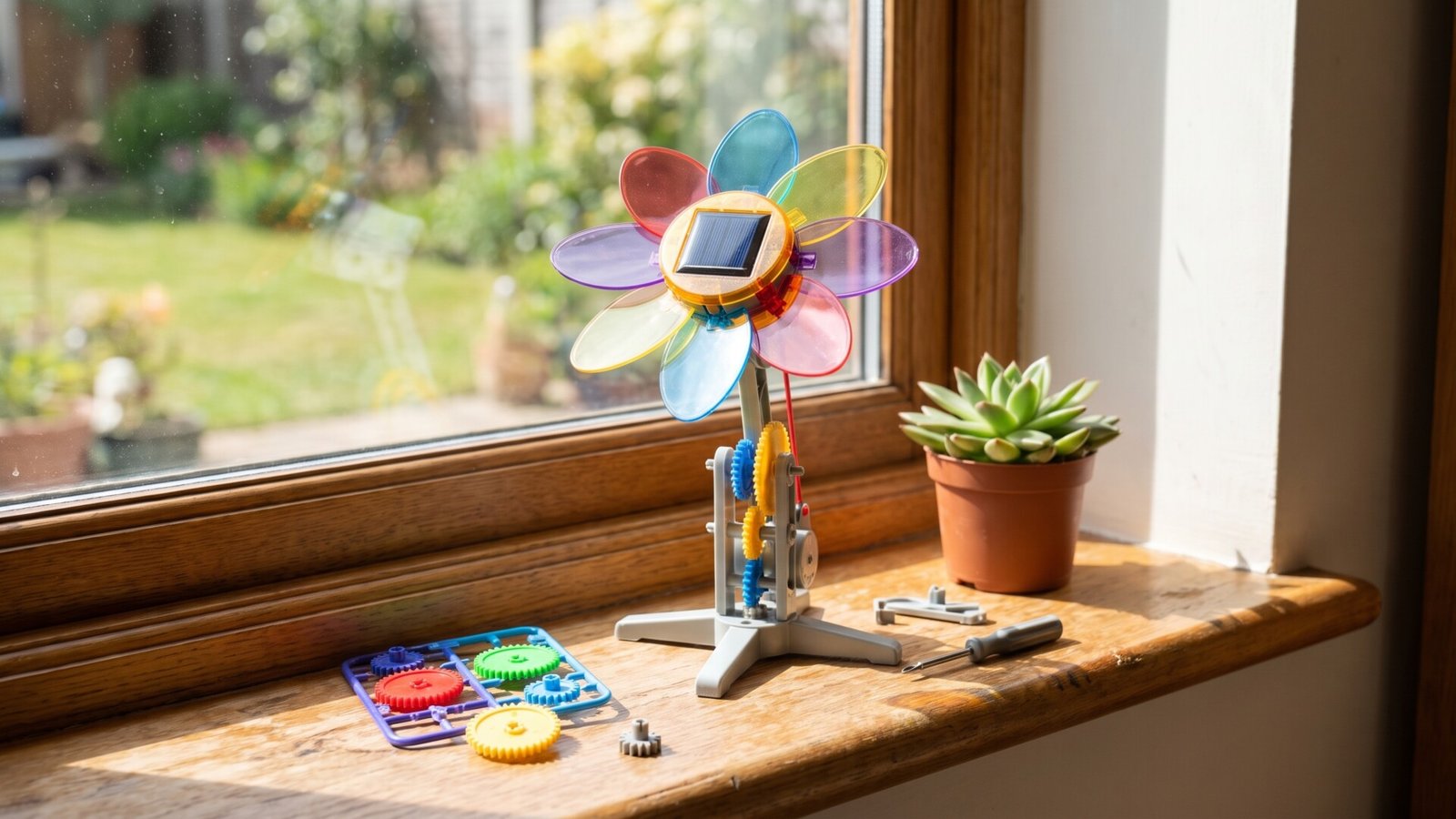
The SolarFlower is a build‑it‑yourself mechanical flower that’s powered entirely by the sun. It’s one of four colour variants—Sapphire Swirl (blue), Ruby Ripple (red), Golden Sunrise (yellow) and others—and all share the same core mechanism.
The building experience
Inside the box you’ll find around 100 durable plastic pieces, including:
- a compact solar panel
- a small DC motor
- planetary gears and axles
- petal sections
- a stem with a clip for attaching to a vase or pot
The assembly process involves snapping together the mechanical gearbox, mounting the motor, attaching the solar panel, and finally fitting the petals. The build is rated for ages 8+, but the instruction manual is clear enough that a focused 8‑year‑old can work through it with minimal adult help.
How it works: sunlight → motion
Once assembled, the flower’s behaviour is elegantly simple. You place the solar panel facing a light source—sunlight is best, but a bright incandescent or LED lamp also works. The panel converts light into electrical current, which drives the motor. Gears transfer that rotation to all petals simultaneously, creating a mesmerising synchronous spin.
In good sun, the petals rotate at a steady, calming pace. In shadow or dim light, the motion slows or stops, offering a wonderfully immediate lesson in how energy availability affects power output.
Modular design sets it apart
A particularly clever feature is the interchangeable petal system. All four colour variants use the same core mechanism, so you can mix and match petals to create unique, custom flowers. This turns the single build into an ongoing activity: a child can disassemble, rearrange, and design their own colour schemes over time.
Key Educational Features
The SolarFlower is certainly attractive, but it’s the educational content that justifies its place as a 2026 Toy of the Year finalist.
- Solar energy conversion – The kit demonstrates the photovoltaic effect in a tangible way: light in, motion out. You can discuss how solar panels are made of silicon cells that, when struck by photons, knock electrons loose to create a current. Despite being a relatively simple kit, it opens the door to conversations about renewable energy that can be as deep as you want to go.
- Mechanical engineering basics – Assembling the gearbox and motor mount introduces concepts like torque, gear ratios, and rotational motion. The fact that a single motor drives all petals through a carefully designed gear train teaches the idea of power distribution.
- Hands‑on problem‑solving – If the flower doesn’t spin immediately, the builder has to troubleshoot: is the panel positioned correctly? Are the gear teeth misaligned? Is a petal rubbing against the stem? These are authentic engineering challenges, not scripted puzzles.
- Observation and recording – The flower’s speed changes visibly with light intensity. A child can track how long it spins at different times of day, note how clouds affect motion, and compare sunlight vs indoor light performance. This turns a simple playset into a legitimate experiment platform.
Because no batteries are required, the flower only moves when real light hits it. That limitation is itself a teaching tool: it naturally raises questions about energy storage, efficiency, and why some things work better on a sunny day than a cloudy one.
4. Pros and Cons of the SolarFlower Kit
| Pros | Cons |
|---|---|
| Genuine STEM learning: Covers solar energy, gears, motors and mechanical design | Sun‑dependent: Sluggish or stationary on cloudy days; indoor lighting works but is less reliable |
| No batteries: Truly “set and forget”, ready to go when the sun shines | Limited replay variety: Once built, the main activity is watching it spin; no alternate builds or expansions |
| Modular and customisable: Mix petals across colour variants to create unique flowers | Moderate fragility: Small gear teeth and the solar panel wire need gentle handling |
| Finished piece is display‑worthy: Works as a decorative object, not just a toy | Younger builders need help: The 8+ rating is accurate; a 6‑ or 7‑year‑old may struggle with gear alignment |
| Interchangeable building system: Works with all four colour variants, encourages ongoing engagement | No weather‑sealing: The kit is designed for indoor or sheltered use; the solar panel could degrade if left in rain |
What the SolarFlower is not
It’s vital to set proper expectations. This is not a remote‑controlled robot or a kit that offers 20 different builds. Once assembled, the interactive element is limited to positioning the panel and watching the petals spin. If your child craves variety and multiple project options, a robotics or multi‑model solar kit would be a better fit.
The “calming” factor is real
Several retailers describe the SolarFlower’s motion as “soothing, hypnotic motion that calms the senses.” This isn’t just marketing fluff. The steady, silent rotation has genuine therapeutic appeal, and I’ve seen children naturally slow down and focus while watching it spin. For the right temperament—a child who enjoys observation and process over chaos—this kit is a winner.
The use case sweet spot
The SolarFlower flourishes as a shared weekend project followed by ongoing window display. It works wonderfully in a homeschool or classroom setting where you can integrate it into a unit on renewable energy. But if you’re looking for a toy that will be played with for hours every day, the novelty may wear off after the first week. The best way to frame it: you’re not buying a high‑action toy; you’re buying a conversation starter and a tiny science exhibition that the child built themselves. When seen through that lens, the price feels much more reasonable.
Best Solar STEM Kits in 2026
The solar‑powered STEM category is far bigger than just flowers. Here’s how the SolarFlower compares to other top kits on the market, from entry‑level robots to advanced classroom gear.
Best Overall: Thames & Kosmos SolarFlower Experiment Kit
The SolarFlower is the flagship solar STEM kit for 2026. It strikes an unusually good balance between educational depth, ease of assembly, and finished display value. The modular petal system allows for creative expression beyond the initial build, and the “no batteries” concept is genuinely liberating.
| Pros | Cons |
|---|---|
| Excellent STEM learning content | Sun‑dependent performance |
| Beautiful finished product | Limited play variety after assembly |
| Interchangeable petal system | Moderate fragility |
| No batteries or ongoing costs | Not for children under 8 |
Price range: around $25-30, depending on color variant
Best for: Kids 8–12, homeschoolers, STEM gift‑givers
Best Advanced Kit: Thames & Kosmos Physics Solar Workshop V2.0
For builders ready to go deeper, Physics Solar Workshop V2.0 offers five distinct models—helicopter, solar‑bot, moon rover, stag beetle, and praying mantis. Each model operates on the same solar concept but explores different mechanical systems (walking, rolling, flying). The kit includes 138 parts and a 48‑page manual with illustrated step‑by‑step instructions.
Pros & Cons Table
| Pros | Cons |
|---|---|
| Five different models in one kit | Higher price |
| Greater engineering depth | Needs more assembly time |
| Compatible with other T&K physics kits | Can be overwhelming for beginners |
Price range: $$$ (approx 49–63)
Best for: Ages 10+, experienced builders
Best Beginner / Budget: 4M Green Science Solar System Kit
This affordable entry point allows a child to build a motorised rotating planetarium that can run on sunlight or a single AAA battery. The instruction manual also includes educational facts about the solar system and hybrid energy concepts.
Pros & Cons Table
| Pros | Cons |
|---|---|
| Very low price | Materials feel less durable |
| Solar + battery hybrid operation | Fragile wiring reported by some users |
| Teaches planetary orbit concepts | Model is not to scale |
Price: $40
Best for: First‑timers ages 5–8
Best Outdoor Learning: OWI Solar Rover Kit
If you want a vehicle that actually drives around, the OWI Solar Rover is a strong pick. With just 17 assembly parts, the OWI Rookie Solar Racer is the perfect beginner kit that teaches how solar energy powers movement. The durable plastic frame can withstand outdoor play, and the compact size (under three inches) makes it easy to store.
Pros & Cons Table
| Pros | Cons |
|---|---|
| Very easy assembly | Smaller than other models |
| Durable for outdoor use | Lesser build complexity |
| Teaches transmission basics | Some users report weak panel performance |
Price: $20
Best for: Outdoor play, ages 8+
Best Classroom / Group: KidWind Solar Energy Exploration Kit
This kit is designed for serious education. It includes a hinged box to discover how panel angle affects power output, three solar panels to explore series vs. parallel circuits, and the ability to pump water or power a motor. It comes with lesson plans and is aligned to NGSS standards, making it suitable for grades 6–12.
| Pros | Cons |
|---|---|
| Very deep educational content | Very expensive |
| Experimentation with variables | Not a “toy” for casual use |
| Lesson plans included | Intended for teacher supervision |
Price : $213
Best for: Classrooms, ages 10+
Comparison Table — Solar STEM Kits
| Kit | Complexity | Educational Depth | Durability | Replay Value | Price Range | Best For |
|---|---|---|---|---|---|---|
| SolarFlower | Medium | High | Very Good | Medium | $$ | Best overall, ages 8–12 |
| Physics Solar Workshop | High | Very High | Very Good | High | $$$ | Advanced learners |
| 4M Green Science | Low | Medium | Good | Medium | $ | Beginners, ages 5–8 |
| OWI Solar Rover | Low‑Medium | High | Very Good | High | $$ | Outdoor STEM, ages 8+ |
| KidWind Solar Kit | Very High | Very High | Very Good | Very High | $$$$ | Classrooms, grades 6–12 |
*Indoor/outdoor use varies: SolarFlower and 4M kits are best indoors; Solar Rover handles outdoor driving; KidWind is classroom‑focused.*
Who Should Buy the SolarFlower Kit?
The SolarFlower isn’t for every family. Here’s how to decide if it’s right for yours.
- Best for STEM‑focused kids (ages 8–12) – Children who enjoy mechanical puzzles, observation, and will want to discuss how the gear train works are the ideal audience.
- Ideal for parents teaching sustainability at home – The flower offers a concrete, visible example of solar energy. You can easily extend the learning by measuring rotation speed at different times of day or comparing indoor vs outdoor performance.
- Great for classroom or homeschool use – In a group setting, the SolarFlower works beautifully as a demonstration model for a unit on renewable energy or simple machines.
- Excellent gift for educational buyers – For grandparents or relatives shopping for a gift that is both fun and substantive, this kit hits a very nice spot between a standard science kit and a decorative object.
- Not for very young children (under 7) – The 8+ rating is accurate. A 6‑year‑old will likely need significant adult help, and the small gear teeth can be frustrating for impatient younger builders.
- Better as a learning tool than a daily play toy – Once assembled, the interactive window is fairly narrow. This is a “build, then observe” kit, not a “build, then play with it for hours every day” kit. Adjust your expectations accordingly.
FAQ
1. How does the SolarFlower kit work?
A small solar panel converts light into electricity, powering a motor. The motor drives a system of gears that rotates all petals synchronously.
2. Does it need batteries?
No. The kit runs exclusively on light (sunlight is best, but bright indoor lighting also works).
3. Can it work indoors?
Yes, but performance is much better in direct sunlight. Under typical indoor lighting, the petals spin more slowly or may not move at all.
4. Is it hard to assemble?
It requires about 1–2 hours of focused work. Children aged 8 and up can handle it with occasional adult help. The instruction manual is clear, but patience with small gear teeth is required.
5. What age is it best for?
Rated for ages 8+. A motivated 8‑year‑old will do fine; children younger than 8 may find the assembly frustrating.
6. What happens on cloudy days?
The petals spin very slowly or stop entirely. This is actually an excellent learning moment: you can discuss cloud cover’s effect on solar efficiency.
7. Is it durable enough for repeated use?
If handled gently and kept indoors, yes. However, the solar panel wire and the small gear teeth are relatively fragile. This is not an indestructible outdoor toy.
8. Is it better than robot solar kits?
It depends entirely on what you value. For a child who loves robotics and wants many different builds, no. For a child who loves nature, design, and calm, deliberate play, the SolarFlower is an excellent fit. They serve different use cases.
9. Does it actually teach real STEM concepts?
Yes, authentically. The manual explains mechanical systems, gear trains, and solar photovoltaic cells in accessible language. The hands‑on assembly reinforces those concepts in ways that passive learning cannot.
10. Where can I buy it?
The SolarFlower is available at major toy retailers including Amazon, Target, the Thames & Kosmos official store, and educational toy shops.
Conclusion
The Thames & Kosmos SolarFlower is a rare hybrid: a genuinely educational STEM kit that also functions as a calming, attractive decorative piece. It teaches solar energy, gear mechanics, and cause‑and‑effect reasoning through a satisfying, one‑afternoon build. The finished flower invites ongoing observation and discussion, and the modular petal system sets it apart from other solar kits that are “done” the moment assembly ends.
However, it’s not a high‑action toy. If your child loves fast‑paced building and multiple project types, a robotics kit is a better fit. But for the child who enjoys watching, tinkering, and understanding why something works, the SolarFlower is a delightful investment.
- Best overall pick: Thames & Kosmos SolarFlower Experiment Kit – the ideal balance of STEM learning, visual appeal, and thoughtful design.
- Best advanced option: Thames & Kosmos Physics Solar Workshop V2.0 – for children ready to explore multiple solar‑powered models.
- Best beginner option: 4M Green Science Solar System Kit – an affordable, solar‑powered introduction.
- Best outdoor option: OWI Solar Rover – kids who want to see their solar creation move across the patio will love it.
- Best classroom option: KidWind Solar Energy Exploration Kit – serious STEM for older students.
Because sometimes the best way to understand the sun isn’t to read about it—it’s to build something that moves because of it.