The Ultimate Guide to Play Food: Hape Wood vs. Learning Resources Plastic
Every family with a play kitchen eventually faces the same question: wooden play food or plastic play food? It may seem like a small decision, but it shapes pretend play in surprisingly different ways. Hape’s wooden sets appeal to parents drawn to natural materials, sensory heft, and the open-ended, symbolic play that aligns with Montessori values. Learning Resources plastic sets attract those who want realism, easy sanitation, and a more structured learning experience.
This guide cuts through the debate by comparing durability, safety, realism, ease of maintenance, educational philosophy, and overall value of each type. I’ll also review specific top‑rated sets so you can decide which best fits your child’s developmental stage, your home environment, and your budget. By the end, you’ll know exactly what to look for—and whether the best play food is wood, plastic, or a thoughtful mix of both.
Disclosure: This article contains affiliate links. If you purchase through them, I may earn a small commission at no extra cost to you.
Why Play Food Is So Important for Development
Before diving into materials, it’s worth remembering why play food is such a staple. A basket of pretend fruits and veggies isn’t just cute—it’s a serious learning tool.
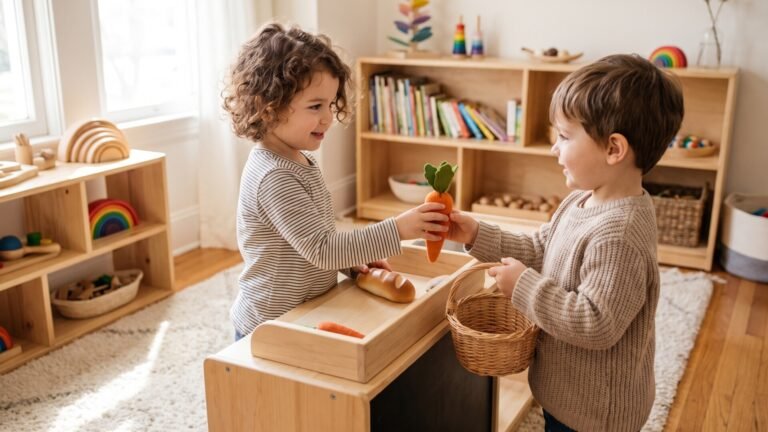
Pretend play and brain development – When a child pretends to slice a cucumber or cook a stew, they are engaging in complex cognitive work. They practice role‑playing real‑world scenarios, building cognitive flexibility and imaginative skills that form the bedrock of creative thinking.
Language and communication – Naming foods (“this is an avocado!”), describing actions (“I’m stirring the soup”), and narrating stories while cooking all enrich vocabulary and sentence formation. Social play with siblings or friends naturally introduces requests, negotiations, and shared storytelling.
Social skills – Sharing a pizza or taking turns at the stove teaches turn‑taking, cooperation, and empathy. Kids learn to navigate disagreements over who gets the red pepper or why the cake needs more candles—key interpersonal lessons.
Early life skills – Sorting groceries into food groups, counting pieces of fruit, and sequencing the steps of a recipe build foundational math, logic, and planning abilities. Play food helps children internalize healthy eating habits and kitchen safety long before they ever use a real stove.
Hape Wooden Play Food Overview
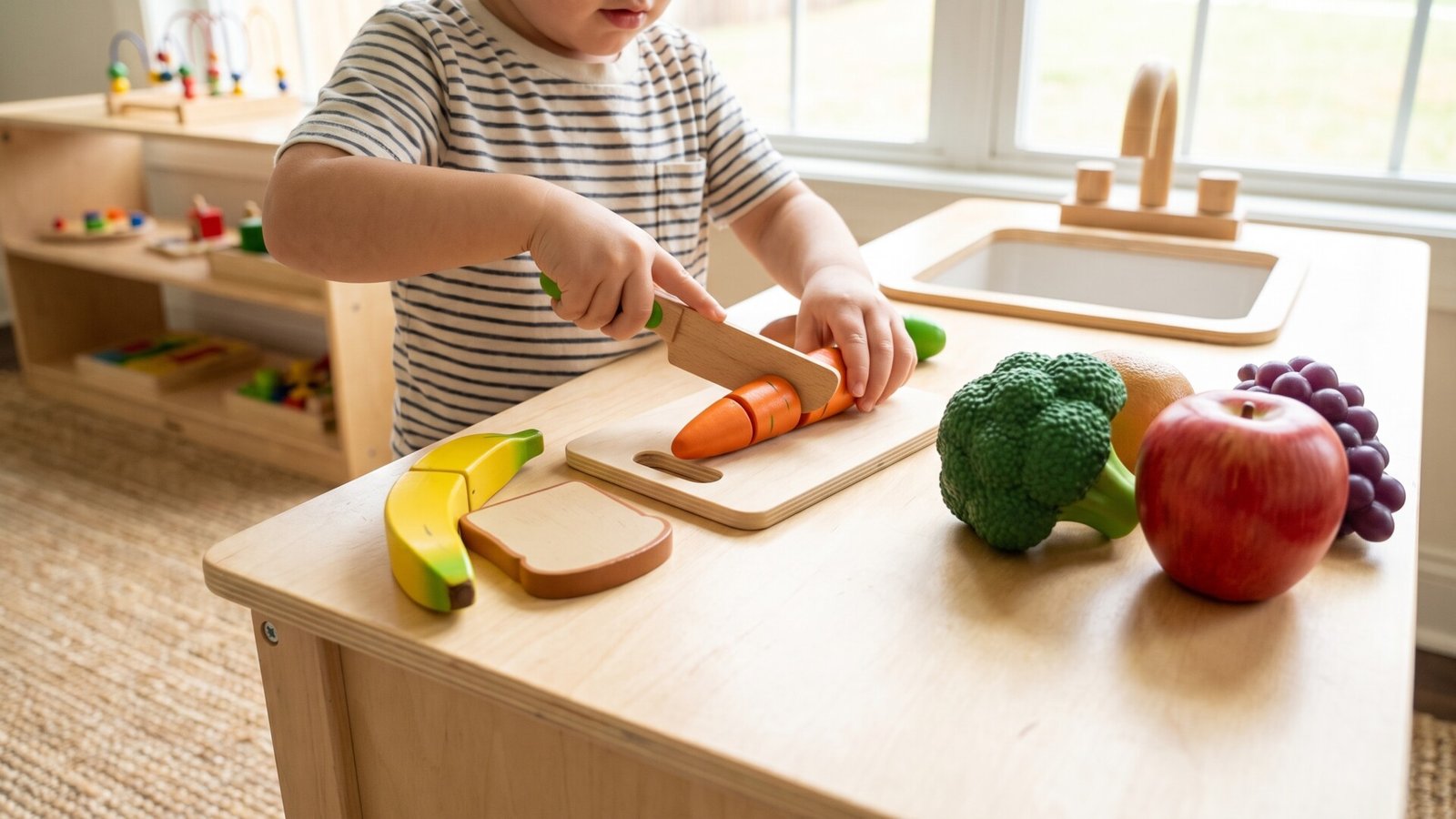
Core concept – Hape’s play food sets are crafted from sustainably sourced wood (often FSC‑certified) with non‑toxic, water‑based finishes. Most sets feature a clever Velcro “cutting” system: fruits and vegetables are held together by a sturdy strip of Velcro, and kids use a child‑safe wooden knife to slice them apart. This mimics the real‑life action of chopping ingredients—a deeply satisfying sensory experience.
Design style – Hape embraces a simplified, Montessori‑inspired aesthetic. Foods are painted in realistic colors but lack the hyper‑detailed ridges, gloss, and brand labels of plastic counterparts. This abstraction encourages symbolic thinking; a painted green oval becomes a pear, a brownish cylinder becomes a sausage. Pieces are chunky enough for small hands to grasp, yet not cartoonishly oversized.
Common features – Velcro‑cut fruits and vegetables, wooden cutting boards and knives, crate‑style storage boxes, and occasional felt accents (such as lettuce leaves). Sets range from focused fruit or vegetable collections to elaborate gourmet dinner kits.
Target age – 2–6 years, though many parents introduce the simpler cutting sets around 18 months with close supervision.
Learning Resources Plastic Play Food Overview
Core concept – Learning Resources’ play food, especially the “New Sprouts” line, is designed with a different goal: hyper‑realism and structured learning. These sets are molded from soft, rubberised plastic that feels pleasant to the touch and withstands serious toddler handling. Many pieces have realistic textures, colors, and even slight variations in weight to mimic real food.
Design style – The emphasis is on authentic recognition. A strawberry is not just a red wedge; it has tiny seeds, a glossy shine, and a green leafy top that is securely attached. Apples have a smooth, waxy feel; pretzels have a dimpled surface. This detail helps very young children connect the toy to the food on their plate, which can be especially helpful for picky eaters or language development.
Common features – Food groups (fruits, veggies, dairy, grains), grocery baskets, shopping lists, cash register integration, and sorting activities. Some sets are explicitly educational, such as the “Food Groups Sorting Set” which encourages categorization.
Target age – 18 months to 7 years, with many pieces labeled as safe for children as young as 18 months (no small parts).
Key Differences — Wood vs Plastic
Realism vs Imagination
Learning Resources leans toward realism. The level of detail—textures, accurate shapes, glossy finishes—is extraordinary. This can be a strong aid for very young toddlers (18–24 months) who are still learning to identify real foods. Seeing a toy avocado that looks almost identical to the one in the fridge reinforces the connection between play and reality.
Hape leans toward abstract, symbolic play. The painted wood leaves room for the child’s imagination to fill in the gaps. A wooden broccoli floret is recognisable but not photo‑realistic. This open‑ended approach aligns closely with Montessori philosophy, which values toys that suggest rather than dictate reality.
Durability and Longevity
Both brands prioritise durability, but they achieve it differently. Hape’s solid wood pieces are extremely tough; they resist chipping, splintering, or breaking under normal play. The paint is sealed and non‑toxic, so even chewing (within reason) won’t damage the finish. However, wood can show wear over years of heavy use.
Learning Resources’ plastic is crush‑resistant and famously sturdy. Their play food is designed to survive daily use in preschool classrooms. The rubberised material has a slight give when squeezed, so stepping on a stray piece won’t crack it. Many parents report sets lasting through multiple children and years of rough handling.
Sensory Experience
Wood offers a distinctive tactile feel: smooth, cool, and substantial. The weight of a wooden orange or the satisfying click of a Velcro “cut” adds sensory richness. The act of sawing through the Velcro seam with a wooden knife is particularly engaging for toddlers practicing bilateral coordination.
Plastic offers variety: soft‑squishy berries, firm pretzels, hollow bread slices. These textural differences can be more stimulating for children who are highly tactile. The lack of cutting action (most Learning Resources food is not sliceable) means fewer fine‑motor challenges, but also less mess.
Cleaning and Maintenance
Plastic wins hands down for hygiene. Learning Resources’ pieces are washable with warm, soapy water and can be tossed into a dishwasher (top rack) or sanitised with baby wipes. This is a major advantage for play kitchens in homes where food toys inevitably end up in mouths, on sticky floors, or near real snacks.
Wood requires more care. You should never submerge wooden play food in water. Instead, wipe with a damp cloth and mild soap, then dry immediately. Avoid soaking or using harsh chemicals. The Velcro strips can accumulate fuzz over time, reducing “cutting” action.
Educational Philosophy
Hape’s design is deeply Montessori‑aligned: the focus on natural materials, simplicity, and self‑correcting play (the Velcro pieces only fit one way) matches Maria Montessori’s principles. These toys invite the child to lead their own discovery.
Learning Resources is built for structured learning systems. Their sets often come with activity guides, sorting categories, and teaching prompts. This makes them a favourite in preschools and for parents who want to integrate explicit lessons (food groups, counting, or language) into play.
Pros and Cons of Each System
Hape Wooden Play Food
| Pros | Cons |
|---|---|
| Eco‑friendly materials – Sustainably sourced wood, non‑toxic finishes. | Less realistic – Abstract shapes may not be instantly recognisable to very young toddlers. |
| Montessori‑aligned – Encourages open‑ended, imaginative play. | Limited variety – Fewer themed sets than plastic options. |
| Cutting action – Velcro design builds fine motor skills. | No dishwasher – Cleaning requires more care. |
| Durable – Solid wood construction lasts for years. | Higher price per piece – Comparable wooden sets are more expensive than plastic equivalents. |
| Beautiful aesthetic – Looks lovely on open shelves. | Pieces can be heavy – Not ideal for very small hands. |
Learning Resources Plastic Play Food
| Pros | Cons |
|---|---|
| Highly realistic – Helps toddlers identify real foods. | Less open‑ended – Can encourage scripted play rather than imagination. |
| Wide variety – Hundreds of themed sets (breakfast, BBQ, multicultural, food groups). | Environmental concerns – Plastic, even high‑quality, is not biodegradable. |
| Easy to clean – Dishwasher safe; great for classrooms. | Some reports of chemical odor – A few parents note a strong initial smell that dissipates after washing. |
| Very durable – Crush‑resistant, survives drops and chewing. | “Cheaper” feel – Despite good quality, plastic may feel less premium to some parents. |
| Educational structure – Often includes sorting guides and lesson prompts. | No cutting action – Lacks the fine‑motor challenge of Velcro slicing. |
Best Play Food Sets in 2026
Best Overall Wooden Set: Hape Fresh Market Wooden Food Set
Age range: 2–6 years
Contents: 34 pieces including fruits, vegetables, a wooden knife, and a crate‑style storage box.
This set is the perfect introduction to wooden play food. It includes a variety of whole foods (apple, banana, carrot, broccoli) plus a few “cut‑and‑serve” items like a wooden cake and bread loaf. All Velcro connections are sturdy and satisfying. The wooden crate doubles as storage and a shopping basket.
“My 2‑year‑old LOVES this toy. He will sit and quietly ‘cut’ the fruits independently. Wooden pieces are strong and have yet to dent or chip, even when he is rough with them!” — Verified customer on Amazon SG.
Pros:
- Beautiful natural finish, FSC‑certified wood.
- Cutting action develops fine motor skills.
- Crate encourages tidy storage.
Cons:
- Fewer pieces than some plastic sets.
- Requires careful cleaning (no soaking).
Price range: $$–$$$
Available on Amazon and Hape official store.
Best Wooden Budget Set: Melissa & Doug Cutting Food Set
Age range: 2–5 years
Contents: 8 wooden “cutting” fruits and vegetables, a wooden knife, and a cutting board.
Melissa & Doug is Hape’s main wooden competitor, often at a lower price point. This classic set includes a wooden knife and cutting board, and each piece of food is held together by a single strip of Velcro. While the design is simpler (fewer pieces, less variety), it remains a durable, Montessori‑friendly entry point.
Pros:
- Very affordable.
- Solid wood, non‑toxic paint.
- Teaches basic food preparation.
Cons:
- Velcro loses stickiness faster than Hape’s.
- Smaller range of foods.
Price range: $
Available on Amazon and Target.
Best Overall Plastic Set: Learning Resources New Sprouts Food Set
Age range: 2–7 years
Contents: 19 pieces, including a basket, fruit, veggies, and a few processed items (juice box, ice cream sandwich).
This is the most popular Learning Resources starter set for good reason. The pieces are chunky enough for small hands yet detailed enough to spark conversations about healthy eating. The soft, rubberised plastic feels pleasant and withstands hours of play.
“The Learning Resources New Sprouts Cookout! set is made from durable and crush‑resistant plastic, which supports longevity and repeated use.”
Pros:
- Highly realistic, including textures and colors.
- Dishwasher safe for easy cleaning.
- Sturdy basket included.
Cons:
- Some pieces may have a slight chemical smell at first (dissipates after washing).
- No cutting action.
Price range: $$
Available on Amazon, Target, and Learning Resources retailers.
Best Educational Plastic Set: Learning Resources Food Groups Sorting Set
Age range: 3–7 years
Contents: 50+ pieces representing five food groups (fruit, vegetables, grains, proteins, dairy), plus sorting mats.
This set is explicitly designed for structured learning. Children sort the play food into the correct groups, which can be tied to nutrition lessons, counting exercises, or language development. The guidebook includes suggested activities for parents and teachers.
Pros:
- Exceptional educational value.
- Covers a wide range of foods.
- Encourages classification and reasoning.
Cons:
- More expensive than basic sets.
- Some pieces are small, not for children under 3.
Price range: $$–$$$
Available on Amazon and Learning Resources store.
Best Hybrid Kitchen Bundle
Age range: 3–6 years
Contents: A combination set (often from independent sellers) that includes a wooden play kitchen plus a curated mix of Hape wooden food and Learning Resources plastic accessories.
This hybrid approach is the best of both worlds: the kitchen itself (usually wood) provides the Montessori environment, while the food set includes realistic plastic items for recognition and wooden cutting pieces for fine motor practice. Sellers on Etsy and specialty toy stores offer these curated bundles.
Pros:
- Maximises learning across both styles.
- One‑stop shopping for a complete kitchen setup.
Cons:
- More expensive upfront.
- May include redundant items.
Price range: $$$
Available via specialty toy stores and Etsy.
Wood vs Plastic Play Food
| Feature | Hape Wooden Sets | Learning Resources Plastic |
|---|---|---|
| Realism | Medium – simplified, symbolic | Very High – detailed, textured |
| Material | Sustainably sourced wood, non‑toxic paint | Soft, rubberised plastic (BPA‑free) |
| Cutting Action | Yes – Velcro slicing | No |
| Cleaning | Wipe only; do not submerge | Dishwasher safe; easy sanitising |
| Durability | Very high (resists chipping, heavy use) | Very high (crush‑resistant, survives drops) |
| Educational Focus | Open‑ended, Montessori symbolic play | Structured, realistic recognition, sorting |
| Sensory Feedback | Smooth, cool, weighty | Variety of textures, some squishy pieces |
| Age Range | 2–6 years | 18 months – 7 years |
| Variety of Sets | Moderate | Extensive (breakfast, BBQ, multicultural, etc.) |
| Price Range | $$–$$$ | $–$$$ |
| Best For | Montessori families, aesthetic homes, fine motor development | Classrooms, picky eaters, structured learning activities |
Which Should You Choose?
Choose Hape Wooden if:
- You follow Montessori or Waldorf educational approaches.
- You prefer open‑ended, symbolic play over hyper‑realism.
- Aesthetic harmony (wooden toys on natural shelves) matters to you.
- You want a self‑correcting fine motor challenge (the cutting action).
- Environmental impact and biodegradability are priorities.
Choose Learning Resources Plastic if:
- Your child is very young (18–24 months) and still learning real food recognition.
- You need easy, frequent cleaning (e.g., many children, classroom setting).
- You plan to integrate structured learning activities (food groups, sorting, counting).
- Realism is important for connecting play to real‑life eating habits (helpful for picky eaters).
- You want a wide variety of themed sets to keep play fresh.
Best strategy for many families: combine both. Invest in a few Hape cutting sets (a fruit basket and a vegetable crate) for the sensory and fine‑motor benefits, and supplement with Learning Resources pieces (a breakfast set or lunch items) to expand realism and variety. This hybrid approach gives your child the best of both worlds.
FAQ
1 Which is better: wooden or plastic play food?
Neither is universally “better.” It depends on your child’s age, your educational philosophy, and your lifestyle. See the section above for detailed guidance.
2 Is wooden play food safer than plastic?
Both are safe when purchased from reputable brands (Hape and Learning Resources each meet or exceed ASTM and CPSIA safety standards). Wood is naturally antibacterial and contains no plasticizers, while Learning Resources’ plastic is BPA‑free, phthalate‑free, and designed to be non‑toxic.
3 Which lasts longer over time?
Both are highly durable. Hape’s wood can show minor wear (scratches, paint fading) over years of heavy use but remains intact. Learning Resources’ plastic may develop stress marks if bent repeatedly but generally resists cracking and can be passed down through multiple children.
4 Is Learning Resources play food realistic?
Extremely realistic. Many pieces include subtle details like seeds on strawberries, dimples on pretzels, and variations in surface texture that mimic real food. This is a major strength of the brand.
5 Does Hape play food break easily?
No. Hape uses solid‑wood construction (not pressed board or cheap composite). Edges are smooth and rounded. The paint is sealed and resistant to chipping, even with rough play. The Velcro connections may lose stickiness after many years but are replaceable.
6 What age is best for play food sets?
Children can start exploring simple wooden or plastic sets around 18 months with supervision. By age 2–3, most children are ready for cutting sets and more complex pretend cooking. Hape and Learning Resources both label most sets for ages 2+ or 18+ months; always check individual product warnings for small parts.
7 Can play food help with real eating habits?
Yes. Several studies suggest that playing with realistic toy food can reduce food neophobia (fear of new foods) and increase willingness to taste new items. Learning Resources’ ultra‑realistic pieces are especially helpful for this.
8 Are these toys good for classrooms?
Both brands are classroom favourites. Hape’s durability and Montessori alignment suit many alternative schools. Learning Resources is ubiquitous in preschools and early‑learning centres due to its easy cleaning, clear learning objectives, and extensive teacher resources.
9 How many pieces should a good set have?
Start with a starter set of 15–25 pieces. Too few and play becomes repetitive; too many can overwhelm a toddler. You can always add supplementary sets later.
10 Where can I buy them through affiliate programs?
All the sets mentioned are available at major retailers. Links are included in the product sections to help you find current pricing and deals while supporting ToyGuideHub.
Conclusion
Play food is one of the richest learning tools in early childhood, supporting language, social skills, problem‑solving, and early nutrition awareness. The choice between Hape wood and Learning Resources plastic isn’t about which is “right” and which is “wrong.” It’s about which philosophy—open‑ended, symbolic play, or realistic, structured learning—better suits your child’s age, temperament, and your family’s values.
For parents who dream of a serene, Montessori‑aligned play space with toys that last a lifetime, Hape’s wooden sets are a joy. For those who want the most realistic, easy‑to‑clean, classroom‑tested play food with a huge variety of sets, Learning Resources is the answer. And for many families, the best approach is a thoughtful blend: wood for cutting and sensory weight, plastic for realism and variety.
Because sometimes the best way to teach children about the real world is to let them build it—one wooden slice or plastic fruit at a time.