Best Kids’ Workbenches: Real Tools vs. Plastic Squeaky Hammers
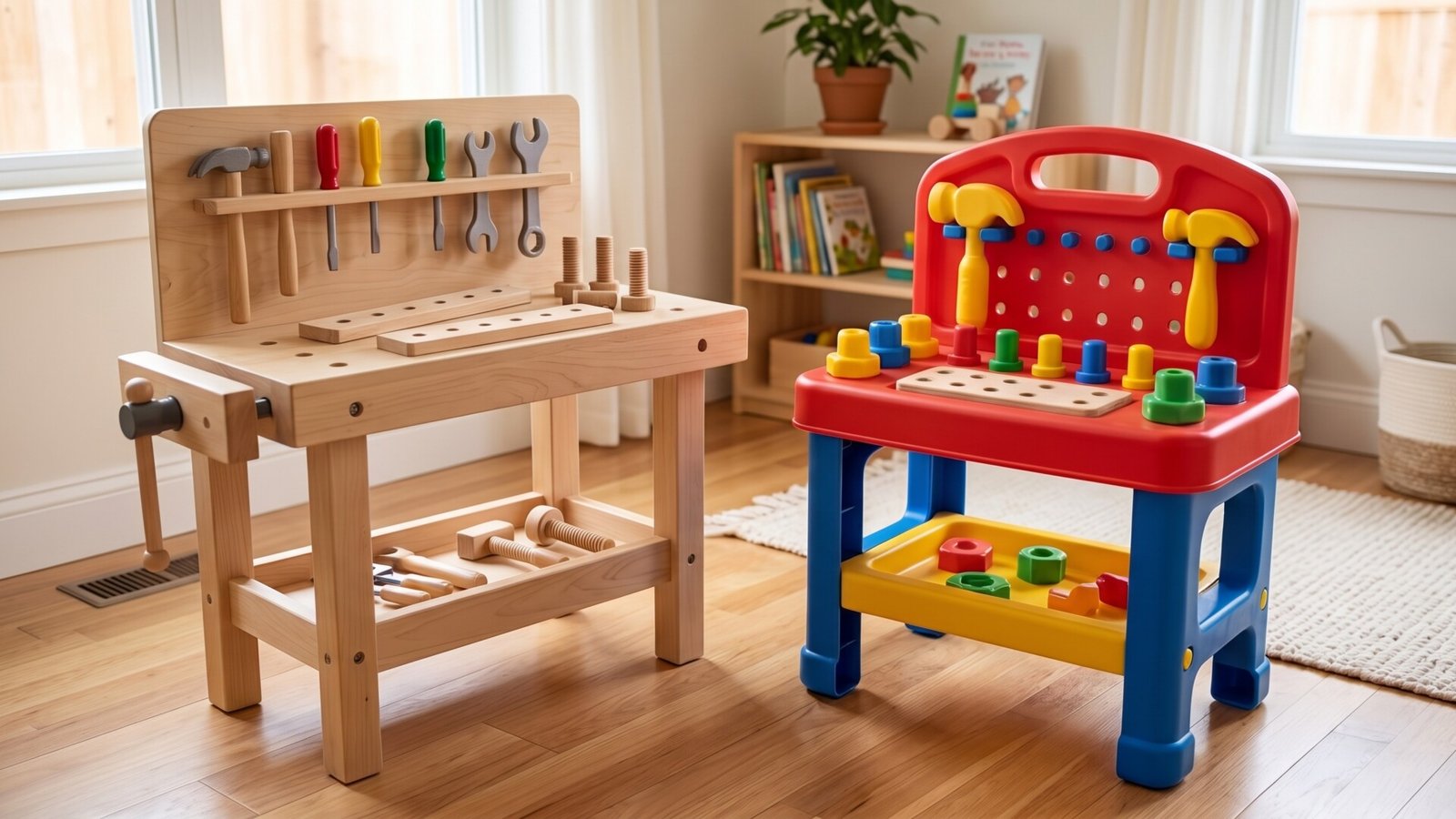
A workbench is one of those rare toys that seems simple on the surface – a bench, some tools, maybe a few screws – but can teach a child more about patience, problem‑solving, and physics than most expensive gadgets on the market. In 2026, kids’ workbenches are more popular than ever, thanks to a growing interest in STEM learning, Montessori life skills, and a collective push away from purely digital play. But there’s a divide in the category that every parent eventually faces: real‑tool‑inspired workbenches versus plastic, sound‑effect‑heavy pretend benches.
One side offers simplified but functional tools: real screws, wooden boards, nuts that actually tighten, and sometimes even battery‑powered drills with limited torque. The other side delivers bright plastic hammers that squeak, lightweight vises, and pretend projects with no risk – or real learning. Both have their place, but the question is: which one is better for your child, at what age, and for what kind of development?
In this guide, I’ll break down the differences in safety, learning depth, age suitability, and long‑term value. I’ll also review the top workbenches in each category, from toddler‑friendly plastic sets to advanced real‑tool kits that could spark an engineer’s first passion – because sometimes the best way to learn how the real world works isn’t pretending, it’s safely building it with your own two hands.
Why Kids’ Workbenches Are a Powerful Learning Tool
A workbench is not just a toy – it’s a tiny workshop that introduces core concepts of engineering, physics, and manual dexterity.
Practical life skills – When a child uses a wrench to tighten a bolt or a hammer to tap a peg, they are practising skills that translate directly to real‑world tasks: fixing a loose shelf, assembling furniture, or understanding how things fit together. These are the foundations of DIY confidence.
STEM and engineering foundations – Building a simple structure from a workbench’s plans teaches cause and effect. “If I hammer this peg too hard, the board splits. If I align the screw straight, it goes in easily.” These experiments in physics and materials are pure, hands‑on STEM learning.
Motor skill development – Hammering, screwing, gripping pliers, and turning a wrench all build fine motor control and hand strength. A 3‑year‑old learning to line up a screwdriver with a slot is practising the same focus and coordination needed later for writing, buttoning, or surgical precision.
Confidence and independence – There’s a special pride a child feels when they complete a project – a birdhouse, a toolbox, a simple car – using tools that feel real. That “I can build things” mindset transfers to other challenges and nurtures resilience.
Real Tools vs Plastic Tools — Core Differences
The two categories aren’t just about materials; they represent fundamentally different play philosophies.
Real‑tool‑inspired workbenches – These use simplified but fully functional components. Instead of a pretend hammer, you get a real wooden mallet. Instead of plastic screws that snap into place, you get actual threaded bolts with nuts. Some advanced sets include low‑voltage battery‑powered drills that spin (but with minimal torque to prevent injury). The bench itself is often made of wood or heavy‑gauge plastic with real metal screws and brackets.
Plastic pretend workbenches – These are molded, lightweight toys. Tools are single‑piece plastic with no moving parts; when you twist the “screwdriver,” a gear turns, but nothing tightens. Many include sound effects – whirring, clicking, or a hammer that squeaks on impact. The bench is durable plastic, often brightly coloured, with storage bins.
Learning depth comparison – A child playing with a plastic bench learns the idea of construction. A child using a real‑tool kit learns the physics of construction: why a screw needs pilot holes, why nuts must align with threads, why a hammer needs control. The former builds imagination; the latter builds competence.
Safety vs authenticity tradeoff – Real‑tool kits require active adult supervision (or at least proximity). Plastic benches can be used independently by a toddler. The tradeoff is risk: a real screw can be lost, a mallet could bruise a toe (though it’s designed to be very light). Most parents find the supervised risk acceptable and far less than letting a child use actual adult tools.
Safety Considerations Parents Must Know
Safety is the number one concern when choosing between these categories. Here’s what to evaluate.
Age appropriateness – No workbench is suitable for all ages. As a rule:
- 2–4 years: Plastic benches with chunky tools, no small parts, no real fasteners.
- 3–6 years: Wooden benches with large screws, wooden tools, and adult supervision.
- 5–10 years: Real‑tool‑inspired kits with metal screws, nuts, bolts, and possibly battery tools (with safety torque).
Tool design safety – Reputable real‑tool kits use blunt edges, rounded hammer heads, and drills that stall if pressed too hard (torque limited to less than 1 Nm). The Black+Decker Junior Workbench, for example, has a battery‑powered drill that spins but stops immediately if it meets resistance, preventing pinching.
Supervision levels – With plastic benches, you can cook dinner nearby while a 3‑year‑old plays independently. With real‑tool kits, you should be in the same room, checking periodically that no child is hammering at the bench frame (instead of the included pegs) or trying to disassemble the bench itself.
Risk factors – Small screws and nuts are choking hazards for children under 3. Cheap plastic benches may have sharp edges or break into sharp shards. Real‑tool benches have heavy parts – a dropped wooden hammer can hurt a toe; a metal wrench could scratch a floor. Teach your child the rule: tools are for the bench, not for swinging.
Pros and Cons of Each Category
Real‑Tool‑Inspired Workbenches
| Pros | Cons |
|---|---|
| Teaches real‑world skills (screwing, tightening, threading) | Requires active adult supervision |
| Highly engaging for older children (5–10) | More expensive upfront |
| Strong STEM learning outcomes (physics of force, levers) | Setup is more complex (assembling the bench itself may be a parent‑child project) |
| Durable – often wood or heavy steel/plastic | Components (nuts, screws) can be lost |
| Grows with child (add more advanced projects) | Some risks of pinching or dropping heavy parts |
Plastic Pretend Workbenches
| Pros | Cons |
|---|---|
| Extremely safe – no choking hazards, soft edges | Little to no real‑world skill transfer |
| Lightweight and portable (take to grandma’s house) | Play is repetitive (same squeak, same turning gears) |
| Affordable (often $30–60) | Limited learning depth – mostly cause‑and‑effect noise |
| Ideal for toddlers (2–4) | Not durable – plastic can crack if dropped on hard floor |
| No supervision needed beyond general toddler safety | Children often outgrow quickly (by age 4) |
Best Kids’ Workbenches in 2026
Here are the top workbenches in each category, based on expert reviews and parent feedback.
Best Overall Realistic Workbench: Black+Decker Junior Power Workbench
Age range: 3–7
Key features: Battery‑powered “drill” (low torque, safe), plastic hammer, wrench, screws, nuts, work light, tool storage. Also includes sound effects (drill noise, click) that actually correspond to tool use.
This bench strikes the perfect balance between safety and realism. The drill spins but stalls on contact – no pinching. The screws are large, with molded plastic heads and real threading; nuts spin on and off. The bench has a built‑in “vise” that opens and closes. It’s not wood, but the plastic is thick and stable. The included project ideas (a small toolbox, a picture frame) give kids a goal.
| Pros | Cons |
|---|---|
| Very safe introduction to power tools | Drill sound can annoy parents |
| Real screw movement teaches threading | Plastic construction, not wood |
| Comes with storage bins | Batteries not included (requires 2 AA for drill) |
| Highly rated for ages 3–6 | Limited projects included |
Price range: $$
Available at Amazon and Black+Decker licensed toy retailers.
Best Advanced Real‑Tool Learning Kit: Bosch Kids Workbench Pro Set
Age range: 5–10
Key features: Wooden workbench, metal screws and nuts, real hand tools (screwdriver, wrench, mallet, pliers), project blueprints.
This is the closest you can get to a real adult workbench without buying expensive power tools. The bench itself requires assembly – a great parent‑child project. Once built, the set includes dozens of metal nuts, bolts, washers, and wooden planks with pre‑drilled holes. Children follow simple blueprints to build a birdhouse, a race car, a shelf, or a toolbox. Tools are scaled down but fully functional: the screwdriver has a real magnetic tip, the wrench adjusts.
| Pros | Cons |
|---|---|
| Exceptional STEM learning – real engineering | Requires significant adult supervision |
| Highly durable (wood + metal) | Expensive |
| Dozens of projects – high replay value | Small parts – not for under 5 |
| Teaches measurement and planning | Assembly of bench is time‑consuming |
Price range: $$$
Available via specialty toy retailers and Amazon.
Best Montessori Real Skills Kit: Hape Master Workbench Wooden Set
Age range: 3–8
Key features: Wooden workbench, wooden tools (hammer, wrench, screwdriver, nuts and bolts), assembly projects, non‑toxic finishes.
Hape’s wooden workbench is a favourite among Montessori families. The tools are scaled to small hands but functional: the wrench actually turns bolts, the screwdriver fits screws, and the wooden mallet hammers pegs into holes. No batteries, no sounds – just pure, tactile cause‑and‑effect. The bench itself is solid, with a top shelf for storing tools. Projects include a simple car, a robot, and a windmill.
| Pros | Cons |
|---|---|
| Beautiful natural wood aesthetic | Tools are wooden, so less durable than metal |
| Teaches real mechanics (screwing, threading) | Fewer projects than Bosch kit |
| Very safe (no sharp edges) | Wood can splinter if mistreated (rare) |
| Encourages independent, quiet focus | No power tool element |
Price range: $$
Available at Hape official and Amazon.
Best Plastic Beginner Option: Step2 Handy Helper Workbench
Age range: 2–5
Key features: Brightly coloured plastic bench, play tools (hammer, saw, wrench, screwdriver), sound effects (clicking gears, “sawing” noise), storage bins.
This is the classic toddler workbench. It’s low to the ground, with no small removable parts. The “screwdriver” turns gears that spin a plastic “screw” (attached permanently). The hammer squeaks. The saw makes a rattling sound when moved. It’s pure pretend, but for a 2‑ or 3‑year‑old, it introduces the idea of building without any risk.
| Pros | Cons |
|---|---|
| Extremely safe – no choking hazards | No real skill learning |
| Very affordable | Quickly outgrown (by age 4) |
| Lightweight and easy to move | Tools are molded plastic, no movement |
| Encourages imaginative roleplay | Sound effects rely on batteries |
Price range: $
Available via Amazon and Target.
Best Budget Wooden Option: Melissa & Doug Wooden Tool Bench
Age range: 3–6
Key features: Wooden frame, wooden tools (hammer, saw, wrench), painted on screws and nuts, storage shelf.
This is a simpler, lower‑cost alternative to the Hape set. It’s solid wood, but the screws and nuts are painted on – they don’t turn. The tools are one‑piece wooden shapes. Children can “hammer” pegs into holes, but the bench does not have threaded fasteners. It’s a step up from the plastic bench in realism and durability, but still firmly in the pretend category.
| Pros | Cons |
|---|---|
| Budget‑friendly (under $50) | No real screw/thread action |
| Durable wood construction | Limited complexity |
| Attractive, simple design | Pegs can be lost |
| Good for 3‑year‑olds | No storage bins |
Price range: $
Available on Amazon and Melissa & Doug.
Real Tools vs Plastic Workbenches
| Workbench | Realism | Safety | Learning Depth | Durability | Supervision Needed | Price Range | Best For |
|---|---|---|---|---|---|---|---|
| Black+Decker Junior Power | High | High | High | High | Medium | $$ | Best overall (ages 3–7) |
| Bosch Kids Pro Set | Very High | Medium | Very High | Very High | High | $$$ | Advanced learners (5–10) |
| Hape Wooden Master | Medium‑High | High | High | Very High | Medium | $$ | Montessori homes |
| Step2 Handy Helper | Low | Very High | Low | Medium | Low | $ | Toddlers (2–4) |
| Melissa & Doug Wooden | Medium | High | Medium‑Low | High | Medium | $ | Budget beginners |
How to Choose the Right Workbench
For toddlers (2–4 years) – Choose a plastic bench with chunky, non‑removable tools, like Step2. Safety is paramount; learning is about cause‑and‑effect (“when I turn this gear, it spins”).
For preschoolers (3–6 years) – A wooden bench with real screws and nuts (Hape) or a simple real‑tool plastic bench (Black+Decker) offers the right balance. Supervision still needed, but children can begin to understand how fasteners work.
For older kids (5–10 years) – Invest in a real‑tool engineering kit like Bosch. This will challenge them for years and teach genuine construction skills.
For Montessori homes – Wooden, unpowered sets (Hape) align perfectly with the philosophy of natural materials and self‑directed learning.
For STEM‑focused families – Bosch or Black+Decker’s power tool element adds excitement and introduces basic mechanics and electricity.
Extra tip: Regardless of the bench you choose, spend time building alongside your child. Talk about why screws grip better than nails, demonstrate how to hold a hammer safely, and celebrate the final project. The real value is in the shared experience.
FAQ
1. Are real‑tool kids’ workbenches safe?
Yes, when used as intended with adult supervision. The tools are designed with blunt edges, low force, and safety stops. The risk is minimal – far less than giving a child access to real adult tools.
2. What age should children start using them?
Plastic pretend benches: 2–4 years. Wooden real‑tool benches: 3–6 years. Advanced real‑tool kits (with metal bits and small parts): 5+ years.
3. Do plastic workbenches actually teach anything?
They teach basic cause and effect (sound follows action) and roleplay (pretending to be a builder). However, they do not teach how real tools work or build practical skills.
4. Which is better for STEM learning?
Real‑tool‑inspired workbenches, hands down. They teach physics (leverage, torque), engineering (threading, fastening), and mathematics (measuring, alignment).
5. Can kids actually use screws and tools?
Yes, with age‑appropriate kits. The screws are larger, the threads are coarse, and the tools are scaled for small hands. A 5‑year‑old can successfully screw a bolt into a nut after a few tries.
6. Are wooden workbenches safer than plastic ones?
Wooden benches are generally heavier and more stable, which reduces tipping risk. However, wooden tools can splinter if abused. Plastic benches are lighter and might slide on smooth floors. Both are safe when used correctly.
7. How long do kids typically use workbenches?
A good plastic bench may be outgrown by age 4. A wooden real‑tool bench can be used from age 3 to 7. An advanced kit (Bosch) can engage a child from 5 to 10 or even older.
8. Do these toys help with real‑life skills?
Absolutely. Children who learn to use a screwdriver and wrench on a toy bench are far more likely to help with real household repairs later. They understand threading, alignment, and the patience required for assembly.
9. What should parents supervise closely?
- Make sure children hammer on the bench’s peg board, not on the bench frame or floor.
- Ensure small screws and nuts are not put in mouths.
- With battery‑powered drills, teach that they are only for the included soft screws.
- Regularly check that no parts have become loose or sharp.
10. Where can I buy them through affiliate programs?
Links are embedded in the product sections above. Major retailers include Amazon, Target, Hape official, and specialty toy stores.
Conclusion
Kids’ workbenches are not one‑size‑fits‑all. For a 2‑year‑old, a brightly coloured plastic bench with squeaky hammers and turning gears is a wonderful introduction to the idea of building. For a 6‑year‑old who wants to understand how a screw holds wood, a real‑tool‑inspired bench (even a plastic one with functional threads) is a giant leap in STEM learning. And for a 9‑year‑old who dreams of building a real birdhouse, an advanced kit with metal fasteners and project blueprints can spark a lifelong passion for engineering.
The best workbench is the one that matches your child’s current ability, your tolerance for supervision, and your family’s educational values. If you want pure safety and imagination, go plastic. If you want real skills and deeper engagement, invest in a real‑tool bench – and plan to build alongside them.
- Best overall pick: Black+Decker Junior Power Workbench – the ideal balance of safety, functionality, and fun for ages 3–7.
- Best advanced option: Bosch Kids Workbench Pro Set – for the child who is ready for real engineering challenges.
- Best Montessori option: Hape Wooden Master Workbench – beautiful, tactile, and perfectly aligned with learning through doing.
- Best toddler option: Step2 Handy Helper Workbench – safe, simple, and perfect for 2‑ to 4‑year‑olds.
- Best budget option: Melissa & Doug Wooden Tool Bench – a sturdy wooden bench at an entry‑level price.
Because sometimes the best way to learn how the real world works isn’t pretending – it’s safely building it with your own two hands. The imperfectly hammered peg and the slightly crooked shelf are where the real lessons live.
Check current pricing and availability:
- Black+Decker Junior Workbench on Amazon
- Bosch Kids Workbench via specialty toy retailers
- Hape Wooden Workbench on Amazon / Hape store
- Step2 Plastic Workbench via Amazon / Target
- Melissa & Doug Tool Bench on Amazon