10 Open-Ended Construction Toys for Rainy Days
Rainy days can feel like a challenge when you have a toddler or preschooler bouncing off the walls. Outdoor play isn’t an option, but indoor play doesn’t have to be boring. One of the best ways to use that energy is open-ended construction toys, which let kids build, knock down, rebuild and invent their own games. They invite fine motor practice, spatial thinking and imaginative play, and, unlike single-purpose toys, they can stay interesting for years as children’s ideas get more ambitious.
This guide covers 10 types of open-ended construction toys for rainy days, with real examples where we could verify them, the age each one actually suits, the main trade-offs, and a rainy-day tip for each. We also flag the safety points that matter most for toddlers, especially around magnets and small parts.
Quick answer: if you buy only one set, choose a large set of basic building pieces that your child can use in many ways: wooden blocks for all ages, LEGO DUPLO for toddlers, or Magna-Tiles-style magnetic tiles from around age 3. Add a second, different type (ramps, gears, or a train track) once they have mastered the first.
Why Open-Ended Construction Toys Work So Well on Rainy Days
Rainy days often need longer indoor engagement, and construction toys suit that because they:
- Invite creativity: The same pieces can become towers, vehicles, houses, or abstract shapes.
- Give problem-solving practice: Children test balance, stability and structure by trial and error.
- Offer fine motor practice: Grasping, stacking and connecting pieces uses small hand muscles.
- Allow sustained focus: Many children will work on one build for a long stretch.
- Lead into pretend play: A tower becomes a castle; a track becomes a city.
For the research and thinking behind this kind of play, see our parent’s guide to how kids learn through construction play. Remember that these toys encourage skills rather than guarantee them; the real value is in the time children spend experimenting.
Before You Buy: Age Grade and Safety
- The age on the box is a safety grade. A set marked 3+ contains small parts or features unsuitable for younger children, even if your toddler seems skilled.
- Small parts: Anything that fits inside a toilet-paper tube is a choking hazard. Keep small-part sets away from children under 3 and from younger siblings.
- Magnets: Loose magnets are a serious swallowing hazard. If a child may have swallowed more than one magnet, seek emergency medical care immediately. Choose sets with sealed magnets from reputable brands, and check the packaging for age limits.
- Marbles and small balls are choking hazards too; use marble runs only with children old enough not to mouth them.
- Supervise play with any set containing magnets, marbles, or small connectors.
The US Consumer Product Safety Commission publishes guidance on small parts and magnets for children’s products.
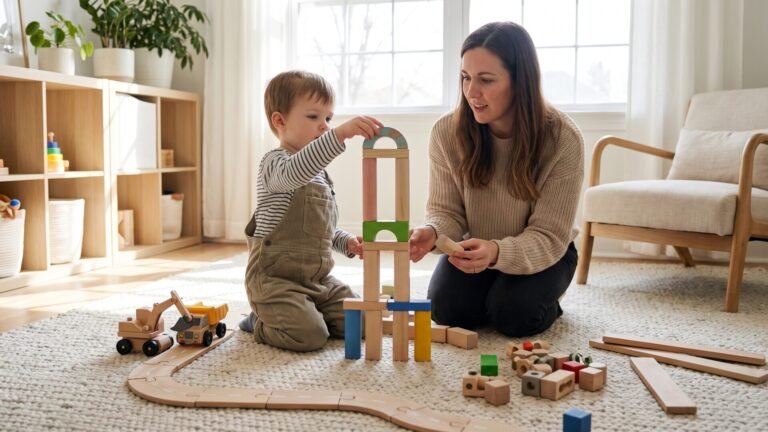
1. Wooden Building Blocks
Overview: Wooden blocks are the classic open-ended toy: simple, durable and usable from the first stacking attempts to elaborate cities.
Features to look for: smooth, splinter-free finish; non-toxic paints or unpainted wood; pieces in varied shapes and sizes; a storage bag or crate.
What it encourages: stacking and balancing, early geometry (rectangles, triangles, arches), and imaginative scenes.
Best age: from about 12 months with large blocks, through the early school years. Trade-offs: blocks can hurt if thrown or dropped on feet, are loud on a hard floor, and larger sets can be pricey. Prices vary widely by brand and set size.
Rainy Day Tip: Use a blanket or rug as a play surface to reduce noise and keep pieces from sliding.
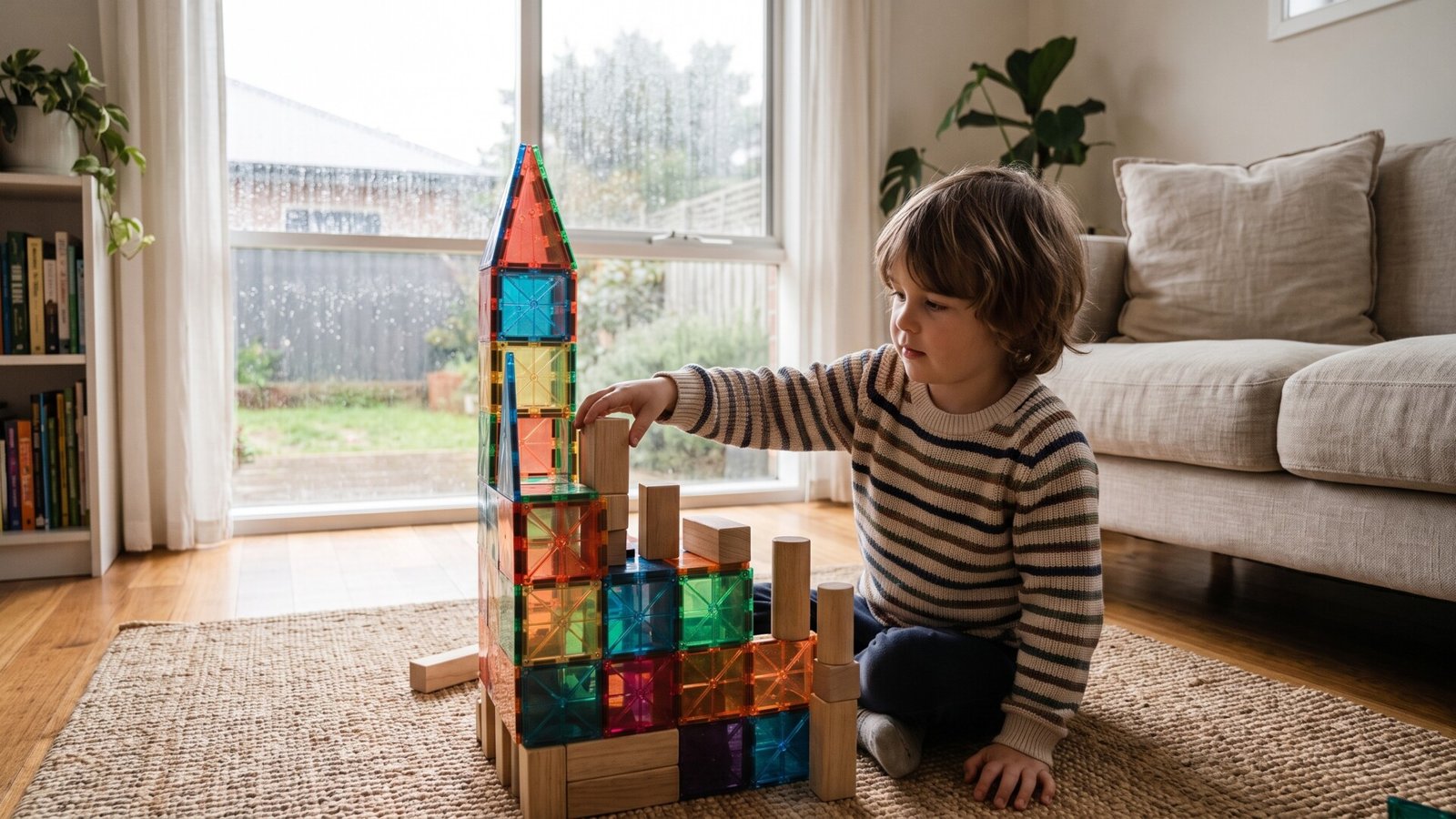
2. Magnetic Tiles
Overview: Magnetic tiles let kids connect flat shapes into walls, floors, towers and houses, with magnets sealed inside translucent plastic. Well-known brands include Magna-Tiles, Magformers and Playmags.
Real example: the Magna-Tiles Clear Colors 100-piece set is graded for ages 3+ and carries a small-parts warning for children under 3. List prices we saw were around $130 USD, with some retailers lower, so shop around.
What it encourages: spatial reasoning, shape recognition, symmetry, and testing what stands up.
Best age: from about 3 years. Trade-offs: one of the pricier options; a bigger set is far more fun than a small one; tiles can crack if dropped and sealed magnets can come out of damaged tiles, so discard any broken pieces. Competing sets are often not compatible with each other.
Rainy Day Tip: Build bridges and tunnels for toy cars, or a “light-up house” on a flashlight.
3. LEGO DUPLO Sets
Overview: DUPLO bricks are the larger-format cousins of standard LEGO bricks, designed for small hands. LEGO’s DUPLO line is organized by age from 1.5+ up to 4+.
Features: chunky bricks, figures, and themed sets (farm, city, animals) that spark storytelling; DUPLO is compatible with other DUPLO sets, and DUPLO bricks can connect to standard LEGO bricks in a limited way, though they are not designed to be mixed.
What it encourages: early construction, pretend play and storytelling, and pressing and pulling bricks apart.
Best age: check each set; many start at 1.5 or 2 years, and bigger themed sets target 3–5. Trade-offs: themed sets can steer play toward one scenario, so a plain brick bucket is more open-ended; sets get expensive quickly.
Rainy Day Tip: Combine two themed sets to build a whole city or zoo in the living room.
4. Wooden Train Tracks
Overview: Wooden railway tracks click together into countless layouts. Well-known makers include Brio and Melissa & Doug, and most wooden track brands are broadly compatible with each other.
What it encourages: planning routes, sequencing, fine motor control when fitting pieces, and pretend play about travel and cities.
Best age: typically from about 3 years for starter sets (check the product, since some sets with small pieces are rated 3+). Trade-offs: track is cheapest in starter packs but expansion packs add up; tracks sprawl across the floor.
Rainy Day Tip: Build blocks into bridges and elevated sections to create multi-level tracks.
5. Construction Vehicle Playsets
Overview: Cranes, dump trucks and diggers combine building with role-play. Sturdy toy trucks from brands such as Bruder and Little Tikes work well alongside blocks.
What it encourages: hauling, sorting, planning, and storytelling.
Best age: varies by model, and many realistic trucks are rated 3+. Trade-offs: single-purpose vehicles are less open-ended than blocks; pair them with a bucket of blocks for the best value.
Rainy Day Tip: Build a structure first, then “transport” blocks with a crane or dump truck.
6. Marble Run Sets
Overview: Marble runs let children build ramps, chutes and tunnels for rolling balls, linking construction with cause and effect.
What it encourages: predicting, testing, adjusting slopes, and spatial planning.
Best age: varies widely; many sets are for ages 4 and up because marbles are a choking hazard. For younger children, look for sets with larger balls, and check the age grade on the box. Trade-offs: marbles disappear under furniture; good sets are not cheap.
Rainy Day Tip: Experiment with different paths and see which ramps make the ball go fastest.
7. Pattern Blocks and Boards
Overview: Pattern blocks are flat geometric shapes that children arrange into pictures and designs on a board or table. Learning Resources is one well-known maker of pattern block sets.
What it encourages: shape recognition, symmetry, early geometry, and following or inventing patterns.
Best age: typically from about 3–4 years with supervision; check the age grade. Trade-offs: small flat pieces are easy to lose; quiet and tabletop-friendly, which suits some rainy-day afternoons.
Rainy Day Tip: Make it a challenge: “Can you build a rainbow?” or “Can you copy this pattern?”
8. Interlocking Gear Sets
Overview: Gear sets show how turning one wheel moves others. A well-known example is Learning Resources Gears! Gears! Gears!
Real example: the Super Building Set (150 pieces) is listed for ages 3+, carries a small-parts warning for children under 3, and was priced around $59 USD at the retailer we checked.
What it encourages: cause and effect, mechanical thinking, planning and patience.
Best age: about 3–6 years. Trade-offs: many pieces to keep track of; best with an adult nearby for the first sessions.
Rainy Day Tip: Challenge kids to build a gear chain that moves a toy car across the table.
9. Magnetic Rod and Ball Sets: Use With Caution
Overview: These sets use magnetic rods and steel balls to build 3D shapes such as cubes and pyramids. Geomag and Magformers are well-known brands; the manufacturer of one popular classic line describes it as suited to ages 3 and up because of small parts.
Important: This is a type of toy to treat carefully. Small magnetic pieces and steel balls are a serious swallowing hazard, so we do not recommend rod-and-ball sets for toddlers or for any child who still mouths objects. If used with a preschooler, supervise closely, count pieces after play, and keep sets away from younger siblings.
What it encourages: 3D thinking, geometry and symmetry. Best age: follow the box; many families wait until school age. Trade-off: the safety risk is the main reason to choose magnetic tiles (with sealed magnets) or non-magnetic building sets for younger children instead.
Rainy Day Tip: For older children, try color-sorting challenges or building the tallest freestanding tower.
10. Foam Building Blocks
Overview: Soft, lightweight foam blocks are a gentle choice for indoor construction, especially for younger toddlers.
Features to look for: large blocks that cannot be swallowed, firm enough to stack but soft enough not to hurt, and a washable surface.
What it encourages: big-body play such as stacking, carrying and knocking down, plus balance and fort-building.
Best age: from about 12–18 months, depending on the product. Trade-offs: foam can be chewed and torn, so supervise toddlers who mouth things; large sets take storage space.
Rainy Day Tip: Build a mini indoor obstacle course or fort to combine construction and active play.
At a Glance: Which Set for Which Child?
| Toy | Typical starting age | Main skill invited | Noise / mess | Key caution |
|---|---|---|---|---|
| Wooden blocks | 12 months+ | Stacking, balance | Loud on hard floors | Heavy if thrown |
| Magnetic tiles | 3+ | Shapes, 3D building | Low | Discard broken tiles |
| LEGO DUPLO | 1.5–4+ by set | Early building, storytelling | Low | Check set age |
| Wooden train track | About 3+ | Planning, routes | Medium | Small train parts |
| Construction vehicles | Often 3+ | Role play, hauling | Medium | Check parts |
| Marble run | Often 4+ | Cause and effect | Medium | Marbles = choking |
| Pattern blocks | About 3–4+ | Shapes, symmetry | Low | Small flat pieces |
| Gear sets | 3+ (Gears! Gears! Gears!) | Mechanical thinking | Low | Small parts |
| Magnetic rods and balls | Check box; use with care | 3D geometry | Low | Swallowing hazard |
| Foam blocks | 12–18 months+ | Big-body building | Very quiet | Chewing/tearing |
Starting ages are typical manufacturer or retailer ranges. Always check the age grade on the exact product you buy.
How to Choose: A Simple Decision Guide
- Under 2: large wooden blocks, soft or foam blocks, and DUPLO sets graded 1.5+.
- 2–3 years: DUPLO, wooden blocks, and vehicle play; magnetic tiles near age 3.
- 3–5 years: magnetic tiles, wooden train track, gears, pattern blocks, and larger-ball marble runs.
- On a budget: a good set of wooden blocks gives the most open-ended play per dollar.
- For quiet play: foam blocks and pattern blocks, or see our guide to quiet construction sets.
Tips for Maximizing Construction Play on Rainy Days
- Create a dedicated play zone: a table, mat or carpet defines the building space and keeps pieces together.
- Combine compatible sets: blocks with vehicles, or tiles with toy animals, expand the game.
- Encourage storytelling: let structures become castles, space stations or cities.
- Rotate toys: keep a couple of sets out at a time to keep them fresh.
- Join in sometimes: ask what they are building and why, but let them lead.
- Take photos: a photo of a favorite build lets you take it down and rebuild it later.
What Children Practise With Construction Toys
- Fine motor skills: grasping, stacking, connecting.
- Spatial awareness: shape, symmetry and stability.
- Problem-solving: trial and error when something falls.
- Persistence and focus: returning to a build that did not work.
- Social skills: taking turns, sharing pieces and agreeing on a plan when building with others.
No single toy guarantees any of these, and children vary a great deal. The point is to give them time, space and interesting materials.
A Sample Rainy Day Routine
- Morning: foam blocks or DUPLO for big, active building and pretend play.
- Midday: magnetic tiles or a wooden train layout for longer construction challenges.
- Afternoon: pattern blocks or a gear set for calmer, focused play.
Rotating the type of play through the day helps children switch between energetic and quiet activity. For more ideas, see our indoor and rainy day activities page.
Storage and Organization Tips
- Use clear bins or drawers for each type of set.
- Label bins with pictures or words so children can help tidy.
- Keep small-part and magnetic sets in lidded containers, out of reach of younger children.
- Rotate sets so a few are out and the rest are stored, which keeps play fresh and floors clearer.
Frequently Asked Questions
Frequently Asked Questions About Open-Ended Construction Toys
What is the best open-ended construction toy for a toddler?
A set of large wooden blocks or LEGO DUPLO bricks graded for your child’s age is a safe, versatile start. Foam blocks are a good option for younger toddlers who mouth things.
At what age can children use magnetic tiles?
Many magnetic tile sets, including Magna-Tiles, are graded for ages 3 and up and carry a small-parts warning for younger children. Always check the age on the exact product and discard cracked tiles.
Are magnetic building toys safe?
Sets with magnets sealed inside tiles are designed for children aged 3 and up. Loose magnets, including those in rod-and-ball sets, are a serious swallowing hazard, so they should not be used by children who mouth objects. If a child may have swallowed more than one magnet, seek emergency medical care.
What does open-ended mean for a toy?
An open-ended toy has no single right way to play. Blocks, tiles and bricks can become anything, which means they stay interesting for longer than toys that do one thing.
How many construction toys does a child need?
One large, versatile set is usually enough. Bigger sets give more building options than several small ones, and you can add a different type later.
How do I stop construction toys from taking over the house?
Use one bin per set, keep only a couple of sets out at a time, and rotate them every week or two.
Conclusion
Rainy days no longer have to mean boredom or screen time. Open-ended construction toys give children hours of hands-on play and plenty of reasons to experiment. The best choice depends on your child’s age: wooden blocks, foam blocks and DUPLO for the youngest, magnetic tiles, trains, gears and pattern blocks from around age 3, and cautious use of anything with loose magnets or marbles.
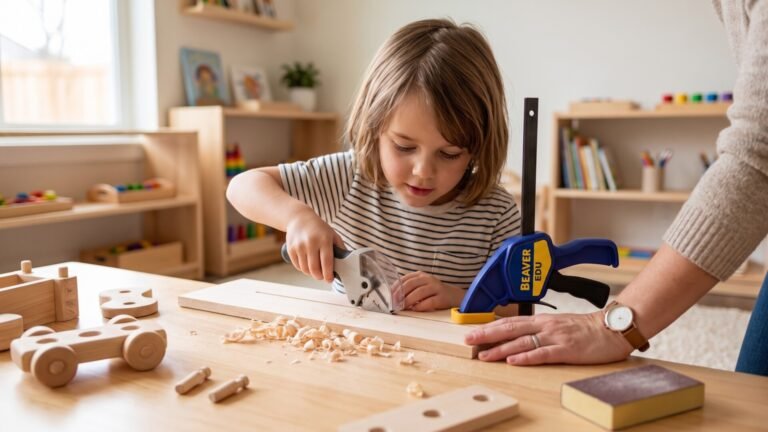
For more ideas, read our guide to how kids learn through construction play, explore the full STEM toys for kids guide, or, for children who are older and ready for real tools, read our review: Beaver Edu Construction Kit: Is This New Wood-Cutting Toy Safe for Kids?