The Ultimate Guide to Play & Activity Ideas: Solving Real-Life Parenting Moments, One Creative Idea at a Time
Every parent knows the feeling. It’s three in the afternoon, rain is pounding against the windows, and you hear those dreaded words: “I’m bored.” Or you’re packing for a family road trip, staring at an empty bag labeled “car activities” with absolutely no idea what should go in it. Maybe it’s a playdate that’s gone sideways, or a quiet moment you desperately need but don’t know how to encourage.
This guide exists for all those moments.
Think of it as your play idea emergency kit—organized by the real-life situations parents actually face, filled with ideas that work for real families with real homes, real budgets, and real limits on patience and energy. Each section connects to a dedicated resource hub where you’ll find deeper dives into that specific category of play.
Let’s get you prepared for whatever comes next.
Quick Guide: Which Play Idea Fits Your Moment?
Not sure where to start? Match the situation you are in right now to the section and deeper guide that fits best. Ideas throughout this page suit roughly ages 2 to 10, so always adapt to your own child’s age, abilities, and safety needs.
| Your situation | What helps most | Prep needed | Go deeper |
|---|---|---|---|
| Car, plane, or waiting room | Contained, low-mess, independent activities | Low (pack ahead) | Travel & On-the-Go Activities |
| You need a calm, quiet stretch | Self-directed play with a clear start and end | Low to medium | Quiet Time & Independent Play |
| Rain, snow, or a sick day | Movement, sensory, and low-mess craft ideas | Low | Indoor & Rainy Day Activities |
| Playdate, party, or family game night | Cooperative games and parallel-play setups | Medium | Social & Group Play |
| You want play with a skill-building angle | Letters, numbers, and STEM through everyday materials | Low | Learning Through Play |
Travel & On-the-Go Activities
Keeping Sanity Intact from Driveway to Destination
Here’s something they don’t tell you about family travel: the journey isn’t the warm-up for the vacation. The journey is the vacation, for better or worse. Those hours in the car, on the plane, or waiting in airports are where memories are made and, let’s be honest, where parental patience is tested most severely.
The secret to successful travel activities isn’t buying the most expensive gadgets. It’s understanding three principles: containment (activities need to stay in the car or on the tray table), independence (kids should be able to use them without constant parental intervention), and longevity (ideally, they hold attention longer than a single episode of anything).
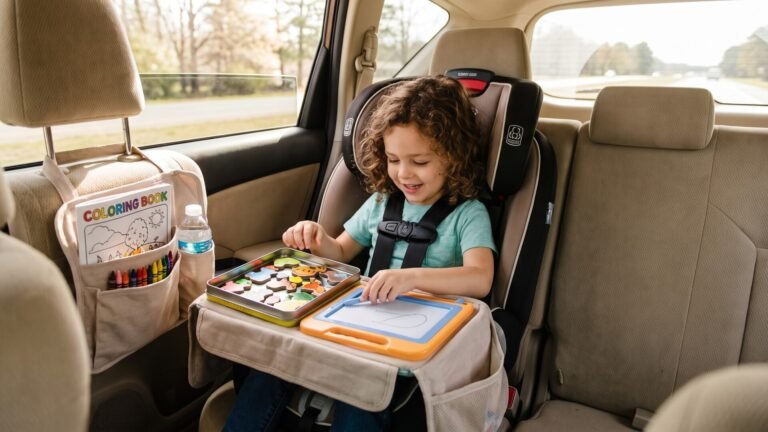
Quiet activities for long car rides present unique challenges. Dropped items are basically gone until you reach your destination. Motion sickness rules out certain activities. And the driver absolutely cannot be reaching into the back seat. This is where magnetic play becomes your best friend—magnetic drawing boards, magnetic puzzle books, and simple magnetic dress-up dolls give kids the satisfaction of creating without loose pieces. Audiobooks deserve their own category of praise, filling the car with a shared story that gives everyone the same experience. And small sensory tools like thinking putty or therapy putty provide quiet hand occupation that stays where it belongs.
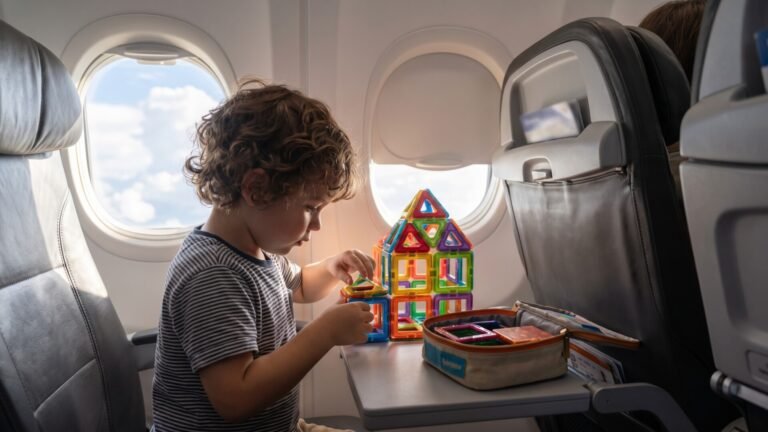
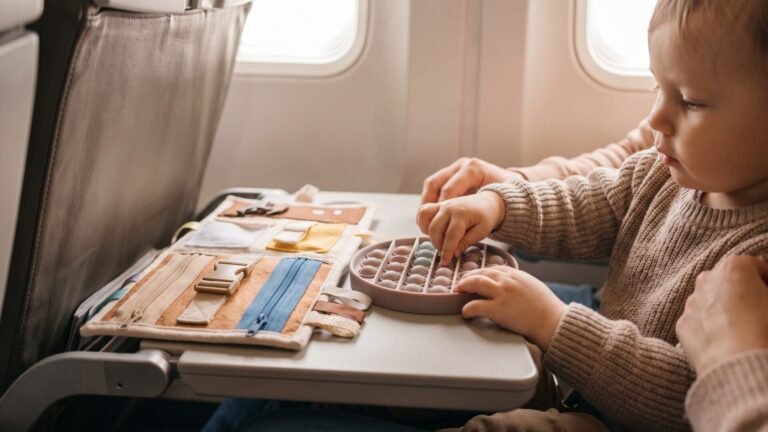
Airplane travel adds even more constraints: space is even tighter, you can’t pull over, and other passengers are counting on your child’s relative quiet. This is where the element of surprise matters more than the specific item. Wrapping small activities in tissue paper or putting them in opaque bags creates curiosity that becomes an activity in itself. Stickers and sticker books earn their reputation as travel heroes—reusable sticker books let kids place and reposition without losing stickiness, and window clings turn airplane windows into canvases. Snacks with staying power aren’t technically toys, but they buy time like nothing else, especially when presented in novel ways.
Screen-free travel toys have their own special category for families who prefer options that don’t involve batteries or wifi. Magnetic building sets that connect in multiple ways travel well and encourage open-ended creation. Wikki Stix or similar waxed yarn stick to windows, trays, and themselves without adhesives or residue, engaging fine motor skills naturally. Search-and-find books provide solo engagement that doesn’t require reading ability, and older children can create their own search challenges for siblings.
Space is always at a premium when packing for family travel, which makes compact design so valuable. Foldable silicone cups or containers become building materials, snack holders, or water scoops at rest stops. A simple deck of cards works for countless games, from matching for preschoolers to complex strategy for older kids. Small flashlights transform rest stops and hotel rooms into adventure zones, especially when you add translucent colored shapes for shadow play.
Sometimes kids genuinely want to create, not just play, and mess-free options make that possible without driving parents crazy. Water-reveal activity books contain special pages that show colors when wet with a water pen, then dry ready for reuse. Washable markers with clear rules about where they go can work beautifully. And sticker mosaics or paint-by-sticker books give older children satisfying creative projects without any liquid or loose materials.
Explore the Travel & On-the-Go Activities Hub
Quiet Time & Independent Play
Giving Kids Space and Parents Breath
Here’s a truth that takes time to learn: quiet time isn’t something you make children do. It’s something you invite them into by creating the right conditions. Independent play is a skill like any other—it develops with practice, encouragement, and the right environment.
The goal isn’t to occupy children so you can ignore them. The goal is to give them the gift of comfortable solitude, the ability to be content in their own company, and the confidence that comes from entertaining themselves. That’s a life skill worth cultivating.
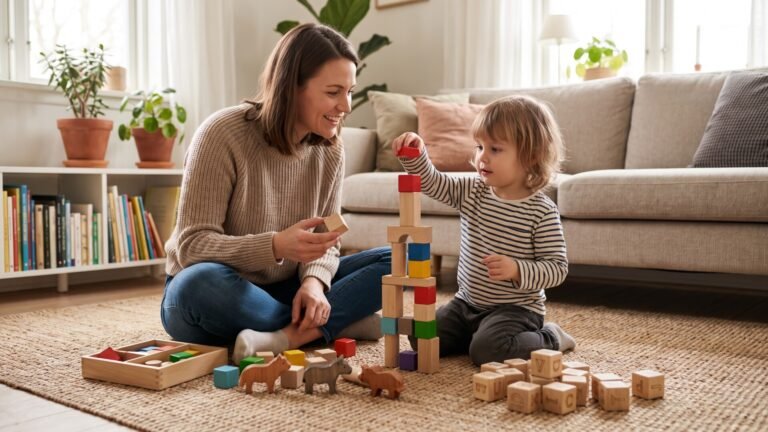
Activities that work for quiet time share certain qualities. They’re engaging without being overstimulating. They can be done alone but don’t require reading complex instructions. And they have a natural ending point or can be paused and resumed. Puzzles of all kinds invite focused attention—floor puzzles for younger children, table puzzles for older ones, and three-dimensional puzzles for those ready for a challenge. Audiobooks paired with physical books let children follow along with the story, building literacy skills while engaging independently. Building challenges transform construction toys into quiet time activities, with specific prompts like “Can you build a tower as tall as your arm?” providing direction without limiting creativity.
Some children naturally gravitate toward solo play, while others need more support developing the skill. For those who struggle, starting small makes sense—five minutes of independent play with a timer visible, gradually increasing as confidence grows. Invitations to play set the stage by arranging materials attractively on a tray or small table before inviting your child to explore. Open-ended materials like wooden blocks, magnetic tiles, or play silks support independent play because they don’t prescribe specific outcomes—the child decides what happens next, maintaining engagement longer. Rotation systems keep materials fresh without constant purchasing, storing most toys out of sight and rotating a selection every few weeks.
Sometimes children need help regulating their emotions, not just occupying their time. Calm-down activities serve this different purpose—they’re tools for emotional processing, not entertainment. Calming bottles with water, glue, and glitter give children something to watch while their nervous systems settle, the slow movement of glitter mirroring the gradual calming of emotions. Breathing exercises with props make abstract concepts concrete—blow pinwheels, feathers, or bubbles to practice slow exhales, or place stuffed animals on bellies to rise and fall with deep breaths. Quiet corners with soft cushions, books, and simple sensory tools create spaces children can choose when they need solitude.
Creating dedicated quiet time bins simplifies the whole process. Each bin contains materials for a specific type of activity, and bins rotate based on what’s currently engaging your child. Sensory bins with rice, beans, or sand require supervision for younger children but offer older ones extended independent engagement, especially with scoops and small toys added. Art bins with paper, child-safe scissors, glue sticks, and developmentally appropriate materials work beautifully when expectations are clear. Construction bins with small building toys, magnetic tiles, or interlocking blocks provide endless possibilities, especially with challenge cards that offer specific building prompts.
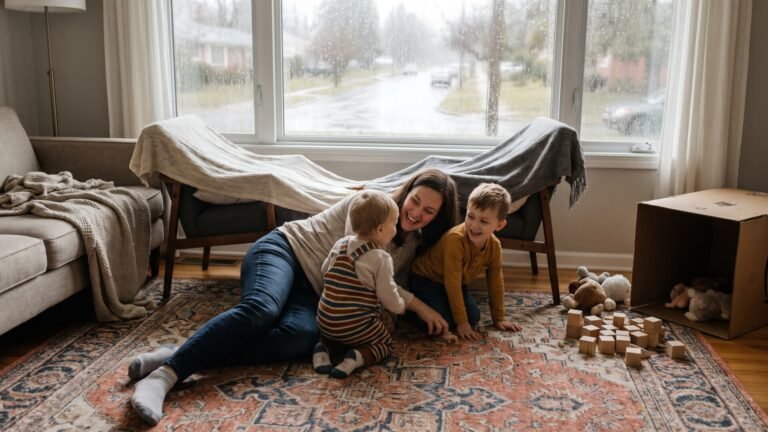
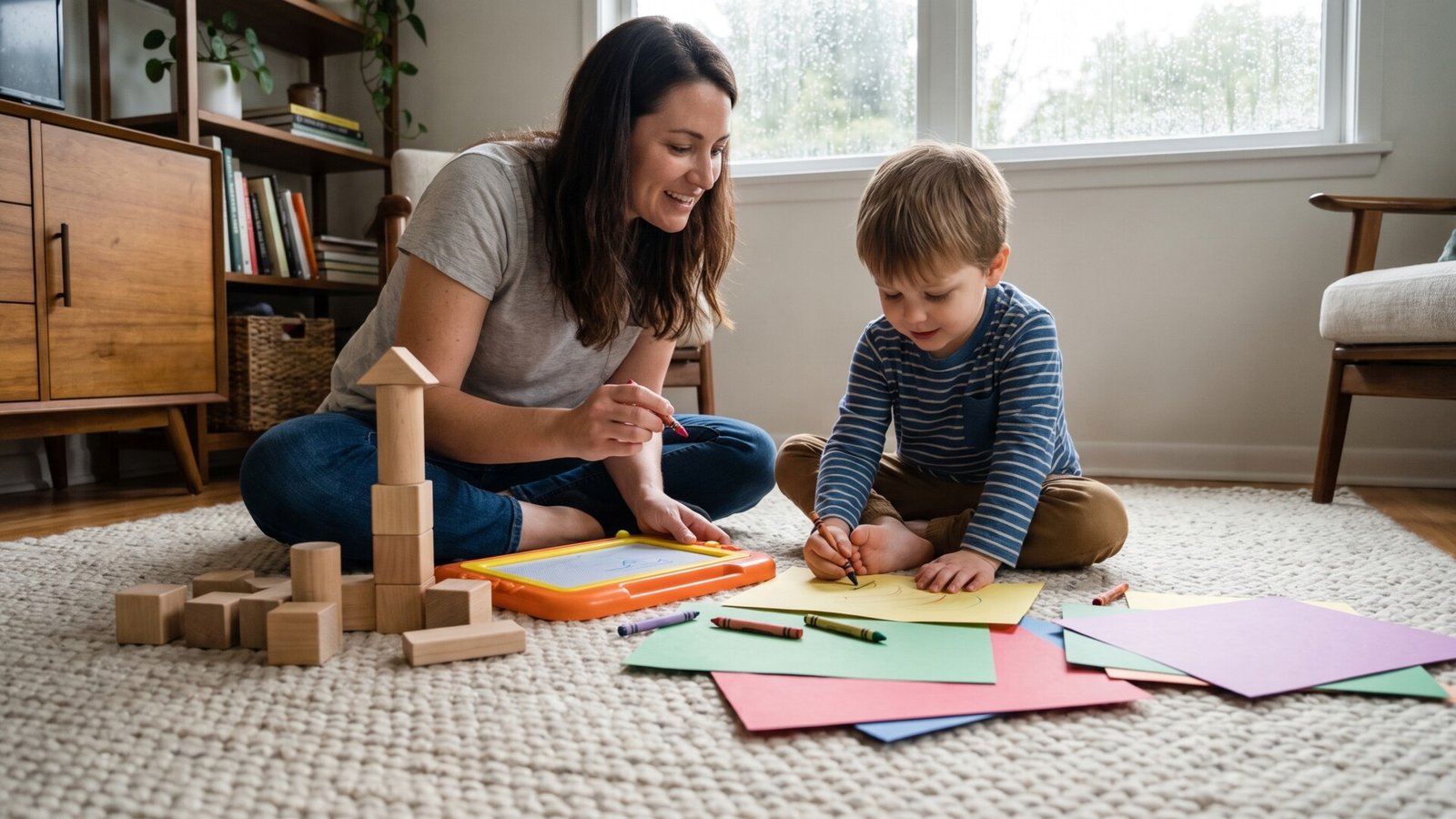
Rainy days test every family’s independent play resources, so having a mental menu of options prevents that desperate “what do we do now” feeling. Blanket forts and indoor dens transform living rooms into adventure spaces, with the building process itself occupying significant time. Indoor scavenger hunts require minimal preparation—”find something red, something soft, something that makes noise”—and older children can create hunts for younger siblings. Floor is lava variations never lose their appeal, with pillows and cushions providing safe stepping spots for physical play that burns energy without outdoor space.
Explore the Quiet Time & Independent Play Hub
Indoor & Rainy Day Activities
When Staying In Is the Best Adventure
Some of the best parenting memories happen on days when going out isn’t an option. Snow days, sick days, days when everyone needs to just be at home. The pressure to entertain disappears when you accept that you’re not going anywhere. What emerges instead is creativity born of constraint.
Rainy day activities fall into categories: high-energy for burning steam, sensory for deep engagement, creative for expression, and low-prep for when parental energy matches the weather outside.
The best indoor activities acknowledge the weather rather than fighting it. Rainy day themes can extend engagement and make being inside feel special rather than disappointing. Puddle jumping preparation activities work before or after actual puddle time—make paper rain boots, draw puddles with chalk on dark paper, or create rainy day collages with blue tissue paper. Indoor camping transforms the ordinary, with blanket tents, “campfire” crafts, and stories told while staying cozy inside. Weather science experiments satisfy curious minds—make rain in a jar with shaving cream and water, make a tiny static spark with a balloon and a metal spoon (adult-led, and balloons need careful handling, see the safety notes below), or learn about clouds while watching the real ones outside.
Some days require activities that don’t require gathering materials, reading instructions, or preparing anything in advance. These games rely only on imagination and willingness to play. I Spy variations work for all ages—traditional I Spy uses visual observation, sound I Spy uses listening skills, and memory I Spy challenges players to remember what they’ve seen. Statues and freeze games combine music, movement, and self-control in endlessly repeatable patterns. Shadow puppet shows need only a light source and hands, with stories emerging from shadows on the wall.
Sensory play deserves its reputation as a powerful engagement tool, and the best news is that most sensory materials cost very little and use ingredients already in your kitchen. Play dough made at home takes minutes and costs pennies—flour, salt, cream of tartar, oil, water, and food coloring, with scents added through extracts or spices. Cloud dough made from flour and oil feels completely different from play dough and supports different kinds of play. Oobleck made from cornstarch and water fascinates children and adults alike, behaving as both solid and liquid and providing science learning through pure sensory exploration.
Children need to move, rain or shine, and indoor movement activities channel that need constructively rather than suppressing it. Animal walks combine movement with imagination—hop like frogs, crawl like bears, slither like snakes, waddle like penguins. Balloon volleyball uses soft balloons that won’t damage anything, moving slowly enough for young children to track and hit successfully. Obstacle courses using pillows, cushions, and furniture create movement challenges that burn energy while building motor skills.
Not every family loves crafts, but for those who do but dread the cleanup, low-mess options preserve creativity without destroying the house. Contact paper collages placed sticky-side up on a table or window let children arrange lightweight materials with no glue and no mess. Tape resist art involves placing painter’s tape on paper, painting over everything, and removing tape to reveal white lines—the process captivates, and cleanup involves only washing paint from hands. Magazine collages use existing images rather than creating new ones, with scissors, glue sticks, and old magazines keeping children engaged for surprisingly long stretches.
Explore the Indoor & Rainy Day Activities Hub
Social & Group Play
When More Kids Means More Fun (and More Planning)
Group play brings unique joys and challenges. The energy multiplies, ideas spread faster, and children learn social skills that solo play can’t teach. But group dynamics also require more adult attention and occasionally, intervention.
The goal with group play isn’t to orchestrate every moment. It’s to set up conditions where children can navigate relationships themselves, with adults available for support when needed.
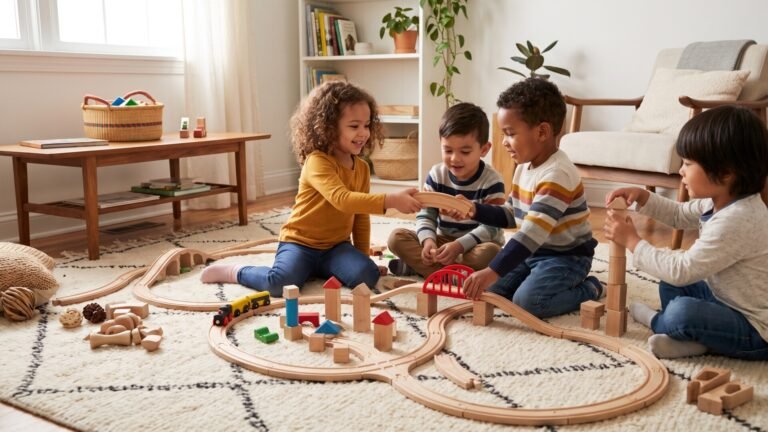
Successful playdates balance structure with free play. Too much structure exhausts everyone; too little leaves children unsure how to navigate. Parallel play setups work beautifully for younger children—providing duplicate or similar materials so each child can play near others without requiring interaction. Sand and water tables, multiple art stations, or duplicate building sets support this. Collaborative projects give older children shared goals—build one large structure together, create a collaborative mural, or work on a group story where each child adds a sentence. Snack preparation as an activity serves multiple purposes, with children practicing cooperation while creating something they’ll share through simple recipes like fruit skewers or decorated cookies.
Birthday parties raise the stakes: more children, higher expectations, and often limited time and space. Having a mental library of reliable games helps tremendously. Traditional party games exist for good reason—musical chairs, freeze dance, and pass the parcel reliably engage groups when adapted for age and space, with small prizes at each layer of pass the parcel maintaining engagement throughout. Station rotations work well for mixed-age groups, with different activity stations set up and children rotating through with small groups while adults supervise individual stations. Group challenges like “keep the balloon up” or “pass the hoop without breaking hands” build cooperation rather than competition, working especially well when children arrive with varying energy levels.
Traditional games often end with one winner and everyone else disappointed. Cooperative games change the dynamic completely—players work together against the game itself, winning or losing as a team. Peaceable Kingdom is a well-known maker of cooperative games for young children, with titles like Hoot Owl Hoot and Count Your Chickens that teach teamwork through simple mechanics preschoolers can follow. Check the age grade printed on each box before buying. For older children, games like Forbidden Island or Castle Panic require genuine strategy and teamwork, with players communicating, planning together, and making collective decisions. Even household item games can become cooperative—build the tallest tower together, complete a puzzle as a team, or work toward a collective goal like “clean up before the timer ends.”
Regular family game nights create traditions children remember forever. The specific games matter less than the routine and the togetherness. Game rotation systems let different family members choose each week, with one week’s pick being a simple preschool game and the next a strategy game for older players, giving everyone experience being the chooser and being chosen for. Tournament formats extend engagement over multiple sessions, with simple bracket systems for quick games like tic-tac-toe building anticipation and providing natural breaks between rounds. Story-based games like storytelling card games or Rory’s Story Cubes engage creative family members who might resist competitive play, working well with wide age ranges since imagination matters more than skill.
Explore the Social & Group Play Hub
Learning Through Play
The Sneaky Way Skills Develop
Here’s what becomes clear when watching children play: they learn constantly, but they rarely realize it’s happening. The counting that happens during a board game, the physics understanding that develops through block building, the literacy skills that emerge from following recipe instructions—all of it happens naturally when play is engaging.
Learning through play isn’t about making play feel like school. It’s about recognizing the learning that’s already happening and occasionally, gently, extending it.
Letter knowledge develops through exposure and play, not drills and worksheets. The more children encounter letters in meaningful contexts, the more naturally literacy develops. Environmental print activities point out letters in the world—cereal boxes, street signs, store names all contain letters that matter to children because they connect to real life. Name-based activities start with the letters most meaningful to children: the ones in their own names. Magnetic letters for the refrigerator, name puzzles, or signing artwork builds personal connections to letter shapes. Alphabet scavenger hunts work anywhere, with children finding something starting with each letter and taking photos, collecting items, or simply checking them off a list.
Number sense develops through real experiences with quantity, not memorization. Games that involve counting, comparing, and manipulating quantities build mathematical understanding naturally. Board games with dice provide endless counting practice—moving pieces the correct number of spaces, counting dots on dice, and comparing distances all reinforce number concepts. Snack math uses food as manipulatives, with children counting crackers into bowls, dividing grapes equally, and estimating how many berries are in the container before eating the materials as motivation. Nature counting uses outdoor finds, with collected rocks counted, leaves sorted by size, and quantities of different items compared across multiple sessions.
Science, technology, engineering, and math don’t require screens. Some of the best STEM learning happens with simple materials and open-ended questions. Building challenges explore engineering principles naturally—how high can you build, what shape supports the most weight, how can you make a structure that withstands “wind” from a fan or “earthquake” from shaking the table? Water play with tools introduces physics concepts through pipes, funnels, tubes, and containers of different sizes, letting children experiment with flow, volume, and pressure. Magnet explorations reveal invisible forces, with simple magnet wands and collections of test items helping children discover which items attract, whether magnetism works through materials, and how to move something without touching it.
Learning bins combine the engagement of sensory play with specific skill practice. Creating them takes minutes but provides repeated engagement opportunities. Letter discovery bins hide magnetic letters in sensory materials like rice, beans, or sand, with children finding letters and matching them to charts, spelling words, or simply naming what they’ve found. Counting bins contain small items grouped in ways that invite quantification—buttons sorted by size, plastic animals grouped by type, or nature items organized for counting and comparing. Pattern bins provide materials for creating and extending patterns through colored manipulatives, beads with laces, or simply collections of small items in different colors.
Explore the Learning Through Play Hub
Safety Notes for Everyday Play Ideas
Most activities in this guide use household items, which is part of their charm, but a few deserve a quick safety check before you start. These are general reminders, not a substitute for the instructions on any product you buy.
- Balloons: Uninflated balloons and broken balloon pieces are a serious choking and suffocation hazard for young children. In the US, balloon packaging carries a warning for children under 8. Supervise closely and pick up popped pieces immediately.
- Small parts and sensory bins: Rice, beans, buttons, and small toys can be choking hazards for children who still mouth objects, typically under 3. Keep bins supervised and within arm’s reach.
- Magnets: Keep loose, small, or high-powered magnets away from young children. Swallowed magnets can cause serious internal injury. Large, sealed magnetic tiles are a different product category, but still check the age grade.
- Homemade doughs and oobleck: These are not food. Salt-heavy play dough in particular should not be eaten, and children with food allergies need a close look at ingredients such as flour.
- Water play: Even shallow water needs constant, hands-on adult supervision for young children.
For ideas built around specific needs, see our guide to toys for children with specific needs, and for choosing play that fits your child’s stage, start with Toys by Age.
Where to Go Next
Once you have found a few activities that work, these related guides help you build the toy shelf behind them: Montessori & Early Learning Toys for calm, child-led materials; STEM Toys for Kids for building and experiment-based play; Building & Construction Toys for open-ended construction; Outdoor & Seasonal Toys for when the weather clears; and Reviews & Comparisons when you are ready to buy.
Bringing It All Together
Remember that rainy afternoon mentioned at the beginning? The one where boredom threatened and nothing was prepared?
Those moments almost always turn out fine. Children find cardboard boxes and turn them into spaceships. They draw control panels with markers, negotiate who will be captain, and eventually fall asleep inside their creations, exhausted from adventures they invented themselves.
The truth is, children don’t need perfect activities or Pinterest-worthy setups. They need time, space, and materials that invite their imaginations. They need adults who are present enough to notice what’s engaging them and flexible enough to follow their lead.
The activities in this guide are starting points, not prescriptions. Use what works for your family, adapt what almost works, and ignore what doesn’t fit. Your children are unique, your family is unique, and the play that emerges from your particular combination will be unique too.
That’s the whole point, really. Not to execute someone else’s idea of perfect play, but to discover what play looks like in your home, with your children, on your ordinary days.
Ready to explore specific categories? Each section above links to a dedicated hub with deeper dives, age-specific guidance, and curated collections for that type of play. Start with whatever situation you’re facing right now—travel, quiet time, rainy day, group play, or learning through play—and see where it leads.
And when an idea works beautifully in your home, or your children take an activity somewhere completely unexpected, you have found exactly what this guide is for: play that fits your family.
Frequently Asked Questions About Play And Activity Ideas
What are some good play ideas for a rainy day at home?
Blanket forts, indoor scavenger hunts, animal walks, balloon volleyball (with close supervision), homemade play dough, and low-mess crafts like tape resist art all need very little preparation. See our indoor and rainy day activities guide for more.
How do I get my child to play independently?
Start small, with five minutes and a visible timer, and set out an inviting tray of open-ended materials such as blocks or puzzles. Rotating a few toys every couple of weeks keeps things fresh. Independent play is a skill that grows with practice.
What are the best screen-free activities for car and plane trips?
Reusable sticker books, water-reveal pads, magnetic drawing boards, audiobooks, and search-and-find books stay contained and keep loose pieces to a minimum. Wrapping a few items to open during the trip adds a sense of surprise.
Which activities are safe for toddlers?
Choose items larger than a choking hazard, supervise all sensory and water play, and avoid balloons and loose magnets. Always follow the age grade on any product and adapt household ideas to your child’s stage.
How can I make group play and playdates run more smoothly?
Offer duplicate materials for younger children so they can play side by side, use cooperative games for older ones, and keep a few simple activity stations ready. Step in only when children need support.