The Ultimate Guide to Open-Ended Play: Top 10 Toys That Grow With Your Child
You know that toy your child played with for ten minutes before tossing it aside? And the cardboard box that kept them busy for an entire afternoon? That’s the power of open‑ended play.
Open‑ended toys don’t have a single “right” way to be used. There are no flashing lights telling your child they’ve succeeded, no voice saying “next level.” Instead, the child decides. A set of wooden blocks can become a castle, a racetrack, a dinosaur den, or a tower to knock down and rebuild. That same set will still be interesting three years later, when your child uses it to explore balance, fractions, and symmetry.
Toys that grow with your child save you money, reduce clutter, and—most importantly—keep delivering developmental benefits year after year. From toddler stacking to preteen engineering, the right open‑ended toy adapts as your child’s skills and imagination expand.
This guide covers ten of the best open‑ended toys, from building sets to art kits to robotics. Many are available through Melissa & Doug, LEGO, Seedling, Tenacious Toys, and Amazon—look for links throughout the article to check current prices and availability.
What Is Open‑Ended Play and Why It Matters
Open‑ended play means there is no fixed outcome. The toy doesn’t come with a script. A puzzle is closed‑ended—you put the pieces in specific spots, and then you’re done. A box of LEGO bricks is open‑ended—you can build anything, take it apart, and build something completely different.
Why does this matter for child development? First, open‑ended play builds creativity. Without an instruction manual, children must invent their own goals, stories, and solutions. Second, it develops problem‑solving. When a block tower keeps falling, the child figures out why and adjusts. Third, it fosters resilience. There’s no “failure” in open‑ended play—just new possibilities. Finally, it supports social skills when children play together, negotiating roles and sharing ideas.
Open‑ended toys differ sharply from single‑purpose or screen‑based toys. A battery‑operated toy that only sings the alphabet song teaches one thing in one way. A set of magnetic tiles teaches geometry, magnetism, balance, and creativity—and a five‑year‑old and a ten‑year‑old will use them very differently.
The multi‑age adaptability of open‑ended toys is what makes them “grow with your child.” A toddler stacks blocks; a six‑year‑old builds houses; a ten‑year‑old constructs a marble run or tests load‑bearing structures. One purchase, years of learning.
Criteria for Choosing Toys That Grow With Your Child
Not every toy labelled “open‑ended” actually delivers long‑term value. Use these five criteria when shopping.
Material quality and durability – The toy must survive years of play. Look for solid wood, heavy‑duty plastic, strong magnets, and connectors that don’t snap. Cheap toys break, and broken toys don’t teach persistence.
Multi‑age usability – Can a two‑year‑old safely use the basic pieces? Can a ten‑year‑old use the same set for advanced challenges? LEGO Duplo (for toddlers) connects to standard LEGO (for older kids)—that’s smart design.
Opportunities for skill progression – The best toys grow along developmental lines. Fine motor control in early years, then logic and planning, then STEM concepts like gears or coding. A single set that supports all three is gold.
Open‑ended vs. structured play balance – A kit that includes a few challenge cards but no fixed instructions is ideal. Too much structure kills creativity; no guidance at all can frustrate some children.
Affiliate program relevance – Many of the toys below are available through Melissa & Doug, LEGO, Seedling, Tenacious Toys, and Amazon.
Top 10 Open‑Ended Toys That Grow With Your Child
3.1 Building & Construction Toys (Toys 1–4)
#1 LEGO Classic / LEGO Duplo
Skills Targeted: Creativity, spatial reasoning, STEM
Affiliate Program: LEGO Affiliate / Amazon
LEGO is the ultimate open‑ended toy. LEGO Duplo bricks are larger, perfect for toddlers (18 months+). Classic LEGO bricks work for children 4 and up. And here’s the magic: Duplo bricks connect to standard LEGO bricks. That means your child can start with simple stacking at age two, move to vehicles and houses at five, and build complex gear‑driven machines at ten—all with the same compatible system.
The open‑ended possibilities are endless. Build a castle, then rebuild it as a spaceship. Create a marble run, then redesign it for speed. LEGO’s “Classic” boxes come with a variety of bricks but no specific model instructions—just inspiration.
Shop LEGO Classic sets on Amazon → | Explore LEGO Duplo →
#2 Wooden Block Sets (Melissa & Doug)
Skills Targeted: Problem‑solving, imaginative play, fine motor
Affiliate Program: Melissa & Doug / Amazon
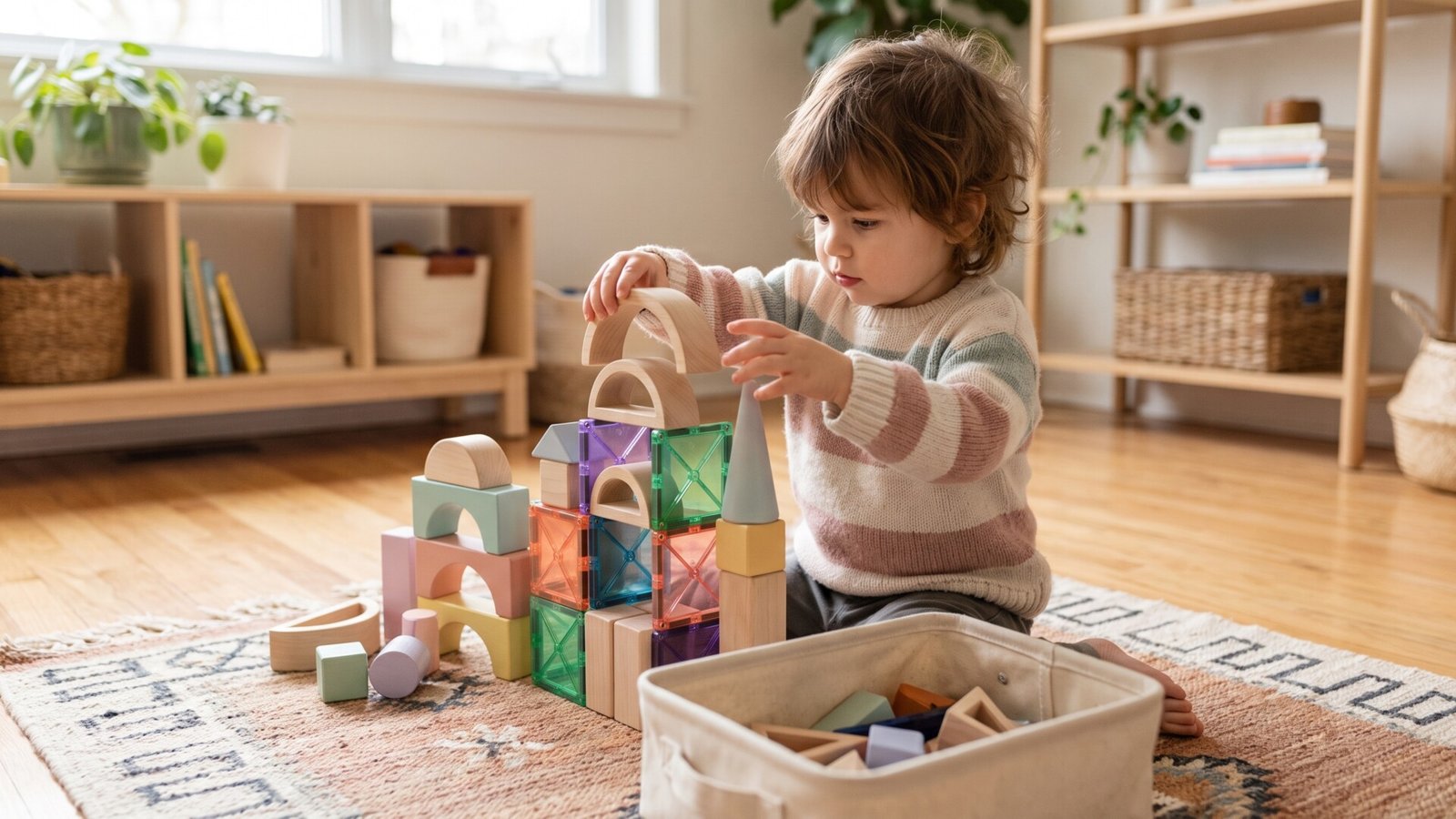
Before plastic, there was wood. A high‑quality wooden block set—like Melissa & Doug’s 60‑piece unit blocks—is a toy your grandchildren could play with. The blocks are precisely cut to standard unit sizes: a half‑unit, a unit, a double unit, and geometric shapes.
At two, children stack and knock down. At four, they build enclosures for toy animals. At seven, they explore fractions (two half‑blocks equal one whole). At ten, they test structural engineering (what shape is strongest for a bridge?). No batteries, no screens, no limits.
Check Melissa & Doug wooden blocks →
#3 K’NEX Building Kits
Skills Targeted: Engineering, structural design, mechanics
Affiliate Program: Tenacious Toys / Amazon
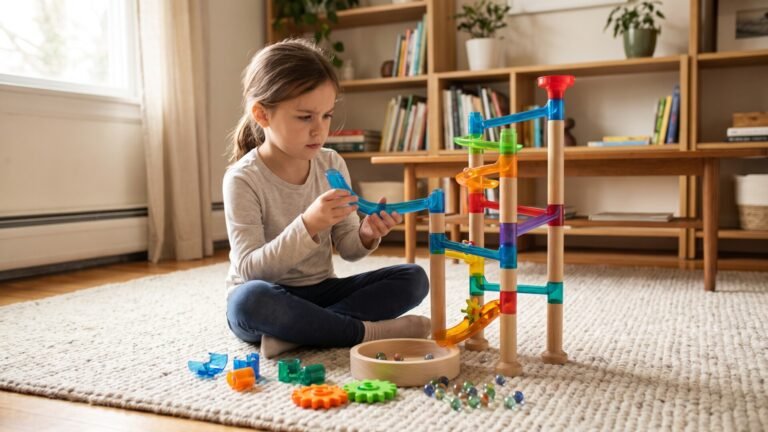
K’NEX is often overshadowed by LEGO, but for pure mechanical learning, it shines. The rods and connectors snap together in three dimensions, allowing realistic trusses, bridges, and working cranes. A K’NEX set can build a Ferris wheel with gears that actually turn, or a roller coaster that sends a marble through loops.
Younger children (6‑7) can follow instructions to build specific models. Older children (9‑12) can design their own creations, learning about tension, compression, and gear ratios. Many K’NEX sets are “combo” packs that build 50+ different models from one box.
Explore K’NEX kits at Tenacious Toys →
#4 Magnetic Tiles (Shifu / Seedling)
Skills Targeted: Geometry, magnetism, creativity, spatial reasoning
Affiliate Program: Seedling / Amazon
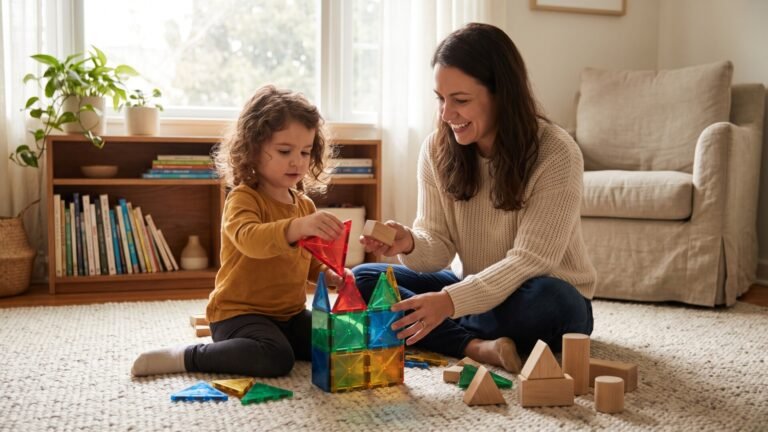
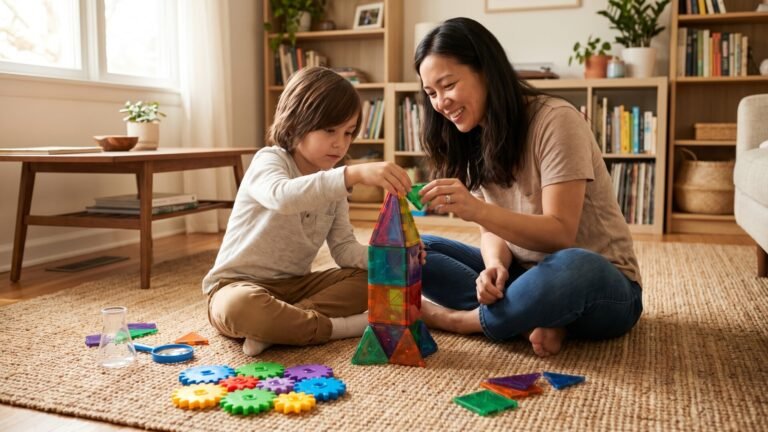
Magnetic tiles (often called Magna‑Tiles or PicassoTiles, also sold by Seedling) are translucent plastic squares and triangles with magnets along the edges. They click together satisfyingly and can be built up, out, and in any direction.
A three‑year‑old loves the snap of magnets and builds simple cubes. A six‑year‑old constructs castles with turrets and roofs. A nine‑year‑old explores symmetry, angles, and 3D nets (the pattern of shapes that folds into a cube). Light shines through the tiles beautifully, making them great for light tables or window play.
Shop magnetic tiles at Seedling →
Creative & Arts Toys (Toys 5–7)
#5 Open‑Ended Art Kits (Seedling / Amazon)
Skills Targeted: Fine motor, self‑expression, creativity
Affiliate Program: Seedling / Amazon
The best art kits don’t tell your child what to make. They provide quality materials and let the child lead. Seedling’s “Create Your Own” series—monster, robot, or fairy kits—includes googly eyes, pom‑poms, glue, and blank bases. No instructions on where the eyes should go. That’s the point.
For older children, a simple kit with blank canvases, acrylic paints, and brushes offers endless possibilities. Younger children love sticker mosaics or collage boxes with scissors, glue, and a pile of interesting papers. The key is open‑ended materials, not colour‑by‑number.
Browse Seedling open‑ended art kits →
#6 Wooden Play Dough Tools & Sets
Skills Targeted: Creativity, tactile skills, fine motor
Affiliate Program: Melissa & Doug / Amazon
Play dough is inherently open‑ended. Add a set of wooden tools—rolling pins, stampers, shape cutters, and extruders—and the possibilities multiply. A two‑year‑old squishes and pokes. A four‑year‑old makes “snakes” and “pancakes.” A seven‑year‑old sculpts animals or builds a play dough village.
Melissa & Doug’s wooden play dough tools are durable, easy to clean, and safe for toddlers. You can also add loose parts like googly eyes, craft sticks, and buttons to turn play dough into a creature‑factory. The same tools work for years, as the complexity of creations grows with the child.
Check Melissa & Doug play dough tools →
#7 Musical Instruments (Tenacious Toys / BrightyToys)
Skills Targeted: Auditory skills, creativity, coordination
Affiliate Program: Tenacious Toys / BrightyToys
Music is open‑ended play for the ears. A set of child‑sized, real (not toy‑grade) instruments—a wooden xylophone, a pair of cymbals, a shaker egg, a small drum—invites experimentation. There are no wrong notes.
At two, children explore loud and soft, fast and slow. At five, they start making simple rhythms. At eight, they may compose their own songs or play along with favourite music. Instruments from Tenacious Toys or BrightyToys are well‑made and pleasant‑sounding (unlike cheap plastic versions that are grating). Music play also builds coordination and emotional expression.
Shop musical instruments at Tenacious Toys →
STEM & Problem‑Solving Toys (Toys 8–10)
#8 SmartLab Engineering & Science Kits
Skills Targeted: Critical thinking, experimentation, STEM fundamentals
Affiliate Program: Seedling / Amazon
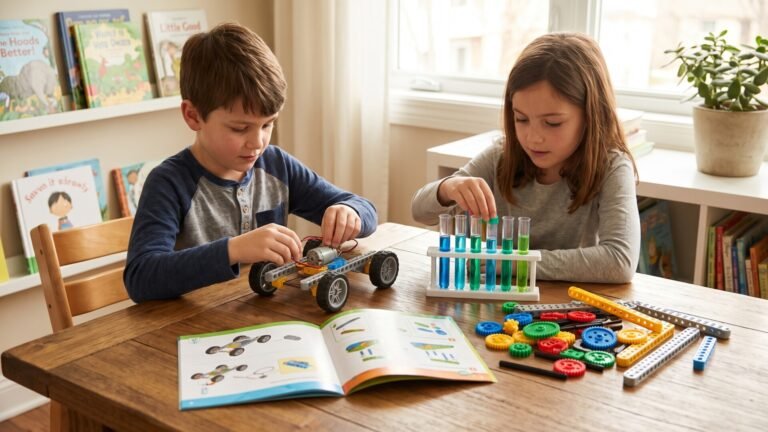
SmartLab kits are known for combining real science with open‑ended challenges. Their “Engineering Lab” includes a motor, gears, pulleys, and a guidebook with 20 experiments. But unlike rigid kits, each experiment ends with a question: “What happens if you change the gear size?” or “Can you design a crane that lifts heavier objects?”
This invitation to tinker turns a one‑time activity into a reusable engineering set. A seven‑year‑old follows the steps; a ten‑year‑old modifies and invents. The same kit works for both.
Explore SmartLab STEM kits at Seedling →
#9 Robotics Kits (mBot, LEGO Education)
Skills Targeted: Coding, logic, STEM skills, problem‑solving
Affiliate Program: LEGO Affiliate / Tenacious Toys
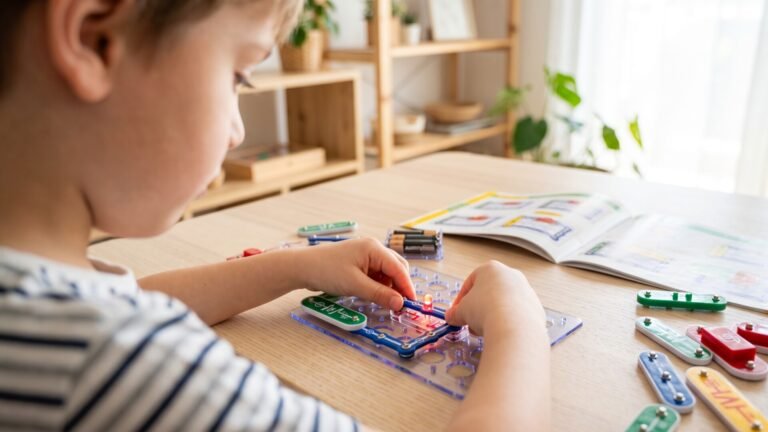
Robotics kits are often seen as “advanced,” but many are wonderfully open‑ended. The Makeblock mBot (ages 8+) comes as a box of parts; children build the robot themselves, then code it using block‑based programming. But the kit doesn’t stop there. Once the basic robot works, children can add sensors, redesign the chassis, or program new behaviours.
LEGO Education Spike Prime (ages 10+) is even more open‑ended, with hundreds of pieces and a powerful coding environment. Children can build anything from a robotic arm to a Mars rover. These kits grow with the child—from simple “move forward” commands to complex conditional logic and even Python.
Check mBot at Tenacious Toys → | LEGO Education Spike Prime →
#10 Gears! Gears! Gears!
Skills Targeted: Mechanical reasoning, creative construction, cause‑and‑effect
Affiliate Program: Melissa & Doug / Amazon
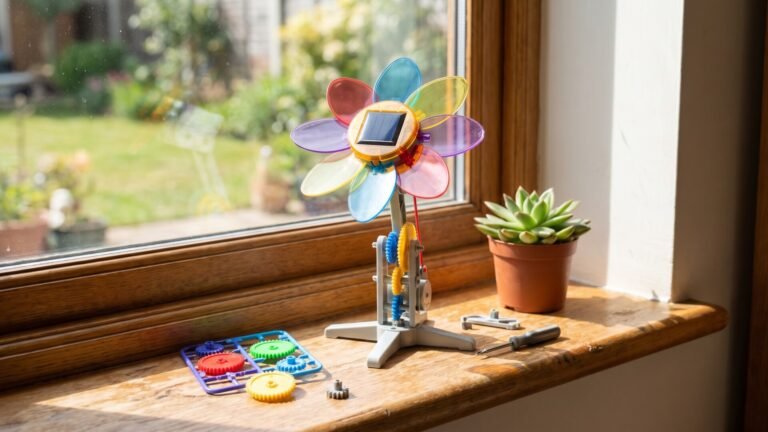
This classic from Learning Resources (often sold via Melissa & Doug) is pure gear play. The set includes plastic gears of different sizes, cranks, connectors, and a baseplate. Children build their own gear systems, then turn the crank and watch the entire chain spin.
A four‑year‑old connects two gears and sees them turn in opposite directions. An eight‑year‑old experiments with gear ratios: a large gear turning a small gear spins faster; adding an idle gear changes direction. By ten, children can design complex machines—a gear‑powered drawbridge, a conveyor belt, or a moving monster. The set is simple but the learning is deep.
Shop Gears! Gears! Gears! on Amazon →
Comparison Table of the Top 10 Open‑Ended Toys
| Toy | Best For | Age Range | Material | Skill Focus | Price Range | Affiliate Program |
|---|---|---|---|---|---|---|
| LEGO Classic / Duplo | Building & Creativity | 2–12+ | Plastic | STEM, creativity | $20–$150 | LEGO / Amazon |
| Wooden Block Sets | Imaginative Play | 2–10 | Wood | Motor & spatial skills | $25–$50 | Melissa & Doug |
| K’NEX Kits | Engineering | 6–12 | Plastic | Mechanics & problem‑solving | $40–$100 | Tenacious Toys / Amazon |
| Magnetic Tiles | Geometry | 3–10 | Plastic/Magnetic | Spatial & creative thinking | $50–$120 | Seedling / Amazon |
| Art Kits | Fine Motor & Creativity | 3–12 | Mixed | Artistic expression | $20–$60 | Seedling / Amazon |
| Play Dough Sets | Tactile & Creativity | 2–10 | Dough & wood | Fine motor, imaginative play | $15–$40 | Melissa & Doug |
| Musical Instruments | Auditory & Creativity | 3–12 | Wood/Plastic | Music & coordination | $20–$50 | Tenacious Toys / BrightyToys |
| SmartLab Science Kits | STEM & Experimentation | 6–12 | Plastic/Metal | Problem‑solving | $30–$90 | Seedling / Amazon |
| Robotics Kits | Coding & Logic | 7–12 | Plastic/Electronics | STEM, programming | $100–$350 | LEGO / Tenacious Toys |
| Gears! Gears! Gears! | Mechanical Reasoning | 4–12 | Plastic | Engineering, creativity | $30–$50 | Melissa & Doug |
Tips for Encouraging Open‑Ended Play
Buying the right toy is only half the battle. How you present it and how you interact makes all the difference.
Set up a play space with accessible toys – Place toys on low, open shelves where children can see and reach everything. Use shallow trays or baskets to group related items. A child who can see their options is more likely to choose and initiate play independently.
Encourage independent exploration with minimal adult intervention – This is hard for many parents. When your child is building or creating, resist the urge to suggest “better” ways. Let them try, fail, and try again. Your job is to observe and keep them safe, not to direct.
Rotate toys to maintain novelty – Keep only 6–8 toys available at a time. Store the rest. Every few weeks, swap in a different set. The “new” old toy feels fresh, and children engage more deeply with fewer choices.
Scaffold play without restricting creativity – If your child is stuck, ask open‑ended questions: “What do you want this to do?” “What happens if you add this piece?” “Can you think of another way?” Avoid giving answers.
Integrate toys into multi‑age family play – Older children can build complex structures that younger siblings decorate. Siblings can collaborate on a single LEGO city. Open‑ended toys naturally bridge age gaps.
Safety & Longevity Considerations
Durable, non‑toxic materials – Wooden blocks should be smooth, splinter‑free, and painted with lead‑free, water‑based paints. Plastics should be BPA‑free and phthalate‑free. Avoid cheap, brittle plastics that crack into sharp shards.
Choking hazards for younger children – If you have a toddler and an older child, keep small parts (like standard LEGO) out of reach of the toddler. Use Duplo or wooden blocks for the younger one.
Easy‑to‑clean materials for long‑term use – Play dough tools and magnetic tiles wipe clean. Art supplies should be washable. Avoid toys with fabric that can’t be cleaned easily.
Frequently Asked Questions About Open-Ended Play
What is open‑ended play?
Open‑ended play is play without a fixed outcome. The child decides what to do, how to do it, and when to stop. There are no “right” answers, only possibilities.
Why are open‑ended toys important for child development?
They boost creativity (inventing scenarios), independence (self‑directed activity), problem‑solving (figuring out how to make something work), and resilience (trying again after failure). They also support social skills when children play together.
How do I know if a toy will grow with my child?
Look for multi‑age usability (e.g., Duplo connecting to LEGO), adaptable challenges (a set that can be used simply at first, then more complex later), and expandability (extra pieces or add‑on kits). Read reviews from parents of different ages.
Are open‑ended toys more expensive than traditional toys?
Often the initial price is higher, but the cost per year of use is much lower. A $50 set of wooden blocks used for eight years costs about $6 per year. A $20 battery‑operated toy that breaks after six months costs $40 per year. Open‑ended toys are an investment.
Can open‑ended toys be STEM‑focused?
Absolutely. Building sets (LEGO, K’NEX, magnetic tiles) teach engineering and spatial reasoning. Robotics kits teach coding and logic. Science kits with open‑ended experiments teach the scientific method. STEM and open‑ended play go hand in hand.
How many open‑ended toys does a child need?
Eight to twelve well‑chosen toys, rotated regularly, are plenty. Too many choices fragment attention. Focus on quality, not quantity.
Can open‑ended toys be used in preschool or classroom settings?
Yes, many of these toys (wooden blocks, magnetic tiles, LEGO) are staples in Montessori, Reggio Emilia, and traditional preschool classrooms. They support collaborative learning and child‑led exploration.
Conclusion
Open‑ended toys are not just “toys that last longer.” They are tools for thinking, creating, and growing. A child who learns to play with a set of blocks or a box of LEGO isn’t just building towers—they’re building the mental muscles for problem‑solving, persistence, and imagination.
The ten toys in this guide will serve your child from toddlerhood to the edge of the teen years. They won’t end up in a landfill after three months. They won’t be forgotten in the back of the closet. Instead, they’ll be pulled out again and again, each time used in a new way, each time teaching something new.
Start with one or two that match your child’s current passion. Add more as they grow. And remember: the best open‑ended toy is often the simplest one. The box the toy came in? That’s open‑ended, too.
Ready to build a collection that grows with your child? Check prices and availability from our trusted partners using the links throughout this article.