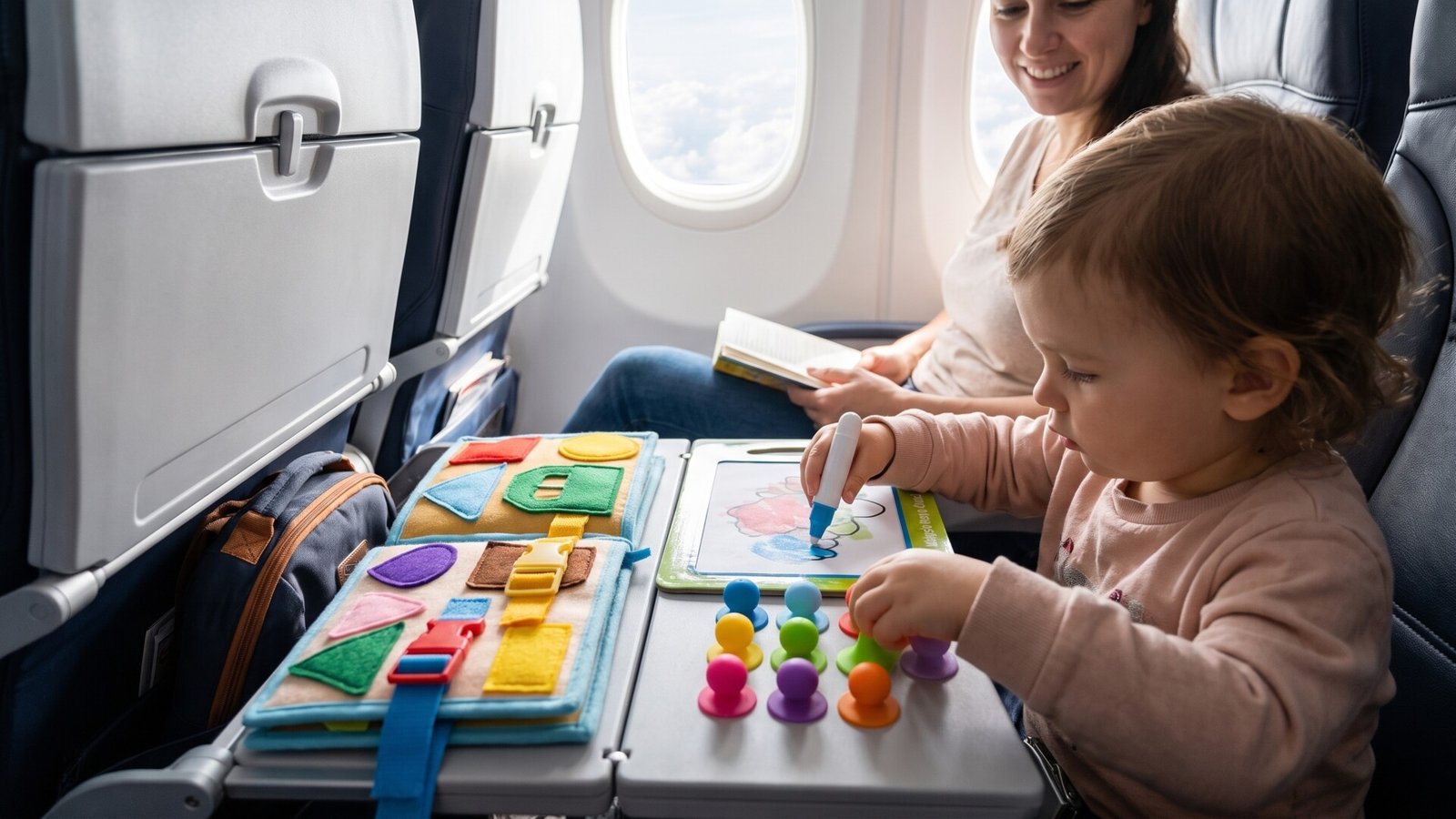
Best Travel Toys for Long Flights: Quiet, No‑Mess Options for Toddlers
A long flight with a toddler is mostly a planning problem. The toys that cause trouble are predictable: crayons that roll under the seat, a noisy fire truck, a tablet that runs out of battery in hour two. The toys that work are just as predictable: quiet, compact, self-contained, and interesting enough to hold a toddler’s attention for more than ninety seconds.
This guide covers the best quiet, no-mess travel toys for toddlers (roughly ages 1 to 4), with the manufacturer age guidance we could verify, approximate US prices where we could confirm them, and the safety trade-offs for each pick. It is part of our Travel & On-the-Go Activities guide, and sits alongside our picks for quiet sensory toys for airplane travel and open-ended toys for 5+ hour flights. Where a product is sold through partner retailers, the links below let you check current pricing and availability.
Quick answer: pack five to seven small toys of different types (something to stack, something to stick, something to look at), keep them in one pouch under the seat, and bring them out one at a time. For children under three, skip anything with loose magnets, button batteries, or small parts.
Why Choosing the Right Travel Toy Matters
Flying with a toddler is a shared space problem. You, your child, and the rows around you are all in the same cabin for hours. The wrong toy turns into dropped pieces, loud buzzers, and sticky fingers. The right one does the opposite.
It keeps the cabin calmer. A quiet, self-contained toy means fewer apologies to the passenger whose foot you just rolled a block under, and a better chance of resting for ten minutes yourself.
It supports quiet, independent play. Toddlers can often stay with a simple, well-matched toy for ten to fifteen minutes at a stretch, which is a long time at 35,000 feet. The best travel toys are designed to be used solo.
It invites practice, not just distraction. Stacking cups invite children to practise balance and spatial reasoning. Magnetic puzzles invite fine motor control and matching. Flap books invite attention and early language. None of that is guaranteed, but it is a better use of a flight than passive viewing alone.
It gives the tablet a supporting role. Screens are a perfectly reasonable backup on a long flight. Many parents find that holding the tablet back until the final stretch, after hands-on toys have had their turn, makes it last longer and eases the wind-down toward sleep.
Key Features to Look for in Travel Toys
Run every candidate through the same checklist before it goes in the bag.
Size & portability. It should fit in a small pouch or the seat-back pocket. Nesting pieces, foldable designs, and soft materials that squish down all help. A tray table is small, so anything wider than a paperback is a risk.
Quiet play. No sirens, no electronic songs, no clacking gears. A soft crinkle or a gentle wooden tap is the upper limit. Even a “quiet” rattle can grate on a red-eye.
Mess-free. Markers, paint, sand, water, slime, and loose glitter stay home. So do toys with many small parts that roll away. Self-contained activities such as magnetic puzzles, nesting cups, and soft blocks fit best.
Play value. A good travel toy is more than a distraction. Look for puzzles, sorting, stacking, patterns, or cause and effect that a child can repeat in new ways.
Durability. Airport floors and tray tables are unforgiving. Sturdy plastic, thick cardboard, or solid wood will survive drops. Anything heavy enough to become a projectile in turbulence should stay in the bag during takeoff and landing.
Versatility. Stacking cups become towers, then sorting bowls, then pretend drums. A magnetic puzzle can become a matching game. The more ways a toy can be used, the less likely it is to be abandoned by hour three.
Safety First: Ages, Magnets, and Small Parts
Manufacturer age grades are primarily safety guidance. In the United States, toys intended for children under three must not contain parts small enough to fit inside the small-parts test cylinder (about 1.25 inches wide), and loose, high-powered magnets and accessible button batteries are regulated because of the serious injury risk if swallowed. For a flight, that translates to a few simple rules:
- Under 3: choose nesting cups, one-piece soft blocks, board books, and chewable materials. Avoid magnetic play sets and anything with loose small pieces.
- Ages 3 and up: magnetic puzzles and small-piece activities are fine with supervision, and a zip pouch keeps pieces from vanishing.
- Always check the age on the packaging, and look up recalls on the CPSC recalls page before bringing a secondhand toy.
For more on matching toys to age, see Toys by Age: The Ultimate Guide.
Types of Travel Toys for Toddlers
Different toddlers are engaged by different things. These categories hold up best on a flight.
Soft toys & comfort items. A small plush or lovey can give emotional security during takeoff and landing. It is quiet, cuddly, and familiar.
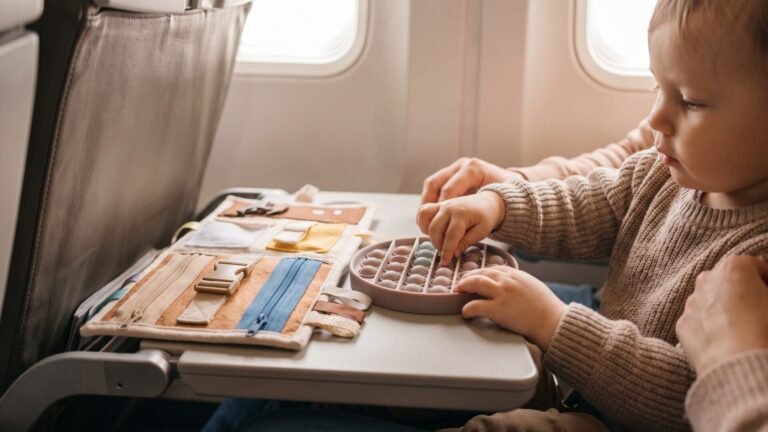
Activity boards & busy books. Fabric or plastic boards with zippers, buttons, and flaps keep little fingers busy. Choose versions without loose pieces.
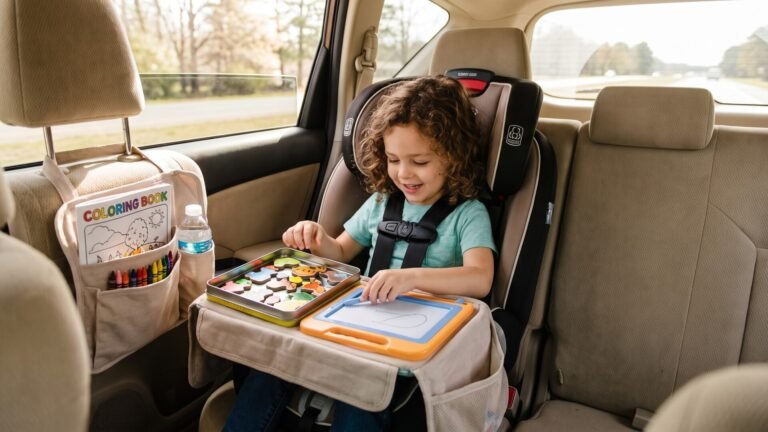
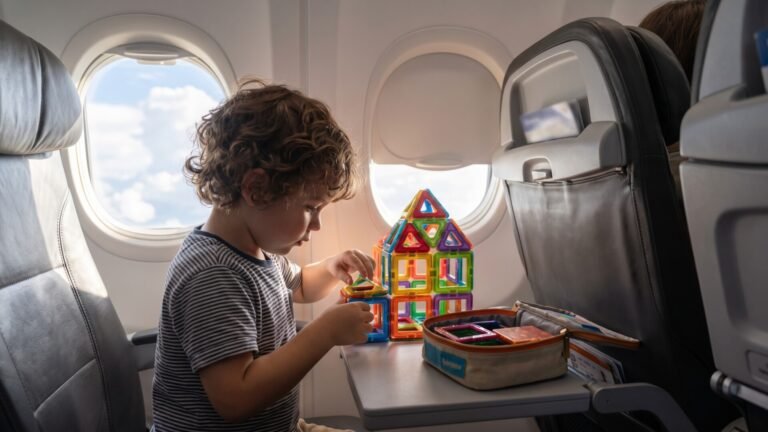
Magnetic puzzles & drawing toys. A magnetic puzzle or a magnetic doodle board is tidy, because there is no ink and nothing to spill. They are best for ages three and up because of the small magnets involved.
Stacking, sorting & puzzle toys. Nesting cups and simple puzzles are excellent. They build fine motor skills and spatial reasoning without clutter.
Interactive books. Lift-the-flap, touch-and-feel, and simple search-and-find board books are quiet and engaging. Reusable sticker books work too; pick small ones with limited sheets.
Top Travel Toys for Long Flights
Ages and sizes below come from manufacturer or retailer listings we checked; prices are approximate US ranges and change often. Where we could not confirm a detail, we have said so rather than guess.
1 Premium Options (Toys 1–3)
#1 Melissa & Doug Take-Along Magnetic Jigsaw Puzzles
Amazon | Melissa & Doug
These compact magnetic puzzles come in themed sets (the Princesses set, for example, has two 15-piece puzzles) and are made for car and plane trips. The pieces stick to a magnetic board, so they stay on the tray rather than sliding to the floor. They are a good fit for the older end of the toddler range: the manufacturer recommends them for ages 3 and up.
Age range: 3+ (listed for ages 3 to 5).
Approx. price: about $15–$20.
Key features: Magnetic pieces, themed puzzle boards, compact case.
Pros: Tidy and quiet; pieces stay put; encourages matching and visual problem-solving.
Cons: Small magnetic pieces make it unsuitable for children under 3 or those who still mouth objects.
Best for: Three- and four-year-olds who like puzzles and need a flat, contained activity.
Check Melissa & Doug magnetic puzzles on Amazon →
#2 Fat Brain Toys Tobbles Neo
Amazon | Ryder Toys
Tobbles Neo is a set of six weighted, wobbly pieces that nest, stack, and balance. Because the bases are weighted, the pieces rock and right themselves, which makes stacking forgiving for small hands. The plastic is smooth, there are no batteries, and the only sound is a soft rocking noise.
Age range: 6 months and up per retail listings (some list it for ages up to about 4).
Approx. price: about $30–$40.
Key features: Six weighted pieces, nests for storage, no batteries.
Pros: Very quiet; invites experimentation with balance; easy to wipe clean.
Cons: Pieces can roll off a tray, so use it on your lap or the seat.
Best for: Toddlers who enjoy building and knocking down without the crash of wooden blocks.
Shop Fat Brain Tobbles Neo at Ryder Toys →
#3 Fisher-Price Stack & Roll Cups
Amazon | Target
Fisher-Price Stack & Roll Cups are a classic stacking-and-nesting set made for babies and young toddlers. The cups nest into one compact stack for packing, can be stacked into a tower, and can be rolled along the tray. Check the current packaging for the exact age grade and piece count, since those details vary by release. For more on the brand, see Fisher-Price Through the Years.
Age range: Baby to young toddler; verify the current label.
Key features: Nesting cups, lightweight, no batteries.
Pros: Very quiet; durable; endless stacking combinations.
Cons: Very simple, so older toddlers may lose interest faster.
Best for: Younger toddlers (12–24 months) who love putting things inside other things.
Get Fisher-Price Stack & Roll Cups at Target →
2 Mid-Range Options (Toys 4–5)
#4 Green Toys Stacking Cups
Amazon | Friendly Toy Box
Green Toys Stacking Cups are a set of six graduated cups, numbered 1 to 6 on the bottom, made in the USA from recycled plastic milk containers. The manufacturer lists them as free of BPA, PVC, and phthalates. The numbers give older toddlers a built-in counting and ordering game.
Age range: 6 months and up.
Key features: Six nesting cups, numbered bases, recycled plastic.
Pros: Quiet, sturdy, and easy to wipe down after a flight; the numbers add a counting game.
Cons: Bulkier than a single-piece toy; cups can roll under seats.
Best for: Parents who prefer simple, recycled-plastic toys with no electronics.
Explore Green Toys Stacking Cups at Friendly Toy Box →
#5 Hape Pound & Tap Bench
Amazon | Ryder Toys
The Hape Pound & Tap Bench is a wooden bench with a mallet, balls, and a slide-out xylophone. It is not a compact airplane toy: it measures roughly 9.4 x 5.9 x 5.3 inches and weighs about 2.7 pounds, so it is better kept for the gate area, a layover, or the hotel room than for a crowded tray table. The mallet and balls are small parts, and the manufacturer lists it for ages 12 months to 3 years. If the xylophone is too loud for a cabin, leave it at home for the flight itself.
Age range: 12 months to 3 years per the manufacturer.
Approx. price: about $25–$35.
Key features: Wooden bench, mallet, balls, slide-out xylophone.
Pros: Hand-eye coordination and cause-and-effect play; solid wood construction.
Cons: Heavy and bulky for a carry-on; the xylophone and pounding make noise.
Best for: Layovers, airport gates, and the destination, rather than the flight.
Shop Hape Pound & Tap at Ryder Toys →
3 Budget-Friendly or Compact Options (Toys 6–7)
#6 B. toys One Two Squeeze Soft Blocks
Amazon | Target
One Two Squeeze is a set of ten soft, squeezable blocks that can be stacked, squeezed, and chewed. They are lightweight and quiet, so a block that bounces off a seatmate is a non-event. The manufacturer’s retail listing describes them as BPA-free and suitable from 6 months, which makes them one of the few block sets on this list that suits younger babies as well as toddlers.
Age range: 6 months and up.
Key features: Ten soft blocks, squeezable and chewable, lightweight.
Pros: Very quiet; soft enough for throwing practice without harm; easy to pack.
Cons: Soft blocks make shorter towers than wooden ones; individual blocks are easy to drop.
Best for: Younger toddlers who like to build and knock down in a soft, travel-friendly format.
Check B. toys One Two Squeeze on Amazon →
#7 Travel Activity Book Set (Sticker & Puzzle Books)
Amazon | Friendly Toy Box
A small stack of reusable sticker books, a mini puzzle book, and a lift-the-flap board book can be a lifesaver. Look for reusable sticker books, where stickers cling to the page without adhesive and can be moved around endlessly. Everything fits in a zip bag and weighs almost nothing.
Age range: 2–4 years (check each book’s label).
Key features: Reusable stickers, flap books, mini puzzles.
Pros: Extremely compact; very quiet; works in short bursts.
Cons: Stickers can fall off and get lost; choose books with a storage page.
Best for: Toddlers who love books and need variety without bulk.
Find Travel Activity Book Set at Friendly Toy Box →
Portability, Quiet Play, and Engagement
| Toy | Type | Age (per listings) | Quiet Level | Mess-Free | Portability | Skills practised | Approx. price |
|---|---|---|---|---|---|---|---|
| Melissa & Doug Take-Along Magnetic Jigsaw Puzzles | Magnetic puzzle | 3+ | Excellent | Yes | Compact | Matching, fine motor | $15–$20 |
| Fat Brain Tobbles Neo | Weighted stacking | 6 months+ | Excellent | Yes | Nesting | Balance, spatial reasoning | $30–$40 |
| Fisher-Price Stack & Roll Cups | Nesting cups | Baby/toddler; verify | Excellent | Yes | Nesting | Coordination, stacking | Check current price |
| Green Toys Stacking Cups | Stacking cups | 6 months+ | Excellent | Yes | Nesting | Counting, sorting | Check current price |
| Hape Pound & Tap Bench | Music/action | 12 months–3 years | Moderate | Yes | Bulky (about 9.4″ long) | Rhythm, hand-eye | $25–$35 |
| B. toys One Two Squeeze | Soft blocks | 6 months+ | Excellent | Yes | Soft, packable | Tactile, stacking | Check current price |
| Travel Activity Book Set | Books/stickers | 2–4 years | Excellent | Yes | Very compact | Focus, creativity | Varies |
Choosing by Age: What Works at 12 Months vs. 3 Years
12–24 months. Younger toddlers explore with their hands and mouths, so soft blocks, nesting cups, and board books are the safest bets. Expect shorter attention spans (often five to ten minutes per toy), so plan on more toys and quicker rotation. Our safe sensory toys for toddlers who chew guide is useful here.
2–3 years. Two-year-olds start enjoying simple puzzles, stickers, and pretend play. Magnets are still best avoided until three, so lean on stacking, sorting, and flap books.
3–4 years. Magnetic puzzles, reusable sticker scenes, and small-piece activities become reasonable with supervision. This is also when a toddler can follow a simple “first this, then that” plan for the flight.
A Sample Plan for a Six-Hour Flight
Toddlers rarely need entertainment evenly spread across a flight. A rough plan helps you ration the best toys for the hardest moments.
| Phase | What to do |
|---|---|
| Boarding and takeoff | Offer a bottle, sippy cup, or pacifier for ear comfort. Keep a lovey in hand; save the new toys. |
| Hour 1 | First “new” toy (stacking cups or soft blocks) plus a flap book. |
| Hours 2–3 | Second toy (magnetic puzzle or activity book). Walk the aisle when the seatbelt sign is off. |
| Hour 4 | Snack break, then the most engaging toy you have held back. |
| Hour 5 | Tablet time if needed, or a familiar book and quiet cuddle for nap time. |
| Descent | Another drink or pacifier for ear pressure; put loose toys away. |
Tips for Traveling with Toddlers
You have the toys. Here is how to make the flight as smooth as possible.
Rotate small toys. Don’t bring everything out at once. Wrap each toy in a separate pouch or cloth bag and reveal one at a time. A “new” toy every thirty minutes stretches your entertainment budget a long way.
Keep toys reachable. A soft cube or clear zip pouch under the seat in front of you means you don’t have to stand up to reach it. Overhead bins are too far when a toddler is melting down.
Hands-on first, screens later. Start with physical toys while your child is fresh and keep the tablet for the final stretch. Our guide to quiet time and independent play has more ideas for building the habit at home before you fly.
Pack snacks, comfort items, and water. A hungry toddler is an unhappy toddler. Non-messy snacks such as dry cereal, crackers, or fruit pouches go further than any toy. A familiar blanket or small stuffed animal helps during takeoff and landing.
Plan short intervals and breaks. Rotate activities every ten to fifteen minutes. Between toys, look out the window, walk the aisle when permitted, or read a book together. Don’t expect any single toy to last an hour.
Tether what you can. A short toy strap or ribbon attached to the tray or your bag keeps a favorite cup from rolling three rows back. Use only short tethers, never anything long enough to loop around a child’s neck.
Pack a change of clothes for you and your child. Spills and motion sickness happen.
If you are traveling by car instead, our guide to quiet activities for long car rides covers the same ideas for the road. For a broader view of play ideas, see the Play & Activity Ideas guide.
Frequently Asked Questions About Travel Toys For Long Flights
Which travel toys are best for toddlers under 2?
For children under 2, choose soft, simple, mouth-safe toys: nesting cups, one-piece soft blocks such as B. toys One Two Squeeze, and fabric or board books with crinkle pages. Avoid magnets, small detachable pieces, and anything with button batteries.
Are magnetic puzzles and drawing boards safe for toddlers?
They are generally designed for ages 3 and up, such as the Melissa & Doug Take-Along Magnetic Jigsaw Puzzles, because the small magnets are a choking and swallowing hazard for younger children. Check the age on the packaging, supervise play, and avoid any set with loose magnetic beads for children under 3.
How many toys should I bring on a long flight?
Five to seven small toys, two or three books, and a charged tablet as a backup is a reasonable starting point. Many of the toys here pack down small. Keep them in one pouch and rotate them.
Can these toys be used in cars or trains?
Yes. Quiet, compact, mess-free toys work well on road trips, train rides, and in waiting rooms. See our guide to quiet activities for long car rides for more ideas.
Do quiet toys still engage toddlers effectively?
Often better than noisy toys. A set of stacking cups offers many ways to sort, build, and knock down, and a puzzle invites focus. Quiet toys are also less likely to overstimulate a tired child.
How can I help my toddler's ears during takeoff and landing?
Sucking and swallowing help equalize ear pressure, so offer a bottle, sippy cup, or pacifier during takeoff and descent. If your child has had recent ear infections or seems to be in significant pain, ask your pediatrician before you fly.
How do I keep toys organized mid-flight?
Use the seat-back pocket for books and thin items, and keep small pieces in a zip pouch on your lap. Put each toy back in its bag when your child is done, since a dropped piece is often a lost piece.
Are teethers useful on flights?
They can be. A silicone teether gives a younger toddler something to chew while swallowing and sucking help with ear pressure. Choose one that is easy to clean and avoid anything sticky.
Conclusion
Long flights with a toddler don’t have to be a test of endurance. Pack toys that are quiet, mess-free, compact, and matched to your child’s age. For three- and four-year-olds, a magnetic puzzle set is a tidy choice. For babies and young toddlers, Tobbles Neo, nesting cups, and soft blocks give the most play for the least noise. Keep the bulkier, noisier options such as the Hape bench for the gate or the hotel room.
You don’t need the entire playroom. Five to seven small, well-chosen toys, rotated thoughtfully, will carry you through even a long flight. Safe travels.
Check current pricing and availability for these travel toys through our partners: