Montessori & Early Learning Toys: Building Skills Through Play
I bought a wooden object permanence box for my second child because a Montessori account I followed said it was essential. It cost about $35. She used it for eleven days. Then she figured out that the ball goes in the hole, which is the entire point of the toy, and she was done with it. My older child got eighteen months out of a $25 box of DUPLO that I bought because it was on sale and I was tired.
That is the whole Montessori toy problem in one anecdote. The label told me nothing about which one would last. What mattered was whether the toy matched what she could almost do, whether she could operate it without me sitting there narrating, and whether it still had something to offer once she had cracked the first challenge.
Most of what gets sold as Montessori is wood, beige, and expensive. None of those things make a toy educational. A good early learning toy gives a child a manageable challenge, allows them to actually do something with their hands, and survives being used the same way forty times in a row. That is the standard this article uses. Age fit, purpose, independence, durability, safety, replayability, and whether it is worth the money. Not the color of the paint.
What Montessori and Early Learning Toys Actually Do
Montessori-aligned toys tend to share a few traits. They invite hands-on exploration rather than passive watching. They use real actions – pouring, posting, hammering, sorting – instead of symbolic buttons that make a noise. They are presented simply, with one clear challenge visible at a time. And they are designed so a child can see whether they got it right without an adult telling them.
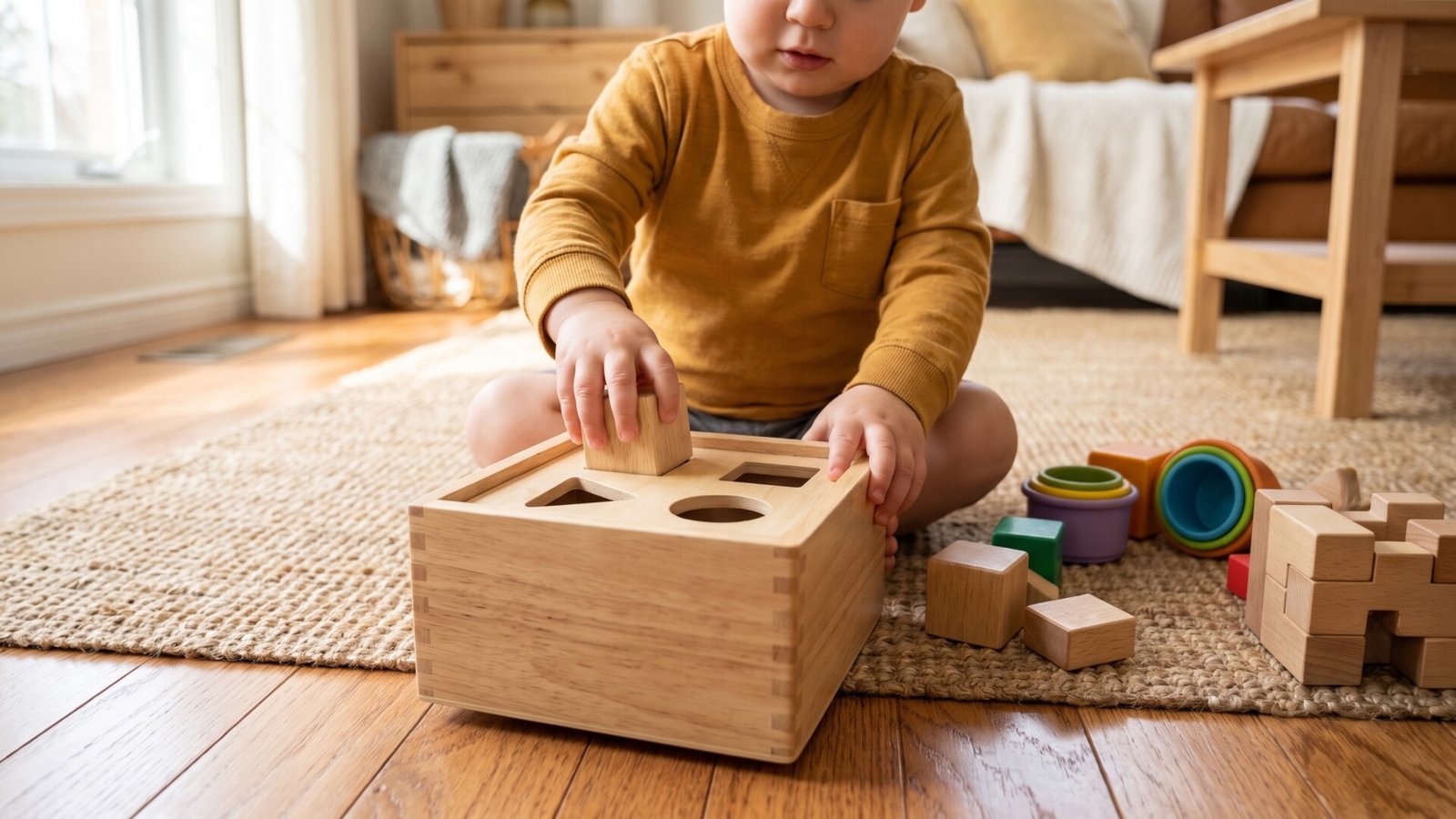
That last point is the one most parents miss. A shape sorter tells the child the answer. The square does not fit the round hole. The child rotates the piece, tries again, and succeeds. No adult needed. That self-correcting feedback loop is what builds concentration, and it is why a $15 wooden cube can outperform a $60 talking toy with twelve buttons.
Montessori-inspired toys are a subset of early learning toys, not a synonym for them. Electronic learning toys, puzzles, blocks, pretend-play materials, and sensory tools can all support learning even when they follow no Montessori approach at all. A good puzzle teaches matching and visual discrimination. A pretend kitchen teaches language and sequencing. A set of nesting cups teaches size order. None of them need a certification to be useful.
The label itself guarantees nothing. A toy marketed as Montessori can be too advanced, too fragile, or too passive for your particular child. A toy with a cartoon character on the box can be exactly the right challenge at exactly the right moment. What matters is fit.
The developmental benefits are real but modest, and worth stating plainly. Fine-motor control, hand-eye coordination, language, early math concepts, problem-solving, practical life skills, attention span, pretend play, and confidence through repetition. None of these arrive because you bought the right object. They arrive because the child uses the object repeatedly, at a level they can manage, over months. The toy is a tool for that practice. It is not the practice itself.
How to Match a Toy to the Child
Choose by developmental readiness, not age alone
Manufacturer age ranges are safety guides first and complexity guides second. They tell you whether a toy is likely to be dangerous for a child that age. They do not predict whether your specific child is ready for it.
The progression most children follow runs roughly like this. Large grasping and mouthing toys for infants. Posting, stacking, and simple cause-and-effect materials for young toddlers. Knob puzzles, shape sorters, and matching activities for older toddlers. Multi-piece puzzles, sorting and counting materials, and early building sets for preschoolers. More complex construction, sequencing, and early literacy materials after that.
The useful question is not “what age is this for” but “what can my child almost do.” Watch what they attempt and fail at. Watch what they attempt and succeed at with effort. That gap – the almost-can – is where the learning happens. Buying for a skill two years out means the toy sits on the shelf until you forget you own it.
Choose by the skill the child needs to practice
Different toys practice different things, and a toy that tries to teach five unrelated concepts usually teaches none of them well. Our [Internal: Montessori Toys by Skill] guide organizes materials by what they actually train.
- Fine motor: posting boxes, peg boards, threading sets, knobbed puzzles.
- Language: picture cards, puppets, realistic role-play sets, books.
- Early math: shape sorters, counting objects, stacking and sequencing toys, pattern materials.
- Sensory: texture materials, play dough, sand and water tools.
- Practical life: pouring, transferring, lacing, child-sized cleaning and kitchen tools.
- Construction: wooden blocks, magnetic tiles, DUPLO, loose-part building materials.
- Social and pretend play: dolls, kitchen sets, realistic figures, dress-up materials.
One clear primary challenge per toy is the goal. Repetition is not a sign the toy is too simple. It is the mechanism. A child who does the same posting activity thirty times is not bored. They are consolidating a skill, and the thirty-first repetition is where it becomes automatic.
Choose by the family’s real environment
Floor space, storage, noise, siblings, and cleanup all decide whether a toy actually gets used. A beautiful wooden activity center that eats a square meter of your living room and takes four minutes to tidy will get used less than a $20 puzzle that lives on a shelf.
Open-ended toys – blocks, DUPLO, loose parts – tend to have the longest play life because they do not have a single correct answer. Contained activities – puzzles, sorting trays, lacing cards – are easier to clean up and rotate. If your home is small, favor contained. If you have space and a child who builds, favor open-ended.
The best toy is the one you can present, store, and maintain without resenting it. That is not a compromise. It is the actual selection criterion.
Key Buying Factors for Montessori and Early Learning Toys
Safety and supervision. Check the manufacturer’s age guidance before anything else. Look for choking hazards, loose parts, magnets, cords, batteries, sharp edges, and finish quality. Small pieces require close supervision with young children, and you should inspect toys regularly as they wear – a cracked wooden piece or a loosened joint is a hazard. Always follow the manufacturer’s guidance and check current safety information rather than relying on a general rule.
Age appropriateness and challenge. A toy should be neither so easy it is abandoned in a week nor so hard the child needs you to do it for them. The sweet spot is a challenge they can complete with effort and a little frustration.
Durability and repairability. Solid wood, tight joints, and washable surfaces survive multiple children. Cheap finishes chip. Thin plastic cracks at the stress points. If a component is replaceable or the toy can be wiped clean, it lasts longer in a house with more than one child.
Independence and educational value. Favor toys with understandable actions, visible cause and effect, and feedback the child can read without you. If every use requires an adult to explain, reset, or congratulate, it is not building independence.
Replayability and storage. Does the toy support more than one play pattern? Does it fit on a shelf or in a bin? Can it be rotated out and brought back without a production? A toy that is hard to put away gets left out, and a toy that is always out stops being interesting.
Parent involvement and maintenance. Some toys need demonstration, sorting, battery replacement, or frequent resetting. In a busy household, a lower-maintenance toy often delivers better value than a technically superior one that needs you every ten minutes.
The Best Types of Montessori and Early Learning Toys
These are categories, not a second product list. The specific recommendations come after.
Practical life toys turn everyday actions into skill practice. Child-sized cleaning tools, dressing frames, pouring and transferring activities, lacing materials, and simple kitchen role-play. These are among the most genuinely Montessori items you can buy, and several of them cost very little. A small pitcher and a tray of dried beans will hold a toddler’s attention longer than most things with batteries.
Fine-motor and coordination toys include posting boxes, peg boards, threading sets, stacking toys, and knobbed puzzles. Controlled hand movements practiced here support later tasks like drawing, dressing, and using tools. This is the category where a well-chosen $15 item does almost everything a $60 one does.
Early math and sorting materials cover shape sorters, counting objects, stacking and sequencing toys, pattern materials, and simple matching games. The goal is quantity, classification, order, and visual discrimination – not memorizing answers. A child sorting buttons by color is doing early math.
Language, books, and pretend play matter more than most toy marketing admits. Picture cards, story materials, puppets, realistic role-play sets, and books support vocabulary and narrative. Open-ended language play is not less educational than a toy with printed letters on it. It is frequently more so.
Building and open-ended materials include wooden blocks, age-appropriate magnetic construction sets, LEGO DUPLO, and simple loose-part building materials. This is the category with the longest usable life, because the toy changes as the child does. Our [Internal: Montessori Buying Guides & Comparisons] covers how the major construction systems compare.
Sensory and nature-based play covers texture materials, play dough, sand and water tools, and supervised nature exploration. These require cleanup and supervision, and they are worth it. See [Internal: Montessori Activities] for practical setups that do not destroy your kitchen.
Recommended Montessori and Early Learning Toys
Six options across budget levels and developmental purposes. Prices are approximate and change often. Check current listings before you commit.
Melissa & Doug Wooden Shape Sorting Cube
| Feature | Details |
|---|---|
| Age Range | Typically suited to toddlers; verify current manufacturer guidance |
| Key Features | Wooden shape sorting, grasping, matching, spatial problem-solving |
| Price (approx.) | $15-$25 |
The Verdict
A straightforward first manipulative for a child learning to rotate objects, match shapes, and persist through trial and error. Less long-term variety than an open-ended building toy, but the clear challenge and low price make it a sensible starter. [Affiliate: Check current pricing through our recommended partners]
Best For
Toddlers developing early fine-motor control and shape recognition.
Pros and Cons
- Pros: Clear cause and effect; compact storage; affordable
- Cons: Limited once the sorting challenge is mastered; check regularly for loose or damaged pieces
Montessori-Inspired Wooden Object Permanence Box
| Feature | Details |
|---|---|
| Age Range | Usually designed for infants and young toddlers; check the exact listing |
| Key Features | Posting action, object permanence, grasping, repetition |
| Price (approx.) | $20-$45 |
The Verdict
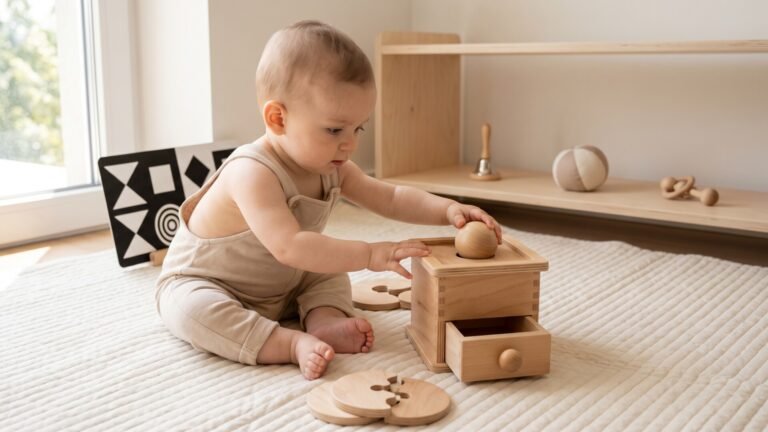
Useful when the child is ready to deliberately place an object into an opening and look for it again. It supports focused repetition with no lights or sounds. The useful period is short – think weeks, not years – so buy it at the right moment or not at all. [Affiliate: Check current pricing through our recommended partners]
Best For
Infants and young toddlers building early coordination and cause-and-effect understanding.
Pros and Cons
- Pros: Simple, focused activity; low visual and audio distraction; encourages repetition
- Cons: Narrow developmental window; small balls or objects require close supervision
PlanToys Wooden Hammer and Peg Bench
| Feature | Details |
|---|---|
| Age Range | Commonly aimed at toddlers; confirm current age guidance |
| Key Features | Hammering, bilateral coordination, grasping, cause and effect |
| Price (approx.) | $30-$45 |
The Verdict
A strong option for a child who enjoys purposeful physical action and can follow a simple demonstration. More engaging than many passive learning toys. It needs a stable surface, and it is loud – genuinely loud – which matters in an apartment or a house with a napping sibling. [Affiliate: Check current pricing through our recommended partners]
Best For
Toddlers practicing hand strength, coordination, and controlled tool use.
Pros and Cons
- Pros: Active hands-on play; durable wooden construction; satisfying repeatable action
- Cons: Can be loud; limited academic content; takes more shelf space than a small puzzle
Hape Easy-Grip Puzzle or Comparable Wooden Knob Puzzle
| Feature | Details |
|---|---|
| Age Range | Varies by complexity, from toddlers through preschool |
| Key Features | Matching, visual discrimination, grasping, early problem-solving |
| Price (approx.) | $15-$30 |
The Verdict
A good knob puzzle is one of the most practical early learning purchases you can make, because you can select the difficulty level and move up as confidence grows. Pick a theme the child recognizes – animals, vehicles, food – then add pieces. [Affiliate: Check current pricing through our recommended partners]
Best For
Toddlers and preschoolers building visual matching and problem-solving skills.
Pros and Cons
- Pros: Low mess; easy to rotate; wide range of difficulty and price
- Cons: Interest depends heavily on getting the difficulty right; pieces get lost
LEGO DUPLO Classic Brick Box
| Feature | Details |
|---|---|
| Age Range | Typically intended for preschool-age children; check the current set guidance |
| Key Features | Construction, fine-motor practice, spatial reasoning, open-ended play |
| Price (approx.) | $25-$60 depending on the set |
The Verdict
DUPLO is not a traditional Montessori material, and it does not pretend to be. It often delivers stronger long-term value than narrowly labeled Montessori toys because children build, rebuild, sort, role-play, and collaborate with the same bricks for years. If you want one system that stays useful from three to seven, this is it. [Affiliate: Check current pricing through our recommended partners]
Best For
Preschoolers and families seeking an adaptable construction toy with high replayability.
Pros and Cons
- Pros: Broad play possibilities; easy to expand; works for solo and shared play
- Cons: Sets get expensive as collections grow; storage needs increase fast
Lovevery Play Kits or a Comparable Montessori-Inspired Play Kit
| Feature | Details |
|---|---|
| Age Range | Kits are organized by developmental stage; select the current stage carefully |
| Key Features | Curated activities, developmental progression, parent guidance, multiple materials |
| Price (approx.) | Approximately $80-$150 per kit, depending on product and purchase format |
The Verdict
A curated kit cuts research time and helps you present a manageable rotation, but convenience carries a real premium. It makes sense for families who value guidance and coordinated materials. It makes less sense if you are happy picking individual toys and would rather spend the difference on one good construction set. [Affiliate: Check current pricing through our recommended partners]
Best For
Busy parents who want age-organized activities and a ready-made rotation.
Pros and Cons
- Pros: Convenient curation; useful presentation ideas; coordinated progression
- Cons: Higher total cost; some pieces get little use; more storage demand
Skip This If: Feature-Heavy Electronic Learning Toys
Not every electronic toy is bad. But the category as a whole – talking buttons, screens, automatic prompts, lights that fire regardless of what the child does – tends to create quick engagement without requiring much child-directed problem-solving. The toy performs. The child watches. That is a different activity from building, sorting, or solving.
There are reasonable cases. Shared play with a parent, specific accessibility needs, travel where you need something contained and quiet, or a child who genuinely enjoys it in moderation. If you are buying one to fill a shelf, skip it and put the money toward blocks, puzzles, practical-life materials, or construction toys instead. Our [Internal: Montessori Toys by Skill] guide has alternatives organized by what you actually want the child to practice.
ToyGuideHub Independent Play Score
This is an original scoring framework, not a laboratory test and not a manufacturer rating. It estimates how likely a toy is to support meaningful child-led use after an adult demonstrates it once. The score is built from six things: clarity of the activity, number of possible play variations, appropriateness of the challenge, how much adult resetting or correction it needs, durability and ease of access, and storage and household friction. A toy that needs you every four minutes scores lower than one the child can run alone.
| Product | Independent Play Score | Why It Earns That Score |
|---|---|---|
| Melissa & Doug Wooden Shape Sorting Cube | 4/5 | Clear action and self-directed repetition, but limited variety |
| Wooden Object Permanence Box | 3/5 | Excellent focused practice during a short developmental window |
| PlanToys Hammer and Peg Bench | 4/5 | Repetitive independent action, with noise and setup trade-offs |
| Hape Wooden Knob Puzzle | 4/5 | Child-led matching and progression through difficulty |
| LEGO DUPLO Classic Brick Box | 5/5 | Strong replayability and open-ended construction |
| Lovevery Play Kit | 4/5 | Curated activities support independence, though adults still manage rotation |
The pattern here is worth sitting with. The toy with the highest independent play score is also the least Montessori-looking thing on the list. DUPLO scores 5/5 not because it teaches anything specific but because it never runs out of things to do. The object permanence box scores 3/5 despite being the most authentically Montessori item here, because its developmental window is genuinely short.
The central insight is this. The simplest toy produces the best independent play when the child understands what to do and can see their own progress without an adult providing entertainment. Complexity is not the variable. Clarity is. A toy that a child can pick up, operate, and put away without asking you for anything is worth more than a shelf of impressive materials that all require a parent to run the show.
What Most Buyers Get Wrong
They buy the label instead of the fit. A toy marketed as Montessori can be too advanced, too fragile, or too passive for your particular child. The label describes an approach, not a guarantee of appropriateness.
They confuse quiet with educational. A silent toy is not automatically better. An active toy that supports purposeful movement and concentration is doing real work. The question is whether the child is directing the activity or the toy is.
They overbuy for a developmental stage. Five related sorting toys do not create five times the learning. They create five times the cleanup and a child who cannot decide what to play with. A small, well-rotated selection produces more focused play than a crowded shelf.
They judge value by first-day excitement. Some toys create immediate novelty and disappear after a week. A puzzle, a block set, or a practical-life activity may look boring on day one and become more useful through repetition. First-day reaction is close to worthless as a predictor.
They expect independent play without a presentation. Most Montessori-inspired materials work best after an adult gives a brief, clear demonstration and then steps back. Show the child once, slowly, without narrating. Then leave the material accessible and let them take it from there. If you never demonstrate, you will spend months being the entertainment.
Which Options Still Make Sense After Six Months?
Split the list into two groups. Short-use materials – object permanence boxes, basic posting toys, first shape sorters – have a defined developmental window and then they are done. That is not a flaw. It is how they work. Buy them at the right moment, use them hard, and pass them on.
Long-use materials – blocks, DUPLO, puzzles with room to grow, practical-life tools – keep working because the challenge scales with the child. A knob puzzle becomes a twenty-four-piece puzzle. A box of bricks becomes a house, a car, a shop, a city.
Cost per use is the honest measure. A $20 toy used daily for a year beats a $70 toy used twice. You do not need precise data to apply this. You need to ask whether the child will still pick it up in March.
What usually limits longevity, in order of frequency: developmental mismatch, missing pieces, overly narrow purpose, weak construction, difficult cleanup, and the child simply outgrowing the challenge. Notice that three of those six are about the toy’s design and three are about your household. Both matter.
Buy fewer toys with clear progression, rotate them, and keep a small number of favorites permanently accessible. Hand-me-down potential is real for solid wood and reputable construction sets – condition, completeness, and demand determine whether it survives to a second child or a resale listing.
How to Build a Montessori-Friendly Play Space
Keep this practical. See [Internal: Montessori Principles & Setup] for the full version.
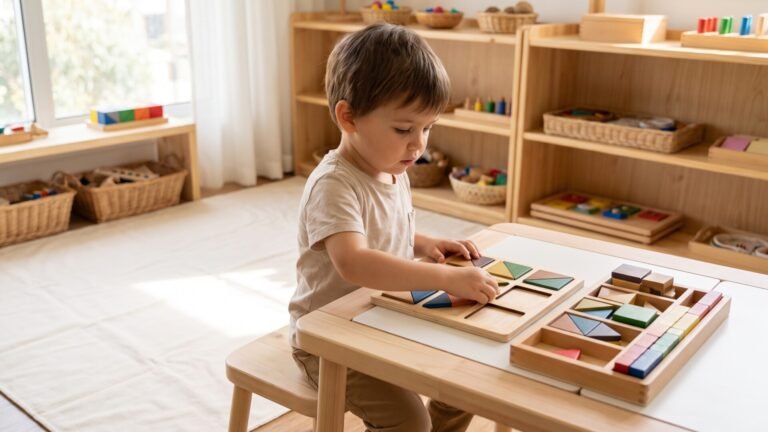
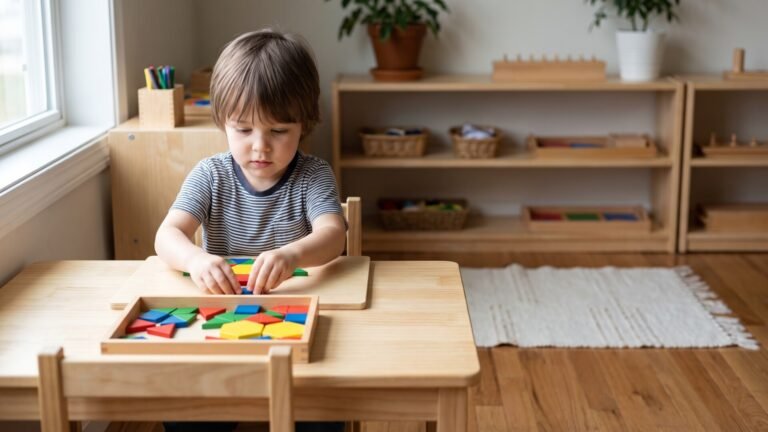
Use low, accessible storage with a limited number of choices. The child should be able to select and return materials without emptying every container onto the floor. A low shelf with four or five items works better than a deep toy box, and it is easier to tidy.
Present one clear activity at a time when introducing a new skill. Once interest fades, rotate it out rather than adding more on top. Rotation is the whole trick. A toy that has been away for three weeks is new again when it comes back.
Create simple zones for books, construction, practical life, sensory play, and pretend play. Adapt to the space you have. A Montessori-friendly play space does not require a dedicated playroom, matching wooden furniture, or a beige color scheme. It requires that the child can reach their things and put them back.
The adult responsibilities are the unglamorous part. Supervise hazards, model careful use, replace damaged items, and adjust the challenge as abilities change. If a material has been untouched for a month, it is either too easy, too hard, or badly placed. Move it or rotate it out.
How to Choose the Right Option
Best for babies and young toddlers
A simple object permanence box, grasping material, or large-piece posting toy, but only when the child is ready for the action. Prioritize safety, easy cleaning, and supervision over visual sophistication. Our Montessori Toys by Age guide breaks this down by stage.
Best for toddlers
A shape sorter, knob puzzle, peg bench, stacking toy, or practical-life activity. The best option matches the child’s current hand control and can be used without constant correction.
Best for preschoolers
LEGO DUPLO, wooden puzzles with increasing complexity, sorting and counting materials, pretend-play tools, and open-ended construction. This is where the long-life purchases start paying off.
Best for small spaces
A knob puzzle, shape sorter, compact stacking toy, or small construction box. Avoid large activity centers and kits with many low-use accessories. Storage friction kills usage faster than boredom does.
Best budget pick
The Melissa & Doug Wooden Shape Sorting Cube or a comparable wooden knob puzzle. Both give a clear developmental challenge at an accessible price.
Best long-term value
The LEGO DUPLO Classic Brick Box. Play possibilities expand as building and pretend-play skills develop, and the bricks hold resale value better than most toys.
Best for busy parents
A curated Lovevery Play Kit or comparable age-organized kit, provided you accept the higher price and have a plan for storing and rotating the materials.
Best for Montessori homes
A simple, non-electronic material with a clear purpose – a practical-life activity, wooden puzzle, sorting material, or open-ended construction set. How you present it matters more than the label on the box.
Comparison Table
| Product | Typical Age | Durability | Independent Play | Price Range | Best For |
|---|---|---|---|---|---|
| Melissa & Doug Shape Sorting Cube | Toddler | Good | 4/5 | $15-$25 | Budget starter toy |
| Wooden Object Permanence Box | Infant to young toddler | Good | 3/5 | $20-$45 | Early cause and effect |
| PlanToys Hammer and Peg Bench | Toddler | Good to very good | 4/5 | $30-$45 | Active fine-motor practice |
| Hape Wooden Knob Puzzle | Toddler to preschool | Good | 4/5 | $15-$30 | Matching and problem-solving |
| LEGO DUPLO Classic Brick Box | Preschool | Very good | 5/5 | $25-$60 | Long-term open-ended play |
| Lovevery Play Kit | Varies by kit | Good | 4/5 | $80-$150 | Curated age-based activities |
Conclusion
Choose for the child’s current readiness, your actual space, and how the toy will be used in month eight rather than week one. The Montessori label is not the deciding factor. Fit, durability, and independent play are. Best overall is the LEGO DUPLO Classic Brick Box for replayability, construction, pretend play, and long-term value. Best budget is the Melissa & Doug Wooden Shape Sorting Cube or a comparable wooden knob puzzle. Best premium is a Lovevery Play Kit for parents who want curation and developmental guidance. Best specialized is the PlanToys Wooden Hammer and Peg Bench for active fine-motor practice, or a wooden object permanence box if your child is at exactly the right early stage.
One well-chosen, repeatedly used toy is worth more than a crowded shelf of impressive-looking materials. For stage-by-stage picks, see [Internal: Montessori Toys by Age]. For skill-based selections, see [Internal: Montessori Toys by Skill]. For brand and price comparisons, see [Internal: Montessori Buying Guides & Comparisons].
It is entirely reasonable to stop researching now. Buy one thing that matches what your child can almost do, put it on a low shelf, and see what happens. It is also reasonable to buy nothing this month and watch what they gravitate toward first. Check current pricing and availability through our recommended partners.
Frequently Asked Questions About Montessori & Early Learning Toys
Are Montessori toys worth the money?
The label alone does not justify a premium. Value depends on how often the child uses it, how long it stays challenging, how well it survives, and whether it replaces several cheaper purchases you would otherwise have made. A $40 toy used daily for two years is a better deal than three $20 toys used for a month each.
What age should children start using Montessori toys?
Babies can use carefully selected grasping and cause-and-effect materials, but follow the specific product age guidance and supervise closely. The right starting point depends on readiness, not a universal age. Watch for the child reaching, grasping, and deliberately releasing objects.
Do Montessori toys have to be wooden?
No. Wood is common because it can be durable and visually simple, but plastic, fabric, cardboard, and electronic materials can all be appropriate when they are safe, purposeful, and well matched to the child. Material is a durability question, not a philosophy question.
Are electronic learning toys bad for children?
Not categorically. They can provide entertainment or targeted practice. But toys that require children to manipulate, build, sort, communicate, and solve problems tend to offer broader opportunities for active learning. If the toy does the work and the child watches, it is entertainment.
How many Montessori toys should a child have?
Start with a small rotation rather than a fixed number. Enough variety to cover current interests and skills, not so much that selection and cleanup overwhelm everyone. Most families find four to six accessible items works better than a full shelf.
What is the best Montessori toy for independent play?
Open-ended construction toys, appropriately challenging puzzles, and simple practical-life materials are the strongest candidates. Independent play still depends on a clear introduction, safe setup, and a challenge the child can manage alone.
How can parents tell whether a toy is developmentally appropriate?
Look for something the child can partly understand and partly master with practice. Immediate frustration means it is too advanced. Completed without any attention every time means it is too easy. The right toy sits in the middle and stays there for a while.
Do I need to buy a full play kit or can I build my own?
You can build your own. A shape sorter, a knob puzzle, a set of blocks, and a practical-life tray cover most of what a kit provides at a lower total cost. Kits are worth it mainly for parents who want the curation and presentation guidance handled for them.
How often should toys be rotated?
Every two to four weeks works for most families. Rotate out what has been untouched and bring back something from storage. The goal is not novelty for its own sake but keeping the accessible selection small enough that the child can actually choose.