Montessori Toys for Early Letter Recognition
You are looking for a toy that will help a child learn their letters, and the honest answer is that the best one is probably not the one with the most letters, sounds, lights, or worksheets attached to it.
Children tend to learn letter recognition through repetition and hands-on work: matching a shape, tracing it with a finger, sorting it, hearing its sound, and naming it. A toy that does that with six letters beats a talking tablet that does it with twenty-six.
So the early split looks like this. If your child is ready to handle symbols, start with tactile wooden letters. If they like sensory input, a textured tracing material will hold them longer. If they are not ready to memorize anything yet, a simple sound or object-matching game is the right purchase, and the alphabet can wait.
Montessori-inspired materials prepare a child for reading. They do not force it, and you should not try to.
What Early Letter Recognition Actually Involves
Recognizing a letter, naming it, knowing its sound, and using it in a word are four separate skills, and they arrive at different times. A child can pick the "M" out of a pile and still call it "W" on a bad day. A child can sing the whole alphabet and not recognize a single symbol in isolation.
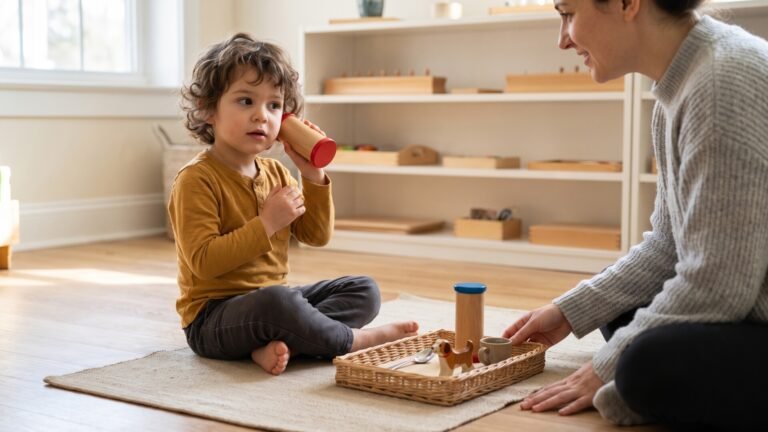
This matters because most alphabet toys only train one of those skills. A puzzle trains shape matching. A talking toy trains letter names. Almost nothing on a shelf trains sound association without an adult in the room.
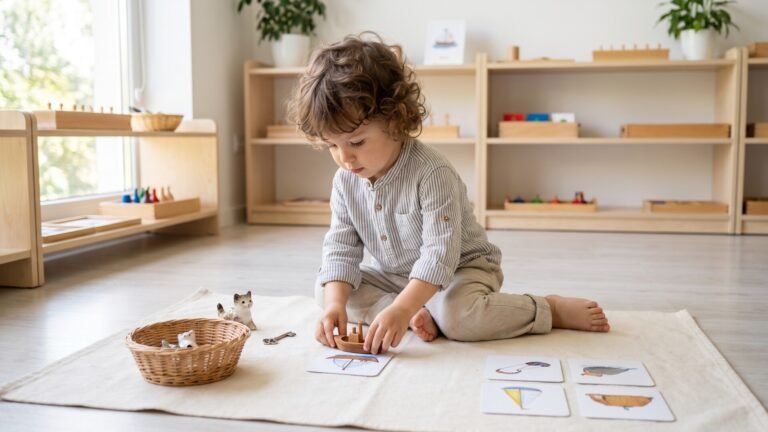
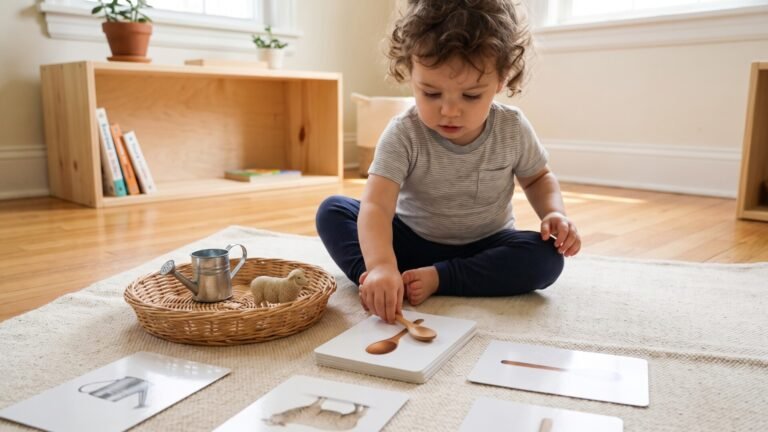
The Montessori sequence runs concrete to abstract, and it is slower than most parents expect. First, spoken sounds and real objects: this is a spoon, spoon starts with the sound "sss." Then tactile symbols the child can trace. Then matching, where the child pairs a letter with an object or another letter. Only after that does the child start building words.
If you want the full picture of how these materials fit together, [Internal: Montessori Language and Literacy Toys: Complete Guide] walks through the whole progression. For the stage before letters, [Internal: Montessori Pre-Reading Activities for Toddlers] covers what to do while you wait for readiness.
The practical takeaway: a toy that supports focused repetition with a few meaningful letters will do more than one that exposes your child to all twenty-six at once.
How to Choose a Montessori Letter Recognition Toy
Four things decide whether a letter toy gets used or sits in a basket.
Developmental fit
Ask whether your child can match two objects, follow a short two-step activity, hold a piece with a three-finger grip, and stay with a small number of pieces before wandering off. If the answer is no to most of those, the toy is too early regardless of what the box says.
Age ratings on the package are a safety floor and a rough marketing guide, not a readiness assessment. A four-year-old who has never shown interest in letters does not need a moveable alphabet because the box says four.
Learning design
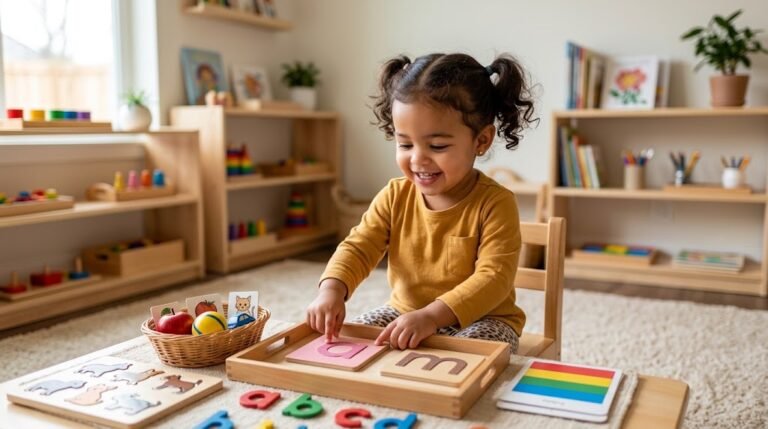
Look for clear letterforms, movable or textured pieces, and a way for the child to check their own work. Self-correction is the quiet engine of Montessori materials: the piece either fits or it does not, the letter either matches or it does not.
A toy where the child presses a button and watches is not the same as a toy where the child has to decide something. Prioritize the second kind.
Practical ownership
Storage, cleanup, loose pieces, noise, and durability decide whether you keep this thing past February. A moveable alphabet is wonderful and also ninety-plus small pieces that will end up under the couch.
Ask yourself where it lives, how long it takes to tidy, and whether your child can put it away without you. If the answer is "in a pile in the corner," that is the answer.
Safety
Check the manufacturer’s age rating and choking-hazard warnings on the specific product you are buying, not the category. Small letter pieces require active supervision around any child who still mouths objects.
Inspect magnets, if the toy has them, and check them regularly for looseness. Look at the finish on wooden pieces for rough edges, splinters, or peeling paint. If you are unsure about a material or a finish, contact the manufacturer directly rather than trusting a listing description.
The Best Montessori Toys for Early Letter Recognition
| Product | Approximate Price | Best For | Learning Style | Space Required |
|---|---|---|---|---|
| Melissa & Doug Deluxe Wooden Alphabet Puzzle | $20-$30 | First alphabet exposure | Matching and visual recognition | Low |
| Melissa & Doug See-Inside Alphabet Peg Puzzle | $20-$30 | Toddlers practicing letter shapes | Peg handling and matching | Low |
| Montessori Sandpaper Letters | $25-$50 | Tactile letter learning | Tracing and sound association | Medium |
| Moveable Alphabet | $25-$60 | Preschoolers ready to build words | Letter manipulation and early spelling | Medium |
| Wooden Alphabet Tracing Board | $15-$35 | Pre-writing and letter formation | Tracing and fine-motor practice | Low |
| LeapFrog Fridge Phonics Magnetic Letter Set | $15-$25 | Families wanting audio reinforcement | Sound and letter-name practice | Low to medium |
Melissa & Doug Deluxe Wooden Alphabet Puzzle
| Feature | Details |
|---|---|
| Age range | Typically marketed for preschool-age children; check the current package |
| Key features | Wooden alphabet pieces, matching board, visual letter exposure |
| Approximate price | $20-$30 |
The Verdict
This is the accessible first step for a child who likes puzzles and needs to see uppercase letters over and over. It does visual matching and vocabulary conversations well. It is not a phonics system, and you should not treat it as one, because puzzle play on its own does not reliably connect a letter to its sound.
Best For
Families who want an inexpensive, low-tech introduction to the alphabet.
Pros and Cons
Pros
- Familiar puzzle format with an easy entry point
- Compact and simple to use
- Supports matching and fine-motor coordination
Cons
- Limited tactile tracing or sound work
- Usually focuses primarily on uppercase letters
- Pieces can be lost or damaged if stored loosely
[Affiliate: Check current pricing on the Melissa & Doug alphabet puzzle]
Melissa & Doug See-Inside Alphabet Peg Puzzle
| Feature | Details |
|---|---|
| Age range | Typically intended for toddlers and preschoolers; verify the current age rating |
| Key features | Peg-mounted letter pieces, matching images or board spaces, grasp practice |
| Approximate price | $20-$30 |
The Verdict
For a younger child, the pegs make this the better buy of the two puzzles. Small hands can lift the pieces without the frustration of prying up a flat tile, which means more repetitions before anyone gives up. The activity stays at recognition and matching rather than independent sound work.
Best For
Toddlers who are starting to notice letters and need larger, easier-to-handle pieces.
Pros and Cons
Pros
- Easier for small hands to grasp
- Combines letter exposure with fine-motor practice
- Appropriate for short, repeatable activity periods
Cons
- Limited progression after the puzzle becomes familiar
- Can encourage visual matching without letter-sound connections
- Requires supervision if pieces are mouthed
[Affiliate: Check current pricing on the Melissa & Doug peg puzzle]
Montessori Sandpaper Letters
| Feature | Details |
|---|---|
| Age range | Commonly introduced around the preschool period, depending on readiness |
| Key features | Raised textured letters, tracing pathway, tactile symbol practice |
| Approximate price | $25-$50 |
The Verdict
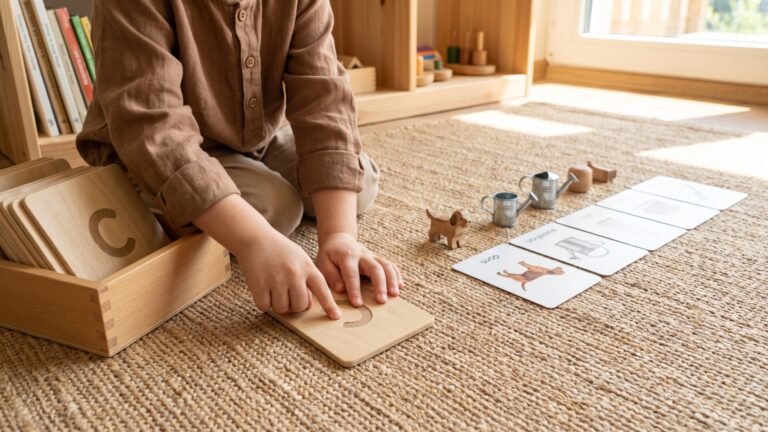
This is the strongest specialist choice for a child who learns through touch and is ready to link a spoken sound to a written symbol. Quality varies a lot at this price, so look for clear letterforms, a smooth backing that will not warp, and a surface that will survive a few hundred finger traces. Buy or introduce a few letters at a time, not the full set at once.
Best For
Preschoolers ready for intentional, tactile letter-sound work.
Pros and Cons
Pros
- Gives the child a physical pathway for tracing
- Supports visual, tactile, and auditory learning together
- Can be introduced gradually in small groups
Cons
- More expensive than a basic puzzle
- Requires adult presentation and correct sound modeling
- Some inexpensive sets have rough edges or confusing letter shapes
[Affiliate: Check current pricing on Montessori sandpaper letters]
Moveable Alphabet
| Feature | Details |
|---|---|
| Age range | Usually best for preschoolers who recognize several letters and are beginning sound work |
| Key features | Loose letter pieces for matching, sorting, and building simple words |
| Approximate price | $25-$60 |
The Verdict
The moveable alphabet is the most expandable option here and the worst first purchase for most children. It earns its place once your child knows some sounds and wants to build words with them. Before that, it is a tray of letters that gets scattered, and scattering is not learning.
Best For
Children ready to move from identifying letters to building simple words and their own name.
Pros and Cons
Pros
- Extends from letter recognition into early writing and spelling
- Allows repeated practice without requiring pencil control
- Can be used with objects, pictures, and spoken words
Cons
- Many small pieces require organized storage
- Less useful if the child does not yet know several letter sounds
- Parents need to model activities without correcting every attempt
[Affiliate: Check current pricing on moveable alphabet sets]
Wooden Alphabet Tracing Board
| Feature | Details |
|---|---|
| Age range | Typically suited to preschoolers developing pre-writing control; verify the manufacturer’s guidance |
| Key features | Grooved or recessed letter paths, tracing stylus or finger practice |
| Approximate price | $15-$35 |
The Verdict
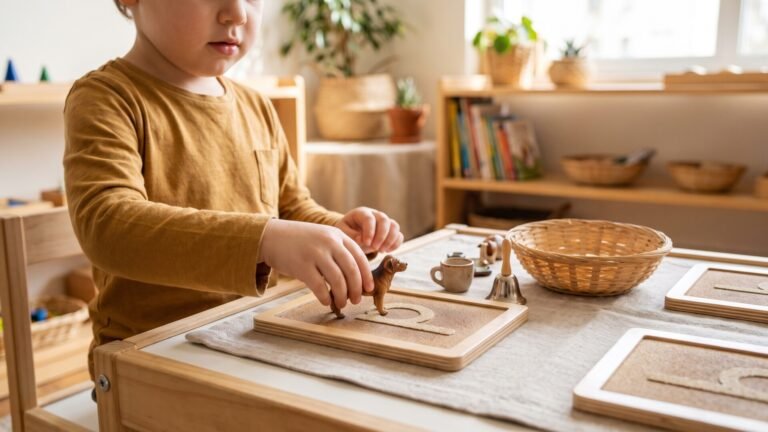
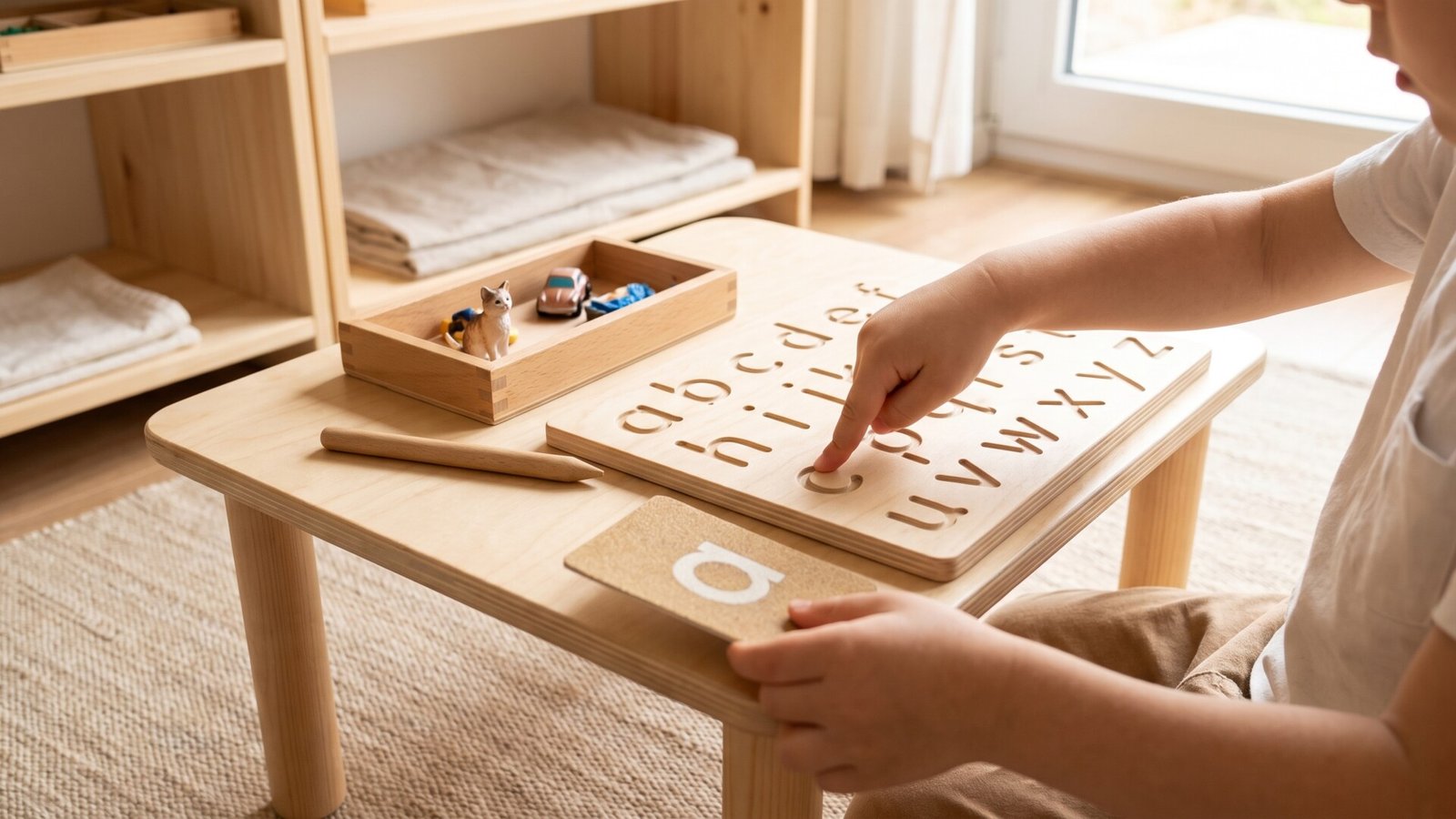
Buy this for the child who keeps asking to write, especially if you want something quieter than a worksheet. Tracing builds motor memory and letter-shape familiarity. It does not build sound knowledge, so pair it with sound games or object matching rather than letting it become handwriting practice with no language attached.
Best For
Children who enjoy repetitive tracing and are developing pencil readiness.
Pros and Cons
Pros
- Supports pre-writing and letter formation
- Reusable and relatively compact
- Gives children a clear physical route to follow
Cons
- Can become handwriting practice without meaningful sound work
- Some boards have shallow grooves or poorly formed letters
- Styluses may be unsuitable for younger children without supervision
[Affiliate: Check current pricing on wooden alphabet tracing boards]
LeapFrog Fridge Phonics Magnetic Letter Set
| Feature | Details |
|---|---|
| Age range | Commonly marketed for toddlers and preschoolers; check the current product guidance |
| Key features | Magnetic letters, electronic letter-name and sound prompts, interactive play |
| Approximate price | $15-$25 |
The Verdict
This is a mainstream interactive toy, not a Montessori material, and it is fine as what it is. It reinforces letter names and sounds in short sessions without an adult prompting every time. It is less open-ended and less tactile than sandpaper letters, and it has batteries, which is its own commitment.
Best For
Families who want convenient sound reinforcement for supervised practice.
Pros and Cons
Pros
- Makes letter sounds accessible without constant adult prompting
- Easy to use in short sessions
- Familiar format for children who enjoy interactive toys
Cons
- Less open-ended than non-electronic materials
- Batteries and sound features add ownership issues
- Magnetic pieces require careful supervision and storage
[Affiliate: Check current pricing on the LeapFrog Fridge Phonics set]
What to Skip: Oversized Alphabet Sets With Too Many Features
Skip the big alphabet centers that combine lights, songs, a screen, worksheets, and forty disconnected activities in one box. They look like value. They are usually a storage problem with a speaker.
The reason is not that electronics are bad. It is that more features means less repetition of any single one. A child who presses a button, watches a light, and moves on has not named a letter, matched a letter, or traced a letter. They have operated a device.
A toy can have thousands of five-star reviews and still be a poor fit for your child if the actual play is watching, pressing, or scattering. The test is simple: does your child have to decide something, or do they just have to touch it?
What Most Buyers Get Wrong About Letter Learning Toys
The alphabet song is not letter recognition. Plenty of children can sing the whole thing at three and cannot identify the letter "S" on a page at four. The song teaches a sequence. Recognition is about individual symbols, and it comes from meeting them one at a time.
The second mistake is presenting uppercase and lowercase together from day one. Two visual forms for every letter is twenty-six extra shapes to sort out. A staged presentation, one form at a time, usually gets there faster even though it feels slower.
The third is assuming a toy that teaches letter names teaches letter sounds. Usually it does not. Names and sounds are different knowledge, and sound work needs a human saying the sound clearly and consistently. Model the sound, not the letter name, when you are doing sound work, and keep it short.
The fourth is expecting the toy to do the teaching. The adult’s presentation is most of the value: introduce a few letters, use the child’s name and their current obsessions, stop before frustration sets in, and come back to the same material next week. A $30 set presented well beats a $90 set left on a shelf.
Which Option Still Makes Sense After Six Months?
This is where most roundups stop and where the real answer lives. Here is the longevity picture for each option, based on how these materials typically hold up in a home rather than a classroom.
The wooden puzzles have the shortest useful life and the lowest risk. Expect a few months of genuine engagement, then a long tail of occasional use. The peg puzzle usually outlasts the flat puzzle because the pieces survive being carried around. Both are cheap enough that a few months of daily use is a fair return. What fails first is not the wood; it is the pieces. Alphabet puzzle letters go missing the way socks do.
Sandpaper letters have a much longer arc. They start as tracing material, become sound-association material, and later get used for matching and simple word work. A decent set can stay in rotation for two or three years. What fails first is the surface: cheap versions lose their grit or peel at the edges, which is exactly why the $25 end of the range and the $50 end are not the same product.
The moveable alphabet has the longest progression of anything on this list. It is the only option that carries a child from recognition into building words, which means it can still be earning its place when the puzzles are long gone. The catch is the pieces. If you do not set up a storage system your child can actually use, you will spend more time hunting for vowels than they spend building words.
The tracing board sits in the middle. It stays useful as long as the child is working on formation, then becomes redundant once handwriting takes over. It is compact, it does not lose pieces, and it does not need batteries, which makes its cost per use quietly excellent.
The electronic set is the one to think about honestly. It is cheap, it works immediately, and it is convenient. It is also the fastest to become repetitive, because the child is not generating anything. Most families report a strong first month and a slow fade. Buy it as a supplement, not as the plan.
Cost per use is the number that matters. A $30 sandpaper letter set used three times a week for two years is cheaper per session than a $15 toy abandoned in six weeks. The cheap option is only cheap if it gets used.
The resolution: choose the wooden puzzle for low-cost first exposure, sandpaper letters for tactile learning, the moveable alphabet for the strongest long-term progression, and the electronic set only when sound reinforcement and convenience genuinely outweigh open-ended play.
How to Match the Toy to the Child
Best for Toddlers Beginning to Notice Letters
Choose the peg puzzle or a simple wooden alphabet puzzle. Keep sessions short and focus on matching, naming, and spotting letters that already mean something, starting with the letters in the child’s name.
Do not require accurate letter sounds or independent recitation at this stage. For more on this window, [Internal: Montessori Language Activities for 2-Year-Olds] covers what to do at this age.
Best for Tactile Learners
Choose sandpaper letters or a good wooden tracing board. Introduce a small number of letters, pair each trace with one clear spoken sound, and supervise.
Check textured surfaces regularly for wear, peeling, or rough edges, and replace anything that has started to degrade.
Best for Preschoolers Ready to Build Words
Choose a moveable alphabet. Start with names, familiar objects, and simple sound-based word building rather than spelling tests or corrections.
Store the letters in labeled compartments so your child can set up and put away independently. [Internal: Montessori Language Activities for Preschoolers] has activity ideas that use the letters rather than just sorting them.
Best Budget and Small-Space Choice
Choose a wooden alphabet puzzle or a tracing board, depending on whether recognition or pre-writing is the priority. Both are compact and both survive being stacked on a shelf.
A durable, compact item used repeatedly beats a large alphabet bundle with a hundred pieces and nowhere to live.
Pros and Cons of Montessori-Style Letter Toys
Pros
- Hands-on materials make symbols easier to explore and remember.
- Many options support fine-motor development alongside language work.
- Open-ended materials can grow from recognition into early writing and spelling.
- Low-tech designs reduce noise, screen dependence, and battery maintenance.
Cons
- Some materials require adult modeling before children can use them independently.
- Loose letters and small parts create storage and supervision challenges.
- Montessori-style labeling does not guarantee sound instruction or quality construction.
- Children develop at different rates, so a toy may be appropriate in theory but frustrating in practice.
Practical Ways to Use the Toys Without Turning Play Into School
The three-part presentation is the workhorse here. Name the letter or sound. Ask the child to identify it. Then ask them to find or match it in a simple activity. That is it, and it works with almost any material on this list.
Start with a few high-interest letters rather than the whole alphabet. Letters from the child’s name, or from something they are currently obsessed with, get far more engagement than a random group of five.
Pair letters with real objects, picture cards, songs, and sound games so the symbol carries meaning beyond memorization. A letter that stands for the name of a thing your child loves is a letter they will remember. [Internal: Montessori Sound Games for Language Development] covers the sound-first work that makes this click.
Stop when interest drops. Revisit later. Do not correct every mistake, and do not turn it into a performance for relatives at a family gathering.
Conclusion
Best Overall: Montessori sandpaper letters, for tactile, focused recognition and early sound association.
Best Budget: Melissa & Doug Deluxe Wooden Alphabet Puzzle, for simple visual matching and first exposure.
Best for Toddlers: Melissa & Doug See-Inside Alphabet Peg Puzzle, for manageable grasping and matching.
Best Long-Term Value: Moveable alphabet, for preschoolers ready to progress toward word building.
Best Interactive Sound Option: LeapFrog Fridge Phonics Magnetic Letter Set, for families prioritizing convenient audio reinforcement.
The best purchase is the material that matches your child’s current readiness and will be used repeatedly, not the set with the most letters or features. Check current pricing and availability through our recommended partners.
Frequently Asked Questions About Montessori Toys For Early Letter Recognition
What age is appropriate for Montessori letter recognition toys?
Readiness matters more than a birthday. Many children start noticing letters during the toddler years, while deliberate tracing, sound association, and moveable-alphabet work often fit better during the preschool period. Watch for the ability to match, follow a short activity, and stay with a small number of pieces.
Are Montessori sandpaper letters worth the price?
They are worth it for a child who learns through touch and is ready for intentional letter work. They are not worth it as a first alphabet toy for a child who still needs simple matching and object-based language play. Quality varies, so look at the letterforms and the surface before buying.
Should children learn uppercase or lowercase letters first?
Begin with the forms your child meets most in their environment, but present fewer visual variations at the start to reduce overload. Consistency and meaningful repetition matter more than which case you pick.
Do alphabet puzzles teach phonics?
Most alphabet puzzles teach visual matching and letter names. If phonics is the goal, you need to add sound modeling and word activities yourself. The puzzle is the entry point, not the curriculum.
Are magnetic letter toys safe for toddlers?
Check the specific product’s safety instructions and inspect magnets regularly for looseness. Loose magnets and small pieces require close supervision and should not be treated as universally safe for every toddler. If you are unsure, contact the manufacturer.
How many letters should a child practice at once?
Start with a small group the child can revisit successfully, then add gradually. The right number depends on attention, interest, and whether your child can tell the letters apart consistently.
Is a moveable alphabet suitable for a child who cannot write yet?
Yes. Children can manipulate letters long before they have the pencil control for handwriting, which is part of the point. It works best when the child already recognizes some letters and enjoys representing spoken words.
How do I stop losing the pieces?
Use a compartmentalized tray or a set of small labeled containers, and make putting it away part of the activity rather than a job you do after bedtime. If your child cannot manage the storage, the storage is wrong, not the child.
Do I need the full alphabet set to start?
No. A few letters used repeatedly will do more than twenty-six used once. Adding letters gradually also keeps the material feeling new rather than overwhelming.