Learning Through Play: A Parent’s Guide to Skill-Building That Feels Like Fun
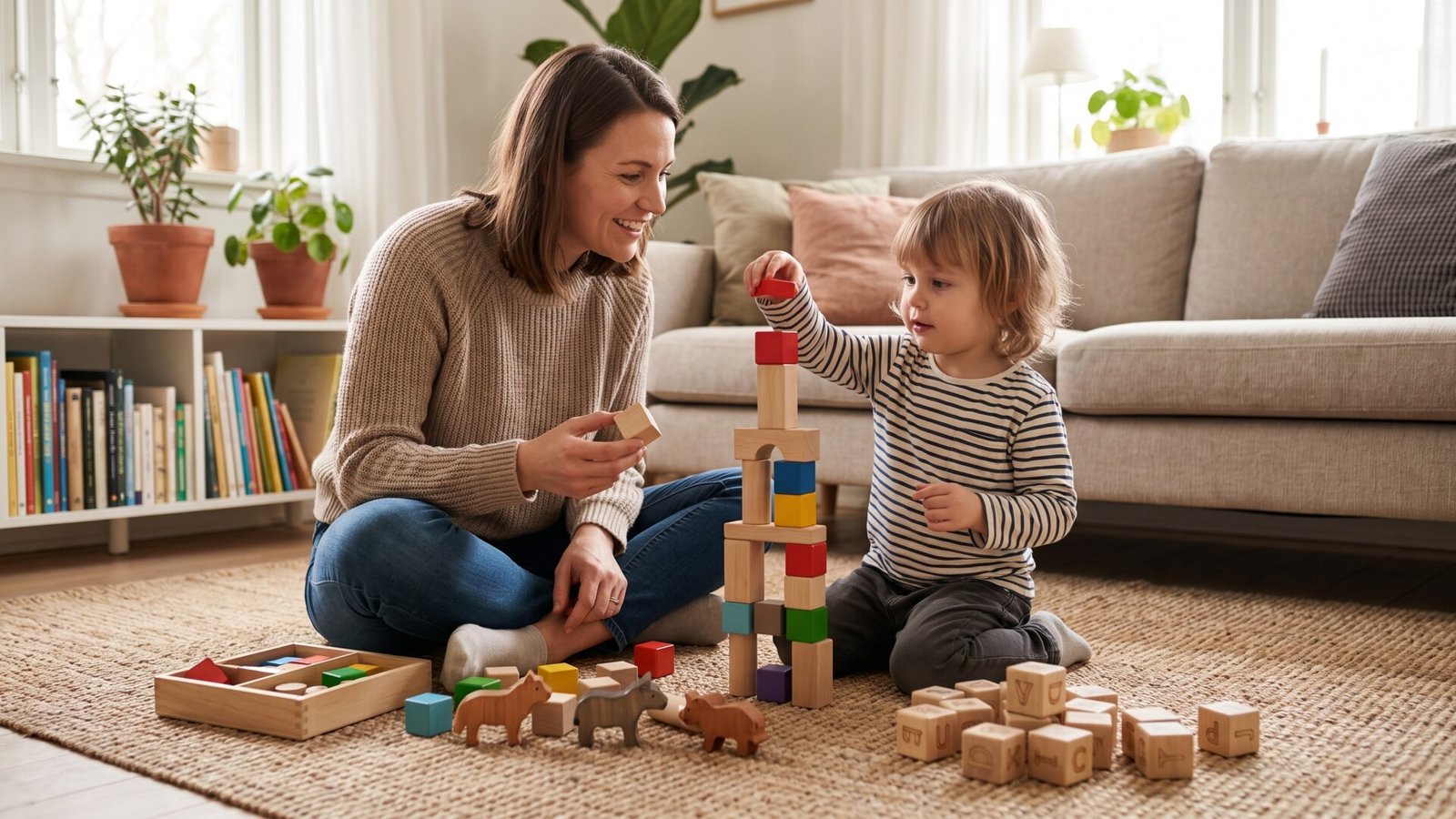
There’s a moment that happens in every home where play is valued. A child is building with blocks, deeply focused, when suddenly they announce that their tower needs to be “taller than the table” and they start comparing heights. Or they’re playing restaurant with stuffed animals and begin writing menus, strings of letters that don’t spell actual words but represent a genuine attempt at written communication. Or they’re sorting their animal figures and notice that some have hooves and some have paws, and they want to know why.
These moments are pure gold. The child isn’t doing a worksheet or sitting through a lesson. They’re playing. But in that play, they’re also counting, measuring, writing, categorizing, questioning—engaging in the early thinking that academic skills grow from.
This is the power of learning through play. Pediatric and early-childhood organisations, including the American Academy of Pediatrics, have long described play as central to healthy development in young children. Skills explored through meaningful, self-directed play tend to feel connected to something the child cares about. The child who discovers number concepts through building and comparing is making sense of quantity, not just memorizing numerals. The child who experiments with letter-like forms in authentic contexts is learning how print works.
This guide explores activities that intentionally blend fun and skill-building across literacy, math, STEM, and cognitive development. These aren’t lessons dressed up as games. They’re engaging play experiences that happen to build important skills along the way. The learning is the secret ingredient, not the main course. Every child develops at their own pace, so treat ages and stages here as typical ranges, not deadlines. If you have concerns about your child’s development, your pediatrician is the best first call.
Return to the main Play & Activity Ideas Hub
Quick Start: Play Ideas by Age
| Age | Play That Fits | Skills It Invites | Watch Out For |
|---|---|---|---|
| Under 1 | Shape sorters with large pieces, board books, simple stacking | Cause and effect, grasping, early language | Anything small enough to fit in a toilet-paper tube |
| 1–2 | Chunky knob puzzles, nesting cups, songs and finger plays | Fit and match, vocabulary, fine motor control | Small parts, loose beans, water beads |
| 2–3 | Simple jigsaws, blocks, play dough, name play | Problem-solving, letter interest, pretend play | Magnets, button batteries, small parts |
| 3–4 | Dice games, counting games, sink-and-float, learning bins | Counting, sorting, prediction | Supervise scissors, tweezers, small items |
| 4–6 | Pattern bins, 24–100 piece puzzles, nature journals, building challenges | Patterns, early reading and writing, engineering | Appropriate challenge so it doesn’t become frustrating |
For ideas aimed at the preschool years, see Learning Through Play: STEM Activities for Preschoolers and our roadmap for introducing STEM early.
Alphabet & Letter Recognition Games
Building Literacy Foundations Through Play
Long before children read, they develop alphabet knowledge—recognizing that those squiggles on the page have names, make sounds, and combine to create meaning. This understanding grows best through playful, meaningful encounters with letters, not through drills or pressure.
The key to alphabet play is meeting children where they are. Some children show intense interest in letters early; others don’t care until much later. Both paths are normal. The goal isn’t early reading—it’s positive associations with letters and language.
Environmental print activities harness the literacy that already surrounds children. Point out letters on cereal boxes at breakfast. Notice the first letter of their name on street signs during walks. Find familiar logos and labels at the grocery store. These encounters matter because they connect abstract symbols to real-world meaning. A child who recognizes the logo of their favorite store or cereal already knows something important about how print carries meaning.
Name-based activities start with the letters most meaningful to any child: the ones in their own name. Magnetic letters for the refrigerator let children arrange and rearrange their name and family members’ names. Name puzzles with individual letter pieces build recognition through touch. Signing artwork with their name—even if the letters are unrecognizable—builds the understanding that written marks carry meaning.
Alphabet scavenger hunts work anywhere and require no materials. “Find something that starts with the letter B” sends children searching through the house or yard, building letter-sound connections through active exploration. For younger children, focus on the first letter of their name. For older preschoolers, work through the alphabet gradually, finding items for a few letters each time.
Sensory letter play engages touch and movement alongside vision. Trace letters in sand, salt, or shaving cream. Form letters with play dough snakes. Create letters with sticks, rocks, or leaves outdoors. Write letters in the air with big arm movements. Many children find the physical experience of forming letters more memorable than looking at them alone.
Alphabet books deserve a permanent place in your library. The best ones go beyond simple A-is-for-Apple to engage children with interesting illustrations, playful language, and sometimes stories. Look for books with clear, recognizable letters and images that invite conversation. Reading alphabet books together, noticing letters, and talking about what you see builds literacy naturally.
Connection to Educational Toys is natural here. Magnetic letters, alphabet puzzles, letter stamps and play dough, and quality alphabet books all support letter learning through play. The best materials invite exploration without requiring specific outcomes. They’re available when children are interested, not forced on them during prescribed “learning time.” Keep magnetic letters made with small loose magnets away from children under 3.
Explore more: our best STEM toys for preschoolers include several open-ended letter and number toys, and beginner coding toys for preschoolers teach sequencing, which is a pre-reading skill too.
Counting & Number Games for Preschoolers
Building Number Sense Through Real Experiences
Number sense—the understanding of what quantities mean and how they relate—develops through real experiences with counting, comparing, and manipulating objects. Children who count during play aren’t just memorizing number words; they’re building understanding of how quantity works.
The best number play happens in meaningful contexts. Counting snack crackers as they’re distributed. Comparing whose tower has more blocks. Figuring out if there are enough cups for everyone at a playdate. These authentic math moments stick because they matter to the child.
Board games with dice provide endless counting practice in a context children love. Moving a piece the correct number of spaces reinforces one-to-one correspondence—each count matches one move. Counting dots on dice builds subitizing skills (recognizing small quantities without counting). Games with two dice introduce addition naturally as children combine the numbers. Classic games like Candy Land, Chutes and Ladders, and Hi Ho! Cherry-O all build counting skills through engaging play. Check the age grade on the box, since some include small pieces.
Snack math turns everyday eating into number exploration. Count crackers into bowls to practice one-to-one correspondence. Divide berries equally among family members to introduce fair sharing and beginning division. Estimate how many raspberries are in the container before counting. Arrange snacks into patterns—cracker, berry, cracker, berry—to build patterning skills. For young children, cut grapes lengthwise and avoid whole nuts, popcorn, and hard candy, which are choking hazards. Children are motivated by the edible reward at the end.
Nature counting uses outdoor finds as mathematical materials. Count collected rocks, comparing who has more or less. Sort leaves by size, then count how many in each group. Find sticks and arrange them from shortest to longest. Notice patterns in flowers or seed heads. The natural world provides endless mathematical material, and being outdoors adds sensory richness to the learning.
Number books and songs build familiarity with number sequences and concepts. Counting books with clear illustrations let children practice number recognition. Songs like “Five Little Ducks” or “Ten in the Bed” introduce subtraction concepts through story. Finger plays with counting movements engage children who like to move. The repetition children love builds number familiarity effortlessly.
Simple board games designed for young children teach number concepts through play. Games like The Sneaky, Snacky Squirrel Game involve collecting acorns with a spinner. Hi Ho! Cherry-O requires counting cherries and understanding when you have none left. Sequence for Kids involves matching in a simplified version of the adult game. These games build number sense while also teaching turn-taking and social skills. For more on cooperative play, see our guide to Social & Group Play.
Match activities to developmental stage. Number understanding develops gradually. A two-year-old may recite “one, two, three, four, five” without understanding that those words represent quantities. A three-year-old begins to understand that “three” means this many objects. A four-year-old can often count objects accurately up to ten or beyond. A five-year-old starts understanding that the last number counted tells how many there are in total. These are typical patterns, not strict timelines.
Explore more: the ultimate guide to open-ended play covers building toys that double as counting and comparing materials.
STEM Activities Without Screens
Science, Technology, Engineering, and Math Through Hands-On Exploration
STEM education has become a buzzword, often associated with screens and apps. But much of the best STEM learning for young children happens offline, through hands-on exploration of how the world works. Building, experimenting, observing, and questioning are the foundations of scientific thinking.
The key to STEM play is following children’s questions. Why do some things float and others sink? How can I make this tower stop falling? What happens when I mix these colors? The adult role is to provide materials and support for investigation, not to deliver pre-packaged lessons.
Building challenges explore engineering principles naturally. Provide materials—blocks, magnetic tiles, recycled cardboard, tape, craft sticks—and open-ended prompts: How high can you build? What shape supports the most weight? How can you make a structure that withstands “wind” from a fan or “earthquake” from shaking the table? The iterative process of building, testing, and rebuilding teaches design thinking in a way worksheets can’t.
Water play with tools introduces physics concepts through pure exploration. Provide pipes, funnels, tubes, containers of different sizes, and a water source (or water table). Children experiment with flow, volume, and pressure as they pour, transfer, and channel water. Add food coloring for extra engagement, or freeze colored ice cubes to explore melting and mixing. Always stay within arm’s reach of young children around any amount of water.
Magnet explorations reveal invisible forces. Provide magnet wands or larger toy magnets and collections of test items—paper clips, coins, aluminum foil, plastic toys, nails. Children discover which items attract, whether magnetism works through materials, and how magnets can move objects without touching them. Use only products intended for children, and keep loose magnets away from children under 3: swallowed magnets can cause serious internal injuries. Skip home-made trays of iron filings for young children; sealed commercial magnet-wand toys are a safer way to see magnetic fields.
Sink and float investigations build understanding of density and prediction. Gather a collection of objects, a large container of water, and recording materials. Have children predict which objects will sink and which will float, discussing reasons for their predictions. Test each object, comparing results to predictions. The objects that surprise everyone—the heavy-looking thing that floats, the light-looking thing that sinks—spark the best conversations about why.
Light and shadow play explores physical science through art and movement. Use flashlights or simply sunny windows to create shadows. Experiment with moving light sources closer and farther, changing shadow size. Create shadow puppets with hands or paper cutouts. Add colored transparencies or gels to explore color mixing with light. Never shine a flashlight or laser pointer into anyone’s eyes.
Nature investigations bring scientific thinking outdoors. Collect specimens to observe with magnifying glasses. Document findings in a nature journal through drawings and dictated observations. Compare leaves from different trees, rocks of different types, or insects found in different locations. Ask questions that invite further investigation: Where do you think this ant is going? Why do you think this rock is shiny? What might happen to this leaf overnight?
Connection to STEM Toys enriches these experiences. Magnifying glasses, bug catchers with magnifying lids, simple microscopes, magnet sets, and water exploration tools all support scientific thinking. The best STEM toys are simple, open-ended, and responsive to children’s questions—they provide tools for investigation rather than prescribed outcomes.
Explore more screen-free STEM: try fun science experiments to try at home, DIY STEM challenges for kids, coding games without a tablet, and astronomy and space science kits. For a broader overview, see STEM Toys for Kids: The Complete Parent Guide.
Puzzle Progression by Age
When to Introduce Puzzles and How to Choose the Right Ones
Puzzles deserve a special place in every home with young children. They build problem-solving, fine motor abilities, and persistence—all through engaging play. But choosing the right puzzle at the right time makes the difference between frustration and flow.
Understanding the typical progression of puzzle skills helps you offer challenges that match your child’s abilities. Success builds confidence and motivation; tasks that are too hard lead to frustration and avoidance. The ages below are typical ranges, and children vary widely.
6-12 months: Cause and effect exploration. At this stage, babies aren’t doing puzzles in any traditional sense. They’re exploring how objects interact with openings. Simple shape sorters with large pieces that can be mouthed safely introduce the concept that some things fit inside other things. The goal isn’t matching shapes correctly—it’s exploration of how objects and containers relate.
12-18 months: Single-piece puzzles emerge. The first true puzzles for many children are single-piece inset puzzles—a single shape that fits into its own space. Chunky wooden puzzles with knobs make it easier for unsteady hands to grasp and place pieces. Children at this stage may need help orienting pieces correctly, and success comes through trial and error rather than strategic thinking.
18-24 months: Multiple pieces with simple shapes. As fine motor skills develop, children can manage puzzles with several pieces, each with its own space. Puzzles with distinct shapes that only fit one way support success. Trays with pictures underneath help children match pieces to their locations. Children still need patience and support—puzzles at this age are cooperative activities.
2-3 years: Interlocking pieces appear. This is when traditional jigsaw puzzles with pieces that connect become possible. Start with very simple puzzles—2-4 large pieces that form a single image. Puzzles with matching pictures underneath the pieces support success. Children learn strategies like looking at the picture, trying pieces, and rotating them to fit.
3-4 years: Increasing complexity. Many three-year-olds can manage puzzles with roughly 8-12 pieces. They develop strategies for solving—finding edge pieces first, looking for distinctive colors or patterns, trying pieces systematically. Puzzles based on favorite characters or themes maintain motivation. Children may still need help, but they’re increasingly independent in puzzle work.
4-5 years: Building skills and confidence. Four-year-olds often manage puzzles with 12-24 pieces independently. They understand puzzle strategies and can persist through difficulty. Floor puzzles with larger pieces and more complex images provide satisfying challenges. Some children develop strong puzzle skills and enjoy increasingly complex puzzles; others maintain interest at simpler levels. Both paths are normal.
5-6 years and beyond: Growing sophistication. By kindergarten, many children manage puzzles with 50-100 pieces with support. They understand advanced strategies like sorting by color or building sections separately. Three-dimensional puzzles, puzzle globes, and other variations offer new challenges. Puzzle interest varies widely—some children become devoted puzzlers, others prefer different activities.
Choosing puzzles for development. Look for puzzles with clear, engaging images that match your child’s interests. Chunky pieces with knobs support younger children. Puzzles with matching pictures underneath provide scaffolding. Progressive puzzles that increase in complexity within the same theme allow children to build skills gradually. For puzzles that teach as well as entertain, see our best world map floor puzzles for kids. Check the age grade for small pieces, and keep puzzles with tiny pieces away from toddlers.
DIY Learning Bins for Home
Creating Rotating Skill-Building Activities on a Budget
Learning bins combine the engagement of sensory play with specific skill practice. A bin contains materials for a particular type of activity, stored accessibly so children can choose when to engage. Creating your own bins saves money while allowing you to tailor activities to your child’s interests and developmental level.
The bin system works because it respects children’s need for choice while containing materials logically. Clear bins let children see what’s inside; opaque bins create mystery and anticipation. Rotating bins maintains novelty—materials put away for a few weeks feel fresh and exciting when they reappear.
A safety note before you fill any bin: many bin materials are small parts or choking hazards. Rice, beans, buttons, pom-poms, beads, and small figures are generally for children old enough not to mouth objects (typically 3 and up), with an adult nearby. Water beads can swell, are a swallowing hazard, and have been the subject of safety warnings from US regulators and pediatric groups, so we suggest skipping them for young children and using dry rice, sand, or water in their place. Use blunt-tipped scissors, and keep batteries and magnets out of reach of toddlers.
Letter discovery bins build alphabet recognition through sensory exploration. Fill a bin with rice, sand, or water. Hide magnetic letters or letter tiles in the sensory material. Provide scoops, small containers, and a chart or tray for sorting discovered letters. Children find letters and match them to charts, spell simple words, or simply name what they’ve found.
Counting bins develop number sense through manipulation. Fill a bin with small items to count—large buttons, plastic animals, nature finds, craft pom-poms. Add numbered cards or foam numerals, small containers for sorting, and tweezers or scoops for fine motor practice. Children count items into containers, match quantities to numerals, or create groups with specified numbers.
Pattern bins invite mathematical thinking through design. Provide materials for creating patterns—colored manipulatives, beads with laces, pattern blocks, colored tiles. Add pattern cards showing sequences to copy, or let children create and extend their own patterns. The open-ended nature invites creativity while building the thinking that underlies early algebra.
Sorting bins build classification skills naturally. Provide collections of items that can be sorted in multiple ways—buttons by color, size, or number of holes; shells by type, size, or color; toys by category, color, or size. Add divided trays or small containers for sorting. The act of classifying and reclassifying builds logical thinking while engaging children’s natural desire to organize their world.
Fine motor bins develop hand strength and coordination. Fill with materials that require manipulation—tweezers and larger items to transfer, lacing cards with strings, scissors and paper strips to cut, play dough with tools, droppers and water. These activities build the hand skills children need for writing while feeling like play. Rotate fine motor materials to maintain interest. For toy-based options, see our guide to STEM toys that build fine motor skills.
Seasonal and theme bins connect learning to children’s interests and experiences. A fall bin might contain leaves, acorns, and small pumpkins for sorting and counting. A construction bin might have small vehicles, rocks, and sand for building play. A dinosaur bin might include figures, “fossil” rocks to excavate, and sorting trays. Following children’s interests ensures engagement while building skills across domains.
Connection to Cognitive Development is inherent in well-designed learning bins. Children classify, count, pattern, and problem-solve through self-directed exploration. They build focus and persistence by engaging with materials that invite deep involvement. They develop language by narrating their activities or simply by having the space that focused play provides. Learning bins support a range of skills while respecting children’s autonomy. On rainy days, bins double as indoor activities, and on trips they pack down into a travel kit.
Budget shopping list. Most bins can be built from things you already have or can buy cheaply: a few clear containers, dry rice or sand, large buttons, craft sticks, pom-poms (for ages that no longer mouth objects), measuring cups, scoops, an old muffin tin for sorting, and index cards for number and pattern cues. Add one new material every couple of weeks rather than buying everything at once.
How Much Guidance Should You Give?
Parents often wonder how much to step in. A helpful rule of thumb is to offer the materials, watch for a few minutes, and join only when the child invites you or gets stuck. When you do join, ask open questions (“What do you notice?” “What do you think will happen?”) instead of quizzing (“What letter is this?”). Describe what you see rather than praising the result: “You put the big blocks at the bottom.” This keeps the focus on the child’s thinking and keeps play from turning into a test.
Trusting Play to Build Skills
After exploring all these activities and approaches, a central idea emerges: children are natural learners. They want to understand how the world works. They want to master new skills. They want to communicate and count and categorize. Our job isn’t to force this learning—it’s to create conditions where it can flourish.
Trust the process. Some days, the carefully prepared learning bin will be ignored while your child spends an hour watching ants on the sidewalk. That’s not a failure—that’s science in its purest form. Some weeks, your child will reject every letter activity you offer, then suddenly start pointing out letters everywhere. Development happens in bursts and plateaus, not steady progress.
Follow the child’s lead. The best learning happens when children are genuinely interested. If your child loves dinosaurs, count dinosaur figures, sort them by type, read dinosaur books, build dinosaur habitats. The skills being practiced—counting, sorting, literacy, engineering—matter more than the specific content. Interests are vehicles for learning, not distractions from it.
Notice and name what’s happening. “You counted all the crackers—there are five!” “You figured out that piece goes there by looking at the picture.” “You and your brother worked together to build that tower.” Your attention to the learning in play reinforces that these skills matter while keeping the focus on the child’s accomplishment, not external expectations.
Connection to the bigger picture brings us back to why learning through play matters. A child who builds with blocks today is practising spatial reasoning that can support later geometry. A child who sorts animals is practising classification, a building block of scientific thinking. A child who insists on writing their name is developing literacy through authentic motivation. Every play experience contributes to the foundation for later learning, though no single toy or activity makes or breaks a child’s development.
The children playing, exploring, questioning, and discovering aren’t just passing time. They’re building the thinking skills that will support later learning. And because they’re playing, that learning is tied to positive emotions, personal meaning, and the deep satisfaction of figuring things out for themselves.
Frequently Asked Questions About Learning Through Play
What is learning through play?
Learning through play means children build skills such as counting, language, problem-solving, and fine motor control while doing activities they enjoy and largely direct themselves, instead of through drills or worksheets. Pediatric and early-childhood organisations describe play as central to healthy development in young children.
At what age should my child start learning letters and numbers through play?
There is no single right age. Many children show interest in letters and counting between ages 2 and 4, and others later. Offer playful exposure, such as name play, counting snacks, and picture books, and follow your child’s interest. If you have concerns about your child’s development, talk with your pediatrician.
How can I make screen-free STEM play work at home?
Provide open-ended materials such as blocks, containers, funnels, magnets intended for children, and a magnifying glass, and follow your child’s questions. Short, repeated sessions often work better than one big project. Keep young children within arm’s reach around water and away from small parts and loose magnets.
Are DIY learning bins safe for toddlers?
Only with careful choices. Many bin materials, including beans, buttons, beads, and pom-poms, are choking hazards for children who still put things in their mouths, and water beads can swell and are a swallowing hazard. For toddlers, stick to large, safe items and water or sand play, with an adult close by.
How do I choose the right puzzle for my child's age?
Start with the number of pieces and the type: chunky knob puzzles for 12 to 18 months, simple multi-piece insets after that, then 2 to 4 piece interlocking puzzles around age 2 to 3, and gradually more pieces. These are typical ranges, so follow your child’s lead and choose a puzzle just challenging enough to be satisfying.
How much should I help during play?
Offer materials, watch, and join when invited or when your child is stuck. Ask open questions and describe what you see instead of quizzing. This keeps play enjoyable and lets your child do the thinking.
How can I tell if an activity is too hard?
Signs include frequent frustration, avoiding the activity, or giving up quickly. Try a simpler version, give less material, or do the first steps together. If a task suddenly becomes easy, add one small new challenge.
Do I need to buy special educational toys?
No. Household items, outdoor finds, and a few open-ended toys such as blocks, puzzles, and play dough cover most learning-through-play goals. Special toys can help, but they are optional.