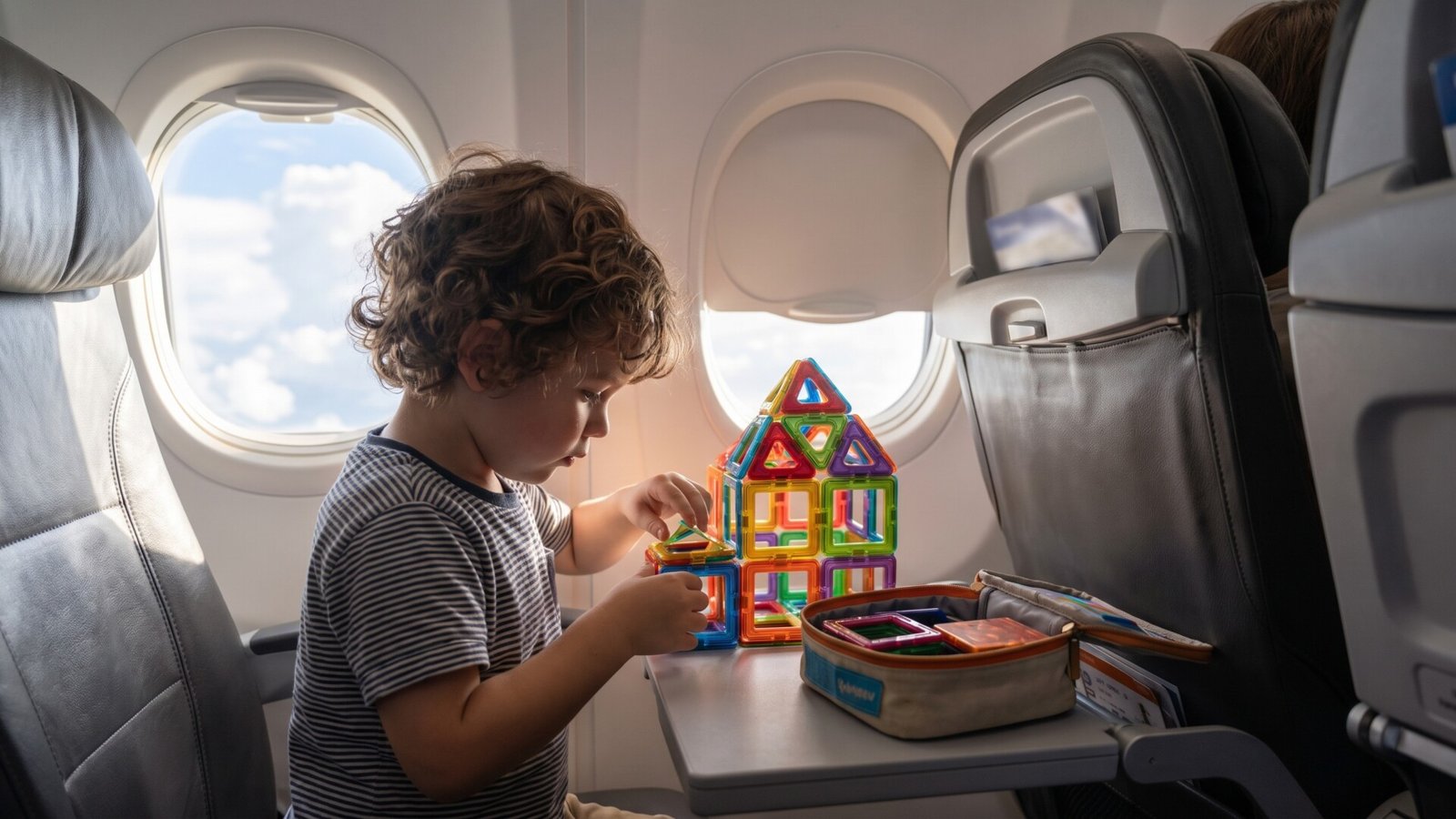
Best Open-Ended Toys for Traveling: Keeping Kids Busy on 5+ Hour Flights
The moment the seatbelt light clicks off, the dreaded question floats through the cabin: “Are we there yet?” You have five more hours. The tablet is fully charged, but you know screen fatigue sets in after the second movie. The crayons will end up on the floor. The sticker book will run out of stickers. What you need are toys that don’t have a fixed endpoint – open‑ended toys that let your child’s imagination take over, no batteries required.
Open‑ended toys are the secret weapon of seasoned travel parents. They have no single “right” way to play, no levels to beat, no instructions to follow. A small bag of magnetic tiles can become a castle, a spaceship, a bridge, or a parking garage – and then something entirely different twenty minutes later. They adapt to cramped tray tables, restless moods, and unpredictable attention spans.
In this guide, I’ll share the best open‑ended toys for flights of five hours or longer. I’ll also cover what makes a toy truly travel‑friendly (quiet, compact, mess‑free), compare top options, and give you a packing strategy that will turn travel days from endurance tests into creative adventures. Because sometimes the key to a peaceful flight isn’t entertainment – it’s giving kids the freedom to create their own.
Why Open‑Ended Toys Work Best for Travel
What “open‑ended play” means – Unlike a puzzle (one solution) or an electronic toy (press button → get reaction), open‑ended toys have no fixed outcome. A set of wooden blocks can be stacked, lined up, sorted by colour, or used as imaginary food. The child decides the rules. This flexibility is gold on a plane where attention spans can shift every twenty minutes.
Why it’s ideal for flights – On a cramped flight, kids get restless, tired, and overstimulated. A rigid activity (a maze book, a colour‑by‑number) can quickly become frustrating. Open‑ended play adapts: if the child is tired, they can simply sort figurines quietly. If they are alert, they can build a complex structure. The toy doesn’t dictate the pace – the child does.
Cognitive and emotional benefits during travel – Open‑ended play reduces anxiety because there’s no “failing.” It encourages independent focus, which is calming in an environment of constant noise and motion. The repetitive action of stacking or sorting can be meditative, helping kids self‑regulate during takeoff, turbulence, or landing.
Comparison to screens – Screens are passive consumption: images and sounds wash over the child. Open‑ended toys are active creation: the child generates the scenario, solves the problem, invents the story. Active play is more tiring in a good way – it leads to deeper satisfaction and less “I’m bored” whining. Plus, zero blue light and no battery anxiety.
What Makes a Toy Travel‑Friendly
Not every open‑ended toy belongs on a plane. Here are the non‑negotiable features.
Compact size – Everything must fit in a carry‑on or small backpack. No oversized playsets. Look for toys that nest, fold, or are naturally small (figurines, magnetic tiles, mini building sets).
No mess factor – Sand, slime, play‑dough, and loose glitter are prohibited. Even small beads or marbles that can roll onto the floor are a disaster at 35,000 feet. Stick to self‑contained or solid pieces.
Quiet play – No electronic sounds, no clicky gears, no squeakers. The toy should be as silent as possible. Whisper‑quiet stacking, drawing, or arranging is fine.
Easy resetability – When the child is interrupted (by meal service, a restroom break, or turbulence), the toy should be quick to restart. A tower of blocks that topples over can be rebuilt; a puzzle that spills is a nightmare.
Durability – It will be dropped, squeezed into seat pockets, and possibly stepped on. Avoid flimsy plastic or paper that tears easily. Magnetic tiles, solid wood, and thick cardboard are ideal.
No small, loose parts that are essential – A few larger pieces are fine (LEGO bricks, magnetic tiles). But hundreds of tiny beads are a choking hazard and a cleanup disaster. Choose toys where pieces are big enough to find in the dark.
Best Types of Open‑Ended Travel Toys
Magnetic building toys – Magna‑Tiles and similar magnetic tiles are the ultimate travel building toy. They stick together with satisfying click, so constructions are stable even during light turbulence. They pack flat and can be used on a tray table. Kids can build in 2D or 3D, making everything from castles to spaceships.
Small figurine sets – A handful of realistic or fantasy animals (Schleich, Safari Ltd.) or people (Playmobil mini sets) turn a tray table into a farm, zoo, jungle, or city. Figurines encourage storytelling and fine motor play. Best of all, they take up almost no space.
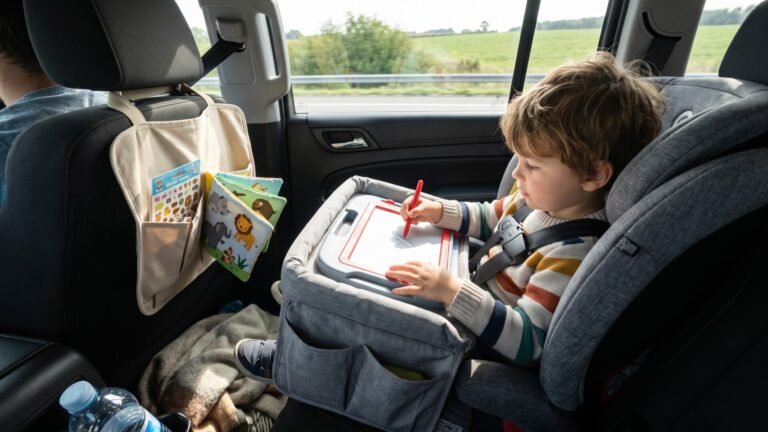
Drawing and creativity kits – The gold standard is water‑reveal books (Water Wow!) where a brush filled with plain water makes colours appear. No ink, no stains, reusable after drying. Also good: small magnetic doodle boards (Etch A Sketch style) or a mini notebook with a few coloured pencils (supervise to avoid sharpener mess).
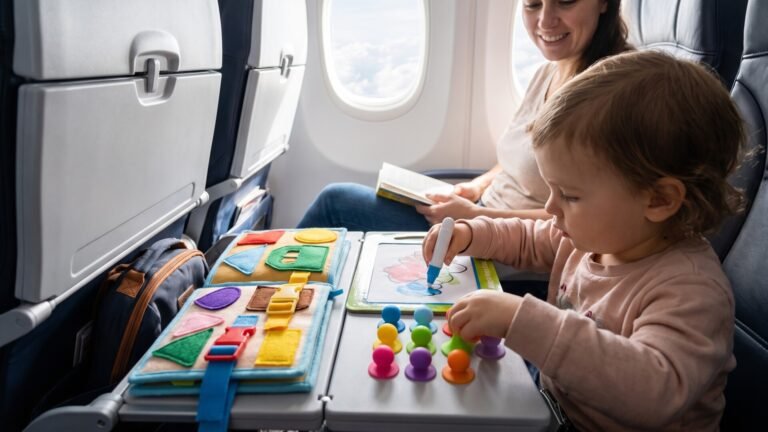
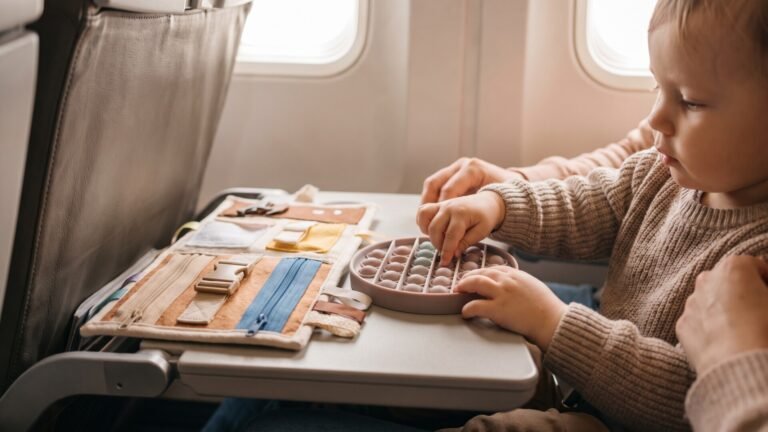
Fidget and sensory toys – For takeoff and landing, when anxiety runs high, small sensory toys help: Dimpl poppers, stretchy noodle fidgets, or a small piece of Theraputty in a sealed bag. These are quiet, calming, and help with ear pressure discomfort.
Mini construction kits – LEGO offers small “Creative Travel” sets in tiny boxes (60–150 pieces). Also good: Plus‑Plus (small interlocking pieces) or Tegu magnetic wooden blocks. These provide the building experience without the bulk.
Section 4: Pros and Cons of Open‑Ended Travel Toys
| Pros | Cons |
|---|---|
| Long engagement time – A good open‑ended toy can be used for hours, reconfigured endlessly. | Parent involvement upfront – You may need to demonstrate possibilities or play alongside at first. |
| Adaptable to moods – Use for calm sorting, energetic building, or imaginative storytelling. | Risk of lost pieces – Small parts can fall under seats; choose sets where you can afford to lose a piece or two. |
| Reduces screen dependency – Kids may actually prefer creating over consuming after the initial transition. | Not every child immediately engages – Some kids need coaching to see the possibilities. |
| Encourages creativity – Builds divergent thinking, problem‑solving, and narrative skills. | Requires smart packing – You need to organise pieces so they don’t scatter. |
| Suitable for multiple ages – Siblings can play together; the same toy works across age groups. | Can be bulky if overpacked – Choose 2–3 small options rather than one large kit. |
Best Open‑Ended Travel Toys for 5+ Hour Flights
Best Overall: LEGO Classic Creative Travel Set
LEGO’s small “Classic Creative Box” (available in 90‑, 150‑, or 250‑piece sizes) is the most versatile open‑ended travel toy. The pieces are small enough to fit on a tray table, yet sturdy. Kids can follow the (very simple) included ideas or invent their own creations. The set comes in a reusable cardboard box that doubles as storage and a baseplate. For flights, I recommend the 90‑piece size – enough variety without overwhelming.
What makes it great for travel: Infinitely rebuildable; quiet clicking; pieces don’t roll away; fits in a quart‑sized ziplock bag. The only downside is the small pieces (watch for children under 3), but for ages 4+, it’s a winner.
Pros: Highest engagement time; encourages engineering thinking; compact.
Cons: Small pieces can be lost; building can be finicky in turbulence.
Age range: 4–10
Price range: $15–$25
Best Magnetic Travel Toy: Magna‑Tiles Travel Set
Magna‑Tiles are the darlings of open‑ended construction. The travel set includes about 15–20 small squares and triangles in a slim plastic case. They click together magnetically, so no loose connections, and they lay flat for easy packing. Children as young as 3 can use them. The translucent colours look beautiful when light catches them.
What makes it great for travel: No wrong way to build; constructions stay together; completely silent. The tiles are solid and won’t break if dropped. They can be used on a lap, tray table, or even stuck to the metal seat frame (a fun discovery).
Pros: Highly engaging spatial play; mess‑free; easy to clean.
Cons: The travel set is more expensive per piece than full sets; can be heavy if you bring too many.
Age range: 3–9
Price range: $30–$45
Best Quiet Creativity Kit: Melissa & Doug Water Wow! Reusable Books
Water Wow! books are pure genius. Each page has a white surface that reveals bright colours when wet. The included brush is filled with plain water – no ink, no stains. As the water dries, the page returns to white, and the book can be reused endlessly. There are themes like “Animals,” “Alphabet,” “Vehicles,” and “Princesses.” The book is about the size of an iPad and contains 4–6 scenes plus a built‑in brush storage.
What makes it great for travel: Zero mess – even if the brush spills, it’s just water. Completely silent. Kids can “colour” again and again. The pages are thick cardboard, very durable.
Pros: Very affordable; perfect for toddlers; no batteries; lightweight.
Cons: Limited to drawing; less creative building; older kids may tire faster.
Age range: 3–7
Price range: $6–10
Best Figurine Set: Schleich Mini Animal Travel Pack
Schleich makes exquisitely detailed, hand‑painted animal figurines. Their “Mini” packs include 5–6 small animals (2–3 inches each) in a reusable plastic carrying case. Choose farm, jungle, safari, or ocean themes. Kids can create habitats, tell stories, line them up, or use them to act out scenes from movies.
What makes it great for travel: Very small footprint; endless storytelling possibilities; durable (solid plastic). The case doubles as a play surface. No assembly required – just open and imagine.
Pros: Strong imaginative play; encourages language development; collectible.
Cons: Some animals are similar size; can be pricey per figure; pieces can roll if not in case.
Age range: 4–10
Price range: $15–$25
Best Sensory Travel Toy: Fat Brain Toys Dimpl Stackables
Dimpl Stackables are a brilliant sensory toy. They are silicone discs with suction cups on one side and a “popper” button on the other. Kids can stack them, line them up, pop the buttons, or stick them to windows, trays, or each other. The set includes 5 pieces in bright colours.
What makes it great for travel: Extremely calming – the popping feedback is satisfying. They are silent enough for a plane. They stick to the window, which is an instant hit. Also, they are very durable and washable.
Pros: Great for anxious kids; fine motor practice; takes up almost no space.
Cons: Limited to popping and stacking; older kids may lose interest after 20 minutes. Best as a rotation item.
Age range: 2–6
Price range: $12–18
Best Travel Open‑Ended Toys
| Toy | Portability | Engagement Time | Mess‑Free | Quiet Play | Creativity Level | Price Range | Best For |
|---|---|---|---|---|---|---|---|
| LEGO Creative Travel Set | High | Very High | Yes | Yes | Very High | $$ | Best overall, builders |
| Magna‑Tiles Travel Set | High | High | Yes | Yes | High | $$–$$$ | Magnetic construction |
| Water Wow! Books | Very High | Medium | Yes | Yes | Medium | $ | Toddlers, mess‑free drawing |
| Schleich Mini Animals | Very High | High | Yes | Yes | Very High | $$ | Storytelling, animal lovers |
| Dimpl Stackables | Very High | Medium | Yes | Yes | Medium | $ | Sensory seeking, young kids |
Packing Strategy for Long Flights
The “Rotation System” – Bring 3–4 small toys and rotate them every 30–60 minutes. When interest wanes, pack it away and bring out a different type. This resets attention.
Divide by activity type – Pack one building toy (LEGO or Magna‑Tiles), one storytelling toy (Schleich animals), one calm creativity toy (Water Wow), and one sensory toy (Dimpl). That covers all moods.
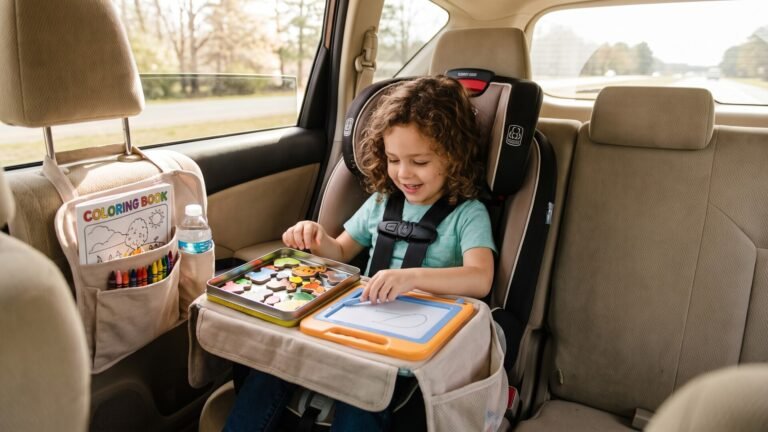
Carry‑on organisation tips – Use small zip pouches (each labelled with a simple icon for non‑readers). Keep the current toy in the seat pocket; others in the backpack. A small “lap tray” (a flat board with raised edges) can contain small pieces.
Avoid overpacking – More toys = more decisions = more mess. Stick to 4–5. The novelty of a “new” toy from the bag every hour works better than dumping everything out at once.
Timing strategy – Use sensory toys (Dimpl, Water Wow) during takeoff and landing when anxiety is higher. Use building toys mid‑flight when child is most alert. Use figurines for quiet storytelling before nap time.
Age‑Based Recommendations
Ages 2–4 – Focus on sensory and mess‑free drawing: Water Wow books, Dimpl Stackables, plus a few large, chunky figurines (not small Schleich). Avoid very small LEGO pieces. Also consider a small magnetic board with large wooden magnets.
Ages 4–6 – Introduce magnetic tiles (Magna‑Tiles travel set) and simple figurines (Schleich or Playmobil 1‑2‑3). Water Wow books still work well. A very small LEGO Classic set (with adult help to pick up pieces) is okay.
Ages 6–9 – LEGO Creative Travel Set becomes the star. Add a small notebook and a few coloured pencils (supervise the sharpener). Magna‑Tiles are still engaging. Figurines may be less interesting; consider a small “create your own story” card set.
Ages 9+ – More complex building: mini K’NEX, Plus‑Plus, or a small geometry set (pattern blocks). Sketchbooks with fine markers (mess‑free, if caps secure). Riddle cards or a small magnetic chess set also work.
FAQ
1. What are open‑ended toys?
Toys without a single correct outcome – building sets, figurines, art supplies, sensory items. They allow for limitless creation and imagination.
2. Why are they better than screen time on flights?
Screens are passive and can cause eye strain, headaches, and overstimulation. Open‑ended toys engage the child’s brain actively, reduce whining, and lead to longer satisfaction.
3. How many toys should I bring on a long flight?
4–5 small options, rotated hourly. Avoid overpacking; ziplock bags are your friend.
4. What if my child loses interest quickly?
Rotate every 20–30 minutes. Also, involve them in “setting up” – have them arrange figurines in a line or sort pieces by colour. Parent engagement for the first few minutes jump‑starts play.
5. Are magnetic toys safe on airplanes?
Yes, standard magnetic toys (Magna‑Tiles, magnets within plastic) are fine. Avoid very strong neodymium magnets which can interfere with electronics – but those aren’t found in children’s travel toys.
6. How do I keep toys from getting lost?
Use a small tray with raised edges (a dollar‑store baking sheet works perfectly). It confines pieces. Also, do a “sweep” before landing.
7. Can these toys be used at airports too?
Absolutely. They are perfect for terminal waiting – quiet, no mess, and easily portable.
8. What is the best single toy for a 10‑hour flight?
For a 4–8 year old, a LEGO Classic 150‑piece set in a small, lidded box. For a 3–5 year old, Magna‑Tiles travel set plus a Water Wow book.
9. Are travel toy kits worth it?
Many brands sell “travel” versions (smaller, packed in cases). They can be more expensive per piece, but the convenience is often worth it – especially for magnetic tiles and LEGO.
10. Where can I buy them through affiliate programs?
Links are embedded in the product sections. Major retailers include Amazon, Target, LEGO Store, and specialty toy shops.
Conclusion
A 5‑hour flight with a child doesn’t have to be an endurance test. The secret is to pack open‑ended toys that let your child build, imagine, and create – not just consume. LEGO bricks, magnetic tiles, water‑reveal books, small figurines, and sensory poppers can transform a cramped seat into a world of possibility. The best part? These toys work just as well in the airport lounge, the hotel room, and the car ride home.
- Best overall pick: LEGO Classic Creative Travel Set – unbeatable flexibility and engagement.
- Best magnetic option: Magna‑Tiles Travel Set – silent, satisfying, space‑smart.
- Best quiet option: Melissa & Doug Water Wow! Books – mess‑free colouring genius.
- Best sensory option: Fat Brain Toys Dimpl Stackables – calming, tactile, tiny.
Remember: you don’t need a suitcase of toys. Four small, thoughtfully chosen open‑ended items, rotated with care, will carry you through the longest flight. The imperfect, wobbly tower built on a tray table at 30,000 feet – that’s not just play. That’s an adventure.
Check current pricing and availability for these travel toys through our recommended partners:
- LEGO Creative Travel Sets on Amazon / LEGO Store
- Magna‑Tiles Travel Set via Amazon / specialty retailers
- Melissa & Doug Water Wow! books on Amazon / Target
- Schleich Mini Animal Packs on Amazon
- Fat Brain Toys Dimpl Stackables on Amazon