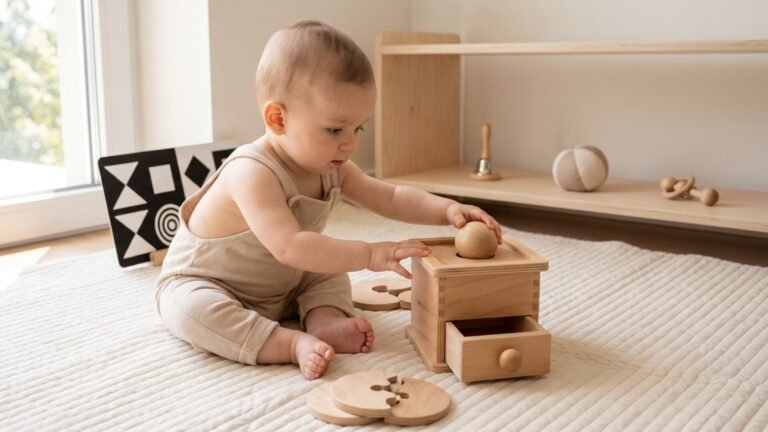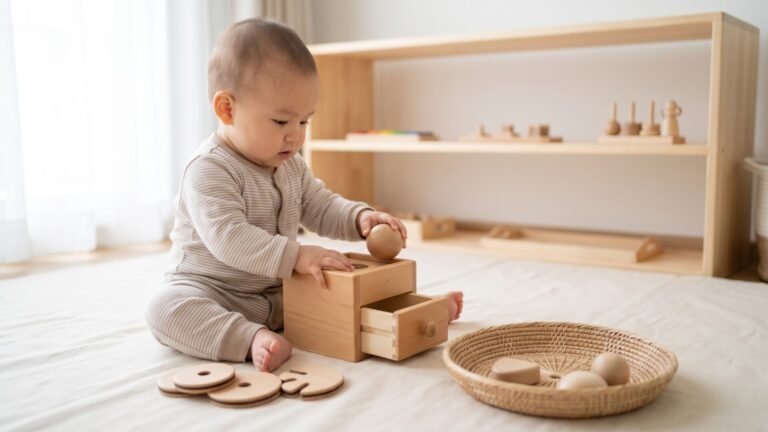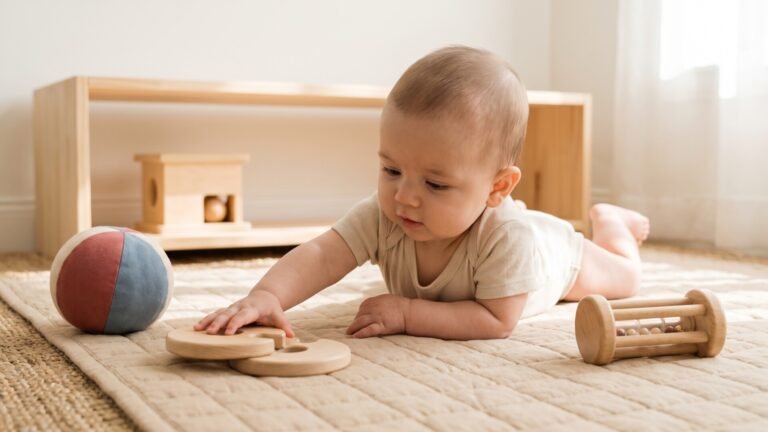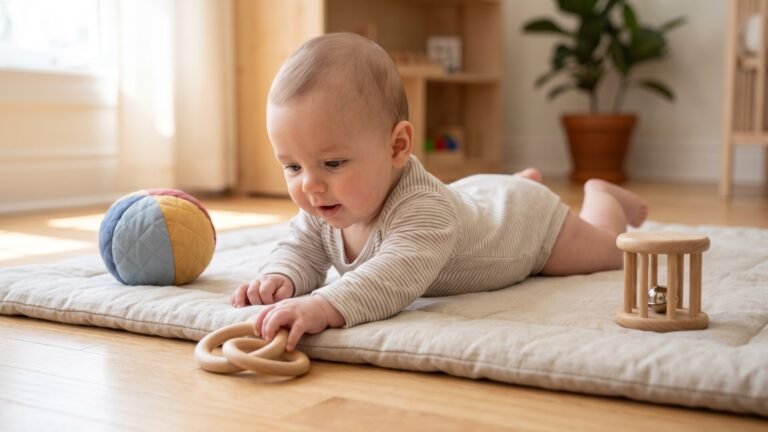
Best Montessori Toys for Newborns (0–3 Months)
The first three months of life bring rapid growth, sensory discovery, and emerging awareness. Newborns may look passive, but they are taking in the world through sight, sound, touch, and movement. For this age, the best Montessori-style toys are simple and calm: a few high-contrast visuals, something soft to feel, a sound the baby can hear without being startled, and safe floor space to practise lifting the head. They invite looking, listening and gentle reaching, without overwhelming the senses.
Unlike flashy baby toys that rely on lights, sounds, or electronics, Montessori newborn toys focus on simplicity, quality, and purposeful design. This guide covers the best types of Montessori toys for newborns, grouped by sense and skill, with age-fit notes, safe-sleep and safety reminders, and honest trade-offs so you can choose a few useful items rather than a pile. Keep in mind that in the first weeks, your face, voice and arms are your baby’s favorite “toys.”
This guide is part of our broader Montessori Toys for Infants (0–12 Months) hub, which covers developmental stages and age-appropriate materials for babies.
Quick answer: for 0–3 months, most families need a high-contrast card set or a simple Montessori-style mobile, a firm play mat with a low unbreakable mirror for supervised tummy time, one lightweight rattle for later in this window, and a soft lovey-free sleep space. Everything else can wait.
Why Montessori-Style Toys Suit Newborns
Maria Montessori believed that even very young children can concentrate when their environment is calm and thoughtfully prepared. For a newborn, that means a quiet, uncluttered space with a few appropriate items. “Montessori” is not a protected label, so judge a product by its design (simple, natural materials, baby-led) and its safety, not by the name. Montessori-style newborn toys aim to:
- Offer gentle sensory exploration through sight, sound and touch
- Give the eyes something clear to look at and follow
- Invite early reaching, batting and grasping as these skills appear
- Avoid overstimulation, so the baby can look away when they have had enough
No toy can speed up development, and babies reach milestones on their own timeline. What a good toy can do is give a baby something interesting to look at and, a little later, something safe to explore. As they grow, the next stage (3–6 months) brings more reaching and grasping.
What Newborns Are Doing at 0–3 Months
Every baby is different, but these areas are commonly in focus in the first three months:
- Looking and tracking: Newborns see best at close range (about the distance to a caregiver’s face during a feed) and are drawn to faces and strong contrast. Tracking a moving object improves over the first months.
- Listening: Babies recognize familiar voices and respond to gentle sounds.
- Touch: Skin contact, texture and temperature all carry information.
- Early movement: Head lifting during tummy time, swiping at objects, and bringing hands to the mouth appear gradually. Intentional reaching and holding usually come toward the end of this window or after it.
- Attention: Short bursts of alert, quiet time between sleeping and feeding.
The CDC’s milestone checklists and your pediatrician are the best guides to what is typical for your baby. If you have concerns about your baby’s vision, hearing or movement, raise them at your next check-up.
Safety First for Newborn Toys
- Keep the sleep space bare. Safe-sleep guidance from the American Academy of Pediatrics recommends a firm, flat sleep surface with no soft objects, toys or loose bedding. Rattles, crochet balls, mirrors and plush toys are for awake, supervised floor play, not for the crib or bassinet.
- Mount mobiles securely and out of reach. A mobile should be firmly attached, high enough that a baby cannot reach it, and removed by about 5 months (or sooner once the baby can push up on hands and knees), because strings and parts can become entangled or fall.
- No small parts, strings or cords that a baby could swallow or wrap around fingers or neck.
- Check materials. Look for non-toxic finishes, sealed wood, and food-grade silicone for anything that may go in the mouth.
- Supervise tummy time, and never let a baby fall asleep on a play mat or on their tummy.
- Wash new fabric and wooden items as the manufacturer instructs before first use.
For official guidance on infant products and safe sleep, see the US Consumer Product Safety Commission and the AAP. Always follow the manufacturer’s age grade and instructions.
Montessori Toys for Visual Development
Newborn vision is still developing. Babies see best up close and are especially drawn to high-contrast patterns, bold shapes and faces. Color vision develops over the first few months, which is why Montessori practice moves from black-and-white to soft color over time.
The Montessori Visual Mobiles
Montessori practice uses a sequence of visual mobiles, each introduced at roughly a different stage in the first months. The first is usually the Munari mobile, a black-and-white design by the Italian artist Bruno Munari, used for the first weeks. Later come the Octahedron mobile (shiny, color-shifting), the Gobbi mobile (graded shades of one color), and mobiles with dancing figures. Of these, the Munari and similar high-contrast designs are the ones that fit the 0–3 month window.
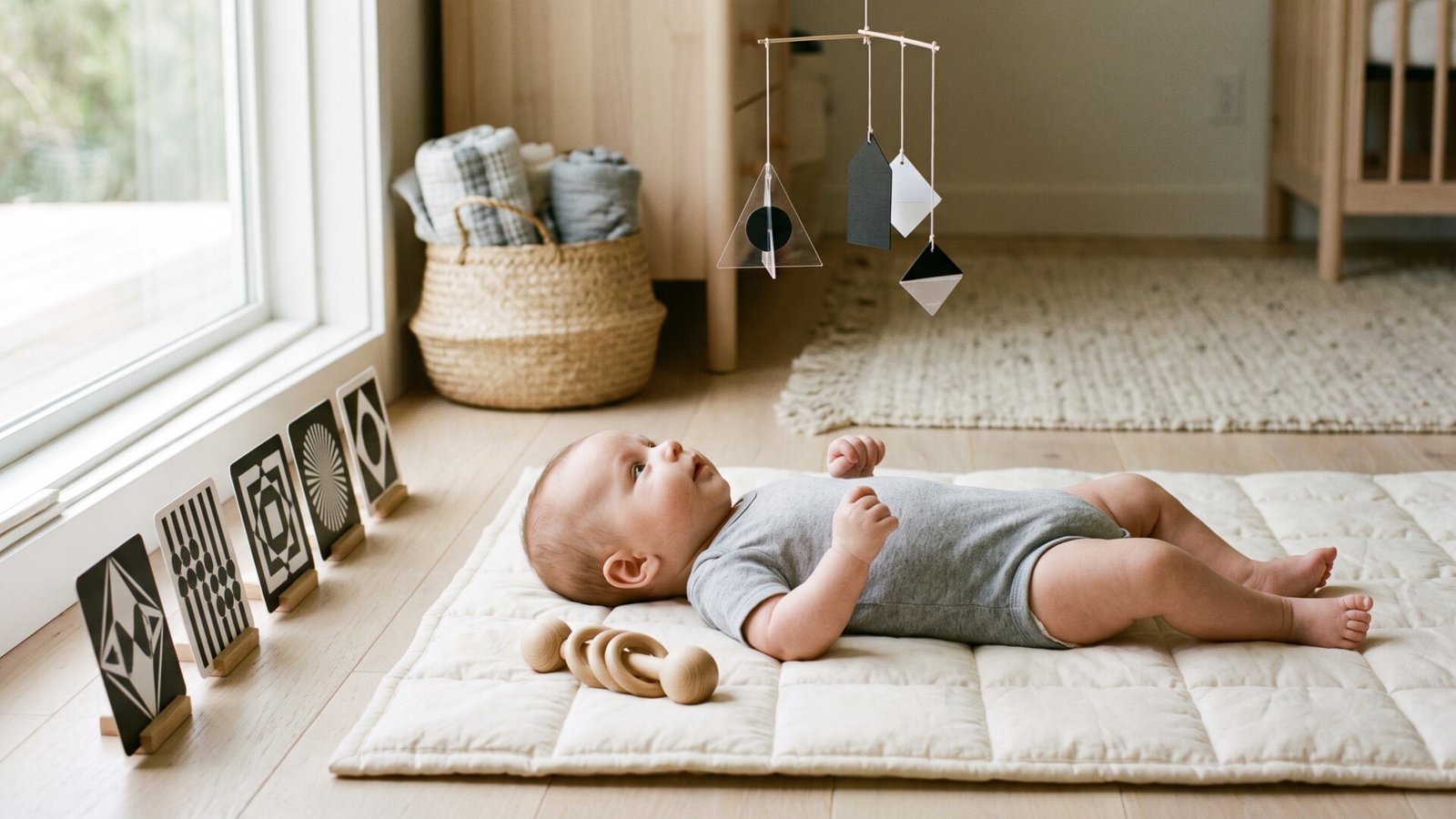
What they encourage: looking, early visual tracking, and calm attention. Placement: hang the mobile above a play mat or changing area where the baby can see it while awake and lying on their back, ideally within a comfortable viewing distance and well out of reach. Trade-offs: authentic Munari-style mobiles are hand-made and can be pricey, while simple DIY or cardboard versions are inexpensive and work just as well for a few months. They are useful only until about 5 months, so treat them as a short-term purchase.
Visual Cards and Patterns
Black-and-white cards or books give a baby something clear to look at during awake time. Lean one against a firm surface at the baby’s eye level, or hold a card about 8–12 inches from the baby’s face during tummy time or while they are on their back. Keep sessions short and stop when the baby looks away.
- High-contrast card sets or board books – inexpensive, easy to rotate, and useful for several months.
- Simple geometric tiles – wooden or board tiles with bold shapes, for supervised looking time only.
Montessori Toys for Auditory Development
Newborns respond to sound from the start. The most valuable “audio toy” is a caregiver’s voice: talking, singing and naming what you are doing.
Rattles and Bells
In the first weeks, a baby cannot hold a rattle on purpose, so a rattle is mainly something you shake gently to the side to draw attention. By around 3 months, many babies begin to grasp lightweight items and bring them to the mouth.
- Natural wooden rattles – lightweight with a smooth finish. Choose one too big to fit in the mouth.
- Fabric or crochet rattles – soft and quiet; check seams and avoid loose parts.
- Sound cylinders – these are more useful from around 4–6 months, once a baby can shake them.
Music and Tone Exploration
Gentle, caregiver-led music suits newborns best. Options include:
- Singing lullabies yourself
- A hand-crank music box used at a low volume
- Soft baby chimes played by an adult
Montessori practice generally prefers live or baby-controlled sound over battery toys that play on a loop, which cannot be switched off by the baby. Keep volume low, and avoid holding sound-making toys close to a baby’s ear.
Montessori Toys for Tactile and Sensory Exploration
Touch is a key sense from birth. In the first three months, much of a baby’s tactile learning comes from being held, bathed and massaged. Toys come later in this window, as hands open and mouthing begins.
Textured Balls and Fabric Toys
- Crochet sensory balls – soft and textured; best from around 3 months when a baby starts to grasp. Inspect seams.
- Fabric sensory squares – different materials in one piece for supervised touching.
- Silicone teething rings – teething itself usually starts later, but babies often enjoy mouthing textured rings from around 3 months.
Sensory Baskets: Wait a Little
A Montessori “treasure basket” of everyday objects (wooden spoons, fabric swatches, natural sponges) is traditionally offered when a baby can sit with support, around 5–6 months, since it relies on reaching and choosing. For a newborn, it is better to offer one safe item at a time, held or placed within view. When your baby is ready, see our guides for 3–6 months and 6–9 months, which cover sensory baskets in more detail.
Montessori Toys for Early Motor Skills
At 0–3 months, babies are just beginning to lift their heads, bring hands together, and swipe at objects. Floor time on a firm surface gives them room to practise.
Tummy Time Accessories
Pediatric guidance recommends tummy time for babies who are awake and supervised, starting in the early days with short sessions several times a day and building up as the baby gets stronger. A few simple accessories can make it more appealing:
- A low, unbreakable baby mirror – gives a baby something interesting to look at. (Babies do not recognise themselves in a mirror until much later, usually in the second year; at this age it is simply an interesting face.)
- A firm play mat – a defined, comfortable space. Avoid very soft or cushiony surfaces.
- A rolled towel under the chest for babies who find tummy time hard (ask your pediatrician if unsure).
Grasping and Hand Coordination
Newborns have a grasp reflex, and deliberate holding develops gradually over the first months. Even so, simple graspable objects give hands something to explore as soon as babies are ready. Good first options are:
- Wooden or silicone grasping rings (large, smooth, one-piece)
- Soft crochet balls
- Lightweight rattles
Offer them during supervised floor time, and let the baby decide how long to hold them.
Early Cognitive Development: Simple Cause and Effect
Even in the first three months, babies start to notice that their actions can have effects, such as a kick that moves a hanging object, or a smile that brings a smile back. Simple pairings help:
- Showing a black-and-white card while talking about it
- Gently shaking a rattle to one side so the baby turns toward the sound
- Responding to coos and smiles with your own sounds
These everyday interactions matter more than any particular product, and they cost nothing.
Quick Comparison: What to Buy for 0–3 Months
| Item | Best from | What it encourages | Useful until | Watch out for |
|---|---|---|---|---|
| High-contrast cards or board book | Birth | Looking, focus | About 4–6 months | Keep sessions short |
| Munari-style mobile | First weeks | Looking, tracking | About 5 months (remove earlier if baby pushes up) | Mount securely, out of reach |
| Floor play mat | Birth | Tummy time, rolling space | Years | Choose a firm surface |
| Unbreakable baby mirror | Birth, awake only | Head lifting, looking | About 12 months | Supervision; not in sleep space |
| Lightweight rattle | About 2–3 months | Listening, early grasping | Often 12+ months | Size and sealed construction |
| Crochet or silicone ring | About 3 months | Grasping, mouthing | Often 12+ months | Seams, loose threads |
“Best from” and “useful until” are general guides based on typical development and common product age ranges. Always check the manufacturer’s age grade.
Organizing a Montessori Play Area for Newborns
A Montessori-inspired play space for 0–3 months should be safe, minimal and easy to reach:
- A firm mat or blanket on a clean floor for awake floor time
- Two or three items at a time, for example a card set, a mirror and a rattle
- Rotating items every week or two so they stay interesting
- A basket or low shelf nearby for later, when the baby can see and choose
Our guide to a minimalist Montessori play shelf shows how to scale this up as your baby grows.
Montessori Toys vs Traditional Newborn Toys
| Montessori-style | Many conventional toys | |
|---|---|---|
| Design | Calm, simple, purposeful | Often bright and busy |
| Sound | Quiet, caregiver-led or baby-made | Often electronic music or lights |
| Materials | Natural fabrics, wood, silicone | Often plastic |
| Newborn fit | Fewer items, more interaction with adults | Can overload a baby’s senses |
| Trade-off | Handmade items can be costly | Cheaper and easier to find |
You do not have to choose one or the other. Many families use a few calm Montessori-style items alongside gifts they have already received.
Tips for Choosing Montessori Toys for Newborns
- Look for high-contrast visuals and simple shapes for the first weeks
- Choose lightweight, one-piece grasping toys for when your baby’s hands open
- Avoid small parts, strings and cords, and anything heavy that could fall on a baby
- Prefer items that will still be useful at 6 months, not just 6 weeks
- Do not buy everything at once; babies change fast, and a few well-chosen items go a long way
Montessori-Style Gift Ideas for a Newborn
Gifts for newborns are best when they stay useful for months:
- A high-contrast card set or board book
- A Munari-style or other simple visual mobile (with a reminder about safe mounting and removal)
- A firm play mat and low mirror for tummy time
- A wooden or silicone grasping ring for later in the window
- Practical gifts for parents; a meal or an hour of help is often more welcome than another toy
Frequently Asked Questions
Frequently Asked Questions About Montessori Toys For Newborns
What are the best Montessori toys for a newborn?
Simple, calm items: high-contrast cards or a Munari-style mobile for looking, a firm play mat and low unbreakable mirror for supervised tummy time, and later a lightweight rattle or grasping ring once your baby can hold things.
Can newborns see black and white?
Newborns see best at close range and are drawn to high-contrast patterns and faces. Color vision develops over the first few months, so soft colors become more interesting as babies grow.
Is it safe to put a mobile over the crib?
A mobile should be firmly attached and out of reach, and removed by about 5 months, or sooner once a baby can push up on hands and knees. Many families hang it over a play mat instead. Keep the sleep space free of toys and soft objects, as recommended in safe-sleep guidance.
When can a baby hold a rattle?
Newborns have a grasp reflex, but holding a toy on purpose usually develops around 3 months or later. Before then, a rattle is something an adult shakes gently to one side for the baby to hear.
Do newborns need toys at all?
Not many. In the first weeks, faces, voices, holding and talking matter most. A few high-contrast visuals and floor space for tummy time are enough.
How long should tummy time last?
Start with short sessions a few times a day while your baby is awake and supervised, and build up as your baby gets stronger. Your pediatrician can advise on timing for your baby.
Final Thoughts
Even in the first three months, babies are active learners, but the best thing you can give a newborn is your attention. A few calm, safe, well-chosen items, such as high-contrast visuals, a mirror and mat for tummy time, and a rattle or ring for later, give your baby something to look at and explore without overwhelming them. You do not need to buy everything, and you can add more as your baby grows.
Keep Exploring
Moving on? See the next stages: 3–6 months, 6–9 months and 9–12 months. For the full first-year overview, see our guide to Best Montessori Toys for Infants (0–12 Months) and the Montessori Toys for Infants hub.
If you are planning a complete Montessori environment that grows from infancy to preschool, our Montessori Toys & Activities for Kids guide and the Montessori & Early Learning Toys hub cover every age.