Best Toys for Children With Specific Needs
The best toy for a child with specific needs is almost never the one with the most features. It is the one the child can pick up, understand, and choose to use without an adult standing over them narrating the experience.
That sounds obvious. It is not, because “specific needs” is not one thing. It covers a child who covers their ears when a toy beeps, a child who cannot grip a small peg, a child who needs to see exactly how a thing works before they will touch it, a child who will happily listen to the same story eleven times and has no interest in the toy that goes with it. Those children need different toys. Often they need the opposite toy.
So this is not organized by diagnosis. It is organized by practical fit: what the child can access, what their senses will tolerate, how they prefer to interact, and what kind of play they already choose when nobody is directing them. Toys can support practice, communication, exploration, and enjoyment. They are not treatments, and nothing here is a substitute for the guidance of your child’s care team.
How to Match a Toy to a Child’s Actual Needs
Start with five questions, in this order. Access: can the child physically operate it, or does it require a hand, a reach, or a force they do not have today? Sensory load: does the sound, light, texture, or unpredictability invite play or shut it down? Interaction style: does the child prefer to build, sort, repeat, listen, move, or narrate? Skill demand: how much frustration sits between the child and the payoff? Play setting: table, floor, car seat, lap, or a quiet corner with the door shut?
Most buyers skip straight to the last question and buy for the setting, which is why so many toys end up in a bin by February.
The distinction that matters most is between a toy that is theoretically educational and a toy the child can actually operate. A toy that requires you to sit beside it and keep it going is not a play activity. It is a job you have taken on, and it will be abandoned the first week you are tired. That is not a failure of the child. It is a mismatch.
Before you buy anything, watch what already happens in your house. What does the child return to without being prompted? What do they avoid, and is it the noise, the texture, the difficulty, or just that it is not interesting? What do they repeat, and what do they abandon after ninety seconds? Ten minutes of observation is worth more than any product page.
Age labels are safety guidance, not developmental prediction. A toy rated for ages three and up is telling you about small parts and choking risk, not about whether your four-year-old will find it engaging or your seven-year-old will find it babyish. Check the manufacturer’s age range for safety, and check the child’s ability to use the thing safely and happily for fit. Those are two separate checks and both need doing.
Key Buying Factors and Safety Checks
Access and adjustability. Large controls, easy-grip pieces, stable bases that do not slide when pushed, high-contrast or tactile elements, and adjustable volume or speed all widen who can use a toy. Switch compatibility, where a toy offers it, can be the difference between a toy a child operates and a toy they watch. If a toy has one fixed volume and one fixed speed, it has one user in mind, and it may not be yours.
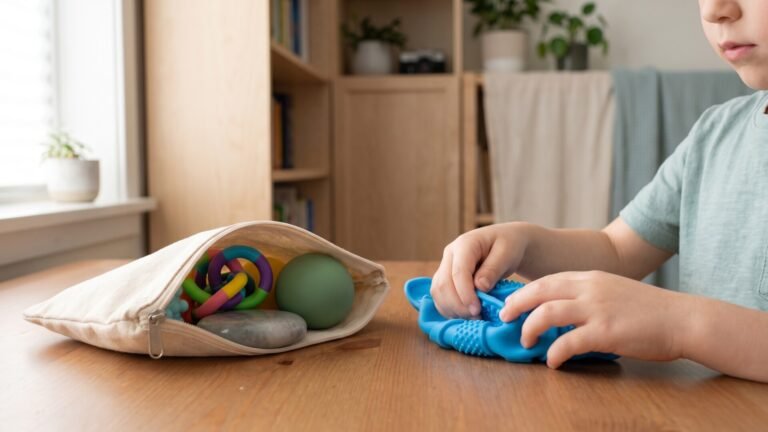
Sensory profile. Sound, light, texture, movement, clutter, and unpredictability are the five things that decide whether a toy is usable. A toy with eight modes is not eight times as engaging. It is eight chances to land on the wrong one, and the child has to cycle through the flashing ones to get back. Predictability is a feature, not a limitation, for a lot of children. So is silence.
Safety. Choking hazards, button batteries, cords, magnets, small detachable parts, and volume levels all matter, and they matter more when a child mouths objects, has reduced sensation, or plays without close supervision. Weighted items and water play carry their own considerations. Magnets in particular need inspecting: if a magnet comes loose from a toy, that is a medical emergency, not a lost piece. Read the manufacturer’s safety instructions for every product, and where a toy involves unusual physical or sensory demands, run it past your child’s care team first. This article cannot tell you what is safe for your specific child, and it will not pretend to.
Ownership burden. How does it clean? How many pieces will be lost, and does a missing piece break the toy or just reduce it? How many batteries, how often, and does the battery compartment need a screwdriver? How long is setup, and does it have to be redone every time? Where does it live when it is not being used? A toy that is wonderful for twenty minutes and then lives on the kitchen counter for a year is a worse purchase than a boring one that fits in a drawer.
Recommended Toys for Different Access and Play Profiles
These are tools, not solutions. None of them suits every child, and several of them will be wrong for yours. The point is to give you a shortlist you can match against the five questions above rather than a shelf of things to guess at.
| Toy | Approximate Price | Best Fit | Main Strength | Main Limitation |
|---|---|---|---|---|
| Fat Brain Toys Dimpl | $15-$25 | Cause-and-effect and tactile exploration | Simple, repeatable interaction | Limited open-ended play |
| Learning Resources Spike the Fine Motor Hedgehog | $15-$25 | Fine motor practice | Clear grasp-and-place activity | Small pieces require supervision |
| Melissa & Doug Pattern Blocks and Boards | $15-$25 | Visual matching and construction | Quiet, structured play | Pieces may be difficult for some grips |
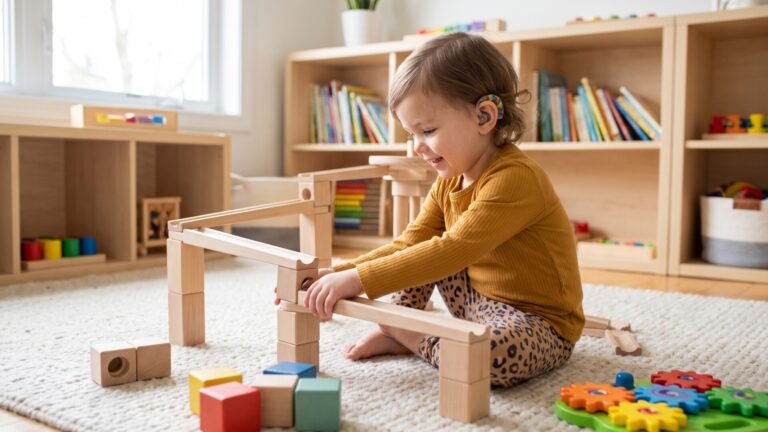
| Magna-Tiles Clear Colors 32-Piece Set | $40-$60 | Accessible building and spatial play | Large magnetic pieces and open-ended use | Premium price and strong magnets require care |
| LEGO DUPLO Classic Brick Box | $25-$40 | Large-piece building and pretend play | Expandable, familiar system | Building may still require hand strength |
| Yoto Mini Player | $50-$70 | Independent audio play | Screen-free and repeatable | Requires cards, charging, and setup |
| Bilibo | $25-$35 | Open-ended movement and imaginative play | Child-led, non-prescriptive use | Needs floor space and supervision |
Fat Brain Toys Dimpl
| Feature | Details |
|---|---|
| Age Range | Check the current manufacturer listing; commonly marketed for young children |
| Key Features | Permanently attached silicone bubbles, tactile cause-and-effect play, compact design |
| Price (approx) | $15-$25 |
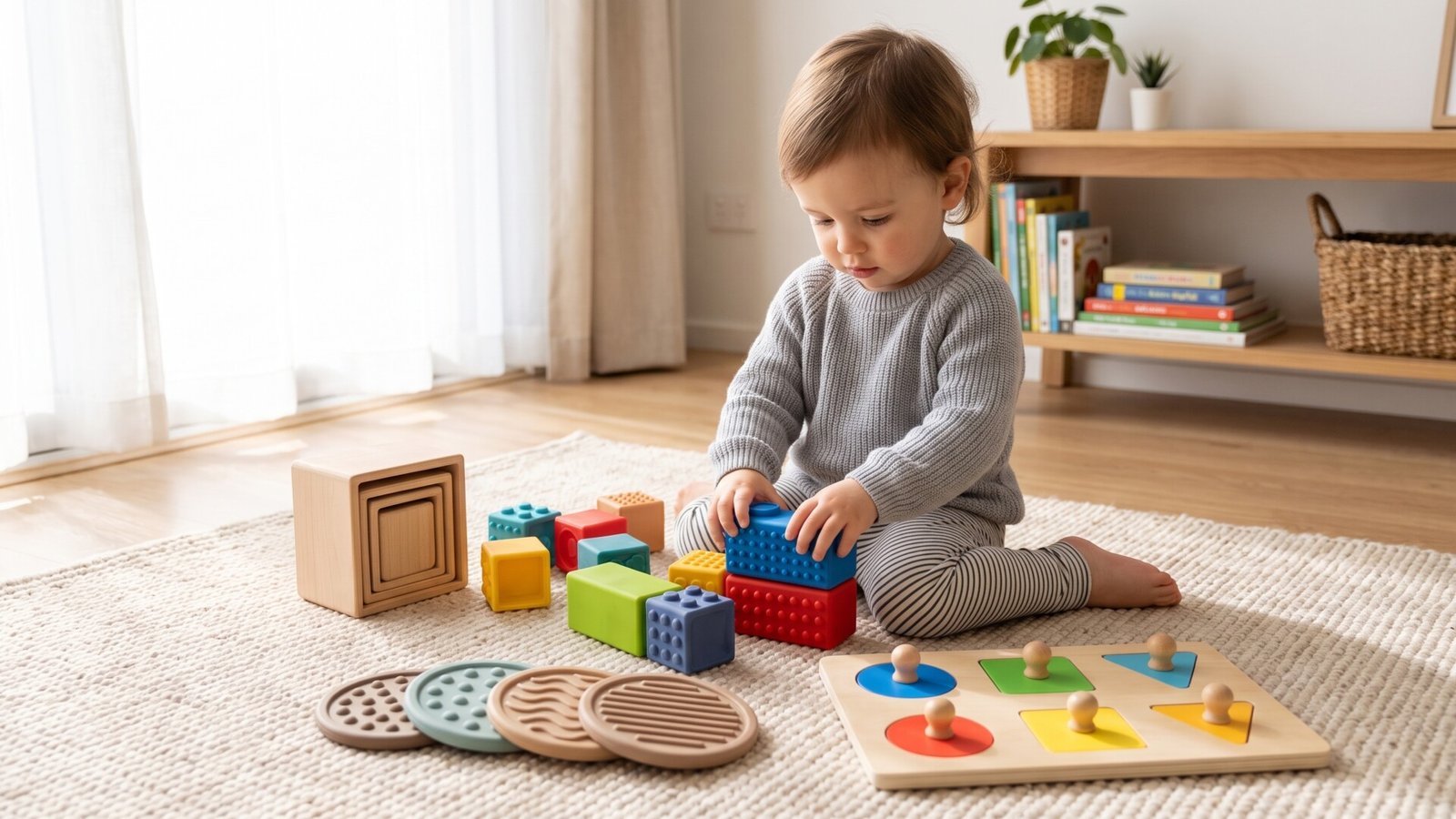
The Verdict: A strong low-complexity option for children who enjoy repetitive push-and-pop actions or need a toy with a clear beginning and end. It is more useful as a calming or transition-friendly object than as a complete developmental play system.
Best For: Tactile exploration, waiting rooms, travel, and children who prefer predictable repetition.
Pros
- Pieces stay attached to the frame.
- Simple interaction requires little setup.
- Compact and easy to carry.
Cons
- Limited variety after the novelty wears off.
- Not ideal for children who dislike silicone textures.
- Adult supervision is still needed for younger children.
Learning Resources Spike the Fine Motor Hedgehog
| Feature | Details |
|---|---|
| Age Range | Check the current manufacturer listing |
| Key Features | Removable peg quills, grasp-and-place activity, color matching |
| Price (approx) | $15-$25 |
The Verdict: A useful structured option when a child enjoys placing objects but needs a manageable activity rather than a complex construction set. The removable pieces create a choking concern for younger children, so the age rating and supervision guidance matter.
Best For: Children practicing grasping, matching, and short tabletop activities.
Pros
- Clear, repeatable play pattern.
- Easy to adapt by offering fewer pieces.
- Usually affordable.
Cons
- Small parts are unsuitable for some children.
- May become repetitive quickly.
- Requires a stable play surface.
Melissa & Doug Pattern Blocks and Boards
| Feature | Details |
|---|---|
| Age Range | Commonly preschool and older; verify the current listing |
| Key Features | Wooden pattern pieces, guided designs, matching and visual-spatial play |
| Price (approx) | $15-$25 |
The Verdict: A good fit for children who like visual order and completion-based activities. Parents can begin with one simple board or use the pieces for open-ended designs, although children with limited grip strength may need larger or lighter alternatives.
Best For: Quiet visual matching, early construction, and structured independent play.
Pros
- Offers both guided and open-ended use.
- No batteries or electronic stimulation.
- Easy to store.
Cons
- Wooden pieces can be difficult for some hands.
- Designs may feel restrictive to children who prefer imaginative play.
- Pieces can be misplaced.
Magna-Tiles Clear Colors 32-Piece Set
| Feature | Details |
|---|---|
| Age Range | Check the manufacturer’s current age and safety guidance |
| Key Features | Large magnetic construction tiles, translucent panels, open-ended building |
| Price (approx) | $40-$60 |
The Verdict: Magna-Tiles are one of the stronger choices for mixed-age households because the pieces are large, visually clear, and useful without requiring precise connection techniques. They are not automatically accessible for every child: some children may need help stabilizing structures or separating pieces.
Best For: Open-ended building, collaborative play, and children who benefit from larger construction pieces.
Pros
- Broad replay value.
- Easy to combine with other compatible magnetic tiles.
- Supports building at different complexity levels.
Cons
- Higher initial cost.
- Structures can collapse unexpectedly.
- Magnets require careful inspection and age-appropriate supervision.
LEGO DUPLO Classic Brick Box
| Feature | Details |
|---|---|
| Age Range | Commonly designed for toddlers and preschoolers; verify the current listing |
| Key Features | Large building bricks, simple figures, storage box, open-ended construction |
| Price (approx) | $25-$40 |
The Verdict: DUPLO is often a better long-term purchase than a narrowly targeted “special needs” toy because it can shift from stacking to vehicles, pretend play, and collaborative building as interests change. It still demands pushing, pulling, and hand coordination, so offer partially built models or larger pieces when needed.
Best For: Children who enjoy building, vehicles, figures, and repeatable pretend-play scenarios.
Pros
- Strong ecosystem and replacement potential.
- Large pieces are easier to handle than standard LEGO bricks.
- Grows with the child’s interests.
Cons
- Some children may still find the pieces hard to connect.
- Sets can become expensive as collections grow.
- Pieces require sorting and storage.
Yoto Mini Player
| Feature | Details |
|---|---|
| Age Range | Check the current manufacturer’s age guidance |
| Key Features | Screen-free audio player, physical audio cards, child-controlled listening |
| Price (approx) | $50-$70 before cards or bundles |
The Verdict: This can work well for children who prefer stories, music, or predictable audio routines and do not enjoy visually busy toys. It is not a universally low-stimulation product: volume, content, and listening length should be managed according to the child’s preferences and household rules.
Best For: Independent listening, travel, bedtime routines, and children who engage strongly with audio.
Pros
- Physical cards make content selection concrete.
- Can support repeated listening without a screen.
- Useful beyond the preschool years.
Cons
- The player and cards create ongoing costs.
- Requires charging and adult setup.
- Audio may be unwelcome for children sensitive to sound.
Bilibo
| Feature | Details |
|---|---|
| Age Range | Check the current manufacturer’s guidance |
| Key Features | Lightweight open-ended seat or container, movement and imaginative play |
| Price (approx) | $25-$35 |
The Verdict: Bilibo is deliberately open-ended, which makes it valuable for children who dislike toys with one correct use. It needs more interpretation and supervision than a tabletop toy, and it may not suit every child’s balance, movement, or sensory profile.
Best For: Imaginative movement, floor play, and children who invent their own uses for objects.
Pros
- Encourages child-led play.
- Durable and easy to wipe clean.
- Can support many play scenarios.
Cons
- Requires clear floor space.
- Movement play needs supervision.
- Not a good fit for every balance or mobility profile.
Skip This If: Overly Complex Electronic Toys
The toy with the most buttons is not the most engaging toy. It is the toy with the most ways to be wrong. A flashing, talking, multi-mode electronic toy usually has one volume setting that is either too quiet or too loud, a mode selector a child has to cycle through to get back to the one they wanted, and a battery compartment that needs a screwdriver every few weeks.
None of that is automatically disqualifying. Some children love a loud toy with a lot of feedback, and for them it is the right purchase. Skip it when the controls cannot be adjusted, the volume cannot be capped, the stimulation cannot be reduced, or the toy cannot be operated without an adult resetting it every two minutes. A simpler toy that the child can run themselves beats a complex one that runs them.
Comparison Table: Which Toy Fits Which Child?
| Toy | Best For | Sensory Load | Independent Use | Long-Term Value |
|---|---|---|---|---|
| Fat Brain Toys Dimpl | Repetitive tactile play | Low to moderate | High | Moderate |
| Spike the Fine Motor Hedgehog | Structured grasp-and-place play | Low | Moderate | Moderate |
| Pattern Blocks and Boards | Visual matching | Low | Moderate | Moderate |
| Magna-Tiles | Open-ended construction | Low to moderate | Moderate | High |
| LEGO DUPLO | Building and pretend play | Low | Moderate | High |
| Yoto Mini Player | Audio-based independent play | Adjustable, depending on content | High after setup | Moderate to high |
| Bilibo | Imaginative movement | Variable | Low to moderate | High for the right child |
Two columns in that table need a warning attached. Independent use depends on the child, not the product: a toy listed as high independence is high independence for a child who can already operate it, and no toy is independent on day one. Sensory load is not fixed either. The same toy is louder in a tiled kitchen than on a rug, busier in a room with the television on, and more tolerable when an adult presents one piece at a time instead of tipping out the box.
What Most Buyers Get Wrong About Specific-Needs Toys
The first mistake is assuming a toy needs a label. Plenty of toys marketed as adaptive or therapeutic are ordinary toys with a different box and a higher price. A toy with large parts, simple controls, adjustable output, or genuinely open-ended play is useful whether or not anyone thought to put the word “sensory” on it. Judge the object, not the category.
The second is matching diagnosis to toy. Two children with the same diagnosis can have opposite reactions to the same texture, the same sound, the same amount of challenge. What predicts fit is observable: what this child reaches for, what they tolerate, what they can do today. Diagnosis is a starting point for a conversation with your child’s care team, not a shopping filter.
The third is the feature-count trap. Extra sounds, lights, and modes read as extra value on a product page. In a living room they read as extra setup, extra noise, extra batteries, and one more thing to troubleshoot. More features frequently means a shorter useful life, because the toy is harder to operate and easier to abandon.
The fourth is buying for a skill the child does not have yet. It is easy to buy the toy for the child you are hoping they will be in eight months. It is more useful to buy the toy they can initiate and enjoy this week, because a toy they can use is a toy they will practice with, and practice is what moves anything forward.
ToyGuideHub Real-World Ownership Verdict
This section rates each recommendation on six things that decide whether a toy survives the year: access, replayability, parent setup, storage, durability, and usefulness after the novelty period. Each is scored 1 to 5 on a consistent editorial scale, where 5 means the toy holds up and 1 means it is a problem you now own. These are editorial judgments based on how these categories of toy behave in households, not laboratory results.
The counterintuitive finding is that the most useful purchase in this list is usually not the specialist product. It is the flexible mainstream one. LEGO DUPLO and Magna-Tiles score highest on long-term value not because they are marketed to any particular need but because they are open-ended, expandable, and indifferent to how a child uses them. A child who cannot build a tower can still sort bricks, load them into a truck, or hand them to a sibling. The toy does not have one correct use to fail at.
Compare the ownership patterns. Compact tactile toys like Dimpl score high on access and storage and low on replayability: easy to carry, easy to put away, and out of new ideas by the third month. That is not a reason to avoid them. It is a reason to buy them at $20 rather than expecting them to carry a birthday.
Building systems cost more upfront and take up more space, but they spread across ages and play styles and hold resale value because the pieces remain compatible with everything else in the system. Audio players sit in the middle: genuinely high independence once set up, but they carry recurring costs in cards and charging, and they are only as good as the child’s interest in audio.
The pattern underneath all of it is that the best long-term value comes from a toy the child can access with decreasing adult help. Not the cheapest toy, and not the one with the longest feature list. The one where you can step back a little further each month.
So buy one highly accessible, low-friction toy first. Watch how it gets used, and for how long, and what the child does with it when they think nobody is watching. Then expand around what you actually saw. Buying a complete category-specific collection before that observation is how a playroom fills up with things nobody touches.
How to Choose the Right Option
Best for low-stimulation play
Fat Brain Toys Dimpl or Melissa & Doug Pattern Blocks and Boards give you simple, predictable interaction with no electronic lights or sound. Both are quiet, both have a clear beginning and end, and both can be presented one piece at a time to reduce clutter. Tactile preferences vary enormously, though, so check the material and texture before you buy, and check whether the child actually likes the feel of silicone or wood.
Best for fine motor challenges
LEGO DUPLO is the better long-term choice when the child can manage pushing pieces together, because the pieces are large and the system grows with them. Spike the Fine Motor Hedgehog suits shorter, more structured sessions when small removable pieces are safe and appropriate for your child. Start with fewer pieces than the box contains; a full set on the table is a mess, and a handful is an activity.
Best for limited mobility or reduced reach
Prioritize toys that work on a stable surface with large pieces, minimal force, and no requirement to stand or move quickly. Magna-Tiles can work well when placed within reach on a tray or table, but no toy is universally suitable for mobility needs, and the right answer depends on the child’s specific positioning and reach. This is the category where an occupational therapist’s input is worth more than any buying guide, including this one.
Best for visual or hearing differences
Toys for visual differences often benefit from strong tactile contrast, sound, or large shapes. Toys for hearing differences often benefit from visual feedback, physical manipulation, or clear cause-and-effect. Neither is a single-product answer, and the detail belongs in the dedicated articles rather than here: Toys for Children With Visual Impairments and Toys for Children With Hearing Impairments cover the specifics properly.
Best for children who prefer solitary play
The Yoto Mini Player works well for children who enjoy audio, and LEGO DUPLO or Pattern Blocks suit children who prefer quiet, repeatable construction or matching. Solitary play is a legitimate preference, not a problem to be corrected, and the toys that support it are usually the ones that do not demand a partner. There is more on this in Toys for Children Who Prefer Solitary Play.
Best budget choice
Fat Brain Toys Dimpl or Spike the Fine Motor Hedgehog, depending on whether tactile repetition or structured manipulation is the better fit. Both land in the $15-$25 range, which is the right amount to spend on finding out whether a category works before committing to it.
Best premium choice
Magna-Tiles offer the strongest combination of expandability, shared play, and long-term reuse, which is what justifies the price. The magnet safety considerations are real and should be taken seriously, particularly in households with younger siblings who mouth objects. If you want more options at this end of the market, [Internal: See our building toys collection].
The Verdict
Best Overall: LEGO DUPLO Classic Brick Box, for flexible, expandable play that survives changing interests. Best for Open-Ended Building: Magna-Tiles Clear Colors 32-Piece Set, if the budget and the household allow for magnets. Best Budget Tactile Pick: Fat Brain Toys Dimpl. Best for Structured Fine Motor Play: Learning Resources Spike the Fine Motor Hedgehog, when small pieces are safe for your child. Best for Audio-Based Independent Play: Yoto Mini Player, for children who enjoy sound and can use it safely. Best for Low-Stimulation Tabletop Play: Melissa & Doug Pattern Blocks and Boards.
Fit matters more than labels, price, or feature count. A $20 toy the child operates independently beats a $70 toy that needs you to run it, every time. Before you buy anything, verify the current age guidance, safety information, battery and magnet warnings, and whether the toy is genuinely accessible for your child. For a wider look at categories that overlap with this one, our sensory toys collection and [Internal: See our learning toys by age collection] are useful next stops.
One caveat worth stating plainly, because it changes the answer for some readers. Everything above assumes you are buying for a child whose needs are stable enough to plan around, and that you have the time to observe and adjust. If your child’s needs are changing quickly, if you are still in the middle of assessments, or if you are buying for a child you do not live with, the right move is probably to buy less, not more. Start with the cheapest accessible option on this list, keep the receipt, and treat the first purchase as information rather than a commitment. The toy that works will tell you what to buy next far more reliably than any guide can. Check current pricing and availability through our recommended partners.
Frequently Asked Questions About Toys For Children With Specific Needs
What are the best toys for children with specific needs?
The best choice depends on the child’s access needs, sensory preferences, communication style, motor abilities, and preferred type of play. A simple tactile toy, a large-piece building set, an audio player, and a matching board can all be the right answer for different children. There is no universal winner, and any list that names one is selling you something.
How do I choose a toy for a child with disabilities?
Start with what the child can already do and already enjoys, then look for toys with manageable controls, stable pieces, adjustable stimulation, and a clear path to independent use. Check the manufacturer’s safety guidance for every product, and where a toy involves complex access needs, talk to an occupational or educational professional who knows your child.
Are adaptive toys better than regular toys?
Not automatically. Adaptive toys can solve specific access problems that nothing else solves, and when they do, they are worth the money. But mainstream toys frequently offer better durability, more variety, lower prices, and longer play value. The useful question is whether the child can access and enjoy the toy, not whether the packaging uses a particular word.
Are sensory toys safe for all children?
No. Sensory preferences differ, and a texture, sound, movement, or light that helps one child may distress another. Avoid small parts, unsecured magnets, unsafe cords, and excessive volume, and be realistic about how much supervision your household can actually provide. Check each product’s age rating and safety instructions rather than relying on the category label.
What toys support independent play?
Toys with simple controls, predictable outcomes, open-ended construction, repeatable activities, or child-controlled audio tend to support it best. Independent play still depends on the individual child and often needs initial modeling, positioning, or setup before it happens on its own. Expect the first few sessions to involve you.
Should I buy toys based on a diagnosis?
Diagnosis alone does not predict toy fit. Two children with the same diagnosis can have completely different reactions to the same toy. Match the toy to the child’s observable access needs, interests, sensory profile, and tolerance for challenge instead.
How much should I spend on a toy for a child with specific needs?
Test the category at a lower price where you can, then pay more for durable, expandable, or genuinely access-improving features. A higher price is justified when the toy will be used frequently, shared across siblings, or expanded over time. It is not justified by a specialist label alone.
How do I know if a toy will still get used in six months?
Ask whether the child can operate it without you. Toys that need an adult to reset, narrate, or troubleshoot tend to fall out of rotation once the novelty passes. Toys the child can pick up and run themselves are the ones that stay in the rotation.
Where should I start if I am not sure what will work?
Buy one accessible, low-friction toy and watch what happens over a few weeks. Note what the child returns to, what they modify, and what they ignore. Then buy the next thing based on what you saw, not on what the category suggests you should own.