LEGO for Early Learners: Duplo vs LEGO Explained
LEGO isn’t just a toy—it’s a hands-on building system that invites creativity, problem-solving, and fine motor practice. But if you’re a parent of a toddler or preschooler, you might wonder: should I start with DUPLO or dive into classic LEGO? This guide explains the differences, what the age labels actually mean, when to make the switch, and which starter sets are worth considering for your child’s age and stage.
The short answer: choose DUPLO for children under about four (sets are labelled from 1½ years up, depending on the set), and standard LEGO bricks from age four, provided no younger siblings can reach the small pieces. Details, safety notes and set ideas follow.
Why LEGO Matters for Early Learning
LEGO bricks are more than building blocks—they give children a low-pressure way to practise early STEM skills:
- Fine motor skills: Picking up, snapping, and pulling pieces apart works the finger muscles (our fine motor development guide has more activities)
- Spatial reasoning: Working out how pieces fit together introduces ideas about shape, balance and symmetry
- Creativity: Open-ended building encourages imaginative play
- Problem-solving: Following instructions or designing your own structures introduces planning and trial and error
LEGO play also gives children a chance to build patience, focus, and pride in accomplishments, which is why it is a staple in many homes and classrooms. For a wider look at construction play, see our complete guide to building and construction toys.
Understanding DUPLO: The Toddler-Friendly LEGO
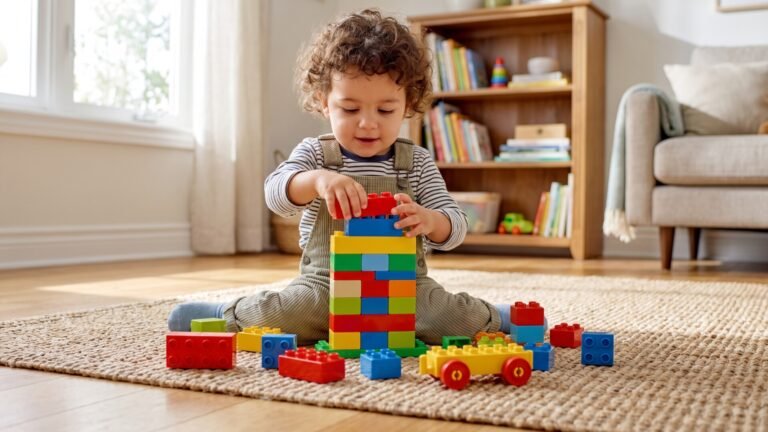
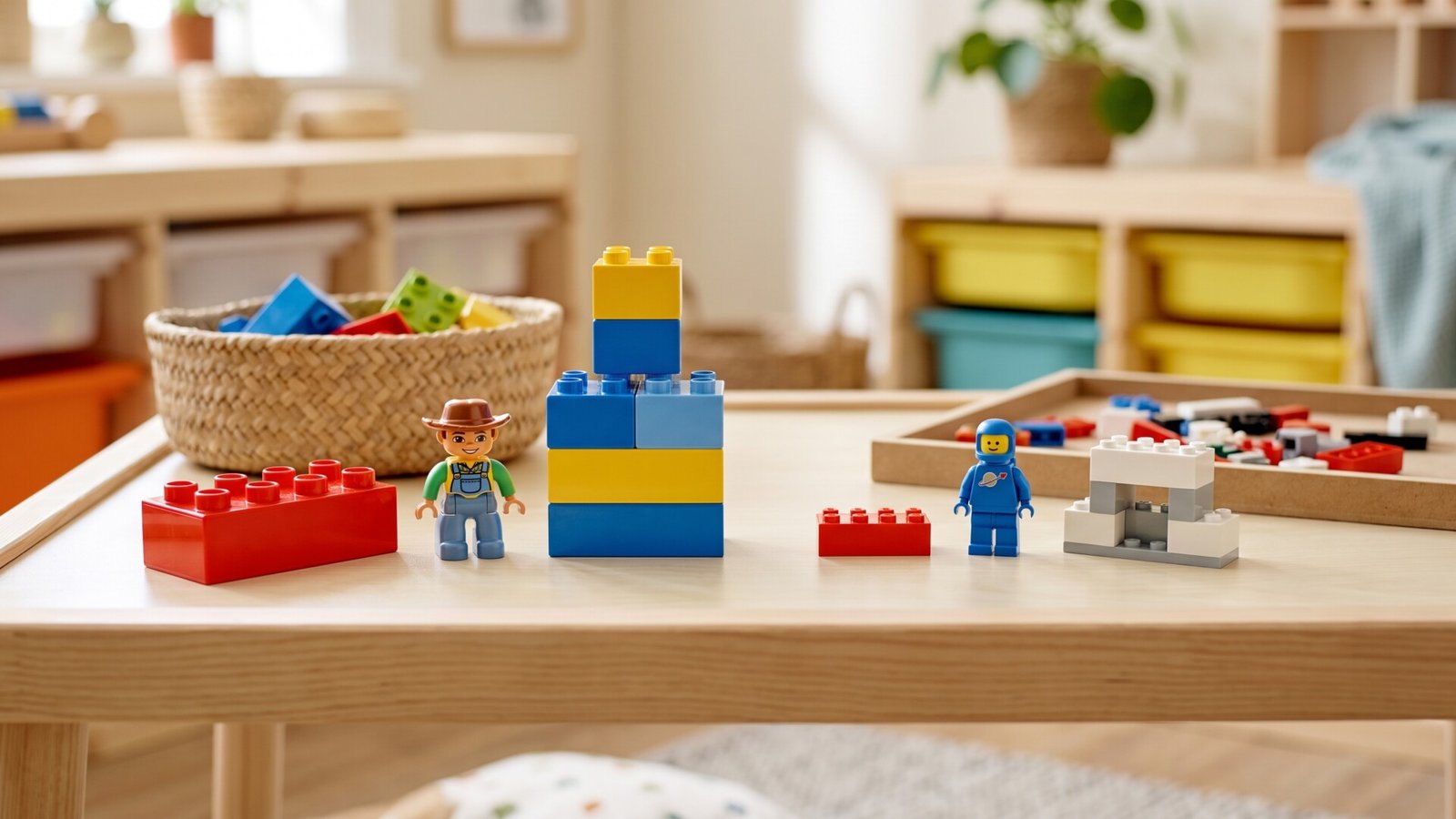
DUPLO is designed for children roughly 1½ to 5 years old. On LEGO’s own site the DUPLO range is grouped into 1.5+, 2+, 3+ and 4+ sets, so the label on each box matters. The bricks are twice as large as regular LEGO, making them easier to handle and, importantly, too big to count as small parts.
Benefits of DUPLO
- Safety and Size
- Large bricks are made to be easier for small hands to manipulate and are sized to avoid the small-parts rule for children under three. Some DUPLO figures and accessories can still be small, so read each box.
- Early Fine Motor Practice
- Pressing, connecting, and stacking DUPLO bricks gives toddlers repeated practice with hand-eye coordination and grip strength.
- Open-Ended Play
- Toddlers can build towers, houses, or imaginary worlds without following strict instructions.
- Invites storytelling and imaginative play.
- Introduction to STEM Concepts
- DUPLO sets with animals, vehicles, or numbers give natural openings to talk about counting, patterns, and cause-and-effect.
Popular DUPLO Sets for Early Learners
- DUPLO My First Number Train (10954) – A 23-piece set labelled 1½+ that combines building with counting and sequencing. It launched in 2021 with a list price of $19.99; expect roughly $20–$30 at retailers, depending on promotions.
- DUPLO My First Animal Train (10412) – A 19-piece set labelled 1½+ in which toddlers build four simple animals and match them to coloured carriages, so it mixes building with colour matching and pull-along play. List price is $19.99; expect roughly $15–$20. It has been on sale since 2024, so check availability.
- DUPLO Classic Brick Box (10913) – 65 pieces labelled 1½+, including a car base, two figures, window and roof pieces and a brick-shaped storage box. It is the most open-ended DUPLO starting point. List price is $29.99; expect roughly $25–$30.
Buying second-hand: older DUPLO sets, such as the retired DUPLO Town Submarine Adventure (10910), now turn up only on resale sites. If you buy used, check that figures and accessories are all present, look for cracked bricks, and wash everything first (see the cleaning section below).
Parent Tip: Let toddlers experiment freely with DUPLO bricks. Stacking, knocking down, and rebuilding teaches cause-and-effect and persistence.
For budget-friendly alternatives and compatible sets, see our roundup of the best LEGO-compatible DUPLO sets for toddlers under $40.
Understanding Classic LEGO: For Older or More Skilled Builders
Standard LEGO bricks are generally labelled ages 4 and up, with smaller bricks that allow for more detailed creations. Not every set in a theme carries the same age: some LEGO City, Friends or Ninjago sets are 4+, while larger or more complex ones are 6+, 7+ or higher, so always check the box.
Benefits of Classic LEGO
- Precision and Fine Motor Challenge
- Smaller bricks ask for finer finger control and hand-eye coordination, building on skills practised with DUPLO.
- Thinking Skills in Action
- Following instructions involves sequencing, planning, and problem-solving.
- Creative Freedom
- Classic LEGO allows for intricate designs, enabling children to explore their imagination at a more advanced level.
- Early Engineering and STEM Exposure
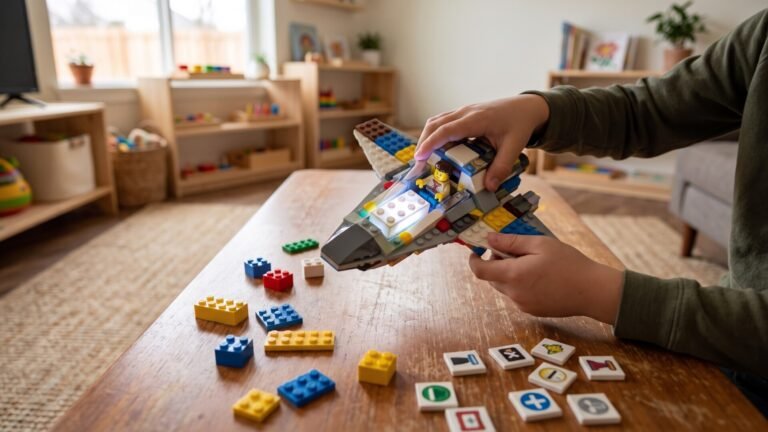
- Sets with moving parts, gears, or simple machines introduce mechanics, structural stability, and spatial awareness. Older children can progress to Technic and Icons sets or robotics kits.
Popular Classic LEGO Sets for Early Builders
- LEGO Classic Medium Creative Brick Box (10696) – Open-ended building with 484 pieces, labelled 4+. List price was $34.99; expect roughly $30–$40 at retailers.
- Small LEGO City sets – Compact vehicle sets introduce storytelling with a single minifigure. For example, City Rides – Police Truck (60481, released 2026) has 71 pieces, is labelled 5+, and lists at $9.99 in the US (roughly $9–$13 at retailers). Many larger City sets are labelled 6+ or older, so check each box.
- LEGO Friends Mini Sets – Combine building with role-play scenarios; smaller sets such as the Horse and Pony Trailer (42634, 105 pieces) are labelled 4+
Parent Tip: For beginners, start with open-ended sets before moving on to complex instruction-based kits.
Key Differences Between DUPLO and Classic LEGO
| Feature | DUPLO | Classic LEGO |
|---|---|---|
| Age labels | From 1½+ (varies by set; ranges to 5) | Generally 4+ for starter sets; many sets 6+ or higher |
| Brick Size | Large, about twice the scale | Small |
| Fine Motor Challenge | Gentle, suits toddler hands | More precise, needs finer finger control |
| Complexity | Simple builds | Instruction-following and detailed models |
| Imaginative Play | Encouraged with big figures and animals | Encouraged with detailed designs and minifigures |
| STEM Introduction | Early concepts (numbers, animals, cause and effect) | Mechanics, engineering and, later, coding kits |
| Safety | Sized to avoid the small-parts rule; still check accessories | Small parts – not suitable for children under 3 |
| Typical starter price | About $20–$30 for a small themed set | About $30–$40 for a 484-piece Classic box |
Takeaway: DUPLO is ideal for toddlers and young preschoolers just starting with building, while classic LEGO suits older preschoolers and elementary-aged children ready for more intricate challenges.
Age Label vs Readiness: What the Numbers Mean
The age printed on a LEGO box is a safety and complexity guide, not a developmental test. A 4+ label means the toy has been designed with children of that age in mind and that the set contains small parts that are not appropriate for children under three. It does not mean every four-year-old will enjoy or manage it.
- Younger than the label: Do not give standard LEGO to children under three. Adult help does not remove the choking hazard.
- Older than the label: It is perfectly fine for a five- or six-year-old to enjoy DUPLO, especially for large-scale building, farm or zoo play, or as a toy for playing with younger siblings.
- Mixed-age homes: Keep small bricks in a closed box or on a high shelf, and keep DUPLO accessible to the youngest child. Teaching older siblings to build at a table or on a mat helps keep tiny pieces contained.
If you want a deeper look at how safety rules work for toddlers, our fine motor article has more hand-skill activities by age. The rule behind the label is simple: in the US, the Consumer Product Safety Commission treats any piece that fits inside its small-parts test cylinder as a choking hazard for children under three, and toys containing such pieces must carry a warning. Standard LEGO bricks fall into that category; DUPLO bricks are made large enough not to.
Transitioning from DUPLO to LEGO
Many parents wonder when to move from DUPLO to classic LEGO. Signs your child may be ready include:
- Comfort snapping DUPLO bricks together and apart
- Interest in more detailed building and following instructions
- Ability to manipulate smaller objects without frustration
- Past the stage of mouthing toys, and age four or older
Parent Tip: You can mix DUPLO and LEGO to ease the shift. According to LEGO’s own help pages, DUPLO and LEGO bricks are compatible, but with limits: LEGO bricks attach to DUPLO bricks that have hollow studs on top, and only LEGO bricks with an even number of studs work (2×2 and 2×4 fit; 1×2 and 2×3 do not). DUPLO figures do not fit LEGO bricks, and LEGO minifigures do not fit DUPLO bricks. Because this mixes small bricks into a toddler toy box, only do it when no child under three is playing.
Creative Play Ideas with DUPLO and LEGO
1. Story-Based Construction
- Encourage children to build scenes for storytelling
- Combine vehicles, animals, and people to act out adventures
- Gives children a reason to talk, imagine, and sequence events (see how toys support language development)
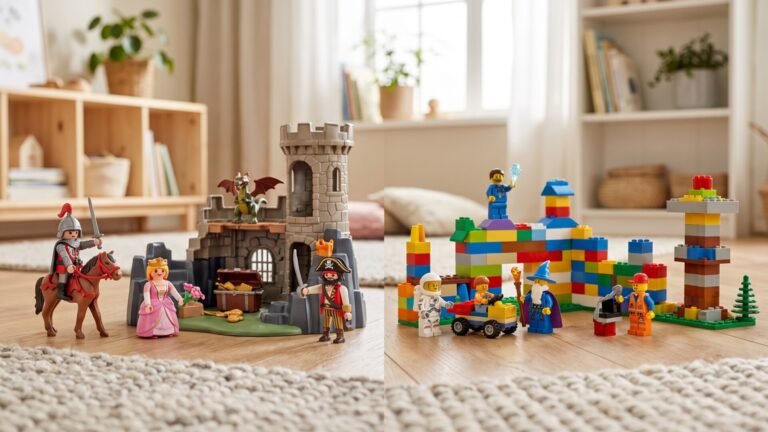
Children who enjoy storytelling may also like comparing systems: our guide to Playmobil vs LEGO looks at which suits imaginative play better.
2. Counting and Pattern Games
- Use DUPLO bricks to sort by color or count pieces
- Classic LEGO can be used for pattern-building challenges
- Gives informal practice with early math ideas
3. Engineering Challenges
- Create bridges, towers, and ramps
- Encourage children to test which structures hold weight or survive crashes
- Introduces basic physics ideas through play
4. Cooperative Play
- Build a city or playset together
- Gives practice in teamwork, negotiation, and taking turns
Practical Tips for Parents
- Start Age-Appropriate
- Don’t rush smaller LEGO bricks before your child is ready.
- Rotate Materials
- Keep interest high by introducing new sets or combining old ones.
- Focus on Play, Not Perfection
- Celebrate creative structures, even if they don’t look like the instructions.
- Use LEGO for Learning Moments
- Count, compare sizes, explore balance, and talk through building strategies.
- Incorporate Cleanup as a Game
- Sorting bricks by color or size gives more fine motor practice and teaches responsibility.
- Plan Storage Early
- Shallow, wide bins and a play mat make it easier to find pieces and keep small bricks in one place.
Cleaning and Caring for Your Bricks
Bricks that live on the floor and spend time in toddler mouths need an occasional wash, and second-hand bricks should always be cleaned before play. LEGO’s own help page recommends washing bricks by hand in water no hotter than 104°F (40°C) with a soft cloth or sponge. You can add a mild detergent, as long as you rinse the bricks well with clear water afterwards. Higher temperatures can affect the quality of the plastic, so avoid hot dishwasher cycles and never speed up drying with a hair dryer.
- Electronics stay dry: sound bricks, lights, battery boxes and other parts containing metal should be wiped with a cloth dampened with water and a mild, unperfumed detergent rather than soaked, as LEGO advises.
- Mind the stickers: stickered pieces can lift if soaked, so wipe around them instead.
- Dry them flat: spread bricks on a towel away from direct sunlight and turn them now and then. The hollow undersides hold water, so full drying can take a day or more.
- Check as you clean: cracked or split bricks can have sharp edges and no longer grip properly, so set them aside.
Value and Cost: What to Expect
Both systems hold their value well, but they reward different buying habits. DUPLO sets are generally small and themed, so a handful of sets (or one large brick box) is enough for a toddler. Classic LEGO tends to snowball: one starter box often leads to requests for themed sets, and it is easy to spend far more than planned.
- Open-ended boxes (a DUPLO brick box or a LEGO Classic box) give the most flexibility for the price and work without instructions.
- Themed sets give a clear goal and figures but are more likely to be built once and displayed.
- Compatible brands can cost less, but fit and plastic quality vary; our compatible DUPLO roundup covers what to check.
- Retired sets may only be available second-hand; prices vary and pieces may be missing.
Prices change often, so use the ranges in this article as a guide and check the current price at your preferred retailer.
Which Should You Buy? A Quick Decision Guide
If you are standing in the toy aisle or scrolling a gift list, these common situations cover most families. Use the child’s age as the starting point, then adjust for temperament, siblings and how much building help you can give.
| Situation | Good choice | Why |
|---|---|---|
| First building toy for a 1½- to 2-year-old | DUPLO Classic Brick Box (10913) or a small set such as the Animal Train (10412) | Large bricks, no small parts, builds a toddler can finish alone |
| Three-year-old who loves building | More DUPLO, including 3+ themed sets | Still below the 4+ label on standard LEGO; more bricks keep it challenging |
| Four- or five-year-old with steady hands | LEGO Classic Medium Creative Brick Box (10696), then one small themed set | Open-ended box first, instructions second |
| Home with a baby or toddler as well as older kids | DUPLO for shared play; standard LEGO only at a table and stored out of reach | Small bricks are a choking hazard for under-3s |
| Child who mainly wants to role-play | DUPLO town or animal sets, or small LEGO Friends or City sets | Figures and vehicles drive the story more than the build |
| Small gift on a budget | A $10–$20 set such as City Rides (60481) or the DUPLO Animal Train | A complete, satisfying build without a big outlay |
Common Mistakes (and Easy Fixes)
- Buying a big instruction set too early: a large set labelled 8+ or 9+ usually ends with an adult doing most of the build. Start small and let your child finish sets on their own.
- Treating the age label as a target: the label is a minimum for safety and complexity, not a deadline. There is no prize for moving to small bricks early.
- One bin for everything: small LEGO pieces drift into the toddler’s DUPLO tub. Separate, lidded containers solve this.
- Insisting on the instructions: many young builders would rather invent their own models. Both kinds of building are useful; follow the child’s lead.
- Giving DUPLO away too soon: older children often return to DUPLO for big scenes, quick builds and playing with younger siblings.
Benefits of LEGO Play at a Glance
- Fine Motor Skills: Snapping and connecting pieces works hand strength and dexterity
- Thinking Skills: Following instructions, planning, and problem-solving
- Imaginative Play: Role-playing with figures and vehicles supports creativity and storytelling
- Early STEM Exposure: Engineering, physics, and math ideas come up naturally
- Social and Emotional Growth: Sharing sets and collaborating encourages communication, patience, and confidence
Combining DUPLO and LEGO in One Play Area
Some parents choose to use both DUPLO and LEGO in one play area:
- Toddlers start with DUPLO to develop grip, coordination, and imagination
- Preschoolers gradually transition to LEGO with instruction-based or open-ended sets
- Mixing sets using compatible even-stud bricks can encourage flexible thinking and problem-solving across different scales
Parent Tip: Observe your child’s interests and readiness—some may transition earlier, others may enjoy DUPLO longer.
Where to Go Next in LEGO
As children grow, the LEGO world opens up. Our toy brands guide places LEGO alongside other major toy makers, and these articles go deeper on specific paths:
- LEGO Smart Play System review – interactive bricks that react to movement
- LEGO Technic vs Icons – advanced sets for older builders
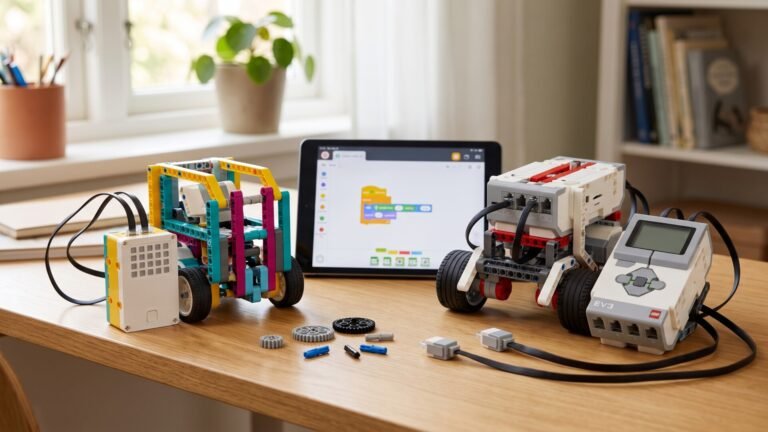
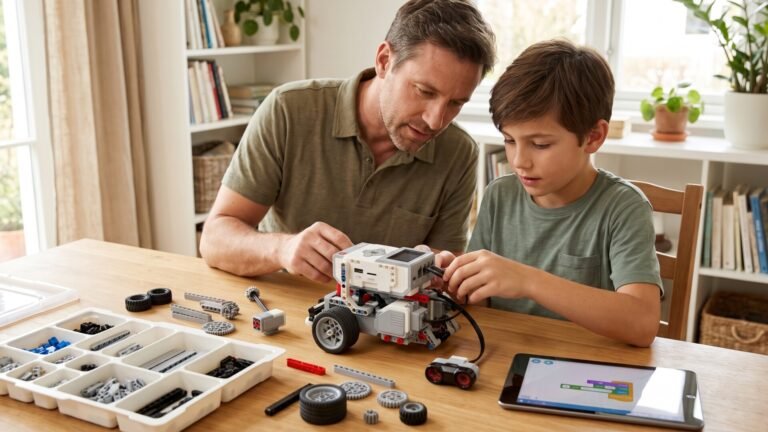
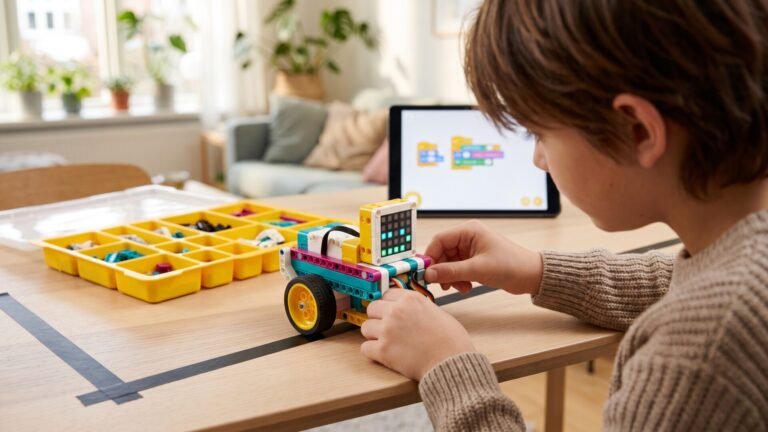
- LEGO MINDSTORMS EV3 at home, SPIKE Prime at home and SPIKE Prime vs EV3 – robotics for school-age children
- 20 home robotics challenges with EV3 and 30 days of SPIKE Prime challenges – ready-made projects once your child moves into robotics
- Space exploration toys – themed building and play ideas
Recommended Starter Sets
DUPLO:
- My First Number Train (10954) – 1½+, about $20–$30
- My First Animal Train (10412) – 1½+, about $15–$20
- Classic Brick Box (10913) – 1½+, about $25–$30
Classic LEGO:
- LEGO Classic Medium Creative Brick Box (10696) – 4+, about $30–$40
- LEGO City Rides – Police Truck (60481) – 5+, about $9–$13
- LEGO Friends small sets such as 42634 Horse and Pony Trailer – 4+
Mixing the two: there is no separate “adapter” product needed for the basics—LEGO states that DUPLO and LEGO bricks are compatible, as long as the even-stud limits above are respected.
Takeaways
- DUPLO is a great fit for toddlers and preschoolers just starting to build
- Classic LEGO suits children four and older who are ready for more detailed, precise building
- Both support fine motor practice, creativity, problem-solving, and early STEM exploration
- Treat age labels as safety guidance and always keep standard LEGO away from children under three
- Transition gradually, using open-ended play and creative storytelling to keep building fun
Frequently Asked Questions About DUPLO Vs LEGO
What age is DUPLO for?
LEGO groups its DUPLO range into sets labelled 1.5+, 2+, 3+ and 4+. Check the label on each box, since not every DUPLO set starts at 18 months.
What age is regular LEGO for?
Most starter sets, such as LEGO Classic boxes, carry a 4+ label, and many themed sets are labelled 6+ or higher. Standard bricks are small parts and are not suitable for children under three.
Can a 3-year-old play with LEGO instead of DUPLO?
Stay with DUPLO until your child is at least four unless a specific set is labelled for their age. The small pieces in standard LEGO are not suitable for children under three, and many three-year-olds also find them fiddly.
Can DUPLO and LEGO be used together?
Yes, within limits. According to LEGO, LEGO bricks with an even number of studs, such as 2×2 and 2×4, can attach to DUPLO bricks, but 1×2 and 2×3 bricks do not fit, and the figures do not interchange.
Is DUPLO safer than LEGO for toddlers?
DUPLO bricks are larger and designed to avoid the small-parts rule, which is why they are the right choice for toddlers. Always read the box, since some accessories can still be small, and supervise young children.
When should my child switch from DUPLO to LEGO?
Many children are ready around age four to five, when they can handle small bricks without frustration and want more detailed builds. There is no hurry, and plenty of older children keep enjoying DUPLO.
Is the DUPLO Submarine Adventure set still available?
The DUPLO Town Submarine Adventure (10910) is listed by LEGO as a retired product, so it is no longer sold new. Look for it second-hand, or choose a current DUPLO ocean or vehicle set.
Which DUPLO set should I buy first?
An open-ended box such as the DUPLO Classic Brick Box (10913, 65 pieces, labelled 1.5+) gives the most building for the money, at roughly $25 to $30. A small themed set such as the My First Animal Train (10412, 19 pieces, 1.5+) adds animals and a simple goal for roughly $15 to $20.
How do I clean DUPLO and LEGO bricks?
LEGO recommends washing bricks by hand in water no hotter than 104 degrees F (40 degrees C) with a soft cloth or sponge and, if you like, a mild detergent, then rinsing well and letting them air-dry. Wipe sound bricks and other electronic parts with a damp cloth instead of soaking them.