Top STEM building block sets under $50 for kids ages 5-7
If you have a five-, six- or seven-year-old who would happily build all day, the real challenge is not finding blocks. It is finding sets that are honestly priced under $50, sized right for this age, and likely to keep getting used after the first weekend. Many boxes say “Ages 3-99” while the price tag says something very different, so this guide sticks to sets with published age grades, piece counts and typical US price ranges.
So what are the best STEM building block sets under $50 for ages 5-7? Our shortlist covers classic bricks, interlocking plus-shaped pieces, magnetic tiles, wooden magnetic blocks and a beginner gear set, so you can match the set to how your child likes to play. Options are sold through [Affiliate: Amazon], [Affiliate: Target], and other retailers. Prices move with sales and sellers, so treat every figure here as a typical range and check the current price before you buy.
This guide is part of our complete STEM toys guide and our building and construction toys collection. If your child is closer to eight, our building toys for ages 6-8 guide covers bigger challenges.
Quick Picks: Best Building Sets Under $50 for Ages 5-7
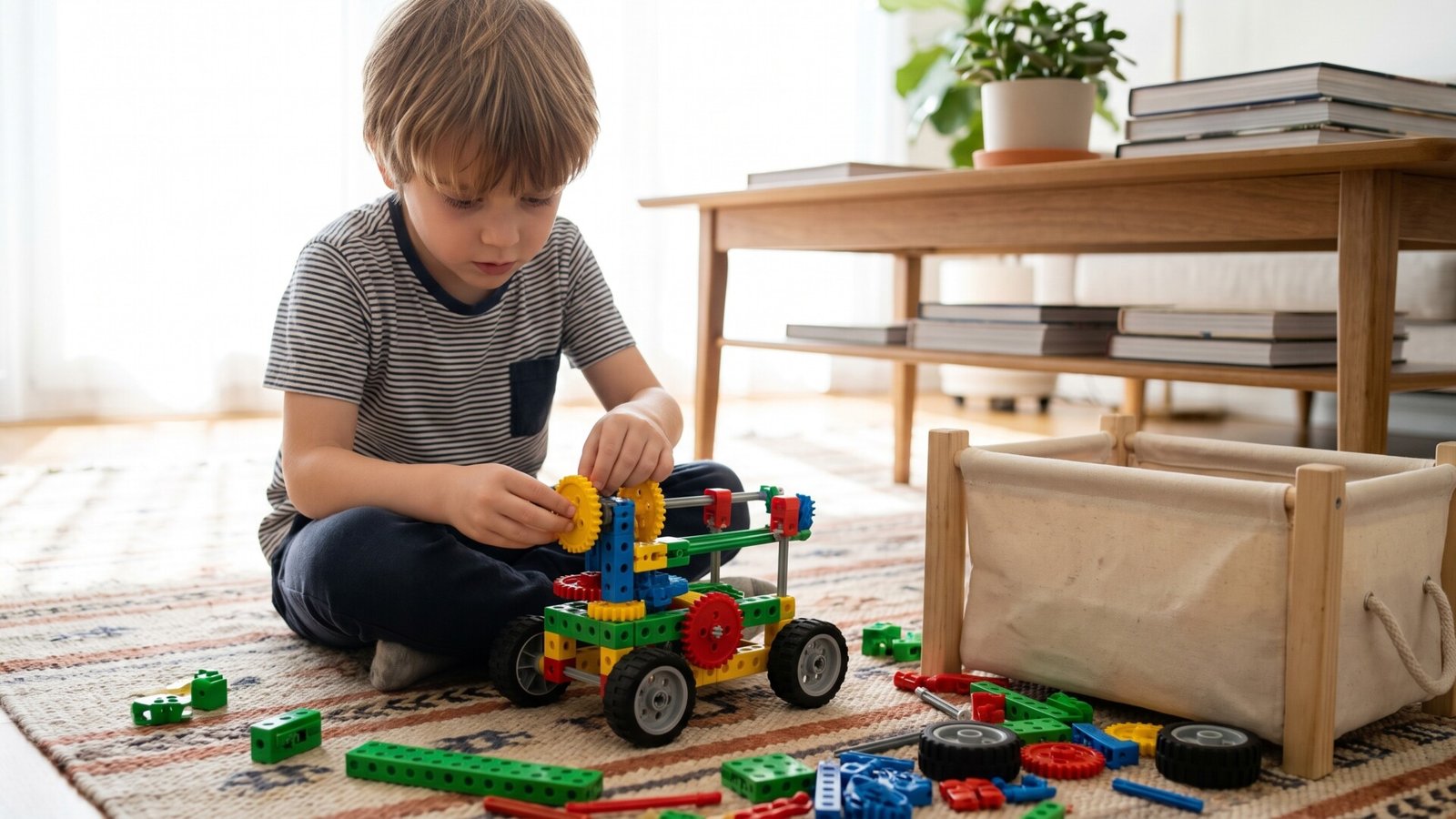
- Best overall for open-ended building: LEGO Classic Medium Creative Brick Box 10696 (484 pieces, ages 4+, roughly $18-35).
- Best for step-by-step builders: Plus-Plus Learn to Build Basic (400 pieces, ages 5+, roughly $25-36).
- Best magnetic set: Playmags 100-piece magnetic tiles (ages 3+, roughly $28-41).
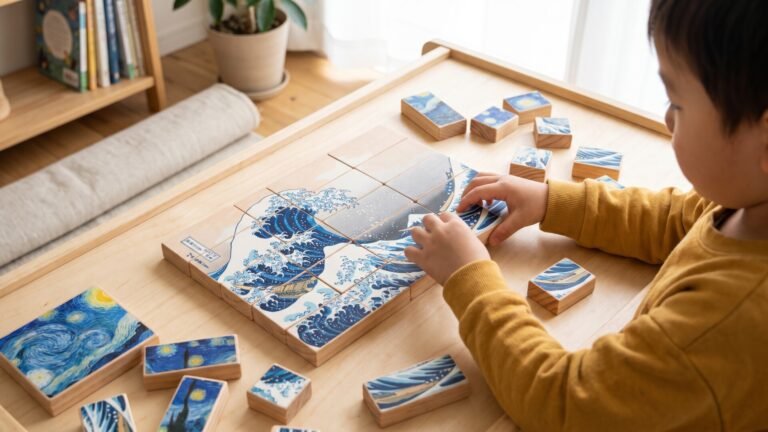
- Best for tabletop and design lovers: Tegu 14-piece magnetic wooden blocks (ages 3+, around $42 at many retailers).
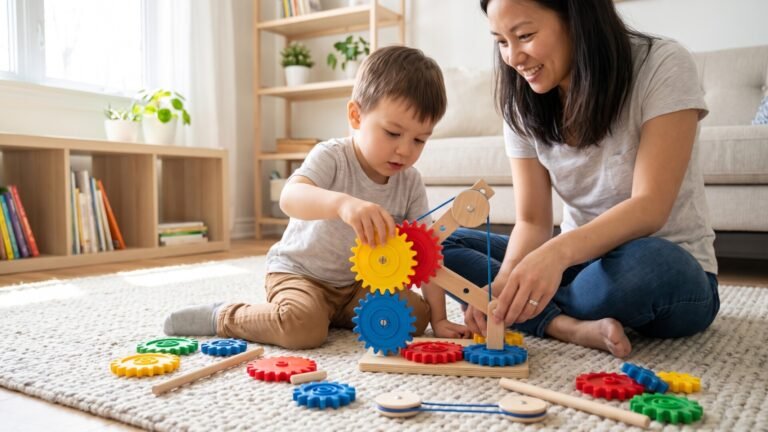
- Best for introducing mechanics: Learning Resources Gears! Gears! Gears! Beginner’s Building Set (about 95-100 pieces, ages 3+, roughly $30-42).
Why Building Sets Are a Good Fit at Ages 5-7
Kids this age are ready for more than stacking. Many can follow a simple picture instruction, sort pieces by shape and colour, and keep trying when a tower wobbles. Building toys give them a low-pressure way to practise that kind of trial and error, and they are a screen-free option for rainy afternoons. Pieces that click or snap also give small hands plenty of practice with grip and control.
Building also happens to touch each letter of STEM in an everyday way. Balancing a bridge is a tiny engineering problem, counting pieces and comparing shapes is early maths, and working out why gears jam is plain cause and effect. You do not need to turn it into a lesson. A few open questions such as “what could we change so it stands taller?” are enough. For more on this, see our guide to toys that teach basic engineering concepts.
Types of Building Sets, Explained
Interlocking bricks (LEGO-style) click together for sturdy models and reward patience. Magnetic tiles and blocks snap together with little finger strength, which makes them forgiving for younger builders and quick for big structures. Gear and mechanical sets turn building into making something move. Wooden blocks are quiet, durable and good for balance experiments; our wooden vs plastic building sets comparison goes deeper.
Another useful distinction is open-ended versus goal-oriented play. A big box of bricks is a blank canvas. A gear kit has a clear aim: make the gears turn. Our guide to open-ended building toys that grow with your child explains why a mix of both tends to work best at this age.
How We Chose These Sets
Each set had to meet three tests. First, a typical US price under $50 at the time of writing, based on retailer listings and published deal histories. Second, a manufacturer age grade that includes 5-7 year olds, or a clear reason it works for them. Third, a piece count and format that suit this age. We left out some popular STEM kits because they miss the brief: for example, Snap Circuits Jr. SC-100 is labelled for ages 8+ and often costs $40-55, and K’NEX sets aimed at grades 3-5 tend to land right around the $50 line, so neither fits a guide for 5-7 under $50.
A note on our experience: this article is based on manufacturer specifications, retailer listings and published parent feedback rather than lab testing. Where a spec could not be confirmed, we have left it out.
What to Look for Before You Buy
Age grade and piece size. Most sets here are labelled for ages 3+ or 4+ because they contain small parts. Five-to-seven-year-olds can usually handle them, but keep sets away from younger siblings who still mouth objects.
Magnet safety. Magnetic sets have powerful magnets sealed inside. If a piece cracks, loose magnets are a serious swallowing hazard, so inspect pieces now and then and stop using any that are damaged. Check the manufacturer’s guidance and recall notices from the US Consumer Product Safety Commission when buying.
Instructions versus free play. If your child gets stuck without a goal, pick a set with model ideas such as the Plus-Plus Learn to Build line. If they ignore instructions, a big bin of bricks or tiles will last longer.
Piece count and storage. More pieces means more possibilities and more mess. A shallow bin or a bag with a drawstring that opens flat into a play mat makes cleanup less of a chore.
Compatibility. LEGO Classic bricks work with other LEGO bricks, which helps if you plan to expand later. Magnetic tiles from different brands often connect with one another, but check the listing before assuming.
The Top STEM Building Sets Under $50 for Ages 5-7
LEGO Classic Medium Creative Brick Box (10696)
| Feature | Details |
|---|---|
| Age Range | 4+ |
| Key Features | 484 pieces in a range of colours, including wheels, windows and eyes, with a few building ideas included. |
| Typical Price | Roughly $18-35 depending on retailer and sales. |
| Affiliate Program | [Affiliate: Check price on Amazon] |
Why we like it: This is the benchmark open-ended set. There are no characters or storylines, just a box of possibilities. The bricks are consistent and click together securely, and they work with the huge LEGO range if your child later wants to expand.
Best for: The child who wants to build their own world from scratch, and the one who happily sorts pieces by colour before building anything.
Pros
- Very durable bricks that tend to survive years of play and can be passed on.
- Open-ended, so it suits both a 5-year-old building simple houses and a 7-year-old trying more complex designs.
- Compatible with other LEGO bricks.
Cons
- Only basic building ideas are included, so kids who like detailed instructions may want a themed kit as well.
- With 484 pieces and many small parts, it needs a storage plan and is not suitable for toddlers in the house.
Plus-Plus Learn to Build Basic (400 pieces)
| Feature | Details |
|---|---|
| Age Range | 5+ |
| Key Features | 400 plus-shaped pieces in mixed colours that connect in many directions, with a guide of simple models to follow. |
| Typical Price | Roughly $25-36. |
Why we like it: Plus-Plus pieces are a single shape, which makes them easy to understand, and the step-by-step guide gives beginners a starting point. They suit kids who like mosaic-style and pixel-art projects as well as 3D models.
Best for: A 5-7 year old who enjoys following a guide first and then improvising.
Pros
- Low learning curve with just one piece shape.
- Instruction guide builds confidence while free building stays easy.
- Good value for the piece count.
Cons
- Models can feel less sturdy than traditional bricks.
- Pieces are not compatible with LEGO.
Playmags 100-Piece Magnetic Tiles Set
| Feature | Details |
|---|---|
| Age Range | 3+ |
| Key Features | 100 magnetic tiles in squares, triangles and other shapes, with translucent colours. |
| Typical Price | Roughly $28-41, with frequent sales. |
| Affiliate Program | [Affiliate: Check price on Amazon] |
Why we like it: Magnetic tiles let kids build big, bright structures quickly, with little frustration. The tiles snap together on their own, so even younger builders can make houses, towers and 3D shapes. Translucent tiles look great on a window sill or lightbox.
Best for: Kids who like building big and fast, and families who want something a 5-year-old and a 7-year-old can share.
Pros
- Forgiving connections with little finger strength required.
- Plenty of tiles to explore shapes, patterns and 3D forms.
- Easy to wipe clean.
Cons
- Tiles are lighter than wood or thick bricks and can feel thin.
- Sealed magnets are a hazard if a tile breaks and a magnet is swallowed; supervise accordingly and check pieces regularly.
Tegu 14-Piece Magnetic Wooden Blocks
| Feature | Details |
|---|---|
| Age Range | 3+ |
| Key Features | 14 wooden blocks in 5 shapes with hidden magnets, finished in a water-based lacquer; made from FSC-certified hardwoods. |
| Typical Price | Around $42 at many retailers; check current listings as prices vary by colourway and seller. |
| Affiliate Program | [Affiliate: Check price on Tegu] |
Why we like it: These are beautifully made and very satisfying to handle. Hidden magnets let blocks cling at angles that would otherwise tip over, which makes balance experiments feel like magic.
Best for: The child who likes to experiment with balance and design, and families who prefer natural materials and a calmer look.
Pros
- Attractive, sturdy wooden pieces that suit a living-room shelf.
- Magnets encourage creative balancing and cantilever-style builds.
- Small footprint for tabletop play and travel.
Cons
- The price per piece is high.
- With only 14 blocks, it is not a set for sprawling cities.
- Sealed magnets are a swallowing hazard if a block is damaged; check blocks regularly.
Learning Resources Gears! Gears! Gears! Beginner’s Building Set (LER9162)
| Feature | Details |
|---|---|
| Age Range | 3+ (retailers list grades PreK-4) |
| Key Features | About 95-100 pieces, including gears, pillars, axles, bases and a crank handle, plus an activity guide. |
| Typical Price | Roughly $30-42. |
| Affiliate Program | [Affiliate: Check price on Amazon] |
Why we like it: This is a friendly way to introduce moving parts. Kids connect gears so that turning one crank spins others, which shows cause and effect clearly. The beginner size keeps the number of parts manageable.
Best for: The child who likes to know how things work and enjoys making things move.
Pros
- Hands-on introduction to gears and simple mechanisms.
- Activity guide gives starting points.
- Works for both 5 and 7 year olds by building simple or more complex layouts.
Cons
- Aligning gears can take patience for a 5-year-old, so expect to help at first.
- More goal-oriented than a box of bricks.
Comparison Table
| Product | Age Range | Pieces | Typical Price (USD) | Best For |
|---|---|---|---|---|
| LEGO Classic Medium Creative Brick Box 10696 | 4+ | 484 | $18-35 | Open-ended building |
| Plus-Plus Learn to Build Basic | 5+ | 400 | $25-36 | Guided then free building |
| Playmags 100-Piece Magnetic Tiles | 3+ | 100 | $28-41 | Big, fast structures |
| Tegu 14-Piece Magnetic Wooden Blocks | 3+ | 14 | About $42 | Balance and design |
| Learning Resources Gears! Gears! Gears! Beginner’s | 3+ | ~95-100 | $30-42 | Mechanics and motion |
How to Choose the Right Set for Your Child
For a 5-year-old: Playmags suit young builders best because the magnets do the work. The Gears set is great too, with a parent nearby for the first few builds.
For a 6- or 7-year-old who likes instructions: Plus-Plus Learn to Build Basic or the LEGO Classic box with model ideas offer a clear target.
For small spaces: Tegu is compact and stores easily.
For a tight budget: LEGO Classic 10696 is often the best value per piece, especially when on sale at the low end of its range.
For siblings: Playmags or LEGO Classic have enough pieces for two children to build side by side.
For coding-curious kids: If your child enjoys logic puzzles, pair a building set with one of our beginner coding kits for 5-7 year olds.
Tips for Getting More Out of Building Time
- Set a gentle challenge. Try “build a bridge a toy car can cross” or “make the tallest tower that survives a gentle shake.”
- Ask, don’t tell. Questions like “what do you think will happen if…?” keep the thinking with your child.
- Take photos of favourites. Kids love to rebuild or show off their designs before taking them apart.
- Mix systems carefully. Keep magnetic tiles separate from small electronics and cards, which magnets can affect.
- Rotate sets. Putting a set away for a few weeks makes it feel new again.
- Build together sometimes. Seven-year-olds enjoy teaching a parent their trick.
For more guidance, see our best construction toys for problem-solving, browse by age in toys by age, or explore toy brands. For younger siblings, see best building toys for preschoolers.
What to Expect at Each Age
Age 5: Many five-year-olds build short towers, simple houses and symmetrical patterns. They often enjoy sets where pieces connect easily, and they may need help with fiddly parts such as gears or tiny bricks. Short sessions of 15-20 minutes are common, so do not worry if a build is abandoned halfway.
Age 6: Sixes usually begin to follow picture instructions with a little help, and they like building something to use in pretend play, such as a garage, a shop or a zoo. This is a good age for guided builds from Plus-Plus or LEGO model ideas.
Age 7: Seven-year-olds often want a challenge. They may redesign a model to make it stronger, taller or faster, and they like showing others how it works. If your seven-year-old is racing through these sets, look at our guide for ages 6-8. Every child develops at their own pace, so use these ranges as a rough guide only.
Getting the Best Price
- Compare retailers. LEGO Classic and Playmags prices move often, and the range on the same set can span $10 or more over a few months.
- Watch for seasonal sales. Late autumn and the holiday shopping period tend to bring discounts, but check the price history rather than assuming.
- Confirm the exact set. Some listings are bundles or different piece counts. Match the set number or piece count to what is listed here, and make sure the listing is from the brand or a reputable seller.
- Check what is included. Some sets add storage or an activity guide; others do not. Factor in a bin if you need one.
- Consider secondhand. Bricks and wooden blocks are often resold in good condition. Avoid used magnetic sets unless every piece is intact.
Our Verdict
If you only buy one set, the LEGO Classic Medium Creative Brick Box is our best overall pick for its value, durability and flexibility. If your child likes clear step-by-step goals, Plus-Plus Learn to Build Basic is a great alternative. Playmags are the easiest for quick, big builds, Gears! Gears! Gears! is a gentle introduction to mechanics, and Tegu is the choice for a calm, design-minded builder.
Whichever you choose, the best set is the one your child returns to. Wobbly towers and odd creations are part of the fun. Prices and availability change often, so confirm the current price and age grade on the retailer’s page before buying.
Frequently Asked Questions About STEM Building Block Sets
What are the best STEM building sets under $50 for ages 5-7?
Good options include LEGO Classic 10696 (484 pieces, ages 4+), Plus-Plus Learn to Build Basic (400 pieces, ages 5+), Playmags 100-piece magnetic tiles (ages 3+), Tegu 14-piece magnetic wooden blocks (ages 3+) and the Learning Resources Gears! Gears! Gears! Beginner’s Building Set (ages 3+). Typical US prices for each fall under $50, but check current listings.
Are magnetic building sets safe for kids aged 5-7?
They are generally labelled for ages 3+, but the magnets inside are a serious hazard if swallowed. Check pieces regularly, stop using any that crack or open, keep them away from younger siblings, and follow the manufacturer’s guidance.
What is the difference between LEGO Classic and Plus-Plus?
LEGO Classic bricks are traditional studded bricks compatible with the wider LEGO system. Plus-Plus uses a single plus-shaped piece that connects in many directions and is not compatible with LEGO. Plus-Plus Learn to Build Basic is labelled 5+, while LEGO Classic 10696 is labelled 4+.
Is Snap Circuits Jr. suitable for ages 5-7 under $50?
Snap Circuits Jr. SC-100 is labelled for ages 8+ and often costs between $40 and $55, so we do not include it here. It can be a good next step once your child is a little older.
How many pieces does a 5-7 year old need?
There is no single answer. A 100-piece magnetic set can be plenty, while open-ended brick sets with several hundred pieces give more room to build bigger models. Choose by your child’s interests and your storage space.
How can I store building sets?
Use shallow bins or a drawstring play-mat bag. Sorting by type, such as bricks, gears and magnets, makes setup and cleanup quicker.
Should I buy a set with instructions or an open-ended set?
Many kids enjoy both. Instructions give a starting point and confidence, while open-ended pieces keep the set interesting longer. Sets like Plus-Plus Learn to Build Basic include a guide but still allow free building.