Quiet STEM Activities for Sensitive Children: Engaging Without Overstimulation
I have a confession. When my oldest child was three, I bought her a singing, flashing, button-pressing STEM toy that promised to teach her coding basics. Within fifteen minutes, she was in tears, hiding under the kitchen table. The lights were too bright, the sounds too loud, and the constant prompts felt like demands she couldn’t meet.
I learned the hard way that sensitive children need a different approach to STEM learning. They don’t need more stimulation. They need less.
If you’re reading this, you probably already know what I learned that day. You’ve watched your child shrink away from noisy classrooms, avoid crowded play areas, or melt down after too much sensory input. And you’ve wondered: How can I give them the benefits of STEM education without overwhelming them?
The answer is quieter than you might expect.
In this article, I’ll walk you through what quiet STEM activities actually look like, why they work so well for sensitive children, and the specific products that have helped families like mine find that sweet spot between engagement and calm. I’ll share what I’ve learned from my own mistakes, from talking to other parents, and from watching children thrive when the volume gets turned down.
Let me tell you what I wish someone had told me back then.
Understanding Why Quiet STEM Matters for Sensitive Children
Here’s something most parenting articles won’t tell you: STEM education isn’t just about preparing kids for future careers. It’s about teaching them how to think. How to problem-solve. How to persist when something doesn’t work the first time.
The American Academy of Pediatrics has emphasized that hands-on, exploratory play is critical for cognitive development. And STEM activities—science, technology, engineering, and math—are essentially structured exploration. They give children a framework for asking questions and finding answers.
But here’s the thing. For sensitive children, the traditional classroom or playroom environment can be overwhelming. Fluorescent lights. Echoing voices. The constant hum of electronics. The pressure of timed activities or group competition. These aren’t just annoying—they’re genuinely stressful for kids with sensory processing differences.
I remember watching my daughter in a preschool STEM workshop. The instructor had set up stations with bubbling chemicals, whirring motors, and loud videos. Every other child was engaged. Mine was covering her ears and rocking.
That’s when I realized: the problem wasn’t her interest in STEM. She was fascinated by how things worked. The problem was the delivery method.
Quiet STEM activities solve this by removing the sensory chaos. They allow children to focus on the thinking part of STEM without fighting against their own nervous systems. And the benefits are remarkable.
Children who engage with quiet STEM activities often show:
- Improved ability to sustain attention
- Reduced anxiety during learning
- Greater willingness to attempt challenging problems
- Increased independence in play
- Better retention of concepts
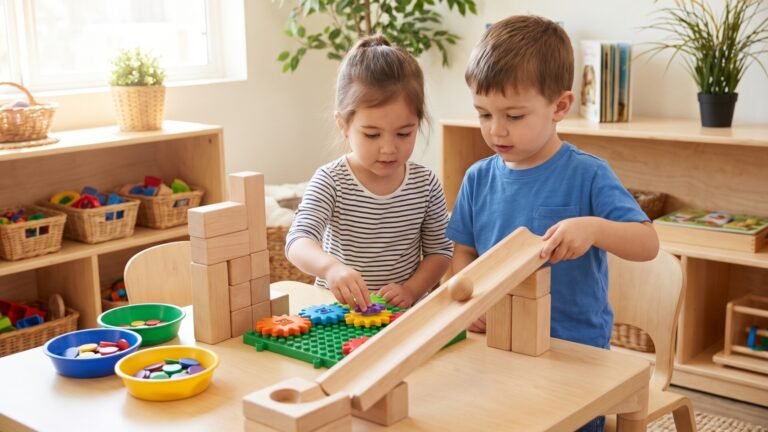
I’ve seen it in my own home. When my daughter discovered marble runs, she spent two hours silently building and testing. No tears. No hiding. Just pure, focused engagement.
The trend toward quiet, low-stimulation educational activities is growing for good reason. Parents are recognizing that louder isn’t better. Sometimes the deepest learning happens in silence.
What Makes a STEM Activity Truly “Quiet”?
Let me clarify something important. When I say “quiet STEM activities,” I’m not just talking about toys that don’t make noise. I’m talking about activities that minimize all forms of overstimulation.
Traditional STEM toys often come with bells and whistles—literally. Electronic features, bright flashing lights, loud sound effects, and constant feedback loops. These are designed to grab attention, but for sensitive children, they can grab too hard.
Quiet STEM activities, on the other hand, prioritize:
- Visual calm: Neutral colors, simple designs, minimal flashing elements
- Auditory peace: No motors, buzzers, or electronic sounds
- Pacing control: The child decides how fast or slow to engage
- Predictable outcomes: Clear cause-and-effect without surprises
- Tactile comfort: Materials that feel good to touch, not jarring
This distinction matters because sensory processing isn’t just about noise. It’s about how the brain receives and organizes all sensory information. A child who struggles with visual stimulation might be fine with a quiet mechanical toy but overwhelmed by a brightly colored electronic one.
I’ve found that the best quiet STEM toys share a common philosophy: they let the child’s mind do the work, not the toy’s electronics.
The terminology here is important. “Sensory processing” refers to how the nervous system receives and responds to sensory input. “Overstimulation” happens when that input exceeds what the child can comfortably process. “Focused engagement” is the sweet spot where the child is absorbed but not overwhelmed.
Quiet STEM activities create conditions for focused engagement by removing sensory obstacles.
What to Look For When Choosing Quiet STEM Activities
Before I share specific product recommendations, let me walk you through what I’ve learned to look for. These are the factors I consider every time I evaluate a STEM toy for a sensitive child.
Safety First, Always
This seems obvious, but it’s worth stating. Look for non-toxic materials, BPA-free plastics, and age-appropriate sizing. For younger children, avoid small parts that could be choking hazards. For older children, check that materials are durable enough to withstand repeated use without breaking into sharp pieces.
Durability Matters More Than You Think
Sensitive children often form deep attachments to their favorite activities. They want to use the same toy over and over. A flimsy toy that breaks after a few uses isn’t just frustrating—it’s genuinely disappointing for a child who found comfort in that activity.
Educational Value Isn’t Always Obvious
Some of the best STEM toys look deceptively simple. A set of wooden blocks can teach physics, geometry, and engineering principles. Don’t assume that more features equal more learning. Often, the opposite is true.
Ease of Use for Independent Play
One of the biggest gifts you can give a sensitive child is an activity they can do without your constant help. Look for clear instructions, intuitive assembly, and activities that allow for trial and error without frustration.
Storage and Cleanup
Sensitive children often thrive on order. A STEM activity that requires extensive cleanup or has many loose pieces can become overwhelming in itself. Consider how the toy stores, whether pieces can be organized, and how easy it is to put away.
I learned this the hard way with a chemistry kit that had dozens of small vials. My daughter loved the experiments but hated the cleanup. Eventually, she stopped asking to use it.
Maintenance
Some STEM toys require batteries, cleaning, or replacement parts. Consider whether you’re willing to maintain that over time. The best quiet STEM toys are often the ones that require almost no maintenance at all.
The Pros and Cons of Quiet STEM Activities
Let me be honest with you. Quiet STEM activities aren’t perfect for every situation. Here’s what I’ve found works well and where they fall short.
What Works Well
Encourages deep thinking. Without sensory distractions, children can focus on the problem at hand. I’ve watched my daughter spend forty minutes trying to get a marble run to work exactly right. That kind of sustained attention is rare in today’s world.
Provides genuine calm. Many parents report that quiet STEM activities have a meditative quality. The repetitive motions of building, sorting, or testing can be soothing for anxious children.
Adapts to different learning styles. Visual learners, kinesthetic learners, and logical learners can all find something valuable in hands-on STEM activities. The quiet format makes it accessible to children who might struggle in group settings.
Where They Can Fall Short
Parental involvement is sometimes necessary. Some children need encouragement to start an activity or help when they get stuck. This isn’t a flaw, but it’s worth knowing going in.
Initial cost can be higher. Quality STEM toys aren’t cheap. But I’ve found that a well-chosen toy that gets used for years is better value than a cheaper toy that gets abandoned after a week.
Some activities have a learning curve. The child might need to build skills before they can fully enjoy the activity. Patience on both sides is key.
Our Top Quiet STEM Activity Recommendations
After years of trial and error, here are the products that have consistently worked for sensitive children in my family and in families I’ve spoken with.
Snap Circuits Jr. Electronics Exploration Kit
| Feature | Details |
|---|---|
| Age Range | 8+ |
| Key Features | Hands-on projects, no soldering required, quiet assembly |
| Where to Find | [Affiliate: Available on Amazon] |
Why We Like It
This was the first electronics kit that didn’t send my daughter running. The pieces snap together with a satisfying but quiet click. No buzzing. No flashing lights. Just pure circuit-building.
The kit includes over 100 projects, from simple light switches to more complex circuits. The instructions are clear and visual, which helps children who struggle with written directions.
Best For
Children who are curious about how electronics work but get overwhelmed by noisy, flashy toys. It’s also excellent for kids who enjoy following step-by-step instructions.
What Parents Should Know
Younger children (around age 8) may need supervision for the first few projects. But once they understand the basics, most can work independently. The pieces are durable and have held up well in our house.
Pros
- Teaches real electronics concepts
- Completely quiet operation
- Projects build in complexity
Cons
- Small pieces require supervision for younger users
- Initial setup of projects can be fiddly
Gravity Maze Marble Run Logic Game
| Feature | Details |
|---|---|
| Age Range | 8+ |
| Key Features | Combines logic with marble runs, quiet play |
| Where to Find | [Affiliate: Available at Target] |
Why We Like It
This is the toy that taught me the power of quiet STEM. The concept is simple: build a tower that guides a marble from start to finish. The execution requires spatial reasoning, planning, and patience.
The pieces are solid and satisfying to handle. The only sound is the gentle click of pieces fitting together and the soft roll of the marble. It’s almost hypnotic.
Best For
Children who love puzzles and building. It’s also excellent for kids who need to practice planning ahead and thinking through consequences.
What Parents Should Know
The challenge levels increase gradually, which prevents frustration. My daughter started with the easiest puzzles and worked her way up over months. The marble run aspect adds a satisfying payoff to each successful build.
Pros
- Multiple levels of challenge
- Quiet, calming play experience
- Teaches spatial reasoning
Cons
- Small marble requires supervision for younger children
- Some puzzles can be frustrating for impatient kids
LEGO Classic Bricks and Eyes Set
| Feature | Details |
|---|---|
| Age Range | 4+ |
| Key Features | Encourages creativity, includes bricks and eyes for building |
| Where to Find | [Affiliate: Available through LEGO] |
Why We Like It
Sometimes the simplest option is the best. This set includes basic bricks plus special pieces with printed eyes, allowing children to create characters and creatures.
The quiet, repetitive motion of clicking bricks together is deeply calming for many sensitive children. And because LEGO is open-ended, the play possibilities are endless.
Best For
Young builders who enjoy imaginative play. It’s also great for children who need a quiet activity they can return to again and again.
What Parents Should Know
This isn’t a set with a specific end goal. That’s the point. Children can build whatever they imagine. Some kids love this freedom; others prefer more structured activities.
Pros
- Open-ended play possibilities
- Quiet construction
- Develops fine motor skills
Cons
- Requires storage space for bricks
- Some children may want more guidance
Tinkering Labs Electric Motors Catalyst
| Feature | Details |
|---|---|
| Age Range | 8+ |
| Key Features | Engages kids in engineering, quiet motor use |
| Where to Find | [Affiliate: Available on Amazon] |
Why We Like It
This kit lets children build real machines using motors, wheels, and wooden parts. The motors are surprisingly quiet—a gentle hum rather than a loud whir.
What I love most is the open-ended nature. There’s no single right answer. Children experiment, fail, and try again. That process is the real learning.
Best For
Aspiring engineers who want to build things that actually move. It’s excellent for children who enjoy tinkering and problem-solving.
What Parents Should Know
This kit requires more parental involvement than some others. Children may need help understanding how to connect components or troubleshoot designs. But that shared problem-solving can be a wonderful bonding experience.
Pros
- Encourages hands-on learning
- Quiet motor operation
- Promotes creative engineering
Cons
- May require additional materials for complex projects
- Some pieces are small
Learning Resources Gears! Gears! Gears! Super Building Set
| Feature | Details |
|---|---|
| Age Range | 3+ |
| Key Features | Colorful gears for building simple machines, encourages STEM concepts |
| Where to Find | [Affiliate: Available through Melissa & Doug] |
Why We Like It
This is one of the few STEM toys that works well for younger children. The gears are large, easy to handle, and snap together with a satisfying click. Children learn about cause and effect as they watch their gear systems spin.
The colors are bright but not overwhelming. The pieces are sturdy enough to survive enthusiastic play.
Best For
Younger children exploring basic engineering concepts. It’s also excellent for children who enjoy seeing immediate results from their efforts.
What Parents Should Know
Older children (age 7+) may find the set too simple. But for preschoolers and early elementary kids, it’s a perfect introduction to mechanical thinking.
Pros
- Develops fine motor skills
- Quiet operation
- Teaches cause and effect
Cons
- Limited complexity for older kids
- Pieces can be lost if not stored properly
Quick Comparison Table
| Product | Age Range | Durability | Educational Value | Price Range | Best For |
|---|---|---|---|---|---|
| Snap Circuits Jr. | 8+ | High | High | $$ | Tech enthusiasts |
| Gravity Maze | 8+ | Medium | High | $$ | Puzzle lovers |
| LEGO Classic Set | 4+ | High | Medium | $$ | Creative builders |
| Tinkering Labs | 8+ | Medium | High | $$ | Aspiring engineers |
| Gears! Gears! Gears! | 3+ | High | Medium | $$ | Young engineers |
How to Choose the Right Quiet STEM Activity for Your Child
Here’s my practical advice, organized by your specific situation.
Best for Small Spaces
If you’re working with limited space, the Gravity Maze game is your best bet. It stores compactly, and the pieces fit in a small box. The LEGO Classic set is also manageable if you use a storage bin.
Best for Toddlers
For children ages 3 to 5, the Gears! Gears! Gears! set is ideal. The pieces are large enough to be safe, and the cause-and-effect learning is perfect for this age.
Best for Sensory Play
The Tinkering Labs kit offers wonderful tactile experiences. The wooden pieces, motors, and wheels provide varied textures without overwhelming the senses.
Best Budget Pick
The LEGO Classic Bricks and Eyes Set offers incredible value. It’s affordable, durable, and provides endless play possibilities. Cost per year of use is extremely low.
Best Premium Pick
The Snap Circuits Jr. kit is worth the investment for children interested in electronics. It teaches real skills and can be used for years as children tackle increasingly complex projects.
The Real Secret Behind Quiet STEM
I started this article with a story about my daughter hiding under the kitchen table. I want to end with a different story.
Last week, I found her sitting on her bedroom floor, surrounded by the Gravity Maze pieces. She was building a tower that wound around itself like a spiral staircase. She’d been working on it for over an hour.
She looked up at me and smiled. “I figured out how to make it work,” she said. And then she dropped the marble in.
It rolled perfectly from the top to the bottom, turning each corner exactly as she’d planned.
That is the secret at the heart of quiet STEM activities. They don’t just teach science and math. They teach children that they are capable. That they can solve problems. That their quiet, focused minds have strengths that louder environments can’t see.
The toy you choose matters less than the space you create for your child to explore. But the right toy can open that door.
I hope you find the one that opens it for your child.
Frequently Asked Questions About Quiet STEM Activities For Sensitive Kids
What are quiet STEM activities for sensitive kids?
Quiet STEM activities are hands-on learning experiences designed to minimize sensory overload. They typically avoid loud sounds, bright flashing lights, and unpredictable elements. Examples include building sets, logic puzzles, marble runs, and simple electronics kits.
Are there specific age recommendations for these activities?
Yes. Always check the manufacturer’s age recommendations. Younger children (ages 3-5) do best with large-piece building sets. Older children (ages 8+) can handle more complex kits with small components.
How do quiet STEM activities benefit sensitive children?
They allow children to focus on problem-solving without fighting against sensory overload. This can reduce anxiety, improve concentration, and build confidence in learning.
What safety features should I look for in STEM toys?
Look for non-toxic materials, BPA-free plastics, and age-appropriate sizing. Avoid toys with small parts for children under 3. Check that pieces are durable enough not to break into sharp edges.
How can I encourage my child to engage with STEM activities?
Start with short sessions. Let your child lead the activity. Praise effort, not just success. And don’t force it—sometimes the best learning happens when children choose to engage on their own terms.
Are there quiet STEM activities that can be done outdoors?
Yes. Many building sets and marble runs work well outdoors on a calm day. You can also explore nature-based STEM activities like rock sorting, leaf classification, or simple water experiments.
What happens if my child loses interest in a STEM toy?
That’s normal. Put it away for a few weeks, then bring it out again. Many children cycle through interests. If the toy still doesn’t engage them, consider whether it matches their current developmental stage.
Can quiet STEM toys be used for group activities?
Yes, but keep groups small. Two to three children often works well. Larger groups can become overwhelming for sensitive children. —