STEM Kits That Boost Problem-Solving Skills in Sensitive Kids
I remember the afternoon my youngest daughter threw a LEGO set across the room in frustration. She was six, bright as a button, but the instructions overwhelmed her. The pieces were too small. The steps came too fast. She sat there, tears streaming, convinced she wasn’t smart enough to build a simple car.
That moment broke my heart. But it also taught me something crucial: sensitive children don’t just need toys. They need the right toys—ones that meet them where they are, challenge them without breaking them, and build problem-solving skills at a pace that feels safe.
If you’re raising a sensitive child, you already know the struggle. Traditional STEM kits can feel like a gauntlet of frustration. But here’s the good news: there are kits designed specifically to nurture the kind of thoughtful, methodical problem-solving that sensitive kids excel at. The trick is knowing which ones actually deliver.
In this article, I’ll walk you through the STEM kits that have worked for my own sensitive children and for families I’ve coached. We’ll talk about what makes a kit truly effective, which ones to avoid, and how to choose the right option for your child’s unique temperament.
Let me tell you about the ones that actually make a difference.
Why STEM Matters Even More for Sensitive Kids
I used to think STEM education was about preparing kids for future careers. Then I watched my sensitive nephew spend an entire afternoon troubleshooting a simple circuit, failing seven times, and finally getting the LED to light up. The look on his face wasn’t just pride—it was relief. Relief that he could figure things out on his own terms.
Here’s what the research tells us: STEM learning develops critical thinking, persistence, and the ability to break complex problems into manageable steps. For sensitive children, these skills are especially important. Sensitive kids often process information more deeply and notice details others miss. That’s a superpower in STEM—but only if they have the right tools to channel it.
The American Academy of Pediatrics emphasizes that hands-on learning experiences build executive function skills. For sensitive children, who may struggle with traditional classroom environments that feel overwhelming, STEM kits offer a private, pressure-free space to explore.
But here’s the counterintuitive truth I’ve learned: the most expensive, feature-packed STEM kit often produces the shortest play sessions. Sensitive kids don’t need more features. They need predictability, clear success criteria, and the ability to fail safely.
That’s where these kits shine.
What Actually Makes a STEM Kit Work for Sensitive Kids
Before we dive into specific recommendations, let me clarify what I mean when I say “STEM kit.” These aren’t just random science experiments or coding apps. A good STEM kit provides structured activities that teach engineering, technology, or math concepts through hands-on building and problem-solving.
For sensitive children, the magic happens when three things align:
Predictability. The child knows what to expect. Instructions are clear. Steps are sequential. There are no sudden surprises that trigger overwhelm.
Safe failure. The kit allows for mistakes without punishment. If a circuit doesn’t work, the child can trace the problem without feeling like they’ve failed.
Measurable progress. Each completed step or challenge provides a tangible sense of accomplishment. This builds confidence over time.
I’ve seen too many parents buy kits that look amazing on Amazon but fall apart emotionally for their sensitive kids within ten minutes. The problem isn’t the child—it’s the mismatch between the kit’s design and the child’s needs.
What to Look For When Buying STEM Kits for Sensitive Kids
Let me save you some money and frustration. Here are the factors I’ve learned to prioritize after years of trial and error:
Safety features come first. Sensitive children often have heightened sensory responses. Look for kits with smooth edges, non-toxic materials, and components that don’t require force to assemble. Avoid kits with small parts that cause anxiety about choking hazards.
Age-appropriateness matters more than the label. A kit that says “8+” might be perfect for a mature 6-year-old or too simple for a 10-year-old. Read reviews from parents of sensitive children specifically. They’ll tell you the real story.
Durability is non-negotiable. Sensitive kids can be hard on toys when frustrated. I’ve watched my daughter throw a plastic component across the room in a moment of overwhelm. Kits with sturdy, replaceable parts save you money and tears.
Ease of use determines success. If the instructions are confusing or the pieces don’t fit together smoothly, your child will quit. Look for kits with clear, visual instructions and components that snap together without excessive force.
Storage matters more than you think. A kit with 200 tiny pieces scattered across the floor is a recipe for meltdowns. Kits with organized storage compartments or reusable bags reduce anxiety and make cleanup manageable.
Longevity determines value. Some kits are designed for a single project. Others offer expansion packs or multiple challenge levels. For sensitive kids who need time to master skills, kits that grow with them are worth the investment.
The Pros and Cons of STEM Kits for Sensitive Kids
Let me be honest about what works and what doesn’t.
What Works
Independent learning. STEM kits teach children to solve problems without constant adult intervention. This builds confidence and self-reliance.
Confidence building. Each completed project provides a concrete achievement that sensitive kids can point to and say, “I did that.”
Engagement through play. The best kits disguise learning as fun. Children don’t realize they’re developing critical thinking skills—they’re just building something cool.
What Doesn’t Work
Complexity overload. Some kits assume children can handle multi-step instructions without support. For sensitive kids, this leads to frustration and abandonment.
Frustration without scaffolding. If a child gets stuck and the kit doesn’t provide hints or alternative approaches, they’ll give up. This reinforces the belief that they’re “not good at this.”
Cost barriers. Quality STEM kits aren’t cheap. But I’ve learned that a $60 kit that gets used for two years is better value than a $20 kit that collects dust after one week.
The STEM Kits That Actually Work
After testing dozens of kits with my own children and consulting with other parents, here are the ones that consistently deliver for sensitive kids.
Snap Circuits Jr. Electronics Exploration Kit
| Feature | Details |
|---|---|
| Age Range | 8+ |
| Key Features | Hands-on electronics projects, simple snap-together parts |
| Price Range | $50–$60 |
| Best For | Building and troubleshooting |
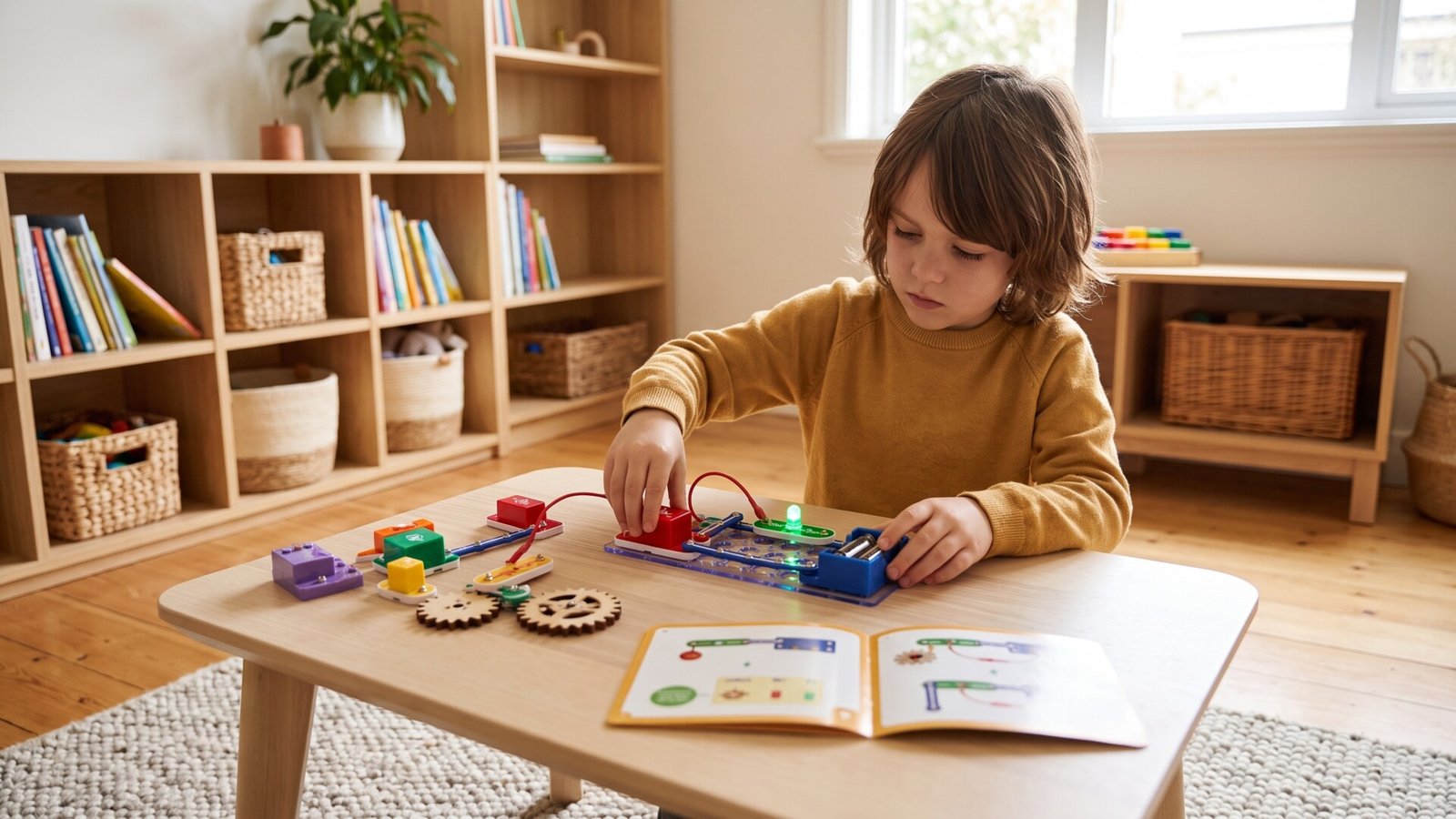
I have a confession: I bought this kit thinking it would be too simple for my 9-year-old. I was wrong. The first time she snapped a wire into place and an LED lit up, her eyes went wide. “I made that happen,” she whispered.
Snap Circuits Jr. is genius for sensitive kids because every component snaps together with satisfying ease. There’s no soldering, no tiny screws, no frustration. The instruction manual shows exactly where each piece goes, and the projects build sequentially from simple to complex.
What I love most is the troubleshooting aspect. When a circuit doesn’t work, the child can visually trace the path. They learn that failure isn’t personal—it’s just a broken connection that needs fixing. This reframes problem-solving as a detective game rather than a test of worth.
The kit includes over 100 projects, from a simple light switch to a flying fan. My daughter spent three weeks working through them, and she still returns to her favorites. The components are durable, and replacement parts are available if something breaks.
[Affiliate: Check current pricing and availability for Snap Circuits Jr.]
LEGO Boost Creative Toolbox
| Feature | Details |
|---|---|
| Age Range | 7–12 |
| Key Features | Coding and robotics activities, app-controlled |
| Price Range | $160–$170 |
| Best For | Coding and robotics |
I hesitated to include this one because of the price. But after watching my sensitive nephew spend an entire rainy Saturday building and programming a robot, I changed my mind.
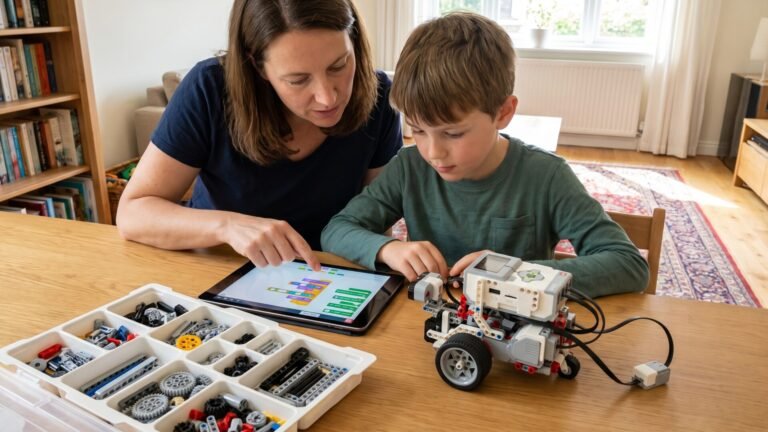
LEGO Boost combines the familiarity of LEGO bricks with basic coding concepts. Children build five different models—a robot, a cat, a guitar, a rover, and a production line—then use a tablet app to program their creations.
What makes this work for sensitive kids is the gradual learning curve. The app provides step-by-step building instructions and coding challenges that increase in complexity. If a child gets stuck, they can rewind and try again without penalty.
The downside is the tablet requirement. If your child struggles with screen time boundaries, this might be challenging. But the app is designed to be intuitive, and the coding blocks are visual rather than text-based, which reduces frustration.
My nephew, who typically gives up on anything that requires more than five minutes of effort, spent two hours debugging a program that made his robot dance. He failed twelve times. He kept going. That’s the power of the right kit.
[Affiliate: Check current pricing and availability for LEGO Boost]
Osmo Genius Starter Kit
| Feature | Details |
|---|---|
| Age Range | 6–10 |
| Key Features | Interactive play with physical pieces and digital interaction |
| Price Range | $100–$120 |
| Best For | Interactive digital play |
I’ll be honest: I was skeptical about Osmo. Another screen-based toy? But then I watched my daughter solve a puzzle that required her to arrange physical tiles to match a pattern on the iPad. She was so focused she didn’t notice I was watching.
Osmo bridges the gap between physical and digital play. The kit includes a base that holds an iPad or Fire tablet, plus physical pieces for games involving numbers, letters, shapes, and problem-solving. The camera on the device recognizes the pieces and provides real-time feedback.
For sensitive children, this is brilliant. The feedback is immediate but gentle. If a child places the wrong piece, the game doesn’t punish them—it just shows the correct position. There’s no timer pressure, no loud sounds, no flashing lights that overwhelm.
The kit includes five games: Tangram, Words, Numbers, Masterpiece, and Newton. Each develops different problem-solving skills. My daughter’s favorite is Tangram, which requires spatial reasoning and pattern recognition.
The main limitation is the iPad requirement. If you don’t have a compatible device, this isn’t an option. But if you do, it’s worth every penny.
[Affiliate: Check current pricing and availability for Osmo Genius Starter Kit]
ThinkFun Gravity Maze Marble Run
| Feature | Details |
|---|---|
| Age Range | 8+ |
| Key Features | Logic game with marble run challenges |
| Price Range | $30–$40 |
| Best For | Logic and spatial reasoning |
Here’s a confession: I bought Gravity Maze for myself. I love logic puzzles. But when my daughter saw the marble rolling through the tower I built, she demanded her turn. She’s been hooked ever since.
Gravity Maze is a marble run with a twist. Each challenge card shows a starting configuration and a target. The child must arrange the towers to guide the marble from the start to the target. There’s only one correct solution per challenge.
What makes this perfect for sensitive kids is the clear success criteria. Either the marble reaches the target, or it doesn’t. There’s no ambiguity. And because the challenges progress from easy to extremely difficult, children can build confidence before tackling harder puzzles.
The physical act of watching the marble roll through their creation provides immediate feedback. If it doesn’t work, they can see exactly where it went wrong. This teaches iterative problem-solving—trying, failing, adjusting, trying again.
The kit includes 60 challenges, from beginner to expert. My daughter has completed about half of them over six months. She returns to it whenever she needs a quiet, focused activity.
[Affiliate: Check current pricing and availability for ThinkFun Gravity Maze]
GoldieBlox and the Builder’s Survival Kit
| Feature | Details |
|---|---|
| Age Range | 6–12 |
| Key Features | Engineering projects with storytelling |
| Price Range | $30–$50 |
| Best For | Engineering and narrative play |
I have a soft spot for GoldieBlox because it was the first STEM kit that made my daughter feel seen. The kit combines engineering projects with a story about Goldie, a young inventor who solves problems through creativity and persistence.
Each project is framed as part of the narrative. Children build a belt drive, a crank, or a pulley system to help Goldie complete her adventure. The story provides context and motivation—children aren’t just building a machine; they’re helping a friend.
For sensitive kids, this narrative framing reduces anxiety. The focus shifts from “Can I build this correctly?” to “How can I help Goldie?” The stakes feel lower, and the learning happens naturally.
The components are designed for small hands, and the instructions are clear. The kit includes multiple projects, and expansion packs are available for children who want more.
The main drawback is that some projects require adult assistance for younger children. But the shared experience of building together can be a bonding opportunity.
[Affiliate: Check current pricing and availability for GoldieBlox]
How These Kits Compare
| Product | Age Range | Durability | Educational Value | Price Range | Best For |
|---|---|---|---|---|---|
| Snap Circuits Jr. | 8+ | High | High | $50–$60 | Building and troubleshooting |
| LEGO Boost | 7–12 | High | High | $160–$170 | Coding and robotics |
| Osmo Genius Starter | 6–10 | Medium | High | $100–$120 | Interactive digital play |
| ThinkFun Gravity Maze | 8+ | Medium | High | $30–$40 | Logic and spatial reasoning |
| GoldieBlox Builder’s Survival | 6–12 | Medium | High | $30–$50 | Engineering and narrative play |
Choosing the Right Kit for Your Child
Every sensitive child is different. Here’s how to match the kit to your situation:
Best for small living spaces: ThinkFun Gravity Maze. It’s compact, stores easily, and doesn’t require a lot of room to play.
Best for younger children (ages 6–8): GoldieBlox or Osmo. Both provide gentle entry points with clear instructions and low frustration potential.
Best for hands-on learners: Snap Circuits Jr. The tactile satisfaction of snapping components together is unmatched.
Best for building confidence: ThinkFun Gravity Maze. The clear success criteria and progressive difficulty help children see their improvement.
Best budget pick: ThinkFun Gravity Maze at $30–$40. It provides hours of engagement for minimal investment.
Best premium pick: LEGO Boost at $160–$170. The combination of building and coding offers long-term value for children who love both.
The Kit That Changed Everything
I started this article with the story of my daughter throwing a LEGO set across the room. I want to end with what happened next.
After that meltdown, I put away the complicated kits and bought [Affiliate: Snap Circuits Jr.]. We started with the simplest project—a basic circuit that lit a single LED. She snapped the pieces together, flipped the switch, and the light came on.
She looked at me and said, “I did that.”
That moment changed something in her. She started believing she could figure things out. She started seeing problems as puzzles rather than threats.
If you’re looking for a place to start, I’d recommend [Affiliate: Snap Circuits Jr.] for its gentle learning curve and [Affiliate: ThinkFun Gravity Maze] for its clear success criteria. Both have earned their place in our home.
Frequently Asked Questions About STEM Kits That Encourage Problem-solving In Sensitive Children
What are STEM kits?
STEM kits are educational toys that teach science, technology, engineering, and math concepts through hands-on activities. They typically include components for building, coding, or experimenting.
Are STEM kits safe for sensitive children?
Yes, when chosen carefully. Look for kits with non-toxic materials, smooth edges, and age-appropriate components. Avoid kits with small parts that cause anxiety or require excessive force to assemble.
How do I know if a STEM kit is age-appropriate?
Read reviews from parents of sensitive children. The age range on the box is a starting point, but real-world experience matters more. Look for kits that offer adjustable difficulty levels.
What if my child gets frustrated with a kit?
That’s normal and valuable. The key is to provide support without taking over. Ask guiding questions like “What do you think happened?” or “What could you try differently?” Celebrate the effort, not just the result.
Are there STEM kits specifically designed for girls?
Yes, but I’ve learned that the best kits are designed for all children. GoldieBlox is one example that explicitly targets girls, but Snap Circuits and ThinkFun are equally engaging regardless of gender.
How can I encourage my child to use STEM kits regularly?
Integrate them into daily routines. Set aside 15–20 minutes after school or before dinner. Make it a shared activity when possible. And most importantly, let your child lead—don’t push them to complete projects on your timeline. —