The Best STEM Subscription Boxes for Kids with Sensory Challenges
A monthly box of science projects sounds like an easy win, until the first one arrives with a buzzer, a strong-smelling powder or a squishy material your child simply cannot tolerate. For many families, the question is not whether a box is educational. It is whether it fits how their child experiences sounds, textures, smells and surprises.
This guide looks at the main STEM subscription boxes through that lens. We compare what each one includes, what a sensitive child might find difficult, and what the practical details are (current price ranges, ages, shipping and cancelling). We have not tested every box with children ourselves, so the sensory notes below come from the companies’ own descriptions and published reviews. Treat them as a starting point and use your own knowledge of your child to decide. If your child works with an occupational therapist (OT), they are a great person to ask before you subscribe.
Prices and plans change often, and we list USD ranges only. Always check the company’s own page before you buy. This article is general information, not medical or therapeutic advice.
Quick Comparison of STEM Subscription Boxes
| Box | Typical ages | Approx. price per box (USD) | Things to preview |
|---|---|---|---|
| KiwiCo (Koala, Kiwi, Tinker and other lines) | Varies by line, from toddlers to teens | About $20 to $32 depending on line and plan length | Small parts, tools, glues and paints in some projects |
| Little Passports Science Expeditions | Upper elementary (roughly 8 to 12; check current listing) | About $18 to $25 on longer or monthly plans | Small parts; some experiments use household water or baking soda |
| Green Kid Crafts | About 3 to 10+ | About $30 to $40, plus U.S. shipping | Craft and nature materials; check each box’s contents |
| MEL Science | About 5 to 16, depending on track | About $30 to $40 | Real chemistry reagents in the chemistry tracks; adult supervision needed |
| Sensory TheraPlay Box | About 5 to 9 | From about $40 per month | Sensory play materials with varied textures |
Figures reflect what the companies and subscription-box review sites listed when we checked in late 2026. Promotions, plan lengths and shipping can shift, so confirm the final total at checkout.
Why STEM Can Suit Sensory-Sensitive Children
Every child’s sensory experience is different. Some children are bothered by certain sounds, textures or smells. Others actively seek strong input, such as pressure, movement or crunchy, messy materials. Many children are a mix of both, and their needs can change from day to day.
Hands-on STEM projects can be a comfortable fit for some of these children because they are often step-by-step, predictable and self-paced. A child can see what comes next in the instructions, take a break when they need to and come back later. A subscription adds another kind of predictability: a box arrives on a familiar schedule, so a child can know that something new is coming.
That said, many kits assume a typical tolerance for sensory input. Lights, buzzers, scratchy materials and strong smells show up often. None of this is a reason to avoid STEM. It just means it is worth previewing what is in the box. For more ideas, see our guides to quiet STEM activities for sensitive children and sensory-friendly science kits for toddlers.
What to Check Before You Subscribe
Sounds
Motors, buzzers, popping balloons, clicking mechanisms and fizzing reactions can all be loud or startling. Look at the project list or sample photos and ask whether any activity makes a sudden noise. A quick preview together (watching a short video or reading the instructions) can take the surprise out of it.
Textures and messy materials
Slime, clay, glue, paint, sand, foam, felt and sticky tape feel very different to different children. Some kids love squishing and pouring. Others find the same materials upsetting. Keeping gloves, a washable mat, wipes and a towel nearby gives a child an easy way to step away from a texture without ending the whole activity.
Smells
Craft glues, paints, scented materials and chemical reactions can all have an odor. Open a window, work near a fan or choose the project order yourself so the strongest-smelling activity does not come first.
Small parts and chemicals
This one applies to nearly every box. Many STEM kits include small parts such as screws, beads, magnets and batteries, and some include chemicals or powders (the chemistry-focused boxes especially). They carry age labels for a reason. Children who mouth objects, or who seek strong tactile input, may need closer supervision regardless of their age. Read the safety information in each box, keep small parts away from younger siblings and pets, and never assume a kit is risk-free because it is marketed for kids.
Instructions and pacing
Clear pictures, a short list of steps and a project that can be paused halfway are all helpful. Check the reading level and the fine motor demands too: tiny screws, folding and cutting can be frustrating for any child who finds them tricky, whatever the reason.
Flexibility on the business side
Look for options to skip, pause or cancel, and check whether shipping is included. Some companies auto-renew, so read the terms and put a reminder in your calendar.
The Honest Tradeoffs of Subscription Boxes
The upsides: a routine that can feel comforting, new projects without you planning them, and materials delivered ready to use. For children who struggle with transitions, a familiar format with new content each month can be a gentle balance.
The downsides: you do not choose the monthly theme, so some boxes will be a miss. Costs add up (a box in the $20 to $40 range is roughly $240 to $480 a year). Projects pile up in storage. And no box is designed to fit every sensory profile. Starting with a one-month or short plan is a low-pressure way to test the fit before you commit to a longer, cheaper-per-box plan.
STEM Subscription Boxes Worth Considering
KiwiCo (including Tinker Crate)
KiwiCo is one of the best-known project-box companies. It sells several lines by age, including Koala Crate for toddlers, Kiwi Crate for early elementary, and Tinker Crate for older kids who like engineering and physics. Tinker Crate is a KiwiCo line rather than a separate company, and reviewers describe it as suited to roughly ages 9 to 14, although you should confirm current ranges on KiwiCo’s site.
Looking for more options? Browse our STEM toys hub.
Where it may fit: Each crate typically comes with illustrated instructions and a self-contained project, which suits children who like knowing what comes next and who prefer to work at their own pace. Many projects can be paused and finished across several sittings.
Sensory notes to check: Projects vary from month to month. Some involve paint, glue, motors or small mechanical parts, and we have not been able to confirm a sensory-specific filter on the company’s site, so preview each month’s project before opening it with your child. Tools and small parts are common, and fine motor demands rise with the age level.
Practical details: Review sites list roughly $20 to $32 per crate depending on the line and whether you pay monthly or prepay for a longer plan. U.S. shipping is reported as free on at least some lines. Reviewers say you can skip, pause or cancel in your account, but one warns that skipping is not the same as cancelling, so make sure you cancel if you want to stop. Check current prices on KiwiCo’s site. [Affiliate: Check current KiwiCo pricing and promotions]
Little Passports Science Expeditions
Little Passports has run for years and is best known for its world-exploration boxes. Science Expeditions is its science line for older children, and each box focuses on a single theme with several experiments and a short activity booklet. Listings vary on the exact age range (some say 8 and up, others closer to 9 and up), so check the current page.
Not sure about the right level? See our toys by age guide.
Where it may fit: A single theme per box gives children context for what they are doing, which some find reassuring. It may also suit a child who likes reading about a topic before trying it.
Sensory notes to check: Experiments differ each month, and we have not verified how the company labels sensory content. Some experiments call for household items such as water or baking soda, so look through the materials ahead of time. Expect small parts in building projects.
Practical details: The company’s pricing page lists a monthly plan around $25, with lower per-month rates around $18 to $21 on 6-month and 12-month plans, and free shipping. Reviewers say you can pause or cancel any time, but confirm the terms at checkout. [Affiliate: Check Little Passports current offers]
Green Kid Crafts
Green Kid Crafts offers science, art and nature-based activity boxes. Its site lists Junior boxes for about ages 3 to 5 and Discovery boxes for about ages 5 to 10 or older. It is an option for families who want a younger-friendly starting point or a mix of crafts and science.
Where it may fit: Craft-style projects can offer plenty of tactile variety for children who enjoy hands-on making.
Sensory notes to check: Crafts often involve glue, paint, dough or other messy materials, so preview the contents when you can. Contents change between boxes.
Practical details: Plans run from one month to twelve months. Per-box prices on the company’s site range from the low $30s (longer plans) to about $40 (one month), and U.S. shipping is charged per box on at least some listings (about $5), though review sites describe it differently, so confirm at checkout. The company says renewals can be cancelled at any time, and a one-month plan is available as a trial.
MEL Science
MEL Science offers subscription tracks in subjects such as chemistry, physics and math, covering a wide age band (from about 5 up to teens, depending on the track). It is the most science-lab-like of these options.
Where it may fit: An older child who loves chemistry and wants more depth than a general craft box.
Sensory notes to check: Chemistry experiments can involve real chemical reagents, which may have smells, textures, fizzing or color changes. Adult supervision and good ventilation matter, and it is wise to read the safety guidance and experiment list before each session. Not a good match for a child who is strongly bothered by smells or sudden reactions, unless you preview carefully.
Practical details: Review sites list roughly $30 to $40 per month, with lower rates on longer plans. We could not verify current shipping and cancellation terms, so check the company’s checkout page.
Sensory TheraPlay Box
Sensory TheraPlay Box is a subscription aimed at sensory play for children roughly ages 5 to 9, with themed monthly boxes. Its listing is current, but its most recent reviews on a major review site date from 2024, so check recent customer feedback before you buy.
For more sensory-friendly ideas, explore our sensory toys guide.
Where it may fit: It leans toward sensory play rather than deep science, so it can be a gentler introduction for younger children, especially those who enjoy varied textures.
Sensory notes to check: Because the point of the box is sensory exploration, materials are likely to be tactile and varied. Look through the contents list and consider testing one material at a time. A box that suits one child’s preferences may not suit another’s. The box is a play product, not a therapy service.
Practical details: Listed at about $40 or more per month. We could not verify shipping or cancellation terms. [Affiliate: Check availability and pricing on Amazon]
Matching a Box to Your Child
Every child is different, so use these as starting questions rather than rules.
- If your child likes predictability and step-by-step building: KiwiCo or Little Passports Science Expeditions are structured and instruction-led.
- If your child enjoys messy, tactile making: Green Kid Crafts or Sensory TheraPlay Box may offer more hands-on variety, with the messier materials previewed in advance.
- If your child is bothered by smells or sudden noises: favor projects you can read through in advance, and be cautious with chemistry-focused tracks.
- If your child is younger: consider Koala Crate, Green Kid Crafts Junior or a different age-appropriate option, and check the small-parts warnings.
- If budget matters: compare cost per project, not just the headline price, and note shipping. Prepaid plans usually lower the per-box price but reduce flexibility.
You might also like our guides to STEM kits for sensitive kids, engineering kits for autistic children and adaptive building kits.
Tips for Making a Box Work at Home
- Preview together. Open the box with your child in a calm moment, not at the end of a long day.
- Set up a calm space. Good lighting, a tray for small parts and a place to leave a half-finished project can lower pressure.
- Offer choices. Let your child pick the project order or opt out of a material.
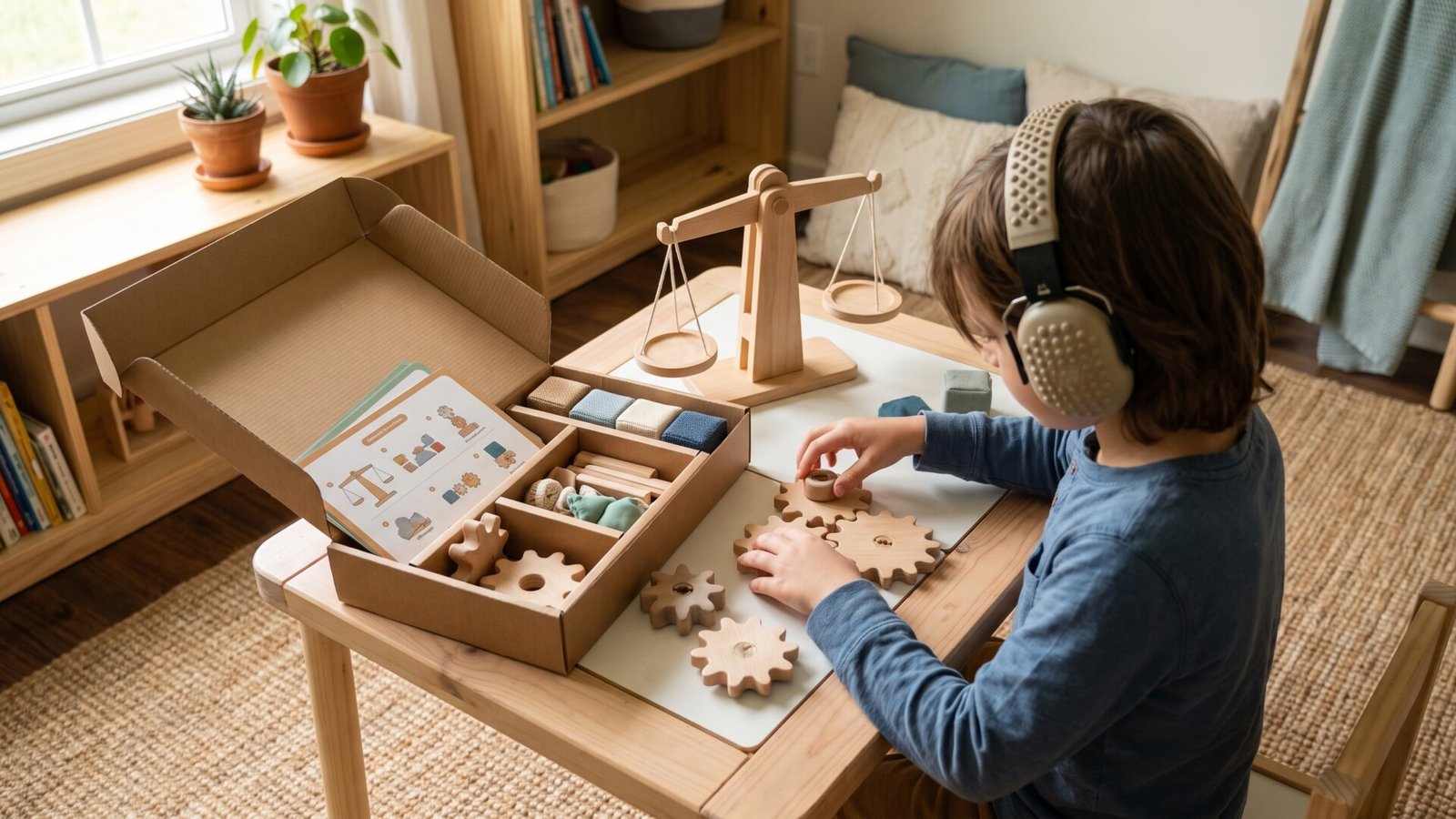
- Have tools ready. Headphones for noisy steps, gloves for textures and wipes for sticky hands.
- Split projects into steps. Taking a break halfway is fine.
- Keep a favorites shelf. Some families keep the projects their children return to and donate the rest.
- Supervise small parts and chemicals. This is especially important with siblings, pets and younger children around.
If you are exploring more sensory-friendly options beyond subscriptions, our toys for children with specific needs collection, our STEM toys hub and our toys by age guide are good places to continue. For no-subscription ideas, try our science experiments to try at home.
When to Involve an Occupational Therapist
If sensory experiences are making everyday activities hard for your child, an occupational therapist or your child’s pediatrician can help you understand what is going on and suggest strategies tailored to your child. STEM boxes are toys and learning activities. They are not treatment, and we do not make claims that any box will improve sensory processing, development or behavior. Many families do find it helpful to ask an OT which materials or activity types tend to suit their child, then use that as a filter when choosing a box.
Our Bottom Line
There is no single best box for every sensory profile. KiwiCo and Little Passports Science Expeditions are well-established, structured options, Green Kid Crafts and Sensory TheraPlay Box lean toward tactile, craft-style play, and MEL Science is best for older children who want real chemistry and whose families can preview and supervise carefully. Whichever you try, start short, preview each month’s contents, and trust what you see in your own child. If a box is not working after a few months, it is completely fine to pause or switch.
Frequently Asked Questions About STEM Subscription Boxes For Children With Sensory Issues
What exactly are STEM subscription boxes?
They are regular deliveries of hands-on science, technology, engineering and math activities. Each box usually contains the materials and instructions for one or more projects.
Are these boxes safe for children with sensory challenges?
Safety depends on the child and the specific project. Many boxes include small parts, and some include chemicals, glues or powders, so check age labels and safety guidance and supervise as needed. Sensory comfort also varies widely, so preview sounds, textures and smells before each project.
How often do boxes arrive?
Most subscriptions are monthly. Some lines, such as certain baby-focused crates, ship less often, and several companies let you skip or pause. Check each company’s terms.
Can I cancel easily?
Most of the companies above say you can cancel or pause, but terms differ. With some, skipping a month is not the same as cancelling, so read the account page and set a reminder before renewal.
What is the typical price range?
The boxes covered here run from roughly $18 to $42 per box in USD, depending on the company, plan length and promotions. Check shipping and the final total at checkout.
Should I ask an occupational therapist before subscribing?
If your child works with an OT, it is a good idea to ask which materials, sounds and activity types suit them. A box is a toy, not a therapy, and no box can promise particular outcomes.
Can siblings do the projects together?
Often yes, but some children need their own materials and space, and group activity can feel busy. Keep small parts away from younger siblings and try one project at a time.