Best World Map Floor Puzzles for Kids
A practical, parent-focused guide to choosing the right giant map puzzle for every age
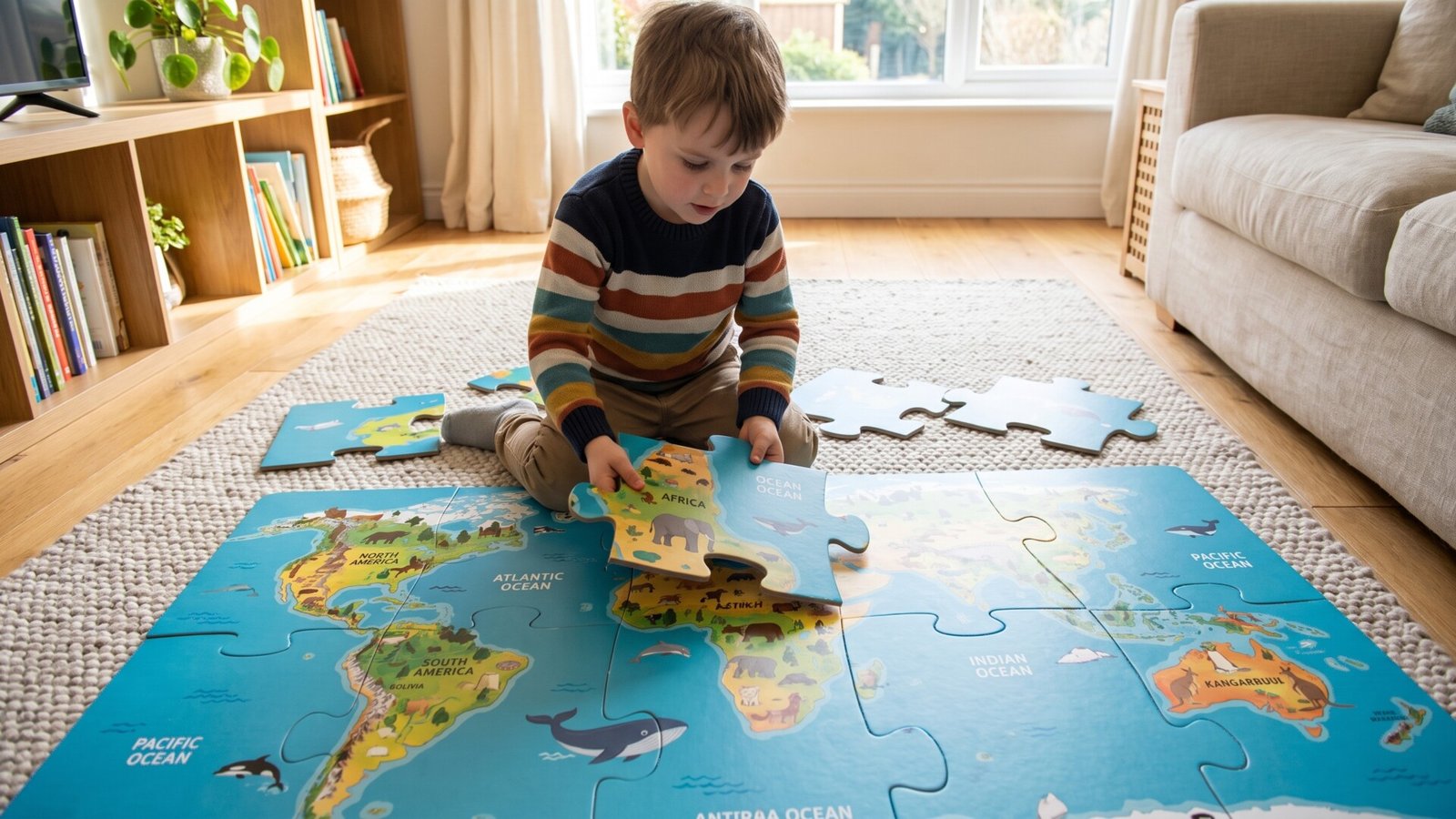
World map floor puzzles are one of those toys you bring home thinking, “This will be fun,” and then you notice your child asking about continents, oceans, animals and landmarks. It’s hands-on geography disguised as playtime: big pieces, big pictures and plenty of movement.
If you’ve wondered which world map puzzle will hold your child’s attention, survive real kids and fit on your living-room floor, this guide walks through what to look for, how to match piece counts to age, and the world map puzzles we could confirm against retailer and maker listings. It is part of our STEM toys for kids guide, and pairs well with our article on floor puzzles that teach geography.
Quick Picks
| Puzzle | Pieces | Listed age | Best for |
|---|---|---|---|
| Melissa & Doug World Map Floor Puzzle | 33 (about 2 x 3 feet when finished) | 3+ | First world map for preschoolers |
| Crocodile Creek World Map | 200 (about 19 x 13 inches, with storage cylinder and poster) | 6–8 and up | Early elementary kids who like a challenge |
| Eurographics World Map XXL | 100 (other Eurographics maps have 550 or 1000 pieces) | Check the listing | Kids and families who want a more realistic map |
Piece counts, sizes and ages come from retailer and maker listings checked in November 2026. Prices change often and vary by retailer, so check current pricing before you buy.
Why World Map Floor Puzzles Are Worth Having
They turn something abstract into something kids can touch
A flat map in a book is tiny and overwhelming. When the world is laid out across the floor, kids can see how continents fit together and how the world has shape and structure.
Big movement supports learning
Floor puzzles invite stretching, crawling, picking up, rotating and sliding pieces into place. That hands-on, full-body play makes the geography more memorable than a worksheet for many children.
They spark questions about the world
Illustrated animals, foods and landmarks prompt questions: “Why are penguins here?” “Why is the Eiffel Tower in France?” “What’s that big desert in Africa?” You get easy learning moments without running a lesson.
They invite many skills at once
While building, children practice spatial reasoning, problem-solving, concentration, memory, fine motor control and perseverance. No puzzle guarantees a result, but the process gives plenty of practice. For the thinking behind this, see how STEM toys improve critical thinking and the science of open-ended play.
They grow with your child
A three-year-old may only match pieces by color or animal. A six-year-old may start learning continent names. An eight-year-old can read labels and countries, and a ten-year-old can follow borders and compare regions. That range makes a map puzzle a longer-lasting toy than many toddler toys, as the table above shows.
What Makes a World Map Floor Puzzle “Good”?
Not all world map puzzles are equal. Some are gorgeous but flimsy; others are educational but frustrating to assemble. These traits matter most:
- Thick, durable pieces. Sturdy cardboard that doesn’t peel or warp holds up to repeated use.
- Clear artwork. Color-coded continents and recognizable icons (animals, landmarks) help young children, while busy designs can overwhelm them.
- Age-appropriate piece count. This is the biggest factor in whether a puzzle feels exciting or overwhelming.
- A reasonable layout. Many children’s maps distort country sizes to fit artwork, which is fine, but the basic layout should still teach real geography.
- The right size. A 2 x 3 foot puzzle suits an apartment better than a giant one; measure your floor space.
- Educational extras. Labels, flags, climate zones, major cities and a matching poster add depth for older children.
- Good color contrast. Distinct edges and readable labels help young eyes.
Safety and Age Grade
Puzzle age grades are safety ratings as much as skill ratings. Cardboard puzzles with small pieces are usually graded 3+ because pieces can be a choking hazard for children under 3, and children who still mouth objects are better off with a foam or chunky wooden puzzle with large pieces. Check the box, supervise young children and pick up stray pieces so they don’t end up under furniture or in a younger sibling’s hands. For when to move up in difficulty, see when to introduce puzzles: progression by age.
Choosing the Right Puzzle by Age
Ages 2–3: simple illustrations and fewer, larger pieces
Look for roughly 24–36 pieces (for a three-year-old), bold colors, animal illustrations and large, chunky pieces. Under 3, choose foam or oversized pieces and supervise. Kids this age aren’t learning detailed geography; they’re learning shapes, matching, recognition and confidence. A simple world map with animals is plenty.
Ages 4–5: bigger puzzles, clear continent boundaries
Look for about 48–60 pieces, clear continent boundaries and basic labels. At this age, many children start remembering continent names and identifying oceans.
Ages 5–7: kids want detail
Look for 60–100 pieces, landmarks, country outlines and richer artwork. This is a sweet spot for world map puzzles.
Ages 7+: accuracy and challenge
Look for 100+ pieces, accurate geography, clear labeling and detailed illustrations. Children this age can start memorizing locations and comparing the puzzle with a globe.
The Best World Map Floor Puzzles for Kids
Below are world map puzzles whose basic specifications we could confirm from retailer or maker listings. We don’t claim to have tested them ourselves. We explain what makes each one useful, who it suits and what to watch for.
1. Melissa & Doug World Map Floor Puzzle
Best first world map puzzle for ages 3 and up
This is a 33-piece jumbo jigsaw that measures about 2 x 3 feet when assembled and is listed for ages 3 and up. Each continent is color-coded, and illustrations of animals and landmarks help children link places to something familiar.
Why it works well: the large pieces are easy for small hands, the piece count is manageable for preschoolers, and the finished size is big enough for floor play. What kids encounter: continents, oceans and the general layout of the world. Trade-off: with only 33 pieces, a confident 6-year-old may finish it quickly, so it suits a first map better than a long-term challenge. Best for: preschoolers and early elementary children building their first world map.
2. Eurographics World Map XXL (100 Pieces)
A step up for older kids who want a more realistic map
Eurographics makes world map jigsaws in several sizes, including a 100-piece XXL version, as well as 550-piece and 1000-piece maps for older builders and adults. The maps lean toward realistic geography rather than cartoon artwork. Details such as exact labeling and extras differ by version, so read the product description of the specific puzzle to confirm what it includes.
Why consider it: a more map-like design helps children move from picture-based puzzles to real geography. Trade-off: less child-oriented illustration means younger children may find it less inviting. Best for: kids who have outgrown 48-piece puzzles, homeschool families and anyone who wants a puzzle that doubles as a teaching map.
3. Crocodile Creek World Map Puzzle (200 Pieces)
Best for early elementary kids who like a bigger challenge
This 200-piece jigsaw is listed for ages 6–8 and up, measures about 19 x 13 inches when finished (so it is a tabletop-sized puzzle rather than a giant floor puzzle) and comes with a matching poster and a heavy-duty storage cylinder with a handle. The poster helps children find where a piece belongs, and the cylinder is useful for travel and storage.
Why consider it: the poster makes it more approachable for independent builders, and the storage tube keeps the pieces together. Trade-off: it is not a toddler or preschool puzzle, and the finished size is smaller than the floor puzzles above. Best for: children aged 6 to 8 and up who like detailed puzzles.
Other Types of World Map Puzzle to Consider
Several other makers, including Ravensburger and Mudpuppy, publish world map puzzles, but we have not confirmed their current specifications, so we don’t recommend specific models here. Whichever you consider, compare piece count, finished size, age grade and whether the pieces are cardboard or foam, then read recent reviews on the retailer page. Some kinds of puzzles to look for:
- Foam world map puzzle mats: soft, easy to wipe clean and better for toddlers who mouth objects, though the pieces are less detailed.
- Round (globe-style) map puzzles: they show the world’s shape more faithfully than a rectangular map and can introduce the idea of map distortion.
- Puzzle plus globe pairings: building the flat map and then finding the same places on a globe helps children connect the two. A small globe is a lasting addition even without a matching puzzle.
How to Use World Map Puzzles to Teach Geography Naturally
You never need to treat a puzzle like a lesson. Work learning into the play:
- Start with animals. Ask, “Where do you think this lion piece goes?” Animals link continents to something familiar.
- Try continent hunts. Pick a piece and ask where it belongs on the puzzle.
- Point out the oceans. Repetition helps names stick: “This is the Pacific Ocean. It’s huge.”
- Compare with a globe or book. Kids notice differences, such as “Why does Africa look smaller on this one?”
- Talk about places your family knows. Show where you’ve traveled or where relatives live.
- Connect puzzles to books and videos. When a story is set in another country, find it on the map.
- Walk around the world. Have children step from South America across to Africa. Movement helps memory.
If you want more ideas like this, read learning through play: STEM activities for preschoolers and introduce STEM early: a parent’s roadmap.
What to Do if Your Child Gets Frustrated
- Break the puzzle into sections. Most puzzles visually separate continents, so start with one.
- Begin with the edges. Many children like building the “frame” first.
- Sort by color first. Color-coded continents make this easy.
- Offer help through questions. “How does this shape match the space?” works better than “Here, let me do that.”
- Keep it out after finishing. Children enjoy revisiting their work and pointing things out.
If a puzzle is a repeated source of frustration, drop down a piece count and try again in a few weeks. Interest often returns once a child has more experience.
Frequently Asked Questions About World Map Floor Puzzles For Kids
What age is a world map floor puzzle suitable for?
Cardboard world map floor puzzles like the 33-piece Melissa & Doug map are listed for ages 3 and up. Younger children, especially those who still mouth objects, do better with foam or chunky puzzles. Always check the age grade on the box.
How many pieces should a world map puzzle have?
About 24 to 36 pieces suits many 3-year-olds, 48 to 60 pieces for ages 4 to 5, 60 to 100 for ages 5 to 7, and 100 or more for ages 7 and up. Every child is different, so choose by how they handle other puzzles.
Are world map puzzles accurate?
Children’s maps often simplify or distort country shapes and sizes to fit illustrations. That is fine for early learning, but older children may benefit from a realistic map like the Eurographics maps. Comparing the puzzle with a globe is a good way to talk about map distortion.
Do floor puzzles help kids learn geography?
They give children hands-on practice with continents, oceans and layout, and prompt questions about the world. They work best alongside conversation, books and a globe rather than on their own.
How big is a world map floor puzzle?
It varies. The Melissa & Doug 33-piece map is about 2 x 3 feet; the Crocodile Creek 200-piece map is about 19 x 13 inches. Measure your space before buying.
How do I store a large puzzle?
Use the box, a zip bag or a storage cylinder, and put all pieces away after each use so none are lost. A puzzle with a storage tube, like the Crocodile Creek version, is easier to carry and store.
Final Thoughts
A world map floor puzzle is a tactile, large-scale, replayable way to build curiosity about the world. Choose a piece count your child can finish with a little effort, check the age grade, and use the puzzle as a starting point for conversation. For more STEM and learning ideas, explore our STEM toys for kids guide, the STEM & educational toys overview and our guide to open-ended toys that grow with your child.