Logic & Math Puzzles for 8-Year-Olds
I have a confession to make. When my oldest turned eight, I thought I had this parenting thing figured out. School was going well, bedtime was under control, and I had a solid rotation of activities to keep him entertained. Then came the dreaded math homework meltdown. You know the one—where tears start flowing and suddenly every number on the page looks like a foreign language.
That’s when I discovered something that changed everything: logic and math puzzles. Not worksheets disguised as fun, but real puzzles that made my son forget he was learning. He’d spend thirty minutes trying to figure out a marble run configuration without looking up once. And the best part? His math confidence started growing without me having to say a single word about multiplication tables.
If you’re reading this, you probably already know that eight-year-olds are at a sweet spot developmentally. They’re old enough to handle complex problems but young enough that play still matters deeply. The question is: how do you find puzzles that actually work? Not the ones that collect dust on a shelf after one use, but the ones that become part of your child’s daily routine.
I’ve spent years testing these puzzles with my own kids and watching what happens when they get them right—and wrong. In this article, I’ll share the five logic and math puzzles that have earned a permanent spot in our home, along with everything I wish someone had told me before I started buying. Let me walk you through what actually works for eight-year-olds.
Why Logic and Math Puzzles Matter More Than You Think
Let me be honest with you. When I first started looking into puzzles for my kids, I thought I understood the basics. Puzzles are good for brains. Kids learn problem-solving. End of story. But then I started reading the research, and I realized I was missing something important.
Here’s what the American Academy of Pediatrics and child development researchers have found: between ages seven and nine, children’s brains undergo a significant shift. They move from concrete thinking—where everything is black and white—to more abstract reasoning. This is when they start understanding that there can be multiple ways to solve a problem, and that some solutions are more elegant than others.
Logic and math puzzles tap directly into this developmental window. When your child works through a puzzle, their brain is literally building new neural pathways. They’re learning to hold multiple pieces of information in working memory, test hypotheses, and adjust their approach when something doesn’t work. These aren’t just nice skills to have—they’re foundational for everything from reading comprehension to advanced math.
I remember watching my son struggle with a particularly tricky logic puzzle. He tried the same approach four times, getting frustrated each time. Finally, he stopped, took a breath, and said, “Wait, what if I start from the end instead?” That moment—when he shifted his entire strategy—was worth more than any worksheet I could have given him.
But here’s the thing I’ve learned the hard way: not all puzzles are created equal. Some are too easy and get abandoned after five minutes. Others are too hard and lead to tears and frustration. The sweet spot is a puzzle that’s challenging enough to require real thinking but achievable enough that success feels possible.
What Actually Makes a Good Logic or Math Puzzle?
Before I jump into specific recommendations, let me clarify what we’re actually talking about. Logic and math puzzles come in many forms, and understanding the differences will help you choose wisely.
Logic puzzles require your child to use deductive reasoning. Think of puzzles where you have to figure out who lives in which house based on a set of clues, or determine the correct sequence of events. These puzzles strengthen the ability to hold multiple conditions in mind and eliminate possibilities systematically.
Math puzzles, on the other hand, focus specifically on numerical reasoning. This includes everything from simple arithmetic puzzles to more complex problems involving patterns, sequences, and spatial relationships. The best math puzzles don’t feel like math—they feel like games that happen to involve numbers.
Then there are hybrid puzzles that combine both logic and math elements. These are often the most engaging because they require your child to switch between different types of thinking. A marble run that requires calculating angles and testing hypotheses? That’s a hybrid puzzle at its finest.
One distinction that matters more than you might think is the difference between open-ended and closed puzzles. Open-ended puzzles, like pattern blocks, have multiple solutions and encourage creativity. Closed puzzles, like a specific logic grid problem, have one correct answer. Both have value, but they serve different purposes. Open-ended puzzles are great for building confidence and encouraging experimentation. Closed puzzles teach precision and systematic thinking.
Key Buying Factors for Logic and Math Puzzles
I wish someone had handed me a checklist before I started buying puzzles. Instead, I learned through trial and error—and a few expensive mistakes. Here’s what I’ve found matters most.
Safety comes first. This seems obvious, but it’s worth stating. Look for puzzles made from non-toxic materials, especially if your child still puts things in their mouth (yes, even at eight, some kids do). Avoid puzzles with small parts that could be choking hazards. Most reputable brands clearly label their age recommendations and safety certifications.
Durability is non-negotiable. Eight-year-olds are not gentle. Puzzles get dropped, thrown, stepped on, and occasionally used as projectiles. I’ve had cardboard puzzles fall apart after a week and wooden puzzles that survived three kids. Pay attention to materials and construction quality. You’re investing in something that should last.
Age appropriateness matters more than you think. An eight-year-old’s cognitive abilities vary widely. Some kids are ready for complex logic puzzles while others need simpler challenges. Look at the recommended age range as a starting point, but also consider your child’s individual development. If they get frustrated easily, err on the side of easier puzzles.
Educational value should be real, not marketing. Some puzzles claim to teach advanced concepts but are really just glorified games. Others are genuinely educational but boring. The sweet spot is puzzles where learning happens naturally because the child is engaged. I’ve found that the best educational puzzles don’t feel educational at all.
Ease of use matters for independent play. If your child needs constant help setting up or understanding a puzzle, it defeats the purpose. Look for puzzles with clear instructions that an eight-year-old can follow independently. Some puzzles require adult setup but then allow independent play—that’s fine too, as long as you know what you’re getting into.
Storage is a practical concern. Puzzle pieces have a way of multiplying and taking over your living room. Consider how the puzzle is stored. Does it come with a bag or box? Can pieces be organized easily? Will you lose pieces if they’re not stored properly? These questions matter more than you’d think.
The Pros and Cons of Logic and Math Puzzles
Let me be real with you. These puzzles are fantastic, but they’re not magic. Here’s what works and what doesn’t.
The good news: When you find the right puzzle for your child, magic happens. They’ll play independently for thirty minutes or more. They’ll develop critical thinking skills without realizing it. They’ll build confidence as they solve increasingly difficult challenges. And they’ll learn that failure is just part of the process—not something to be afraid of.
I’ve watched my kids go from “I can’t do this” to “Let me try again” with the right puzzles. That shift in mindset is worth more than any academic skill.
The honest challenges: Some puzzles are genuinely frustrating. If your child has a low tolerance for failure, you’ll need to be strategic about which puzzles you introduce. Start with easier ones and build up. Also, some puzzles require adult involvement that you might not have time for. Be honest with yourself about how much hands-on help you can provide.
The initial cost can also be a barrier. Quality puzzles aren’t cheap, and some require additional purchases (like an iPad for Osmo). But I’ve found that a few high-quality puzzles that get used regularly are better than a shelf full of cheap ones that get ignored.
Our Top Logic and Math Puzzles for Eight-Year-Olds
After years of testing with my own kids and talking to other parents, these are the five puzzles that consistently deliver. Each one has earned its place in our home.
ThinkFun Math Dice Jr.
| Feature | Details |
|---|---|
| Age Range | 8+ |
| Key Features | Quick math games, fun dice format, encourages mental math skills |
| Affiliate Program | ThinkFun Affiliate Program |
Why We Like It
Math Dice Jr. is one of those rare puzzles that feels like a game first and math practice second. The concept is simple: roll the dice, then use basic arithmetic to reach the target number. But the execution is brilliant. Kids get so caught up in the competition that they forget they’re drilling math facts.
I remember the first time I played this with my son. He was struggling with subtraction, and I was dreading another tutoring session. But within five minutes, he was shouting out answers and begging for another round. The dice format keeps things fast-paced and unpredictable, which is exactly what an eight-year-old needs.
Best For
This is perfect for kids who love games and friendly competition. It works great for siblings or parent-child play. If your child is motivated by beating their own high score or competing against others, this will be a hit.
Pros
- Easy to learn in under two minutes
- Encourages mental math without worksheets
- Portable enough for restaurants or travel
- Multiple difficulty levels as kids improve
Cons
- May require adult supervision for younger kids who struggle with math
- The competitive aspect can be stressful for some children
- Limited replay value if your child prefers solo activities
[Affiliate: Check current pricing and availability for ThinkFun Math Dice Jr.]
Melissa & Doug Wooden Pattern Blocks
| Feature | Details |
|---|---|
| Age Range | 3-8 |
| Key Features | 60 colorful wooden blocks, encourages spatial reasoning |
| Affiliate Program | Melissa & Doug Affiliate Program |
Why We Like It
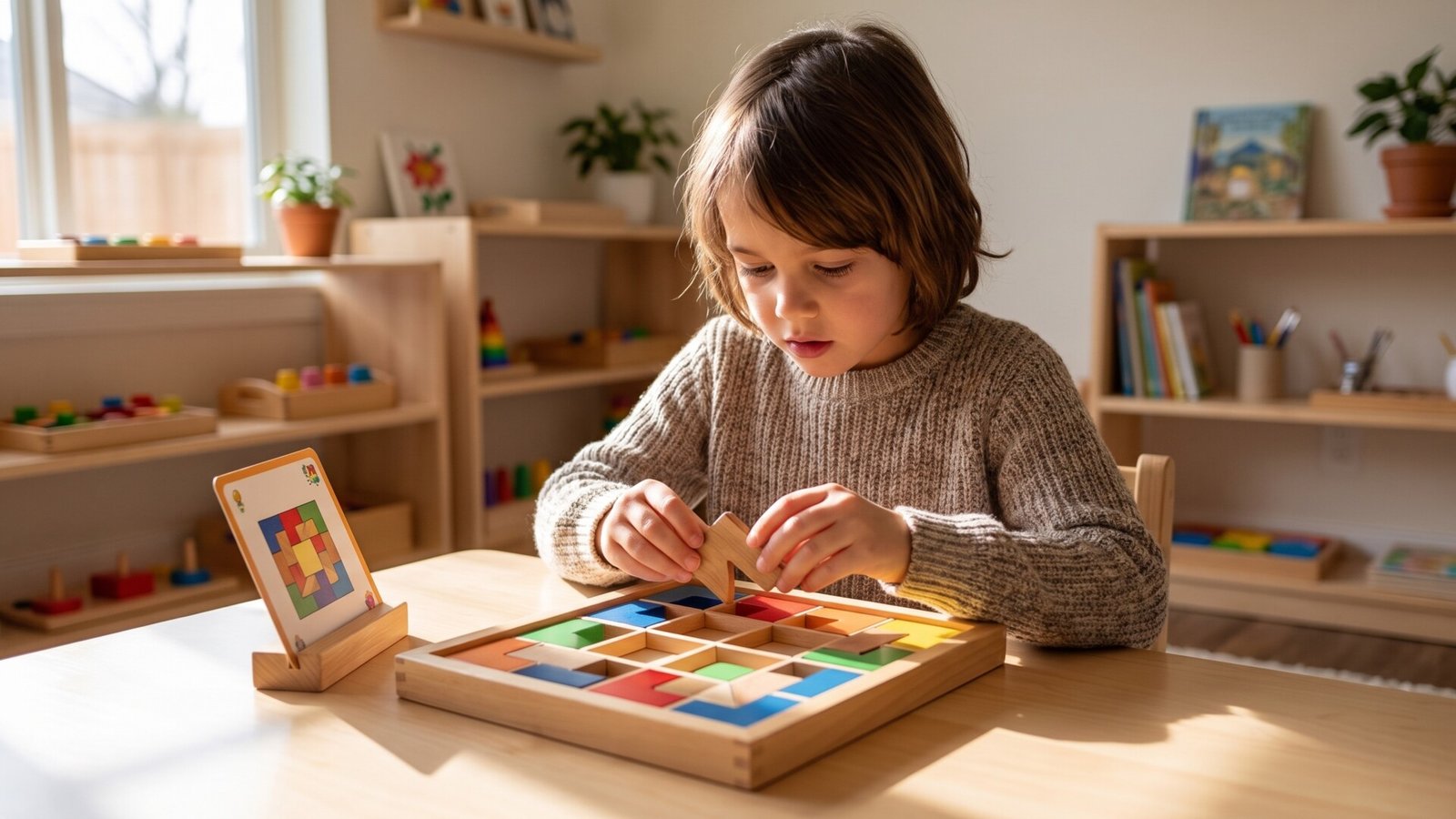
I almost didn’t include this one because it seems so simple. But then I watched my eight-year-old spend an entire rainy afternoon creating geometric patterns, and I changed my mind. These blocks are deceptively educational. They teach spatial reasoning, symmetry, and pattern recognition—all foundational math skills.
The wooden blocks are satisfying to hold and arrange. Unlike digital puzzles, there’s something tactile about physically moving pieces into place. My daughter, who usually avoids anything that looks like math, gravitates toward these blocks because they feel like art.
Best For
This is ideal for hands-on learners who need to touch and manipulate objects to understand concepts. It’s also great for creative kids who enjoy open-ended play. The pattern cards provide structure, but the real magic happens when kids start creating their own designs.
Pros
- Durable wooden construction that survives rough play
- Open-ended play possibilities
- Teaches geometry concepts naturally
- No batteries or screens required
Cons
- Less focused on math compared to other options
- Some kids may need encouragement to use the pattern cards
- Pieces can get lost if not stored properly
[Affiliate: Check current pricing and availability for Melissa & Doug Wooden Pattern Blocks]
Brain Quest Workbook: Grade 3
| Feature | Details |
|---|---|
| Age Range | 8-9 |
| Key Features | Comprehensive workbook covering math and logic puzzles |
| Affiliate Program | Amazon Associates |
Why We Like It
I’ll be honest: I was skeptical about workbooks. They seemed like homework disguised as fun. But Brain Quest changed my mind. The puzzles are genuinely engaging, with colorful illustrations and clever challenges that don’t feel like busywork.
What sets this apart is the variety. One page might have a logic puzzle about figuring out which animal lives in which house. The next page has a math puzzle about sharing cookies equally. This variety keeps kids engaged and exposes them to different types of thinking.
Best For
This is perfect for kids who thrive on structure and clear expectations. If your child likes knowing exactly what to do and checking off completed pages, this will work well. It’s also great for parents who want to see measurable progress.
Pros
- Comprehensive coverage of multiple subjects
- Engaging illustrations that hold attention
- Clear progression of difficulty
- Portable and requires no setup
Cons
- Some puzzles may not be challenging enough for advanced learners
- Requires writing, which some kids resist
- Less interactive than hands-on puzzles
[Affiliate: Check current pricing and availability for Brain Quest Workbook]
Osmo Genius Starter Kit for iPad
| Feature | Details |
|---|---|
| Age Range | 6-10 |
| Key Features | Interactive learning with physical puzzles and digital feedback |
| Affiliate Program | Amazon Associates |
Why We Like It
I had mixed feelings about introducing more screen time, but Osmo is different. The physical pieces interact with the iPad in a way that feels magical. Kids arrange physical tiles, and the app responds in real time. It’s the best of both worlds—tactile play with digital feedback.
The math games are particularly clever. Kids arrange number tiles to solve equations, and the app provides immediate feedback. There’s no waiting for a parent to check answers. The instant correction helps kids learn from mistakes without feeling judged.
Best For
This is ideal for tech-savvy kids who are drawn to screens anyway. Instead of fighting screen time, you’re channeling it productively. It’s also great for kids who need immediate feedback and motivation to keep going.
Pros
- Innovative format that feels like magic
- Immediate feedback helps learning
- Multiple games included in starter kit
- Physical and digital elements engage different senses
Cons
- Requires an iPad to use
- Initial cost is higher than other options
- Some kids may prefer purely physical puzzles
- Requires supervision to ensure proper setup
[Affiliate: Check current pricing and availability for Osmo Genius Starter Kit]
Gravity Maze Marble Run Logic Game
| Feature | Details |
|---|---|
| Age Range | 8+ |
| Key Features | Logic game that builds spatial reasoning and problem-solving skills |
| Affiliate Program | Amazon Associates |
Why We Like It
This is the puzzle that surprised me the most. I bought it thinking it would be a fun toy, not realizing how much logic was involved. Each challenge requires you to build a path for a marble to reach its target. But you can only use certain pieces, and the marble has to follow the laws of physics.
The first time my son completed a challenge, he ran through the house shouting, “I did it! I figured it out!” That feeling of accomplishment is exactly what we want for our kids. The puzzles start easy and gradually increase in difficulty, so kids build confidence before facing harder challenges.
Best For
This is perfect for kids who love building and construction. If your child enjoys LEGOs, K’NEX, or other building toys, they’ll love Gravity Maze. It’s also great for kids who need to see physical results from their logical thinking.
Pros
- High replay value with multiple challenges
- Teaches physics concepts naturally
- Satisfying physical feedback when marble reaches target
- Encourages trial and error learning
Cons
- Assembly may require adult help for some challenges
- Pieces can be lost if not stored properly
- Some kids may find the increasing difficulty frustrating
[Affiliate: Check current pricing and availability for Gravity Maze Marble Run]
Comparison Table
| Product | Age Range | Durability | Educational Value | Price Range | Best For |
|---|---|---|---|---|---|
| ThinkFun Math Dice Jr. | 8+ | High | 5 stars | $$ | Game lovers |
| Melissa & Doug Wooden Pattern Blocks | 3-8 | High | 4 stars | $ | Hands-on learners |
| Brain Quest Workbook: Grade 3 | 8-9 | Medium | 4 stars | $$ | Structured learning |
| Osmo Genius Starter Kit | 6-10 | High | 5 stars | $$$ | Interactive learners |
| Gravity Maze Marble Run | 8+ | High | 5 stars | $$ | Builders |
How to Choose the Right Puzzle for Your Child
You’ve seen the options. Now let me help you make a decision that actually works for your family.
Best for small spaces: The Brain Quest Workbook takes up almost no space and requires no setup. It’s perfect for apartments or families who need portable options. ThinkFun Math Dice Jr. is also compact enough to fit in a bag.
Best for collaborative play: Gravity Maze and ThinkFun Math Dice Jr. both work well for siblings or parent-child play. The marble run naturally invites multiple people to problem-solve together, while Math Dice Jr. is designed for competition.
Best for visual learners: Melissa & Doug Pattern Blocks are perfect for kids who think in images and patterns. The colorful blocks and geometric designs appeal to visual thinkers who might resist traditional math.
Best for independent play: Osmo and Gravity Maze both allow kids to work independently once set up. The immediate feedback from Osmo means kids don’t need to wait for parent approval.
Best budget pick: Melissa & Doug Pattern Blocks offer the most play value for the lowest price. They’re durable, versatile, and can be used for years.
Best premium pick: Osmo Genius Starter Kit costs more upfront but includes multiple games that grow with your child. If you have an iPad already, it’s worth the investment.
What Most Reviews Don’t Tell You
Here’s something I learned the hard way: the best puzzle in the world won’t help if your child isn’t ready for it. I bought Gravity Maze thinking my seven-year-old would love it. He wasn’t ready. The frustration was real, and the puzzle sat on a shelf for six months before he tried again.
The same thing happened with Osmo. My daughter loved it immediately, but my son found the digital feedback overwhelming. Every wrong answer felt like failure to him. We had to take a break and come back later.
The lesson? Don’t force it. Introduce puzzles, let your child explore them at their own pace, and be ready to put them away if frustration builds. Some puzzles click immediately. Others need time. Both are normal.
Another thing I wish I’d known: the packaging always shows kids solving puzzles independently. In reality, most eight-year-olds need some adult guidance at first. Plan to spend fifteen minutes showing them how the puzzle works before expecting independent play.
Which Toy Actually Gets Used After Six Months?
If I had to pick one puzzle that survives the novelty phase and becomes a lasting favorite, it’s Gravity Maze. Something about the marble run format keeps kids coming back. They want to beat their previous challenges, try new configurations, and show off their solutions to anyone who will watch.
But here’s the honest truth: every child is different. My son loves Gravity Maze. My daughter prefers Osmo. My nephew can’t get enough of Math Dice Jr. The best puzzle is the one your child actually wants to play.
Frequently Asked Questions About Logic & Math Puzzles
What are the benefits of logic and math puzzles for kids?
These puzzles develop critical thinking, problem-solving, and mathematical reasoning skills. They also build persistence, patience, and confidence. Kids learn that failure is part of learning and that there are multiple ways to solve problems.
How do I know if a puzzle is age-appropriate?
Start with the manufacturer’s recommended age range, but also consider your child’s individual development. If they get frustrated easily, choose puzzles on the easier end. If they crave challenge, look for puzzles with multiple difficulty levels.
Are there any safety concerns with these puzzles?
Always check for small parts that could be choking hazards. Look for non-toxic materials, especially if your child still puts things in their mouth. Most reputable brands clearly label safety information.
How can I encourage my child to engage with puzzles more?
Lead by example. Solve puzzles alongside your child. Celebrate their successes and normalize their frustrations. Make puzzles accessible—keep them where your child can reach them. And don’t force it. Sometimes taking a break is exactly what’s needed.
What should I look for in the best educational puzzles?
Look for puzzles that balance challenge with achievability. The best puzzles are engaging enough that kids want to play, educational enough that learning happens naturally, and durable enough to survive repeated use.
How long do these puzzles typically last?
With proper care, wooden puzzles can last years. Cardboard puzzles may show wear after several months. Digital puzzles like Osmo last as long as the app is supported. In general, quality puzzles are built to survive multiple children.
Can these puzzles be used for group activities?
Absolutely. Math Dice Jr. is designed for multiple players. Gravity Maze works well for collaborative problem-solving. Pattern blocks are great for group creativity. Even workbooks can be used in group settings with a little creativity.