Montessori Language Games for Kids
Language development in Montessori education begins long before children learn to read or write. From the first spoken words to early literacy skills, Montessori language games are designed to help children absorb language naturally, through movement, repetition, and meaningful interaction.
Rather than worksheets or rote memorization, Montessori language games focus on oral language, vocabulary building, phonemic awareness, and symbolic understanding, all introduced at the child’s developmental pace. These activities are playful, hands-on, and deeply connected to real-world experiences.
This page serves as a language games sub-hub, guiding parents and educators toward Montessori-aligned language activities across ages and skill levels. This collection is part of our main Montessori Toys & Activities for Kids hub and of our wider Montessori & early learning toys guide, where we share thoughtfully designed games, toys, and activities that support early reading, vocabulary building, and communication skills through hands-on Montessori learning.
Start Here: Find the Right Montessori Language Guide
This page gives you the big picture. When you are ready to go deeper, these guides each cover one stage in detail:
- Ages 2–3: Montessori language activities for 2-year-olds and pre-reading activities for toddlers
- Listening and sounds: Montessori sound games for language development
- Letters: Montessori toys for early letter recognition
- Toys and materials: Montessori language toys and the complete guide to Montessori language and literacy toys
- Preschool games and activities: Montessori language games for preschoolers and Montessori language activities for preschoolers
- Beyond Montessori: how toys support language development and toys to encourage language skills in 18-month-olds
- Related skills: Montessori practical life toys and Montessori sensory toys
What Are Montessori Language Games?
Montessori language games are structured activities that help children explore spoken and written language through concrete experiences. They are called “games” not because they are competitive, but because they invite joyful participation and repetition.
Key characteristics of Montessori language games:
- Hands-on and interactive
- Progress from oral language to written language
- Often self-correcting
- Designed for independent or guided use
- Integrated into daily life
Language is treated as something children discover, not something they are forced to memorize.
Why Language Development Is Central in Montessori
Maria Montessori viewed language as a natural human instinct that flourishes when children are surrounded by rich, meaningful communication. She described early childhood, roughly from birth to age six, as a “sensitive period” when children absorb spoken language with unusual ease. Modern research also shows that the early years are an important time for language growth and that conversation with caring adults matters a great deal, although the specific Montessori term “sensitive period” is part of her educational philosophy rather than a clinical diagnosis.
Montessori language work helps children:
- Expand vocabulary naturally
- Develop clear pronunciation
- Understand sentence structure
- Build confidence in communication
- Prepare for reading and writing
Importantly, Montessori language games prioritize spoken language first, laying a foundation before introducing letters and symbols.
How Montessori Language Games Differ from Traditional Language Toys
Many conventional language toys focus on early reading drills, flashcards, or electronic prompts. Montessori language games take a more developmental approach.
Montessori language games:
- Begin with listening and speaking
- Introduce letters only after sound awareness
- Avoid screens and electronics
- Emphasize real objects and experiences
The aim is for children to understand language, not just recognize symbols. A word of caution: “Montessori” is not a protected certification, so a toy sold with the label is not automatically authentic. Look at the design—is it simple, hands-on, self-correcting, and focused on one skill—rather than the packaging. Our beginner’s guide to what makes a toy “Montessori” explains what to look for.
Core Categories of Montessori Language Games
Montessori language activities progress in a natural sequence, moving from oral language to written expression.
Oral Language Games (Listening & Speaking)
Oral language is the foundation of all later literacy skills.
Common Montessori Oral Language Games
- Object naming games
- Classified vocabulary sets (animals, food, tools)
- “I Spy” sound games
- Conversation prompts and storytelling cards
These games help children:
- Expand expressive vocabulary
- Improve listening skills
- Learn descriptive language
- Gain confidence speaking
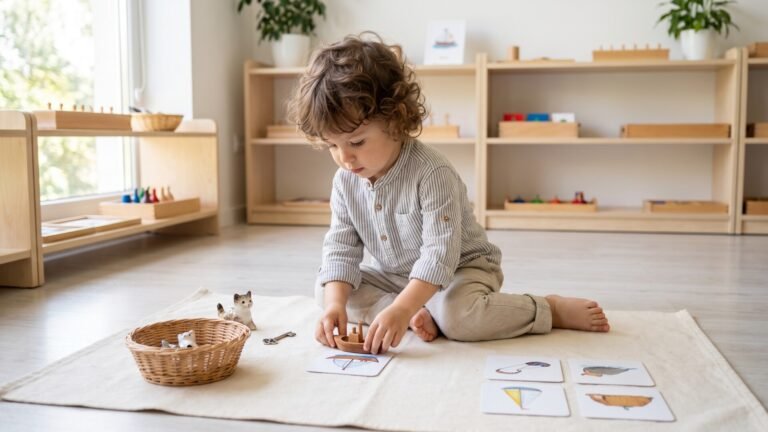
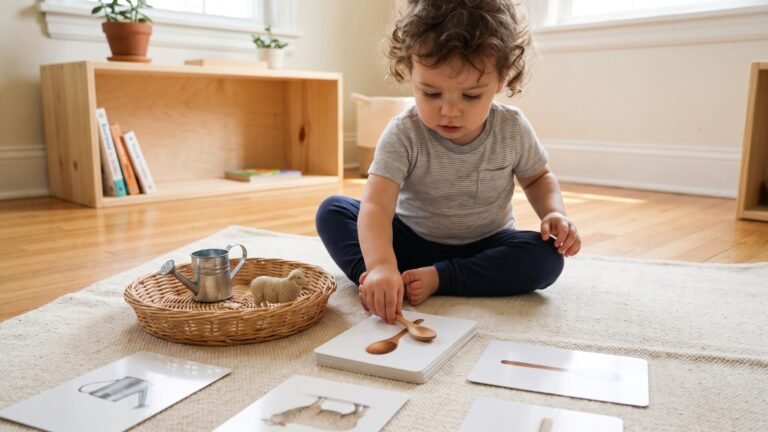
Many oral language games require no materials at all, making them easy to use daily. A classic is the three-period lesson: first you show and name an object (“This is a spoon”), then you ask the child to find it (“Can you point to the spoon?”), and finally you ask them to say it (“What is this?”). Keep sessions short, and stop when the child loses interest.
Phonemic Awareness Games (Sound Recognition)
Before children can read, they must recognize and manipulate sounds in words.
Common Montessori Phonemic Games
- “I Spy” with initial sounds
- Rhyming word games
- Sound sorting activities
- Object-to-sound matching sets
These activities develop:
- Sound discrimination
- Auditory memory
- Early decoding readiness
Montessori introduces sounds first, not letter names. This fits well with mainstream reading research, which highlights phonemic awareness and the link between sounds and letters as key early reading skills. For a full set of sound games, see Montessori sound games for language development.
Letter Recognition & Symbol Games
Once children are comfortable with sounds, they are ready to connect them to symbols.
Common Montessori Letter Games
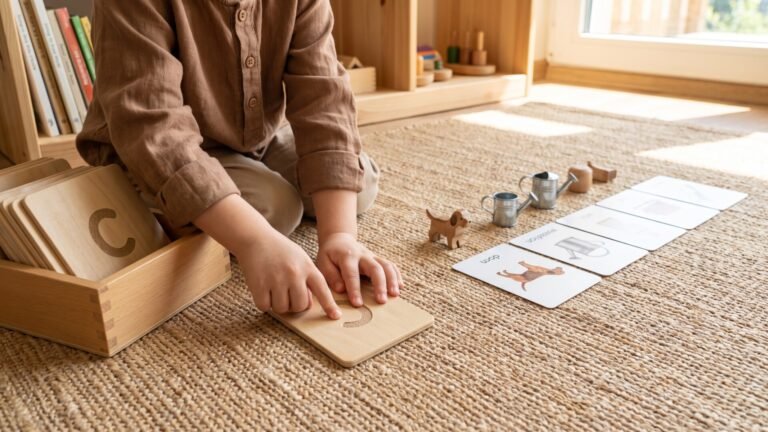
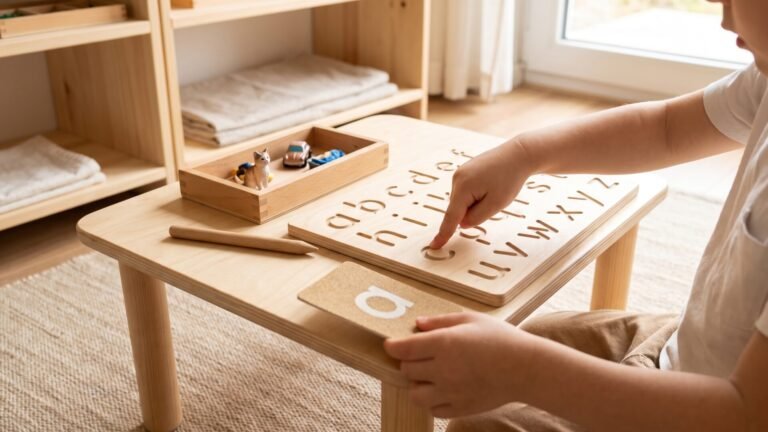
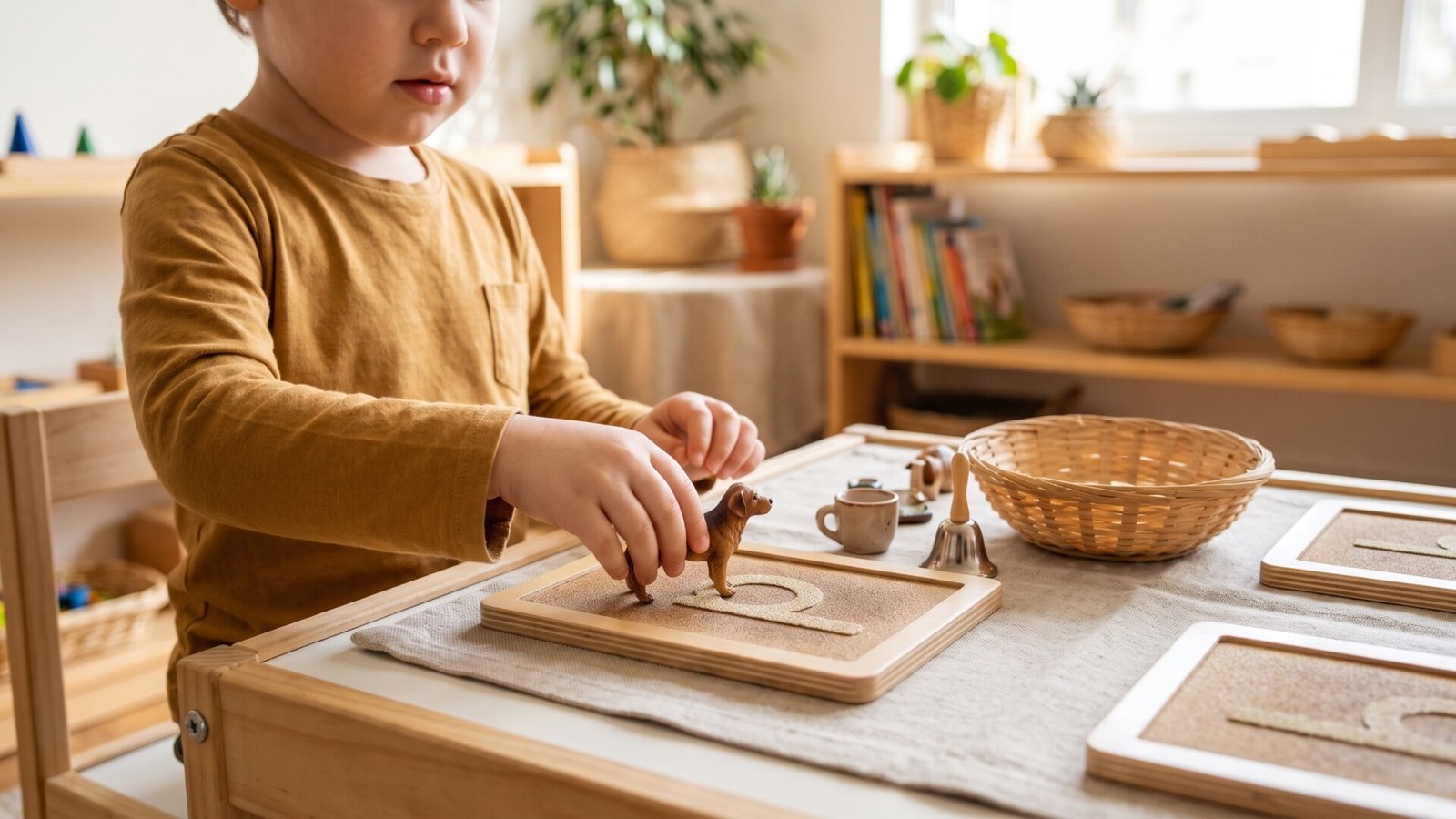
- Sandpaper letters
- Letter matching boards
- Alphabet object trays
- Moveable alphabet exploration
These games support:
- Muscle memory through tracing
- Visual-symbol association
- Fine motor development
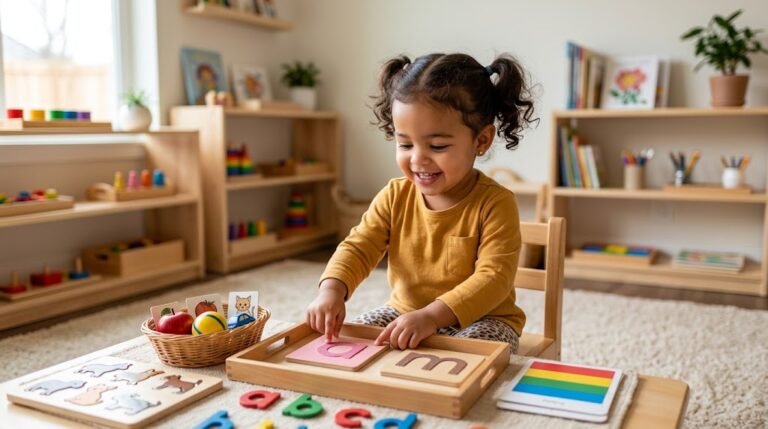
Children often learn to write words using the moveable alphabet before they read them. In traditional Montessori materials, the moveable alphabet colors consonants blue and vowels red, and sandpaper letters are mounted on boards (commonly pink for consonants and blue for vowels) so that children trace the letter while saying its sound. Many parents buy these as wooden or cardboard sets; check the age grade, since the individual letters are small and are not suitable for children who still mouth objects. See also Montessori toys for early letter recognition.
Early Reading Games
Reading emerges naturally when sound-symbol connections are strong.
Montessori Reading Games Include
- Phonetic word cards
- Object-to-word matching
- Simple command cards
- Early reading booklets
These activities help children:
- Practise decoding words independently
- Build reading confidence
- Connect words to meaning, not just symbols
Reading is not rushed—children progress when they are ready. In many Montessori classrooms, the first reading materials follow a sequence often called the pink, blue, and green series: simple three-letter phonetic words first, then words with consonant blends, then words with letter combinations such as “sh” or “ai.” The exact order can vary between schools and home programs.
Writing & Expression Games
Writing in Montessori begins as a physical and expressive process, not a test of spelling accuracy.
Common Montessori Writing Games
- Moveable alphabet storytelling
- Labeling real objects
- Drawing and dictation
- Journaling with prompts
These games encourage:
- Creative expression
- Sentence construction
- Confidence in communication
Spelling and grammar are refined later, after fluency develops.
Montessori Language Games by Age Group
| Age | Main focus | Example games and materials | Go deeper |
|---|---|---|---|
| 1–2 years | Naming, listening, first words | Real objects, songs, picture books, three-period lessons | Language activities for 2-year-olds |
| 2–3 years | Vocabulary growth and pre-reading | Classified picture cards, object baskets, rhymes | Pre-reading activities for toddlers |
| 3–6 years | Sounds, letters, early reading and writing | I Spy, sandpaper letters, moveable alphabet, phonetic cards | Language games for preschoolers |
| 6–9 years | Grammar, comprehension, creative writing | Grammar symbols, sentence analysis, writing prompts | Language and literacy toys guide |
Toddlers (1–3 Years)
Language games at this stage focus on naming and listening.
Recommended activities:
- Object naming with real items
- Simple songs and rhymes
- Picture vocabulary cards
- Daily conversation routines
The goal is joyful communication and a growing vocabulary, which varies widely from child to child. If you have concerns about your toddler’s speech or language, your pediatrician or a speech-language pathologist can help; games are a supplement, not a substitute.
Preschoolers (3–6 Years)
This is the most active period for Montessori language work.
Recommended activities:
- Sound games
- Sandpaper letters
- Moveable alphabet
- Early reading cards
Many children show strong interest in words and sounds during this stage, though readiness for letters and reading varies. If your child is not interested yet, return to oral games and try again in a few weeks.
Early Elementary (6–9 Years)
Language games evolve into structured literacy and expression.
Recommended activities:
- Grammar symbol games
- Sentence analysis
- Creative writing prompts
- Reading comprehension cards
Language becomes a tool for thinking and reasoning.
Free and Low-Cost Language Games You Can Start Today
You do not need to buy a full Montessori language shelf. These ideas use household items:
- Mystery bag: Put a few safe, familiar objects in a cloth bag. The child feels one, guesses, and names it. For sound practice, choose objects that start with the same sound.
- Sound basket: Gather three to five small toys that start with a single sound (for example, a toy sheep, a sock, and a spoon for “s”). Make sure none are small enough to be a choking hazard for the youngest child.
- Kitchen labels: Write simple labels (“door,” “cup”) in clear lowercase and let children match them to objects once they are interested in reading.
- Story retelling: After a picture book, ask your child to retell the story using the pictures, or to say what happens next.
- Dictation: Write down a sentence your child says about their drawing, read it back, and let them add details.
Creating a Montessori Language Area at Home
A prepared environment supports independent language exploration.
Key elements:
- Low shelves with limited materials
- Real objects instead of pictures when possible
- Quiet reading and writing space
- Rotating language materials
Consistency and calm matter more than quantity. Display a few books with their covers facing out, keep each game in its own small tray or basket, and rotate materials every week or two based on what your child is using. Our guide to setting up a minimalist Montessori play shelf shows how to lay this out.
Montessori Language Materials Worth Knowing (and What They Cost)
Most of the games on this page need nothing more than household objects, but a few classic materials come up again and again. Here is what each one is for, how it is usually used at home, and a realistic idea of cost. Prices are approximate US figures and vary a lot between budget home sets and classroom-grade materials.
| Material | What it is for | Typical age | Approx. cost (USD) | Watch out for |
|---|---|---|---|---|
| Object baskets and real-object sets | Naming, three-period lessons, I Spy | From about 18 months | $0 (household items) | Choose objects too large to be a choking hazard |
| Classified picture cards | Vocabulary by category (animals, tools, food) | 2+ | $0 (printable) and up | Use clear, realistic photos rather than cartoons |
| Sandpaper letters (lowercase) | Tracing a letter while saying its sound | 3+ | Budget home sets from about $30 | Board colors and letter styles (print or cursive) vary by maker |
| Moveable alphabet | Building words before handwriting is easy | 3.5–4+ | Budget sets are inexpensive; classroom sets cost much more and are often sold box and letters separately | Many small pieces; not for children who still mouth objects |
| Phonetic object and word cards (pink series) | First reading of three-letter words | 4+ | $0 (printable) and up | Choose cards that match the sounds of your home language |
A few practical notes:
- Sandpaper letters: budget lowercase sets from home-school brands such as Adena Montessori start at roughly $30. Buy lowercase first; Montessori teaches lowercase before capitals because most text a child sees is lowercase.
- Moveable alphabet: classroom makers such as Nienhuis sell the wooden box separately from the letters (the box alone lists at around $70 in the US), which is why full classroom sets cost far more than home versions. A budget wooden set works fine at home if the letters are clearly cut and the vowels and consonants are different colors.
- Mainstream alternatives: not everything needs a Montessori label. Learning Resources’ Alphabet Acorns Activity Set (ages 3+), for example, has children match letters on 26 acorns, which works well as a letter-matching tray. Magnetic letters on the fridge are another inexpensive option for word building, but keep sets with small loose magnets away from children under 3.
For more detailed product recommendations, see Montessori language toys and toys for early letter recognition.
A Simple Week of Language Games
Language games work best as short, regular moments woven into the day rather than long lessons. Here is a sample week for a three- to four-year-old; each activity takes five to fifteen minutes:
- Monday – Mystery bag: four familiar objects to feel, guess and name.
- Tuesday – I Spy with sounds: “I spy something that starts with /m/” during breakfast or a walk.
- Wednesday – Sound basket: sort a handful of objects into two sounds, such as /s/ and /m/.
- Thursday – Tracing: trace two or three sandpaper (or homemade glitter-glue) letters while saying their sounds.
- Friday – Story time and retelling: read a picture book, then let your child tell it back using the pictures.
Skip a day whenever your child is tired or uninterested; consistency over months matters more than any single session. For a fuller plan by age, see Montessori toys by age group.
Signs Your Child Is Ready for the Next Step
- From oral games to sound games: your child names many everyday objects, enjoys rhymes, and can follow a two-step instruction.
- From sound games to letters: they can tell you the first sound of familiar words in I Spy without much help, and they are curious about print (“What does that say?”).
- From letters to the moveable alphabet: they know a good number of letter sounds and can say the sounds in a short word such as “c-a-t.”
- From building words to reading: they start sounding out words they have built, or point to words in books.
If a new step leads to frustration, go back a stage for a few weeks. Moving backwards now and then is normal and not a sign of a problem.
Common Mistakes to Avoid
- Teaching letter names and sounds at the same time: stick to sounds first so children are not confused about which one to use when reading.
- Testing instead of playing: constant “What letter is this?” questions turn a game into a quiz. Name things far more often than you ask.
- Buying the whole shelf at once: one or two materials used well beat a cupboard full of sets.
- Correcting every mistake: when a child builds “kat” with the moveable alphabet, that is a sound-based success. Spelling conventions come later.
Montessori Language Games for Multilingual Homes
Many Montessori language ideas—oral games, sound play, labeled objects—can be used in bilingual or multilingual homes.
Best practices include:
- Clear separation of languages (for example, one person or one setting per language)
- Rich oral exposure in each language
- Consistent sound-based instruction
- Avoiding translation-based drills
Children can learn more than one language when they hear each one regularly in meaningful contexts. Sound-letter relationships differ between languages, so check which letter sounds your materials teach.
Language Games and Academic Readiness
Montessori language games can help children get ready for school without pressure.
They support:
- Reading fluency
- Writing confidence
- Comprehension
- Clear communication
Children who enjoy language play at home often feel more comfortable when formal reading instruction begins, but there is no single path to reading and no guarantee. Children learn to read at different ages, and most schools will teach it systematically. If your child finds reading difficult, ask the teacher or a reading specialist about screening for issues such as dyslexia rather than relying on games alone.
Choosing Montessori Language Games as Gifts
Language materials make excellent long-term gifts.
When choosing:
- Prefer physical, hands-on materials
- Avoid electronic “talking” toys
- Choose open-ended language tools
- Focus on durability and clarity
- Read the age grade and check for small pieces, especially for children under 3
Well-made language materials can be used for years. For specific toys and materials, see our guides to Montessori language toys and language and literacy toys.
Final Thoughts: Language as a Living Skill
Montessori language games respect language as something children live, not something they memorize. By focusing on sound, meaning, and expression, these games can help nurture confident communicators and thoughtful readers.
When children are given time, structure, and meaningful materials, language learning becomes a joyful and lasting process. To continue, explore the Montessori & early learning toys guide, or jump to sound games or letter recognition toys.
Frequently Asked Questions About Montessori Language Games
What age should I start Montessori language games?
You can start from infancy with talking, singing, and naming real objects. Sound games usually begin around age 2.5 to 3, and letter and writing materials around 3 to 4, depending on the child’s interest.
What are the pink, blue, and green series?
They are a common Montessori reading sequence: pink for simple three-letter phonetic words, blue for words with consonant blends, and green for words with letter combinations such as sh, ch, and ai. Schools and programs may vary.
Do I need to buy special Montessori materials?
No. Many games, such as I Spy, mystery bags, and story retelling, need no special materials. If you do buy materials, choose simple, well-made items with the right age grade, and keep in mind that the word ‘Montessori’ on a package is not a certification.
Is the sounds-first approach supported by research?
Mainstream reading research highlights phonemic awareness and phonics as important early skills, and this is consistent with the Montessori emphasis on sounds before letter names. Individual children still progress at different rates.
Are Montessori language games suitable for multilingual children?
Yes, many can be adapted. Keep each language clearly separate, give rich oral exposure in each, and check that letter sounds in your materials match the language being taught.
Should I be worried if my child isn't reading at 4 or 5?
Children learn to read at different ages. If you have concerns about speech, language, or reading progress, speak with your pediatrician, teacher, or a speech-language pathologist.
Do children need to know the alphabet before playing Montessori language games?
No. Montessori introduces letter sounds before letter names, and most early games are oral, so children can start long before they know the alphabet song.
Are worksheets used in Montessori language work?
Typically not in the early years. Hands-on materials such as objects, sandpaper letters and the moveable alphabet are preferred, with pencil work introduced once children have the hand control for it.
Can Montessori language games help a child who is struggling to read?
They can support sound awareness, which helps many children. But a child who is struggling with reading should be assessed by a teacher or reading specialist, since games alone may not be enough.