Montessori Toys by Age Group
Montessori Toys by Age: Best Choices From Infancy Through Early Elementary
I bought a wooden shape sorter for my daughter’s first birthday because the box said 12 months and I am a person who follows instructions. She looked at it, turned it over twice, and went back to the cardboard box it came in. Eight months later she used it daily for about three weeks and then never touched it again. The toy was fine. My timing was wrong. That gap between what a box promises and what a child can actually do is where most Montessori toy money gets wasted, and it is the thing this page exists to fix.
The best Montessori toy for your child is rarely the one matching their birthday. It is the one that sits just past what they can already do, in a space where they can reach it, start it, and finish it without you running the show. Infants need to observe, reach, grasp, and move. Toddlers need repetition and real tasks. Preschoolers need to build, sort, and explain. Early elementary children need projects with an end they can see. This page maps those shifts age by age. The deeper shortlists live in the individual age articles linked throughout, and those are where you should go once you know which stage you are actually buying for.
None of this guarantees anything. A good toy creates conditions for practice. It does not replace you, and no box on a shelf is going to raise your child.
What Changes in Montessori Toys as Children Grow
The materials change because the work changes. A six-month-old is building the connection between eyes, hands, and mouth. A four-year-old is building a tower, a pattern, and an argument about whose turn it is. Same shelf, different job.
Age bands overlap more than product pages admit. A three-year-old who is not interested in puzzles may still want the posting box their younger sibling uses, and an advanced five-year-old can handle logic materials aimed at seven. Buy for the child in front of you, not the number on the box.
The word Montessori on packaging tells you almost nothing. What matters is whether the toy has a clear purpose, real manipulable parts, limited distraction, and a difficulty level the child can meet with effort rather than tears. A plastic posting box that gets used daily beats a hand-carved one that sits on a shelf because it is too precious to touch.
Rotation is the cheapest upgrade you can make. Keep a small number of things visible on a low shelf, store the rest, and swap every week or two. Watch what your child does with a toy rather than what they say about it. Frustration that lasts more than a minute or two means the toy is too hard right now. Instant mastery with no repeat visits means it is too easy. The sweet spot is the toy they return to three days running without being asked.
Montessori Toys by Age Group
Infants: 0-12 Months
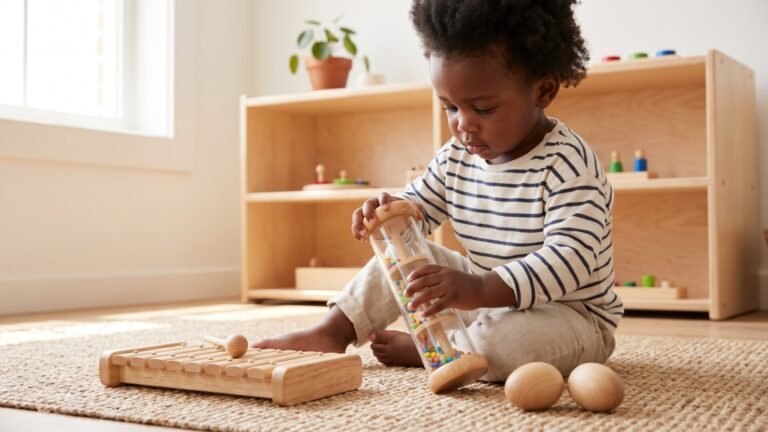
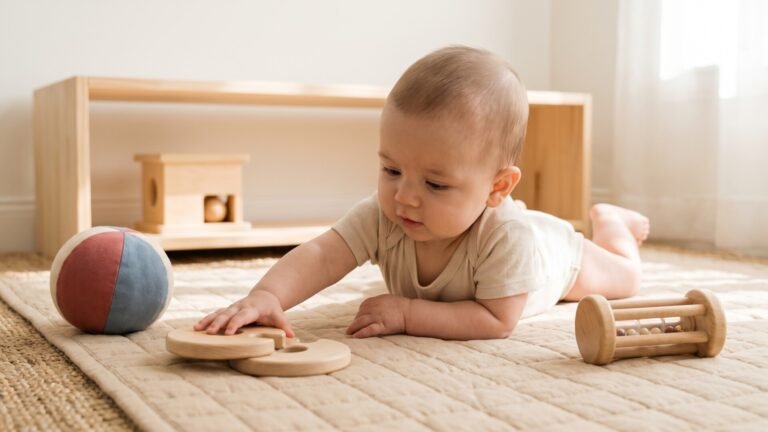
Infant materials are about the body before they are about the mind. Everything in this stage gets mouthed, dropped, and inspected, which means supervision is not optional and the sleep space stays clear of toys entirely. For the full breakdown, Montessori Toys for Infants guide.
Newborns, 0-3 months. High-contrast images, a simple mobile used during supervised awake time, and soft rattles. That is the whole list. A newborn’s job is looking and listening, and a cluttered visual field works against that. Keep mobiles out of the crib and use them where you can see your baby.
3-6 months. Grasping rattles, teethers, a baby-safe mirror, and anything that encourages reaching, rolling, and passing an object from one hand to the other. This is where hand-eye coordination starts getting deliberate. Light, easy-to-grip items beat anything with a battery.
6-9 months. Object permanence boxes, stacking and nesting cups, grasp-and-release toys, and materials that survive being dragged across the floor. Crawling changes everything about how a toy gets used, so weight and durability start to matter as much as shape.
9-12 months. Posting toys, large-piece puzzles, early shape sorters, containers for filling and emptying, and sturdy push or pull toys used only when your child is steady enough on their feet. A push toy given too early becomes a fall waiting to happen.
Safety at this age is mostly about what is not there: no small parts, no loose strings, no magnets, no accessible batteries, no unstable furniture nearby. Check the current manufacturer warnings on anything you buy, including wooden items. Our newborn, 3-6 month, 6-9 month, and 9-12 month guides cover each window in detail.
Toddlers: 1-3 Years
Toddlers want to do what you are doing, badly, and usually with more enthusiasm than control. This is the stage where practical life stops being a category and becomes the main event. See our Montessori Toys for Toddlers hub for the full range.
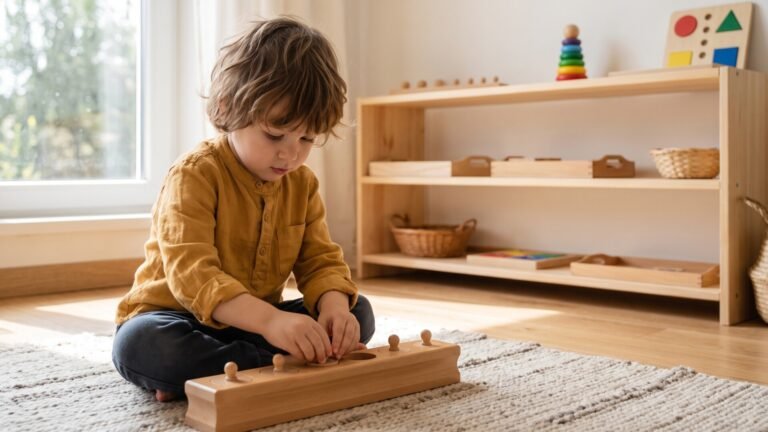
1-year-olds. Large knob puzzles, stacking rings, nesting cups, simple posting toys, object permanence boxes, and push-along or carry materials. Nothing here requires walking. A child who is not walking yet can still get months of use out of a good posting box.
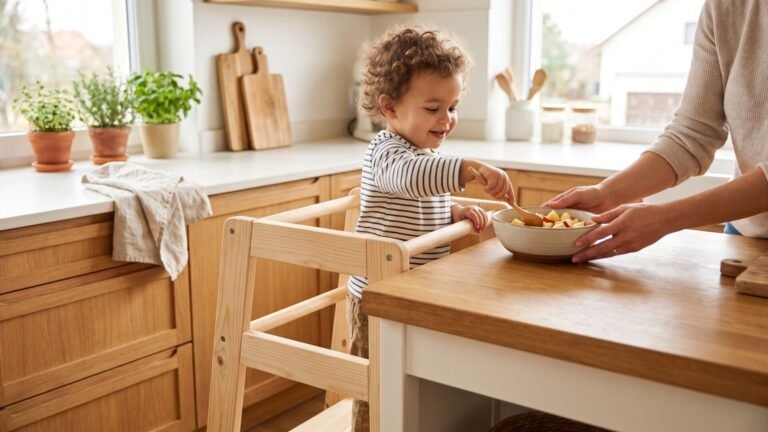
2-year-olds. Practical-life toys, simple matching and sorting, large interlocking blocks, beginner lacing, scooping and pouring, and pretend play grounded in real routines. The kitchen helper that lets a two-year-old stand at the counter and actually stir something outperforms every toy stove on the market. Our Montessori Kitchen Helpers for 2-Year-Olds article covers that specific setup.
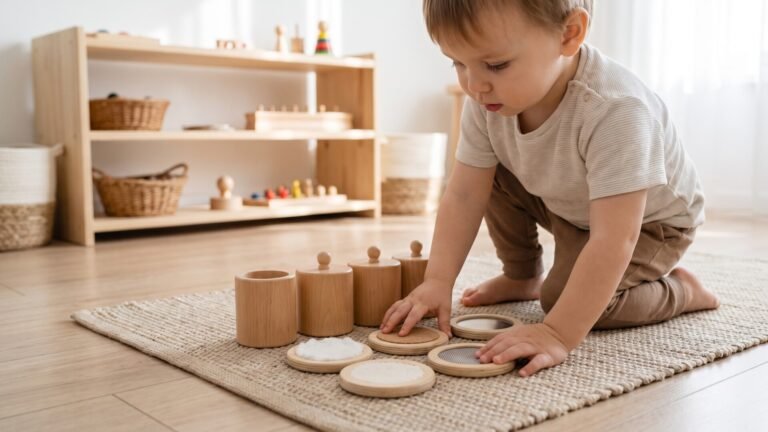
3-year-olds. More complex puzzles, patterning, counting, classification, beginner threading, building sets, and carefully chosen sensory or sound materials. Montessori-Style Sound Explorer Toys for Toddlers is worth reading before you buy anything that makes noise, because most of it makes too much.
The reason toddlers get more from a small number of repeatable activities than from a multi-mode electronic toy is simple: repetition is the learning. A toy with twelve functions gives twelve shallow encounters. A posting box gives a hundred deep ones.
Safety here means choking hazards, water supervision, furniture that can tip, and cords. A toy labeled for threes and a toy labeled for fives can look identical and be very different purchases. Read the label every time.
Preschoolers: 3-6 Years
Preschool is where Montessori materials start looking like what people picture when they hear the word. It is also where parents start panicking about academics and buying worksheets disguised as toys. See our Montessori Toys for Preschoolers hub.
3-year-olds. Practical-life trays, sequencing cards, simple puzzles, matching games, wooden building materials, and early language activities. Best Educational Montessori Toys for 3-Year-Olds has the shortlist.
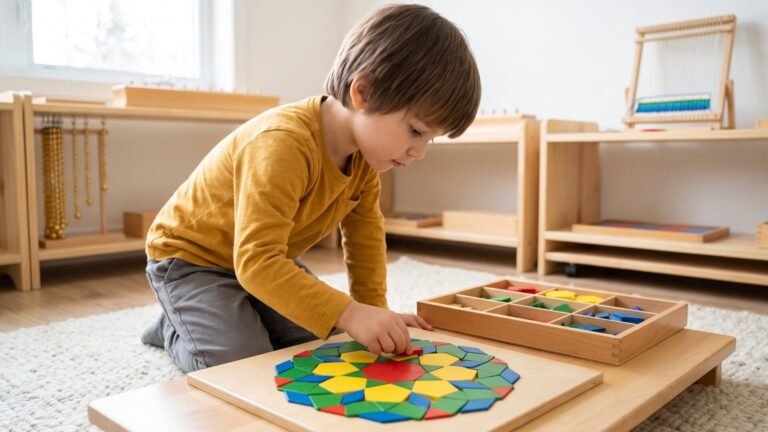
4-year-olds. Pattern blocks, more advanced construction, logic puzzles, classification materials, beginner maps, and games with memory or turn-taking. Montessori Logic Toys for 4-Year-Olds is the place to start if your child likes being right.
5-year-olds. Counting and math manipulatives, nature and biology materials, geography, beginner chemistry demonstrations designed for children, writing tools, and longer building projects. Montessori Biology and Chemistry Toys for Age 5 covers the science side without overselling it.
Educational does not mean academic. A preschooler who sorts, measures, builds, and then explains what they made is doing more cognitive work than one filling in a workbook. The talking matters as much as the doing.
Science materials, small manipulatives, water, and anything involving heat or sharp tools need an adult in the room. That is not a disclaimer, it is the actual supervision requirement.
Early Elementary: 6-9 Years
By six, the word Montessori gets slippery. What you are really looking for is work that has a beginning, a middle, and an end the child can see for themselves. Montessori Toys for Early Elementary (6-9) covers this stage in full, with a dedicated 6-9 shortlist in progress.
Good choices here look less like toys and more like equipment: open-ended building systems, advanced puzzles, geography and science materials, math manipulatives, coding and logic tools, writing and research materials, and project kits. Real tools, reference books, and craft supplies often beat anything marketed as Montessori for this age.
The test for a purchase at this stage is whether it can grow. A building system that supports a six-year-old’s house and a nine-year-old’s working crane is a different product from a kit that produces one finished thing. Buy the system, not the project.
Key Buying Factors for Every Age
Developmental Fit and Challenge
Buy the next manageable challenge, not the next birthday. If a toy is too easy, your child uses it once and moves on. If it is too hard, they hand it to you and you end up doing it, which teaches them that hard things are someone else’s job.
The signs are consistent. Too easy: finished in under a minute, no return visit. Too hard: thrown, abandoned, or brought to you repeatedly. Right: used for ten or fifteen minutes, put down, picked up again the next day.
Age ratings are safety guidance first. They tell you when a product is safe to have in the room, not what your child can do. A four-year-old reading at a six-year-old level still should not have small parts if they mouth things.
Safety and Supervision
Choking hazards, magnets, button batteries, cords, water, and furniture that tips are the recurring risks across this whole age range. None of them announce themselves. A magnet that falls out of a toy is a medical emergency, not a minor inconvenience, and button batteries are worse.
Natural wood does not automatically mean safe. Check finishes, seams, splinters, and whether anything is loose enough to pull off. Inspect wooden toys the way you would inspect a secondhand car, because that is roughly the level of attention they need.
Follow the manufacturer’s instructions and supervise anything with small pieces, science materials, or tools. This is the one area where I will not soften the language: check the current label and the current recall status before you hand anything over.
Durability, Storage, and Maintenance
Solid wood survives drops, siblings, and a decade of use, and it can often be sanded or glued back together. Plastic is lighter, cheaper, and easier to clean, and it usually fails at the joints. Cardboard is fine for consumables and hopeless for heirlooms. Fabric needs washing and will not survive a dog.
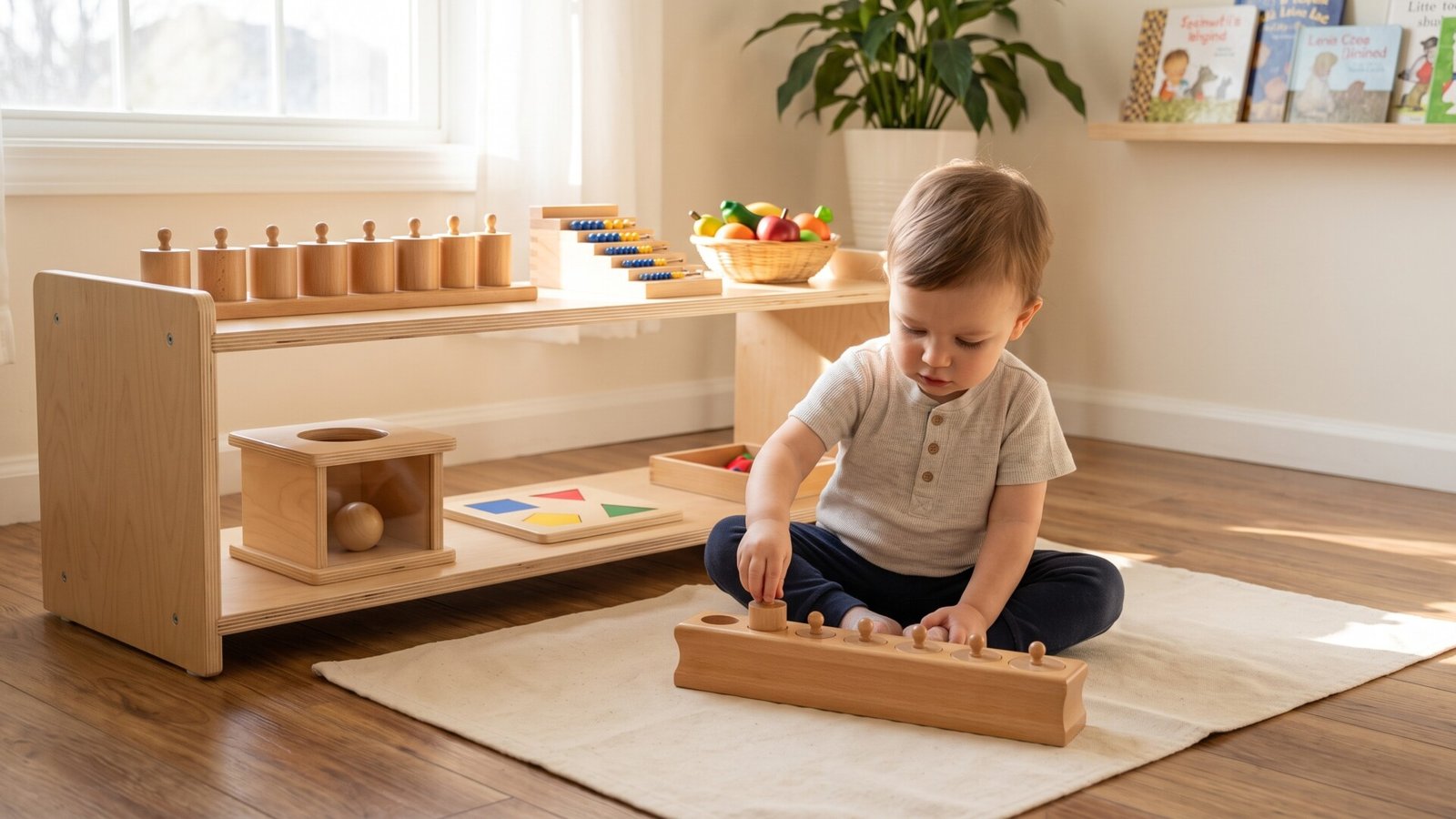
The question that decides whether a toy earns its space is whether it can be stored visibly. A toy that lives in a closed bin gets forgotten. A toy on an open shelf gets used. Trays, baskets, and low shelves do more for your child’s play than any single purchase.
One shelf, a handful of items, and a rotation schedule beats a playroom that looks like a toy store. You are not depriving anyone. You are making the good things findable.
Educational Value and Real-World Use
Ask what your child will do with this after the novelty wears off. If the answer is “press the same three buttons,” you have your answer.
A toy earns its keep if it invites repetition, problem-solving, movement, language, or independent work. It loses it if the main activity is watching something happen. Lights, sounds, app connectivity, and high piece counts are marketing, not learning, and none of them predict whether a toy gets used in March.
The parent decision test is one sentence: what does my child do with this on day thirty? If you cannot picture it, do not buy it.
Recommended Montessori Toys by Age
This is a shortlist, not a catalog. Pick by developmental fit and by how much floor and storage you actually have, not by brand prestige. Every option below has a job, and the job matters more than the logo.
Best for Infants: Lovevery Play Kits or Comparable Infant Development Materials
| Feature | Details |
|---|---|
| Age Range | Varies by kit; match the kit to the child’s current age |
| Key Features | Rotating materials for visual tracking, grasping, object permanence, and movement |
| Price (approx.) | Premium; commonly more than $100 per kit |
| Loud | No |
| Storage reality | One box per stage; stacks in a closet |
The Verdict. A convenient way to get a coordinated set of infant materials without researching each item. The trade-off is cost and volume. You will likely receive more than you can keep out at once, which is fine if you rotate and a problem if you do not.
Best For. Parents who want curated, age-matched rotation and gift-buyers who want something substantial.
Pros
- Clear developmental progression
- Removes individual product research
- Covers several types of infant activity
Cons
- High total cost
- Some families would rather buy three good items
- Requires storage discipline
[Affiliate: Check current pricing and availability through our recommended partners]
Best Budget Infant Pick: Wooden Grasping and Posting Toys
| Feature | Details |
|---|---|
| Age Range | Usually 6-12 months, depending on the item |
| Key Features | Grasping, releasing, posting, object permanence, hand-eye coordination |
| Price (approx.) | About $15-$45 per item |
| Loud | No |
| Storage reality | One small box |
The Verdict. A single well-made wooden activity usually beats a large infant bundle on value. Choose one with large, securely finished components, and use it only when your child is ready and you are watching.
Best For. Budget-conscious families and gift-buyers who want one purposeful item.
Pros
- Lower entry price
- Supports repeated practice
- Takes up almost no space
Cons
- Narrower age window on some items
- Safety depends entirely on construction
- Less convenient than a kit
[Affiliate: Browse wooden grasping and posting toys on Amazon]
Best for Toddlers: Melissa & Doug Wooden Shape Sorting Cube
| Feature | Details |
|---|---|
| Age Range | Commonly recommended for toddlers; verify the current label |
| Key Features | Shape matching, fine-motor practice, problem-solving, repeated posting |
| Price (approx.) | Usually around $20-$35 |
| Loud | No |
| Storage reality | Cube plus loose pieces; pieces go missing |
The Verdict. A strong toddler pick because it has one clear purpose and no setup. It is most useful when your child is ready to match shapes, and it is not a test they have to pass. If they are not interested yet, put it away for a month.
Best For. Toddlers building shape recognition and hand control.
Pros
- Straightforward independent activity
- Compact and easy to store
- Good value for repeated use
Cons
- Frustrating before readiness
- Less open-ended than blocks
- Check for wear and loose parts
[Affiliate: Check the Melissa & Doug shape sorter on Amazon]
Best for Practical Life: Melissa & Doug Cleaning Set or Child-Sized Tools
| Feature | Details |
|---|---|
| Age Range | Generally toddlers and preschoolers; verify the current label |
| Key Features | Sweeping, carrying, imitation of real routines, participation in actual tasks |
| Price (approx.) | About $25-$50 |
| Loud | No |
| Storage reality | Tall; needs a hook or corner |
The Verdict. Practical-life tools beat toys that only imitate work because your child sees a real result. The set earns its space only if you let them use it during actual routines. Bought as decoration, it is just clutter with a handle.
Best For. Children who want to help and parents willing to include them.
Pros
- Connects play to real responsibility
- Encourages movement and coordination
- Stays useful past the novelty period
Cons
- Needs storage space
- Some tools are decorative rather than functional
- Requires patience while they practice
[Affiliate: Check practical-life sets through our recommended partners]
Best for Preschoolers: LEGO DUPLO or LEGO Classic
| Feature | Details |
|---|---|
| Age Range | DUPLO for younger children; LEGO Classic generally suits older preschoolers and up |
| Key Features | Construction, planning, fine-motor control, spatial reasoning, storytelling |
| Price (approx.) | About $20-$70 depending on set |
| Loud | No |
| Storage reality | Bin, and eventually a sorting system you will abandon |
The Verdict. Building materials are not always labeled Montessori, and they fit the goal of purposeful self-directed work better than most things that are. DUPLO is the safer start. Small LEGO pieces wait until your child meets the stated age and safety guidance.
Best For. Preschoolers who build, rebuild, and invent their own designs.
Pros
- Excellent replayability
- Supports many skills with no fixed solution
- Useful for years
Cons
- Small pieces are a safety concern for younger children
- Storage and sorting become a chore
- Themed sets reduce open-ended use
[Affiliate: Check LEGO DUPLO and LEGO Classic collections]
Best for Logic and Early Math: Learning Resources Pattern Blocks or Attribute Blocks
| Feature | Details |
|---|---|
| Age Range | Usually preschool through early elementary; verify the label |
| Key Features | Patterning, classification, spatial reasoning, geometry, counting, design |
| Price (approx.) | About $15-$40 |
| Loud | No |
| Storage reality | One tub; pieces migrate |
The Verdict. Open-ended manipulatives outlast narrowly scripted academic toys because a four-year-old can copy patterns and an older child can explore symmetry, fractions, and area with the same tub. This is the cheapest genuinely long-range purchase on this page.
Best For. Preschool and early elementary children who like puzzles and patterns.
Pros
- Broad age range
- Many uses from one purchase
- Works independently or with guidance
Cons
- Less engaging for children who prefer dramatic play
- Some families need activity prompts
- Small pieces need age-appropriate storage
[Affiliate: Check Learning Resources pattern blocks on Amazon]
Best for Early Elementary: Osmo Coding Starter Kit or a Screen-Light Coding Alternative
| Feature | Details |
|---|---|
| Age Range | Commonly aimed at early elementary; verify device and age requirements |
| Key Features | Sequencing, logic, problem-solving, introductory coding concepts |
| Price (approx.) | About $50-$100, plus a compatible device |
| Loud | No |
| Storage reality | Small box plus a tablet you already own |
The Verdict. A coding kit fits Montessori principles when the child is solving problems rather than watching content. It is a poor fit for screen-free homes, and you should confirm device compatibility before buying. Not every six-year-old needs this, and most do not need it at five.
Best For. Children ages 6-9 who like puzzles and step-by-step challenges.
Pros
- Makes abstract sequencing tangible
- Progressive challenges
- Coding without text-based programming
Cons
- Requires a compatible device
- Screen use does not suit every family
- Some children outgrow the early levels fast
[Affiliate: Check coding kits through our recommended partners]
Best Premium Open-Ended Pick: Grimm’s Large Rainbow or Similar Wooden Building Materials
| Feature | Details |
|---|---|
| Age Range | Commonly used from preschool onward; verify current safety guidance |
| Key Features | Open-ended construction, balancing, color, spatial reasoning, imaginative play |
| Price (approx.) | Often around $80-$150 depending on size |
| Loud | No |
| Storage reality | Beautiful and awkward; needs a dedicated shelf |
The Verdict. Premium wooden building materials can become the center of play because they work as construction, as props, and as design tools. The price is justified only if your child already builds and you have somewhere to put it. Otherwise you have bought an expensive object lesson in your own optimism.
Best For. Families wanting a durable, screen-free centerpiece.
Pros
- Strong replayability
- Works across several ages
- Supports imaginative and spatial play
Cons
- Expensive next to basic blocks
- Careful storage required
- Some children prefer defined toys
[Affiliate: Check premium wooden building sets]
Skip This If: Large Electronic “Montessori” Learning Systems
Here is the skip. Expensive electronic systems with lights, sounds, subscriptions, and dozens of preset activities are not better because they cost more. They add setup, charging, and updates, and they narrow your child’s role to pressing buttons in the order the toy decides. A block set, a puzzle, a practical-life tool, or a tub of pattern blocks will get more repeat use for less money. The lights are for the adult in the room.
Comparison Table: Montessori Toys by Age
| Product or Category | Best Age | Approx. Price | Main Strength | Ownership Value | Best For |
|---|---|---|---|---|---|
| Curated infant play kit | 0-12 months | $100+ | Age-based variety | Convenient but expensive | Gift-buyers wanting a complete set |
| Wooden grasping or posting toy | 6-12 months | $15-$45 | Fine-motor practice | Strong if used repeatedly | Budget-conscious families |
| Melissa & Doug shape sorter | Toddler | $20-$35 | Matching and coordination | Good | First problem-solving activities |
| Practical-life tools | 1-5 years | $25-$50 | Real-world participation | Strong when used in routines | Children who want to help |
| LEGO DUPLO or LEGO Classic | 2-9 years, by set | $20-$70 | Construction and replayability | Very strong | Builders and creative play |
| Pattern or attribute blocks | 4-9 years | $15-$40 | Logic, math, patterns | Excellent across ages | Structured independent work |
| Early coding kit | 6-9 years | $50-$100 | Sequencing and logic | Variable | Screen-tolerant families |
| Premium wooden building set | 3-9 years | $80-$150 | Open-ended construction | Strong if frequently used | Long-term centerpiece toy |
[Affiliate: Check current pricing and availability through our recommended partners]
What Most Buyers Get Wrong About Montessori Toys by Age
The first mistake is buying by birthday instead of ability. This produces a shelf of toys that are either instantly mastered or permanently frustrating, and both get abandoned. The birthday tells you when a toy is safe. It does not tell you when your child is ready.
The second is assuming wood or a Montessori label equals educational. What actually matters is purposeful action, repetition, feedback, and room for independent thinking. A plastic scoop used to move rice from one bowl to another is doing more work than a wooden object that only gets looked at.
The third is overvaluing novelty and piece count while ignoring storage, setup, and cleanup. A toy with ninety pieces is a toy with ninety pieces to find, and you will find eighty-nine. The question is not how much comes in the box. It is how much of it ends up on the floor at 7pm on a Tuesday.
The fourth is buying many age-specific toys instead of a few that change function. Blocks, pattern materials, practical-life tools, and open-ended art supplies serve a four-year-old and an eight-year-old differently. A shape sorter serves one age and then it is done.
Which Montessori Toys Still Make Sense After Six Months?
This is a replayability analysis, scored on four factors: repeated use, number of possible activities, independence, and age range. A toy that scores well on all four is worth real money. A toy that scores well on none of them is a birthday present from someone who does not have to store it.
Blocks and construction systems score highest. Rebuildable, many activities, usable alone, spans years. Pattern blocks and attribute blocks score nearly as well, with the caveat that some children need an adult to suggest the first activity. Practical-life tools stay in use as long as the routines do. Puzzles with graduated difficulty hold up if you keep adding harder ones, and fade if you do not. Single-purpose posting toys and shape sorters have the shortest life, usually a few months of intense use followed by permanent retirement.
The value math is not complicated, and it does not need false precision. A $25 toy used weekly for a year is a better purchase than a $70 toy used once. A premium item is worth it only when it replaces two or three cheaper things you would otherwise buy and abandon. The Grimm’s rainbow at $100-plus is reasonable if it becomes the default building material for four years. It is a bad buy if it becomes a shelf ornament, and you will know which within a month.
Here is the six-month ownership checklist. Is it still accessible, or is it in a bin under something? Can your child start it without help? Have they found a second use for it? Is cleanup manageable enough that you let them get it out? Can it be handed to a younger sibling or sold? Four or more yeses and you spent well. Two or fewer and you have learned something about your particular child, which is worth knowing.
How to Choose the Right Montessori Toy for Your Family
Best for Small Spaces
Pick one or two compact materials rather than a set. A wooden puzzle, a nesting toy, pattern blocks, or a small construction kit will do more than a full shelf. Prioritize vertical storage, contained pieces, and materials with more than one use. A tub of pattern blocks fits on a shelf and works for five years.
Best Budget Pick
Start with practical-life materials you already own. A real dustpan, a small pitcher, a bowl of dry beans, and a sponge cover most of what toddler Montessori play actually requires. Add a shape sorter, a simple puzzle, wooden blocks, or pattern blocks, and you have a functional setup for under $50. You do not need a subscription or a complete toy shelf to do this well.
Best Premium Pick
A curated infant kit for babies, or a premium wooden building set for older children. Both have the same condition attached: you need enough storage and your child needs to genuinely enjoy that style of play. Premium materials reward families who already know what their child reaches for. They punish wishful thinking.
Best for Independent Play
Open-ended blocks, age-appropriate puzzles, posting and sorting materials, and pattern blocks. Independent play develops gradually and depends on a calm room, realistic expectations, and you modeling the activity once or twice before stepping back. A toy your child cannot start alone is not an independent-play toy, no matter what the box says.
Best for STEM and Logic
Pattern blocks, attribute blocks, construction materials, and an early coding kit for children ready for screen-supported play. Building and classification are usually better first steps than buying an advanced coding product too early. A child who has spent two years sorting and building will take to sequencing faster than one who has never done either.
Best for Montessori Homes
A small rotating shelf, practical-life tools, open-ended building materials, and one or two carefully selected manipulatives. Focus on the setup rather than recreating a classroom. The shelf does more work than the inventory.
Conclusion
Choose for the stage your child is actually in, not the one on the box. That one decision prevents most of the wasted money in this category.
If you want the long-term category that pays off most, it is open-ended building materials: LEGO DUPLO, age-appropriate LEGO, or durable wooden blocks. For a budget pick, a focused wooden puzzle, shape sorter, posting activity, or practical-life tool will do the job for under $50. If you are buying premium, a curated infant play kit or a high-quality wooden building set earns its price only when storage and interest are both already there. And if your child is ready for logic and STEM work, pattern blocks or a carefully chosen coding kit will take them further than a flashier alternative.
The most valuable toy is the one your child can use repeatedly, independently, and safely. Everything else is storage.
Check current pricing and availability through our recommended partners, and use the detailed age-specific pages to narrow the choice further.
Frequently Asked Questions About Montessori Toys By Age
What age should children start using Montessori toys?
Babies can use simple sensory and movement materials from the beginning, but the right toy depends on safe handling, supervision, and readiness rather than a label. Start with high-contrast visuals and soft rattles, and add complexity as your child’s reach and grip develop.
Are Montessori toys worth the money?
They are worth it when the construction is durable, the toy gets repeated use, the play is open-ended, and the age range is broad. They are not worth it when you are paying for the label. Inexpensive household materials and basic toys support Montessori-style play perfectly well.
What are the best Montessori toys for a 1-year-old?
Large-piece posting and stacking toys, nesting cups, simple puzzles, push or carry materials, and practical-life activities. See our guide to the best Montessori toys for 1-year-olds for the specific shortlist, and keep everything supervised.
How do Montessori toys differ for toddlers and preschoolers?
Toddlers work on grasping, posting, and simple matching, plus practical routines. Preschoolers move into language, patterning, construction, classification, and longer independent projects. The materials get more complex and the adult role gets smaller.
Do Montessori toys need to be made of wood?
No. Wood is common because it is durable and tactile, but plastic, fabric, cardboard, books, art materials, and carefully chosen electronic tools can all work when they support purposeful activity. Material is a preference. Function is the requirement.
How many Montessori toys should a child have out at once?
A small, manageable selection they can see and reach, with the rest stored and rotated. A handful of visible options is easier to use than an overflowing shelf, and rotation keeps the good items findable.
Are electronic toys compatible with Montessori principles?
Selectively, and mostly for older children working on coding or logic. They should not replace hands-on materials, movement, practical work, books, or open-ended construction. If the main activity is watching, it is not Montessori, whatever the box says.
When should I move my child to the next age group?
When the current materials are consistently too easy, not when the birthday arrives. Watch for toys finished in under a minute with no return visit. That is your signal, and it usually comes earlier or later than the label predicts.
What is the single best Montessori toy purchase for most families?
A durable open-ended building system or a tub of pattern blocks, because both serve multiple ages and get used without adult direction. Everything else on this page is a supporting player.