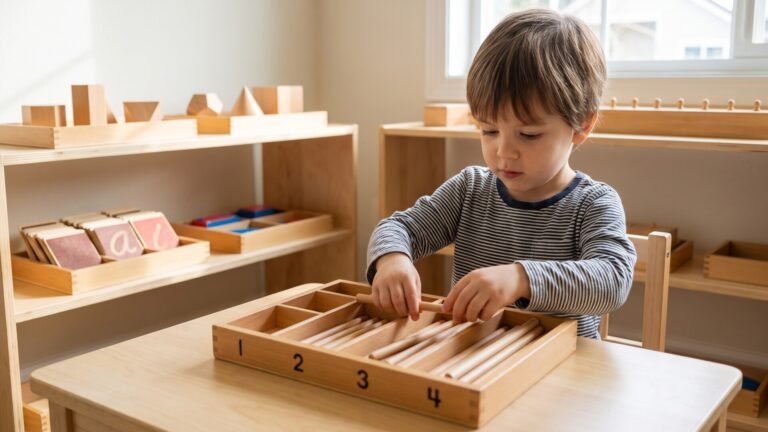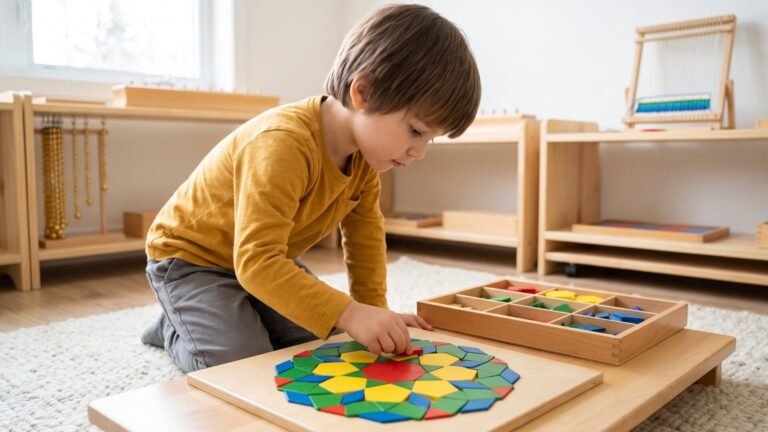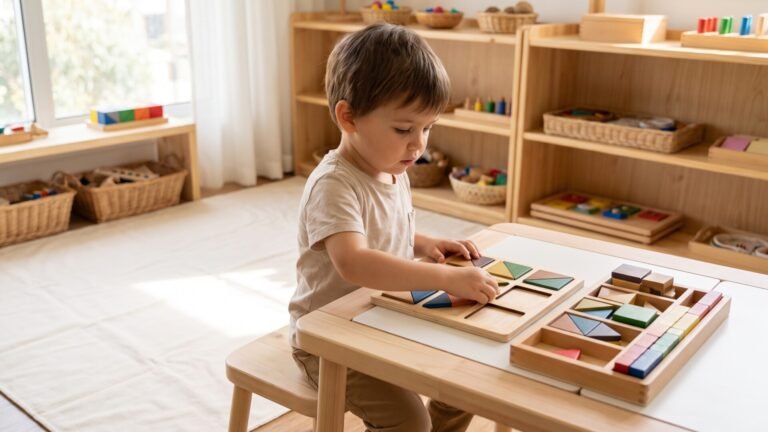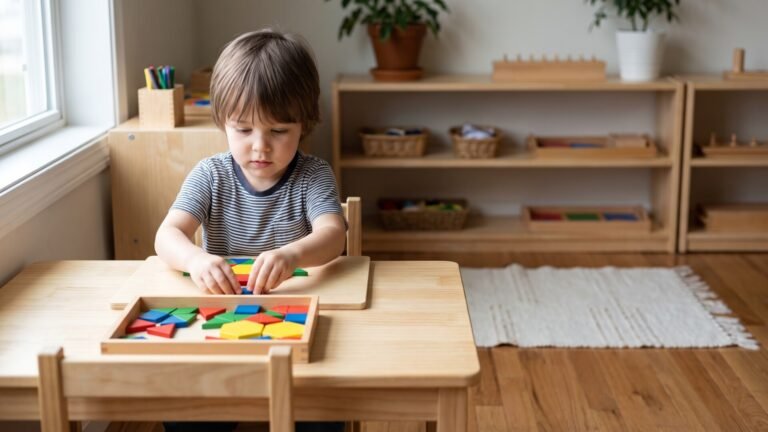
Future Scientists: Montessori Biology and Chemistry Toys for Age 5
I have a confession to make. When my oldest turned five, I thought I had to choose between two parenting paths: the structured, screen-filled world of traditional science kits with their flashy buttons and pre-determined outcomes, or the beautiful, wooden, but sometimes abstract world of Montessori materials. I worried that if I picked the wrong one, I’d either squash her natural curiosity or leave her unprepared for the “real” science she’d encounter in school.
I was wrong. Dead wrong.
The truth is, the best science education for a five-year-old lives right in the messy, wonderful middle. It’s found in toys that respect a child’s ability to discover on their own terms, while still providing the structure of a real experiment. It’s about nurturing that tiny spark of “why?” into a full-blown love for biology and chemistry, without ever making it feel like a chore.
This article is for the parent who wants to do just that. I’ve spent countless hours—and more than a few frustrating afternoons cleaning up baking soda volcanoes—to find the Montessori-aligned biology and chemistry toys that actually deliver. We’ll explore the best options on the market, break down what makes a toy truly Montessori-friendly, and help you figure out which one is right for your unique little scientist.
Let’s get our hands dirty.
The Montessori Mindset: Why Science at Five Matters
Before we dive into the shopping list, let’s talk about the “why.” Montessori education isn’t just about wooden toys and quiet classrooms. At its heart, it’s a philosophy that trusts the child. It believes that children are naturally eager to learn, and that the best learning happens when they are given the freedom to explore a carefully prepared environment.
For a five-year-old, this is pure gold. Their brains are like little sponges, but they’re not just soaking up facts. They are building the neural pathways for critical thinking, problem-solving, and cause-and-effect reasoning. A Montessori-aligned science toy supports this by being:
- Self-Correcting: The toy or activity has a built-in “right answer” that the child can discover on their own, without an adult telling them they’re wrong.
- Hands-On: This is non-negotiable. A five-year-old learns by doing, not by watching. They need to touch, pour, mix, and manipulate.
- Purposeful: The activity has a clear goal, but the path to get there is open-ended. This fosters concentration and a sense of accomplishment.
- Beautiful: Montessori materials are designed to be aesthetically pleasing. This isn’t just about looking nice; it communicates to the child that their work is important and worthy of respect.
In a world of screaming screens and passive entertainment, these toys offer an anchor. They pull the child back into their own body and their own mind. They answer the fundamental question every five-year-old has: “How does this stuff work?” And they do it without a single battery.
Decoding the Category: What Are Montessori Biology and Chemistry Toys?
You won’t find a “Montessori Biology Kit” with a brand label on a shelf at a big-box store. Instead, the term describes a philosophy of play. A true Montessori biology or chemistry toy is one that allows for discovery-based learning.
Let’s break it down.
Biology for a Five-Year-Old: This isn’t about memorizing the parts of a cell. It’s about observing life. This means:
- Gardening sets: Planting seeds, watering, and watching something grow.
- Life cycle puzzles: Understanding that a caterpillar becomes a butterfly.
- Animal and plant classification cards: Sorting and matching based on characteristics.
- Simple nature exploration tools: Magnifying glasses, bug viewers, and collection jars.
Chemistry for a Five-Year-Old: This is about cause and effect and the properties of matter. It means:
- Kitchen science: Baking soda and vinegar reactions.
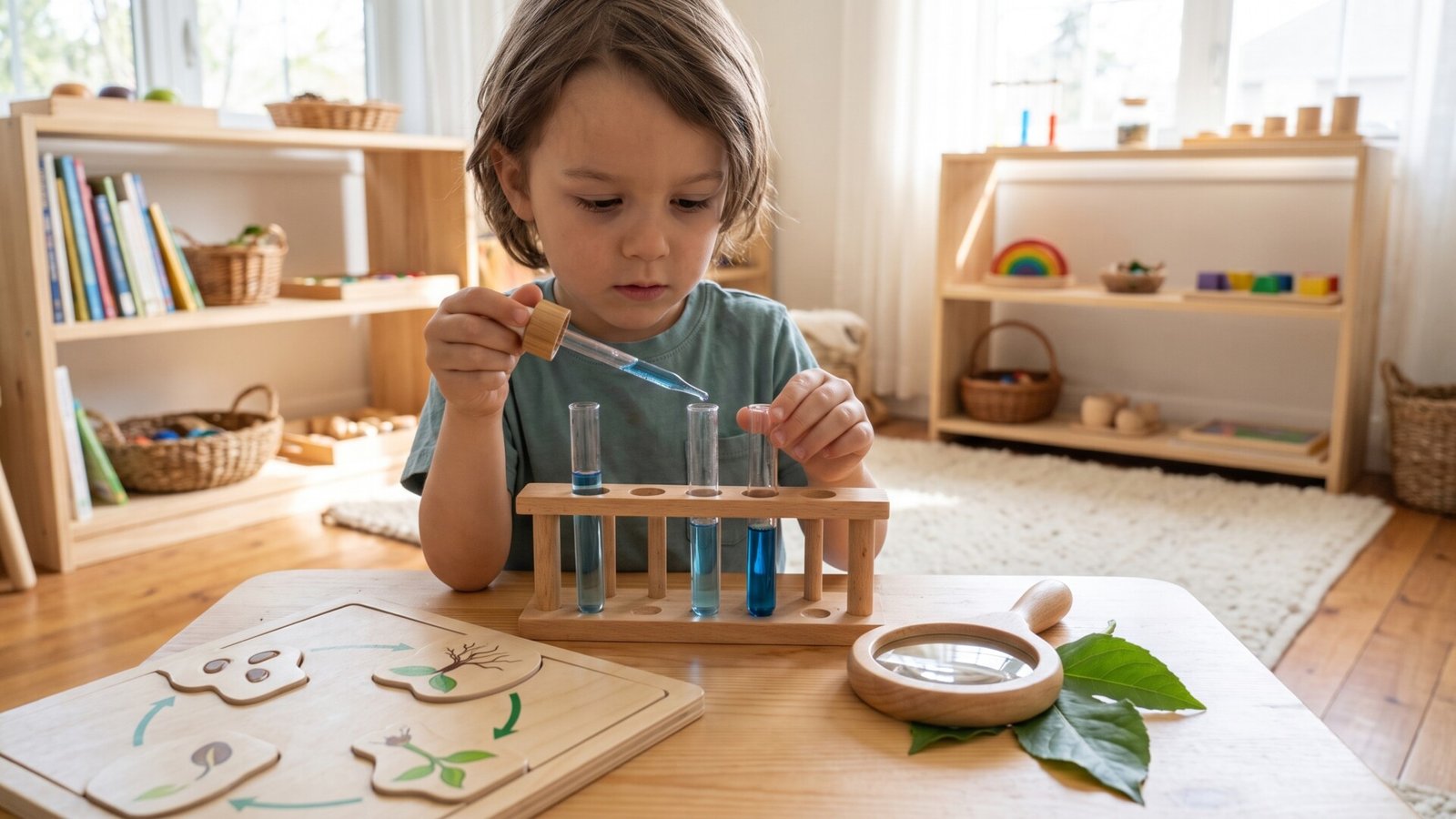
- Mixing and measuring: Using real (child-safe) beakers and test tubes.
- Sensory play with a purpose: Making slime, playdough, or oobleck.
- Color mixing: Understanding that blue and yellow make green.
The key distinction is intentionality. A pile of dirt is just a mess. A pile of dirt with a trowel, a set of seeds, and a small watering can is a Montessori biology lesson. The toy provides the structure for discovery, but the discovery itself belongs to the child.
The ToyGuideHub Parent Hassle Score: What to Look For
I’ve learned the hard way that not all “educational” science toys are created equal. Some look great in the box but end up in the back of the closet after one use. To save you that heartache, here are the factors I consider before letting anything into my home. I call this the ToyGuideHub Parent Hassle Score—a measure of how much joy versus frustration a toy will actually bring.
- Safety First: This is the absolute non-negotiable. For age 5, look for toys that are non-toxic (look for ASTM or CE marks), have no small parts that could be a choking hazard for younger siblings, and include safety goggles for any chemistry experiments. Avoid anything with harsh chemicals or open flames.
- Material Durability: Wood is beautiful and feels wonderful, but it can be ruined by a spilled experiment. High-quality, BPA-free plastic is often the better choice for wet activities. Look for thick, sturdy pieces that won’t crack or break easily. This is a toy that should survive multiple children.
- Ease of Setup and Cleanup: I cannot overstate this. A toy that requires 20 minutes of setup for 10 minutes of play is a toy that will gather dust. Look for kits that come with everything you need in one box, with clear, simple instructions. Cleanup is just as important. Is it washable? Can it be stored easily?
- Replayability: The best Montessori toys are not one-and-done. They offer a “low floor, high ceiling.” Your child can do a simple activity today, and a more complex version of the same activity months later. A set with an experiment guide offers a path for this.
- Open-Endedness: Can the toy be used in multiple ways? A set of beakers and test tubes can be for a chemistry experiment, but also for a pretend tea party or a water play session. This is the hallmark of a great toy.
The Big Picture: Pros and Cons of Montessori Science Toys
Let’s be honest with each other. No toy is perfect. Here’s the real deal on what you’re signing up for.
The Pros (What I Love):
- True Independence: These toys are designed for a child to use without constant adult intervention. You set them up, show them the “how,” and then step back. It’s magical to watch them figure it out.
- Deep Engagement: Because the child is driving the play, they get lost in it. This is the opposite of the frantic, five-second attention span screen time can create.
- Skill Building: Beyond science, these toys build fine motor skills (pouring, measuring), language skills (naming tools and concepts), and emotional regulation (patience, dealing with a failed experiment).
The Cons (What You Need to Know):
- The Upfront Cost: High-quality, durable materials cost more. A cheap plastic kit from the dollar store is not the same thing. You are paying for longevity and safety. I consider it an investment.
- The Mess: Let’s be real. Science is messy. You will have spills. You will have baking soda on the floor. You will have dirt under fingernails. This is not a toy for a pristine, white-carpeted playroom. It’s a toy for real life.
- The Need for a “Guide”: While the toy is self-directed, you, the parent, are still the “prepared environment.” You need to set up the space, provide the materials, and sometimes, just sit on your hands and let them make mistakes. This is the hardest part.
Our Top Picks: The Best Montessori Biology and Chemistry Toys
After testing, observing, and cleaning up after a lot of play, these are the five toys I believe are the best investments for your future scientist.
1. Melissa & Doug Primary Science Lab Set
This is the gold standard for a reason. It’s not a kit of pre-packaged experiments; it’s a set of real, high-quality tools that a child can use to conduct their own investigations.
- Age Range: 3+
- Key Features: 10 pieces including a magnifying glass, test tubes with a rack, a beaker, a funnel, and a pair of safety goggles. The materials are thick, durable plastic that can handle being dropped.
- Why We Like It: This is the quintessential “starter lab.” It perfectly embodies the Montessori principle of the “prepared environment.” The tools are beautiful and purposeful. A child can use them to examine a leaf, mix colored water, or just pretend to be a mad scientist. The open-endedness is its superpower.
- Best For: The child who loves to explore the world around them. The one who picks up rocks and asks what they are. This set gives them the tools to find the answer.
- Pros: Incredibly durable. Encourages independent, open-ended play. Teaches real lab skills. Easy to clean.
- Cons: It does not come with any experiment cards or instructions. You, the parent, need to provide the “experiment” ideas (mixing colored water, testing what floats or sinks).
- [Affiliate: Check current pricing on Amazon]
2. Learning Resources Primary Science Lab Set
If the Melissa & Doug set is the open-ended tool kit, this one from Learning Resources is the guided experiment starter. It comes with a 10-piece activity set and a 10-card activity guide.
- Age Range: 3+
- Key Features: Includes beakers, test tubes, a magnifying glass, a funnel, and a set of activity cards. The pieces are large and chunky, perfect for small hands.
- Why We Like It: For parents who want a little more structure, this is a fantastic choice. The activity cards give you a clear jumping-off point for simple experiments like “Does it float?” or “Color mixing.” It takes the pressure off you to be the “science teacher.”
- Best For: The child who needs a little guidance to get started. The parent who wants a ready-made activity for a rainy afternoon.
- Pros: Comes with experiment ideas. Very durable, large pieces. Easy to clean. Great for siblings.
- Cons: The pieces are less “beautiful” than the Melissa & Doug set. The activity cards are simple and your child may quickly want to move beyond them.
- [Affiliate: Check current pricing on Amazon]
3. Hape Organic Gardening Toy Set
This is the toy that connects the dots between the dinner table and the garden. It turns the abstract concept of “food comes from the ground” into a tangible, hands-on reality.
- Age Range: 3+
- Key Features: A wooden planting box, a trowel, a watering can, and three packets of organic seeds (basil, cress, and a mystery seed). All wood is sustainably sourced.
- Why We Like It: This is pure Montessori biology. It teaches responsibility, patience, and the cycle of life. The child plants the seed, waters it, watches it grow, and then—if they’re patient—harvests it. The sense of accomplishment is enormous. It’s a living science experiment that changes every day.
- Best For: The child who loves being outside. The family that wants to grow some of their own food. The parent looking for a screen-free activity that lasts for weeks.
- Pros: Teaches real-world biology. Encourages responsibility. The materials are beautiful and sustainable. It’s a multi-week activity.
- Cons: Requires outdoor space (or a very sunny windowsill). It’s not a “quick” activity; it takes time and patience. The wooden box can get waterlogged if left outside in the rain.
- [Affiliate: Check current pricing on Target]
4. Scientific Explorer My First Mind Blowing Science Kit
This is the gateway drug to chemistry. It’s a classic for a reason. It delivers on the promise of “mind-blowing” with a series of simple, safe, and visually impressive experiments.
- Age Range: 6+ (I’ve used it successfully with very engaged 5-year-olds, with supervision)
- Key Features: 11 activities including a color-changing volcano, a sunset-in-a-tube, and a jiggly crystals experiment. Includes safety goggles and most of the necessary chemicals (baking soda, citric acid, etc.).
- Why We Like It: It provides the “wow” factor that hooks a child on science. The experiments are genuinely cool and produce immediate, satisfying results. The instructions are clear and easy to follow.
- Best For: The child who asks “why?” a hundred times a day. The one who loves a good reaction. The parent who wants to show their child that science is fun.
- Pros: High “wow” factor. Clear instructions. Most materials included. Teaches cause and effect.
- Cons: Requires significant adult supervision for every experiment. The chemicals are consumable (you’ll run out and need to buy more). Some experiments are messy.
- [Affiliate: Check current pricing on Amazon]
5. Thames & Kosmos Kids First Chemistry Set
This is the premium choice for the serious young chemist. It’s a comprehensive kit that introduces real chemistry concepts in a way a five-year-old can grasp.
- Age Range: 5+
- Key Features: 40 experiments, a 48-page full-color experiment manual, and high-quality lab equipment (beakers, test tubes, a pipette, a funnel). The manual is the star here—it tells a story while teaching science.
- Why We Like It: This kit respects the child’s intelligence. The manual doesn’t just say “mix this and that.” It explains why the reaction happens, using simple language and illustrations. It’s the most educational kit on this list.
- Best For: The child who loves to read and follow instructions. The parent who wants a deep, structured science education. The family that is willing to invest in a long-term learning tool.
- Pros: Incredible educational value. High-quality materials. The manual is a learning tool in itself. 40 experiments provide months of play.
- Cons: The price is higher. The experiments require more setup and cleanup. Some small parts (like the pipette) can be a choking hazard for younger siblings.
- [Affiliate: Check current pricing on Target]
At a Glance: The Comparison Table
| Product | Age Range | Durability | Educational Value | Price Range | Best For |
|---|---|---|---|---|---|
| Melissa & Doug Primary Science Lab | 3+ | ⭐⭐⭐⭐⭐ | ⭐⭐⭐⭐ | $25-$30 | Open-ended exploration & tool set |
| Learning Resources Primary Science Lab | 3+ | ⭐⭐⭐⭐ | ⭐⭐⭐⭐ | $20-$25 | Guided first experiments |
| Hape Organic Gardening Toy Set | 3+ | ⭐⭐⭐⭐⭐ | ⭐⭐⭐⭐⭐ | $30-$35 | Outdoor biology & responsibility |
| Scientific Explorer Mind Blowing Science | 6+ | ⭐⭐⭐ | ⭐⭐⭐⭐ | $15-$20 | High-impact chemistry reactions |
| Thames & Kosmos Kids First Chemistry | 5+ | ⭐⭐⭐⭐ | ⭐⭐⭐⭐⭐ | $40-$45 | Deep, structured chemistry education |
How to Choose the Right Toy for Your Family
You’ve seen the options. Now, let’s get personal. Which one is right for your child?
- Best for Indoor Play: The Melissa & Doug Primary Science Lab Set or the Learning Resources Primary Science Lab Set. Both are clean, contained, and easy to set up on a kitchen table.
- Best for Outdoor Exploration: The Hape Organic Gardening Toy Set is the clear winner. It lives outside and connects your child to the natural world.
- Best for Visual Learners: The Scientific Explorer My First Mind Blowing Science Kit. The color changes and fizzy reactions are a feast for the eyes and make abstract concepts concrete.
- Best for Budget-Conscious Parents: The Scientific Explorer My First Mind Blowing Science Kit is the most affordable and provides the most “bang for your buck” in terms of immediate excitement.
- Best for Gift Giving: The Thames & Kosmos Kids First Chemistry Set. It feels like a serious, grown-up gift. It’s the one that says, “I believe you are a real scientist.”
The ToyGuideHub Long-Term Value Analysis
Here is the most important insight I can share with you. The most expensive toy on this list is not the best value, and the cheapest one is not the worst.
The Thames & Kosmos set costs $40-45, but with 40 experiments, it provides a cost of about $1 per activity. It will last for months, and the manual can be re-read and referenced for years. That is incredible value.
The Hape Gardening Set costs $30-35, but it is a one-season toy. Once the seeds are planted and harvested, the “experiment” is over. However, the wooden tools can be used for years in the garden, and the skill of gardening is a gift that lasts a lifetime.
The Scientific Explorer kit costs $15-20, but the chemicals are consumable. You will need to buy more baking soda and vinegar (which is cheap), but the “wow” factor is immediate. It’s the best for a single, memorable afternoon.
The Melissa & Doug and Learning Resources lab sets are the true value champions. For $20-30, you buy a set of tools that can be used for years of open-ended play. The cost per hour of play is pennies. They are the most “Montessori” of the bunch because they trust the child to create their own learning.
The Final Verdict
Choosing a Montessori science toy for your five-year-old is not about finding the “perfect” product. It’s about choosing a philosophy. It’s about saying, “I trust you to learn. I trust you to make a mess. I trust you to ask questions.”
If I had to pick just one, my heart belongs to the Melissa & Doug Primary Science Lab Set. It is the most faithful to the Montessori ideal. It hands the child a set of beautiful, purposeful tools and says, “Go. Discover.”
For the parent who wants a little more structure, the Learning Resources Primary Science Lab Set is a close second.
And for the family ready to make a serious commitment to science, the Thames & Kosmos Kids First Chemistry Set is an investment that will pay dividends in curiosity and knowledge for years to come.
Check current pricing and availability through our recommended partners below. And remember, the best science experiment is the one your child invents on their own, with a little bit of dirt, a little bit of water, and a whole lot of wonder.
Frequently Asked Questions About Montessori Toys For 5 Year Olds Who Love Science
What are Montessori toys?
Montessori toys are designed to support a child’s natural development through hands-on, self-directed, and purposeful play. They are typically made of natural materials, are self-correcting, and focus on one skill or concept at a time.
Are these toys safe for 5-year-olds?
Yes, all the toys recommended here are designed for children aged 5 and up and meet standard safety requirements. However, I always recommend parental supervision for any science experiment involving mixing or small parts. Always check for small parts if you have a younger sibling in the house.
How do Montessori toys differ from traditional toys?
Traditional toys often entertain the child (lights, sounds, pre-determined stories). Montessori toys *engage* the child. They require the child to be an active participant in their own learning, rather than a passive consumer of entertainment.
What developmental skills do biology and chemistry toys promote?
They promote critical thinking, problem-solving, cause-and-effect reasoning, fine motor skills, language development, patience, and a sense of wonder about the natural world.
How can I encourage my child’s interest in science at home?
The best thing you can do is follow their lead. When they ask a question, don’t just give them the answer. Say, “I don’t know, let’s find out together.” Set up a small science shelf with a few tools and let them explore. Talk about the science you see in everyday life—cooking, gardening, the weather.
What should I consider when purchasing science kits?
Consider your child’s attention span, your tolerance for mess, your available storage space, and whether you want a guided kit (Thames & Kosmos) or an open-ended tool set (Melissa & Doug).
Can these toys be used for multiple children?
Absolutely. The lab sets and gardening tools are perfect for siblings. The chemistry kits are best used one-on-one with a child so you can supervise the experiments closely.
How do I store and maintain these toys?
Keep them in a dedicated, accessible place. A low shelf in the playroom or a bin on the kitchen counter works well. Clean the lab tools with warm, soapy water after each use. Store the gardening tools in a dry place to prevent rust or rot.
What happens if my child loses interest?
Don’t panic. This is normal. Put the toy away for a few weeks or months. When you bring it back out, it will feel new again. The best toys are the ones that can be rediscovered.