Critical Thinking for Kids: Montessori Logic Toys for 4-Year-Olds
Four is an interesting age for logic play. Children can hold a goal in mind, try an idea, notice it didn’t work, and try something different, which is the core of what we usually mean by critical thinking at this age. The right toys give them low-pressure practice at exactly that. This guide covers what makes a toy a good Montessori-style logic toy, how to choose one for a 4-year-old, and five categories of toys with named examples, plus honest notes on trade-offs, safety, and cost.
This page is part of our Montessori & early learning toys collection and our guide to Montessori toys for preschoolers (3–6 years). If you’re shopping more broadly for this age, see best Montessori toys for 4-year-olds.
Quick answer: for most 4-year-olds, a good starting set is one pattern or building toy (open-ended), one single-player logic puzzle with graded challenges, and one cooperative game. We’d start with pattern blocks or a graded puzzle such as Camelot Jr., then add open-ended blocks.
Why Logic Play Matters at Age Four
Child-development researchers describe the preschool years as an important period for building executive function, the set of mental skills that help children plan, focus, remember instructions, and switch strategies. Play that involves trial and error is one of the ways children practise those skills, though no single toy produces a particular outcome and every child progresses at their own pace.
Critical thinking in a preschooler looks like asking questions, comparing options, noticing patterns, and persisting when the first idea doesn’t work. A puzzle where a piece won’t fit gives a child a built-in reason to try another approach, with no adult needed to say “that’s wrong”.
Montessori education, developed by Dr. Maria Montessori in the early 1900s, is built on child-led learning with hands-on materials designed so that the material itself shows the child whether they succeeded (the “control of error”). That is why many Montessori-style logic toys have no screens, sounds, or scoring: the activity is the feedback.
What Makes a Toy a Montessori-Style Logic Toy?
“Montessori” isn’t a protected certification, so a label alone doesn’t guarantee anything. These features are more reliable guides:
- Self-correction. The toy shows the child whether they got it right. A shape won’t fit the wrong hole; a pattern either matches the card or doesn’t.
- One skill at a time. A sorting toy should be about sorting, not also letters and numbers and sounds.
- Open-endedness or graded challenge. Either many ways to play (blocks, pattern pieces) or a clear ladder of difficulty (a puzzle book that starts easy).
- Natural, tactile materials. Wood and similar materials are common, though not essential.
- Simplicity and attractiveness. Calm design that invites careful handling over throwing.
Key Buying Factors
Safety
Check the age grade, which reflects safety testing for small parts rather than how clever the toy is. Look for non-toxic finishes and for compliance information such as ASTM F963 (US) or EN 71 and CE marking (Europe). Most logic toys for 4-year-olds have small pieces, so keep them away from any younger siblings under 3, and store them where little ones can’t reach. If a toy contains magnets, follow CPSC guidance and check regularly for damage.
Durability
Solid wood, bonded paint, and smooth edges matter more than a premium label. Cardboard components, such as challenge cards, wear faster and can be protected with a small box or sleeve.
Educational Value
A toy marketed as teaching “critical thinking” should actually require thinking: pattern recognition, sequencing, deduction, or planning ahead. If a child can complete it with no decisions, it’s not a logic toy.
Ease of Use
A 4-year-old should be able to grasp the basic idea without reading instructions, even if an adult explains the first challenge.
Storage and Care
Toys with many small pieces need a home. A wooden case, cloth bag, or labelled tray on a low shelf helps. Wipe wood with a lightly damp cloth and keep cardboard dry.
Pros and Cons of Montessori-Style Logic Toys
Pros
- Encourage independent problem-solving. There are no batteries or screens, and the child has to work things out.
- Involve hands and eyes together. Manipulating pieces gives practice with fine motor skills useful for later writing.
- Practise persistence. Trying again after something doesn’t work is built into the activity.
Cons
- Adult introduction helps. A new toy often needs a few minutes of modelling before a child picks it up on their own.
- Higher upfront cost than plastic equivalents; though quality wooden toys often last through several children.
- Not every child enjoys logic play. Some prefer pretend play or movement. Offer, don’t force.
What Keeps a Logic Toy in Rotation?
Many toys lose their appeal once the novelty fades. Three features tend to help a toy stay in use:
Complexity that grows with the child. Graded challenge books, or toys with several levels, stay interesting longer than single-solution puzzles.
Open-endedness. Blocks, pattern pieces, and sorting sets can be used in many ways.
Shared play. Cooperative games and building projects that siblings or friends can do together often get more use than purely solitary toys, although some children thrive on solo play; see our guide to toys for children who prefer solitary play.
Main Product Recommendations
The examples below are well-known products that fit each category. Specifications come from retailer or manufacturer listings and can change, so confirm age grades and prices before buying.
Graded Logic Puzzle: SmartGames Camelot Jr.
| Feature | Details |
|---|---|
| Age Range | 4+ |
| Key Features | Wooden game tray, towers, stairways, a bridge, and two figurines; booklet of challenges and solutions |
| Typical price | About $25–$35 |
| Affiliate Program | [Affiliate: Check price on Amazon] |
Why it’s worth considering: A single-player puzzle where the child arranges pieces to build a path between two figurines, following a challenge booklet that moves from easy to harder. It invites planning ahead and spatial reasoning.
Best for: Children who like a clear goal and a step-by-step ladder of challenges. Trade-offs: The booklet challenges are finite, and cards and booklets will show wear. Introduce a few challenges at a time.
[Affiliate: Check current pricing and availability]
Pattern Play: Melissa & Doug Pattern Blocks & Boards
| Feature | Details |
|---|---|
| Age Range | 3+ |
| Key Features | 120 shapes, five boards, storage case |
| Typical price | About $25–$35 |
| Affiliate Program | [Affiliate: Check price on Melissa & Doug] |
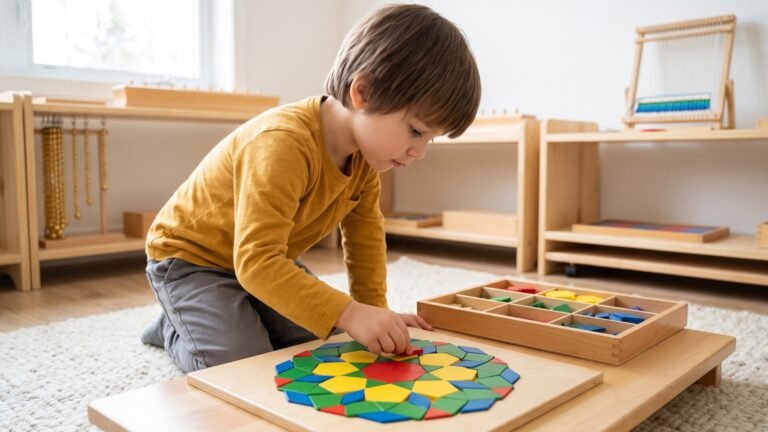
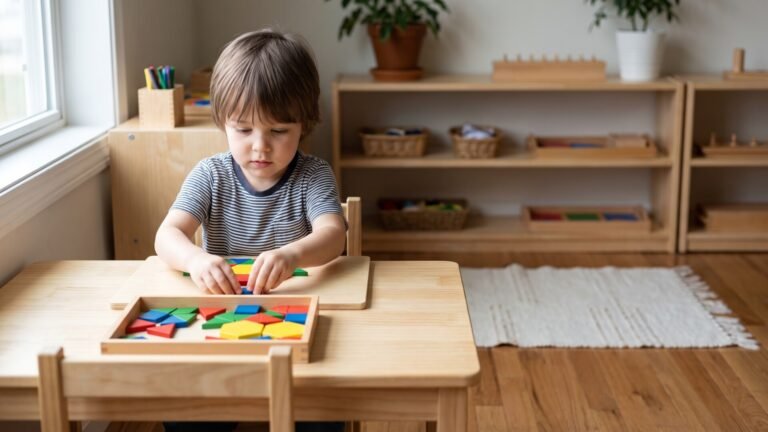
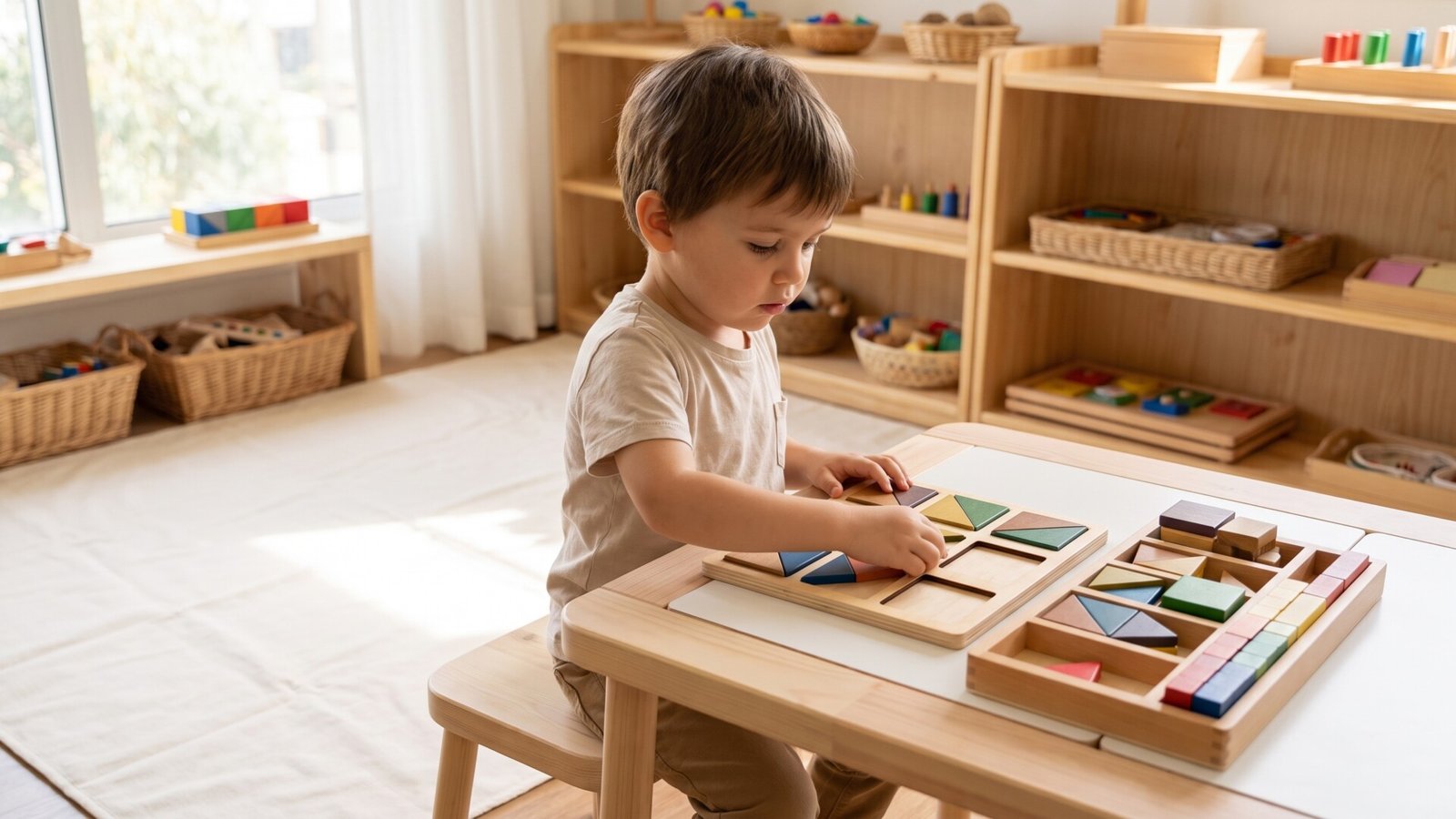
Why it’s worth considering: Pattern blocks let children copy patterns, make their own designs, and explore symmetry and shape relationships. The same pieces work for matching a board at age 3 and for creating original designs later.
Best for: Children who enjoy patterns, matching, and creating. Trade-offs: 120 small shapes mean sorting and storage work, and the set isn’t suitable for children under 3 or those who still mouth objects.
[Affiliate: Check current pricing and availability]
Sorting and Categorising: Melissa & Doug Shape Sorting Cube
| Feature | Details |
|---|---|
| Age Range | 2+ |
| Key Features | Hardwood cube with 12 wooden shapes (retailer listings vary) |
| Typical price | About $20–$25 |
| Affiliate Program | [Affiliate: Check price on Melissa & Doug] |
Why it’s worth considering: Sorting is a foundational logic skill. A shape sorter is graded 2+, so it will be easy for most 4-year-olds as designed, but it can be reused for sorting games: sort by shape, then by colour, then by how many sides, then by whether the piece will roll.
Best for: Families with a younger sibling, or children who like categorising. Trade-offs: On its own, it’s less of a challenge for a 4-year-old; its value comes from the sorting games you invent.
[Affiliate: Check current pricing and availability]
Cooperative Strategy: HABA My Very First Games – First Orchard
| Feature | Details |
|---|---|
| Age Range | 2+ (1–4 players) |
| Key Features | Cooperative game: players work together to pick the fruit before the raven reaches the orchard; wooden fruit and a colour die |
| Typical price | About $25–$35 (HABA lists $29.99) |
| Affiliate Program | [Affiliate: Check price on Amazon] |
Why it’s worth considering: A game where everyone wins or loses together removes competition and invites shared decisions. It’s simple (colour matching and counting), so a 4-year-old can play it independently with siblings and also help a younger child. See our guide to Montessori-aligned board games for more options.
Best for: Families who want a gentle first game. Trade-offs: The rules are simple, so the logic demand is modest and some 4-year-olds will move on quickly to more strategic games.
[Affiliate: Check current pricing and availability]
Open-Ended Building: Wooden Unit Blocks
| Feature | Details |
|---|---|
| Age Range | Check the specific set |
| Key Features | Cubes, rectangles, triangles, arches and cylinders |
| Typical price | Varies widely by set size and brand |
| Affiliate Program | [Affiliate: Check price on Amazon] |
Why it’s worth considering: Blocks are the most open-ended toy on the list. Children experiment with balance, symmetry, and structure through trial and error, and the same set stays relevant for years as builds get more complex. We cover blocks in more detail in our guide to magnetic tiles and Montessori alignment.
Best for: Children who love to build, alone or together. Trade-offs: They make a mess and a noise when they fall; keep a bin or a low shelf for storage.
[Affiliate: Check current pricing and availability]
Montessori-Style Activity Cube
Activity cubes typically combine several activities (bead maze, shape sorter, sliding doors, gears) on different sides. They suit small spaces and children who like variety, but most are aimed at younger toddlers, so check the age grade carefully. For a 4-year-old, a cube is usually more suitable as a shared toy with a younger sibling than as a core logic toy. Beads and small attached parts can break if a cube is dropped, so inspect it periodically.
[Affiliate: Check price on Target]
Comparison Table
| Toy | Age grade | Skill practised | Play type | Approx. price |
|---|---|---|---|---|
| SmartGames Camelot Jr. | 4+ | Planning, spatial reasoning | Solo, graded challenges | $25–$35 |
| Melissa & Doug Pattern Blocks & Boards | 3+ | Pattern recognition, symmetry | Solo or shared, open-ended | $25–$35 |
| Melissa & Doug Shape Sorting Cube | 2+ | Sorting, categorising | Solo or shared | $20–$25 |
| HABA First Orchard | 2+ | Colour matching, cooperation | Cooperative game | $25–$35 |
| Wooden unit blocks | Check set | Balance, structure, creativity | Open-ended | Varies |
How to Choose the Right Option
Best for small spaces: Camelot Jr. or the Shape Sorting Cube, which store in a box.
Best for a child new to logic toys: The pattern blocks, whose boards give a clear target, or the Orchard game for a gentle start with others.
Best for STEM-minded kids: Blocks and Camelot Jr., which invite experimenting with structure and planning ahead. More ideas appear in our guide to Montessori biology and chemistry toys for age 5.
Best on a budget: The sorting cube (reused for sorting games) or a simple set of blocks. For lower-cost wood options, see our guide to finding real wood toys on a budget.
Planning ahead: If your child is already comfortable with these, our guide to Montessori toys for 5-year-olds is the next step, and puzzles are covered in our puzzle progression guide. For language-based play at this age, see Montessori language activities for preschoolers, and for math play, inclusive math manipulatives.
How to Present a Logic Toy
The way a toy is introduced often matters as much as the toy. These habits tend to help:
- Treat it as an invitation, not a lesson. Ask “What do you notice?” rather than telling a child what to do.
- Model once, then step back. Show one challenge slowly, then let the child try.
- Let mistakes happen. Resist correcting right away; the struggle is part of the point.
- Offer a small selection. Two or three toys on a low shelf, swapped every week or two, tend to hold attention better than a full toy box.
- Adjust difficulty. If a child melts down, go back a level; if they finish quickly and walk away, move up.
Simple Logic Games You Can Play Without Buying Anything
- What comes next? Make a colour or shape pattern with blocks and ask the child to continue it.
- Which one doesn’t belong? Line up four objects where three share a feature and one doesn’t.
- Sort it your way. Give a pile of household objects and let the child choose how to sort them, then guess their rule.
- Build a bridge. Challenge a child to span a gap between two books using only blocks.
Conclusion
The best logic toys for a 4-year-old invite thinking rather than tapping: a puzzle that graduates in difficulty, pieces that can be rearranged in many ways, and games that reward working things out together. You don’t need all of them; one or two well-chosen toys, introduced thoughtfully and rotated, will usually do more than a shelf full. Whatever you choose, treat it as an invitation, let your child struggle a little, and follow what they return to.
[Affiliate: Check current pricing and availability through our recommended partners]
Frequently Asked Questions About Montessori Logic Toys For 4 Year Olds
What are Montessori toys, and why might they help my child?
Montessori-style toys are designed for hands-on, self-directed learning. They usually focus on one skill, such as sorting or matching, and let the child see for themselves whether they have succeeded. They invite practice of problem-solving and concentration, though outcomes vary from child to child.
Are logic toys safe for 4-year-olds?
Check the age grade and compliance information (ASTM F963 in the US, EN 71 and CE marking in Europe). Many logic toys have small pieces, so keep them away from children under 3 and supervise play if younger siblings are around.
How can I encourage my child to play with logic toys?
Show one challenge slowly, then step back. Ask open questions such as “What do you notice?” or “What could we try next?”, and praise effort rather than speed. Keep a small selection out and rotate them.
My 4-year-old gets frustrated quickly. What should I do?
Move back to an easier challenge, work on it together for a few minutes, and return to the harder one later. Frustration usually means the step up was too large, not that the toy is wrong.
How do I know if a toy is the right level?
Check the age grade, but watch your child. If they complete it in seconds and walk away, it’s too easy; if they melt down quickly, it’s too hard. The best level is a small stretch beyond what they can already do.
Can siblings share these toys?
Yes. Blocks, pattern pieces, and cooperative games work well for siblings of different ages. Keep small-piece toys away from children under 3.