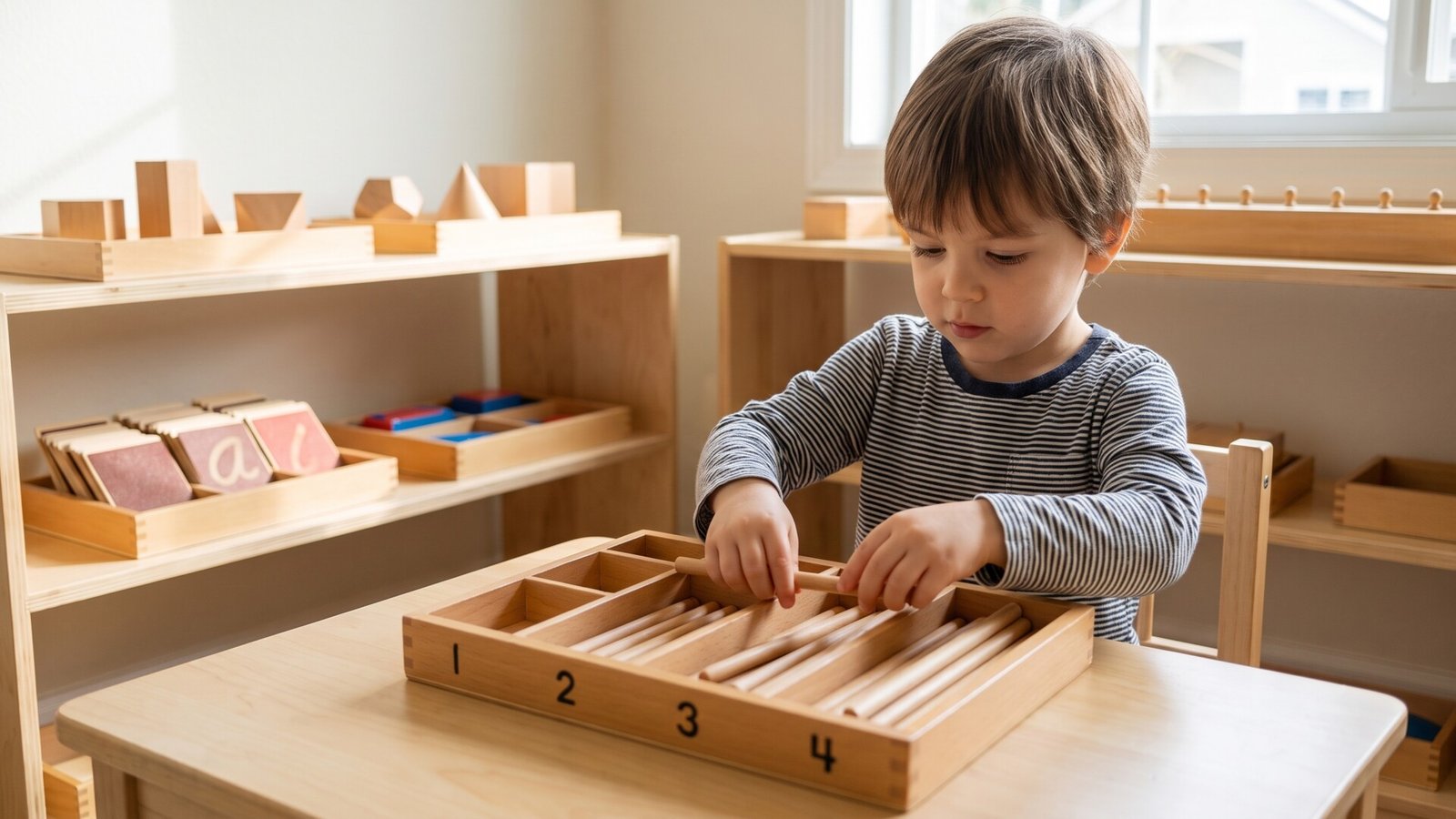
Montessori Toys for Preschoolers (3–6 Years Old)
The preschool years mark a big shift in how children think, communicate, and interact with the world. Between the ages of three and six, children move from learning mainly through movement to learning through reasoning, language, and purposeful work. Maria Montessori called the stage from about three to six the period of the conscious absorbent mind: children still soak up their surroundings, but now they do it with growing awareness, choice, and a wish to understand how things work.
Montessori toys for preschoolers are designed for this moment, when curiosity is intense and concentration deepens. They give children hands-on, self-directed ways to practise early language and math.
This page is the sub-hub for Montessori toys and activities for preschool-aged children (3–6 years). It covers language, early math, sensory refinement, and practical hands-on learning, then gets specific: real products with US price ranges, where classroom-grade materials are worth the money (and where they are not), and safety rules for homes with younger siblings.
For a broader view across childhood, visit our Montessori Toys & Activities for Kids hub, the main Montessori & Early Learning Toys guide, and the Montessori Toys by Age Group overview.
Start Here: Preschool Guides by Age and Skill
- Best Educational Montessori Toys for 3-Year-Olds
- Best Montessori Toys for 4-Year-Olds
- Best Montessori Toys for 5-Year-Olds
- Critical Thinking for Kids: Montessori Logic Toys for 4-Year-Olds
- Future Scientists: Montessori Biology and Chemistry Toys for Age 5
Coming from an earlier stage? See Montessori Toys for Infants (0–12 Months) and Montessori Toys for Toddlers (1–3 Years Old). Looking ahead to school age? See Montessori Toys for Early Elementary (6–9 Years Old).
Understanding the Montessori Preschool Stage
Preschoolers are no longer satisfied with simple exploration. They want to name, classify, compare, count, and explain. They ask endless questions, repeat activities until they feel confident, and take pride in finishing something on their own.
Common characteristics of preschoolers in a Montessori setting include:
- Rapid language growth and curiosity about letters and symbols
- A growing ability to concentrate for longer periods
- Sensitivity to order, sequence, and logic
- Interest in numbers, letters, and patterns
- Strong intrinsic motivation to learn
Montessori materials for this age try to work with these traits, so that play becomes meaningful practice without pressure or external rewards. Children develop at different speeds, so treat the ages in this guide as rough guides, not deadlines.
Why Montessori-Style Toys Work Well for Preschoolers
At the preschool level, Montessori materials start to look more “academic,” but their purpose is the same: learning through hands-on experience. Montessori preschool toys typically:
- Introduce abstract ideas through concrete materials
- Let children notice and correct their own mistakes
- Encourage independent work and choice
- Favor deep focus over quick stimulation
Instead of rushing into worksheets or screens, these materials give children physical tools to explore language, numbers, and sensory ideas. “Montessori” is not a protected label, so the quality and design of a product matter more than the name on the box. This page focuses on the most central areas for this age: language, math, and sensory learning, plus hands-on practical activities.
Montessori Language Toys for Preschoolers
Language develops quickly between ages three and six. Montessori language materials support spoken language, vocabulary, sound awareness, and early reading and writing, without pushing children before they are ready.
Key Goals of Montessori Language Toys
- Refine vocabulary and sentence structure
- Build awareness of the sounds in words (phonemic awareness)
- Connect spoken language to written symbols
- Build confidence in communicating
In the Montessori approach, language begins with spoken language and moves gradually to written language through tactile and visual materials. Reading to your child and talking together every day remain the most important language activities.
Common Montessori Language Toys and Materials
- Sandpaper letters – tactile letter cards traced with the fingers while saying the sound
- Movable alphabet – loose letters for building words before a child can write them by hand
- Object-to-word matching cards
- Classified picture cards (animals, food, transportation)
- Early reading puzzles and phonics games
These materials let children touch, see, and manipulate language rather than just memorize it. Small movable-alphabet letters and tiny object miniatures are small parts, so keep them away from younger siblings.
Why Hands-On Language Materials Help
Many preschoolers learn well when more than one sense is involved. Tracing letters, arranging word cards, and matching objects to names combine seeing, touching, and hearing, which can make the practice more memorable. These materials are especially useful for:
- Children building early literacy skills
- Preschoolers who like to learn through movement
- Multilingual households
- Children who resist traditional instruction
Montessori Math Toys for Preschoolers
Montessori math materials are among the most distinctive parts of the method. Rather than starting with numerals alone, they introduce math through concrete quantities, so children can physically experience what numbers mean. Our Montessori Math Games for Kids sub-hub has more ideas.
Core Math Ideas in the Preschool Years
- Number recognition
- Quantity and counting
- One-to-one correspondence (one object for each number)
- Early addition and subtraction with objects
- First ideas about place value (units, tens)
Working with concrete materials gives children a feel for quantity before they are expected to do abstract calculations.
Common Montessori Math Toys and Materials
- Number rods – ten rods in graded lengths (a classic Montessori material)
- Number boards and counters
- Bead chains and bead bars
- Spindle boxes – compartments for counting spindles from 0 to 9
- Simple math games using everyday objects
These materials let preschoolers see and feel math. Many are small-parts items (beads, counters, spindles), so check the age grade and supervise closely with children under 3 in the home.
How Montessori Math Supports Confidence
Because Montessori math materials are largely self-correcting and hands-on, children can learn that mistakes are a normal part of the process. No material guarantees a positive relationship with numbers, but a relaxed, playful approach with no pressure gives children the best chance to enjoy math.
Sensory Toys for Preschoolers
Sensory learning begins in infancy, but at preschool age it becomes more refined and analytical. Montessori sensory toys invite children to compare, categorize, and describe what they see, feel, hear, and smell.
Purpose of Sensory Work at the Preschool Level
- Notice subtle differences in size, shape, and texture
- Build descriptive language
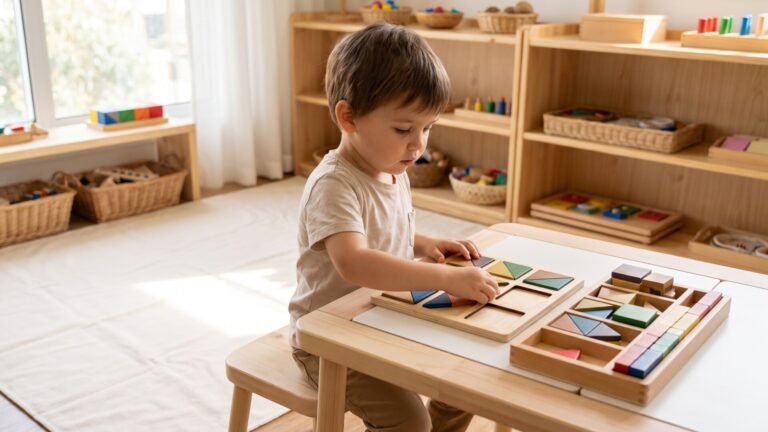
- Lay the groundwork for math and geometry ideas
- Practise concentration and observation
Common Montessori Sensory Toys
- Pink Tower and size-grading blocks – ten pink cubes, from 1 cm to 10 cm, stacked in order
- Color tablets and matching games
- Texture tablets and fabric boards
- Sound cylinders
- Smelling jars or sensory matching sets (use only safe, mild scents)
These toys isolate one variable at a time, so children can concentrate on one difference and refine their perception. Full traditional sets can be expensive; the next sections show where that spending makes sense.
Hands-On Activities and Practical Learning
Language and math matter more in the preschool years, but hands-on activity remains central to Montessori learning. Good practical, hands-on activities include:
- Food preparation tasks (cutting soft foods with a child-safe knife under supervision, pouring)
- Gardening and plant care
- Sorting and organizing materials
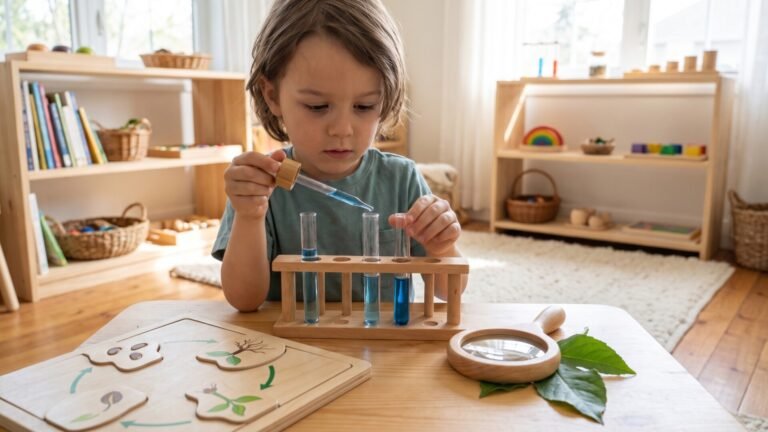
- Simple science exploration (see our simple science kits for 4-year-olds)
- Building and construction with open-ended materials
These activities give preschoolers practice with planning, sequencing, and sustained attention, skills sometimes grouped under “executive function.” Most of them cost little or nothing: a small pitcher, a tray, and real (child-sized) tools from your kitchen do the job.
Classroom-Grade, Home-Grade or Homemade: Where the Money Matters
Most Montessori toy lists treat every material as a must-buy. In practice, the price gap between a classroom-grade material and a home version is large, and it only matters for some materials. A simple rule helps:
- Pay for accuracy when a precise difference is the lesson. The Pink Tower works because each cube is exactly 1 cm larger than the last; sandpaper letters work because the letter shape and texture are clean and consistent. A well-made home-grade version is fine, but avoid very cheap sets with uneven sizing or rough, peeling sandpaper.
- Buy mainstream when the lesson is quantity or pattern. Counting, sorting and pattern work do not depend on a fine finish. Linking cubes, pattern blocks or household objects like buttons and pasta (for children past the mouthing stage) teach the same idea for much less.
- Make it yourself when the lesson is a routine or a vocabulary. Practical life trays, classified picture cards and object baskets are easy to put together from things you already own.
- Skip anything where the “Montessori” label is doing all the work, such as electronic toys with lights and rewards, or bundles of dozens of pieces you will never present.
The numbers show why this matters. At the time of writing, Nienhuis, a long-established maker of classroom Montessori materials, lists its beech Pink Tower at about $148 on its US site, while a home-grade beech Pink Tower from Adena Montessori sells for about $60 (stand sold separately). The Nienhuis Pink Tower and Nienhuis sandpaper letters (about $113) together already pass $250; a home shelf built on the rule above can start at around $100.
Real Montessori-Friendly Toys for Preschoolers, With US Prices
These are real, widely sold products that fit the materials described above. Prices are typical US retail ranges checked in November 2026; they change often, so treat them as a guide. Age grades are the manufacturer’s, and they mostly reflect small-parts safety rather than skill level.
| Product | What it practises | Age grade | Approx. US price | Best for |
|---|---|---|---|---|
| Nienhuis Pink Tower | Visual size discrimination | 3+ | About $148 | Families wanting classroom quality |
| Adena Montessori Pink Tower | Visual size discrimination | 3+ | About $60 | Home-grade budget option |
| Nienhuis Sandpaper Letters (lowercase print) | Letter sounds and shapes by touch | 3+ | About $113 | Children starting sounds |
| Nienhuis Small Movable Alphabet | Building words before handwriting | 3+ | From about $40 | Ages 4–6 who know some sounds |
| Melissa & Doug See & Spell | Three- and four-letter words | Listed 3+ to 4+ | About $15–$40 | Low-cost word building |
| Melissa & Doug Pattern Blocks and Boards | Shapes, patterns, early geometry | 3+ | About $25–$31 | Open-ended pattern work |
| Learning Resources MathLink Cubes Kindergarten Math Activity Set | Counting, comparing, early addition | 5+ | About $24 | Five-year-olds ready for numbers |
| Magna-Tiles Classic 32-Piece Set | Shapes, building, spatial play | 3+ | About $50 | Open-ended construction |
A few notes on these picks:
- Nienhuis sandpaper letters use pink boards for consonants and blue for vowels, the standard classroom color code. If $113 is too much, start with homemade letters made from fine sandpaper on card and buy a quality set later.
- See & Spell comes with 64 wooden letters, 8 double-sided spelling boards and a storage case. The boards show where letters go, so it is more guided than a true movable alphabet, but it is a gentle, inexpensive first step. Listings vary between ages 3+ and 4+; the letters are small parts.
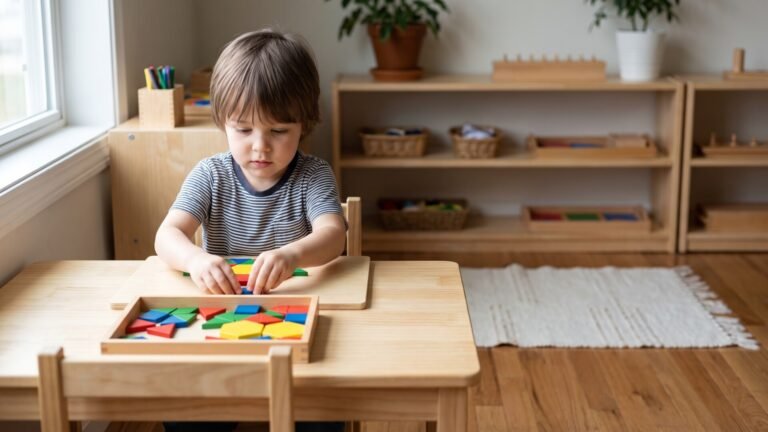
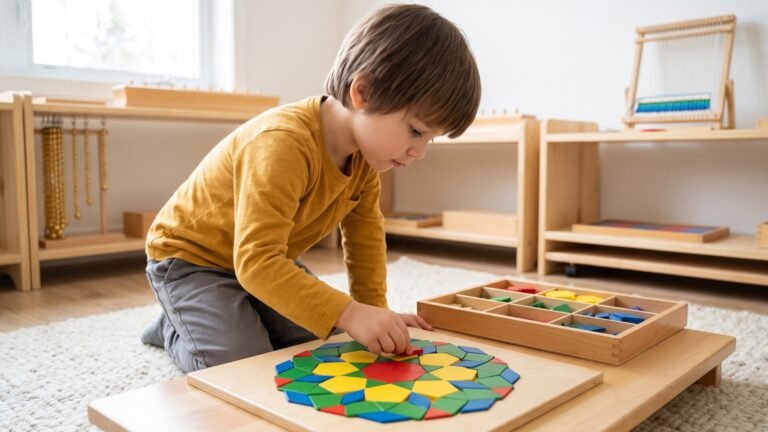
- Pattern Blocks and Boards includes 120 wooden shapes and five double-sided pattern boards in a case. Children can copy the patterns, then move on to free designs, so it lasts across the whole 3–6 range.
- MathLink Cubes sets include 100 linking cubes and 15 double-sided activity cards. They are a mainstream classroom product rather than a Montessori material, but they make the same point as bead bars: a number is a quantity you can hold.
- Magna-Tiles are not a classic Montessori material, but they are open-ended and battery-free, which is why many Montessori-minded families keep them. The magnets are riveted inside the tiles; check tiles regularly and stop using any that crack.
- “Montessori-inspired” bundles such as PlanToys’ three-toy Brain Builders set (age 3+, about $63) can be well made, but the label itself tells you little. Judge each piece on the rule above.
A first shelf for under about $100: Pattern Blocks and Boards, See & Spell, a homemade practical life tray (small pitcher, two cups, a sponge) and a basket of picture cards. Add MathLink Cubes around age five, and a Pink Tower only if your child is drawn to building and grading.
Montessori Toy Recommendations by Preschool Stage
Preschool development covers a wide range, and children progress at different speeds. Some general patterns still help when choosing. Our age guides listed at the top of this page go deeper on each year.
Early Preschool (3–4 Years)
Children focus on foundational language, sensory refinement, and simple math. Good toy types: sandpaper letters, counting materials, simple matching and sorting games, sensory grading toys such as the Pink Tower, and pattern blocks.
Mid Preschool (4–5 Years)
Language and math skills become more complex. Good toy types: movable alphabet sets, early phonics games, bead chains and counting boards, and beginner math puzzles. Logic-minded children may enjoy the puzzles and sequencing games in our logic toys guide for 4-year-olds.
Late Preschool (5–6 Years)
Children get ready for early elementary ideas. Good toy types: early reading games, simple addition and subtraction materials such as linking cubes, advanced classification cards, geometry and pattern toys, and simple nature and science work.
Quick Reference: Montessori Materials by Skill
| Skill area | Classic materials | Typical stage | Notes |
|---|---|---|---|
| Language | Sandpaper letters, movable alphabet, picture cards | 3–6 years | Start with sounds, not letter names |
| Math | Number rods, spindle boxes, bead chains | 3–6 years | Beads and counters are small parts |
| Sensory | Pink Tower, color and texture tablets, sound cylinders | 3–5 years | Full sets can be costly |
| Practical life | Pouring, food prep, gardening, sorting | 3–6 years | Supervise real tools |
| Science and logic | Simple experiments, puzzles, sequencing games | 4–6 years | Check age grades on kits |
The stages shown are typical ranges used in Montessori practice, not strict rules.
Safety and Buying Tips for Preschool Montessori Toys
- Check the age grade. Many Montessori math and language sets are labelled 3+ because of small parts. They are not suitable for under-3s in the home without close supervision.
- Keep small parts away from younger siblings. Beads, counters, spindles and movable letters are easily swallowed. US rules treat anything that fits inside the CPSC small-parts test cylinder (about 1¼ inches wide) as a choking hazard for children under 3, and toys with small parts sold for ages 3–6 must carry a choking-hazard warning.
- Avoid loose, high-powered magnets in puzzles or sets, and retire magnetic tiles that crack.
- Look for non-toxic finishes and follow the manufacturer’s care instructions.
- Do not rely on the label. A “Montessori” tag does not guarantee quality, safety or educational value.
The US Consumer Product Safety Commission publishes toy safety guidance, including information on age labelling and small parts.
Creating a Montessori Preschool Toy Environment at Home
Montessori materials work best in a calm, ordered space that encourages independence. Key elements include:
- Clearly organized shelves (our minimalist play shelf guide shows how)
- Materials arranged from simple to complex
- Defined work areas (a table and a floor mat)
- Freedom to choose an activity and repeat it without interruption
Montessori Toys vs. Traditional Preschool Toys
| Montessori-style | Many mainstream educational toys | |
|---|---|---|
| How concepts are taught | Physical, concrete materials | Often screens, buttons, or electronic prompts |
| Feedback | Self-correcting design | Electronic rewards or adult correction |
| Focus | One idea at a time | Many features at once |
| Cost | Authentic sets can be expensive | Wide range, often cheaper |
| Best for | Children who like hands-on, repeated work | Children who like variety and games |
Neither approach is wrong. Many families mix them, using Montessori-style materials for focused work and other toys for variety and fun.
How Montessori Preschool Toys Prepare Children for School
Montessori toys do not aim to push children ahead academically. They give children chances to practise the underlying skills that make later learning easier:
- Focus and attention
- Fine motor control
- Logical thinking
- Language confidence
- Self-regulation and independence
Every child is different, and school readiness depends on many things, including sleep, relationships and plenty of unstructured play. If you have questions about your child’s development, talk with your pediatrician or your child’s teacher.
Choosing Montessori Toys as Gifts for Preschoolers
Montessori-style toys make good gifts for preschoolers because they tend to stay useful for a long time. Pattern blocks or magnetic tiles suit most budgets and most children across the 3–6 range; a Pink Tower or sandpaper letters make a bigger shared gift from grandparents. When choosing:
- Look for open-ended or repeatable materials
- Prefer battery-free toys where possible
- Prioritize quality over quantity
- Match the age grade on the box to the child and the household, including younger siblings
Common Questions About Montessori Toys for Preschoolers
Frequently Asked Questions About Montessori Toys For Preschoolers
Are Montessori toys too structured for creative kids?
Not necessarily. Each Montessori material has a clear purpose, but many children also use them in their own way once they have mastered the original task. Open-ended items like blocks, magnetic tiles and art supplies fit well beside them, and a good shelf usually mixes both kinds of play.
Can Montessori toys be used alongside traditional schooling?
Yes. Montessori-style materials complement most preschool and kindergarten programs. Many children enjoy using hands-on letters or counting materials at home to revisit what they meet at school, at their own pace. Avoid turning home materials into homework; let your child choose when to use them.
How many Montessori toys does a preschooler need?
There is no fixed number. A focused selection of roughly 8 to 12 materials on a low shelf, rotated every week or two, is a common approach. Fewer choices make it easier for a child to settle into one activity, and rotation keeps interest without buying more.
When should my child start learning letters and numbers?
Children differ widely. Montessori practice usually begins with spoken language and concrete quantities, and moves to written symbols when the child shows interest, which for many children is somewhere between three and five. There is no need to rush, and interest matters more than age.
Why do Montessori materials teach letter sounds before letter names?
Reading depends on hearing and blending the sounds in words, so Montessori practice introduces the sound of each letter first, for example the sound at the start of mat rather than the name em. Letter names usually follow naturally later. This phonetic start lets children build simple words sooner.
What if my preschooler ignores the materials?
That is common. Show one material slowly and quietly, then leave it out for your child to try. Put away anything that has been ignored for a few weeks and bring it back later. Interest often depends on timing, so a material that is skipped at three may be loved at four.
Are magnetic tiles Montessori?
They are not a classic Montessori material, but they fit Montessori principles reasonably well: they are open-ended, battery-free and invite children to explore shapes and balance. Many Montessori-minded families keep them for free building. Check tiles for cracks and stop using damaged ones, because loose magnets are dangerous if swallowed.
Final Thoughts: Learning Through Purposeful Play
Montessori-style toys give preschoolers tools to explore language, math, and the sensory world through direct experience. Spend on accuracy where it matters, keep the rest simple, and follow your child’s interests, and learning can feel natural rather than forced.
For early STEM and coding exploration, check out:
- Beginner Coding Toys for Preschoolers – an introduction to sequencing, logic, and problem-solving without screens.
- Montessori Coding Robots for Preschoolers – Montessori-inspired robots that make coding interactive while practising step-by-step thinking.