Best Montessori Toys for 4-Year-Olds
Best Montessori Toys for 4-Year-Olds: Buying Guide and Shortlist
The people who sell Montessori toys will tell you the good ones are made of beech, cost $90, and come with a lesson plan. The people who actually run Montessori classrooms will tell you something less marketable: the best material for a four-year-old is the one they can pick up, use, and put back without you narrating it. That is the whole test. Not the wood. Not the certification. Not how it looks on the shelf in the photo.
Which is inconvenient, because the word Montessori has become a sticker. You can buy a plastic shape sorter with “Montessori” printed on the box and it will do less for your child than a $12 set of lacing beads. You can spend $200 on a bundle of natural-wood pieces that nobody explains, and watch it sit untouched while a $30 box of pattern blocks gets used every afternoon for a year.
So the shortlist below is not ranked by price or pedigree. It is grouped by what a four-year-old actually does with it, which is the only thing that predicts whether it survives past February.
What Makes a Montessori Toy Suitable for a 4-Year-Old?
Montessori is not a product category. It is a method, and the method has a few practical features you can check in a shop or a listing photo.
The activity should be hands-on and self-correcting where possible, meaning the child can tell whether it worked without you telling them. The pieces should connect to real life, not to a cartoon. The child should control the pace. And the challenge should be just hard enough that they need to concentrate, but not so hard that they need you standing over them.
That last point is where most “Montessori” products fail. A toy that requires an adult to explain it every time is not independent work. It is a supervised activity with extra steps, and it will get used exactly as often as you are willing to sit down.
A genuinely Montessori-aligned toy is also usually limited. One skill, one clear purpose, a defined beginning and end. The tray is part of the design. So is the fact that the child can carry it to a table without help.
The developmental case for this kind of play is straightforward and not controversial. Fine-motor control, hand-eye coordination, early language, early number sense, concentration, sequencing, and the small daily experience of doing something yourself. You do not need a study to justify a four-year-old threading beads onto a lace. You need to know that it holds their attention long enough to matter.
Age ranges are a starting point, not a promise. A four-year-old who has been doing puzzles since two will be bored by a product aimed at three. A four-year-old who has never used a lacing bead may need a few weeks before it clicks. Their frustration tolerance matters more than the number on the box.
Key Buying Factors for Parents
Developmental fit and challenge level
The failure mode at four is not a toy that is too hard. It is a toy that is too easy, gets solved once, and is never touched again. Four-year-olds are quick, and they notice when a challenge has run out.
The second failure mode is the opposite: a material so abstract that the child needs you to translate it every time. A Pink Tower works when someone shows how to carry the cubes carefully, build from largest to smallest, and put it back. Without that, it is a stack of wooden cubes.
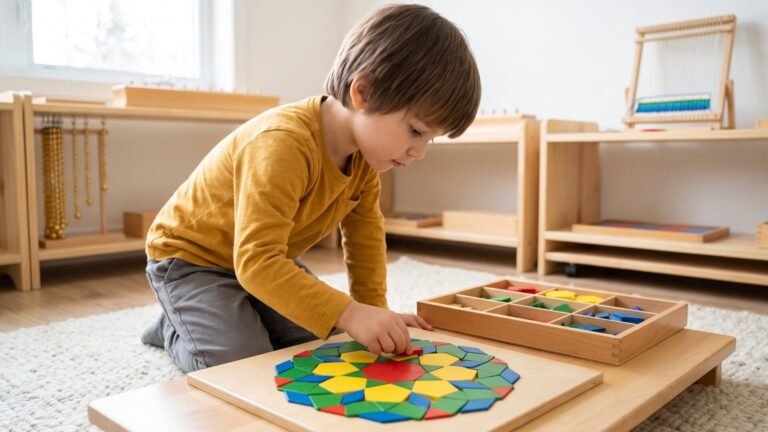
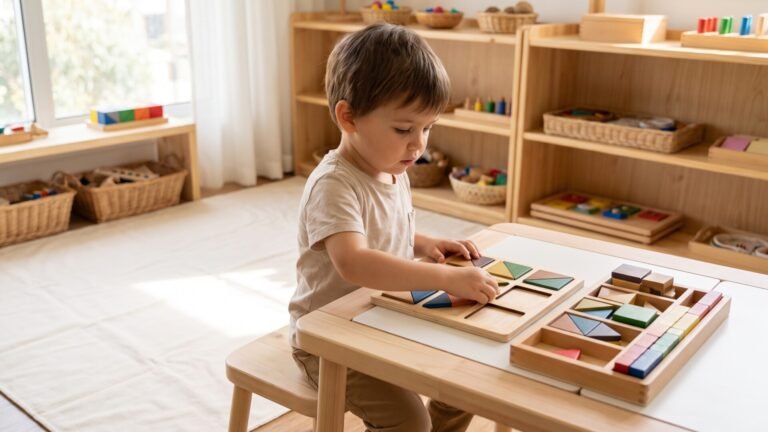
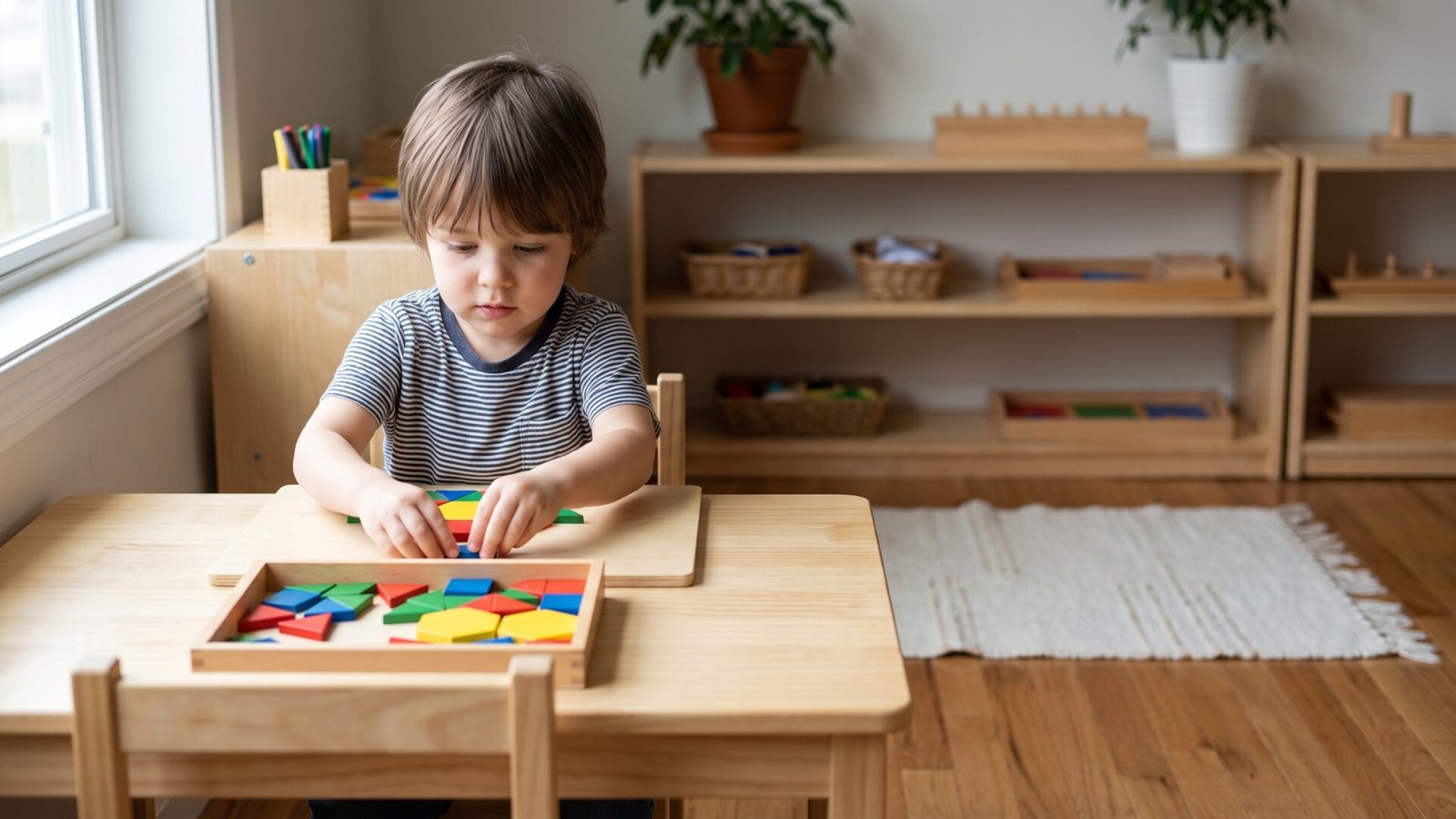
The sweet spot is an activity with a low floor and a high ceiling. Pattern blocks are the clearest example. A four-year-old can copy a design from a board, then rearrange the same pieces into something of their own. Same box, two different jobs, months apart.
When you are choosing between practical life, math, language, sensory, building, and pretend play, pick the one your child already gravitates toward. A child who follows you around the kitchen will use a pretend baking set. A child who lines up objects by size will use the Pink Tower. Buy for the child you have.
Independent play and adult involvement
The ToyGuideHub Independent Play Score is our planning framework for this, not a lab result. It scores each toy from one to five on four things: how long setup takes, how obvious the activity is without instructions, how likely the child is to repeat it, and how much adult correction it needs. A five means you can put it on a shelf and walk away. A two means you are part of the activity, every time.
Independent play does not mean unsupervised. It means the child can start, work, and finish without you running it. You are still in the room. You are still the one who checks for broken pieces and keeps small parts away from younger siblings.
Some toys are genuinely better with an adult. Art sets, for example, are more valuable when you sit down and draw alongside them rather than handing over a case and walking off. Pretend cooking gets better with a second person to serve. That is not a flaw. It is just a different kind of purchase, and you should know which one you are making.
Durability, storage, and ownership
Wood is the default for a reason. It survives drops, it does not yellow, and it can be handed to a younger sibling. But wood is not automatically better. A cheap wooden toy with a rough finish and inconsistent sizing is worse than a well-made plastic one, and in the Pink Tower’s case, inconsistent cube sizes break the entire point of the material.
The bigger issue is storage, and it is the one buyers underestimate. A toy with forty loose pieces needs a home, or it becomes floor debris within a week. The practical test: can your four-year-old get it out, use it, and put it back without turning the shelf into a mixed-parts bin? If not, you will end up doing it, and that is the version that gets quietly retired.
A smaller toy with one dedicated spot beats a large activity set with no home. Every time.
Safety and age appropriateness
Check the current manufacturer guidance before you buy, especially for small parts, magnets, cords, pegs, and any tool that cuts. Beads and lacing are fine for a four-year-old, but they are a choking hazard for a younger sibling, and that is a household decision, not a product one.
Supervise anything involving scissors, food preparation, water, or small pieces. This is standard advice and it is not complicated.
One thing worth stating plainly: “Montessori” is not a safety certification. It does not mean the toy has been tested, inspected, or rated. Inspect what arrives. Look for loose parts, sharp edges, cracking, peeling finish, and damaged hardware, and stop using anything that fails.
Pros and Cons of Montessori Toys for 4-Year-Olds
Pros
- Hands-on activities make abstract ideas concrete, which is exactly what a four-year-old needs.
- Open-ended and practical toys run on repetition, not batteries, so they do not need replacing or recharging.
- Many of them fold into normal family life, which is where four-year-olds do most of their learning anyway.
- A well-chosen material can last years and pass down to a younger sibling.
Cons
- A lot of Montessori-branded product is an ordinary toy with a premium price and a beige photo.
- Open-ended toys look boring on a shelf. They often need you to present them once, properly.
- Small pieces mean storage work and supervision, whether you wanted that or not.
- Practical-life activities are slower and messier than handing over a tablet, and pretending otherwise is dishonest.
Best Montessori Toys for 4-Year-Olds
This is a shortlist of different jobs, not a ranking. The right pick depends on your child, your shelf space, and how much mess you are willing to absorb.
| Product | Approximate age fit | Main learning focus | Independent play | Price range | Best for |
|---|---|---|---|---|---|
| Melissa & Doug Wooden Pattern Blocks and Boards | 4+ | Visual-spatial thinking and patterns | High | $20-$35 | Open-ended tabletop play |
| Learning Resources Pattern Play Shape Cards and Blocks | 4+ | Geometry, matching, problem solving | High | $20-$35 | Guided-to-independent challenges |
| Montessori Pink Tower | 4+ with presentation | Size discrimination and sequencing | Medium | $40-$100 | A dedicated sensorial shelf |
| Melissa & Doug Deluxe Art Set | 3+ | Fine-motor control and creative expression | Medium | $25-$40 | Regular creative work |
| Melissa & Doug Wooden Lacing Beads | 3+ | Fine-motor coordination and sequencing | High | $15-$25 | Quiet table work, small spaces |
| LEGO DUPLO or LEGO Classic Creative Brick Box | Varies by set | Construction and early engineering | High | $25-$60 | Maximum replay value |
| Melissa & Doug Slice and Bake Cookie Set | 3+ | Pretend practical life and social play | Medium | $20-$35 | Kitchen role play |
Melissa & Doug Wooden Pattern Blocks and Boards
| Feature | Details |
|---|---|
| Age range | Typically 3+; confirm current packaging |
| Key features | Wooden geometric pieces, pattern boards, matching, open-ended designs |
| Price, approximate | $20-$35 |
| ToyGuideHub Independent Play Score | 4/5 |
The Verdict: The strongest all-round value on this list. The boards give a four-year-old a clear starting task, and the same shapes then work for free design once the boards are done. It is the rare toy that is useful on day one and still useful in eighteen months.
Best For: Children who like puzzles and patterns but are not ready for abstract Montessori math materials.
Pros
- Repeat pattern and shape work without needing you to reset it.
- Compact, easy to store, easy to put on a tray.
- Works as a guided activity and as open-ended play.
Cons
- Some children burn through the included boards in a few weeks.
- The pieces migrate into other toy bins if there is no dedicated container.
- Present it as a one-time puzzle and it becomes one.
[Affiliate: Check current pricing on Amazon]
Learning Resources Pattern Play Shape Cards and Blocks
| Feature | Details |
|---|---|
| Age range | Generally 4+; confirm current packaging |
| Key features | Pattern cards, geometric blocks, visual matching, graded difficulty |
| Price, approximate | $20-$35 |
| ToyGuideHub Independent Play Score | 4/5 |
The Verdict: A practical bridge between simple matching and real logic work. The cards give a visible goal and a built-in difficulty curve, which suits a child who needs to know when they are finished.
Best For: Preschoolers who want a clear target and a next level to reach.
Pros
- Clear challenge structure, obvious when done.
- Builds shape recognition, visual planning, and concentration.
- Mid-range price for the amount of use.
Cons
- Less open-ended than a classic sensorial material.
- Some children solve by trial and error rather than planning, which is fine but limits the stretch.
- Cards and blocks need one consistent home or the cards vanish.
[Affiliate: Check current pricing on Amazon]
Montessori Pink Tower
| Feature | Details |
|---|---|
| Age range | Commonly introduced around 3-4+, depending on readiness |
| Key features | Graduated cubes, visual size comparison, sequencing, careful carrying |
| Price, approximate | $40-$100 |
| ToyGuideHub Independent Play Score | 3/5 |
The Verdict: The clearest example of a real sensorial material, and one of the easiest to buy badly. It only works when an adult presents how to carry, build, compare, and return the cubes, and when the cubes are actually accurate. It is not a first purchase for most homes.
Best For: Families deliberately building a Montessori shelf, with the space and the patience for presentation.
Pros
- Teaches size discrimination and sequencing through the hands, not a screen.
- Encourages careful movement and precise vocabulary.
- Slots naturally into a wider sensorial setup.
Cons
- Takes more shelf space than the simple design suggests.
- Cheap versions often have inconsistent cube sizes or rough, unfinished edges.
- Play value collapses without adult presentation.
[Affiliate: Check Montessori sensorial materials on Amazon]
Melissa & Doug Deluxe Art Set
| Feature | Details |
|---|---|
| Age range | Commonly 3+; check the current kit contents |
| Key features | Drawing and craft materials in a portable case |
| Price, approximate | $25-$40 |
| ToyGuideHub Independent Play Score | 3/5 |
The Verdict: Creative work is more Montessori-aligned than most parents assume, as long as the child controls the materials and nobody is pushing them to copy a finished picture. This set gives a four-year-old a wide invitation to draw, cut, and design. It is also the one on this list with an ongoing cost attached.
Best For: Children who choose art on their own, in a house with a workable art station.
Pros
- Builds fine-motor skills and self-expression at the same time.
- Variety without buying each material separately.
- The case makes basic storage simple.
Cons
- Consumables run out and need replacing, indefinitely.
- The full kit overwhelms some children; offer a few items at a time.
- Scissors and cleanup mean adult involvement, every session.
[Affiliate: Check current pricing on Amazon]
Melissa & Doug Wooden Lacing Beads
| Feature | Details |
|---|---|
| Age range | Commonly 3+; confirm current product guidance |
| Key features | Large wooden beads, laces, color matching, sequencing |
| Price, approximate | $15-$25 |
| ToyGuideHub Independent Play Score | 4/5 |
The Verdict: The cheap, unglamorous thing that keeps earning its place. It is not impressive on a shelf, but it is easy to get out, easy to put away, and useful for a child who needs one calm, bounded task.
Best For: Quiet work, travel, fine-motor practice, and small apartments.
Pros
- Low cost, tiny footprint, no batteries.
- Threading, sequencing, and color language in one activity.
- Presents cleanly on a tray or in a small tin.
Cons
- Beads get lost, and the set shrinks over time.
- Children who dislike repetition will drift off.
- Less complexity than a construction or logic set.
[Affiliate: Check current pricing on Amazon]
LEGO DUPLO or LEGO Classic Creative Brick Box
| Feature | Details |
|---|---|
| Age range | DUPLO suits younger preschoolers; many LEGO Classic sets are 4+ or older, so check the set |
| Key features | Building, balance, construction, pretend scenarios, open-ended design |
| Price, approximate | $25-$60 |
| ToyGuideHub Independent Play Score | 5/5 after initial familiarity |
The Verdict: Traditional Montessori materials are not the only route to self-directed, hands-on learning. A good building set delivers concentration, planning, spatial reasoning, and story play, provided you resist taking over the design. It is also the most replayable thing here, and the biggest storage problem.
Best For: Children who build, dismantle, redesign, and invent around their creations.
Pros
- Exceptional replayability; the same bricks stay useful for years.
- Strong construction and spatial-learning value.
- Grows with the child instead of capping out.
Cons
- Small pieces mean real storage and supervision demands.
- Instruction booklets can narrow play if they become the only option.
- Bricks end up in every room of the house. Accept it.
[Affiliate: Check LEGO DUPLO and LEGO Classic collections]
Melissa & Doug Slice and Bake Cookie Set
| Feature | Details |
|---|---|
| Age range | Commonly 3+; verify current product guidance |
| Key features | Pretend baking, cutting, serving, sequencing, social play |
| Price, approximate | $20-$35 |
| ToyGuideHub Independent Play Score | 3/5 |
The Verdict: Not a formal Montessori material, and it does not pretend to be. It supports purposeful pretend play and practical-life language when it sits next to real household routines. It is worth it for the child who follows you around the kitchen. It is dead weight for the child who wants a precision task.
Best For: Pretend kitchens, sibling play, and children drawn to everyday household work.
Pros
- Builds sequencing and practical vocabulary through play.
- Supports cooperative and imaginative play with siblings or adults.
- Holds up to regular pretend use when stored properly.
Cons
- A poor fit for children who prefer solitary, structured work.
- Small pieces disappear, like all small pieces.
- It does not replace real, supervised kitchen participation.
[Affiliate: Check current pricing on Amazon]
Skip This If: Oversized “Montessori” Activity Bundles With No Clear Progression
Large bundles are the worst value in this category. Fifty unrelated pieces look like more toy for the money, but they create clutter, mixed storage, and shallow engagement. The child picks through it, uses three things, and the rest becomes shelf filler.
Skip the bundle when the seller cannot clearly explain what the activity is, who it is for, what it is made of, and how the pieces are stored. That is not a hard test, and most bundles fail it.
Buy one focused material instead. Pattern blocks, lacing beads, or a building box. Add a second only after the first gets used consistently for a few weeks. A high price and a natural-wood finish do not make something Montessori, and they do not make it good.
What Most Buyers Get Wrong About Montessori Toys at Age Four
More educational usually means more features, and more features usually means less use. A toy that does six things rarely does any of them well enough for a four-year-old to return to it. A toy that does one thing, clearly, gets picked up on a Tuesday afternoon without anyone suggesting it.
The second mistake is treating Montessori as a set of prescribed lessons. You do not need to run a three-part lesson with a lacing bead. A child can gain real skills from open-ended building, art, sorting, and pretend cooking as long as the activity is purposeful and they are the one directing it. The method is a set of principles, not a script, and the script is the part most parents quit.
The third is confusing independent access with unsupervised access. Toys should live at the child’s height, on a low shelf, where they can reach them without asking. That is different from leaving a four-year-old alone with scissors or a younger sibling who eats beads. You are still the safety layer.
The fourth is the overloaded shelf. Three to five activities available at once will get more use than twenty. Rotation is the trick. Put some away, bring them back in a few weeks, and the same toy reads as new. It also means you can own more toys than fit on the shelf without the shelf becoming noise.
ToyGuideHub Independent Play and Longevity Analysis
Every score in this article comes from the same four questions: how long does setup take, is the activity obvious without instructions, will the child repeat it, and how much adult correction does it need. These are editorial judgment calls based on how the toy is designed and how four-year-olds generally use it. They are not lab results, and no toy was tested in a facility.
Run the ownership pattern forward and the list sorts itself.
Lacing beads cost the least, set up in seconds, and have a modest ceiling. They will not carry a whole afternoon, but they will carry fifteen quiet minutes, repeatedly, for a long time. Pattern blocks have the best repeat curve on the list because the child moves from copying a board to inventing a design using the same pieces. The Pink Tower demands shelf space and a presentation before it does anything, and it only pays that back inside a broader sensorial setup. The art set has the highest creative ceiling and the only running cost, because paper and markers do not refill themselves. Building bricks have the strongest long-term replayability and the worst storage risk. The baking set has high social value and depends entirely on whether your child likes playing house.
Here is a simple way to compare them for your own house. Take the approximate useful months, divide by the price, then adjust down for storage burden and up for sibling hand-me-down value. A $25 lacing set used twice a week for two years beats a $90 material that needs a dedicated shelf and gets built once a month. Do not treat any cost-per-use figure as a fact. Treat the method as the point, because it forces you to think about months, not features.
The counterintuitive conclusion: the most durable-looking wooden toy is not automatically the best long-term buy. A small lacing set or an adaptable brick box will often see more total use than an expensive material that requires a shelf, a presentation, and an adult standing nearby. Durability is not the same as use, and use is what you are paying for.
So the analysis resolves into buyer types. Pattern blocks for broad value across most homes. Lacing beads for budget and small spaces. Building bricks for maximum replayability, if you can live with the pieces. The Pink Tower only if you are genuinely committed to a sensorial shelf and will present it properly. If you are not sure which type you are, you are the pattern-blocks buyer.
How to Choose the Right Option for Your Family
Best overall
The Melissa & Doug Wooden Pattern Blocks and Boards wins on the widest combination of price, repeat use, storage, and independent challenge. It is the safest recommendation for a child you do not know well, which makes it the default gift pick too. If you want the logic side of this age range covered in more depth, Critical Thinking for Kids: Montessori Logic Toys for 4-Year-Olds goes further.
Best budget pick
The Melissa & Doug Wooden Lacing Beads are compact, cheap, and clearly purposeful. Nothing on this list beats them for a small apartment, a travel bag, or a household that is already drowning in plastic.
Best for long-term replayability
LEGO DUPLO or a LEGO Classic Creative Brick Box, chosen by what your child can handle safely. DUPLO for a child who still mouths pieces or builds simply; a Classic set for one who manages smaller bricks and wants detail. This is the option that is still in rotation when the child is seven.
Best for a Montessori shelf
A well-made Montessori Pink Tower, but only if you have the space and intend to present it as regular sensorial work. Bought as a display piece, it is an expensive stack of cubes.
Best for creative expression
The Melissa & Doug Deluxe Art Set, with the caveat that access to a manageable art station matters more than owning a large assortment. If you want the broader picture of how these toys fit a preschooler’s development, Montessori Toys for Preschoolers (3-6 Years Old) covers the whole span.
Best for practical-life-inspired pretend play
The Melissa & Doug Slice and Bake Cookie Set, for children who gravitate to cooking, serving, and household role play. Pair it with real, supervised kitchen jobs and it earns its shelf space.
Best for small spaces or travel
Melissa & Doug Wooden Lacing Beads or a compact pattern-block set. Avoid oversized wooden activity stations entirely. They eat floor space, they are heavy, and they get used less than the small things.
Conclusion
The best Montessori toy for a four-year-old is the one that matches what they already like doing, can be used with limited adult direction, and fits the space and supervision you actually have. That is the whole decision. Everything else is marketing.
The winners, plainly. Best Overall: Melissa & Doug Wooden Pattern Blocks and Boards. Best Budget: Melissa & Doug Wooden Lacing Beads. Best Premium or Montessori Shelf Option: Montessori Pink Tower. Best Long-Term Replay: LEGO DUPLO or LEGO Classic Creative Brick Box. Best Creative Option: Melissa & Doug Deluxe Art Set.
Check the age ranges and safety guidance before you buy, especially on anything with small pieces, and inspect what arrives. Then put it on a low shelf, show your child once, and let them take it from there.
[Affiliate: Check current pricing and availability through our recommended partners], or browse the wider Montessori Toys for Preschoolers (3-6 Years Old) collection to see how these fit alongside the rest of the age range.
Frequently Asked Questions About Montessori For 4 Year Olds
Are Montessori toys good for 4-year-olds?
They can be, when they offer hands-on work, a manageable challenge, independence, and repetition. The label alone guarantees nothing. A plain wooden toy that sits unused is worse than a plastic one that gets played with daily.
What is the best Montessori toy for a 4-year-old?
The pattern-block set is the best general recommendation because it works for a wide range of children and holds up over time. Building bricks, art materials, practical-life toys, or sensorial materials may suit a specific child better.
Are Montessori toys safe for toddlers and preschoolers?
Safety depends on the individual product, the piece size, the construction, and the child. Follow the current manufacturer guidance, and supervise small parts, magnets, cords, water, and tools. Montessori is a method, not a safety certification.
How many Montessori toys should a 4-year-old have out at once?
Start with a small rotating selection rather than a fixed number. Limited choices make independent selection and cleanup easier, and rotation keeps the toys feeling new without buying anything else.
Do Montessori toys need to be made of wood?
No. Natural materials are common and often durable, but plastic and composite toys can support hands-on, open-ended, purposeful play if the design and the play pattern are right.
Are Montessori toys worth the higher price?
Sometimes. Premium pricing makes sense when you get durable construction, replaceable parts, strong replayability, or use across several ages. Branding and a wood-grain photo do not justify it on their own.
What should I buy for a 4-year-old who loses interest quickly?
Pick something with a short entry task and several levels of challenge, like pattern blocks, lacing beads, or open-ended bricks. Offer fewer pieces and change the challenge rather than buying a bigger set.
What is the difference between Montessori toys for 4-year-olds and 5-year-olds?
At five, the materials shift toward longer sequences, more language work, and more complex building and logic tasks. Our Best Montessori Toys for 5-Year-Olds covers where the list changes, and Future Scientists: Montessori Biology and Chemistry Toys for Age 5 handles the science side when your child is ready for it.
Can I use these toys with younger toddlers in the house?
Yes, with supervision. Beads, small bricks, and cutting tools are a hazard for children who still mouth objects, so keep them out of reach and bring them out for the older child. Many of these materials also work well for younger toddlers once they are past the mouthing stage and you adjust the challenge down.