Montessori Kitchen Activities for Toddlers
A learning tower costs about $200. The activities it is designed to support cost about $4, and most of that is the price of a lemon.
That is the whole problem with this category in one line. Parents searching for Montessori kitchen activities for toddlers get shown furniture, wooden utensil sets, and pretend food, and the assumption underneath all of it is that you need to build a small kitchen system before your child can start. You do not. The best Montessori kitchen activities are the ones already happening in your kitchen: washing produce, spreading something soft on something flat, pouring water between two small pitchers, stirring, carrying a plate, wiping up what happened next.
What decides whether it works is not the label on the tools. It is the age, the setup, the supervision, and whether the task has a beginning, a middle, and an end your toddler can see. Get those right and a $3 bowl does more than a $200 tower. Get them wrong and the tower becomes a very expensive place to store a toddler who has lost interest.
This is written for real kitchens – small ones, rented ones, ones where someone is trying to get dinner on the table at 6pm. See our Montessori Practical Life Toys & Activities for the broader framework this sits inside.
Cooking and kitchen activities are an excellent part of Montessori practical life because toddlers can practice meaningful skills such as pouring, stirring, transferring, washing, and preparing simple foods. These are just one part of the broader practical life approach, which is covered in our Montessori Practical Life Toys: Complete Guide.
What Makes a Kitchen Activity Montessori-Inspired?
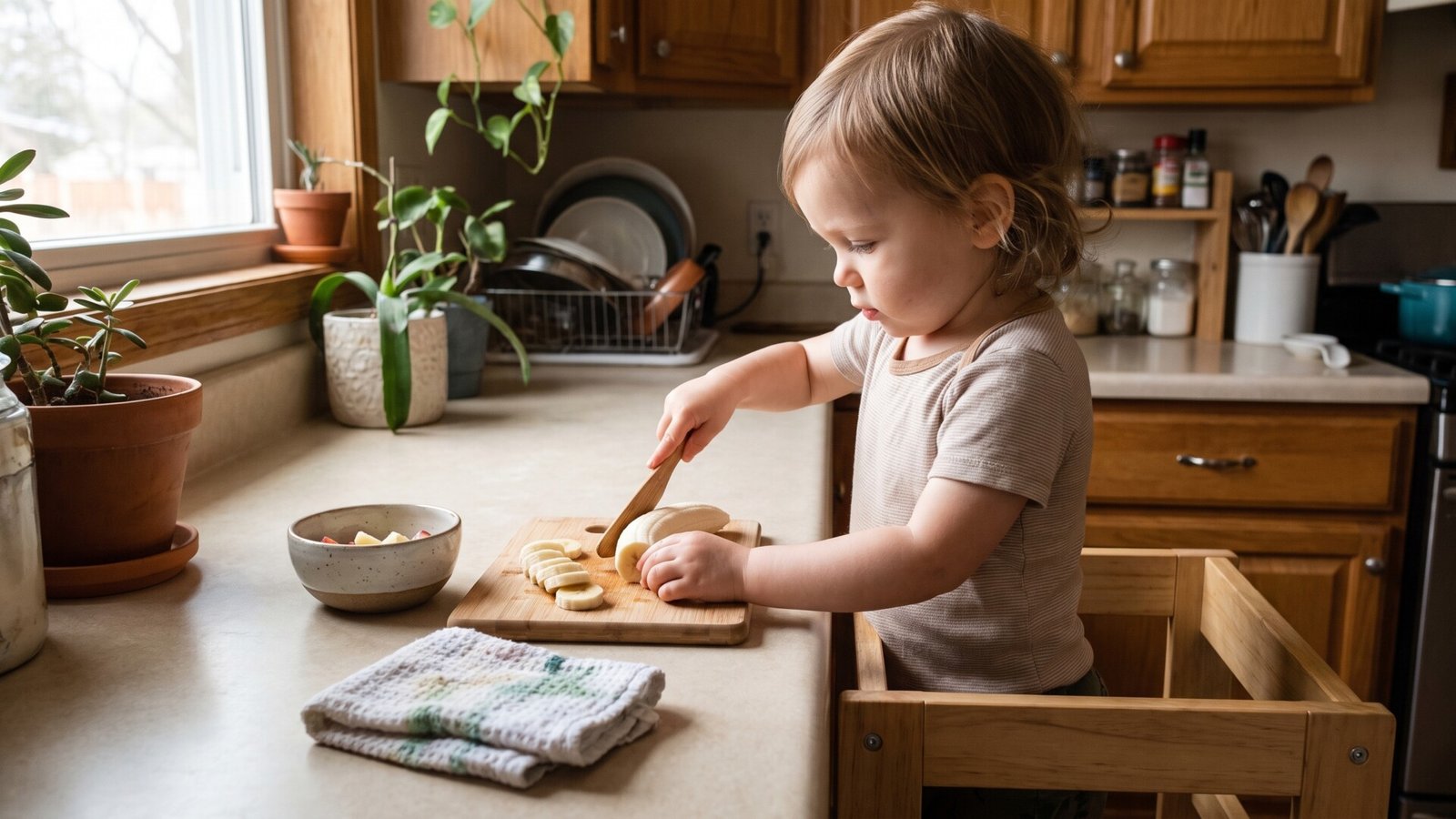
A Montessori-style practical life activity is a real task, done with real tools, for a real reason. Your toddler is not pretending to cut a wooden carrot. They are cutting a soft banana with a blunt spreader because the banana is going in the bowl and the bowl is going on the table. That distinction is doing most of the work.
Purposeful work gives a toddler something pretend play cannot: a visible result. Water goes in the pitcher, water comes out, the plant gets watered or the batter gets thinner. There is a beginning, a middle, and an end, and the child can see they caused it. That is where the concentration comes from – not from the toy, from the consequence.
Repetition is the other half. A toddler who pours water between two cups eleven times is not failing to complete the task. They are completing it eleven times, which is the point. Each repetition builds coordination, sequencing, and the working memory to hold a short instruction in their head long enough to follow it. Independence and confidence are the byproducts, not the lesson plan.
What Montessori does not mean is unsupervised. Practical life in a classroom runs on prepared environments and trained adults within arm’s reach. At home that translates to: knives adult-only until you have judged otherwise, heat adult-only always, appliances and cords out of the activity zone, and an adult who can physically reach the child at every moment. The method is about real participation, not about handing a two-year-old a peeler and leaving the room.
The Best Montessori Kitchen Activities for Toddlers
These run roughly from lowest risk to most involved. Readiness matters more than age at every step, and the readiness signs are the same throughout: steady balance, can follow a one- or two-step instruction, will stop when you say stop, and stays interested for more than a minute.
Washing and Preparing Produce
This is the best first activity in the kitchen, and it is not close. Fill a shallow basin or the sink with a little water, hand over a child-sized scrub brush, and let them work through potatoes, apples, carrots, or mushrooms. Then a small towel to dry, and a bowl to put the finished produce in.
The sensory feedback is immediate and the repetition is built in – there is always another potato. Crucially, the failure mode is a wet counter, not a cut finger. That is why this beats rushing to cutting tasks, which is the mistake most eager parents make in week one.
Skills here are hand strength, wrist rotation, sequencing (wash, dry, put away), and the vocabulary that comes free with it: scrub, rinse, dry, stem, skin.
Main safety point: wash your own hands and the child’s before and after, and keep the water shallow. Produce that will be eaten raw should be washed under running water per normal food-safety practice.
Transferring, Pouring, and Measuring
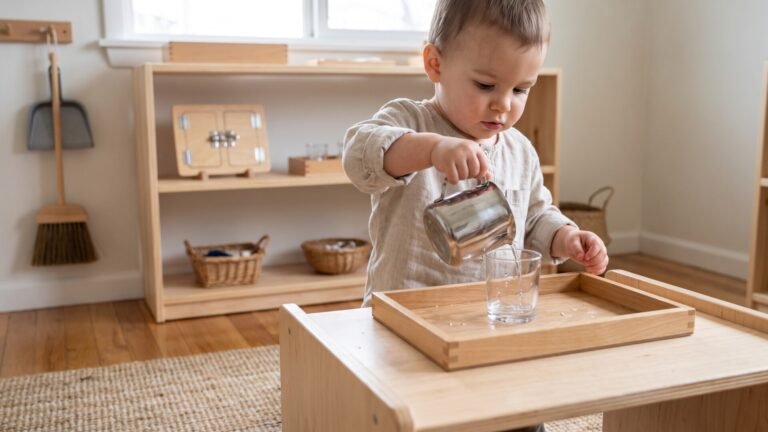
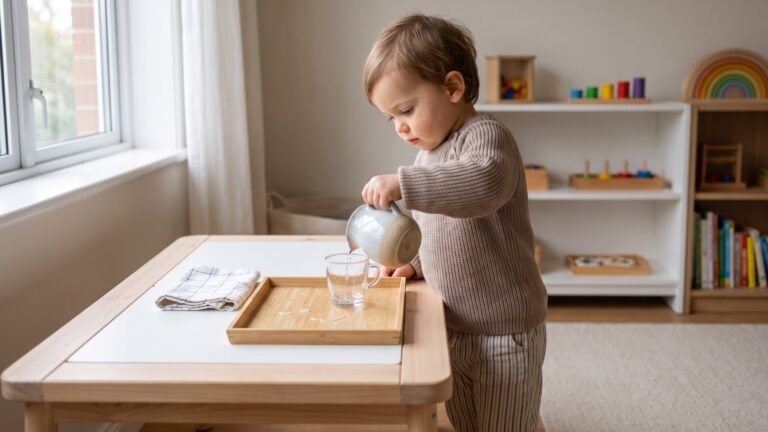
Pouring water between two small pitchers is the classic, and it is worth the puddle. Start with a tray underneath, a small quantity of water, and pitchers with handles sized for a toddler’s grip. Dry transfers – oats, cereal, dried beans – are the lower-mess entry point and build the same wrist control.
Measuring is the sleeper activity here. Hand a toddler the measuring cup while you are actually cooking and they are participating in the real thing, not a simulation of it. Counting scoops out loud covers the math without turning it into a lesson.
Main safety point: dried beans and similar hard dry goods are a choking hazard for children who still mouth objects. Use them only if your child has moved past that stage, and keep quantities small.
Spreading and Assembling
A blunt toddler-safe spreader, a soft food, and a base. Hummus on a pita, cream cheese on toast, mashed avocado on a cracker. The tool does very little cutting and a lot of smearing, which is exactly what a two-year-old can manage.
Assembling is where this gets genuinely useful. Let them build their own snack from prepared components – yogurt, fruit, cereal in a cup, layered in whatever order they choose. A toddler who assembled their own snack eats it with a focus that a pre-made one never gets, and they did the whole thing themselves. That is more independence than any adult-directed pretend activity delivers.
Main safety point: check the spreader’s current age guidance and construction, and supervise the whole time. A blunt plastic blade is not a guarantee.
Stirring, Kneading, and Mixing
Stirring pancake batter, oatmeal that has cooled to safe temperature, or any no-cook mixture is a strong activity because the child can see the mixture change because of what they did. Kneading soft dough is the same idea with more resistance and better hand strength work.
Pouring pre-measured ingredients into a bowl is the version to use with a two-year-old who is not ready to measure. You do the measuring, they do the dumping, everyone is happy.
Main safety point: the stove, oven, hot pans, and hot liquids stay adult territory, full stop. Raw meat and raw eggs should be handled by an adult, and anything containing raw egg should not be tasted. This is standard food-safety practice, not a Montessori rule.
Peeling and Simple Food Preparation
Bananas, clementines, and hard-boiled eggs are the training ground. They peel with fingers, they have a clear finished state, and a toddler can genuinely complete the task – which is the entire point. A fork or masher for soft foods like avocado or cooked potato extends this without adding a sharp edge.
A child-safe vegetable peeler is a later step, not a starting one. Introduce it only when your child has the coordination and the attention span to follow instructions and stop when asked. Hand-over-hand help can show the motion, but it does not replace clear boundaries about when the tool comes out and when it goes away.
Main safety point: readiness, not age, decides this. Check the manufacturer’s guidance on any peeler and supervise continuously.
Serving and Setting the Table
Carrying a small cup or plate to the table, placing napkins and spoons, serving pre-portioned food with tongs or a small spoon. This is real work with a real audience – the family is waiting for the napkins – and toddlers respond to that.
On materials: the Montessori tradition favors real, breakable items because they teach care. That is a reasonable principle and an unreasonable first step if you are not ready to sweep up. Start with durable items you can tolerate losing, and introduce glass or ceramic when your child’s grip and your patience have both improved. There is no prize for breaking a bowl in week one.
Main safety point: hot food and full cups stay with the adult. Let the child carry what they can carry.
Cleaning Up
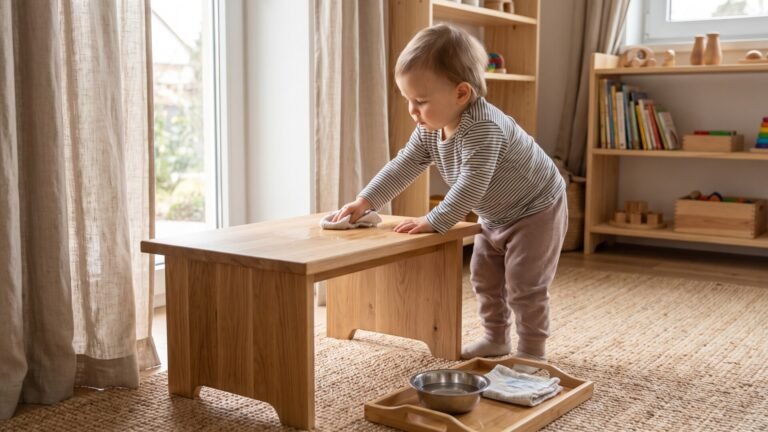
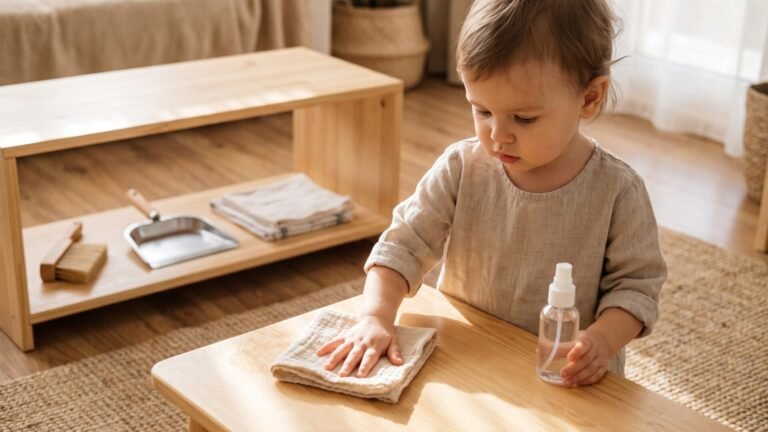
Wiping a small spill with a cloth, carrying dishes to a designated counter or tub, sweeping crumbs with a child-sized brush and dustpan. Cleanup is part of the activity, not the punishment for it, and treating it that way is what makes the whole system repeatable.
See our Montessori Cleaning Activities for Young Children for the fuller version of this.
Main safety point: keep cleaning chemicals out of the child’s reach entirely. A spray bottle of anything is adult-only.
What Parents Need Before Starting Kitchen Activities
You need a work surface at the right height, a small set of tools, a clear boundary around the hazards, and a routine. That is the whole list.
The work surface is the only place where money genuinely changes the experience. Three options:
- Floor or low table. Free. Works for washing, transferring, spreading, and kneading. The limitation is that it is not the counter, and some toddlers want to be where you are.
- Learning tower or kitchen helper. $150-$250 typically. Puts the child at counter height, which is where the real work happens. Worth it only if counter participation happens several times a week.
- Supervised chair or stool. Free to cheap, and the least stable. Only if you are standing right there.
The tool set is small: a mixing bowl, a child-sized pitcher, a spoon, a towel, a blunt spreader, a scrub brush, and a tray. Most of this you own. A tray matters more than it sounds – it defines the work area, contains the mess, and gives the activity a physical boundary a toddler can understand.
The boundary is non-negotiable: hot surfaces, sharp knives, glass hazards, cleaning chemicals, appliances, cords, and choking hazards stay out of the activity area. Not “away from the child” – out of the zone where the activity happens.
The routine is what makes it stick. Demonstrate slowly without narrating every motion. Let them repeat the task as many times as they want. Accept the mess that is manageable and stop the mess that is not. Involve them in cleanup every time, from the first time.
Key Safety and Readiness Factors
Match the activity to demonstrated readiness, not to a birthday. The signs that matter are balance, impulse control, the ability to follow a short instruction, and the willingness to stop when redirected. A child who cannot stop on request is not ready for the tools that require stopping.
Learning towers are active-supervision equipment. They are not containment devices and they are not a substitute for you being there. A child at counter height is at counter height next to heat, water, and tools, and should stay within reach the entire time. Check the manufacturer’s weight limits, stability information, and assembly instructions, and place the tower on level flooring away from anything it can be pushed against.
Food safety applies to toddlers exactly as it applies to you: wash produce, keep raw meat and raw eggs in adult hands, and check allergy concerns with your child’s caregiver or clinician rather than guessing. Choking hazards – whole grapes, hard raw vegetables, nuts, popcorn, and similar – are worth reviewing before any food activity.
For every purchased item, check the manufacturer’s age guidance, weight limits, and cleaning instructions. That is the standard advice and it is the advice that actually prevents injuries.
Montessori Kitchen Tools and Helpers Worth Buying
The activity matters more than the label. With that said, a few purchases genuinely reduce friction, and one of them is expensive.
Sprout Kids Learning Tower
| Feature | Details |
|---|---|
| Age Range | Check current manufacturer guidance; intended for children who can stand safely with close supervision |
| Key Features | Adjustable platform, counter access, structured standing support |
| Price (approx) | Premium, often around $200 or more |
The Verdict: A genuine tool, not an accessory, if your kitchen layout lets you supervise from where you actually stand.
Best For: Families who cook most days and have a toddler who wants to be at the counter constantly.
Pros: Puts the child at real counter height; adjustable platform extends the useful years; solid construction holds up to daily use.
Cons: Expensive; takes up floor space even when folded or parked; useless if your counters are laid out so you cannot watch the child while working.
[Affiliate: Check current pricing and availability through our recommended partners]
Little Partners Explore n Store Learning Tower
| Feature | Details |
|---|---|
| Age Range | Check current manufacturer guidance and weight limits |
| Key Features | Adjustable standing platform, storage-oriented design on some versions |
| Price (approx) | Mid-range to premium, commonly around $150-$250 |
The Verdict: The better buy if storage is your constraint and you want the adjustability without the top-tier price.
Best For: Kitchens where the tower has to live somewhere when it is not in use.
Pros: Adjustable platform; storage features on some versions; generally cheaper than the premium option.
Cons: Confirm the current version’s features before buying, since designs change; still a large object; same supervision requirement as any tower.
[Affiliate: Check the price on Amazon]
Melissa & Doug Wooden Cutting Food Play Set
| Feature | Details |
|---|---|
| Age Range | Commonly marketed for preschool-age children; verify current package guidance |
| Key Features | Pretend food, child-friendly cutting action, reusable play setup |
| Price (approx) | Usually around $20-$40 |
The Verdict: A good pretend-play toy. It is not a substitute for supervised real food preparation, and buying it as one is how parents end up disappointed.
Best For: Independent play, food vocabulary, and the child who wants to “cook” while you are cooking something they cannot help with.
Pros: Low mess; easy to store; survives siblings well.
Cons: No real skill transfer to actual cooking; the velcro cutting action gets old faster than the box suggests; not the answer to “my toddler wants to help.”
[Affiliate: Check the price on Amazon]
Montessori-Style Wooden Toddler Kitchen Tool Set
| Feature | Details |
|---|---|
| Age Range | Select according to the manufacturer’s guidance and the individual tool |
| Key Features | Sized tools for spreading, stirring, scooping, and simple food preparation |
| Price (approx) | Budget to mid-range, often around $15-$40 |
The Verdict: Worth it if the tools are genuinely usable at toddler scale. Many sets are decorative – check that the spreader actually spreads and the whisk actually whisks.
Best For: Families who want a dedicated, child-accessible set rather than lending the child your utensils.
Pros: Correct sizing makes a real difference to success; a dedicated set means the child can reach their own tools; wood and stainless hold up better than plastic.
Cons: Quality varies wildly between sellers; some sets include pieces too large or too small to be useful; you may already own equivalents.
[Affiliate: Check current pricing and availability through our recommended partners]
Melissa & Doug Wooden Scoop and Serve Set
| Feature | Details |
|---|---|
| Age Range | Verify the product’s current age guidance |
| Key Features | Scoops, serving tools, transferring practice |
| Price (approx) | Usually around $15-$35 |
The Verdict: Useful if the pieces work for real transferring and serving. Assess that before buying rather than after.
Best For: Serving practice and scooping work, both of which are strong toddler activities.
Pros: Scooping and serving are genuinely good practical life work; durable; low storage demand.
Cons: Some pieces are more decorative than functional; overlaps heavily with what is already in your kitchen drawer.
[Affiliate: Check the price on Amazon]
Child-Size Broom and Dustpan Set
| Feature | Details |
|---|---|
| Age Range | Toddler or preschool age, depending on dimensions and manufacturer guidance |
| Key Features | Crumb cleanup, upright practice, clear beginning and end to the task |
| Price (approx) | Usually around $10-$30 |
The Verdict: The unexpected win of this entire category. Cheap, durable, and it stays useful for years after the toddler stage.
Best For: Every family. There is no kitchen where this is a bad purchase.
Pros: Real work with a visible result; teaches a routine that outlasts toddlerhood; costs less than a single wooden toy.
Cons: Bristles on cheap sets flatten quickly; the dustpan is usually the weak point; you will still sweep afterwards.
[Affiliate: Check the price on Amazon]
Skip This If: Oversized Toddler Kitchen Sets
A large pretend kitchen labeled Montessori is the most common expensive mistake in this category. It eats floor space, it is a nightmare to store, and it does nothing for real meal preparation.
If your toddler wants to be where you are, a pretend kitchen in the corner will not hold them. They will abandon it and come stand at your counter anyway, and now you own a piece of furniture that has to be moved every time you clean.
Buy one useful tool first. Watch whether the child repeats the activity. Add furniture only when a routine you already have reveals a limitation.
Comparison Table: Kitchen Helpers and Tools
| Product or Tool | Approx. Price | Best Use | Space Demand | Long-Term Value |
|---|---|---|---|---|
| Sprout Kids Learning Tower | $200+ | Frequent supervised counter participation | Medium | High if used daily |
| Little Partners Explore n Store Tower | $150-$250 | Families needing adjustability or storage | Medium | High if it fits the kitchen |
| Melissa & Doug Cutting Food Set | $20-$40 | Pretend cutting and food vocabulary | Low to medium | Moderate |
| Wooden toddler kitchen tool set | $15-$40 | Spreading, stirring, scooping, measuring | Low | High when used repeatedly |
| Child-size broom and dustpan | $10-$30 | Cleanup and responsibility routines | Low | High for families using it regularly |
| Household bowl, pitcher, tray, towel | $0-$10 | Everything above | Low | Highest |
ToyGuideHub Parent Hassle Score: What Actually Gets Used?
This is an editorial framework, not a lab result. I score each option from 1 to 5 on ongoing hassle, where 1 means easy to store, supervise, clean, and repeat without thinking about it, and 5 means it demands real effort every single time. The score is about the parent’s experience, because a toy the parent dreads getting out does not get used.
Real kitchen tools: 1. The lowest hassle in the category, and it is not close. You already own the bowl, the spoon, and the towel. You already have the ingredients because you were making dinner anyway. There is no setup, no storage problem, and no separate activity to schedule – the child joins the routine that was happening regardless. The only cost is accepting that the counter gets wet.
Learning towers: 4. High marks for capability, low marks for hassle. It has to be positioned, the child has to be lifted or helped in, and you cannot step away for the duration. It occupies floor space permanently in most kitchens, because folding and unfolding it twice a day gets old by week two. If your kitchen layout means you cannot supervise from where you actually work, the hassle score goes to 5 and the tower stops being worth it.
Pretend cutting sets: 2. Low mess, easy storage, no supervision burden. The problem is not hassle, it is usefulness. A child who wants real participation will use it for a while and then go back to standing at the counter. It scores well on everything except the thing you actually wanted.
Baking activities: 4. Flour gets everywhere, the prep takes longer with a toddler than without one, and there is a genuine food-safety layer to manage. The replayability is excellent if your family already bakes, because the routine exists and the child is joining it. If you are inventing a baking habit specifically to give your toddler something to do, the hassle is real and the payoff is thinner.
Cleanup tools: 1. Ten to thirty dollars, lives in a corner, no supervision beyond the obvious, and it produces a visible result every time. The broom and dustpan is the highest value-per-dollar item in this entire article, and it is the one nobody writes about.
The conclusion is uncomfortable for anyone hoping to buy their way into this: the best purchase is not the product with the most Montessori language on the box. It is the item that removes friction from a routine your family already performs. If you cook every day, a tower earns its place. If you do not, it does not, and no amount of wooden utensils changes that.
How to Choose the Right Kitchen Activity or Product
Best for Small Spaces
Start with a tray, a small bowl, a cloth, a spoon, and one transferable ingredient. That is a complete setup and it fits in a drawer.
Skip the play kitchen entirely. If you want counter access, look at folding or storage-friendly helpers, but only if counter participation is happening several times a week already. In a small kitchen, a tower that lives in the middle of the floor is a worse problem than the one it solves.
Best for a Two-Year-Old
Begin with washing produce, transferring, stirring, spreading soft foods, carrying napkins, and wiping. Those six cover months of development and none of them require a sharp edge or a hot surface.
Do not make sharp tools or hot food the developmental goal. There is no deadline. A two-year-old who can pour water without spilling and wipe a counter when asked has learned more than one who was handed a peeler early.
See our Montessori Practical Life Activities for 2-Year-Olds article.
Best for Families Who Cook Often
A stable learning tower is genuinely worth it here, because the routine already exists and the tower just removes the friction of lifting a child onto a chair. Choose tasks that slot into meal prep rather than creating separate projects – if you are chopping vegetables, the child washes them.
Keep a low shelf or basket with only the approved tools so the child can reach their own equipment without going through your knife drawer.
Best Budget Setup
Household bowls, a small pitcher, a towel, a spoon, a tray, and a child-size dustpan. Total cost: under $30, most of it the dustpan.
Add one blunt spreader or toddler utensil set before you consider furniture. A $20 tool used weekly beats a $200 tower used twice, and you will know within a month which one you actually have.
Best for Montessori Homes With Limited Plastic
Choose wood, stainless steel, or washable materials where it is practical, and skip the material purity test everywhere else. Stability, safe sizing, and actual use matter more than whether something is plastic.
Ordinary household objects support Montessori-style work perfectly well when they are the right size and the adult is present. A stainless mixing bowl from your own cabinet is not less Montessori than a wooden one from a catalog.
ToyGuideHub Longevity Analysis: Which Setup Still Makes Sense After Six Months?
Six months is long enough for the novelty to wear off and short enough that you will remember what you spent. Here is how each setup tends to age.
The low-cost tray setup. The most likely to still be in use, because the barrier to starting it is roughly zero. It comes out of the drawer in ten seconds, it goes back in ten seconds, and it works on a Tuesday when you have twenty minutes and no energy. Families testing whether their toddler actually wants kitchen work should start here and stay here until the child asks for more. Most will not need to go further for a while.
The learning tower setup. The strongest long-term value in the category, with the biggest caveat. If your toddler regularly wants to watch or participate at counter height, and you have a kitchen where you can supervise while working, the tower gets used daily for years and the cost-per-use drops below almost anything else you could buy. If your kitchen layout makes supervision awkward, or your child prefers floor-level work, it becomes a large object you move out of the way. The tower does not fail gradually – it either fits your kitchen or it does not, and you usually know within three weeks.
The pretend food setup. It survives, but not as what you bought it for. The cutting food set stays useful for independent pretend play long after the child stops treating it as cooking practice. That is a legitimate second life and worth the $20-$40. It should not have been the main solution to a toddler who wanted to help cook, because it never was one.
The tool-and-cleanup setup. The best cost-per-use in the article. The same small pitcher, spreader, and scoop support washing, transferring, spreading, and serving, and the broom and dustpan outlast the toddler stage entirely. Nothing here is outgrown in six months, and nothing here was expensive.
The overbuilt Montessori station. The riskiest setup over time. Shelving, matching containers, labeled baskets, and a dedicated child-height prep area can cost more than a learning tower and deliver less actual participation. Organization is not the same as opportunity. If the child is not doing real work at the station, the station is storage with better marketing.
The six-month rule: keep what gets used, upgrade only what a real routine has outgrown, and replace anything that has become a safety problem. Add a product when an existing habit reveals a clear limitation – not before. The tower you buy because your toddler has been climbing the chair for a month is a good purchase. The tower you buy because a blog post said so is a $200 maybe.
Pros and Cons of Montessori Kitchen Activities
Pros
- Builds real coordination and independence through work that has a visible result.
- Creates natural openings for language, sequencing, counting, and sensory exploration.
- Runs on ordinary household materials, so the entry cost is close to zero.
- Gives a toddler a constructive way into family routines instead of a separate activity.
Cons
- Requires close adult supervision and some preparation every time.
- Produces spills, food waste, and cleanup that you will do part of.
- Some popular products take up significant space and cost more than their use justifies.
- Toddlers often repeat one simple task rather than working through a full activity set.
The Bottom Line
Best Overall: A simple real-kitchen setup – stable work surface, small bowl, spoon, towel, and one food-preparation task your child can complete. This costs almost nothing and outperforms most of what is sold as a Montessori kitchen.
Best Budget Pick: Household tools plus a child-size broom and dustpan. Under $30 total, and the dustpan outlasts everything else in this article.
Best Premium Pick: A learning tower such as the Sprout Kids Learning Tower, for families who cook frequently and can supervise consistently. See our Montessori Kitchen Helpers / Learning Towers for 2-Year-Olds before you spend the money.
Best for Pretend Play: The Melissa & Doug Wooden Cutting Food Play Set, as a supplement to real participation rather than a replacement for it.
Best Long-Term Value: A small set of durable, appropriately sized tools used repeatedly across washing, transferring, serving, and cleanup. See our Best Montessori Toys for Teaching Independence post for where this fits into the bigger picture.
Buy for the routine your child already wants to join, not for the Montessori kitchen you pictured. If they follow you to the counter every evening, get them up there. If they do not, save the $200.
Check current pricing and availability through our recommended partners.
Frequently Asked Questions About Montessori Kitchen Activities For Toddlers
What is the best Montessori kitchen activity for a toddler?
Washing produce, transferring dry ingredients, stirring, spreading soft foods, and wiping are the strongest starting points. They are low-risk, endlessly repeatable, and use tools you already own. The best individual choice depends on your child’s readiness and how much supervision you can give that day.
Are kitchen activities safe for two-year-olds?
Safety depends on the task, the setup, the supervision, and the tools. Low-risk preparation like washing, pouring, and spreading is very manageable with an adult present. Heat, sharp objects, appliances, choking hazards, and raw meat and eggs need adult-only handling or strict boundaries. Check the manufacturer’s guidance on any tool you buy.
Does my toddler need a learning tower?
No. It is useful if your child regularly wants counter access and you can supervise from where you actually work. A low table or floor setup covers most activities for far less money. Buy the tower when a routine you already have demands it, not in advance.
What should a toddler use for Montessori food preparation?
A small bowl, a spoon, a child-sized pitcher, a towel, a tray, a blunt spreader, and simple serving tools. Add a scrub brush for produce and a child-size broom and dustpan for cleanup. Verify age guidance on anything you purchase.
Are pretend kitchen toys Montessori?
Pretend kitchens support symbolic play and language, which have value. Practical life activities use real, purposeful tasks with real materials. A pretend set is a supplement, not a requirement, and it is not a substitute for supervised participation in actual cooking.
How do I stop kitchen activities from becoming too messy?
Start with small quantities, work over a tray, choose dry or easily cleaned materials first, and limit the number of tools on the table. Build cleanup into the activity from the start so wiping up is part of the task rather than a consequence of it.
When can a toddler use a knife or vegetable peeler?
There is no universal age, and anyone who gives you one is guessing. Readiness, tool design, adult instruction, and continuous supervision decide it. Introduce sharp tools only when you judge your child ready, and follow the manufacturer’s guidance on the specific tool.
Do I need to buy Montessori-branded tools?
No. Appropriately sized household items work. What matters is that the tool fits the child’s hands, is stable, and can be used safely under supervision. Branding adds cost without adding capability in most cases.