Best Montessori Toys for Teaching Independence
Twenty-two dollars. That is what the cheapest useful thing in this article costs, and it will probably do more for your child’s independence than the $180 wooden kitchen you have been looking at.
That is not a knock on the wooden kitchen. It is the pattern that shows up again and again in this category: the products that actually build independence are the small, unglamorous ones that let a child finish a real task. A latches board. A pitcher that pours without a waterfall. A broom that reaches the floor. The expensive stuff tends to be access equipment – a learning tower, a low shelf – and it earns its price only if your family genuinely uses it every day.
The Montessori toys for teaching independence that hold up are the ones a child can reach, use, and put back without you. Everything else is packaging. This guide covers which tools are worth buying, which popular ones are not, and how to tell the difference before the box arrives.
Montessori toys designed to encourage independence often overlap closely with practical life, giving children opportunities to practice real-world skills rather than simply play with a finished toy. If independence is your main goal, our Montessori Practical Life Toys: Complete Guide explains the wider range of practical life materials and activities worth considering.
What Makes a Toy Useful for Independence?
Independence, in practical terms, is not a personality trait. It is a set of small behaviors: starting a task without being told, making a choice, finishing a sequence, noticing an error and fixing it, and contributing to something the family actually needs done.
A toy that builds those behaviors has to allow all five. That is a narrow filter, and it eliminates most of what gets sold as Montessori.
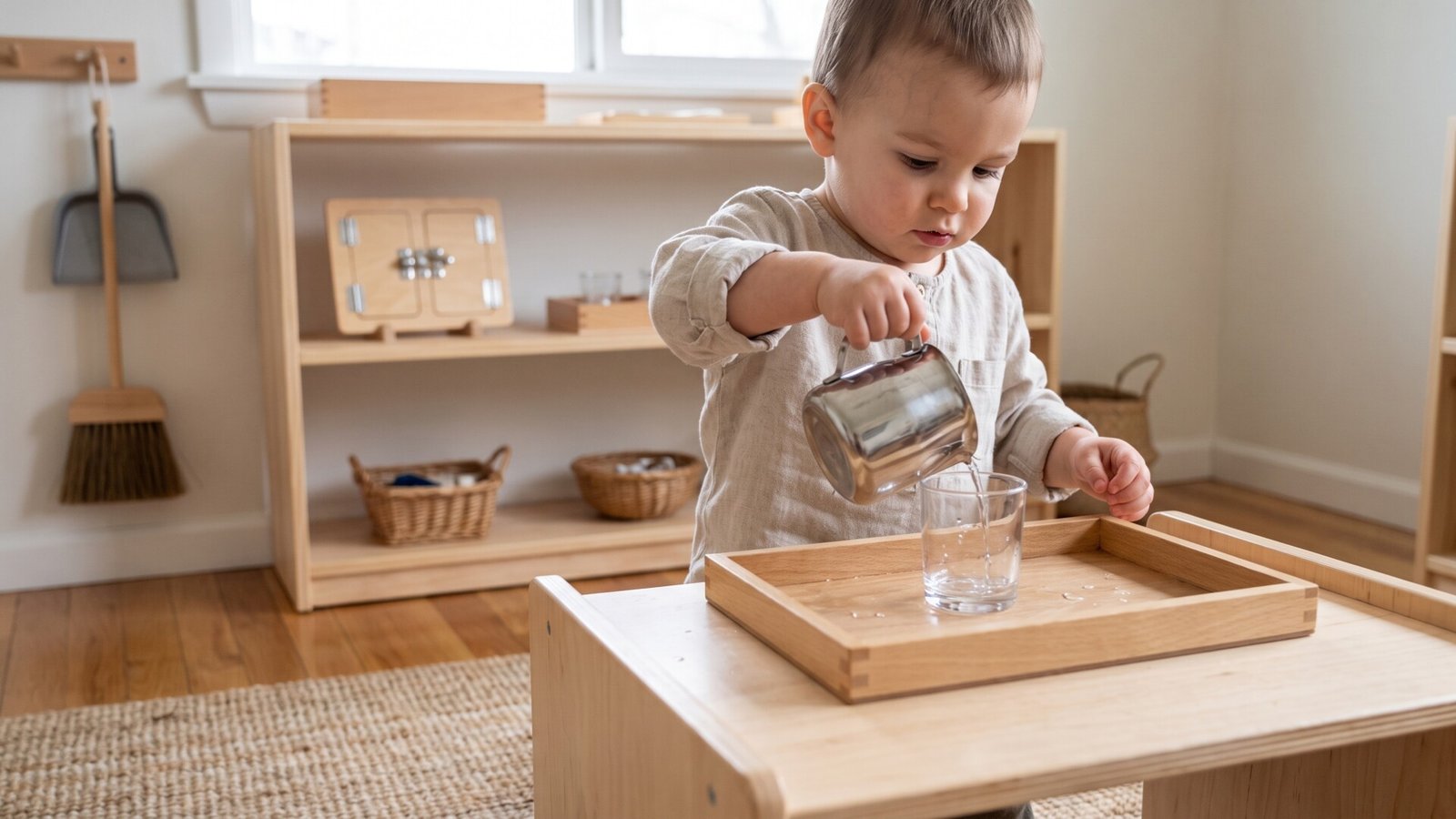
Practical life materials tend to outperform conventional educational toys here for one reason: the child can see the point. When you pour water from a pitcher into a cup, the feedback is immediate and honest. You either got the water in the cup or you did not. No adult has to tell you. That self-correcting quality is what keeps a child returning to the task, and repetition is where the skill actually forms.
It helps to separate three things that get lumped together:
- A true practical life tool is a real or realistic version of a household item, sized for a child. A small pitcher. A working broom. A knife that cuts a banana.
- An open-ended pretend-play toy lets a child act out a routine – a play kitchen, a doctor kit. Useful for language and social play, but the child is not building the real skill.
- A child-sized household item is the genuine article, scaled down. Often the cheapest and the most effective, and frequently not sold as a toy at all.
All three can be useful. They just do different jobs, and the pretend-play version is usually the one parents overbuy.
To compare options across the rest of this article, I use an Independence Value Score, rated 1 to 5. It weighs six things: real-world usefulness, repeatability, how much control the child has, how well it ages with the child, parent setup burden, and storage footprint. It is an editorial framework, not a lab test – a way to make the trade-offs visible instead of arguing about which wood is prettier.
How to Choose Montessori Toys That Build Real Skills
Four questions do most of the work. If a product fails two of them, it is probably clutter with good photography.
Match the task to what the child can almost do. The sweet spot is partial success – the child can get most of the way there and needs a little struggle to finish. Transferring, pouring, opening, fastening, sorting, putting away. If an adult has to complete most of the activity, the child is watching, not practicing. If it is too easy, they will do it twice and walk away.
Prioritize accessible design over elaborate design. Stable bases. Child-sized handles. Fasteners a small hand can actually grip. Containers the child can carry and return without help. A low shelf at the right height matters more than the finish on it. This is the least exciting advice in the article and the one that changes outcomes most.
Take safety seriously, plainly. Avoid small parts for any child still mouthing objects. Use water and kitchen tools only with close supervision. Check for tipping hazards on anything a child can climb, inspect hinges and cords, and follow the manufacturer’s stated age and weight guidance rather than the age of your particular child. If a product does not publish clear safety information, that is your answer.
Count the ownership burden before you buy. Cleanup time. Drying time. Replacement parts. Where it lives when it is not in use. Whether it fits into a routine you already have, or requires a new one you will have to maintain. A toy that needs fifteen minutes of parent setup will get used twice, and you will be the one who feels bad about it.
Best Montessori Toys for Teaching Independence
The list below mixes budget, mid-range, and premium options on purpose. Not every family needs a learning tower, and not every family can get away with a single tray. Each entry carries the same structure: what it is, whether it works, and an Independence Value Score.
Melissa & Doug Wooden Latches Board
| Feature | Details |
|---|---|
| Age Range | Usually suited to toddlers and preschoolers; follow current manufacturer guidance |
| Key Features | Multiple doors, latches, knobs, and hidden spaces |
| Price (approx) | $20-$35 |
| Noise | Silent |
| Storage | Small; shelf or bag |
| Independence Value Score | 4/5 |
The Verdict: The best cheap entry point into closure practice, with one honest caveat – it teaches latches, not dressing.
Opening and closing different fasteners builds hand strength, coordination, and the patience to keep going when a latch resists. The self-correcting part is built in: the door opens or it does not. Children who like to finish things tend to return to it for months.
The limitation is transfer. Practicing a latch on a board is not the same as managing the zipper on a coat you are already late putting on. Some children move from the board to real clothing easily; others treat them as unrelated skills. Use it as a focused fine-motor tool alongside real dressing practice, not as a substitute for it.
Best For: Toddlers beginning to manage closures who need a compact, repeatable practice item.
Pros: Small footprint; genuinely repeatable fine-motor practice; affordable.
Cons: Limited real-world transfer; some children outgrow it fast; the enclosed spaces are annoying to clean.
Learning Resources New Sprouts Serve and Store Picnic Set
| Feature | Details |
|---|---|
| Age Range | Commonly designed for preschool pretend play; check the current listing |
| Key Features | Child-sized dishes, utensils, serving pieces, and storage components |
| Price (approx) | $25-$45 |
| Noise | Silent |
| Storage | Medium; bins or basket |
| Independence Value Score | 3.5/5 |
The Verdict: A bridge between pretend play and practical life. Good for sequencing and cleanup habits, not a replacement for real kitchen work.
This is the set that lets a child set a place, carry a plate without disaster, serve, sort, and put everything away. Lightweight and durable, which means your child can actually handle it – a fragile household plate teaches caution, but it also teaches an adult to hover.
The honest framing: this is symbolic play, not kitchen independence. Its value comes from how you connect it to real routines. If the play dishes live next to the real snack plates and your child uses both, the skills carry. If they live in a play bin in another room, they do not.
Best For: Families who want a low-mess way to practice serving, organizing, and cleanup.
Pros: Supports sequencing; encourages social play; storage is manageable.
Cons: Does not replace real kitchen practice; plastic construction; pieces scatter.
Montessori-Inspired Wooden Dressing Frame
| Feature | Details |
|---|---|
| Age Range | Often suited to preschool-age children; simpler fasteners can be introduced earlier |
| Key Features | One fastening system per frame – buttons, snaps, zippers, buckles, or laces |
| Price (approx) | $20-$50 |
| Noise | Silent |
| Storage | Small; stacks flat |
| Independence Value Score | 3/5 |
The Verdict: Buy one frame matched to your child’s current sticking point. Do not buy the set.
Isolating a single fastener removes every distraction and lets a child repeat the exact motion twenty times without a coat on. That is genuinely useful when a specific closure is the thing standing between your child and getting dressed.
Which skills transfer depends on the frame. A frame with realistic tension and scale transfers well. A loose, oversized frame with a decorative zipper teaches the general motion but not the feel of real fabric. Check construction before buying: secure fasteners, smooth edges, firmly attached fabric, no loose pieces.
Many children find frames boring, and that is fine. It is a practice tool, not entertainment. If your child has no interest, a real coat on a real hook will do the same job.
Best For: Children motivated to dress themselves who need isolated practice with one closure.
Pros: Focused practice; easy to repeat; useful alongside dressing routines.
Cons: Some children find it dull; transfer is not automatic; quality varies widely between sellers.
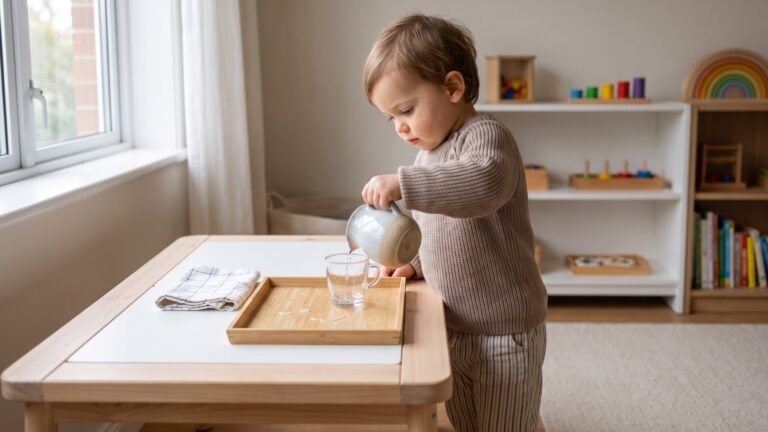
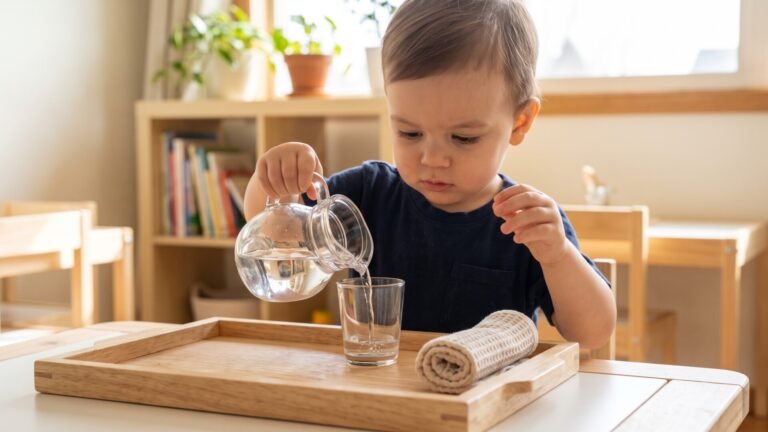
Montessori Pouring and Transferring Set
| Feature | Details |
|---|---|
| Age Range | Typically introduced in the toddler and preschool years with close supervision |
| Key Features | Small pitchers, cups, bowls, trays, tongs, scoops, transfer materials |
| Price (approx) | $20-$60 depending on contents and materials |
| Noise | Silent |
| Storage | Small to medium; tray-based |
| Independence Value Score | 5/5 |
The Verdict: The most adaptable thing you can buy for independence, provided you keep the setup small.
Pouring and transferring build control, concentration, and bilateral coordination, and they end in a visible finished result. Dry transfer first – beans, rice, pom-poms. Then a small amount of water. Then snack preparation, plant watering, cleanup. The same tray carries a child from eighteen months to five years.
The trap is the oversized kit. Large sets include materials you will never use, which means more sorting, more storage, and more for you to manage. A useful starter setup is a tray, two small pitchers, a bowl, and a sponge. That is it.
Best For: Toddlers and preschoolers who enjoy repetition and sensory feedback.
Pros: Adaptable across skill levels; leads naturally into snack prep and household tasks; compact.
Cons: Spills are inevitable; kits often include unnecessary pieces; loose materials need supervision.
Learning Tower or Kitchen Helper, Such as Little Partners Explore n Store Learning Tower
| Feature | Details |
|---|---|
| Age Range | Varies by model; generally for children who can stand confidently – follow manufacturer guidance |
| Key Features | Stable raised platform, safety enclosure, adjustable height, sometimes a foldable or activity surface |
| Price (approx) | $150-$250 |
| Noise | Silent |
| Storage | Large; floor space required |
| Independence Value Score | 4/5 |
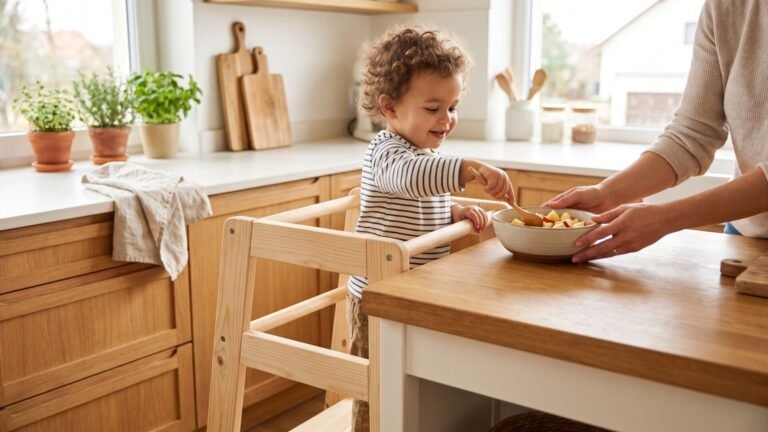
The Verdict: An access tool, not a toy. Worth it only if your family cooks together most days.
A learning tower brings your child up to counter height safely, which turns washing produce, stirring, spreading, and wiping into things they can actually do rather than watch. That is real participation in a real routine, and it holds value for years.
It is also the most expensive thing here, and the most demanding of your floor plan. A tower takes up permanent counter-adjacent space in most homes. If it folds, you will still rarely fold it. If your child climbs rather than works – and some do – you have bought an indoor climbing structure with a safety rail.
Follow the exact weight and use instructions, keep it away from stoves and hot surfaces, and supervise. This is not a device that lets you leave the kitchen.
Best For: Families prepared to include a child in frequent kitchen routines who can dedicate the floor space.
Pros: High real-world transfer; supports repeated family participation; useful for several years.
Cons: Expensive and bulky; requires active supervision; some children climb instead of helping.
Melissa & Doug Wooden Cleaning Set
| Feature | Details |
|---|---|
| Age Range | Commonly suited to toddlers and preschoolers; verify current age guidance |
| Key Features | Child-sized broom, mop, dustpan, brush components with a storage stand |
| Price (approx) | $35-$60 |
| Noise | Silent |
| Storage | Medium; stands upright |
| Independence Value Score | 5/5 |
The Verdict: The clearest independence payoff on this list, if you give your child a real job.
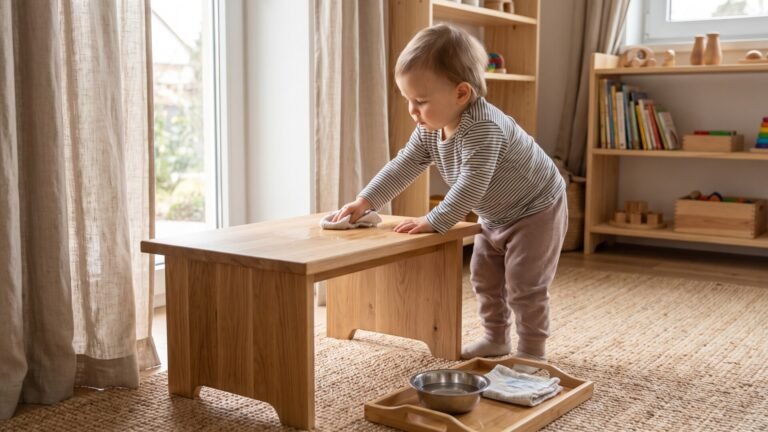
Cleaning tools have unusually strong independence value because the child can see the result and repeat the action. Crumbs on the floor, broom, no crumbs. That loop is short enough for a toddler to complete and satisfying enough to repeat. It also makes the child a contributor to the household rather than a recipient of activities.
The set only works if the tools are accessible and used for genuine small jobs. If the broom lives in a closet and comes out for a supervised pretend session, it is a prop. If it lives on a hook your child can reach and there is a designated crumb zone, it becomes a habit.
Check handle height against your child, and check whether the bristles actually pick anything up. Some sets look right and clean nothing, which your child will notice before you do.
Best For: Children who imitate adults, and families willing to hand over a small repeatable responsibility.
Pros: Clear purpose; strong real-world transfer; encourages contribution and cleanup.
Cons: Takes storage space; may not clean effectively; becomes a prop without an assigned routine.
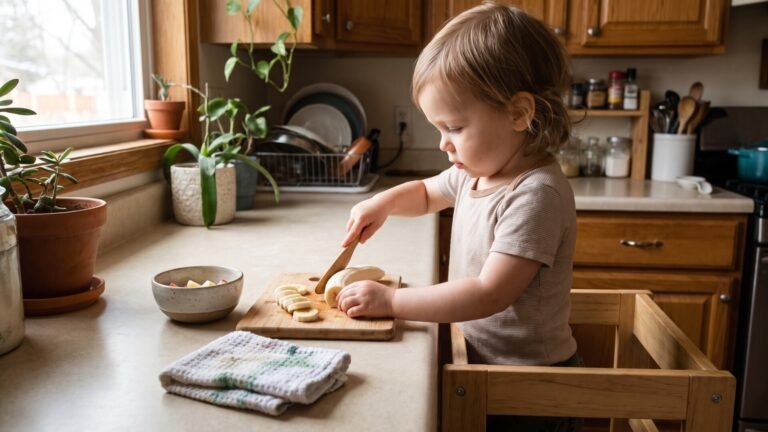
Toddler-Safe Kitchen Tool Set, Such as Curious Chef 3-Piece Nylon Knife Set
| Feature | Details |
|---|---|
| Age Range | Intended for supervised child participation; confirm current product guidance |
| Key Features | Child-oriented utensils for spreading, cutting soft foods, mixing, serving |
| Price (approx) | $15-$30 |
| Noise | Silent |
| Storage | Small; drawer or crock |
| Independence Value Score | 4.5/5 |
The Verdict: Supervised food preparation is the highest-value independence activity here. The tools are cheap; the supervision is not optional.
Food prep combines choice, sequence, coordination, and a useful result in one task. Your child picks the banana, peels it, cuts it, puts it on the plate, and eats it. That is a full independence loop, and it happens daily if you let it.
Choose tools for your child’s actual ability, and stay in the kitchen. A nylon knife that cuts soft foods is not a real knife, but it is also not a babysitter. Clean thoroughly, store separately from adult knives so there is no confusion, and check the manufacturer’s guidance on what the tool is designed to cut.
Best For: Preschoolers ready to take part in snack preparation with an adult nearby.
Pros: Strong transfer to daily life; naturally repeatable; creates meaningful responsibility.
Cons: Requires supervision; tools get outgrown; food prep adds cleanup.
Low Shelf and Practical Life Storage Setup
| Feature | Details |
|---|---|
| Age Range | Adaptable from toddlerhood through the preschool years |
| Key Features | Low, stable shelf or basket system for trays, dressing materials, cleaning tools, self-care items |
| Price (approx) | $30-$150 depending on construction and size |
| Noise | Silent |
| Storage | It is the storage |
| Independence Value Score | 5/5 |
The Verdict: The least exciting purchase in this article and the one most likely to change your mornings.
Here is the counterintuitive case: accessible storage contributes more to independence than another activity kit. If your child cannot find it, carry it, and put it back, you are the system. That means every activity starts with a request to you and ends with you tidying up. The child is participating in your logistics, not building their own.
Keep it small. Two or three choices visible at once, each in a consistent location. Rotate the rest out of sight. A dedicated child-height shelf is ideal, but a sturdy cube organizer or a repurposed low cabinet does the same job for less.
Whatever you use, anchor it to the wall if it can tip. A shelf a child climbs is a hazard, and children climb shelves.
Best For: Families whose child has activities but still depends on an adult to find, carry, or put them away.
Pros: Enables initiation and cleanup; works with toys you already own; grows with the child.
Cons: Furniture takes space; poor anchoring is a real safety issue; requires adult organization to maintain.
What Most Buyers Get Wrong About Montessori Independence Toys
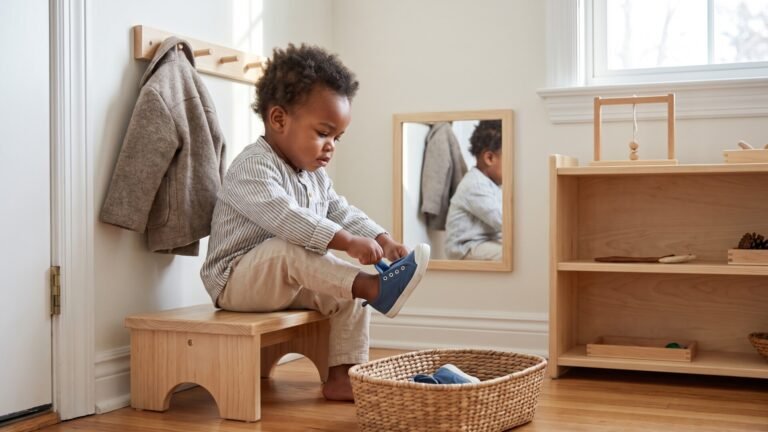
They buy practice instead of access. A dressing board may help with a zipper. A coat hook at your child’s height, a step stool by the door, and ten extra minutes in the morning will help more. The board is a supplement to access. It is not a replacement for it.
They confuse attractive materials with Montessori value. Natural wood, muted colors, and minimalist packaging do not guarantee that a product is useful, safe, or developmentally appropriate. Some of it is beautiful and does nothing. Some of the best practical life materials in your home are plastic and cost four dollars.
They expect the toy to create independence by itself. No object makes a child independent. Adult modeling, consistent routines, limited choices, and patience do the work. The toy is a prop in a process you are running. If the process is not there, the toy will not be either.
They offer too many choices. A crowded shelf is harder to use than a sparse one. When a child has to navigate twelve activities to find one, they ask an adult instead. Two or three visible options, rotated regularly, supports initiation far better than a full collection on display.
Which Options Still Make Sense After Six Months?
This is where the category sorts itself out. At six months, cleaning tools and a learning tower are often still in use because they connect to tasks that keep changing – the floor still needs sweeping, the counter still needs wiping, dinner still needs making. A single-purpose fastening board may already be at the back of a shelf, its skill learned or abandoned.
Cost per use is the honest test. A $25 latches board used twice a week for eight months costs you about eighty cents a session. A $200 tower used daily costs less than that and does more. A $60 activity kit used three times costs twenty dollars a session and is the worst purchase in the article, even though it was cheaper than the tower.
What fails first, in order of frequency: loose fasteners, unstable stands, surfaces that are hard to clean, missing storage, and anything that requires more than a minute of parent setup. Notice that none of those are about the toy breaking. They are about the toy becoming inconvenient, which is functionally the same thing.
Run this checklist at the six-month mark:
- Is the child starting to use it without being prompted?
- Can the child get it out and put it back alone?
- Has the skill shown up in daily life – shoes, snacks, spills?
- Does it still fit your space and your routine?
Three yeses means keep it. Fewer than two means it is taking up room that a better option could use, and there is no shame in moving it on.
Choosing by Child, Home, and Budget
Best Budget Pick
The Melissa & Doug Wooden Latches Board at $20-$35 is the cheapest focused practice tool here. Pair it with the free stuff: a coat hook your child can reach, a small towel on a low rail, a child-sized brush, a tray from the kitchen. The budget winner is not the item with the most pieces. It is the one that solves a specific current difficulty without adding clutter.
Best Overall Pick
A thoughtfully chosen pouring and transferring setup wins on adaptability. The same tray moves from dry transfer to water to snack preparation to plant care to cleanup, and it stays useful for years. Keep it small and purposeful – a tray, two pitchers, a bowl, a sponge – and add materials as your child’s control improves. See our Montessori Practical Life Toys & Activities hub for setup guidance.
Best Premium Pick
The Little Partners Explore n Store Learning Tower at $150-$250 is justified by access to recurring activities, not by its appearance or its activity surface. If your family cooks together most days and you have the floor space, it earns its price over several years. If either of those is not true, it is a very large object that holds a very small child.
Best for Dressing and Self-Care
One Montessori-inspired dressing frame matched to your child’s current fastening challenge, plus accessible clothing storage and real dressing practice. Do not buy the full set. Montessori Dressing and Self-Care Activities covers how to pair the frame with actual mornings.
Best for Household Contribution
The Melissa & Doug Wooden Cleaning Set at $35-$60, with an assigned repeatable job rather than occasional pretend cleaning. Montessori Cleaning Activities for Young Children has a list of jobs that are genuinely within a small child’s ability.
Best for Small Spaces
A compact latches board, one tray-based transfer activity, and a low basket. That is the whole setup. Rotation is what preserves interest – swap the tray contents every week or two rather than adding more shelves.
Skip This If: When a Popular Montessori Purchase Is Not Worth It
Skip the large generic “Montessori toy bundle” sold on the strength of its piece count, its muted color palette, and its long activity list.
These bundles share a predictable set of problems. Repetitive items – you get four variations of the same sorting task. Unclear age fit, because the bundle spans eighteen months to five years and suits none of them precisely. Loose small parts that end up in a bag. Weak or missing storage. And enough setup required that you will run each activity once, photograph it mentally, and never rebuild it.
The tell is simple. Any product that cannot answer three questions is not worth your money:
- What real skill does it practice?
- Can the child access it independently?
- Will your family use it repeatedly?
A basic household tool, a low shelf, and one well-chosen activity will usually beat a premium bundle on all three. That is not a knock on spending money. It is a note that the money goes further when it buys access and repetition rather than variety.
Conclusion
The best Montessori toys for teaching independence are the ones that give your child repeated access to meaningful tasks. Not the ones with the most specialized features, the nicest wood, or the longest activity list.
Best Overall: A compact [Affiliate: Montessori pouring and transferring setup], for flexibility and years of skill progression.
Best Budget: The [Affiliate: Melissa & Doug Wooden Latches Board], for focused fastening practice at $20-$35.
Best Premium: The [Affiliate: Little Partners Explore n Store Learning Tower], for families who regularly involve a child in kitchen activities and have the floor space to prove it.
Best for Household Contribution: The [Affiliate: Melissa & Doug Wooden Cleaning Set], with a real job attached.
Best for Dressing: A single, well-matched [Affiliate: Montessori-inspired dressing frame], paired with clothing your child can actually reach.
Check current pricing and availability through our recommended partners, then choose the option that fits your child’s next real-life skill and your home’s available space.
One caveat before you buy anything. Every recommendation here assumes you can give the time – the ten extra minutes at the door, the willingness to let the water spill, the patience to watch a slow broom finish a small job. If that time is not available this month, buy the low shelf and the tray, skip the rest, and come back when the mornings are calmer. The tools work. They just do not work alone.
Frequently Asked Questions About Montessori Toys For Teaching Independence
What age are Montessori toys for teaching independence suitable for?
Independence work can start in toddlerhood with simple choices, carrying, putting away, transferring, and participating in self-care. The right starting point depends on your child’s motor ability and how closely you can supervise – not on the label on the box. A two-year-old can pour dry beans. A four-year-old can cut a banana. The material matters less than the fit.
Are Montessori toys better than ordinary toys for developing independence?
Not automatically. Montessori-aligned materials are not superior by virtue of being Montessori-aligned. Their advantage, when they have one, is a clear purpose, manageable complexity, and a connection to real tasks. An ordinary child-sized broom or a coat hook at your child’s height may do more than a specially marketed toy, and it will cost less.
What is the best Montessori toy for a two-year-old?
A low shelf, a simple pouring or transferring activity, a child-sized cleaning tool, and accessible self-care materials are usually more appropriate than complex dressing frames or kitchen tools. At two, the goal is participation and repetition, not mastery. Montessori Practical Life Activities for 2-Year-Olds and Montessori Kitchen Helpers and Learning Towers for 2-Year-Olds cover the specifics.
Do learning towers really help children become independent?
A learning tower provides safe access to kitchen participation. That is all it does. It does not create independence without supervision, clear tasks, and routines your family actually keeps. Consider space, stability, whether your child climbs rather than works, and the manufacturer’s instructions before buying. If you cook together most days, it earns its place. If you do not, it will not.
Are Montessori dressing frames necessary?
No. They are optional practice tools. A frame can isolate a difficult fastening and let a child repeat it without the pressure of getting dressed, which helps some children. But real clothing practice remains essential, and many families get the same result from a coat, a bag, and a pair of shoes by the door.
How many practical life toys should a child have at once?
A small rotation – two or three activities visible, based on your space and your child’s ability to return materials independently. A few accessible, repeatable activities are easier to use than a crowded shelf, and easier to keep tidy. Rotate the rest out of sight rather than adding storage.
How can parents prevent practical life activities from becoming too messy?
Start with small quantities. Use a tray. Introduce dry materials before water. Keep cleanup tools within reach of the activity. Assign one clear task at a time rather than setting up a full sequence. Manageable mess is part of the learning – uncontrolled setup is what stops you from setting it up again.