Montessori Dressing and Self-Care Activities
If you are looking for a toy that teaches a three-year-old to put on their own coat, you are shopping for the wrong thing. The most effective Montessori dressing and self-care activities are not products at all. They are ordinary routines – socks, sleeves, soap, a hairbrush – practiced slowly, in the same order, with an adult who has budgeted an extra ten minutes and does not take over.
That is the whole method, and it is free. What you can buy is support: a hook the child can actually reach, a step stool that does not wobble, a basket for shoes, a dressing frame for the one fastener that keeps defeating them. Those tools matter. They just are not the thing doing the teaching.
Skip this article if you want a system that produces independent dressing by a fixed date. Nothing here works that way. If you want to know which tools genuinely reduce how often you have to help, and which Montessori-labeled products end up in the donation bag by spring, keep reading.
Dressing and self-care are important practical life skills because they give children daily opportunities to practice independence through meaningful routines. Alongside dressing, Montessori practical life includes activities involving food preparation, cleaning, movement, and other everyday tasks, all covered in our Montessori Practical Life Toys: Complete Guide.
What Montessori Dressing and Self-Care Activities Actually Teach
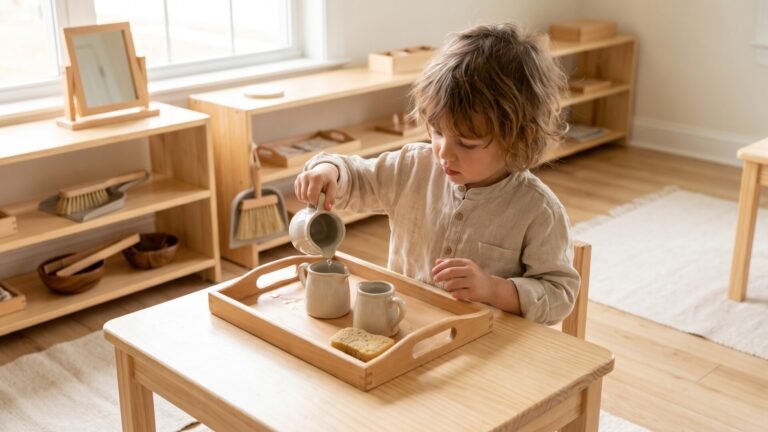
Practical life in the Montessori tradition means real work with real objects, not a worksheet about zippers. The child is not pretending to get dressed. They are getting dressed, badly and slowly, while you stand nearby and do not fix it.
The skills involved are ordinary and observable. Sequencing – socks before shoes, soap before rinse. Fine-motor control, which is a polite way of saying the child has to learn where their fingers are. Bilateral coordination, because pulling up pants requires two hands doing different jobs at once. Body awareness, concentration, and the small daily experience of making a decision and living with it.
Notice there is no developmental claim hiding in that list. These are things you can watch happen. Whether a dressing frame accelerates any of it is genuinely uncertain, and anyone selling you one with a confident timeline is selling.
The distinction that matters most is between completing a task and participating in one step. A two-year-old who pushes their arm through a sleeve has participated. A four-year-old who retrieves their own shoes, puts them on the correct feet, and returns the brush to the shelf has completed a sequence. Both are progress. Parents get into trouble when they treat the second as the standard for the first.
Your job is preparation and restraint. Set the environment up so the child can reach what they need, model the step once without narrating it to death, then allow more time than feels reasonable. Intervene for safety, and for genuine frustration – not for slowness, and not for the sleeve going on inside out.
Age-Appropriate Dressing and Self-Care Activities
For Toddlers Around 18 Months to 2 Years
At this stage you are not teaching dressing. You are teaching that dressing is something they are part of.
Reasonable participation tasks: pulling off loose socks, dropping shoes into a basket, pushing arms through sleeves, carrying a washcloth to the bathroom, putting clothes into the hamper. Note how many of these are really “carrying things to the correct location.” That is the actual skill, and it is the foundation for everything later.
Simplify the environment rather than the child. Elastic waistbands, front-opening tops, slip-on shoes, and a small number of visible choices. Two shirts on a low shelf beats a full wardrobe every time.
You handle choking hazards, water temperature, sharp grooming tools, and anything unstable. A toddler can put a sock in a basket. A toddler cannot be trusted alone with a step stool near a sink.
For Children Around 2 to 3 Years
This is where pants, jackets, and simple fasteners enter the picture, along with handwashing, toothbrushing participation, hair brushing, and wiping small spills.
Break each routine into visible steps and practice one hard skill at a time. If you are working on pulling down pants, do not also be working on the jacket. Two new skills in one morning routine produces a meltdown and teaches nothing.
Dressing frames can supplement real dressing here. They should not replace it. A frame gives the child unlimited repetitions of a button without the pressure of a coat and a departure time, which is a real benefit. But the frame is not the coat. If the only buttons in the child’s life are on a wooden board, the skill stays on the board.
Offering a choice between two outfits works at this age. Offering a choice among seven does not – it converts a simple task into a decision the child is not equipped to make quickly, and mornings get worse rather than better.
For Preschoolers Around 3 to 5 Years
More complex tasks become reasonable: zippers, large buttons, turning clothes right-side out, packing a small bag, washing and drying hands thoroughly, putting away personal items, managing basic grooming.
The shift here is responsibility for preparation and cleanup, not just execution. Checking that shoes are paired. Returning the brush to its place. Putting the dirty towel in the hamper instead of on the floor.
Adjust expectations for clothing complexity, time pressure, and readiness. A child who can zip a jacket at home on a Saturday may not manage it in a parking lot in February, and that is not a regression. It is a different task with a different amount of pressure attached.
Best Montessori Dressing and Self-Care Tools
Before the recommendations, the criteria. A useful tool here does four things: it removes a step that currently requires an adult, it fits the child’s actual size, it survives being handled daily by someone who is not careful, and it supports a routine the family already has.
If a product fails any of those, it is decoration.
Montessori Dressing Frames
A wooden dressing frame set, such as the Melissa & Doug wooden dress-up and button-practice options or a comparable wooden frame, gives a child focused repetitions on a single fastener away from the morning rush. That is the entire value proposition, and it is a real one for a child stuck on buttons or zippers.
What to look for: securely attached fabric that will not pull loose after a month, large fasteners appropriate to the child’s current skill, and a stable base that does not slide while the child works. A frame that wobbles teaches the child to hold it down with one hand, which defeats the purpose.
Be clear about what a frame is not. It is a practice tool. It does not replace real coats, shirts, shoes, and pants, and a child who has mastered every frame in the set may still need help with an actual jacket. Buy one frame for the specific fastener your child is struggling with rather than a full set of six. [Affiliate: Check current dressing frame options on Amazon]
Low Hooks and Accessible Storage
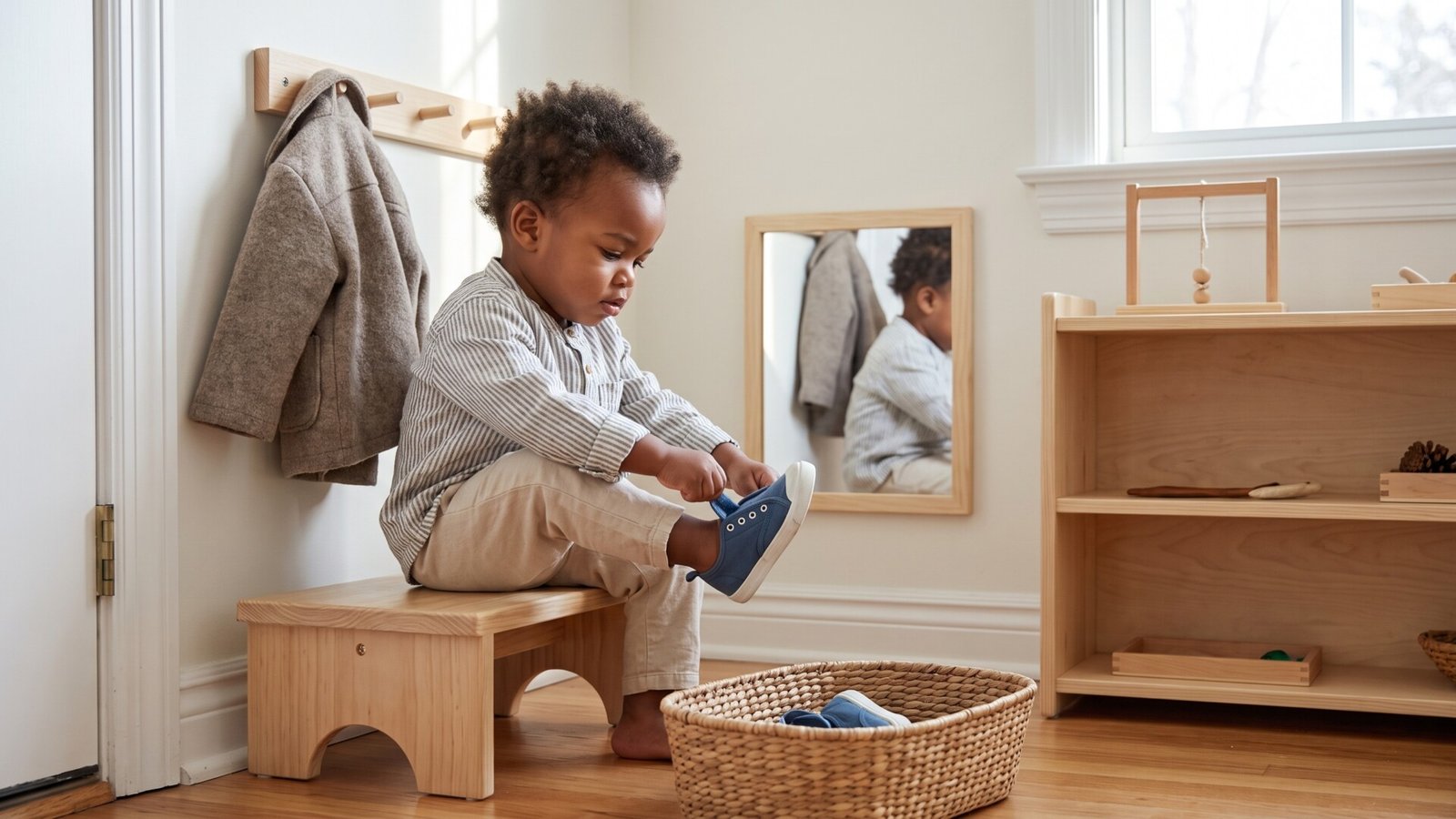
A child-height wall hook or peg rail is the single highest-value purchase in this category, and it is also the cheapest. It removes the step where the child hands you their coat because they cannot reach the closet.
Mount it securely into a stud or with appropriate hardware, at a height the child can reach without stretching or climbing. A hook that requires standing on tiptoes is a hook that requires you.
A generic securely mounted low hook set is the right answer here. You do not need a branded peg rail. You need a piece of wood attached to a wall at the correct height, and you need to check it periodically for looseness. [Affiliate: Compare child-height hook and peg rail options on Amazon]
Child-Sized Step Stools
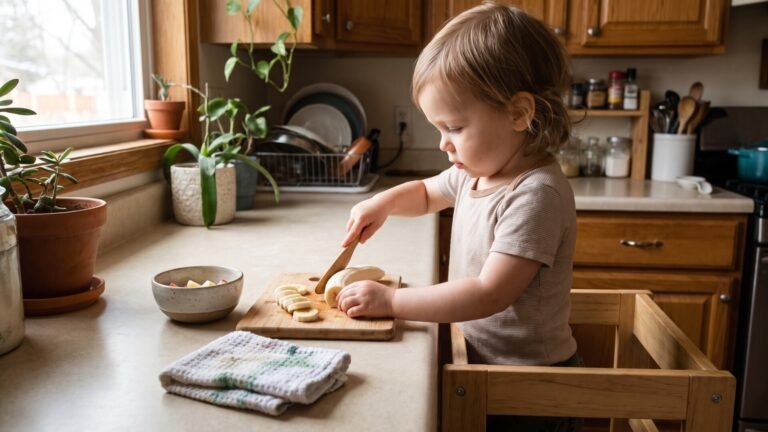
A stable learning tower, such as a Little Partners learning tower or a comparable model, gives a child safe supervised access to a sink or counter. That access is the point. A child who can reach the faucet can participate in handwashing. A child who cannot reach it is watching you wash your hands.
Understand the difference between two products that get lumped together. A learning tower is a supervised platform – the child is enclosed, elevated, and within arm’s reach of an adult. A freestanding step stool is used independently, and its safety depends entirely on stability, footing, and what is nearby.
Check the manufacturer’s current age, weight, and assembly guidance for whichever model you consider, and follow it. Non-slip footing, stable construction, and adult supervision are not optional. Keep any stool away from hot surfaces, stoves, and anything that becomes a climbing route to somewhere worse. [Affiliate: Check learning tower pricing on Amazon]
Personal-Care Tools
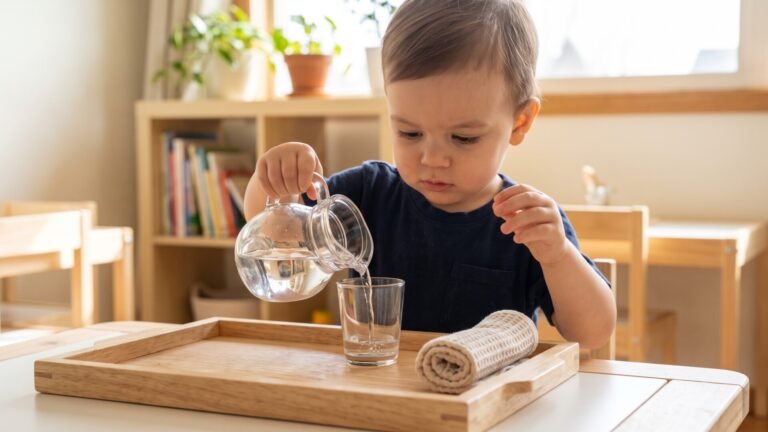
The most useful items here are real, not pretend: a child-sized hairbrush that fits a small hand, soft washcloths, a small hand towel at child height, a low-mounted mirror, a pump soap dispenser the child can operate, and a divided basket that holds grooming items in a fixed place.
Pretend grooming sets are where this category goes wrong. A toy razor and a plastic hairdryer do not teach self-care. They teach that self-care is a game played with objects that do not work. A real brush, used on real hair, in a real routine, does more.
A low mirror deserves a mention because it is doing quiet work. A child who can see their own face while brushing their hair is getting feedback that a mirror on the bathroom wall at adult height never provides. Mount it securely – a mirror is heavy, and a child will lean on it. [Affiliate: Compare child-safe mirrors and grooming tools on Amazon]
Clothing Organization and Routine Aids
Open baskets, labeled or picture-marked storage, a laundry hamper, and a small tray for shoes. These are low-cost additions that reduce the number of steps a child has to ask an adult to complete.
The design principle is that the child should be able to see what is available and put it back without help. A lid is a barrier. A deep bin is a barrier. A shallow open basket at floor level is not.
Keep labels simple. A picture of shoes on the shoe tray is useful. A laminated eleven-step morning routine chart with a reward column is a project you are now maintaining, and it will be abandoned within three weeks. [Affiliate: Check open storage basket options on Target]
Comparison Table
| Tool or Product Type | Approximate Price | Best Age or Stage | Main Skill Supported | Space Required | Best For |
|---|---|---|---|---|---|
| Wooden dressing frame | $15-$40 | Around 2.5-5 years | Fasteners and sequencing | Small | Focused practice |
| Low wall hooks | $10-$35 | Around 2-5 years | Dressing routine and organization | Small wall area | Daily independence |
| Stable learning tower | $100-$250 | Often around 18 months and up, depending on model | Safe supervised reach | Moderate | Sink and kitchen access |
| Child-sized grooming tools | $5-$30 | Around 2-5 years | Grooming participation | Small | Personal-care routines |
| Open clothing or shoe basket | $10-$35 | Around 18 months and up | Putting away and choosing | Small | Low-cost routine setup |
| Low mirror with secure mounting | $20-$80 | Around 2-5 years | Body awareness and grooming sequence | Wall space | Dressing and grooming |
Prices are approximate and vary by retailer and season. Age guidance, installation requirements, and safety instructions must be checked with the manufacturer or retailer before purchase.
What Most Parents Get Wrong About Montessori Self-Care
The most common mistake is believing that a dressing board teaches independence. It does not. It builds a specific hand skill in a controlled setting. Independence comes from using that skill in a real routine, repeatedly, with the stakes of an actual morning attached.
The second mistake is offering too many choices. A toddler standing in front of a full wardrobe is not empowered. They are overwhelmed, and the practical result is that they ask you to decide, which is the opposite of what you were going for. A small accessible selection – two tops, two bottoms, one pair of shoes – produces more independent dressing than an open closet.
The third mistake is pace, and it is the one almost nobody admits. You are not actually short of a dressing frame. You are short of four minutes. Rushing the child, correcting every movement, or finishing the task because it is faster all communicate the same message: this is not really yours to do. If you fix nothing else, fix this. Practice on Saturday when there is no schedule.
The fourth mistake runs the other direction. Some parents read “promote independence” as “leave them to it,” and then leave a three-year-old alone with water, stairs, grooming tools, or a jacket with a stuck zipper. Participation and supervision are not opposites. A child can be doing the work while you are standing right there.
How to Set Up a Montessori Self-Care Area at Home
Start at the dressing area. A low hook for the current coat and bag, a limited selection of clothing at child height, a shoe basket or tray, a hamper the child can open, and a mirror mounted at their eye level and secured properly. That is the whole setup.
In the bathroom: a stable step stool or a supervised learning tower if the child needs to reach the sink, an accessible towel, a child-sized washcloth, a pump soap dispenser, and adult-controlled access to everything else. Hot water, grooming tools, and medication stay out of reach. This is not negotiable and it is not a limitation on independence – it is the condition that makes independence possible.
The principle to hold onto is one accessible step, not open access. Leave the brush available. Store the nail clippers. Leave the washcloth within reach. Control the water temperature at the tap. Every routine should have exactly one part the child owns, and the rest stays adult-managed until they are ready for the next piece.
Maintenance is the part nobody plans for. Rotate clothing by season so the accessible shelf does not fill with things that do not fit. Remove broken tools immediately – a brush with a loose handle is a toy, not a tool. Wash fabric items regularly, especially anything that lives near a sink. Check mounts and fasteners on hooks, mirrors, and towers every few weeks, because a child hanging on a hook is a load test you did not design for. And if the setup has become clutter, simplify it. A self-care area that looks like a storage unit is not helping anyone.
Best Activities by Routine
Dressing and Undressing
Start with the easiest step and build from there. Removing loose socks. Pulling down elastic-waist pants. Arms through sleeves. Carrying clothing to the hamper. Pairing shoes. Hanging a jacket on the low hook.
Use backward chaining: you complete most of the task while the child performs the final step, then gradually hand back earlier steps. Pants go on with your help until the last inch, which the child pulls up. Next week you stop three inches short. It is slow, and it works, because the child always finishes with a success rather than a failure.
Choose clothing that is loose, comfortable, and free of difficult fasteners for daily wear. Save the buttons and laces for practice time, not for a Tuesday when you need to leave.
Handwashing and Bathroom Participation
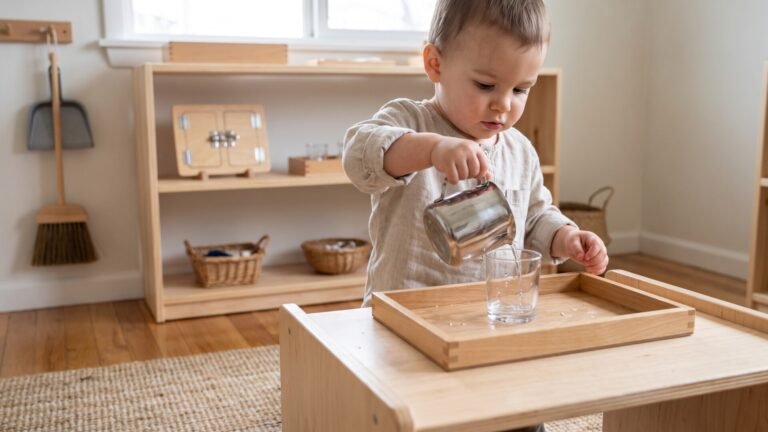
The sequence: water on, hands wet, small amount of soap, rub, rinse, dry. Turning the water on is the step to hold back until the child can manage it safely – you control the temperature at the tap.
A consistent setup matters more than any novelty handwashing product. A pump dispenser at the right height, a towel within reach, and the same six steps in the same order every time. A singing soap dispenser that lights up adds a variable, not a skill. See our Montessori Practical Life Toys & Activities guide.
Grooming
Brushing hair, wiping the face, placing used tissues in a bin, returning grooming tools to their place. Lip balm only when age-appropriate and supervised.
Keep scissors, nail clippers, razors, and medications stored securely. A child can participate in grooming without performing every step accurately, and they should not be handling the tools that require precision.
Personal Responsibility
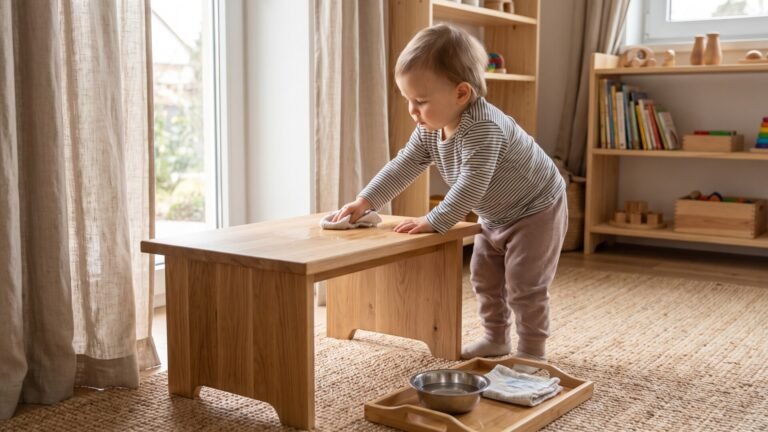
Putting pajamas in a basket, placing shoes together, hanging a coat, carrying a small toiletry bag, wiping a small spill, returning tools to storage. These are the tasks that quietly build the habit of noticing what needs doing.
Keep it limited, concrete, and sized to the child. “Put your shoes on the tray” is a task. “Tidy your room” is not. See our Montessori Cleaning Activities for Young Children article.
ToyGuideHub Independent Play Score and Real-World Ownership Verdict
The ToyGuideHub Independent Play Score is an editorial framework, not a laboratory test. We score each tool on five factors: daily usefulness, child access, replay value, parent hassle, and longevity across stages or siblings. Scores are out of ten and reflect how the item behaves in a normal household over months, not how it performs in a product photo.
Low hooks and open baskets: 9/10. Used twice a day, every day, by a child who can reach them. Cost is trivial. The only maintenance is checking the mount. Nothing else in this category comes close on cost per use.
Child-sized real grooming tools: 8/10. A brush, a washcloth, and a pump soap dispenser do more for self-care routines than any pretend set. The deduction is for the supervision required around water and the fact that small items get lost.
Secure low mirror: 7/10. Genuinely useful for grooming and body awareness, and it stays useful for years. Loses points for installation – if it is not mounted properly, it is a hazard rather than a tool.
Wooden dressing frame: 6/10. Excellent for a child actively stuck on one fastener. Useless the moment that fastener is mastered, and it does not transfer automatically to real clothing. Buy one, not a set.
Stable learning tower: 6/10. High value if it is used daily at a sink or counter, and a large object taking up floor space if it is not. The score swings hard based on your kitchen layout and how consistently you supervise.
Novelty self-care kits: 3/10. Imitation grooming sets and themed activity boxes that mimic adult routines without improving access to real clothing, water, or grooming tasks. They get played with for two weeks and then occupy a shelf.
The counterintuitive conclusion, and the one worth carrying out of this article: the strongest Montessori self-care setup is mostly ordinary household items arranged well. A hook, a basket, a stool, a brush. A specialized toy earns its place when it solves one specific practice problem – a fastener the child cannot crack – not because it carries a Montessori label. Ask the six-month question before you buy anything: will the child still use this weekly, and does it reduce how often I have to help? If the answer to either is no, it is another object to store.
How to Choose the Right Option
Best for Small Spaces
A low hook, a small shoe basket, a washcloth, and an accessible grooming tray come first. Add a dressing frame or a tower only if you have somewhere to put it and a routine that uses it. Vertical storage and one-purpose containers preserve floor space. Remove anything that does not support a routine you currently have.
Best Budget Setup
Elastic-waist clothing, one secure low hook, a laundry basket, a small towel, and a child-sized brush. That is under $40 and it covers most of what this article describes. Add a secondhand or budget dressing frame only when the child is actively practicing the relevant fastener. Prioritize daily-use items over complete themed sets every time.
Best for Toddlers
Favor tasks with immediate feedback: carrying clothes, pulling off socks, putting shoes away, washing hands with help, brushing hair with an adult finishing. Avoid unstable furniture, difficult fasteners, and unsupervised access to water or grooming equipment. See our Montessori Practical Life Activities for 2-Year-Olds post.
Best for Preschoolers
Add larger buttons, zippers, outfit preparation, grooming sequences, packing a small bag, and responsibility for putting items away. Use a dressing frame selectively for the one skill that is genuinely difficult. See our Montessori Practical Life Activities for Preschoolers take.
Best for Montessori Homes
Build the environment around real access, limited choices, predictable routines, and adult modeling. Choose neutral, durable tools used every day rather than accumulating activity kits. See our Best Montessori Toys for Teaching Independence guide.
Pros and Cons of Montessori Dressing and Self-Care Activities
Pros
- Builds participation in routines children already have to complete anyway.
- Supports practice with sequencing, coordination, concentration, and responsibility.
- Can be implemented almost entirely with ordinary household items.
- Gives parents a repeatable framework for reducing unnecessary help.
Cons
- Requires extra time, especially during rushed mornings.
- Some tools need careful installation, supervision, or regular maintenance.
- Progress is uneven and should not be treated as a timetable.
- Specialized activity products become clutter when they are not tied to real routines.
Safety and Practical Parent Guidance
Furniture such as learning towers and step stools must be used according to the manufacturer’s age, weight, installation, and supervision instructions. Check the current guidance for your specific model rather than relying on what a listing summary says.
Keep hot water, cleaning products, medication, scissors, nail tools, razors, and choking hazards inaccessible unless an adult is directly supervising. Secure mirrors, hooks, shelves, and baskets so they cannot fall or become climbing hazards. A mounted mirror that a child can pull on needs hardware rated for the load.
Teach one step at a time, allow extra time, and stop when fatigue or frustration makes the activity unsafe or unproductive. If you have concerns about a child’s development or safety, talk to a pediatric professional. Nothing in this article is a substitute for that.
Skip this if: your child’s environment still lacks a safe, accessible place for everyday clothing, shoes, handwashing, and grooming. Elaborate Montessori self-care kits will not fix that, and buying them first is a way of feeling like you have solved a problem you have not solved. Also skip any product marketed as Montessori that has unclear construction, unstable support, or no meaningful connection to a real routine. The label is not a standard. It is a label.
The Setup That Actually Works
If you take one thing from this, take the ordering. Before you buy anything with a Montessori label, put a hook at your child’s height, clear a shelf they can reach, and put a brush and a washcloth where they can get them without asking. That is the environment. Everything else is optional.
Buy a dressing frame only if your child is stuck on one specific fastener and you want unlimited practice repetitions without the morning clock running. Buy a learning tower only if you will genuinely use it several times a week at a sink or counter and you have somewhere safe to put it. Buy the rest only when a real routine has a real gap that a real object would fill.
And it is entirely reasonable to buy nothing at all this month. You already own most of what this article describes. The part that cannot be purchased is the ten extra minutes and the willingness to stand there while a four-year-old puts a shoe on the wrong foot and figures it out. That is the actual Montessori dressing and self-care activity. The hook just helps.
If you do want to compare options, check current pricing and availability through our recommended partners, and compare each item’s safety guidance and return policy before choosing. Start with our Montessori Practical Life Toys: Complete Guide.
Frequently Asked Questions About Montessori Dressing And Self-Care Activities
What are Montessori dressing activities?
They are real or carefully prepared activities that let a child participate in dressing, undressing, clothing organization, and related routines. Pulling up elastic-waist pants, putting shoes in a basket, practicing a large zipper, and hanging a jacket on a low hook all qualify. The defining feature is that the work is real rather than simulated.
What age should a child start Montessori self-care activities?
Participation can begin in toddlerhood with simple, supervised steps, but readiness varies considerably between children. Adapt the activity to the child’s size, coordination, attention, and safety awareness rather than assigning it by age alone. A child who cannot yet reach the sink is not ready for independent handwashing regardless of their birthday.
Are Montessori dressing frames worth buying?
They can be useful for practicing a specific fastener in a controlled setting, especially when morning time pressure makes real clothing practice frustrating. They are not essential, and they do not replace real clothing. Real garments and an accessible dressing environment generally deliver better long-term value for the money.
How can I encourage independence without making mornings stressful?
Practice outside rushed times, prepare clothing the night before, offer only two choices, and let the child complete one step while you handle the rest. Mornings are for execution, not for learning new skills. Save the practice for a weekend when nobody has to be anywhere.
Are learning towers safe for self-care activities?
Safety depends on the specific model, correct assembly, secure placement, the manufacturer’s age guidance, and close supervision. A tower is a supervised platform, not a childproofing device, and it should never be treated as a substitute for an adult standing nearby. Check the current instructions for your model.
What clothing is easiest for Montessori dressing practice?
Loose, comfortable clothing with elastic waists, large openings, simple zippers, and slip-on footwear. Introduce buttons, laces, and more complex fasteners when the child is ready rather than making them a daily source of frustration. The goal is practice, not a test.
Do children need Montessori-branded products?
No. The factors that matter are accessibility, safety, child-sized design, durability, and regular use. Ordinary baskets, hooks, towels, brushes, and clothing support the same practical-life principles at a fraction of the cost. A branded label does not make a hook reachable.
How long does it take before a child dresses independently?
There is no reliable timetable, and any product or program that offers one should be treated with suspicion. Progress is uneven, and a child who manages a task at home on a Saturday may need full help in a parking lot in February. Track participation rather than completion and the whole thing gets less frustrating.
Should I buy a full dressing frame set or just one?
Just one, and only for the fastener your child is currently struggling with. A full set of six frames covers skills your child may already have or will not need for another year. Buy the single frame that solves the problem in front of you.