Montessori Practical Life Toys: Complete Guide
The first practical life material I bought was a beautiful wooden pouring set. Beech, food-safe finish, two little pitchers, a tray with a lip. It cost more than my own kettle. It sat on the shelf for three weeks while my daughter ignored it completely and instead spent every afternoon carrying the dog’s water bowl across the kitchen, spilling most of it, and refilling it. That was the pouring activity. She had found it herself, and it was free, and it was better.
Most parents shopping for Montessori practical life toys are looking for the wrong object. You do not need a toy that looks like a toy. You need a tool that lets a child rehearse a real action: pouring, transferring, fastening, sweeping, wiping, carrying, sorting, preparing food, caring for their own belongings. A few of those, chosen well, will outperform a shelf of Montessori-branded kits every time.
The buying question is not whether something looks Montessori. It is whether your child will use it, on their own, most days, for the next year.
What Montessori Practical Life Toys Actually Teach
Practical life materials are tools and activities that let a child rehearse real-life tasks in a scaled-down, simplified, safe form. That is the whole definition. A small jug is a practical life material. A toy jug that makes a sound when you tip it is not.
The category splits into four groups, and most good products serve at least one:
- Care of self. Dressing, fastening, washing hands, wiping a face, putting on shoes. Anything that moves a child toward managing their own body and belongings.
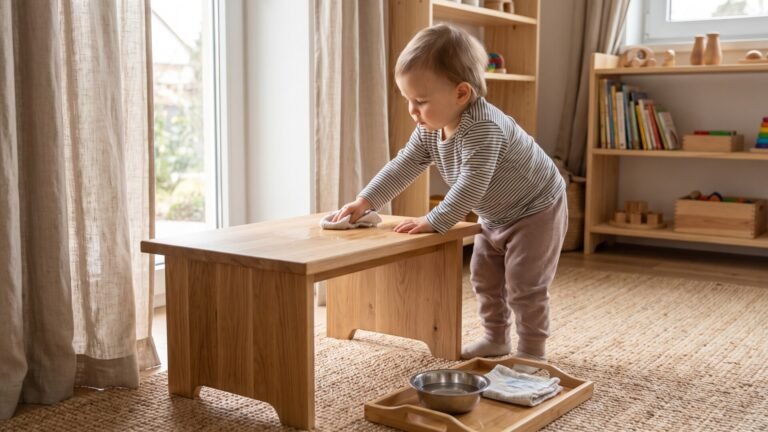
- Care of the environment. Sweeping, wiping tables, watering plants, putting things away, cleaning up after a meal.
- Grace and courtesy. Carrying a tray without dropping it, waiting, passing a plate, saying excuse me. These are learned through doing, not through a product.
- Movement and coordination. Pouring, scooping, threading, carrying, balancing. The controlled-movement work that underpins everything else.
The outcomes are real but modest, and it is worth being straight about that. Pouring practice supports controlled hand movement and hand-eye coordination. Dressing frames support sequencing and the small muscles that manage buttons and zips. Cleaning tools support follow-through and a sense of responsibility for a shared space. None of this is a medical intervention, and none of it needs to be. It is the ordinary business of learning to do things.
Where parents get confused is the boundary between three different objects. A practical life material rehearses a real action with a functional purpose. A pretend-play toy supports symbolic play – a toy blender that makes no smoothie. A household tool adapted for supervised child use is exactly what it sounds like: a real small whisk, a real dustpan, a real sponge, sized down. All three can live in the same house. Only the first and third build practical life skill. The second is fine, it is just doing a different job.
How to Choose Materials That Get Used
Age and readiness
Toddlers can manage large, simple actions: transferring, scooping, wiping, carrying, placing objects into containers. Preschoolers can handle more steps, finer fasteners, and sequences that take longer than ninety seconds. That is the broad shape, and it is less useful than watching your own child.
Readiness beats age labels every time. The signals that matter are whether the child can follow a short demonstration, handle the material safely, and stay engaged for a minute or two without you redirecting them. If they can, they are ready for something. If they cannot, the material will sit there and you will feel bad about it.
The same object usually scales. A transfer tray with dry beans becomes a transfer tray with water when control improves. A dressing frame with a large button becomes a dressing frame with a buckle. You are not buying for a stage, you are buying for a progression, which is why simple materials outlast complicated ones.
Safety and supervision
This is the section where you have to be an adult about it. Choking hazards, sharp or breakable household items, water spills, food allergens, cords, hot surfaces. Follow the manufacturer’s age guidance on the specific product you buy, and treat it as a starting point rather than a guarantee.
Some activities need you in the room, close: food preparation, anything involving real cleaning products, glassware, water play, and any tool with a blade or a point. Child-sized tools should be functional – a blunt knife that will not cut anything teaches nothing – but appropriately blunt, stable, and easy to clean. A wobbly tool is a hazard and a frustration at the same time.
If you are unsure about a specific material, check the manufacturer’s guidance directly rather than trusting a roundup. That includes this one.
Durability, storage, and daily fit
Solid construction, washable or replaceable components, a piece count you can manage, and storage the child can use without help. That last one is the most commonly ignored. If returning the material requires you, the child cannot complete the cycle, and the cycle is the point.
A beautiful set that takes four minutes to set up will lose to a basic tray that is ready every morning. I have watched this happen in my own kitchen repeatedly. The fancy thing loses to the thing that is already out.
You do not need a Montessori shelf. A low drawer, one rotating basket, or a single tray on a bottom shelf does the same job. In a small apartment, one basket that changes weekly beats five shelves that never change at all.
Open-ended value versus novelty
Favor materials that teach a repeatable action and slot into a real routine. Pouring water at snack time. Wiping the table after lunch. Putting socks in a drawer. These get used because they are not optional – they are just what happens at that time of day.
Be suspicious of accessories, electronic prompts, and activity cards. A practical life material that requires a card to tell you what to do has replaced the child’s own observation with instructions, which is a different activity. Complicated kits also tend to be used once and then stored, because the setup cost is higher than the payoff.
Here is the framework this article runs on. For any practical life purchase, score it on four things: frequency of use (how often will this actually come out), independence potential (can the child start and finish it alone), supervision burden (how much of you does it require), and useful life (how many months before it is outgrown). Anything that scores well on all four is worth buying. Anything that scores well on one and badly on the rest is decoration.
The Best Montessori Practical Life Toys
Prices below are approximate and move around. The shortlist mixes budget, mid-range, and premium options, and in several cases an ordinary household tool is the better buy than a dedicated product. Where a specific current model is uncertain, I have described the category rather than inventing a product name.
Melissa & Doug Deluxe Wooden Lacing Sneaker
| Feature | Details |
|---|---|
| Age Range | Usually marketed for preschool-age children; follow current manufacturer guidance |
| Key Features | Child-sized shoe form, laces, tying practice, hands-on dressing skill |
| Price (approx) | $20-$30 |
The verdict. A focused self-care material for a child who is ready to practice tying and sequencing. It is worth more when it sits next to real dressing routines than when it is treated as a one-off challenge to be conquered and abandoned.
Best for. Children working on dressing independence and parents who want a compact self-care activity that stores in a drawer.
Pros
- Direct connection to a real dressing skill
- Compact and easy to store
- Encourages repeated hand practice
Cons
- Narrow purpose compared with a multi-activity set
- May be frustrating before the child is ready for laces
- Does not replace practicing with the child’s own shoes
[Affiliate: Check current pricing through our recommended partners]
Melissa & Doug Bead Sequencing Set or Similar Wooden Threading Material
| Feature | Details |
|---|---|
| Age Range | Typically preschool age; verify the specific product’s guidance |
| Key Features | Threading, sequencing, pattern work, controlled hand movements |
| Price (approx) | $15-$30 |
The verdict. A lower-cost way to build the controlled movements that dressing, fastening, and tool use all depend on. It is not exclusively a practical life material, but it earns a place because it combines coordination with simple, repeatable work.
Best for. Families who want a budget-friendly fine-motor material with broader use than a single dressing frame.
Pros
- Accessible price
- Useful for patterns and independent repetition
- Small storage footprint
Cons
- Beads can create a choking risk for younger children
- More indirect than a real-life dressing activity
- Pieces can be lost
[Affiliate: Check current pricing through our recommended partners]
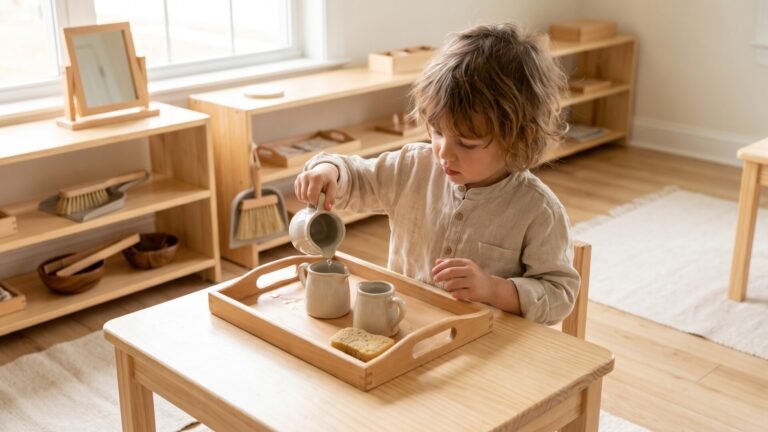
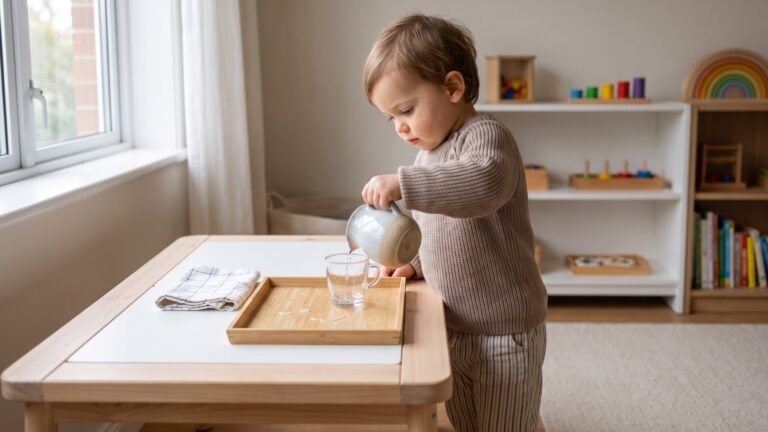
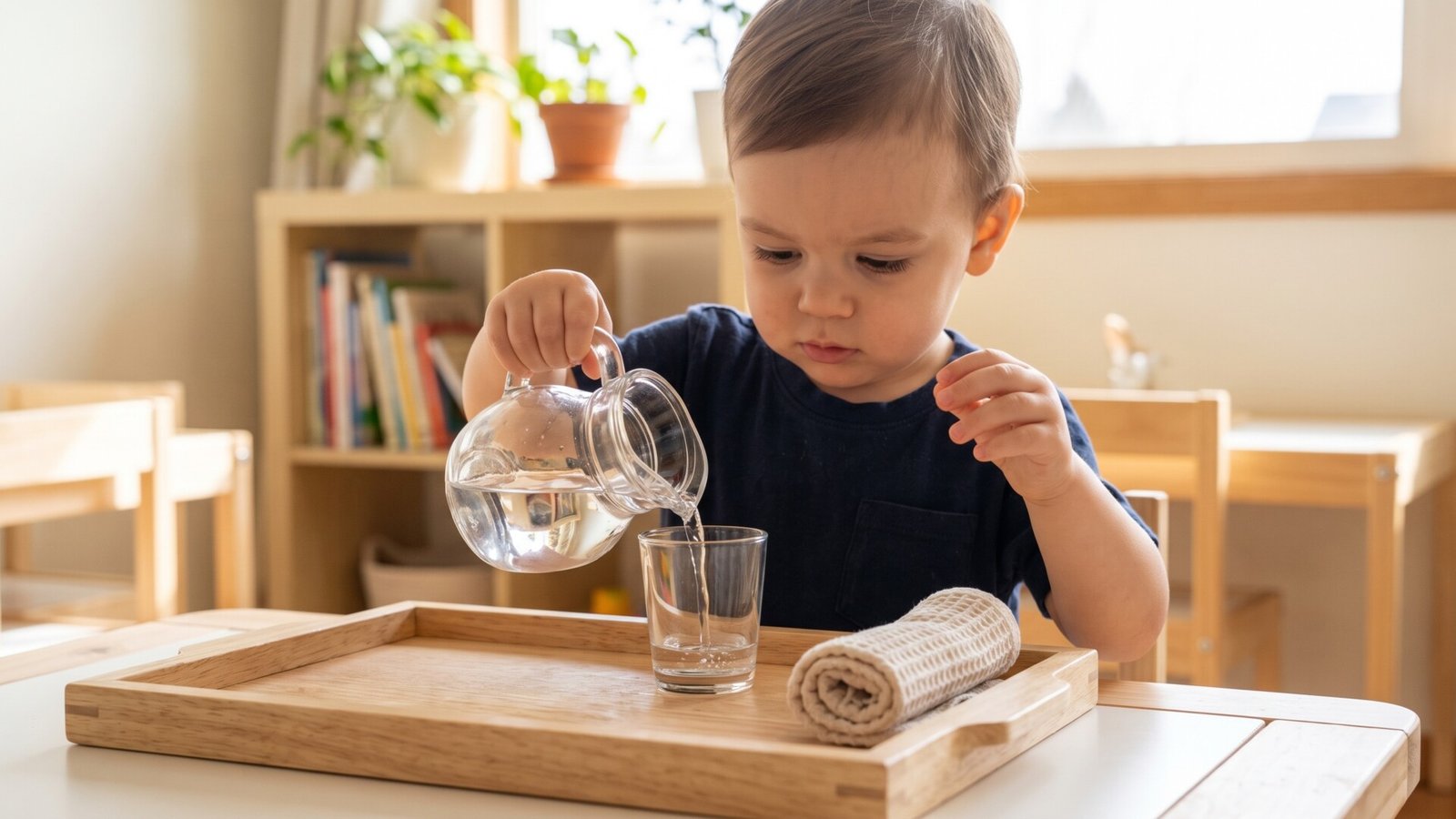
Montessori-Inspired Pouring and Transfer Tray
| Feature | Details |
|---|---|
| Age Range | Often suitable from the toddler or preschool period depending on piece size and supervision |
| Key Features | Pitchers, cups, bowls, scoops, beans or large transfer objects, tray |
| Price (approx) | $20-$60 |
The verdict. One of the highest-value categories in practical life, because pouring and transferring can be repeated daily and adapted as control improves. A simple, stable setup with a tray that contains the mess beats an ornate set with fourteen pieces every time. Specialist Montessori retailers carry wooden pouring sets; a small pitcher, a bowl, and a tray from your own kitchen do the same job.
Best for. Toddlers and preschoolers practicing control, concentration, and table-related routines.
Pros
- Highly repeatable action
- Easy to scale from dry transfers to supervised water pouring
- Supports independent setup and cleanup
Cons
- Spills are part of the learning process
- Small loose materials require supervision
- Wood may need careful cleaning and drying
See our full Montessori Practical Life Toys and Activities collection.
Child-Sized Kitchen Tool Set
| Feature | Details |
|---|---|
| Age Range | Choose a product whose guidance matches the child’s size and supervision needs |
| Key Features | Child-sized utensils, serving tools, bowls, tongs, or food-preparation accessories |
| Price (approx) | $15-$50 |
The verdict. Kitchen materials are most valuable when they connect to a real family routine: spreading, stirring, serving, washing produce. Buy functional tools, not pretend ones. A small real whisk and a real bowl will be used for years; a toy blender with sound effects will be used for a fortnight.
Best for. Children who want to participate in meal preparation and families willing to build practical life into daily routines.
Pros
- High potential for repeated real-world use
- Builds sequencing and responsibility
- Can grow with family routines
Cons
- Requires adult supervision
- Some products are more pretend than functional
- Food preparation creates cleaning and allergy considerations
[Affiliate: Check current pricing through our recommended partners]
Child-Sized Cleaning Set
| Feature | Details |
|---|---|
| Age Range | Usually preschool-oriented; check bristle, handle, and accessory guidance |
| Key Features | Broom, dustpan, brush, mop, or wiping tools scaled for children |
| Price (approx) | $20-$50 |
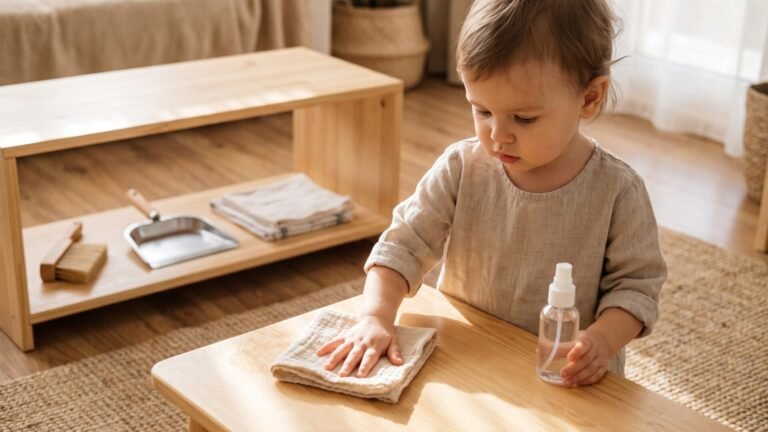
The verdict. A strong choice for children who enjoy purposeful movement and visible results. Expect imperfect cleaning and focus on participation, not adult-level performance. Melissa & Doug and specialist Montessori retailers both make versions worth considering; a supermarket dustpan and brush set also works if the handle is short enough.
Best for. Children learning care of the environment and families comfortable making cleanup part of the daily rhythm.
Pros
- Connects directly to household responsibility
- Encourages large-movement coordination
- Often useful beyond a single activity
Cons
- Takes more storage space
- Results may be uneven
- Avoid products with loose or fragile parts
See our guide to Montessori cleaning activities for young children.
Montessori Dressing Frames
| Feature | Details |
|---|---|
| Age Range | Varies by fastener and child readiness; simple fasteners generally precede complex ones |
| Key Features | Mounted practice frames for buttons, zippers, snaps, buckles, or laces |
| Price (approx) | $25-$100 or more depending on the set |
| Best For | Targeted self-care practice and preschool classrooms or home shelves |
The verdict. Worthwhile when a child is actively struggling with a specific fastener and the family will practice consistently. A full premium set is rarely necessary at home unless several children will use it or you want a complete progression on the shelf. Buy the one frame that matches the current problem.
Pros
- Focused practice away from time pressure
- Clear progression from simple to complex fasteners
- Durable versions may serve multiple children
Cons
- Premium sets can be expensive
- Limited use after the skill is mastered
- Some children prefer practicing on real clothing
See our Montessori dressing and self-care activities guide
Learning Tower or Kitchen Helper
| Feature | Details |
|---|---|
| Age Range | Varies substantially by design, stability, and manufacturer guidance |
| Key Features | Elevated standing platform, safety enclosure or support, access to counter-height activities |
| Price (approx) | $100-$300 or more |
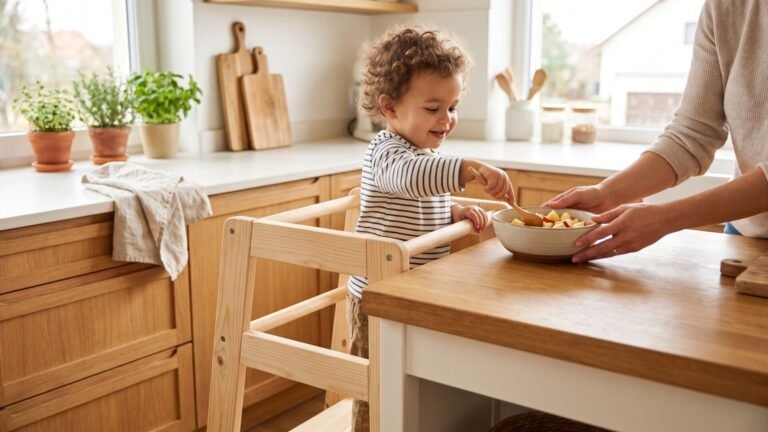
The verdict. A major practical life purchase rather than a toy, and the one item here that can create access to dozens of real activities: washing produce, stirring, wiping, pouring, watching. Stability, footprint, safe use, and supervision matter far more than how it looks against your cabinets.
Best for. Families who want the child involved in kitchen routines and have a safe, suitable place to use and store it.
Pros
- Converts ordinary household routines into learning opportunities
- Potentially useful for years
- More versatile than many single-purpose toys
Cons
- Highest cost and space requirement on the list
- Requires careful safety assessment
- Not suitable for every kitchen layout
Read our full guide to Montessori kitchen helpers and learning towers for 2-year-olds.
Comparison Table
| Product or Category | Approx. Price | Best Skill Focus | Space Needed | Best For |
|---|---|---|---|---|
| Lacing sneaker | $20-$30 | Dressing and sequencing | Low | Targeted self-care practice |
| Bead sequencing set | $15-$30 | Hand control and patterns | Low | Budget-conscious families |
| Pouring and transfer tray | $20-$60 | Coordination and concentration | Low to medium | Toddlers and preschoolers |
| Child-sized kitchen tools | $15-$50 | Food preparation and responsibility | Medium | Families using real routines |
| Cleaning set | $20-$50 | Care of the environment | Medium | Cleanup participation |
| Dressing frames | $25-$100+ | Fasteners and self-care | Medium | Focused skill progression |
| Learning tower | $100-$300+ | Kitchen participation and independence | High | Frequent family cooking |
What Most Buyers Get Wrong About Practical Life Toys
The most common mistake is buying a large themed set and calling it a prepared environment. A big box of pouring, scooping, and sorting accessories looks like Montessori learning. What it usually produces is one enthusiastic afternoon, a storage problem, and a child who has done each activity once. Regular use comes from repetition, and repetition comes from a small number of materials that are always available.
The second mistake is assuming wood equals developmental value. It does not. A sturdy plastic scoop that gets used every day is a better practical life tool than a beautiful wooden one that lives on a shelf because it is too precious to get wet. Wood is attractive, it lasts, and it feels good in the hand – all real advantages. It is not a learning outcome. If a household sponge or a plastic jug does the job and gets used, buy the sponge.
The third is ignoring your own availability. A water-pouring activity is excellent in theory and unsuitable for a family that cannot manage a puddle at 7am on a Tuesday. That is not a failure of parenting. It is a mismatch between the material and the household. Choose activities you can actually supervise at the times you actually have.
And the fourth is confusing independence with unsupervised access. Practical life is not about removing yourself from the room. It is about building a prepared environment with clear boundaries, where the child can start, work, and finish something without you hovering. You are still there. You are just not doing it for them.
Which Materials Still Make Sense After Six Months?
This is the section most buying guides skip, because it requires thinking past the unboxing. I am scoring each category on four factors – frequency of use, number of routines supported, useful age span, and ownership burden (setup, cleanup, storage, adult time) – on a consistent 1-5 scale, where 5 is best. This is editorial analysis based on how these categories behave in ordinary homes, not hands-on testing.
| Category | Frequency | Routines | Age Span | Ownership Burden | Overall |
|---|---|---|---|---|---|
| Pouring and transfer tray | 5 | 4 | 4 | 4 | 4.3 |
| Child-sized cleaning tools | 4 | 5 | 4 | 3 | 4.0 |
| Child-sized kitchen tools | 5 | 5 | 5 | 2 | 4.3 |
| Learning tower | 4 | 5 | 5 | 2 | 4.0 |
| Dressing frames | 3 | 2 | 2 | 4 | 2.8 |
| Lacing sneaker | 3 | 1 | 2 | 5 | 2.8 |
| Bead sequencing set | 3 | 2 | 3 | 4 | 3.0 |
| Themed activity bundle | 2 | 2 | 2 | 2 | 2.0 |
The six-month survivors are predictable once you look at them this way. Pouring and transfer trays survive because the action is repeatable and the setup is small. Child-sized cleaning tools survive because there is always something to clean and the child can see the result. Kitchen tools survive because they plug into a routine that happens three times a day whether you planned an activity or not. A learning tower survives because it is not an activity at all – it is access.
The short-term purchases are equally predictable. Novelty activity kits get used until the novelty runs out, which is usually two to three weeks. Oversized collections with redundant pieces get raided once and then become storage. Anything bought before the child is ready gets abandoned and quietly resented by the adult who paid for it.
The hidden costs are the part nobody puts on the product page. Spills mean towels and time. Loose materials get lost and replaced. Cleaning tools take up a corner of a small apartment permanently. Dressing frames stop being useful the moment the skill is learned, which is the point, but it also means the money is spent on a short window. And every single-purpose product you buy has an opportunity cost: it is one more thing competing for the same shelf and the same ten minutes of your afternoon.
Here is the counterintuitive conclusion. The best practical life purchase is usually the one that expands your child’s access to family life, not the one with the most Montessori-looking presentation. A learning tower that puts a two-year-old at the counter while you cook beats a beautiful wooden sorting set that lives in the playroom. A real dustpan beats a toy cleaning caddy. The materials that survive are the ones that are part of the day, not adjacent to it.
How to Build a Practical Life Shelf by Age and Budget
Starter setup for toddlers
Begin with one transfer or pouring activity, a wiping cloth, a small basket, and one safe household responsibility. That is genuinely enough. Keep pieces large, movements simple, demonstrations short, and supervision close.
See our guide to the best practical life activities for toddlers guide.
See our Montessori practical life activities for 2-year-olds post.
Expanded setup for preschoolers
Add dressing practice, child-sized cleaning tools, supervised kitchen tasks, and more complex fastening or sequencing. Rotate materials without removing access to real daily responsibilities – the routine jobs stay, the shelf activities change.
See our Montessori practical life activities for preschoolers article.
See our Montessori dressing and self-care activities guide.
Budget setup
Prioritize ordinary safe household items: a small pitcher, a bowl, a sponge, a cloth, a basket, tongs, a child-sized apron. Spend on one durable tool that solves a real access problem – a stable learning tower is the classic example – rather than a complete themed collection. Household adaptation should never override safety or manufacturer guidance.
Premium setup
Specialist materials are justified when several children will use them, in a classroom, with frequent home practice, where durable construction matters, or where you want a clear skill progression across fasteners. They are not justified for decoration, branding, or extra pieces that do not increase practical use.
See our picks for the best Montessori toys for teaching independence.
How to Introduce Practical Life Toys Without Creating More Work
Demonstrate slowly and, where you can manage it, silently. Then let the child repeat the action without constant correction. The silence is harder than it sounds and it is doing most of the work.
Present one activity at a time. Keep the setup visible, stable, and easy to return. If the child cannot put it back without you, simplify the storage until they can.
Accept imperfect results while holding the safety line and one simple cleanup expectation. The table gets wiped badly and then it gets wiped again tomorrow. That is the process.
Connect materials to real routines: wiping after meals, carrying napkins, putting clothing away, washing produce, sweeping crumbs. A practical life material that has no place in the day is a toy with a job title.
See our broader Montessori Practical Life Toys and Activities hub
Best Choices by Family Situation
- Best overall: A simple pouring and transfer setup, or a small combination of real child-sized tools. Repeat use, manageable cost, small footprint.
- Best budget pick: Household-adapted materials plus a basic threading or bead-sequencing activity, provided pieces are age-appropriate and supervised.
- Best for self-care: A dressing frame or lacing sneaker chosen around the child’s current fastener challenge, not the whole set.
- Best for kitchen participation: A safe learning tower, when the family cooks often and can supervise consistently.
- Best for care of the environment: A child-sized cleaning set paired with a predictable cleanup job.
- Best premium option: A durable, modular dressing-frame or practical life progression set for multiple children, classrooms, or families committed to regular shelf rotation.
- Not worth it: Large bundled sets filled with duplicate pouring, scooping, and sorting accessories when a smaller tray and a few household tools would offer the same practice for less money and less storage.
Conclusion
Choose practical life materials on repeated use, readiness, safety, and fit with your family’s routines. Not on the size of the set, and not on how Montessori the packaging looks.
The winners, plainly. Best overall: simple pouring and transfer materials, or a small collection of real child-sized household tools. Best budget: household-adapted tools supplemented by a basic threading or sequencing activity. Best premium: a durable learning tower for families who regularly cook with a child at the counter, or a quality dressing-frame progression for focused self-care practice. Best specialized: dressing frames for a specific fastener, and child-sized cleaning tools for care of the environment.
The strongest practical life shelf is small, visible, and connected to real family work. It is the tray that is already out, the dustpan by the door, the stool at the counter. It is the dog’s water bowl, carried across the kitchen by a child who decided, without being asked, that this was their job now. You will still mop the floor. But you will not have wasted $60 on a pouring set that nobody touched.
Check current pricing and availability through our recommended partners.
Frequently Asked Questions About Montessori Practical Life Toys
Are Montessori practical life toys worth buying?
They can be, when they support a real routine the child is ready to practice. A dedicated product is not automatically better than a safe household tool, and in several categories the household tool wins.
What are the best Montessori practical life toys for a 2-year-old?
Simple transferring, scooping, wiping, carrying, and supervised pouring activities. Check the current manufacturer age recommendation on anything with small parts, and start with large pieces and short demonstrations.
Do practical life toys need to be made of wood?
No. Material matters less than safety, function, durability, size, and whether the child can use the tool meaningfully. Wood is attractive and durable. It is not a requirement, and it is not a learning outcome.
Are learning towers Montessori toys?
A learning tower is better understood as prepared-environment equipment than as a toy. Its value comes from giving a child safer access to supervised real activities, which is why it tends to outlast almost everything else on the shelf.
How many practical life toys should a child have?
Start with a small rotation and add materials only when the child has a genuine new skill or routine to practice. More products usually means more clutter and less independent choice.
Should practical life activities be completely independent?
Independence develops gradually and depends on setup, readiness, and supervision. Children still need demonstrations, boundaries, and adult oversight for water, food, tools, and household equipment.
What is the difference between practical life toys and pretend-play toys?
Practical life materials rehearse real actions with a functional purpose. Pretend-play toys primarily support symbolic or imaginative play. Some products serve both roles, but the learning objective is different.
Can I use ordinary household items instead of buying practical life toys?
Yes, and often you should. A small pitcher, a bowl, a sponge, a cloth, a basket, and a set of tongs cover most of the toddler and preschool curriculum. Buy a dedicated product when it solves a specific problem – access, safety, durability, or a fastener your child is stuck on.
How do I stop practical life materials from becoming clutter?
Keep the active set small, store the rest out of sight, and rotate only when the child has outgrown something or mastered a skill. If a material has not been used in a month and does not connect to a routine, it goes.