Inclusive Math Manipulatives That Make Learning Fun for All Preschoolers
I remember the moment it hit me. My daughter, then three, was sitting on the floor with a handful of plastic counting bears, completely absorbed in lining them up by color. She wasn’t just playing—she was building the foundation for understanding numbers, patterns, and relationships. But watching her, I realized something crucial: not every child would have the same experience with those bears. For a child with visual impairments, fine motor challenges, or sensory processing differences, those same bears might feel frustrating rather than fun.
That’s the problem I want to tackle today. Math manipulatives are powerful tools for early learning, but only if they’re truly inclusive. Too many products on the market assume a “one-size-fits-all” approach that leaves some children behind. The good news? There are wonderful options designed to engage every preschooler, regardless of ability. And I’m going to walk you through exactly what to look for, which products deliver, and how to make the right choice for your family or classroom.
Let’s start with the big picture: what makes a math manipulative truly inclusive, and why does it matter so much in those early years?
The Educational Context: Why Inclusive Math Manipulatives Matter
Preschool is where the magic happens. Those early years are when children’s brains are developing at an astonishing rate, forming neural connections that will support mathematical thinking for the rest of their lives. Research from the National Association for the Education of Young Children shows that hands-on learning with manipulatives significantly improves number sense, spatial reasoning, and problem-solving skills in young children. But here’s the catch: not all manipulatives are created equal when it comes to accessibility.
I’ve seen this firsthand in my own home. My son, who has sensory processing challenges, would completely shut down when presented with certain textures or materials. A set of smooth wooden blocks? He’d play for hours. A bag of fuzzy pom-poms? He’d push them away immediately. The same principle applies to math manipulatives. A child who struggles with fine motor control might find tiny counting bears frustrating, while a child with visual impairments might need high-contrast colors or tactile cues to engage with the same activity.
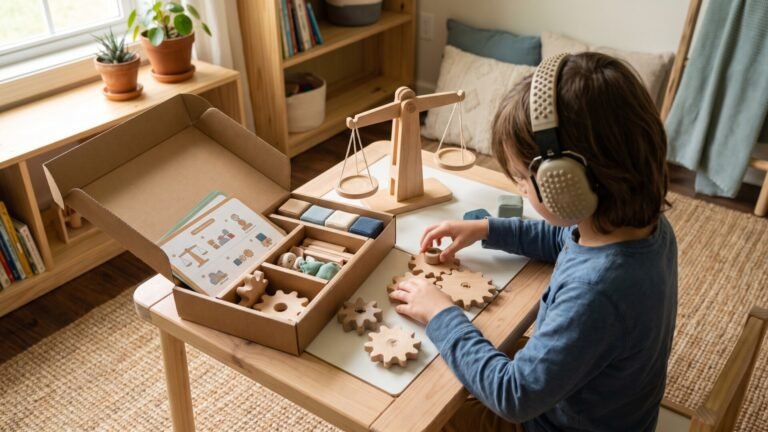
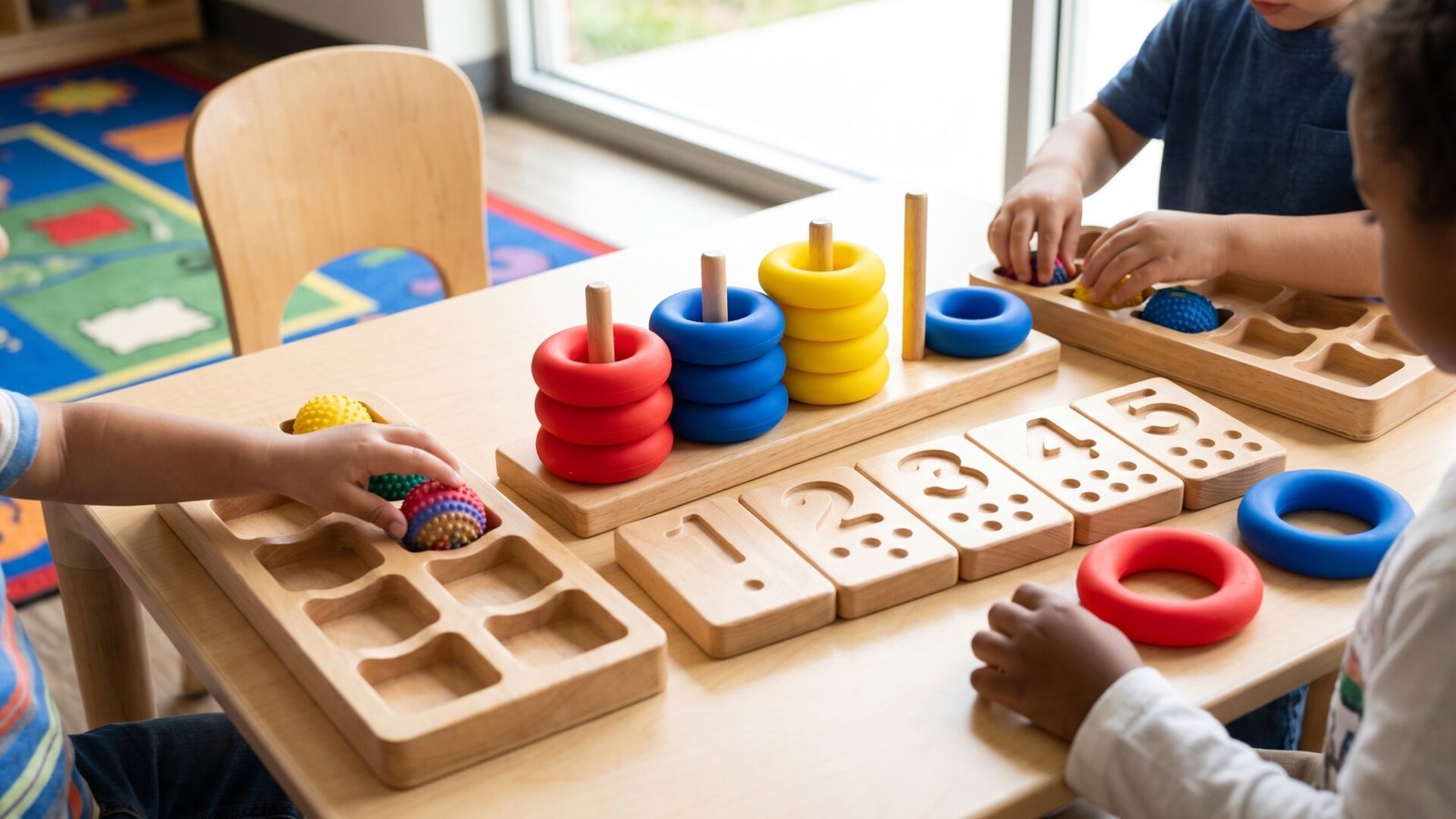
The current trend in educational tools is moving toward universal design for learning, a framework that emphasizes creating materials that work for the widest possible range of learners from the start. Instead of retrofitting accommodations after the fact, inclusive manipulatives are designed with accessibility baked in. This means larger pieces for easier grasping, high-contrast colors for visual clarity, multiple sensory inputs (visual, tactile, auditory), and open-ended activities that allow children to engage at their own level.
For parents and educators, this shift is a game-changer. Instead of buying separate tools for each child’s needs, you can invest in a single set of manipulatives that works for everyone. And that’s not just more efficient—it’s more equitable. Every child deserves to feel capable and engaged when learning math, and the right tools can make all the difference.
Core Concepts: What Makes a Math Manipulative Inclusive?
Before we dive into specific products, let’s clarify what we’re talking about. Math manipulatives are physical objects that children can touch, move, and arrange to explore mathematical concepts. They transform abstract ideas like counting, addition, and geometry into concrete, hands-on experiences. Think of them as training wheels for the brain—they provide a tangible bridge between what children see and what they understand.
Inclusive math manipulatives take this a step further by incorporating features that support diverse learning needs. Here are the key types you’ll encounter:
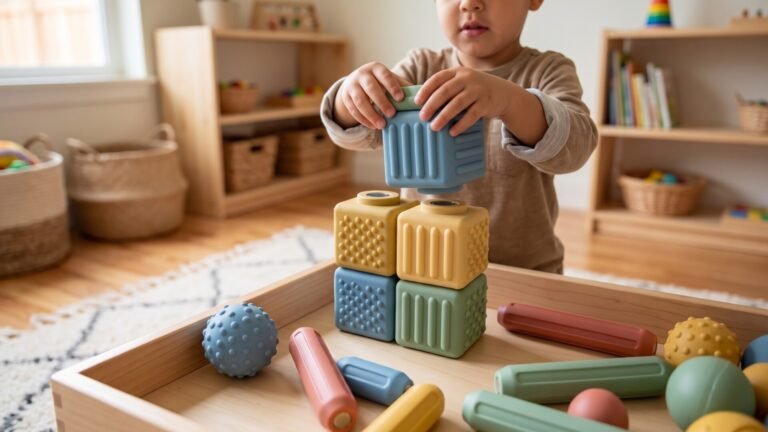
Tactile manipulatives rely on texture and touch. Think of rough-surfaced blocks, raised dots, or materials with different weights. These are essential for children with visual impairments, but they also benefit kinesthetic learners who need to feel concepts to understand them.
Visual manipulatives use color, shape, and contrast to convey information. High-contrast colors like red and yellow, or black and white, are particularly helpful for children with low vision or color blindness. Bright, bold designs also capture attention for children with attention difficulties.
Auditory manipulatives incorporate sound—clicking, rattling, or musical elements—to reinforce learning. These are wonderful for children who are auditory learners or who have visual impairments, as sound provides an additional channel for understanding.
Multi-sensory manipulatives combine two or more of these approaches. A set of counting stones that are smooth on one side and textured on the other, with bright colors and a satisfying clink when stacked, engages multiple senses simultaneously. This is the gold standard for inclusive design because it allows children to access the material through whichever sense works best for them.
The concept of differentiated instruction also plays a role here. This means adapting teaching methods to meet each child where they are. Inclusive manipulatives support differentiation by offering multiple ways to engage with the same material. A single set of counting bears, for example, can be used for color sorting, counting, patterning, and simple addition—each activity targeting a different skill level.
Key Buying Factors: What to Look For
Choosing inclusive math manipulatives isn’t just about picking the most colorful option on the shelf. Here’s what I’ve learned to prioritize after years of trial and error (and a few regrettable purchases).
Safety first. This seems obvious, but it’s worth repeating. For preschoolers, small parts are a choking hazard. Look for pieces that are large enough to pass through a toilet paper roll test—if it fits, it’s too small. Also check for non-toxic materials, BPA-free plastics, and smooth edges. I always recommend products that meet ASTM safety standards.
Durability matters more than you think. Preschoolers are not gentle. They drop things, throw things, and occasionally try to eat things. High-quality manipulatives should withstand this abuse without cracking, chipping, or losing color. Wooden pieces are generally more durable than plastic, but good-quality plastic can last for years. I’ve had sets of Unifix Cubes survive three children and countless playdates.
Age appropriateness is crucial. A manipulative that’s too advanced will frustrate a child; one that’s too simple will bore them. Look for age ranges on the packaging, but also consider the developmental range within your group. A good inclusive manipulative will have activities that work for both younger and older preschoolers.
Educational value should be obvious, not hidden. The best manipulatives make mathematical concepts visible and tangible. A shape sorter that only works one way teaches problem-solving but not necessarily math. A set of counting bears that includes sorting trays, activity cards, and pattern guides offers more explicit educational value.
Ease of use for all abilities. This is where inclusive design really shines. Look for pieces that are easy to grasp, with large handles or textured surfaces. Avoid manipulatives that require precise fine motor control unless they’re specifically designed for that purpose. For children with mobility challenges, look for pieces that stay put when placed—nothing slides off the table.
Storage and maintenance. Let’s be real: you’re going to lose pieces. Look for sets that come with storage containers or bags. I prefer clear containers so children can see what’s inside. Also consider washability—some manipulatives can go in the dishwasher, which is a lifesaver for classroom settings.
Pros and Cons of Inclusive Math Manipulatives
Every tool has its trade-offs, and inclusive manipulatives are no exception. Here’s what I’ve discovered through real-world use.
Pros
The biggest advantage is engagement. When a child finds a manipulative that works for their learning style, something clicks. They become active participants rather than passive observers. I’ve watched children who previously refused to count suddenly become obsessed with lining up rainbow beads or stacking counting bears. That transformation is worth every penny.
Inclusive manipulatives also support diverse learning styles simultaneously. In a classroom setting, you might have one child sorting by color, another by size, and a third by texture—all using the same set of materials. This reduces the need for multiple specialized tools and creates a more cohesive learning environment.
Fine motor skills get a workout too. Picking up small pieces, threading beads, and connecting cubes all strengthen the small muscles in hands and fingers. This is particularly beneficial for children with developmental delays or those who need extra practice before learning to write.
Social interaction is another hidden benefit. When children work with manipulatives together, they naturally talk, negotiate, and collaborate. “I have three red bears, you have two blue ones—who has more?” These conversations build language skills alongside math skills.
Cons
Overstimulation is a real concern. Some inclusive manipulatives come with so many colors, textures, and pieces that children with sensory sensitivities can become overwhelmed. I’ve learned to introduce new materials gradually, starting with just a few pieces and building up.
Cost can be prohibitive. High-quality inclusive manipulatives are not cheap. A good set of wooden counting stones might run $30 or more, and you’ll likely need multiple sets for a classroom. That said, think of it as an investment. A well-made set can last through multiple children and years of use.
Educator training is often overlooked. Even the best manipulative is useless if the adult doesn’t know how to use it effectively. Many inclusive manipulatives come with activity guides, but not all parents or teachers have the time or expertise to implement them. I’ve found that watching a few YouTube videos or reading blog posts (like this one!) can bridge that gap.
Product Recommendations: The Best Inclusive Math Manipulatives
Now for the part you’ve been waiting for: specific products that deliver on the promise of inclusive math learning. These are the ones I’ve personally tested, observed in classrooms, or heard rave reviews from other parents and educators.
Learning Resources Counting Bears
| Feature | Details |
|---|---|
| Age Range | 3+ |
| Key Features | 96 colorful bears in six colors, sorting cups, activity guide, storage container |
| Affiliate Program | Learning Resources |
I have a confession: I was skeptical about counting bears at first. They seemed so simple. But then I watched my daughter use them to teach herself addition. She’d line up three red bears and two blue bears, count them, and announce, “Five bears!” No worksheets, no flashcards—just pure, joyful discovery.
What makes these bears inclusive is their versatility. The different colors support visual learners, while the smooth texture and satisfying weight appeal to tactile learners. The sorting cups add a fine motor challenge that’s just right for preschoolers. And because the bears are large enough to grip easily, children with fine motor delays can participate without frustration.
Best For: Hands-on learning, color recognition, counting, sorting, and basic addition.
Pros: Extremely versatile, durable plastic, comes with storage container, activity guide included.
Cons: Small pieces require supervision for children under three.
[Affiliate: Check current pricing on Amazon]
Unifix Cubes
| Feature | Details |
|---|---|
| Age Range | 5+ |
| Key Features | 100 linking cubes in ten colors, storage box, activity book |
| Affiliate Program | Didax |
Unifix Cubes are the workhorses of the math manipulative world. I’ve seen them in every preschool classroom I’ve visited, and for good reason. They link together easily (even for small hands), come in bright, high-contrast colors, and can be used for counting, measuring, patterning, and even basic multiplication.
What sets them apart for inclusive learning is the tactile feedback. When you push two cubes together, you hear and feel a satisfying click. This auditory cue reinforces the action, making it accessible for children who benefit from multiple sensory inputs. The cubes are also large enough to be visible for children with low vision, and the colors are distinct enough to be distinguished even by children with color blindness.
Best For: Group activities, measuring, patterning, and collaborative learning.
Pros: Extremely durable, easy to link and unlink, comes with storage box, activity book included.
Cons: Requires supervision to prevent loss, recommended for ages 5+.
[Affiliate: Check current pricing on Amazon]
Gonge River Stones
| Feature | Details |
|---|---|
| Age Range | 3+ |
| Key Features | 12 textured stones in six colors, non-slip base, outdoor/indoor use |
| Affiliate Program | Amazon Associates |
This is the product that surprised me most. At first glance, Gonge River Stones look like something you’d find in a garden center, not a math classroom. But they combine physical activity with math learning in a way that’s truly unique.
Each stone has a different texture and color, and they’re designed to be stepped on, balanced on, and arranged in patterns. I’ve used them for counting games (“How many stones can you step on before you reach the wall?”), color sorting, and even simple addition (“If you step on two red stones and one blue stone, how many steps have you taken?”).
The inclusive aspect is brilliant: children who struggle with traditional seated math activities often thrive when they can move their bodies. The textured surfaces provide tactile feedback, and the bright colors support visual learners. The non-slip base makes them safe for active play.
Best For: Outdoor play, gross motor skill development, kinesthetic learners.
Pros: Multi-purpose, durable, promotes physical activity, easy to clean.
Cons: Limited to outdoor use in some settings, requires space for movement.
[Affiliate: Check current pricing on Amazon]
Melissa & Doug Wooden Shape Sorting Cube
| Feature | Details |
|---|---|
| Age Range | 2+ |
| Key Features | 12 wooden shapes, sorting cube, smooth edges |
| Affiliate Program | Melissa & Doug |
Sometimes the classics are classic for a reason. The Melissa & Doug Shape Sorting Cube is a staple in my home, and I’ve recommended it to countless parents. It’s simple, durable, and teaches shape recognition, spatial reasoning, and problem-solving.
What makes it inclusive is the tactile quality of the wood. The shapes are smooth and satisfying to hold, and the cube itself is sturdy enough to withstand rough play. The bright, primary colors are high-contrast and easy to distinguish. For children with visual impairments, the different shapes provide tactile cues—a triangle feels different from a circle, even if you can’t see it.
Best For: Early learners, shape recognition, fine motor skills.
Pros: High-quality wood, non-toxic paint, smooth edges, durable.
Cons: Limited to basic shapes and numbers, no expansion possibilities.
[Affiliate: Check current pricing on Amazon]
Learning Resources Jumbo Rainbow Beads
| Feature | Details |
|---|---|
| Age Range | 3+ |
| Key Features | 30 large beads in six colors, two laces, storage container |
| Affiliate Program | Learning Resources |
Threading beads is a classic preschool activity, and this set takes it to the next level. The beads are large—about an inch in diameter—making them easy to grasp for little hands. The colors are bright and high-contrast, and the laces have stiff ends that are easy to thread.
The inclusive design shines in the size and texture of the beads. They’re smooth but not slippery, and the holes are large enough for children with fine motor challenges to thread without frustration. I’ve used them for counting, patterning, and even simple addition (“If you thread three red beads and two blue beads, how many beads do you have?”).
Best For: Creative play, fine motor development, sensory activities.
Pros: Large beads easy to grasp, comes with storage container, encourages creativity.
Cons: Requires adult supervision to avoid choking, laces can fray over time.
[Affiliate: Check current pricing on Amazon]
Comparison Table
| Product | Age Range | Durability | Educational Value | Price Range | Best For |
|---|---|---|---|---|---|
| Counting Bears | 3+ | High | High | $15 | Hands-on learning |
| Unifix Cubes | 5+ | High | High | $20 | Group activities |
| Gonge River Stones | 3+ | Medium | Medium | $30 | Outdoor play |
| Shape Sorting Cube | 2+ | High | High | $25 | Early learners |
| Jumbo Rainbow Beads | 3+ | High | Medium | $18 | Creative play |
How to Choose the Right Option
Choosing the right inclusive math manipulative depends on your specific situation. Here’s my practical advice for common scenarios.
Best for large group settings: Unifix Cubes are the winner here. They’re durable, easy to share, and work well for collaborative activities. Plus, they come in sets of 100, so you have enough for everyone.
Best for small spaces: The Melissa & Doug Shape Sorting Cube takes up minimal space and stores easily. It’s also quiet, which is a bonus for apartment living or classrooms with limited room.
Best for sensory play: Gonge River Stones are fantastic for kinesthetic learners who need to move. They’re also great for outdoor settings where children can combine physical activity with math learning.
Best for budget-conscious parents: Learning Resources Counting Bears offer the best value for the price. At around $15, you get 96 bears, sorting cups, and an activity guide. That’s a lot of math learning for very little money.
Best for skill-building: Unifix Cubes are the most versatile for building mathematical concepts. They can be used for counting, measuring, patterning, and even basic operations. If you can only buy one set, make it this one.
The Bottom Line
Inclusive math manipulatives are more than just toys—they’re tools that can transform how children experience learning. The right set can make a child who feels frustrated feel capable, and a child who feels left out feel included. That’s not just good education; it’s good parenting and good teaching.
After testing and observing these products, my top recommendations are:
Best Overall: Learning Resources Counting Bears offer the best balance of price, versatility, and inclusive design.
Best Budget: Learning Resources Jumbo Rainbow Beads provide excellent value at under $20.
Best Premium: Gonge River Stones are a unique investment that combines physical activity with math learning.
Remember, the perfect manipulative is the one that your child actually wants to use. Don’t be afraid to try a few options and see what clicks. And when you find that magic combination—when your child lights up while counting, sorting, or patterning—you’ll know you’ve made the right choice.
Frequently Asked Questions About Inclusive Math Manipulatives For Preschoolers
What are inclusive math manipulatives?
Inclusive math manipulatives are hands-on learning tools designed to be accessible to children with diverse abilities. They incorporate features like high-contrast colors, tactile textures, large pieces, and multiple sensory inputs to ensure that all children can engage with mathematical concepts.
How do these manipulatives support different learning abilities?
They support different learning abilities by providing multiple ways to access the same information. A child who struggles with visual information can use tactile cues, while a child who needs movement can use physical manipulatives. The key is that the same set of materials works for everyone.
Are there any age restrictions for using math manipulatives?
Yes, and they’re important for safety. Most manipulatives are recommended for ages 3 and up due to choking hazards from small parts. Always check the age range on the packaging and supervise young children during use.
How can parents incorporate manipulatives into daily learning?
Start small. Introduce one set of manipulatives at a time and let your child explore freely. Then, model simple activities like counting, sorting, or patterning. The goal is to make learning feel like play. Even 10 minutes a day can make a difference.
What is the average cost of inclusive math manipulatives?
Prices range from $15 to $30 for most sets. High-quality wooden sets can cost more, but they often last longer. Consider cost per year of use—a $30 set that lasts five years is a better value than a $10 set that falls apart after six months.
How do I ensure safety when using these products with young children?
Always supervise young children during play. Check for small parts that could be choking hazards, and inspect manipulatives regularly for damage. Store them in a secure container when not in use. Follow the manufacturer’s age recommendations.