Montessori Cleaning Activities for Young Children
Here is the finished article. It follows the outline’s structure and the Playroom Realist voice, opens with the “What happens later” mode, closes with “The long view,” and lands inside the 3,000-3,500 word range.
There is a specific shelf in your house that tells the whole story. Right now it holds a plastic spray bottle with a sticker peeling off, a tiny mop with a sponge head that went gray in week two, and a bucket that has never once held water. In eight months, the mop will be in a donation bag and the bucket will be holding LEGO. The cloth, though, will still be in rotation. It will be the one your child grabs without being asked to wipe up the juice they spilled, because at some point it stopped being a toy and became a thing they know how to use.
That is the entire argument for Montessori cleaning activities in one image. The kits look like the activity. The tools are the activity. Most of what gets sold as a toddler cleaning set is a costume for chores, and costumes get outgrown. A short, real task done with a correctly sized tool is what actually sticks, and it costs less than the kit.
The best Montessori cleaning activities for young children are not elaborate pretend chores with a dozen accessories attached. They are brief, genuine jobs a child can start, finish, and put away: wiping a table, sweeping crumbs into a dustpan, dropping laundry in a basket, dusting a low shelf. The result will not be clean. That is not the point, and it never was.
Cleaning activities give young children a practical way to participate in everyday family life while developing coordination, concentration, responsibility, and independence. They are just one category of Montessori practical life work, so for more ideas covering cleaning, cooking, dressing, self-care, and other everyday skills, see our Montessori Practical Life Toys: Complete Guide.
Why Cleaning Activities Matter in Montessori Practice
Practical life work sits at the center of Montessori for the early years, and cleaning is the most accessible version of it. The child is not being taught to clean. The child is being given a real job with a visible beginning and end, using tools their hands can actually control.
What that work tends to build, over many repetitions, is coordination, concentration, and a sense of sequence. A table-cleaning routine has an order: get the cloth, wet it, wring it, wipe, put the cloth in the laundry basket. That order is the lesson. The table being clean is a side effect.
The distinction that matters most for your wallet is between helping with a real task and playing with a themed cleaning toy that has no usable function. A pretend spray bottle that only makes a clicking sound is a prop. A small spray bottle filled with water that your child uses on the actual table is a tool. Both have a place, but only one of them survives past the novelty phase, and it is usually the cheaper one.
Repetition is where parents get impatient. A child may need ten or fifteen chances at carrying a cloth across the room before it becomes something they do without prompting. That is normal. The task is not mastered in a weekend, and the early attempts will look like wandering.
The adult’s job is narrower than most parents assume. You prepare the environment so the tool is reachable and the task is possible. You demonstrate the motion slowly, once or twice, without narrating every step. Then you let the result be imperfect. Taking over the moment the wiping gets inefficient is the fastest way to end the activity, because the child learns their effort is not the real one.
If you want the broader picture of how cleaning fits alongside pouring, scooping, and dressing, our Montessori Practical Life Toys & Activities guide covers the whole shelf. Cleaning is one strand of it, not a separate project.
How to Choose a Safe, Useful Cleaning Activity
Match the task to the child’s stage
Age ranges are starting points, not promises. Readiness depends on grip strength, balance, attention span, and whether the child can follow a simple safety instruction. A three-year-old who ignores “stay away from the stairs” is not ready for a mop and a bucket regardless of what the box says.
Toddlers can carry a small cloth, drop clothes in a hamper, wipe a spill with your hand over theirs, dust a surface at their height, or move lightweight items into a basket. These tasks are short, visible, and easy to stop.
Young preschoolers can sweep crumbs into a dustpan, wash a plastic item in a shallow basin with you nearby, water a plant, sort laundry, and put cleaning materials back where they belong. This is the age where a complete sequence starts to hold together.
Older preschoolers can fold simple laundry, clean a low table, use a spray bottle filled with plain water, mop a small area, and run a short multi-step routine without a reminder at every stage.
Use the right level of realness
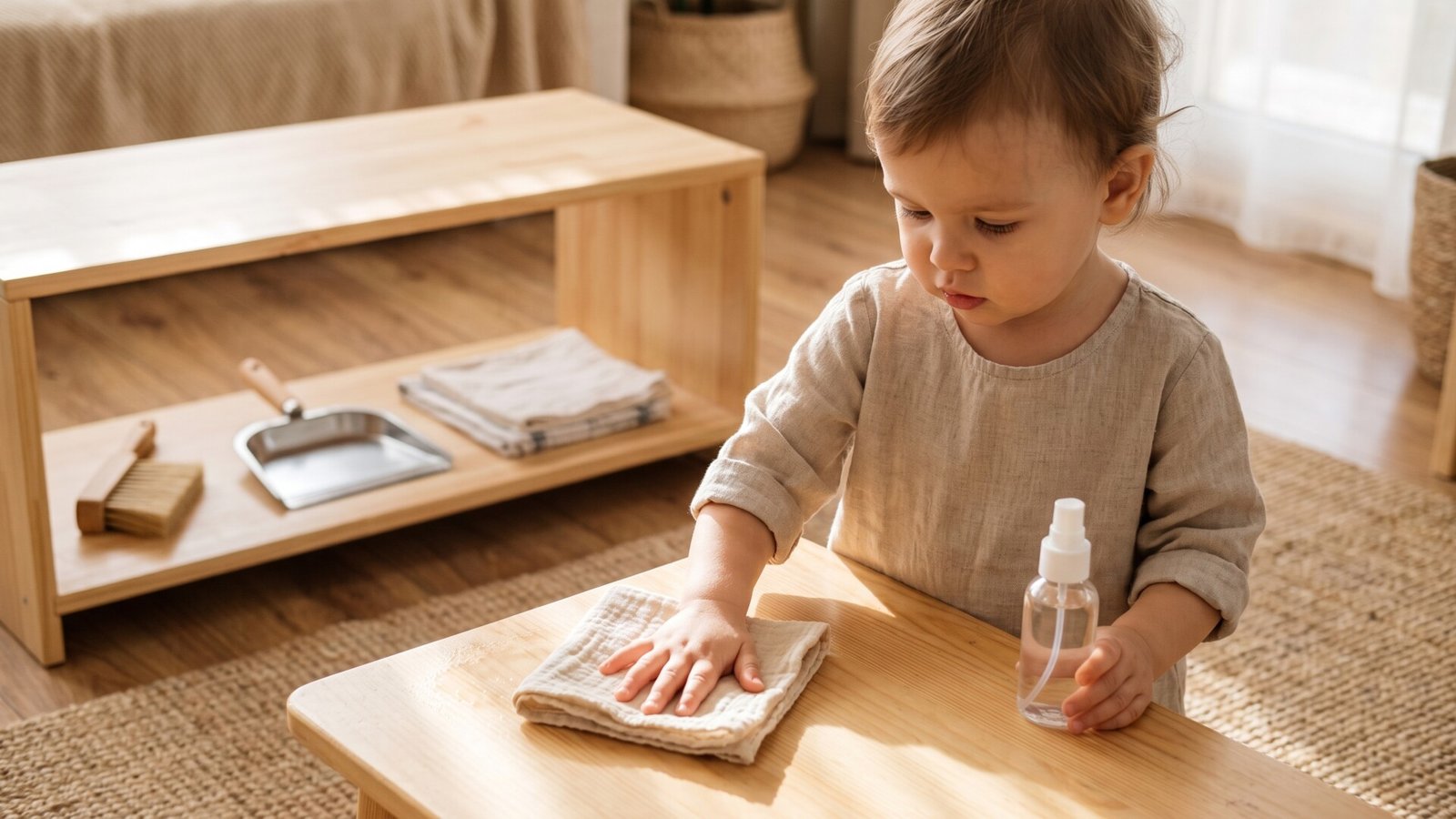
Real but child-sized tools beat scaled-down replicas almost every time. A small cloth, a hand brush, a dustpan that sits flat on the floor, a sponge, a low basket, a spray bottle that actually sprays a little water. These are the tools that let a child do the job rather than act it out.
Pretend versions earn their place in two situations: role-play, where the child wants to copy you and is not ready for water or real cleaning materials, and dry practice, where you want the motions learned before the mess is introduced. Both are legitimate. Neither replaces a functional tool once the child is capable.
Keep full-strength cleaning chemicals, sharp tools, heavy buckets, hot water, and anything with a cord away from young children entirely. That is standard household safety advice, not a Montessori principle, and it does not change because the activity is educational. Check the manufacturer’s age guidance on any tool you buy and follow it.
Design for easy cleanup
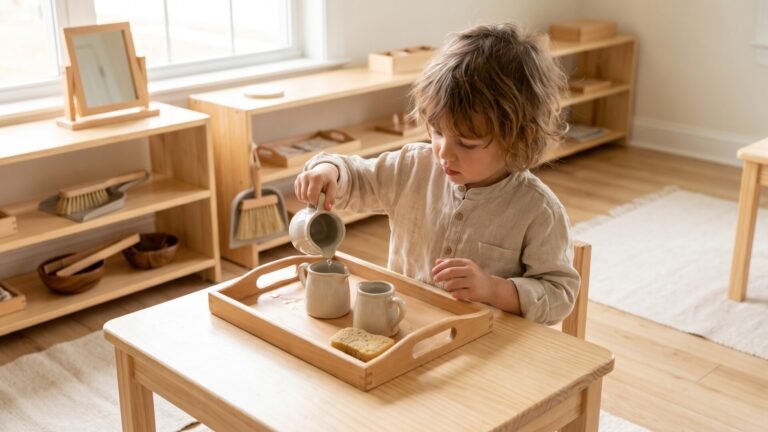
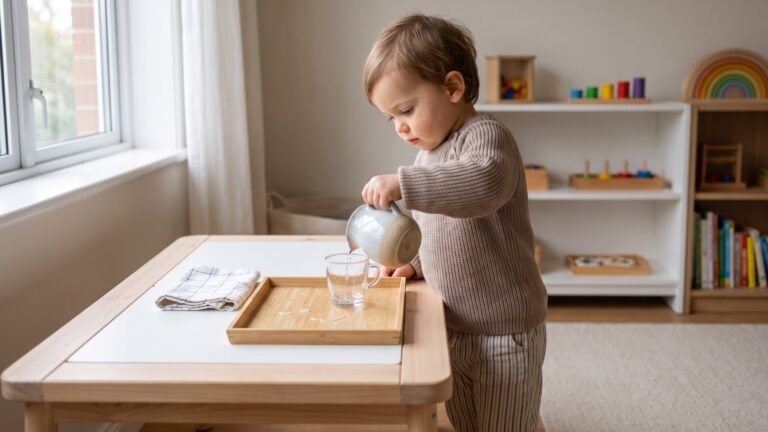
The setup is what makes or breaks this. A small tray, an open basket, or a low shelf holding only the materials for one task keeps the activity usable. When you pile every cleaning accessory into one bin, the child has to dig through it, you have to help, and the whole thing collapses back into adult-led tidying.
Keep the water shallow. Choose washable cloths over anything decorative. Limit the work area to one table or one square of floor. Keep a towel within reach so a spill is a two-second fix rather than an emergency. These small constraints are what let a child work without you hovering, and hovering is what kills the independence you were aiming for.
Montessori Cleaning Activities by Age
Simple activities for toddlers
Start with carrying. Hand your child a cloth and ask them to take it to the kitchen. That is the whole task. It sounds too small to matter, and it is the foundation for everything else, because it teaches that they are a person who moves things where they belong.
From there, wiping a low table, cleaning a small spill with your hand guiding theirs, and putting toys into a basket are all within reach. Dusting a shelf or wiping a washable plastic object with a damp cloth works well because the surface is at their height and the material cannot be ruined.
Set it up so there is one motion to copy and one task at a time. Stop before tiredness turns into frustration, which usually means stopping while they are still enjoying it. A toddler who ends the activity happy will come back to it. A toddler who ends it in tears will not.
Activities for children around age two
Sweeping a small amount of dry material with a child-sized broom and dustpan is the classic at this age. Start with a deliberately placed pile of crumbs rather than a whole floor, so the task has a clear finish line. The dustpan needs to sit close to the floor or the crumbs will skate underneath it and the child will lose interest fast.
Washing a plastic cup, a toy, or an outdoor object in a shallow basin with a small amount of water is the other reliable one. Two inches of water, one object, a sponge, and a towel. That is the whole station.
Watering a plant with a light watering can, wiping the drips, and returning the can to its spot gives you a complete sequence with a natural end. For more of these, our Montessori Practical Life Activities for 2-Year-Olds has the wider list.
Activities for preschoolers
Table cleaning is the one to build toward, because it has a real sequence: collect the materials, wipe the surface, rinse the cloth or drop it in the laundry, return the tray. Once a child can run that without reminders, they can clean up after their own snack, which is the moment this stops being an activity and becomes a habit.
Mopping a small area with a lightweight mop, dusting reachable surfaces, and wiping cabinet fronts all work at this age. So does sorting, folding, and putting away simple laundry, which is quieter and easier to supervise than anything involving water.
Cleaning up after snack preparation pulls it together: sweeping crumbs, wiping the eating area, putting the cloth away. Our Montessori Practical Life Activities for Preschoolers covers the kitchen side of this in more detail if you want to connect the two.
Best Montessori Cleaning Tools and Activity Sets
The useful purchase here is almost never the set with the most pieces. It is the single tool that removes a barrier to your child participating. A child who cannot reach the broom cannot sweep. A child whose dustpan is too heavy will hand it back to you. Buy the tool that fixes the specific problem, and skip the rest until you know what your child actually reaches for.
Best budget option: Melissa & Doug Household Chores Pretend Play Set
| Feature | Details |
|---|---|
| Age Range | Check current manufacturer recommendation |
| Key Features | Pretend cleaning tools, role-play format, child-oriented accessories |
| Price (approx.) | Usually around $25-$45 |
This is a pretend-play set, and it should be treated as one. It is not a replacement for functional household tools, and it will not teach a child to sweep a real floor. What it does well is let a child copy you before they are ready for water, chemicals, or anything breakable.
The Verdict: A reasonable entry point for role-play, especially for a child who is fascinated by what you are doing but not yet capable of doing it. Its value drops sharply if what you actually want is durable tools for real chores.
Best For: Pretend play, supervised imitation, and gift buyers who want a recognizable starter set.
Pros:
- Easy introduction to cleaning routines
- Supports imaginative role-play
- Usually accessible at a moderate price
Cons:
- Not all pieces perform useful cleaning work
- Can create storage clutter
- Does not replace a real cloth, basket, or child-sized broom
[Affiliate: Check current pricing on the Melissa & Doug set through our recommended partners]
Best for real sweeping: A child-sized broom and dustpan set
Buy a simple child-sized broom and dustpan from a reputable toy or household retailer rather than chasing a specific model name. Look for a lightweight handle, a dustpan that sits close to the floor, secure construction at the joint where the handle meets the head, and bristles that actually gather dry crumbs instead of pushing them around.
The Verdict: A basic broom and dustpan usually gets more repeat use than a large themed kit, because it works after every meal and during ordinary cleanup. The limitation is coordination: sweeping only feels satisfying once a child has enough balance to control the broom, and before that it is a frustration.
Best For: Preschoolers who want a genuine household job.
Pros:
- Performs a real task
- Easy to store on a hook or in a basket
- Encourages a complete sweep-and-collect routine
Cons:
- Toddlers may need substantial help
- Cheap versions may have loose handles or ineffective bristles
- Works best on dry, limited areas
Best for Montessori-style wooden tools: Smiling Tree Toys child-sized cleaning tools
Wooden, simple tools have obvious appeal in a prepared Montessori environment, and Smiling Tree Toys makes child-sized versions aimed at exactly this. Before buying, check the construction, the finish, the strength of the handle joints, and the current age guidance on the specific set.
The Verdict: A specialist wooden set can fit a carefully prepared practical-life shelf, particularly where material simplicity matters to you. It deserves the price only if the tools are genuinely usable and can survive being wiped dry and put away regularly.
Best For: Families prioritizing natural-looking materials and a coordinated practical-life shelf.
Pros:
- Simple visual design
- Can integrate into a Montessori-style home
- Encourages real tool use rather than button-based play
Cons:
- May cost more than functional household alternatives
- Wood can require more careful drying and storage
- Some sets include tools children outgrow quickly
[Affiliate: Check current pricing on Smiling Tree Toys wooden cleaning tools]
Best for water-based practical life: A shallow basin, sponge, cloth, and small brush
Assemble this yourself. A washable plastic basin, absorbent cloths, a sponge, a small scrub brush, and a towel. It is more flexible and usually cheaper than a branded washing kit, and you can size it to your child rather than the other way around.
The Verdict: A self-assembled washing station is one of the strongest options for families willing to supervise and manage water. It supports a complete work cycle, which is the whole point, but it needs firm boundaries because the mess can easily exceed the learning value.
Best For: Preschoolers and families comfortable with short, supervised water activities.
Pros:
- Adaptable to the child’s age
- Useful for washing toys, tables, or outdoor items
- Often lower cost than a themed set
Cons:
- Requires active supervision
- Can create spills and slippery floors
- Materials need regular washing and drying
Best for storage and carrying: A low basket or practical-life tray
A sturdy open basket or handled tray, sized so the child can carry it safely. Look for a stable base, smooth edges, easy-grip handles, room for only one activity, and a home the child can reach without asking.
The Verdict: The tray is not exciting, and it may be the part that decides whether the activity gets repeated. A small, organized setup reduces how much you have to prompt, and it makes returning the materials part of the work instead of an adult cleanup job afterward.
Best For: Families building several practical-life routines in limited space.
Pros:
- Makes materials easy to access
- Supports beginning-to-end routines
- Useful across cleaning, dressing, and kitchen activities
Cons:
- Does not create learning value by itself
- Must be sized to the child and activity
- Open storage can look untidy if overfilled
Skip this if: oversized multi-piece cleaning kits
Large kits with many fragile accessories, tiny pieces, or tools that cannot perform a real task are poor value for most homes. The child uses the novelty for a week or two, then the pieces scatter, and you are left storing a plastic caddy full of nothing useful.
A cloth, a basket, a dustpan, and a small brush will stay useful across several years. That is the comparison that matters. If a kit’s main selling point is the number of pieces, it is usually telling you how much of it will end up in a drawer.
What Most Parents Get Wrong About Montessori Cleaning
The first mistake is treating independence as a standard of cleanliness. A four-year-old wiping a table will leave streaks and miss the corners. The activity still worked. If you re-wipe it in front of them, you have told them their effort was a rehearsal for yours, and they will stop volunteering.
The second is starting with water because it looks engaging. Water is the most appealing material and the hardest to contain. Dry tasks are easier to control, safer for early practice, and far less demanding on you. Get sweeping and wiping established before you introduce a basin.
The third is buying a complete set before you know what your child is drawn to. Some children want to carry things, some want to wipe, some want to sweep, some want to sort. Watching for a week tells you which single tool to buy first. Buying the whole shelf tells you nothing and costs more.
The fourth is turning every cleanup into a lesson. Children need clear demonstrations and firm limits. They do not need a running commentary on their technique. Demonstrate, step back, and let the task be the teacher.
ToyGuideHub Parent Hassle Score and Real-World Ownership Verdict
The Parent Hassle Score is our editorial framework, not a laboratory result. It runs from 1 to 5, where 1 means easy to set up, supervise, clean up, and store, and 5 means high daily effort. We score the activity type, not the brand, because the same cloth can be a 1 or a 4 depending on what you ask a child to do with it.
Wiping a table scores 1 to 2. It needs a cloth, a surface, and about ninety seconds of your attention. Dry sweeping scores 2 to 3, because the dustpan has to be positioned and the crumbs have to cooperate. A tray-based dusting routine sits around 2. Water washing scores 4 to 5, depending on your floor, your tolerance for puddles, and how close you need to stand.
The hidden costs are the part nobody puts on the listing. Cloths get lost and need replacing. Wooden tools need drying or they warp. Small accessories vanish, and a dustpan without its brush is a flat piece of plastic. Wet floors need a towel, which needs laundering. And the largest cost is adult time, which is the one you cannot buy your way out of.
Here is the counterintuitive part. The simplest setup usually has the highest replay value, and it is not close. A cloth and a basket can be used during ordinary household routines, in the middle of a Tuesday, without being set up as a special activity. A themed kit has to be brought out, assembled, supervised, and packed away, which means it gets used when you have the energy for a project. The cloth gets used when you do not.
So buy one useful tool that fits a recurring job in your home. If crumbs land on the floor after every meal, buy the broom and dustpan. If the table gets wiped constantly, buy the cloth and the basket. Then wait. Expand only after the child uses the first tool repeatedly without being asked. Two tools they actually use beat eight they do not, and the unused six still take up the same shelf.
How to Build a Cleaning Routine That Children Repeat
Three parts, every time. Prepare the materials, complete one clearly defined task, return everything to its place. The preparation and the return are not filler, they are half the routine, and skipping them is why so many practical-life setups quietly stop working.
Start with five-minute sessions. End while the child is still engaged rather than pushing for a full adult standard, because the goal of the first month is that they want to come back, not that the floor is clean.
Offer choice without offering chaos. “Do you want to wipe the table or sweep the crumbs?” is a real choice. “Pick anything from the cleaning cupboard” is a decision that ends in tears and a scattered shelf. Two options, both of which you are happy to supervise.
When something goes wrong, model it again rather than correcting it verbally. Reduce the amount of water or material so the task gets easier. Separate the skill from the result, and let the child try again tomorrow. That is the whole method, and it works precisely because it is unglamorous.
Which Cleaning Activities Are Worth Buying For?
Best for small spaces
A cloth, a small basket, a dustpan, or a compact hand brush. Skip the standing sets that need dedicated floor space, because in a small apartment the storage requirement is what kills the activity. One low shelf or tray can hold several routines if you rotate what is out.
Best for toddlers
Carrying, wiping, dusting, putting away, and laundry sorting. Avoid mops, deep water, sprays, and anything requiring a strong grip or steady balance. Our Montessori Practical Life Activities for Toddlers covers the earlier stage in more depth.
Best for preschoolers
A child-sized broom and dustpan, shallow-basin washing, table cleaning, and simple laundry work. Look for tools that support a complete sequence rather than isolated pretend actions, because a preschooler can hold a multi-step routine and enjoys finishing it.
Best budget pick
Assemble a cloth, a low basket, a hand brush, a dustpan, and a small towel from what you already own or from inexpensive replacements. A low-cost functional setup routinely outperforms a premium decorative kit, because the child is using real tools and you are not protecting anything expensive.
Best premium pick
A durable coordinated set makes sense only when the child already shows repeated interest and the materials will stay accessible. Judge it on construction and actual use, not on the wood finish or the piece count. If a set is beautiful and the child never reaches for it, you bought furniture.
Comparison Table
| Option | Best Age Starting Point | Real Task Value | Parent Hassle | Approx. Price |
|---|---|---|---|---|
| Cloth and low basket | Toddler | High for simple routines | Low | $5-$25 |
| Child-sized broom and dustpan | Preschooler | High | Low to moderate | $15-$40 |
| Melissa & Doug pretend cleaning set | Toddler to preschooler | Low to moderate | Low | $25-$45 |
| Smiling Tree Toys wooden tools | Preschooler | Moderate to high, depending on set | Moderate | $30-$80 |
| Shallow basin washing station | Preschooler | High with supervision | High | $15-$50 |
| Coordinated tray and tool setup | Toddler to preschooler | High | Low to moderate | $20-$75 |
[Affiliate: Check current pricing and availability through our recommended partners]
If you are building out the rest of the shelf alongside cleaning, Best Montessori Toys for Teaching Independence covers the tools that support dressing, pouring, and self-care without turning your living room into a storage unit.
The Long View
Think about where this ends up, not where it starts. In a year, the themed kit will be in a bag in the garage and the cloth will still be hanging on the hook by the sink, because one of them was a toy and the other was a tool your child knows how to use. In five years, the specific broom will have been replaced, probably twice, and the routine will not need replacing at all.
That is the trade you are making. You are not buying an activity, you are buying your way into a set of habits that outlast every product in this article. The child who learns to wipe a table at three is the child who cleans up after themselves at ten without being asked, and no kit on the market sells that directly.
So start with one thing. A cloth, a basket, a small broom, whatever matches the mess your house actually produces. Demonstrate it slowly, accept the streaks, and let it be boring. The boring version is the one that survives to next summer, and the shelf that holds it will still be earning its space long after the mop is gone.
Frequently Asked Questions About Montessori Cleaning Activities For Young Children
Are cleaning activities safe for toddlers?
Dry, simple activities are generally the easiest starting point, but an adult should supervise closely. Keep chemicals, hot water, sharp tools, cords, and small detachable parts out of reach, and follow the manufacturer’s age guidance on anything you buy.
What is the best first Montessori cleaning activity?
Carrying a cloth, wiping a small surface, putting clothes in a hamper, or placing toys in a basket. These are simple, visible, and easy to stop, which matters more than how impressive they look.
Do Montessori cleaning tools need to be made of wood?
No. A safe, lightweight, correctly sized plastic or fabric tool can be more practical, especially for water activities or anything that gets washed frequently. Wood is an aesthetic preference, not a requirement.
How much cleaning should a young child be expected to do?
Participation and gradual independence, not adult-quality housework. Keep tasks short and adjust expectations to age, interest, and ability. A child who wipes half a table and puts the cloth away has done the work.
Are pretend cleaning sets worth buying?
They can support role-play and imitation, which has real value for a child who wants to copy you. They offer less practical value than a small number of functional tools if the child’s goal is to participate in real household routines.
How do parents prevent cleaning activities from becoming too messy?
Limit water, use a tray or a defined work area, keep a towel nearby, choose washable materials, and start with dry tasks. Most mess problems are setup problems, not child problems.
When should a child start using a broom or mop?
A light broom is usually workable once a child can hold and control it safely. Mopping needs more balance, coordination, and close supervision. Check the manufacturer’s guidance for any purchased tool.
How many cleaning tools should be out at once?
One activity at a time. A single tray or basket with the materials for one task keeps the routine usable and makes returning everything part of the work rather than a job you do afterward.
What if my child loses interest after a week?
That is common and usually means the task was too hard, too long, or too supervised. Reduce the scope, shorten the session, and try again in a few days rather than buying a new set to revive the interest.